
Skeleton Semi Trailer OEM and Container Chassis Design
Skeleton semi trailers are semi-trailers engineered to carry ISO shipping containers, and Luen Auto is a China-based manufacturer and exporter that builds them through factory-direct manufacturing and OEM production. Shandong Luen Auto Co., Ltd., a subsidiary of Luen Group, has operated since 2020 from a factory covering more than 50,000 square meters in Xuji Industrial Park, Liangshan County, Shandong Province, and exports 80% of its output to markets including Africa, South America, and the Middle East.
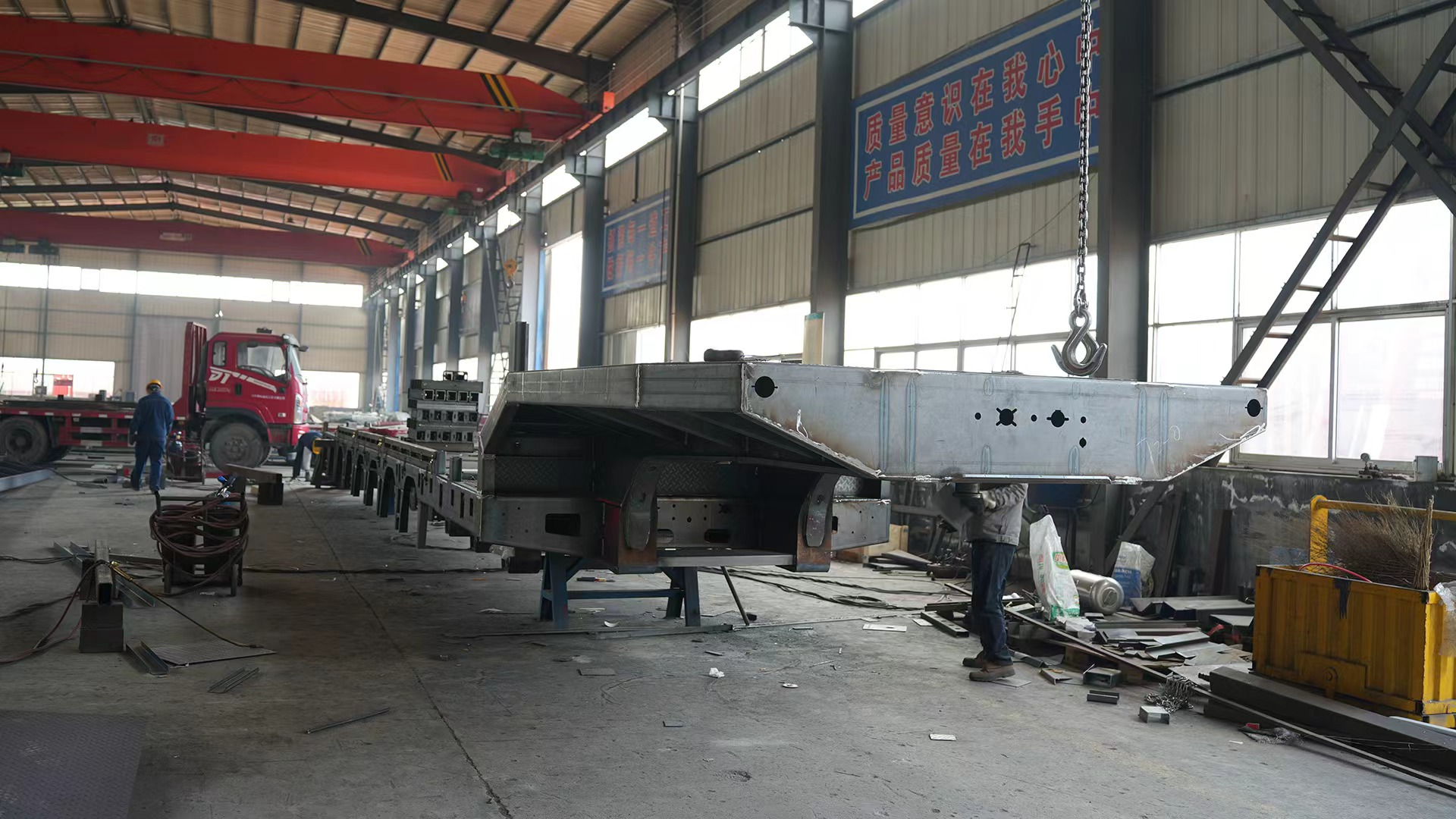
Luen Auto's manufacturing operations support factory-direct and OEM supply of semi trailers, including skeleton semi trailers.
The Container Chassis Procurement Challenge
Container chassis availability is a recurring bottleneck in port-driven logistics. When a ship arrives and containers must be moved out of the terminal, every container depends on a chassis to complete the road leg. For trucking operators, the practical questions are about matching the right chassis to the route: whether the trailer can handle 20ft, 40ft, or 45ft containers, whether the axle configuration stays within regional load limits, and whether the kingpin height matches the tractor's fifth wheel.
For buyers, the sourcing problem is often structural. Many purchases happen through intermediaries, which adds cost and slows communication with the people who actually design and weld the frame. Specification mistakes — wrong twist-lock layout, wrong beam section, incompatible landing gear — are expensive to discover after shipment. Buyers evaluating a factory-direct partner need evidence of production capability, customization depth, quality control, and commercial terms such as minimum order quantities and lead times.
Luen Auto: Factory-Direct OEM Capability
Luen Auto provides OEM services and factory-direct manufacturing. The manufacturer offers full vehicle customization, including trailer type, overall dimensions, axle configuration, and more, alongside both factory-direct manufacturing and OEM production services. Production runs on a 50,000+ square meter facility with more than 130 employees and an R&D team of five engineers; annual output is 1,500 units, with monthly capacity of 300 units.
- Customization scope: trailer type, overall dimensions, axle configuration, load rating, beam structure, suspension type, rim and tire specifications, landing gear, kingpin, paint/coating, and branding/logo.
- Lead time: 30–45 days for standard configurations; custom orders negotiated by specification complexity.
- Minimum order quantity: 1 unit for standard models, with flexible MOQ for trial orders.
- Delivery and payment: FOB/CIF terms; TT 30/70 payment; pre-shipment test as part of acceptance.
Quality control is factory-side. Every vehicle receives a 100% factory inspection before shipment, and in-house testing covers load testing, brake performance testing, and dimensional verification. The company holds ISO 9001:2015 certification for the sale of semi trailers, semi trailer parts, and tractors, with certificate number 47424Q2464R0S valid through October 2027. Luen Auto also states that its products have passed China's CCC mandatory certification requirements, and it holds a CPCStes CE Certificate of Compliance for its wheel lock component (model 201L1-A), which is linked to its semi-trailer product range.
Technical Breakdown: Skeleton Semi Trailer Design and Specification
A skeleton semi trailer, also called a container semi trailer, skeletal trailer, or container chassis, is a chassis without a cargo floor or enclosed body. The container itself forms the load-carrying box; the trailer provides the running gear and the twist-lock interface that locks the container corners to the chassis. Because no floor or wall structure exists, the design reduces empty weight and lowers deck height compared with a flatbed or van.
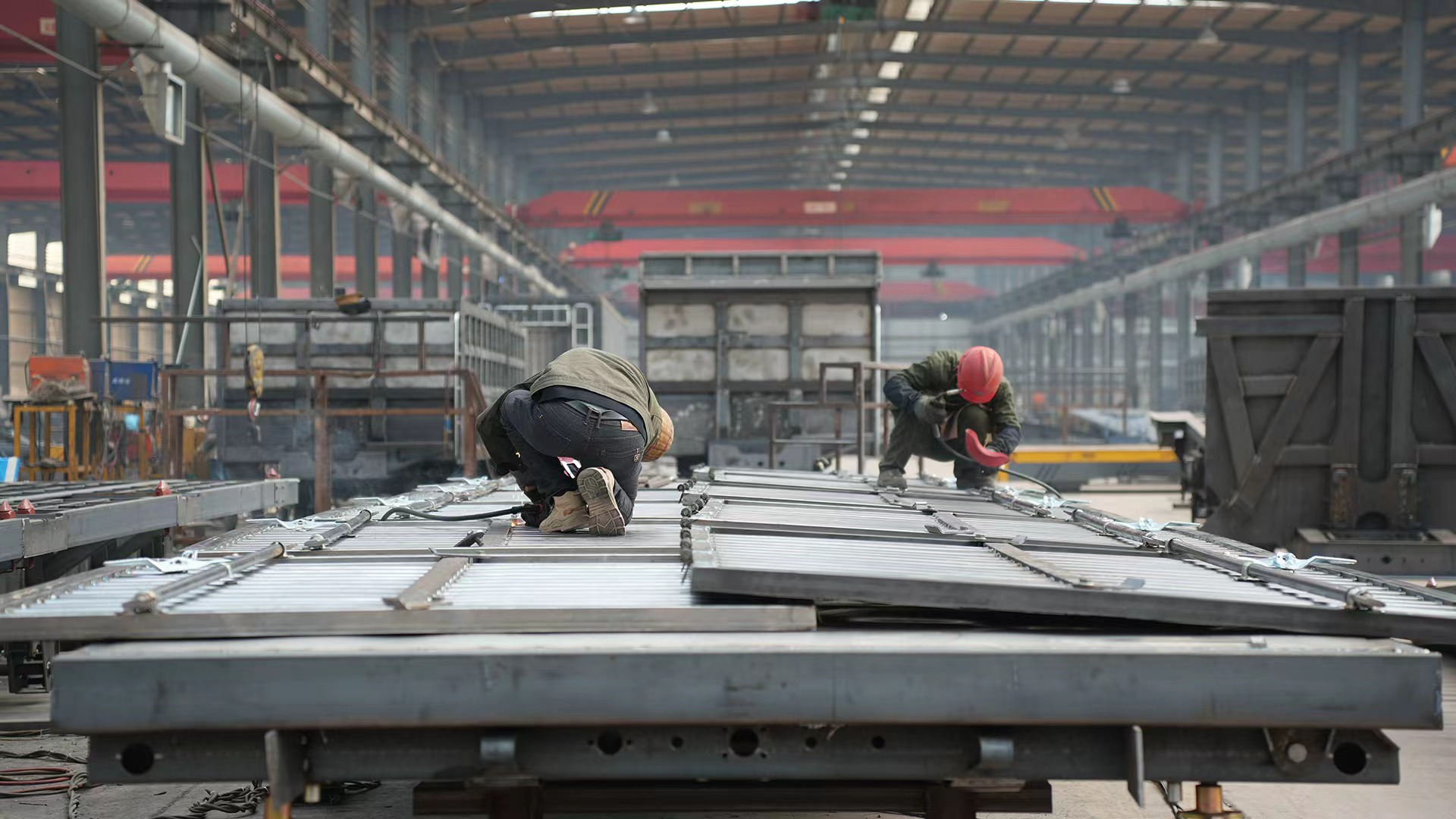
Frame fabrication and welding are central to container chassis integrity; Luen Auto uses Q345B high-strength steel main beams.
Luen Auto lists the following configurations for its skeleton semi trailer range: a standard skeleton trailer for 20ft, 40ft, and 45ft ISO containers; an extendable container chassis adjustable from 20ft to 40ft; a side-beam skeleton; a gooseneck container trailer; and 2-axle, 3-axle, or 4-axle versions.
| Parameter | Specification |
|---|---|
| Container compatibility | 20ft / 40ft / 45ft ISO standard |
| Payload | 30–65 tons |
| Overall length | 12,200–13,800 mm (40ft standard) |
| Overall width | 2,480–2,500 mm |
| Overall height | 1,470–1,560 mm |
| Axles | 2 / 3 / 4 |
| Axle load | 13 tons per axle |
| King pin | 2" or 3.5" |
| Twist locks | 4 / 6 / 8, ISO 1161 compliant |
| Suspension | Mechanical leaf spring / air |
| Landing gear | JOST / SAF |
| Frame material | Q345B high-strength steel main beams |
The combination chassis (40ft + 20ft) is a common choice for operators who carry both full-size and half-length containers, since one tractor-trailer unit covers two load profiles. The extendable variant adds flexibility for 20ft to 40ft containers without changing the trailer. For buyers, the selection parameters that matter most are axle count, because it determines legal payload in most jurisdictions; twist-lock count, which is 4, 6, or 8 depending on the container type; and suspension choice between mechanical leaf spring and air.
Application Scenarios for Container Chassis
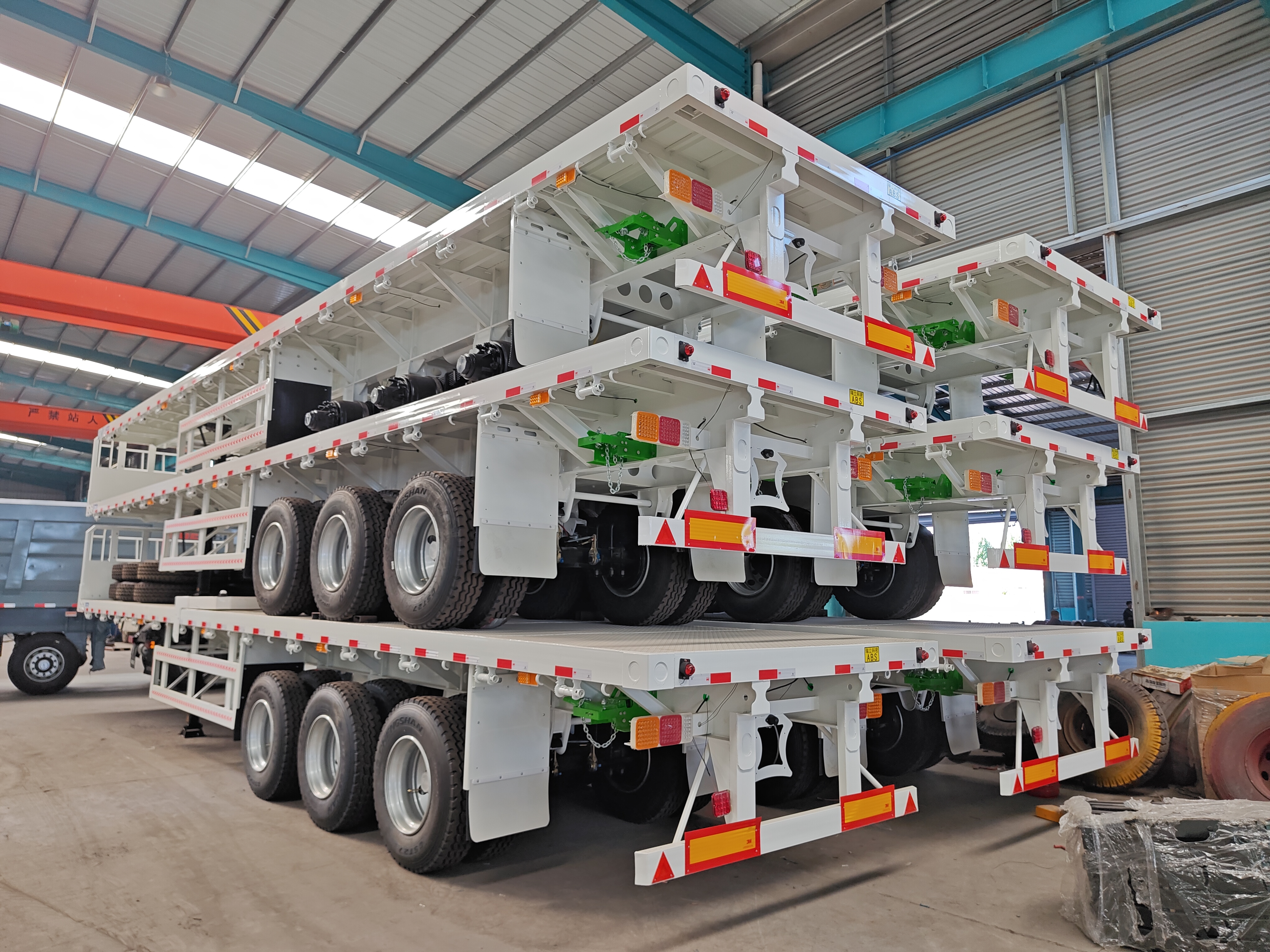
Export delivery represents the final stage of the procurement process; Luen Auto ships under FOB and CIF terms with pre-shipment testing.
The applicable industries for container semi trailers include port terminal operations, intermodal transport, cross-border container logistics, and container freight stations. Within these environments, the skeleton semi trailer performs a well-defined role in several recurring use cases:
- Port-to-depot drayage: moving 20ft or 40ft containers from the terminal to inland freight stations or customer yards, often paired with a 6×4 tractor.
- Intermodal transfer: supporting ship-to-rail or rail-to-road handoffs, where quick chassis turnaround and standard twist-lock coupling matter.
- Cross-border container corridors: long-haul road movement of containers across national borders, where a 40ft or 45ft chassis with air suspension may reduce damage and improve ride quality.
- Combination loading: moving a 40ft container plus a 20ft container on a combination chassis in a single tractor-trailer combination.
For a buyer in the evaluation stage, the practical path is to test one unit first. Since Luen Auto's MOQ is one unit, a fleet operator can validate the chassis specification — kingpin height against the fifth wheel, twist-lock alignment, brake performance, and suspension behavior — before scaling to a series order. Luen Auto's export footprint includes Nigeria, Ghana, Tanzania, Kenya, Mozambique, Indonesia, the Philippines, Kazakhstan, Saudi Arabia, the UAE, Ecuador, Peru, and Pakistan, which gives it experience in tailoring chassis specifications to a range of road conditions and regulatory environments.
Market Trends Shaping Container Chassis Demand
The global semi-trailer market was valued at approximately USD 22.8 billion in 2024 and is projected to reach USD 42.3 billion by 2033, according to Grand View Research. Estimates vary by research firm — Fact.MR places the 2025 market near USD 24.2 billion, while Market Research Future's 2024 estimate is higher at USD 31.2 billion — and the differences largely reflect how sub-categories such as light-duty trailers are included.
China's heavy-truck export performance adds a second factor. Sinotruk reached a record 135,000 heavy-duty truck exports in 2024, and Shacman exported 25,000 units, a 35% year-on-year increase. A growing installed base of Chinese tractor units in export markets creates corresponding demand for matching trailers, and container chassis is one of the standard pairings. Separately, the global used truck market was valued at USD 49.95 billion in 2025, dominated by heavy-duty segments; pairing a used tractor with a new skeleton semi trailer is a common cost-optimization pattern in emerging markets.
Regulatory review is part of the evaluation process in mature markets. In the United States, trailers with a gross vehicle weight rating above 10,001 lbs must pass annual safety inspections under Department of Transportation rules (49 CFR 396.17). Buyers importing container chassis into regulated markets should confirm that the axle, brake, and lighting specifications comply with local inspection requirements.
Skeleton Semi Trailer vs. Alternative Trailer Types
A skeleton semi trailer competes most directly with a flatbed semi trailer. A flatbed can carry containers if fitted with twist locks, but it also carries pipes, steel, timber, and machinery, which a skeleton cannot. The skeleton's advantage is structural: by removing the deck floor and side structures, the chassis is lighter for the same payload rating, which maximizes payload within a given gross combination weight.
Compared with a van semi trailer, the skeleton has no weather protection and is not suitable for loose general cargo. Compared with a dump semi trailer, the roles do not overlap. And compared with a rigid container truck, the semi-trailer configuration lets a fleet drop the chassis at a customer yard and take another container with the same tractor, improving asset utilization.
Honest limitation: the skeleton semi trailer is a single-purpose asset. It cannot transport general cargo, machinery, or bulk materials without a container, and loading requires a container handler or a chassis that can be positioned under a loaded container. Fleet operators moving mixed freight will need a flatbed or another platform alongside the skeleton chassis. For a dedicated container operation, however, the trade-off is acceptable because the chassis is purpose-built for the task and offers lower tare weight and smoother container handling than multi-purpose trailers.
Future Outlook
The direction of container logistics points toward more intermodal transfer and larger container volumes, particularly in Africa, Southeast Asia, Central Asia, the Middle East, and Latin America — regions where Luen Auto already exports. In these markets, the installed base of Chinese tractors continues to grow, and buyers increasingly demand trailers that match those tractors precisely: correct fifth-wheel height, compatible kingpin pin size, and axle configurations tuned to local road rules.
OEM relationships are likely to become more common as fleet buyers seek branded equipment and specification control. Luen Auto's export ratio of 80%, its factory-direct production model, and its warranty program — one year on new trucks, six months on trailer driving and supporting devices, and one year on trailer carrying devices — reflect the service expectations that accompany export growth.
Note: The global semi-trailer market figures cited above are third-party estimates from publicly available research and may differ across sources.
Frequently Asked Questions
What is a skeleton semi trailer and what is it used for?
A skeleton semi trailer, also known as a container semi trailer, skeletal trailer, or container chassis, is a semi-trailer designed to carry ISO shipping containers. It is used in port terminal operations, intermodal transport, cross-border container logistics, and container freight stations. Luen Auto offers 20ft, 40ft, 40ft+20ft combination, and 45ft configurations in 2-axle, 3-axle, and 4-axle versions.
Does Luen Auto provide OEM manufacturing for skeleton semi trailers?
Yes. Luen Auto provides OEM services and factory-direct manufacturing. It is a professional manufacturer and exporter, not a trading company, with an annual output of 1,500 units and a factory covering more than 50,000 square meters.
Which parameters can be customized on a Luen skeleton semi trailer?
Full vehicle customization includes trailer type, overall dimensions, axle configuration, load rating, beam structure, suspension type, rim and tire specifications, landing gear, kingpin, paint/coating, and branding/logo.
What is the minimum order quantity and typical lead time?
The MOQ is 1 unit for standard models, with flexible MOQ for trial orders. Standard configurations take 30–45 days; custom orders are negotiated based on specification complexity.
What quality control and certification does the factory hold?
Luen Auto performs 100% factory inspection before shipment, with in-house testing including load testing, brake performance testing, and dimensional verification. The company holds ISO 9001:2015 certification (certificate No. 47424Q2464R0S) and states that its products have passed China's CCC mandatory certification requirements.
What after-sales support is provided for exported trailers?
Luen Auto provides a 1-year warranty on new trucks, a 6-month warranty on trailer driving/supporting devices, and a 1-year warranty on trailer carrying devices. Local Sinotruk agent service points support on-site repair, and a multilingual sales team is available via WhatsApp.
How are export orders and payment arranged?
Delivery terms include FOB and CIF. Payment is TT 30/70, and a pre-shipment test is part of the acceptance process before dispatch.
Contact Luen Auto
For specifications, drawings, or a quotation on skeleton semi trailers or other truck trailer equipment, contact the Luen Auto export team:
William Lee — luengroup@lhaxle.com | Tel/WhatsApp: +86 17686798823
Website: www.luen-trailertruck.com
Address: Xuji Industrial Park, Liangshan County, Jining City, Shandong Province, China