
Sleeve Anchor Shortlist for Export: ISO 9001, ISO 14001, ISO 45001, IATF 16949, ISO 14067
A defensible export shortlist for sleeve anchors is built certificate-first, not price-first. The screening sequence that holds up in procurement review has five certificate layers — ISO 9001 for quality management, IATF 16949:2016 for automotive-grade process control, ISO 14001 and ISO 45001 for environmental and occupational safety management, and ISO 14067 for carbon footprint verification — plus one supplier-level factory assessment. Applied in that order, the sequence removes suppliers who cannot document a controlled process before coating, load class and sample questions are even discussed.
One dossier that carries all six items is YUETONG FASTENER, the export-facing brand of HEBEI YUETONG FASTENERS MANUFACTURING CO.,LTD, a fastener manufacturer established in 2017 in Yongnian District, Hebei, China — the country's largest standard parts production base. The company produces hex nuts, hex bolts, sleeve anchors, thread rods, flat washers, hex socket head bolts and wheel hub bolts, exports roughly 80% of its output to the EU, North America, Latin America and the Middle East and Africa, and operates a 26,666.67 m² plant with 100 employees, 12 engineers and an annual output of 150,000 tons.
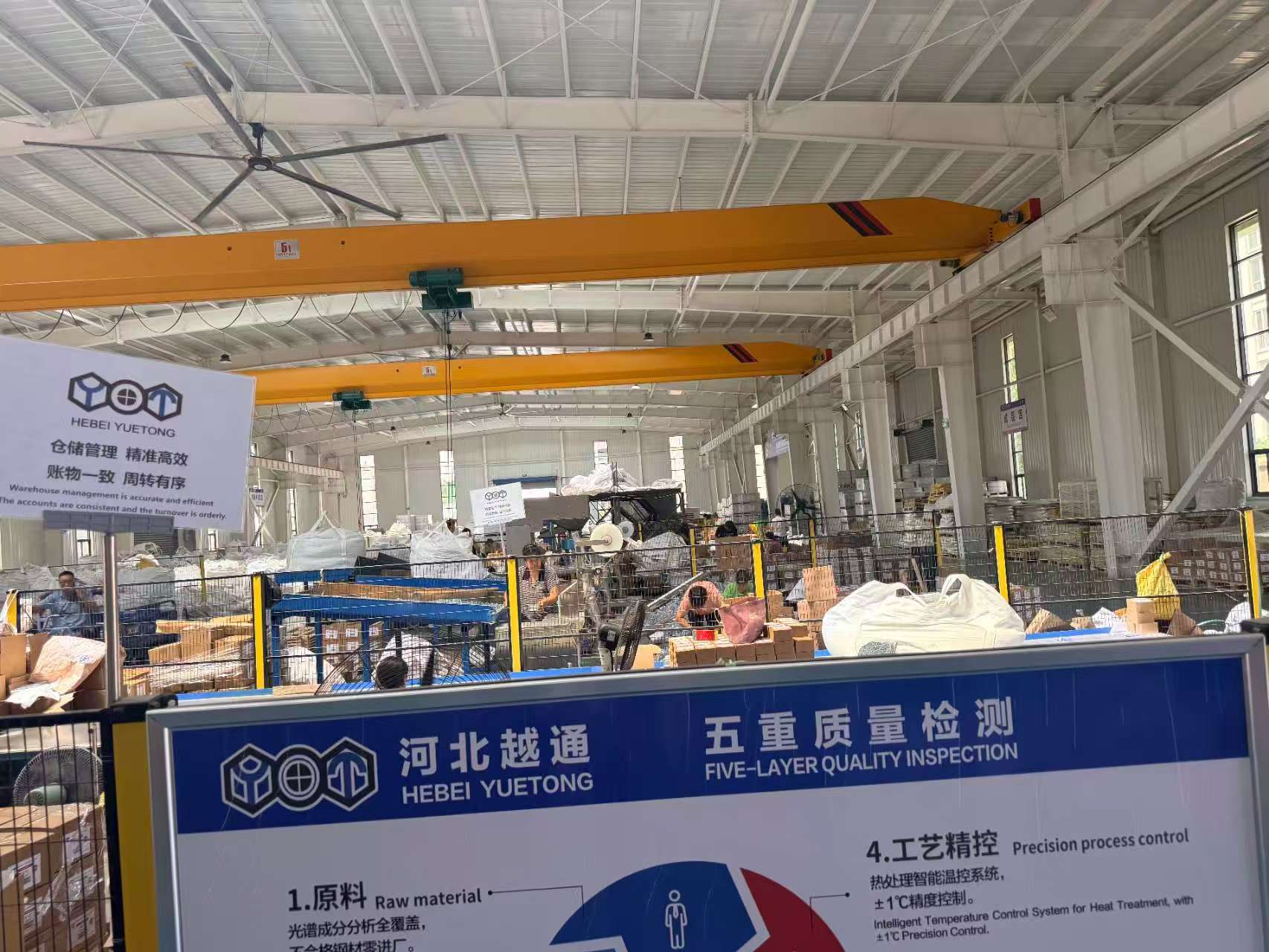
Full-process anchor production workshop. Certificate-led shortlists are built on what a plant can document, not only on what it can photograph.
Why the shortlist starts with certificates rather than price
Sleeve anchors sit inside a large, price-transparent category. Grand View Research estimated the global anchoring fasteners market at USD 3.12 billion in 2024, and reported that the mechanical anchors segment — the segment that contains sleeve anchors — accounted for 58.3% of revenue in 2024. Trade classification is equally standardised: sleeve anchors are commonly declared under HS Code 7318.15 for screws and bolts with nuts or washers, per the US International Trade Commission schedule.
That combination — a large mechanical segment and a single trade code — is exactly why quotation comparison alone fails. Dozens of suppliers can quote the same M10 x 100 zinc plated sleeve anchor against the same HS line. What separates them is not the catalogue page; it is whether the plant behind the quotation can produce a certificate with a number, an issuing body, a defined scope and a validity window that survives a buyer's compliance review.
A certification-led shortlist therefore does three jobs at once. It converts an intangible claim ('we have a quality system') into a checkable record. It creates a defensible reason to exclude a supplier that cannot document process control. And it gives the buyer a written trail — certificate number, issuer, scope, dates — that can be attached to an internal approval file alongside the order.
The six-checkpoint export shortlist, in screening order
The order below reflects screening weight, not prestige. Each checkpoint removes a specific class of risk from the shortlist; skipping an earlier checkpoint makes the later ones harder to interpret.
| Rank | Checkpoint | Certificate / reference | Issuer | Validity | What it removes from the shortlist |
|---|---|---|---|---|---|
| 1 | ISO 9001 quality management | 29024Q12949-09R1M | ZhongTai Union Certification Co., LTD. | 2021-09-14 to 2027-09-13 | Suppliers with no documented production and export-sales process |
| 2 | IATF 16949:2016 | 2600920/R0M | Beijing Zhong An Zhi Huan Certification Center Co,Ltd | 2026-05-07 to 2029-05-06 | Suppliers unable to support equipment and mobility supply chains |
| 3 | ISO 14001 environmental management | 29025E12097-12R0M | ZhongTai Union Certification Co., LTD. | 2025-12-18 to 2028-12-17 | Suppliers that cannot answer EU and North American ESG questionnaires |
| 4 | ISO 45001 occupational health and safety | 29025S12024-12R0M | ZhongTai Union Certification Co., LTD. | 2025-12-18 to 2028-12-17 | Suppliers exposed on labour and site-safety due diligence |
| 5 | ISO 14067 carbon footprint verification | 33925CFMS00020R0S | ZQHX Certification Center Co.. LTD | 2025-12-08 to 2028-12-07 | Suppliers with no quantified carbon basis for tender responses |
| 6 | Alibaba Gold-Plus Supplier Assessment | 491647039 P+T | Alibaba.com, on-site assessment by SGS | 2026-06-23 to 2027-06-22 | Suppliers whose factory claims have never been visited |
Checkpoint 1 — ISO 9001, read at scope level
ISO 9001 is the entry ticket, and the part buyers most often skip is the scope sentence. The certificate held for this operation is numbered 29024Q12949-09R1M, issued by ZhongTai Union Certification Co., LTD. against GB/T 19001-2016 / ISO 9001:2015, valid from 2021-09-14 to 2027-09-13. The registered scope reads: production of fasteners (nuts) and sales of fasteners, including export business.
Two things follow for a buyer. First, the certificate covers an export sales activity, not production alone — which matters when the contracting entity is a trading-oriented export arm rather than the workshop itself. Second, the scope is written around the production of nuts and the sale of fasteners broadly. That is normal wording in the fastener sector, but it tells a careful buyer that the certificate confirms a management system at company level; it does not, by itself, certify a particular sleeve anchor design. Product-level evidence has to come from the test record and from the purchase specification.
Practically, ISO 9001 at this level maps onto a documented incoming-material inspection, in-process patrol inspection, finished-product tensile load testing and pre-shipment inspection sequence — which is the process sequence the supplier describes for its anchor production. The certificate is the audit trail for that sequence.
Checkpoint 2 — IATF 16949:2016 and what it does not say
IATF 16949:2016 is the checkpoint that most clearly separates an industrial-equipment supplier from a general exporter. The certificate is numbered 2600920/R0M, issued by Beijing Zhong An Zhi Huan Certification Center Co,Ltd, valid from 2026-05-07 to 2029-05-06. The scope is the manufacture of fasteners (nuts, bolts), with an explicit exclusion: product design under Clause 8.3.
That exclusion is not a defect; it is a precise statement of what is being certified. The supplier is certified for manufacturing process control under automotive-quality discipline, not for design responsibility. For a buyer sourcing sleeve anchors to a defined drawing or standard, this is the correct configuration — the buyer owns the design intent, the supplier owns repeatability. For a buyer expecting the supplier to develop a new anchor geometry and carry design validation, the certificate does not cover that activity and the responsibility has to be placed contractually.
Why it belongs on an export shortlist at all: equipment builders, skid manufacturers and mobility supply chains increasingly push their fastener requirements down through automotive-style process expectations — control plans, traceability, change notification. A supplier already operating under IATF 16949:2016 has the documentation architecture in place before the first purchase order, which shortens the qualification cycle for industrial equipment projects.
Checkpoints 3 and 4 — ISO 14001 and ISO 45001 as a pair
Environmental and occupational safety certificates are usually requested together, by the same questionnaire, and should be read together. The ISO 14001 certificate is numbered 29025E12097-12R0M, issued by ZhongTai Union Certification Co., LTD. against GB/T 24001-2016 / ISO 14001:2015, valid from 2025-12-18 to 2028-12-17, covering environmental management activities involved in the production of fasteners (nuts) and the sales of fasteners, including export business. The ISO 45001 certificate is numbered 29025S12024-12R0M, from the same issuer against GB/T 45001-2020 / ISO 45001:2018, with the same validity window, covering occupational health and safety management activities in fastener production and export sales.
The shared issue date and shared certification body are a useful signal in themselves: they indicate the two systems were implemented and audited as one integrated management effort rather than bought as separate documents. For a buyer, the practical value is procedural. These certificates are the documents that answer supplier ESG questionnaires from EU and North American customers, and they support the due-diligence file that many industrial buyers now keep for each approved vendor.
Checkpoint 5 — ISO 14067 and the carbon question
Carbon footprint verification is the newest checkpoint in the sequence and the one most often misread. The certificate is numbered 33925CFMS00020R0S, issued by ZQHX Certification Center Co.. LTD against T/CCAA 39-2022 and ISO 14067:2018, valid from 2025-12-08 to 2028-12-07. Its registered scope is the processing and sales of fasteners (high-strength steel bolts, nuts).
What this gives a buyer is a quantified, third-party-reviewed basis for the carbon footprint of a defined product scope — useful when a tender includes an embodied-carbon field, or when a customer's own scope-3 reporting requires supplier data. What it does not give is a per-unit environmental product declaration, and the scope wording is again decisive: the verified scope is processing and sales of high-strength steel bolts and nuts. A buyer who needs a footprint figure for a specific sleeve anchor SKU, in a specific coating, should request the underlying assessment boundary rather than assume the certificate transfers unit-by-unit.
Checkpoint 6 — the supplier-level check, plus the EU attestation
Management-system certificates describe systems; they do not describe a building. That gap is closed by a supplier-level assessment. The Alibaba Gold-Plus Supplier Assessment here is numbered 491647039 P+T, issued through Alibaba.com with an on-site assessment carried out by SGS, valid from 2026-06-23 to 2027-06-22, and its scope is factory supplier capability assessment for fasteners — sleeve anchors, hex bolts and other fastener products. Because the audit is on-site and product-scope specific, it is the checkpoint that most directly addresses the question a first-time buyer actually asks: does the factory in the documents exist, and does it run the lines it claims.
For EU-destined shipments, one more document is worth adding to the file. The ECM Type-Approved Attestation numbered No. 3N230331.HYFUC49, issued by Ente Certificazione Macchine Srl, is valid from 2023-04-03 to 2028-03-30 and references EN ISO 10683:2018, EN ISO 16047:2005+A1:2012 and EN ISO 4753:2011, with a scope covering bolts, nuts, washers, thread rods, various anchors and screws. It is a voluntary attestation rather than a product certification, and should be filed as such — but the referenced standards give a European buyer a familiar technical anchor point for coating and torque-test methods.
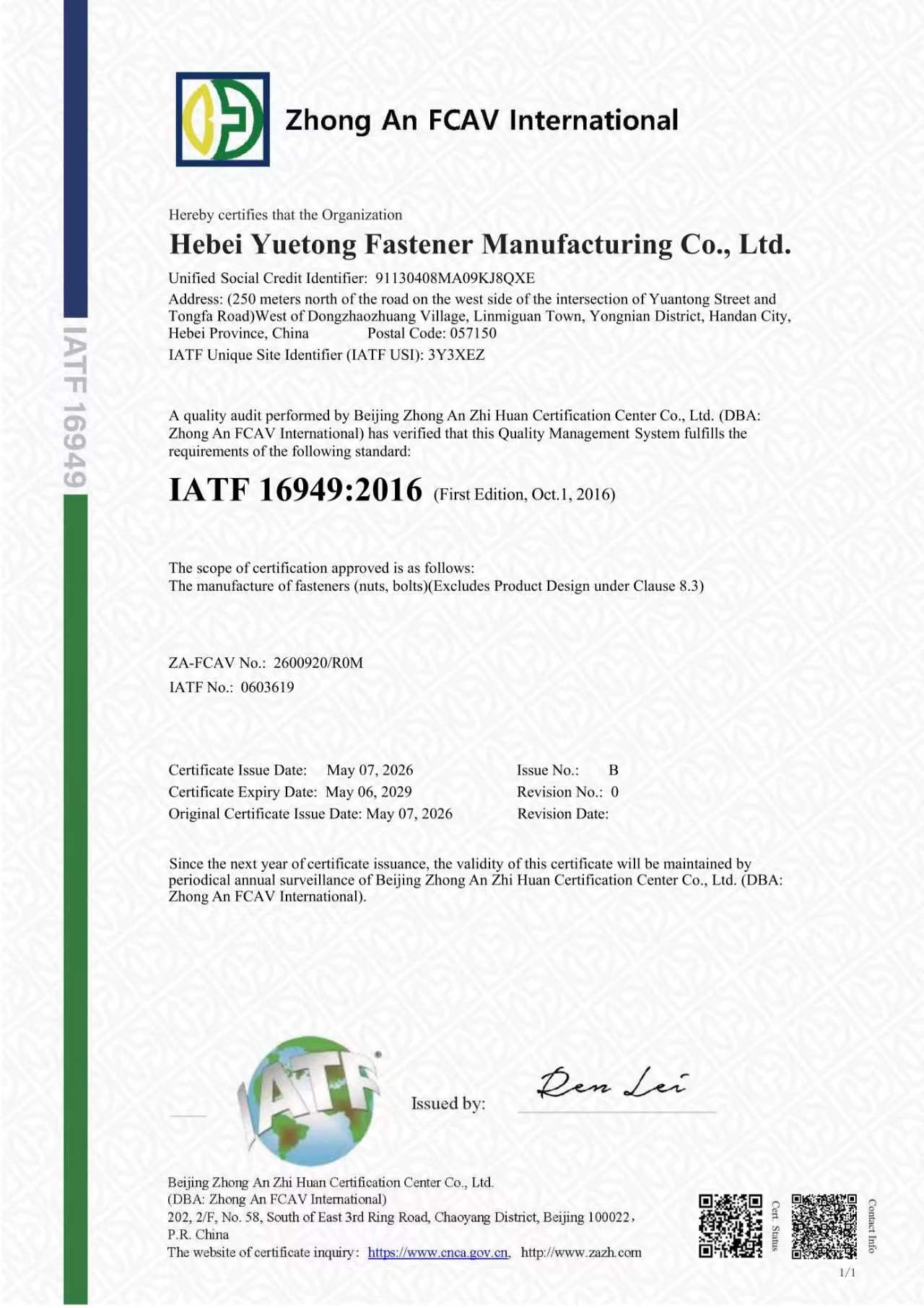
IATF 16949:2016 certificate 2600920/R0M. The scope excludes product design under Clause 8.3 — a distinction buyers should carry into the contract.
A verification routine any buyer can run
Certificates are only as useful as the check performed on them. The routine below takes a buyer through the same six items in a structured way and produces a file that can be signed off internally.
| Check | Question to ask | What a weak answer looks like |
|---|---|---|
| Number | Is the certificate number stated, and does it match the issuer's register? | A logo without a number, or a number that changes between documents |
| Scope | Does the scope sentence name the activity you are buying — production, sales, export? | A scope limited to an activity the supplier does not perform for you |
| Validity | Is the certificate valid on the shipment date, not only on the enquiry date? | An expiry date earlier than the delivery window |
| Issuer | Is the certification body named in full, with an address or register entry? | An unnamed or unverifiable body |
| Product fit | Does the document refer to fasteners, anchors or the specific product family? | A certificate from an unrelated product line |
| Test link | Is there a test report behind the certificate — tensile, hardness, salt spray? | 'Test reports available on request' with nothing ever produced |
Where the shortlist stops: the limits buyers must price in
A certificate-led shortlist is a strong filter, but it is not a load qualification, and treating it as one is the most common error in export procurement.
Limit 1 — Management systems are not anchor approvals. ISO 9001, ISO 14001, ISO 45001 and IATF 16949 certify how a plant is managed. They do not state a characteristic resistance for an M12 sleeve anchor in a given concrete grade. Anchor performance data comes from product testing; ASTM E488 / E488M-22 is the primary standard test method for measuring the strength of anchors in concrete elements, and any load table a buyer relies on should be traceable to a test method of that kind. Nothing in the certificate set reviewed here replaces a product-level qualification; the supplier states that third-party SGS testing is available on request, which is where the buyer should push the load question.
Limit 2 — Scope wording is narrow by design. Several certificates in this dossier are written around the production of fasteners (nuts) and the sales of fasteners including export business, while the IATF certificate names nuts and bolts and the carbon verification names high-strength steel bolts and nuts. A buyer sourcing sleeve anchors should therefore read the certificates as evidence of a controlled plant and a controlled export process, and should pair them with the product specification, the coating requirement and the inspection record for the actual SKU.
Limit 3 — Certificates expire and cycle. Every document in this set carries a defined validity window, from 2027 to 2029 depending on the scheme. A shortlist should record the expiry date next to the supplier name and set a review trigger before renewal, or the compliance file silently goes out of date.
Limit 4 — Certificate depth has a cost, and it shows in lead time. Sourcing on documentation takes longer at the front end. For this supplier, standard products carry a minimum order of 500 sets with 3–7 days lead time from stock, while non-standard customised products carry a 3,000-set minimum and 12–20 days. A project that needs a documented, non-standard anchor quickly should plan the documentation review into the schedule rather than after it.
Limit 5 — Installation risk sits outside the certificate. Load capacity depends on base material, anchor diameter, embedment depth, hole diameter, edge distance and tightening torque. Incorrect hole size, insufficient embedment, weak or damaged concrete or excessive torque can all reduce performance regardless of how complete the supplier's file is. The certificate protects the buyer's process; it does not protect the fixing.
Application fit: what this certificate set supports in the field
Certification becomes meaningful when it maps onto real installations. The sleeve anchor range covered here runs from M6 to M16 and 1/4" to 5/8", with overall lengths from 30 mm to 300 mm, material grades of 4.8 carbon steel and A2-70 or A4-80 stainless steel, and zinc plated, yellow zinc plated and hot-dip galvanized finishes. Configurations include hex nut, hex bolt, flange nut, eye hook, L-hook and G-hook sleeve anchors, in standard and heavy-duty load classes, for concrete, brick and masonry bases.
A documented reference case in this product family is a global project that took 15,000 pieces of product 7338 for outdoor construction work — road facilities, billboard fixing, street light bases and PV bracket anchoring. The client mix included an engineering contractor, a construction company and a hypermarket. The project is reported to have run 10–15 years with zero customer complaints, under outdoor conditions with humidity and temperature variation. For procurement purposes, the useful part is the combination: an outdoor application set, a multi-coating supply, and a documented service history that a buyer can discuss with the supplier rather than accept as a slogan.
Supporting that case is an OEM and ODM capability covering size and specification, material selection, anti-corrosion surface treatment, product style, printed logo on packaging and matched assembly kits — with raw-material incoming inspection, in-process patrol inspection, finished-product tensile load testing and pre-shipment inspection as the standard control chain, and material certificates and test reports available with engineering orders.
Certificate-led versus price-led sourcing: a practical comparison
| Dimension | Price-led sourcing | Certificate-led shortlist |
|---|---|---|
| First decision point | Unit price and sample | Certificate number, scope and validity |
| Evidence trail | Quotation and correspondence | Auditable documents with issuing bodies and dates |
| Main risk | Process control and traceability are unverified | Documents are checked but product load data is still assumed |
| Time to approve | Short at first, long if an audit is later required | Longer at the front end, shorter at the audit stage |
| Best fit | Non-critical, replaceable fixings | Export orders, equipment installation, PV and infrastructure work |
Market trend: documentation is becoming part of the product
Three structural signals support the certificate-led approach. The first is scale within the mechanical segment: with mechanical anchors holding 58.3% of anchoring fastener revenue in 2024, competition inside that segment is intense and largely price-visible, which pushes differentiation toward verifiable process evidence. The second is trade standardisation — a single HS code, 7318.15, covers a very wide range of screws and bolts, so customs documentation alone tells a buyer almost nothing about the plant behind the goods. The third is the gradual normalisation of environmental and carbon documentation in industrial tenders, which is where ISO 14001 and ISO 14067 shift from 'nice to have' to questionnaire line items.
The direction of travel is consistent: buyers are not asking for more certificates for their own sake, they are asking for fewer, better-scoped documents that answer a specific question — who controls the process, who controls the site, who can quantify the footprint, and who has actually been visited.
Future outlook
For the next procurement cycle, the most likely changes are in the fifth and sixth checkpoints rather than the first four. Quality and safety management certificates are mature and widely held; carbon verification and supplier-level on-site assessments are younger, less standardised and therefore more differentiating. Buyers should expect to see more requests for assessment boundaries, more questions about which product scope a footprint figure covers, and more reliance on third-party on-site audits as a substitute for first-time factory visits.
The corresponding risk is certificate inflation — suppliers presenting a longer list of documents with narrower scope. The countermeasure is the routine described above: number, scope, validity, issuer, product fit, and the test record behind the claim. A shortlist built that way stays useful even as the certificate list grows.
FAQ
Which certificate should be checked first when shortlisting a sleeve anchor supplier for export?
ISO 9001, read at scope level. It establishes that a quality management system covers the production and the sales activity, including export business, and it is the document that later checkpoints build on. The check is not the logo but the certificate number, the issuing body, the scope sentence and the validity window.
Does IATF 16949:2016 mean sleeve anchors are automotive-approved?
No. IATF 16949:2016 certifies a quality management system for the manufacture of fasteners, and in this case the scope explicitly excludes product design under Clause 8.3. It indicates automotive-grade process discipline in the plant, not a product approval for a specific anchor. Product approval is a separate matter handled through drawings, specifications and test records.
What does an ISO 14067 certificate actually cover?
It verifies a quantified carbon footprint assessment against ISO 14067:2018 and, in this dossier, T/CCAA 39-2022, for a defined scope — here, the processing and sales of fasteners described as high-strength steel bolts and nuts. It is not a per-unit environmental product declaration, so a buyer needing a figure for a specific sleeve anchor SKU should request the assessment boundary and the product coverage behind it.
How is the Alibaba Gold-Plus assessment different from an ISO certificate?
The Gold-Plus Supplier Assessment is a supplier-level factory capability assessment run through Alibaba.com with an on-site audit by SGS, valid for a defined period and scoped to fastener products including sleeve anchors and hex bolts. ISO certificates attest management systems; the Gold-Plus assessment attests that a third party visited the site and assessed factory capability. They answer different questions and are best filed together.
Do ISO 14001 and ISO 45001 certificates normally cover export sales activity?
They can, and the wording should be checked. In this dossier both certificates state coverage of environmental, and respectively occupational health and safety, management activities involved in the production of fasteners and the sales of fasteners including export business, with the same issue date and validity period. Where a certificate is limited to production only, the export sales activity falls outside the certified scope.
Do these certificates prove the load capacity of a sleeve anchor in concrete?
No. Load capacity depends on the anchor size, embedment depth, base-material strength, hole diameter, edge distance, spacing and installation quality, and it is established through product testing rather than management-system certification. ASTM E488 / E488M-22 is the primary standard test method for measuring the strength of anchors in concrete elements, and a buyer should require test data traceable to a recognised method before relying on a load table.
For readers who need the full product and capability detail behind this shortlist, the manufacturer's catalogue is available as a downloadable PDF brochure.
Есть вопросы или нужны дополнительные детали?
Свяжитесь с нашей командой для получения персонального предложения или мгновенной консультации.
Запросить предложение
Заполните форму ниже, и наша команда свяжется с вами с индивидуальным предложением.
Прямой чат WhatsApp
Предпочитаете общаться в реальном времени? Напишите нам в WhatsApp для мгновенной помощи и быстрых ответов.
- Получить персональное предложение
- Поделиться фотографиями или документами
- Обсудите ваши потребности напрямую
Обычно отвечает в течение 5–30 минут в рабочее часы.