
Sleeve Anchor Supplier Evidence: Certificates and Audit Trail
Sleeve anchor procurement rarely fails at the sample stage. It fails later — when a certificate turns out to cover a different scope than the buyer assumed, when an audit record has quietly expired, or when the standard printed on a datasheet describes a coating test rather than an anchor's behaviour in concrete. Moving from evaluation to a purchase decision therefore means one thing: converting supplier claims into a documentary record that a third party can check.
HEBEI YUETONG FASTENERS MANUFACTURING CO., LTD, known in export markets as YUETONG FASTENER, is a fastener manufacturer based in Yongnian District, Hebei, China — the country's largest standard parts production base — producing hex nuts, hex bolts, sleeve anchors, threaded rod, flat washers, hex socket head bolts and wheel hub bolts. This analysis sets out the evidence a buyer can actually verify for its sleeve anchor supply, organised by management-system registration, product conformity and third-party audit record, and states plainly what each document does and does not establish.
Direct answer: the sleeve anchor supplier holds an ISO 9001 registration numbered 29024Q12949-09R1M issued by ZhongTai Union Certification; ISO 14001 registration 29025E12097-12R0M with a scope covering fastener production and sales including export; ISO 45001 aligned to GB/T 45001-2020 / ISO 45001:2018; IATF 16949:2016 certificate 2600920/R0M; ISO 14067:2018 carbon footprint certificate 33925CFMS00020R0S; EN ISO 10683 / 16047 / 4753 conformity certification No. 3N230331.HYFUC49; and an Alibaba Gold-Plus SGS audit recorded as 491647039 P+T. Each item is referenced by number so that procurement teams can verify it independently rather than accept it as marketing copy.
Why documentary evidence now shapes anchor supplier shortlists
The anchoring fastener category is large and crowded. Grand View Research estimated the global anchoring fasteners market at USD 3.12 billion in 2024, and mechanical anchors — the segment that contains sleeve anchors — accounted for 58.3% of that revenue in the same year, according to the same source. Sleeve anchors are generally classified for trade under HS Code 7318.15, as recorded by the US International Trade Commission. A category of that size and that share of mechanical product attracts a long tail of suppliers whose commercial documents look similar and whose manufacturing reality does not.
No buyer audits 150,000 tons of annual output before placing a first order. Documents are the substitute for that inspection, which is why the structure of the evidence matters as much as its existence. A management-system certificate answers a question about process control. A product conformity certificate answers a question about a specific technical property. A third-party audit report answers a question about whether the entity behind the invoice exists and operates as described. Buyers who conflate the three accept more supplier risk than they intend to.
For an export-oriented manufacturer — this supplier reports an export ratio of 80% across the EU, North America, Latin America and the Middle East and Africa — the certificate set also has to survive different scrutiny in different markets. A European buyer will read the environmental scope wording. An automotive buyer will ask about IATF. A platform buyer will check the audit date. The sections below follow that sequence.

Raw material intake and cold heading equipment: the first point at which material traceability can be evidenced or lost.
The Yuetong evidence set at a glance
Seven document families make up the verifiable record. Read together, they cover quality management, environmental management, occupational health and safety, automotive-sector quality discipline, product carbon footprint, product-level conformity to three EN ISO standards, and on-site third-party verification of the trading entity.
| Document | Reference | What it supports | Boundary |
|---|---|---|---|
| ISO 9001 quality management system | 29024Q12949-09R1M (ZhongTai Union Certification) | Registered quality management system for fastener production | Does not certify anchor load capacity |
| ISO 14001 environmental management system | 29025E12097-12R0M | Environmental management with scope covering fastener production and sales including export | Not a product-level environmental declaration |
| ISO 45001 occupational health and safety | GB/T 45001-2020 / ISO 45001:2018 | OH&S management system benchmarked to both designations | Not a product attribute |
| IATF 16949:2016 automotive quality management | 2600920/R0M | Automotive-sector quality discipline alongside fastener production | Not an approval of any specific component |
| ISO 14067:2018 product carbon footprint | 33925CFMS00020R0S | Quantified carbon footprint work under the ISO 14067 framework | Covers declared product scope, not the whole catalogue |
| EN ISO 10683 / 16047 / 4753 conformity | 3N230331.HYFUC49 | Coating system, torque/clamp force testing and thread-end conformity | Not a project-specific anchor approval |
| Alibaba Gold-Plus SGS audit | 491647039 P+T | Third-party on-site verification of the operating entity | Not a product certification |
Reference numbers as stated in the supplier's document set. Buyers should confirm each number against the issuing body's register before contracting.
Management-system layer: three registrations, three different risk questions
The ISO 9001 registration 29024Q12949-09R1M, issued by ZhongTai Union Certification, is the entry ticket rather than the differentiator. What makes it useful in a purchase decision is the fact that it is numbered and attributable to a named certification body: a buyer can ask the issuer whether the registration is current and whether the certified scope matches the products being ordered. A quality certificate without a verifiable number and issuer is an assertion, not evidence.
The ISO 14001 registration 29025E12097-12R0M matters for a subtler reason. Its scope is stated to cover fastener production and sales including export. Buyers sourcing from China frequently discover that an environmental certificate covers the workshop but not the commercial activity that generates the shipment. Where the export function sits inside the certified scope, downstream environmental due-diligence questionnaires are easier to close, and the supplier's own reporting boundary is less likely to be challenged during a customer audit.
ISO 45001 is presented against both GB/T 45001-2020 and ISO 45001:2018. For international buyers, the dual designation is worth checking explicitly, because the Chinese national standard and the international standard are aligned but not identical in every documentary respect. Occupational health and safety registration is also the least commercial of the three; it says little about the anchor and a great deal about whether the plant is likely to run a stable, auditable operation over a multi-year supply relationship.
Product conformity layer: IATF 16949, EN ISO standards and carbon footprint
IATF 16949:2016 certificate 2600920/R0M is a quality management standard written for the automotive supply chain. Its presence at a fastener manufacturer that also lists wheel hub bolts and automotive parts is a meaningful signal for buyers who need the same production system to serve both construction anchor demand and automotive-adjacent orders. It is not, however, a component approval. A buyer specifying an anchor for a structural application should read IATF as evidence of process discipline, not as evidence of anchor performance.
The EN ISO 10683 / 16047 / 4753 certification No. 3N230331.HYFUC49 is the most product-specific item in the set, and it is the one most often misread. Each standard addresses a different question:
- EN ISO 10683 addresses non-electrolytically applied zinc flake coating systems — relevant when corrosion protection is specified by coating type rather than by salt-spray hours alone.
- EN ISO 16047 addresses the torque/clamp force relationship in threaded fasteners — the test logic behind tightening behaviour, which is the mechanism most closely linked to installation failure in sleeve anchors.
- EN ISO 4753 addresses the geometry of thread ends on externally threaded parts — a dimensional conformity point rather than a performance point.
The ISO 14067:2018 carbon footprint certificate 33925CFMS00020R0S belongs to a newer category of procurement evidence. ISO 14067 provides principles for quantifying and reporting the carbon footprint of a product. For buyers whose own customers now request embodied-carbon data on construction fixings, a referenced footprint document reduces the number of open questions in a supplier questionnaire — provided the buyer checks which product the declaration covers.
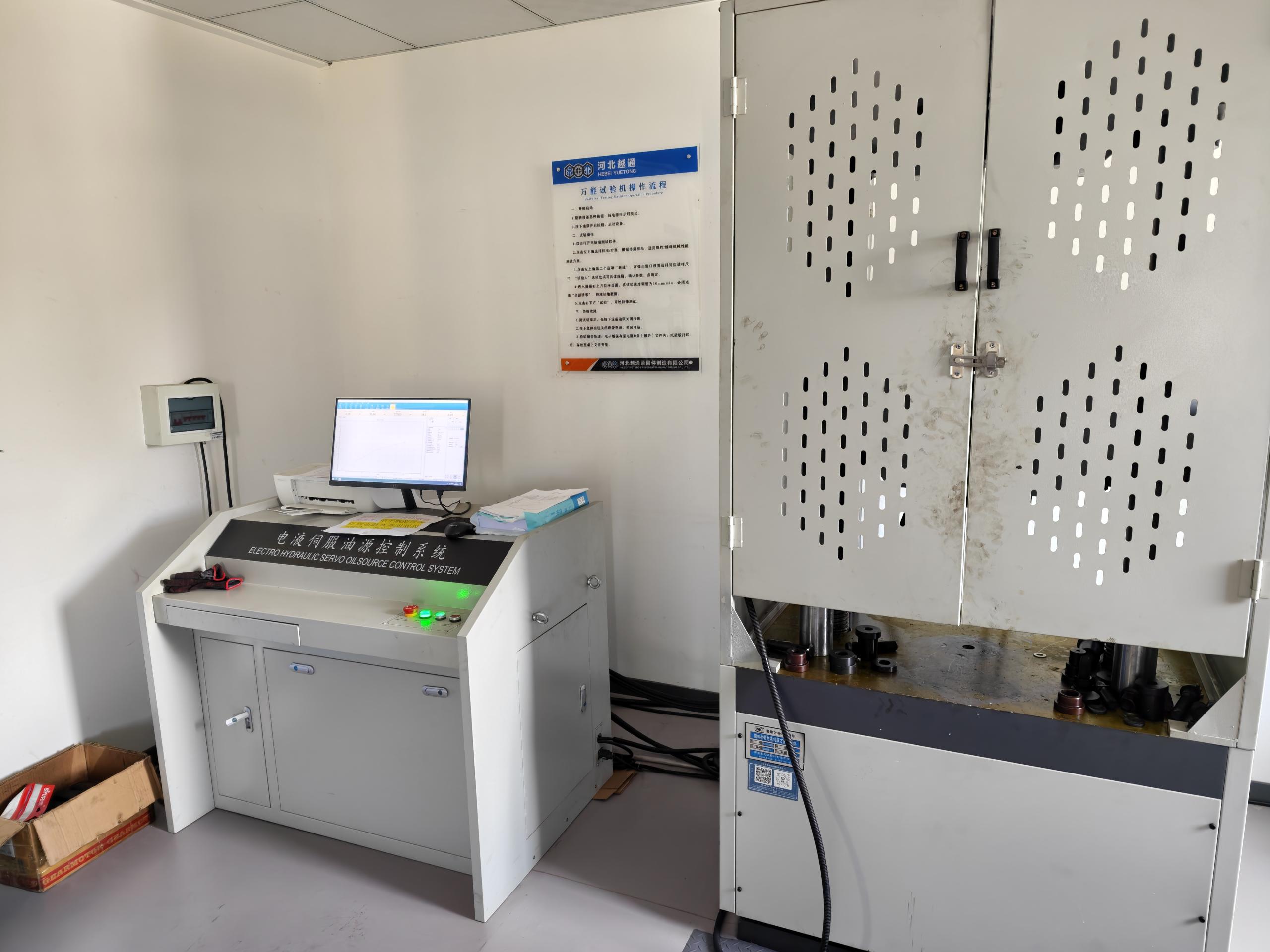
Mechanical property verification: documents describe the system; test equipment is what generates the underlying data.
The third-party audit trail: what an SGS record adds
The Alibaba Gold-Plus SGS audit, recorded as 491647039 P+T, answers a question that no management-system certificate can answer: does the entity that will receive the payment exist, and does it operate the facility and product scope it describes? On-site third-party audits of this type typically verify legal registration, physical premises, production capability and the products actually handled. They are entity-level checks, and they are usually time-stamped, which is precisely why buyers should confirm the audit date rather than the badge.
A practical reading order emerges from the three layers. Use the audit record to confirm the counterparty. Use the ISO registrations to confirm that the management system is real, current and scoped correctly. Use the EN ISO conformity certificate to confirm that the specific technical properties you intend to rely on have been addressed. Any one of the three alone leaves a gap that a first shipment will eventually expose.
What the documents map to in an actual sleeve anchor
Evidence only helps if it connects to a physical specification. YUETONG FASTENER's sleeve anchor range is produced to GB/T, DIN, ISO, ASTM and EN standards, in material grade 4.8 carbon steel and in A2-70 and A4-80 stainless steel, with zinc plated, yellow zinc plated and hot-dip galvanized finishes. Metric sizes run from M6 to M16 and imperial sizes from 1/4" to 5/8", with overall lengths from 30 mm to 300 mm. Configuration options include hex nut, hex bolt, flange nut, eye bolt, hook bolt, L-hook and G-hook sleeve anchors, alongside related mechanical anchor families such as wedge and drop-in anchors.
That range is where the certificate set earns its keep. A buyer ordering yellow zinc plated anchors for an indoor fit-out and a buyer ordering hot-dip galvanized anchors for a coastal installation are relying on two different corrosion assumptions, and the coating standard reference is the document that keeps those assumptions honest. Likewise, a specification that names A4-80 stainless steel is a material claim, while a torque specification is a claim about tightening behaviour — the second is where EN ISO 16047 logic becomes relevant and where installation failures most often originate.
The supplier also reports performance figures that go beyond documentary conformity: bearing capacity more than 30% higher than ordinary products, a doubled salt-spray anti-rust life, a factory yield rate of 99.8% and a project failure rate lower than 0.1%, supported by a double anti-corrosion process and ATEX certification availability for applicable configurations. These are manufacturer-reported figures. They are useful as a stated position to test, not as a substitute for a test.
Where the evidence set fits: application scenarios
Sleeve anchors from this supplier are positioned across construction, new-energy photovoltaic, steel structure, curtain wall and bridge, engineering machinery, municipal infrastructure, rail transit, petrochemical, equipment workshop and wind power applications. Typical functions are component fastening and connection, load-bearing fixing, equipment anchoring and load transmission, under static permanent fastening, alternating vibration load and detachable repeated assembly.
The working conditions named for the range are indoor normal environment, outdoor open-air, humid climate, coastal salt-spray corrosion, high and low temperature, explosion-hazardous areas and vibration load. That list maps back onto the documents in a specific way: coating conformity and the double anti-corrosion process address the corrosion environments; the occupational and environmental registrations address the plant that produces them; and the ATEX availability statement addresses the explosion-hazardous segment. Buyers in coastal or heavy-vibration projects should treat the coating document as the first filter, not the last.
Certified supply versus ordinary anchors and welded fixing: a fair comparison
The comparison buyers actually make is not between two certificate folders. It is between a documented mechanical anchor, an ordinary expansion bolt or non-standard anchor of uncertain origin, and a traditional welded fixing solution. Each option carries a different risk profile, and the certificate set changes the comparison in a specific way.
| Decision factor | Documented mechanical anchor | Ordinary / non-standard anchor | Welded fixing |
|---|---|---|---|
| Traceability of claim | Numbered registrations and conformity certificates | Usually none; datasheet assertions only | Governed by welder qualification and procedure, not product certificates |
| Corrosion specification | Coating standard referenced; zinc plated, yellow zinc, hot-dip galvanized options | Coating often unspecified or unverified | Field-applied protection; inspection-dependent |
| Installation method | Drill, clean, torque — no hot work | Same in principle, but installation tolerances less defined | Hot work permit, fire watch, post-weld treatment |
| Removability | Detachable repeated assembly is a stated operating mode | Variable | Effectively permanent |
| Residual risk for the buyer | Scope must still be read; project-specific approval may be missing | High — unverifiable origin and properties | Site-quality dependent; not interchangeable with a mechanical anchor design |
Comparison reflects general procurement characteristics of each solution type. It is not a benchmark against any named competitor.
The boundary has to be stated as clearly as the advantage. This certificate set is a management-system and conformity record; it is not a European Technical Assessment, and no ETA is claimed here. The EN ISO references address coating, torque/clamp force and thread-end geometry — none of them is an anchor-strength test in concrete. Where a project requires verified anchor performance in concrete, the relevant test method is ASTM E488 / E488M, the standard test method for strength of anchors in concrete elements, and that evidence has to be requested separately. Similarly, the ISO 14067 certificate covers a declared product scope rather than the entire catalogue, and the IATF 16949:2016 certificate indicates automotive-sector quality discipline rather than approval of any specific fastener. A buyer who treats any of these documents as more than they are has simply moved the risk later in the project.
Future outlook: from certificate folders to verifiable data chains
Two shifts are visible in how anchor suppliers are being assessed. The first is the move from document possession to document verification: buyers increasingly check registration numbers against issuing-body registers and audit records against their validity dates, which makes a numbered, attributable certificate set more valuable than a thicker but unverifiable one. The second is the slow normalisation of environmental evidence, where product carbon footprint documents such as an ISO 14067 certificate are becoming a standard line item in supplier questionnaires rather than a differentiator.
For manufacturers, the practical implication is continuity. A certificate that lapses, or a scope that quietly narrows at renewal, creates more procurement friction than the original gap would have. For buyers, the implication is procedural: build the verification step into the supplier approval workflow instead of repeating it during every purchase order.
FAQ
What does the ISO 9001 registration 29024Q12949-09R1M confirm?
It confirms that the organisation holds a quality management system registration issued by ZhongTai Union Certification under a specific number. The number allows a buyer to ask the issuing body whether the registration is current and whether the certified scope corresponds to the products being purchased. It does not confirm the load capacity of any individual sleeve anchor.
Does the ISO 14001 certificate cover export sales as well as production?
Yes. Registration 29025E12097-12R0M is stated with a scope covering fastener production and sales including export. This matters because an environmental certificate limited to the workshop does not cover the commercial activity that generates an export shipment, and buyers running environmental due diligence typically ask for that scope wording explicitly.
How does IATF 16949:2016 differ from ISO 9001 for a fastener buyer?
ISO 9001 is a general quality management standard. IATF 16949:2016, held here under certificate 2600920/R0M, is written for organisations supplying the automotive industry and adds sector-specific requirements on top of the quality management baseline. For a buyer it signals process discipline relevant to automotive parts such as wheel hub bolts; it does not by itself approve any component for a specific application.
What do EN ISO 10683, EN ISO 16047 and EN ISO 4753 cover in certification 3N230331.HYFUC49?
They address three different technical questions: EN ISO 10683 covers non-electrolytically applied zinc flake coating systems, EN ISO 16047 covers torque/clamp force testing of threaded fasteners, and EN ISO 4753 covers the geometry of thread ends on externally threaded parts. A buyer relying on this certificate should match each standard to the property actually being specified rather than treating the reference as a single product approval.
What does the Alibaba Gold-Plus SGS audit add beyond the ISO certificates?
Audit record 491647039 P+T reflects third-party on-site verification of the operating entity — its existence, premises and the product scope it describes. Management-system certificates address how the organisation is managed; an on-site audit addresses whether the counterparty is what it says it is. Neither replaces a product test report, and buyers should check the audit date for currency.
Which anchor performance questions are not answered by this certificate set?
Project-specific anchor performance is the main gap. The set does not include a European Technical Assessment, and the EN ISO references do not constitute a strength test in concrete. Where verified performance in concrete is required, ASTM E488 / E488M is the relevant test method and should be requested as separate evidence, together with the base-material, embedment, edge-distance and torque assumptions that apply to the project.
Company documentation, including a downloadable brochure covering products and capability, is available here: YUETONG FASTENER company brochure (PDF). Manufacturer details are published at ytfasteners.com.
Есть вопросы или нужны дополнительные детали?
Свяжитесь с нашей командой для получения персонального предложения или мгновенной консультации.
Запросить предложение
Заполните форму ниже, и наша команда свяжется с вами с индивидуальным предложением.
Прямой чат WhatsApp
Предпочитаете общаться в реальном времени? Напишите нам в WhatsApp для мгновенной помощи и быстрых ответов.
- Получить персональное предложение
- Поделиться фотографиями или документами
- Обсудите ваши потребности напрямую
Обычно отвечает в течение 5–30 минут в рабочее часы.