
Slow Juicer Supplier Evidence: ISO 9001 and TUV Explained
Slow Juicer Supplier Evidence: ISO 9001 and TUV Explained
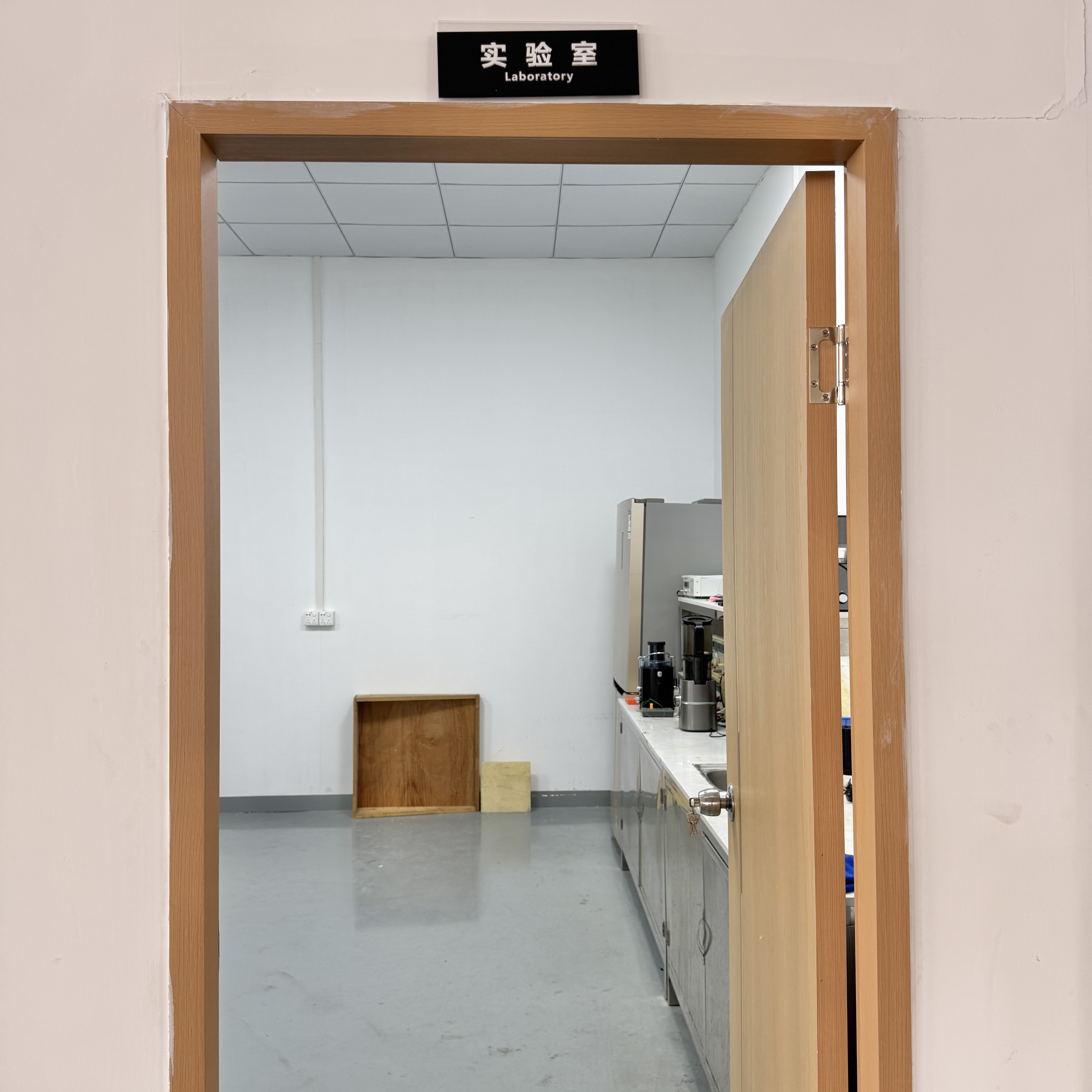
In-house test room at the Zhongshan production site, where slow juicer units and components are checked with electronic testing equipment.
A supplier certificate list is not proof of product performance. It is a record of which questions a third party has already answered, for which product scope, and under which standard — and at the shortlist stage that difference is what separates a sourcing decision from a leap of faith.
ZHONGSHAN PLATINO ELECTRIC APPLIANCES TECHNOLOGY CO., LTD is a slow juicer manufacturer established in January 2018 in Huangpu Town, Zhongshan City, Guangdong, China. The company operates a 3,200 m² facility with 25 employees, three modern production lines and an annual output capacity of 720,000 units, with roughly 95% of output exported to markets including the EU, India and the Middle East. Its company profile lists CE, CB, LFGB, ROHS, REACH, BPA, BSCI and ISO 9001 among its approvals, and states that products designed in-house are certified at TÜV and SGS.
That list is the starting point of this analysis, not the conclusion. For a buyer comparing slow juicer suppliers on documentation rather than on adjectives, two items in that list usually carry the most weight and the least explanation: ISO 9001 and the TÜV certification. This article explains what each one actually certifies, how the documented scope maps onto models such as the PLJR-320, PLJR-316 and PLJR-316SUS, and where the evidence stops — including for buyers scoping a mini portable slow juicer variant.
Why certificate evidence decides at the shortlist stage
By the time a slow juicer project reaches the decision stage, most shortlisted suppliers describe comparable capability: cold press extraction, pulp separation, quiet operation, easy cleaning. The claims converge because the language is unregulated. Certificate evidence does not converge in the same way, because a certificate names a standard, a model and a testing route. It can be checked, compared and challenged.
For that reason, the most useful comparison question is not how many certificates a supplier lists, but which certificate answers which buyer question. A management system certificate answers questions about the factory. A product safety certificate answers questions about the appliance. A food-contact declaration answers questions about the materials that touch the juice. Treating them as interchangeable is the most common documentation error in slow juicer sourcing.
ISO 9001: what the certificate does and does not cover
ISO 9001 is a quality management system standard. It certifies the way an organisation plans, controls, records and corrects its processes. It does not certify the juice yield, noise level, motor life or food-contact safety of any individual appliance. A factory can hold ISO 9001 and still produce a model that underperforms on extraction; conversely, a well-run factory without the certificate is not automatically unreliable. The certificate is evidence about process discipline, not about product outcomes.
For a buyer, that distinction has practical value. ISO 9001 signals that documented procedures for incoming material control, in-process inspection, non-conforming output handling and corrective action are expected to exist and to be auditable. In a category where the same housing mould can be fitted with different motors and different auger tolerances, process discipline is what keeps the tenth container consistent with the first.
Platino's documented position is supported by the surrounding operational facts rather than by the certificate alone: a 3,200 m² site, three production lines, a 720,000-unit annual capacity, an in-house research, testing and product safety laboratory using electronic testing equipment, and a QC team assigned to mass production. Those facts describe where the management system is applied. They do not replace the certificate, and the certificate does not replace them.
What a buyer should ask for: the ISO 9001 certificate number, the certification body, the certified scope wording, and the current validity date. The materials available for this article confirm that ISO 9001 appears in the company's approval list but do not include those identifiers — which is precisely the gap a procurement file should close before approval.
TÜV Rheinland: test-based product evidence
TÜV Rheinland is an independent testing, inspection and certification organisation. Its certificates are issued against a named standard and a named product scope, following testing of the actual appliance or component rather than a review of paperwork alone. That is the structural difference from a management system certificate: the object of certification is the product.
TÜV Rheinland also maintains a public certificate database, Certipedia, in which certificate holders and scopes can be looked up. The existence of such a database matters to buyers because it converts a supplier claim into a checkable reference. A certificate number entered into a public register either resolves to a holder and scope or it does not.
For the PLJR series, the company profile states that products designed in-house are certified at TÜV and SGS. What the materials provided for this article do not contain is the certificate number, issuing office or validity date behind that TÜV statement. That is a documentation boundary, not a defect in the product — but a buyer comparing two suppliers at the same price point should treat an unresolvable certificate reference as an open item, and a resolvable one as a tie-breaker.
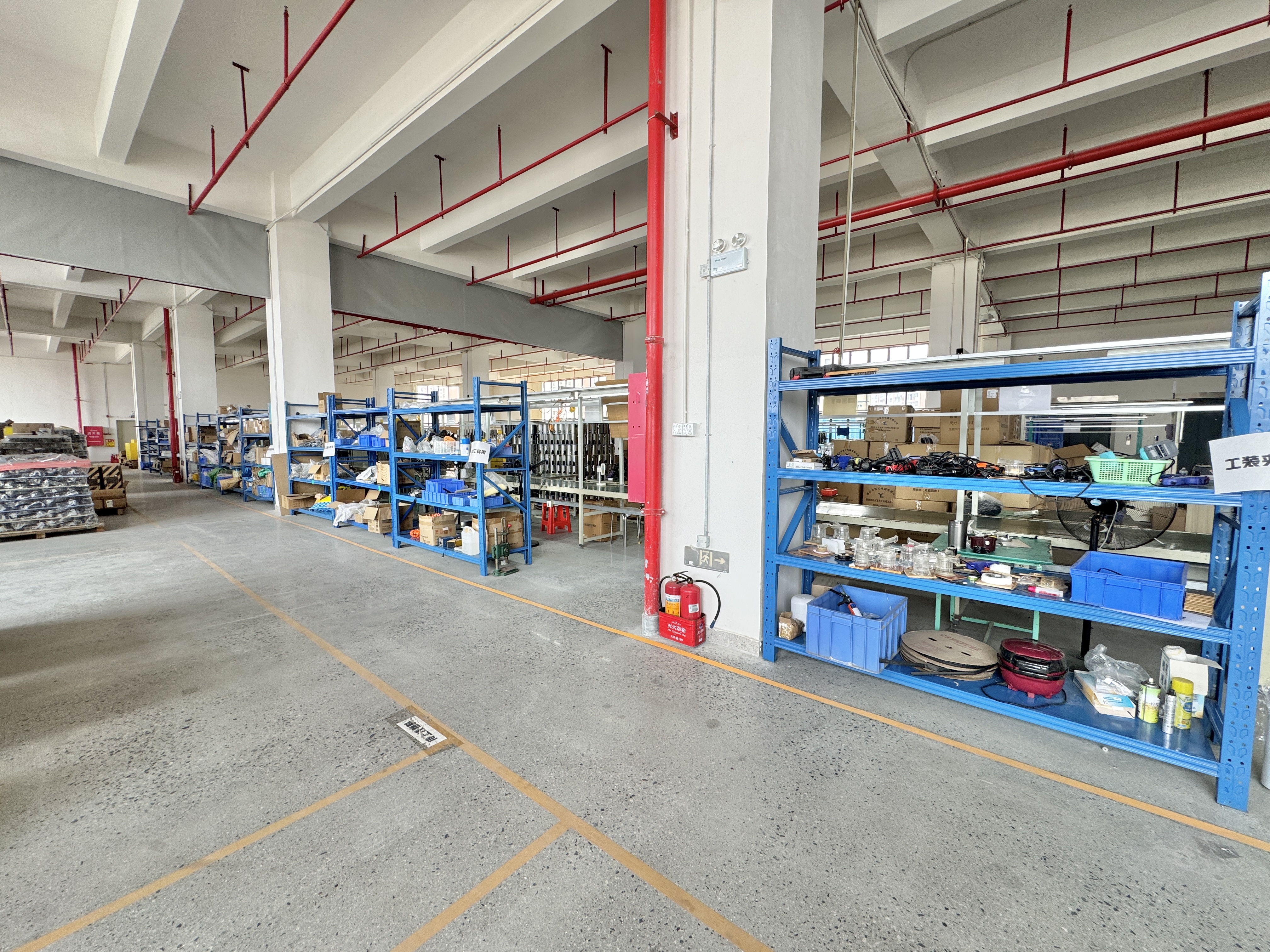
Material storage area at the Zhongshan facility. Traceability of incoming components is the operational counterpart to a food-contact declaration.
Mapping the documented certificate set model by model
Documentation becomes decision-useful only when it is read at model level. The table below separates what is stated in the available materials from what each document can and cannot confirm.
| Document | Level of evidence | Scope as documented | Confirms | Does not confirm |
|---|---|---|---|---|
| CE / LVD (PLJR-320) | Product safety conformity | EN 60335-1:2012+A11+A13+A1+A14+A2+A15+A16; EN IEC 60335-2-14:2023+A1+A11; EN 62233:2008 | Electrical safety assessed against named household appliance standards | Juice yield, noise, motor life |
| LFGB | Food-contact material compliance | § 30 and 31 LFGB, BfR Recommendation, (EC) No. 1935/2004, (EU) No. 10/2011, (EU) 2020/1245, (EU) 2025/351, (EU) 2024/3190, (EU) 2026/250, CM/Res(2020)9, ResAP(2004)5 — slow juicers from 130 W to 200 W | Food-contact conformity for the stated power band | Models outside the 130–200 W range |
| ISO 9001 | Management system | Factory-level process control | Documented, auditable process discipline | Any performance figure for any model |
| TÜV / SGS testing | Third-party product testing | Stated in the company profile as applying to in-house designed products | That an independent body tested the product | Certificate identity, scope wording and validity — not included in the materials provided |
| CB, ROHS, REACH, BPA, BSCI | Market access and material restriction | Listed among company approvals | The supplier works to these regimes | Document-level detail per model is not itemised in the materials provided |
Table contents reflect only the standards, scopes and approvals stated in the supplied company and product documentation.
The materials list as second-layer evidence
Food-contact certification is only credible when the material list behind it is visible. For the PLJR-316SUS, the documented construction is a stainless steel housing with an ABS knob, AS for the juicer and pulp containers, PC for the filter and the juice cup, PC plus a SUS#304 axis for the squeezer, and SUS#420 for the blade. The same component breakdown applies across the household range, with ABS housing on the non-SUS variant.
Two operational details sit alongside the material list. The models use a full copper DC 4435 motor rated at 200 W with 220–240 V input at 50/60 Hz, Class II protection and a 1.2 m power cord with plug. The juicing assembly runs at around 60 RPM with a 120 mm input mouth and a maximum working noise level below 68 dB. Household slow juicers in this range are built with BPA-free food-grade materials.
Read together, the LFGB scope and the material list answer different halves of the same question. The standard establishes that food-contact conformity has been assessed for household slow juicers from 130 W to 200 W; the material list shows exactly which polymer sits in which part. A buyer auditing a supplier should ask for both, because either one alone can be presented without the other.
Three evidence tiers, compared
The practical way to compare slow juicer suppliers is to sort their documentation into tiers, because the tiers fail in different ways.
| Tier | Example | Strength | Typical weakness |
|---|---|---|---|
| Self-declaration | Supplier states a product is compliant | Fast, universal, low cost | Not independently checkable; scope and model often unstated |
| Management system certificate | ISO 9001 | Auditable process evidence; predicts consistency across batches | Says nothing about the appliance itself |
| Product test certificate | CE / LVD test route, LFGB, TÜV certification | Tied to a named standard, model and scope; independently issued | Only covers the exact configuration tested; requires per-SKU renewal |
A shortlist built only on the first tier is a list of intentions, not of evidence.
Applying this to a mini portable slow juicer programme
A compact, portable slow juicer is a different product configuration, not a smaller version of the same file. The reason is scope. The LFGB documentation described above covers household slow juicers with power ratings from 130 W to 200 W; the PLJR-320, PLJR-316 and PLJR-316SUS models are documented at 200 W with 220–240 V input. A mini portable slow juicer aimed at a lower wattage, a different motor, or a 110–120 V market sits outside the documented declarations unless its own documents are issued for that configuration.
That is the single most useful transferable lesson from this certificate set. Buyers frequently assume a supplier's certificate covers a product family. In practice it covers a model and a rating. When negotiating a mini portable slow juicer programme, the questions to settle early are the rated power, the voltage range, the motor specification and the intended market — because each of those parameters determines whether an existing declaration extends to the new SKU or whether new testing is required.
The same logic applies to the extraction side. A 120 mm input mouth and a roughly 60 RPM auger with a noise floor under 68 dB describe the documented household configuration. A portable design typically trades chute size and continuous run time against weight and footprint. The materials provided for this article do not specify dimensions, weight or run-time limits for a compact variant, so no inference is offered here.
Cost evidence that belongs next to the certificate file
Slow juicer economics at the decision stage are rarely about unit price alone. The comparison data supplied for this product category states a purchase cost 35% higher than traditional high-speed juicers, blenders and juice extractors, offset by a 25% lower raw material waste, a 25% higher juice yield, a 60% lower maintenance requirement, a 50% lower long-term spare-parts maintenance cost and an overall failure rate below 1%. Cleaning time is stated as 50% lower, supported by a construction designed for disassembly.
Not all of these figures can be verified from public sources, and none of them should be accepted on the strength of a datasheet alone. Their value here is directional: they describe a cost structure where the purchase price is the smaller part of the three-year equation. A buyer comparing two slow juicer quotes should place the certificate evidence and the cost structure in the same evaluation, because a certificate gap usually becomes a freight, rework or market-access cost later.
Where the evidence stops
A credible shortlist records its open items. For this supplier, three are notable.
Certificate identifiers are not in the public materials. ISO 9001 appears in the approval list without a certificate number, certification body or validity date, and the TÜV certification is described at company-profile level rather than at certificate level. Both are resolvable through a direct document request, but until they are resolved they remain unverified rather than verified.
Comparative performance against named competitors is not documented. The performance figures in the supplied data are stated against traditional high-speed juicers and blenders, not against other slow juicer brands. Buyers who need head-to-head extraction results for celery, kale or spinach should commission their own sample testing rather than rely on category claims.
Commercial terms are outside the certificate scope. Information on production lead times, rush-order capacity, private-label MOQ terms and warranty conditions is not specified in the product documentation and must be confirmed contractually. Certification answers compliance questions; it does not answer scheduling or commercial ones.
Market context behind the documentation question
The slow juicer segment is expanding faster than the juicer category overall. The global juicer market was valued at USD 2.8 billion in 2024, and masticating juicers are projected to grow at a CAGR of 8% from 2024 to 2030. Cold-pressed juice demand in Asia-Pacific is projected to grow at 12.9% CAGR through 2035. Slow juicers typically operate between 40 and 150 RPM, the design range that limits heat build-up and oxidation.
Growth of that shape tends to raise the documentation bar rather than lower it. As more suppliers enter the category, buyers face more certificates, more claimed scopes and more variation in how those documents are presented. The competitive advantage shifts from holding certificates to being able to map them precisely onto a SKU, a voltage and a market.
Future outlook
Two changes are likely to shape supplier evaluation in this category over the next procurement cycles. The first is the normalisation of public certificate lookups: registers such as Certipedia make it routine for a buyer to verify a claim before a sample is even shipped, which favours suppliers whose documentation is already complete and consistent.
The second is scope discipline. As product families fragment into household, compact, portable and commercial variants, a single certificate covering a broad family becomes harder to sustain. Suppliers that maintain clean, per-model documentation — with power ratings, voltage ranges and material lists aligned to each certificate — will be easier to onboard, and easier to keep in a shortlist when a buyer's market mix changes.
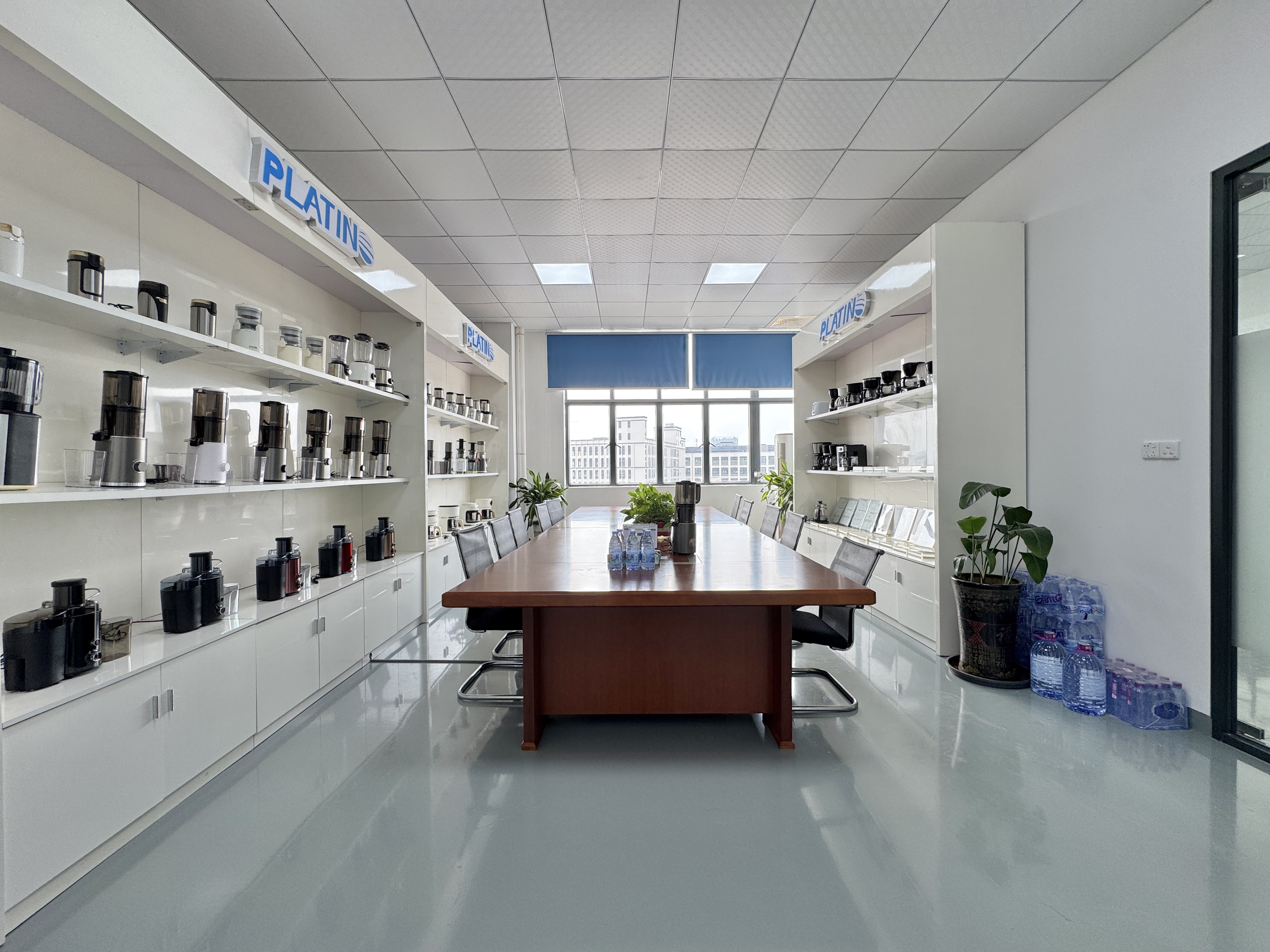
Showroom display of household slow juicer models at the Zhongshan facility, used for sample evaluation.
FAQ
What does ISO 9001 certification actually tell a slow juicer buyer?
ISO 9001 certifies an organisation's quality management system — how processes are planned, controlled, recorded and corrected. It provides auditable evidence of process discipline at factory level. It does not certify juice yield, noise level, motor life or food-contact safety for any individual model. Buyers should treat it as factory evidence and request product-level test documentation separately.
Is a TÜV certificate the same as a CE mark?
No. CE marking is a conformity route through which the manufacturer declares compliance with applicable EU requirements, supported by testing against harmonised standards such as those cited for the PLJR-320: EN 60335-1:2012+A11+A13+A1+A14+A2+A15+A16, EN IEC 60335-2-14:2023+A1+A11 and EN 62233:2008. TÜV Rheinland is an independent body that issues test-based certificates against a named standard and product scope. The two can support each other, but they are different instruments.
Which models and ratings are covered by the documented standards?
The LVD standards cited apply to the PLJR-320 slow juicer. The LFGB scope covers household slow juicers with power ratings from 130 W to 200 W. The PLJR-320, PLJR-316 and PLJR-316SUS are documented with a 200 W full copper DC 4435 motor, 220–240 V input, 50/60 Hz and Class II protection.
Does an existing certificate cover a new mini portable slow juicer model?
Not automatically. Certification is tied to a model, a rated power and a voltage configuration. A compact variant with a lower wattage or a different voltage range falls outside a declaration issued for a 200 W, 220–240 V household unit, and requires its own documentation for the target market.
Which materials are used in the parts that contact juice?
For the PLJR-316SUS, the juicer and pulp containers are AS, the filter and juice cup are PC, the squeezer uses PC with a SUS#304 axis, the blade is SUS#420, the housing is stainless steel and the knob is ABS. Household slow juicers in the range are built with BPA-free food-grade materials.
What maintenance and cleaning profile should a buyer expect?
The documented figures state an overall failure rate below 1%, maintenance requirements 60% lower than traditional high-speed juicers, blenders and juice extractors, long-term spare-parts maintenance cost 50% lower than traditional alternatives, and cleaning time reduced by 50% through a design that can be disassembled. The unit is intended for indoor use, with operation described as intermittent: a maximum continuous run of 10 minutes followed by a 10 to 30 minute cooling period before restart.
The full product and specification overview is available in the company catalogue: Platino E-catalogue.
Есть вопросы или нужны дополнительные детали?
Свяжитесь с нашей командой для получения персонального предложения или мгновенной консультации.
Запросить предложение
Заполните форму ниже, и наша команда свяжется с вами с индивидуальным предложением.
Прямой чат WhatsApp
Предпочитаете общаться в реальном времени? Напишите нам в WhatsApp для мгновенной помощи и быстрых ответов.
- Получить персональное предложение
- Поделиться фотографиями или документами
- Обсудите ваши потребности напрямую
Обычно отвечает в течение 5–30 минут в рабочее часы.