
Sludge Dewatering Shortlist: Four Families by Sludge Type
Sludge dewatering equipment is a category of machines, not a single answer. What separates a workable shortlist from an expensive mismatch is the feed itself: its solids concentration, its fibre and oil content, and how much inorganic material it carries. A surplus sludge at 0.6–1.5% suspended solids, a pre-thickened stream entering a high-pressure stage at 15–20% solids, and an oily industrial sludge that blinds filter media each point to a different equipment family.
This reference groups thickening and dewatering families by the sludge condition they are specified for, using the published parameters of the range manufactured by Shanghai Fuchan Machinery Technology Co., Ltd. (SFC Machinery). SFC Machinery, established in 2007 in Pudong New Area, Shanghai, is a National High-Tech Enterprise integrating technology R&D, intelligent manufacturing, international trade and engineering services, with a focus on sludge treatment, dewatering, drying and solid waste resource recovery. The company operates a 25,000 m² facility with an annual production capacity of 500 sets, employs approximately 36 people including a five-engineer R&D team, and serves Southeast Asia, Russia, South America and the Middle East, with export business accounting for 30% of total sales. Its product scope covers sludge thickening, dewatering, deep dewatering, drying and polymer preparation systems.
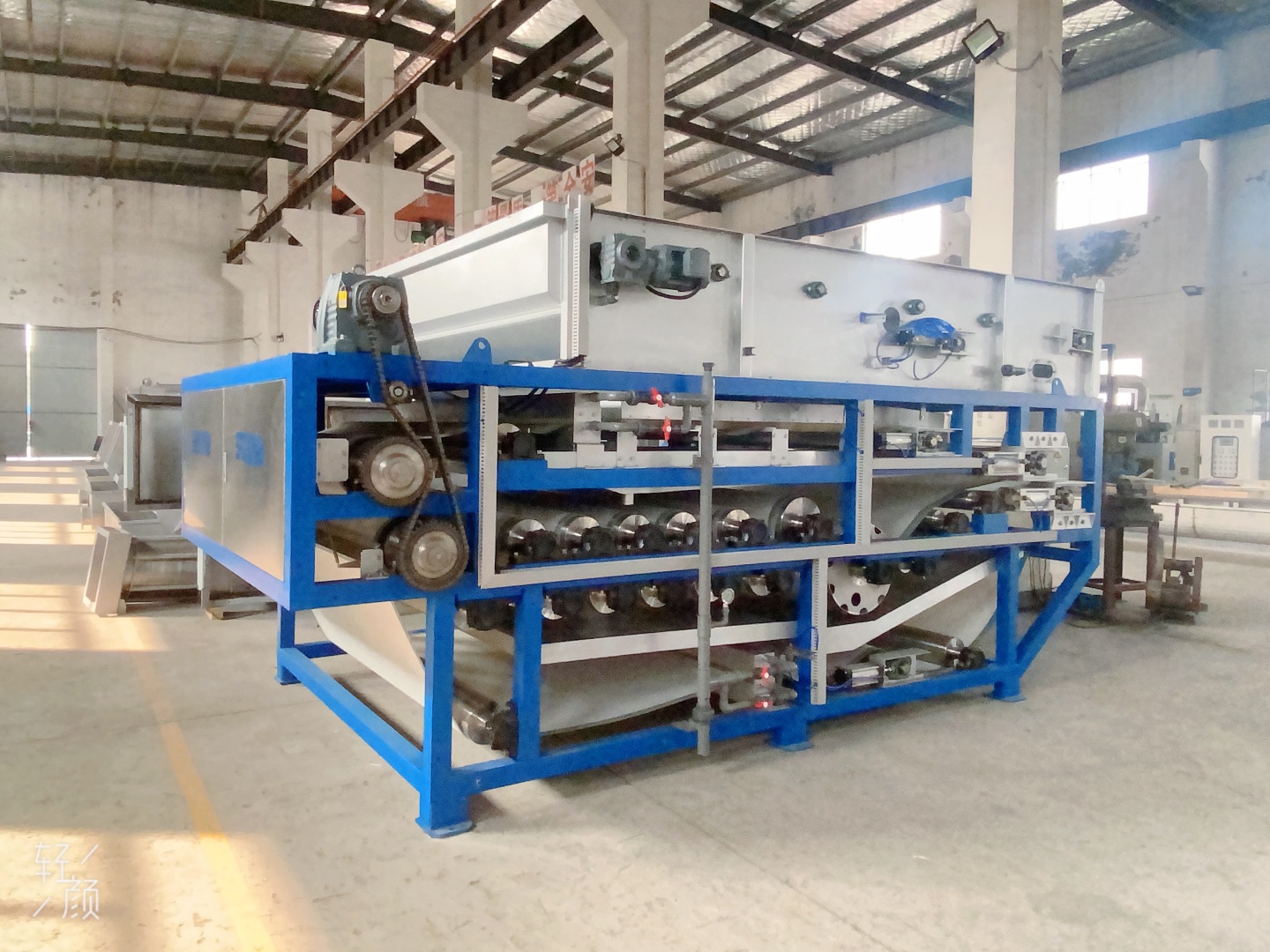
Why the shortlist starts with solids, not with equipment category
Thickening and dewatering are different process duties, and confusing them is the most frequent cause of over- or under-specified equipment. Thickening raises the solids concentration of dilute feed so downstream equipment carries less water. Dewatering produces a handleable cake. The thickening families in this range publish outlet consistencies of 2.5–8% solids — a feed condition for dewatering, not a disposal condition.
Peer-reviewed inventory work gives a useful benchmark for what dewatering then achieves. A 2023 review of published datasets reports typical mechanically dewatered sludge at approximately 25–30% total solids, and deep dewatering at approximately 35–40% total solids. Those figures aggregate heterogeneous datasets and are not a guaranteed machine specification, but they explain why the shortlist below is staged: thickener, dewatering machine, then deep dewatering, with drying treated as a separate decision rather than an automatic add-on.
| Sludge condition | Recommended family | Verified parameter anchor |
|---|---|---|
| Low-solids feed, S.S. 0.6–1.5%, thickening only | FBT gravity belt thickener; FRDT rotary drum thickener | Outlet 2.5–8% solids; 12–95 m³/h (FBT); 7.5–100 m³/h (FRDT) |
| Low-solids feed needing one-step thickening plus dewatering | GDY belt thickening and dewatering machine | Inlet 0.6–1.5%; 15–90 m³/h; cake 75–80% water content |
| Sticky, oily or high-inorganic sludge | SRD wear-free multi-disc screw press | Inlet 0.6–5.0%; 25–900 kg/h dried sludge; cake 75–85% water content |
| Integrated thickening and dewatering at medium solids | FTB and FTE rotary drum plus belt press machines | Inlet 1.5–2.5% (FTB) and 0.6–1.5% (FTE); cake 75–85% water content |
| Pre-thickened sludge in the high-solids band | SD high-pressure belt deep dewatering machine | Inlet 15–20%; 0.3–5.0 t/h at 65–75% water content |
Group 1: Low-solids feed at S.S. 0.6–1.5%
Feed in the 0.6–1.5% suspended solids band is the classic thickening duty. Three families apply, and the choice depends on whether a dewatering stage already exists downstream.
FBT series gravity belt sludge thickener
The FBT series is a gravity belt sludge thickener built in SS304 stainless steel, available as FBT-1000, FBT-1500, FBT-2000, FBT-2500 and FBT-3000, with belt widths from 1000 mm to 3000 mm and belt speed of 3–18 m/min. Published performance includes an inlet consistency of S.S. 0.6–1.5%, outlet consistency of 2.5–8%, treating capacity of 12–95 m³/h, dried sludge output of 72–900 kg/h, power consumption of 0.55–1.5 kW and a solid-capture rate of 98%. It is applied in municipal and industrial wastewater treatment, paper mills, printing and dyeing, and sludge thickening projects.
The 98% capture figure is the parameter buyers should interrogate first in a dilute-feed application, because lost solids return to the plant as load rather than leaving as thickened sludge. The trade-off is conditioning dependence: the family requires sludge sample testing and polymer selection before final sizing, plus a polymer preparation system, feed pump, mixing tank, wash water system and local control cabinet around it.
FRDT series rotary drum sludge thickener
The FRDT series is an enclosed drum sludge thickener in SS304, spanning FRDT-20 to FRDT-100, with filter openings of 30–80 mesh and a drum speed of approximately 10 rpm. Published data include inlet consistency of 0.6–1.5%, outlet consistency of 2.5–8%, treating capacity of 7.5–100 m³/h, dried sludge output of 45–1140 kg/h, solid capture of 95%, a driving motor of 0.75–1.5 kW and a disposal agitator motor of 0.37–0.55 kW.
The drum format is specified where the thickening duty must be enclosed and installation space is limited. Screen mesh selection and polymer conditioning are the two site-specific decisions that determine whether the published capture rate is actually reached in service.
GDY series belt thickening and dewatering machine
Where no downstream dewatering stage exists, the GDY series integrates gravity belt thickening and belt press dewatering into a single unit. Models run from GDY-1000 to GDY-3000 with belt widths of 1000–3000 mm; inlet consistency is 0.6–1.5%, treating capacity 15–90 m³/h, dried sludge 90–1050 kg/h, and the cake water content rate is 75–80%. Power is split between a 1.1–4.0 kW driving motor, a 0.37–0.75 kW disposal agitator motor and a 0.55–1.5 kW belt thickener. The family targets high-flow continuous duties in municipal and industrial treatment, paper mills and printing and dyeing.
Group 2: Sticky, oily and high-inorganic sludge
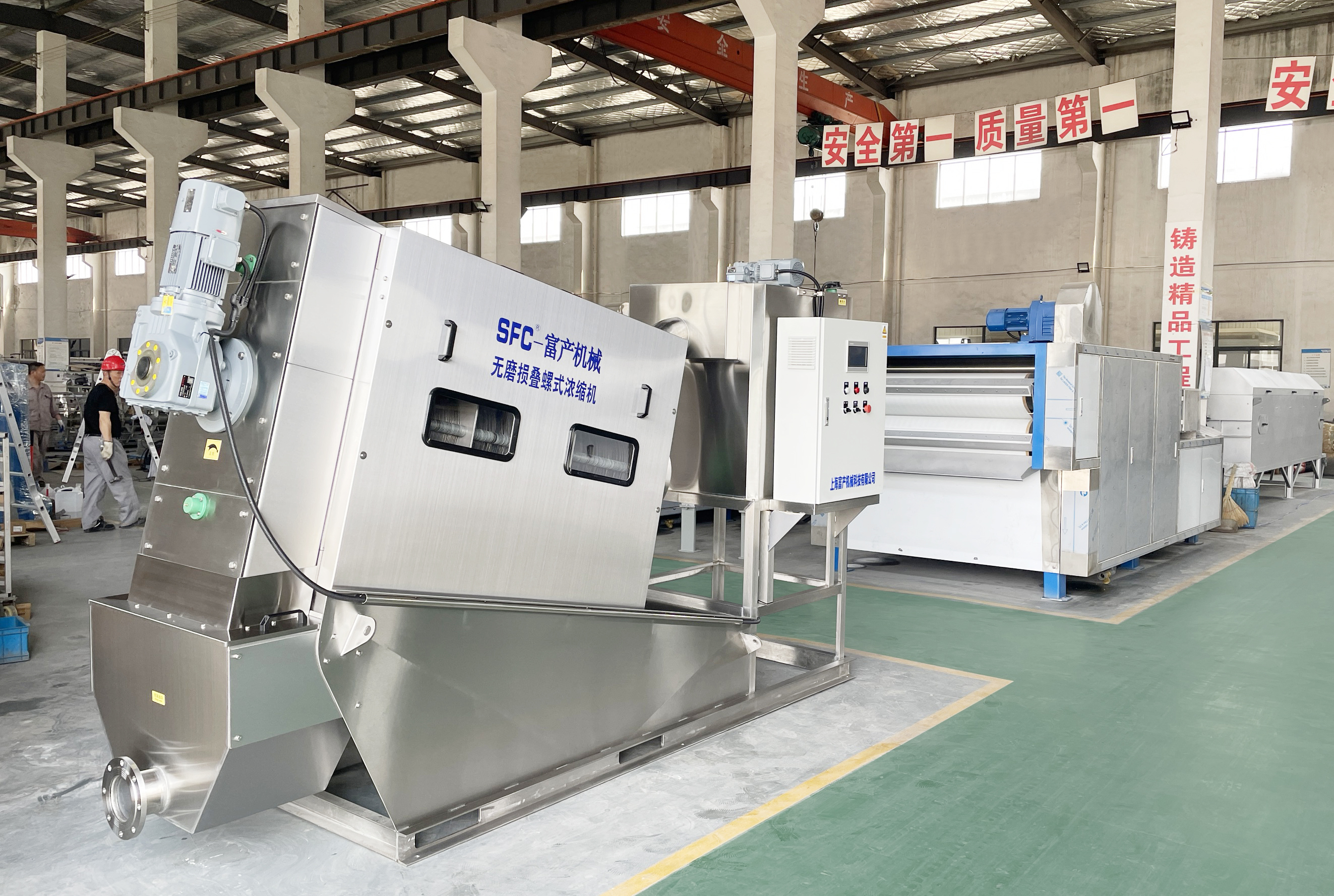
Some sludges do not fail because of concentration but because of character. Oily, sticky and high-inorganic-content sludges resist stable conveying and accelerate wear between screw and ring surfaces. That is the condition the SRD series is specified for.
SRD series wear-free multi-disc screw press
The SRD series is a wear-free multi-disc screw press in SS304, available as SRD-301 through SRD-404. Published parameters include inlet consistency of S.S. 0.6–5.0%, dried sludge of 25–900 kg/h, a cake water content rate of 75–85%, screw specifications from Ø270×1 to Ø370×4, and a driving motor of 0.55–1.1 kW with multi-motor configurations by model. The manufacturer lists its suitable sludge types as low-concentration, sticky, oily and high-inorganic-content sludge, and positions it for oily sludge treatment, food processing wastewater, high-inorganic sludge treatment and decentralised sludge treatment.
The stated engineering role is specific: improve stable conveying and dewatering while reducing screw-to-ring wear risk. That matters because a standard screw press on an abrasive or greasy feed tends to lose the very clearances that make it work.
DL series as the general-purpose baseline
For comparison, the DL series multi-disc screw press in SS304 covers DL-101 to DL-404 with a structure of fixed rings, moving rings, screw shaft and volute filter. Published parameters include inlet consistency of S.S. 0.6–5.0%, dried sludge of 1.5–900 kg/h, cake water content of 75–85%, screw specification of Ø85×1 to Ø400×4, screw motor power of 0.18–1.5 kW and conditioning motor power of 0.18–1.1 kW. It serves municipal and industrial treatment, paper mills, printing and dyeing, oily sludge and decentralised projects.
Read side by side, the two families show a real design trade-off. The DL range reaches lower units and lower motor power; the SRD range narrows its screw geometry to Ø270–Ø370 and raises the base motor power to 0.55–1.1 kW in exchange for wear resistance under difficult feed.
Group 3: Integrated thickening and dewatering at medium solids
Two rotary drum plus belt press families cover the middle of the range. They look similar in principle — a rotary drum thickener ahead of a belt press section — and differ almost entirely by inlet solids and scale.
FTB series for medium-solids feed
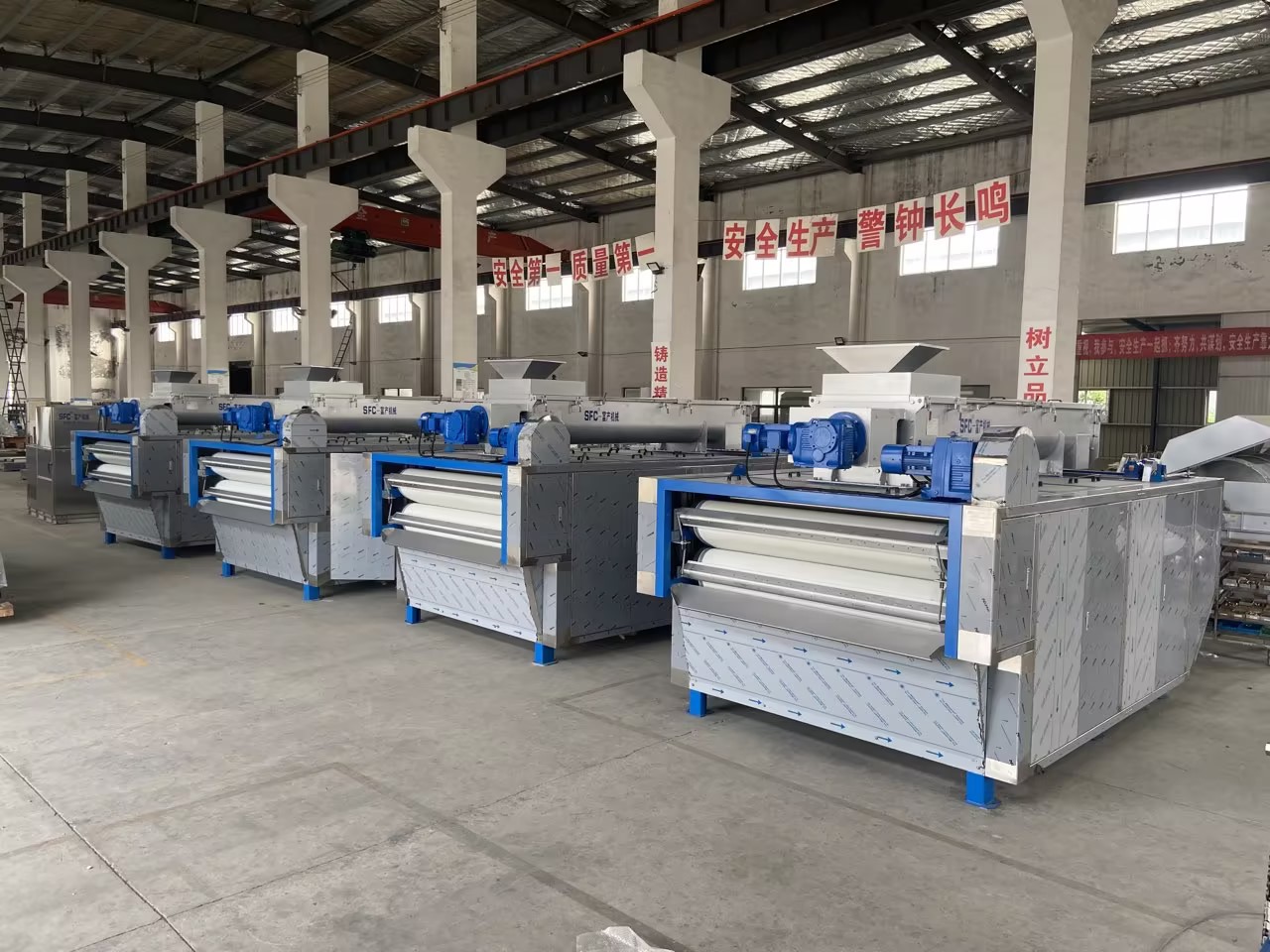
The FTB series is a rotary drum thickening plus belt press dewatering machine in SS304, with models FTB-500, FTB-750, FTB-1000, FTB-1500, FTB-1500L and FTB-2000 and belt widths of 500–2000 mm. Published parameters are inlet consistency of S.S. 1.5–2.5%, treating capacity of 3.0–30 m³/h, dried sludge of 45–450 kg/h, cake water content of 75–85%, a 0.37–1.1 kW driving motor, a 0.37–0.55 kW disposal agitator motor and a 0.37–0.55 kW drum thickener motor. It is aimed at small and medium sludge dewatering projects.
FTE series for dilute to low-solids feed at larger scale
The FTE series uses the same drum-plus-belt architecture but takes thinner feed. Models run from FTE-1000 to FTE-3000 plus the FTE-1500L, FTE-2000L, FTE-2500L and FTE-3000L variants, with belt widths of 1000–3000 mm. Published data include inlet consistency of S.S. 0.6–1.5%, treating capacity of 12–90 m³/h, dried sludge of 90–975 kg/h, cake water content of 75–85%, a 0.55–4.0 kW driving motor, a 0.37–0.75 kW disposal agitator motor and a 0.37–0.75 kW drum thickener motor. It is positioned for medium and large continuous dewatering projects.
The practical distinction is simple. If the feed arrives at 1.5–2.5% solids, the FTB range matches it directly. If the feed arrives between 0.6 and 1.5% solids and the plant wants one continuous machine instead of a separate thickener, the FTE range is the closer fit. Both require the same supporting scope — polymer preparation, wash water, conveyors and controls — and both depend on polymer conditioning and routine belt washing or filter cloth cleaning to hold their published ranges.
Group 4: Deep dewatering of pre-thickened sludge
Once the sludge has already been concentrated, the constraint changes again. High-solids feed will not flow or flocculate the way dilute feed does, so deep dewatering machines are designed as a secondary stage with their own conditioning train.
SD series high-pressure belt deep dewatering machine
The SD series, from SFC-SD05 to SFC-SD25, is a high-pressure belt deep dewatering system and secondary deep dewatering machine in SS304. Published parameters include inlet consistency of S.S. 15–20%; for 65–75% water content output, a treating capacity of 0.3–5.0 t/h and dried sludge of 60–760 kg/h; for 60–70% water content output, a treating capacity of 0.35–6.1 t/h and dried sludge of 70–920 kg/h. Power is distributed across a 0.55–3.0 kW driving motor, a 2.2–5.5 kW sludge mixer, a 0.25–1.5 kW sludge distribution spiral and a 0.37–0.75 kW sludge crushing screw.
That power breakdown is the clearest evidence of what the machine actually does. The largest motor on the unit is the mixer, not the press drive: the equipment re-conditions high-solids sludge before it can be pressed. Applications include municipal wastewater treatment plants, chemical plants, sludge deep treatment, sludge drying pretreatment and sludge incineration pretreatment.
Read against the literature benchmark, the numbers line up. A cake at 65–75% water content corresponds to roughly 25–35% dry solids, and a cake at 60–70% water content corresponds to roughly 30–40% dry solids — the band the 2023 review associates with deep dewatering. The SD series is therefore an appropriate stage when the disposal route needs solids in the high twenties or above, and an unnecessary one when it does not.
Where the shortlist stops: drying is a separate decision
Dewatering shortlists are frequently extended into drying without a clear justification. The two duties carry materially different energy burdens, and the published figures show why buyers should decide the disposal route first.
Mechanical dewatering is reported in peer-reviewed inventory data at average energy use of approximately 0.12 kWh/kg TS for raw sludge and 0.26 kWh/kg TS for digested sludge. Thermal drying is reported at approximately 3.8 kWh/kg TS. These are different process classes with different system boundaries and are not directly comparable as efficiency rankings, but the order of magnitude explains why drying is justified by a disposal requirement — incineration, landfill restrictions, or volume-driven transport cost — rather than by habit.
For reference, the drying families in this range are specified downstream of dewatering. The SFC-BSD series belt sludge dryer takes inlet consistency of S.S. 15–25% or S.S. 25–35%, reaches a final water content rate of 10–50%, and uses 23–506 kW in a fully enclosed, modular SS304 construction. The SFC-TR series low-temperature dryer processes 1000–9000 L per batch, extracts 21–360 kg/h of water, draws 15–145 kW, and achieves unit power consumption of 0.4–0.55 kWh/kg water with sludge reduction after drying of up to 70%.
Matching the shortlist to documented applications
The families above map onto application conditions recorded in the manufacturer's project scope, which is a more reliable starting point for a buyer than a general capability claim.
- Petrochemical coking wastewater. A sludge thickening, dewatering and thermal drying package built around an FTE3-2000 belt sludge dewatering machine, with explosion-proof design and corrosion-resistant materials for automatic continuous operation.
- Distillery and brewery wastewater. High-organic sludge with a moisture content typically described as 95–99.8%, prone to fermentation and odour, handled through thickening, screw press dewatering and thermal drying with an FTB-2000 drum thickening belt filter press and enclosed, corrosion-resistant equipment.
- Electroplating and surface finishing. Corrosive heavy-metal sludge handled with an FTB-500 rotary drum concentrator belt press in a dewatering and drying package.
- Palm oil. Palm oil mill effluent and empty fruit bunch conditions using a DL-301 screw press in unattended continuous operation.
- Pharmaceutical wastewater. High-organic, chemically complex sludge with a DL-201 screw press dewaterer ahead of deep dewatering and drying.
- Municipal wastewater. A DL-202 screw type sludge dewatering machine feeding a continuous low-temperature belt drying system.
Market context for this shortlist
Third-party market research places the global sludge dewatering equipment market at USD 6.4 billion in 2026, with a projection of USD 14 billion by 2035 (Global Market Insights, published April 2026). Separate commercial research identifies Asia Pacific as the largest regional market at 37.57% share in 2024 (Fortune Business Insights). Published estimates use different product boundaries and methodologies, so these figures should be read as directional signals about where capacity and competition sit, not as a budget line for any single project.
A more useful signal for buyers is the evidence gap. A peer-reviewed inventory review located 55 datasets on sewage sludge dewatering and 21 on sludge drying — a substantial but still limited public base, without a verified head-to-head benchmark for screw press, belt press and filter press performance under identical feed conditions. On the technology side, a 2025 peer-reviewed study proposed an image-based method using smartphone photographs of flocculation to evaluate sludge dewaterability, pointing toward cheaper, more routine characterisation as a process-control input.
What this shortlist does not solve
A condition-based shortlist shortens the search, but it does not replace site evidence. Four boundaries apply to every family above.
- No verified model-level cross-technology benchmark exists in public sources. Published cake and capacity figures come from manufacturer specifications; comparing a screw press to a belt press on those numbers alone is not a like-for-like comparison.
- Belt-based families carry a water and maintenance load. Wash water systems, belt tension, filter cloth cleaning and stable flocculation are operating requirements, not optional extras, and they consume operator attention that a screw press largely avoids.
- Chemicals are a real cost line. Peer-reviewed inventory data reports typical chemical-agent consumption of 5–15 g per kg TS for mechanical dewatering, without specifying agent type or dose basis. That is a question to put to a supplier, not a number to budget from directly.
- Difficult sludge needs a test, not a brochure. Both the wear-free screw press and the deep dewatering system explicitly require sludge confirmation or project-specific testing before selection.
Compared against the traditional default — one generic dewatering machine applied across every duty in a plant — the staged approach above is more demanding in engineering time and more honest about where each family stops working. That trade is usually worth it, because the failure mode of the generic approach is silent: a unit that runs, consumes excess polymer, and never quite reaches the cake solids the discharge route requires.
Future outlook
Three directions appear to be shaping sludge line design. First, solids targets are increasingly set by the disposal route rather than by the dewatering machine, which pushes plants toward staged configurations — thickener, dewatering press, deep dewatering, then drying only where the downstream process demands it. Second, the equipment trend is toward enclosed and modular construction, visible in the fully enclosed, modular design of the belt dryer range and the enclosed drum format of the rotary thickener. Third, characterisation is beginning to move ahead of equipment selection: if low-cost dewaterability testing becomes routine, shortlists will be built from measured sludge response rather than from suspended-solids percentages alone.
For SFC Machinery, the relevant capability question is not whether a single machine can serve all four conditions — it cannot — but whether the range covers them coherently, from FBT and FRDT thickening through GDY, FTB, FTE, SRD and DL dewatering to SD deep dewatering and BSD or TR drying, with polymer preparation and dosing systems to support the whole line.
Frequently asked questions
What is the difference between sludge thickening equipment and sludge dewatering equipment?
Thickening raises the solids concentration of dilute sludge so downstream equipment carries less water; the thickening families in this range publish outlet consistencies of 2.5–8% solids. Dewatering produces a cake for handling and disposal, and peer-reviewed inventory data reports typical mechanical dewatering results of approximately 25–30% total solids. The two are sequential process duties, not interchangeable options.
Which equipment suits feed at S.S. 0.6–1.5%?
If a dewatering stage exists downstream, the FBT gravity belt thickener (12–95 m³/h, 98% solid capture) or the FRDT rotary drum thickener (7.5–100 m³/h, 95% solid capture, enclosed format) applies. If the plant needs one-step thickening and dewatering, the GDY series integrates gravity belt thickening and belt press dewatering with a 15–90 m³/h capacity and 75–80% cake water content, and the FTE series achieves the same integration through rotary drum thickening at 12–90 m³/h.
When is a wear-free screw press the better choice than a standard screw press?
When the sludge is sticky, oily, low-concentration or high-inorganic-content. The SRD series is specified for those conditions and its stated role is to improve stable conveying and dewatering while reducing screw-to-ring wear risk, with inlet consistency of 0.6–5.0%, dried sludge of 25–900 kg/h and cake water content of 75–85%. Selection still requires sludge type confirmation and suitability testing for difficult sludge.
What inlet consistency does the SD series deep dewatering machine require?
The SD series is specified at an inlet consistency of S.S. 15–20%, which places it after primary dewatering rather than at the head of the sludge line. For 65–75% water content output it treats 0.3–5.0 t/h and produces 60–760 kg/h of dried sludge; for 60–70% water content output it treats 0.35–6.1 t/h and produces 70–920 kg/h. Conditioning chemicals and project-specific sludge testing are prerequisites.
What supporting equipment does a belt thickening and dewatering system need?
A polymer preparation system, sludge feed pump, flocculation tank, wash water system, screw conveyor and control cabinet form the standard scope around the GDY family. The FTB and FTE drum-plus-belt machines require a polymer preparation system, rotary drum thickener, belt press section, wash water system, screw conveyor and control cabinet. Belt tension, flocculation stability and adequate wash water are operating conditions rather than accessories.
How can buyers verify dewatering performance before ordering?
Request sludge-specific test data rather than catalogue ranges. Public sources contain no verified head-to-head benchmark across screw press, belt press and filter press under identical feed conditions, and a 2023 peer-reviewed review located only 55 dewatering datasets in the published literature. Polymer jar tests, feed concentration confirmation and anti-clogging assessment are the practical verification steps named in the equipment documentation, and conditioning consumption and energy use per kg total solids should be compared on the same basis.
For readers who need the full model and parameter listing behind this shortlist, the manufacturer's product catalogue is available for public download: SFC Product Catalog 2026 (PDF).
Есть вопросы или нужны дополнительные детали?
Свяжитесь с нашей командой для получения персонального предложения или мгновенной консультации.
Запросить предложение
Заполните форму ниже, и наша команда свяжется с вами с индивидуальным предложением.
Прямой чат WhatsApp
Предпочитаете общаться в реальном времени? Напишите нам в WhatsApp для мгновенной помощи и быстрых ответов.
- Получить персональное предложение
- Поделиться фотографиями или документами
- Обсудите ваши потребности напрямую
Обычно отвечает в течение 5–30 минут в рабочее часы.