
Sludge Dewatering Supplier Capability: Records That Survive Audit
Sludge Dewatering Supplier Capability: Records That Survive Audit
Buying sludge dewatering equipment is an exercise in comparing descriptions written to sound alike. Almost every supplier in the category can present a stainless-steel machine, a model list and a reference project. What separates a capable manufacturer from a capable brochure is whether those three items can be tied to documents, model-level numbers and sludge conditions that a buyer can check before a purchase order is issued.
This article sets out a working method rather than a verdict. It examines the four evidence layers a sludge dewatering supplier can realistically be asked to produce — material and construction records, the model range with its documented operating envelope, project references attached to specific sludge conditions, and the manufacturing and conformity documents behind the catalogue — and it shows how to read each layer, including the point at which the evidence runs out. Shanghai Fuchan Machinery Technology Co., Ltd (SFC Machinery), a Shanghai-based manufacturer of sludge thickening, dewatering, deep dewatering and drying equipment established in 2007, is used as the worked example throughout, because its supplied records contain both unusually specific project data and clearly identifiable gaps. Its company profile is published at https://www.sfceco.com/.
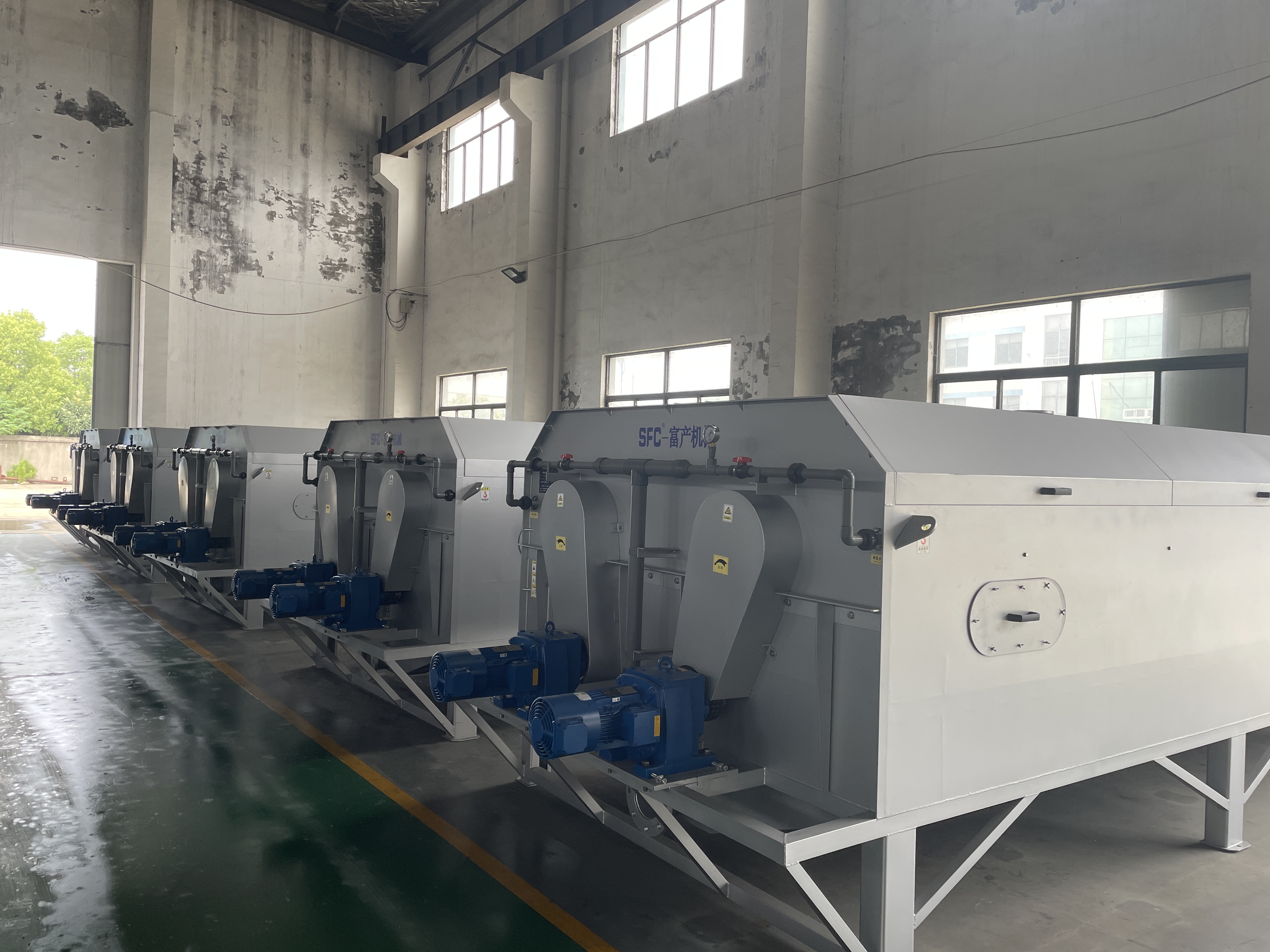
Why supplier capability is hard to compare
The commercial context explains why the question keeps returning. Global Market Insights estimates the global sludge dewatering equipment market at USD 6.4 billion in 2026 and projects USD 14 billion by 2035; Fortune Business Insights puts Asia Pacific at 37.57% of that market in 2024. Both are commercial research estimates rather than audited statistics, and they use different methodologies, so they should be read as scale indicators. What they do establish is a category large enough for a buyer to meet many suppliers quoting similar ranges.
Public technical evidence does not close the gap. A peer-reviewed review of sludge dewatering and drying inventory data identified 55 datasets on dewatering and 21 on drying, yet it reports aggregate ranges rather than model-level results for named commercial machines. That produces three practical problems. First, a stated capacity means little without the inlet consistency and sludge type attached to it. Second, a reference project proves that an application was served, not that the same result will transfer to a different sludge. Third, certification and manufacturing claims are only comparable when the certificate scope and the production site are both identifiable.
The buyer's answer is to reduce every supplier conversation to four layers of evidence that either exist or do not: a wetted-parts material schedule, a model range with a documented operating envelope, references described against sludge conditions, and conformity plus manufacturing documents. Everything else is positioning.
Layer one: materials and construction records
SS304 is the austenitic stainless grade most frequently written into sludge-contact specifications, and it is the grade a buyer should be able to trace component by component. The productive question is not "is the machine stainless steel?" but "which components are SS304, which are a different grade, and which are coated carbon steel?" Frames, base plates, fasteners, drive housings and bearing blocks are routinely a different material in otherwise stainless equipment, and that is normal — provided the boundary is documented before the order rather than discovered after commissioning.
Across the equipment families discussed in this article, the parts that matter differ, and so do the questions:
- Thickeners (belt thickener FBT series, rotary drum thickener FRDT series): drum or belt support structure, wedge-wire or screen elements, wetted housing panels and wetted fasteners.
- Screw presses (DL and wear-free SRD series): screw flights and shaft, screen cylinder and rings, end plates and discharge assemblies, where abrasion and corrosion interact.
- Belt thickening and dewatering machines (GDY, FTB, FTE series): frame, rollers, belt support surfaces and wash-water piping, since the wash circuit is a corrosion path in its own right.
- High-pressure deep dewatering (SD series): the high-pressure zone frames and rollers, where mechanical load and slurry exposure combine.
- Dryers (SFC-TR and SFC-BSD series): belt materials, chamber panels and heat-exchange surfaces, where temperature adds a design constraint that ambient dewatering equipment does not carry.
A supplier's answer to these points should arrive as a wetted-parts schedule naming grade and thickness per component, supported by mill certificates from the steel producer for the plate actually used. Verbal confirmation that a unit is "made of SS304" does not survive a tender clarification. Two further checks are worth adding. First, the electrical and machinery-safety side of the same machine can be verified against a named document rather than a promise: the CE attestation held by SFC Machinery for sludge treatment equipment is written against EN ISO 12100:2010 and EN 60204-1:2018+A1:2025, which are design and electrical-equipment standards rather than material standards. Second, the published catalogue is the right place to confirm the model range, but a model-level material schedule is a separate document that should be requested for the specific unit under evaluation.

Layer two: the model range and what each designation covers
A model ladder is evidence of a manufacturing scope only when each rung can be tied to a documented envelope. SFC Machinery lists ten product records spanning thickening, dewatering, deep dewatering and drying. The table below reproduces the listed series and models and states what a buyer should obtain for each.
| Family and product record | Series and models listed | Documents to request per model |
|---|---|---|
| Belt sludge thickener (5120) | FBT series: FBT-1000 / FBT-1500 / FBT-2000 / FBT-2500 / FBT-3000 | Belt width, hydraulic loading, inlet consistency range, polymer dose, wash-water demand, footprint and weight |
| Rotary drum sludge thickener (5122) | FRDT series: FRDT-20 / FRDT-25 / FRDT-35 / FRDT-40 / FRDT-50 / FRDT-70 / FRDT-80 / FRDT-100 | Drum diameter and length, treating capacity at a stated inlet solids content, outlet solids band, drive power, enclosure type |
| Screw press sludge dewatering machine (5160) | DL series: DL-101 / DL-102 / DL-201 / DL-202 / DL-301 / DL-302 / DL-303 / DL-304 / DL-351 / DL-352 / DL-353 / DL-354 / DL-401 / DL-402 / DL-403 / DL-404 | Screw diameter, screen slot, capacity at stated solids, outlet cake solids, conditioning dose, motor power, weight |
| Wear-free screw press (5166) | SRD series: SRD-301 / SRD-302 / SRD-303 / SRD-304 / SRD-351 / SRD-352 / SRD-353 / SRD-354 / SRD-401 / SRD-402 / SRD-403 / SRD-404 | The same envelope as above, plus a written definition of what "wear-free" means operationally: inspection intervals, expected screw and screen service life, spare-parts basis |
| Belt sludge thickening and dewatering machine (5174) | GDY series: GDY-1000 / GDY-1500 / GDY-2000 / GDY-2500 / GDY-3000 | Belt width, belt speed range, gravity-zone and pressure-zone design, wash-water requirement, outlet solids |
| Rotary drum sludge dewatering machine (5175) | FTB series: FTB-500 / FTB-750 / FTB-1000 / FTB-1500 / FTB-1500L / FTB-2000 | Drum size, treating capacity, outlet solids, and the specific difference the "L" variant introduces |
| Rotary drum type sludge thickening and dewatering machine (5176) | FTE series: FTE-1000 / FTE-1500 / FTE-2000 / FTE-2500 / FTE-3000 / FTE-1500L / FTE-2000L / FTE-2500L / FTE-3000L | How thickening and dewatering duties split inside one machine, combined footprint, and the feed conditions assumed for each |
| High-pressure belt deep sludge dewatering machine (5179) | SD series: SFC-SD05 / SFC-SD10 / SFC-SD15 / SFC-SD20 / SFC-SD25 | Pressure-zone design, achievable dry solids on a stated feed, required upstream dewatering stage, polymer demand, belt service life |
| Sludge dryer, container type (5181) | SFC-TR series: SFC-TR1000 / SFC-TR1500 / SFC-TR2000 / SFC-TR3000 / SFC-TR4500 / SFC-TR6000 / SFC-TR9000 | Evaporation capacity, heat source and heat-pump configuration, inlet and outlet moisture, energy per kilogram of water removed |
| Sludge dryer, belt type (5183) | SFC-BSD series: BSD1000 / BSD2000 / BSD3000 / BSD4000 / BSD6000 / BSD9000 / BSD12000 / BSD15000 / BSD18000 / BSD21000 / BSD24000 / BSD27000 / BSD30000 | Belt area, evaporation capacity, operating temperature band, waste-heat integration options, extruder or feed-preparation requirements |
Designations such as FTB-500 through FTB-2000, DL-101 through DL-404 or BSD1000 through BSD30000 establish that a size ladder exists across a wide range. They do not, on their own, establish belt width, treating capacity or inlet consistency; those numbers have to come from the model datasheet. Suffix variants — FTB-1500L and FTE-2000L among the FTE and FTB ranges — signal a distinct configuration inside the same series, and the buyer should ask precisely what changes rather than assuming a longer belt or a larger drum. This is the single most common point at which a tender specification and a supplier quotation drift apart.
Layer three: documented operating envelopes, and how to sanity-check them
An operating envelope is the only part of a quotation that can be tested later. Six values should be fixed in writing for the specific model: inlet consistency expressed as total solids or moisture content together with the sludge type; treating capacity in cubic metres per hour at that inlet condition; outlet cake solids or moisture; conditioning or polymer dose in grams per kilogram of total solids; installed power and energy per kilogram of total solids; and the physical envelope — belt width or drum diameter, footprint and weight. A seventh item, the acceptance test method, determines whether any of the first six can be demonstrated on site.
Published literature gives buyers a rough reference frame for those numbers. The figures below come from a peer-reviewed review of dewatering and drying inventory data (2023) and, for the definitional cake range, trade media. They are aggregate benchmarks, not equipment specifications, and the review's own datasets use different feed sludges, conditioning regimes and measurement protocols.
| Parameter | Literature benchmark | Procurement use |
|---|---|---|
| Cake solids after mechanical dewatering | Approximately 25–30% total solids | Use to test whether a claimed outlet is realistic for the feed, not to set a guarantee |
| Cake solids after deep dewatering | Approximately 35–40% total solids | Separate mechanical and deep-dewatering requirements in the RFQ |
| General dewatered cake range (definitional) | Roughly 15–45% dry solids | Place a quoted outlet within the process class before comparing prices |
| Conditioning or chemical agent | Typically 5–15 g per kg total solids for mechanical dewatering | Convert to annual polymer cost using the buyer's own price, not the supplier's claim |
| Energy, mechanical dewatering | Average about 0.12 kWh/kg total solids for raw sludge and 0.26 kWh/kg for digested sludge | Compare energy per kg total solids, with the system boundary defined |
| Energy, thermal drying | Average about 3.8 kWh/kg total solids | Confirms that drying is a separate process stage with a materially different energy burden, not an upgrade to dewatering |
Reading the SFC reference data against this frame is instructive rather than confirming. The reported mechanical-dewatering outcomes sit at 77–80% moisture, which is roughly 20–23% total solids — at or slightly below the lower edge of the 25–30% band reported in the review. That is not a contradiction: the review aggregates heterogeneous datasets, and feed sludge type, conditioning and downstream requirements differ. It is, however, exactly why a buyer should define the expected outlet on their own sludge through a bench or pilot test instead of accepting a generic band, and why a supplier's reference should always carry its inlet condition alongside its outlet figure.
Layer four: project references read against sludge conditions
A reference becomes evidence only when it states what went in, what came out and how long the unit has run. The eight references in the SFC record cover thickening, screw press dewatering, belt-type dewatering and drying, and they are summarised below as published by the supplier — they are company-reported case records, not independently audited results.
| Equipment and site | Feed and application | Reported outcome | Recorded duration |
|---|---|---|---|
| FRDT rotary drum thickener, 8 machines, municipal WWTP, China | Raw sludge pre-concentration ahead of plate-and-frame filter press dewatering | 99.4% to 97% moisture, solids raised to 3%, improving downstream press performance | 1 year |
| GDY belt thickening and dewatering machine, 2 machines, city sewage treatment plant, China | Excess sludge at 99.2% moisture | Reduced to about 80% moisture in continuous, largely unattended operation | 5 years |
| DL screw press, 1 machine, vegetable oil processing, China | Wastewater sludge from soybean, palm and canola oil processing | 97% to 77% moisture, volume reduction reported as up to 98% | 8 years |
| DL screw press, 1 machine, pharmaceutical wastewater, China | Biological aeration sludge at the plant's wastewater treatment station | 99% to under 85% moisture, volume cut by up to 93% | 10 years |
| FTB-1000 rotary drum dewatering machine, 1 machine, food processing, Malaysia | Food-processing wastewater sludge at 98.5% moisture | Reduced to below 80% moisture; the reference additionally reports a 30% reduction in sludge handling cost for the client | 8 years |
| FTB-1500L rotary drum dewatering machine, 1 machine, specialty chemicals, China | Chemical wastewater treatment sludge at 99% moisture | Reduced to well below 80% moisture, delivered as a discharge-ready cake | 5 years |
| SFC-TR dryer, 2 machines, automotive parts manufacturing, China | Sludge dewatered to 75% moisture by a plate-and-frame press | Dried to under 25% moisture, over 700 kg of water removed per tonne of sludge, volume reduction above 70% | 5 years |
| BSD-2000 belt dryer, 1 machine, precision component manufacturing, China | Screw press cake at 85% moisture | Dried to below 30% moisture; the reference notes the extruder needed optimisation before stable distribution was achieved | 6 years |
Five questions turn this table from marketing into due diligence. Was the feed sludge the same type and consistency as the buyer's, or merely the same industry? What downstream step did the reference assume — the municipal thickener reference, for example, exists because a plate-and-frame press followed it, and its 3% solids output is a pre-treatment figure rather than a cake figure. What was the acceptance method at commissioning, and is that method applicable to the new site? Does the recorded duration reflect continuous duty or intermittent operation? And what is absent: none of the eight records states polymer dose, throughput in cubic metres per hour, or energy consumption, so none of them can be used to calculate operating cost without site data.
The same discipline applies to coverage. In the supplied record there is a project reference for the FRDT thickener, the GDY belt machine, the DL screw press, the FTB machine, the SFC-TR dryer and the BSD dryer. There is no published reference in this set for the FBT belt thickener, the SRD wear-free screw press, the FTE combined unit or the SD high-pressure deep dewatering machine. Those series have a documented model range and sit inside the certified scope, but a buyer evaluating them should request application-specific references rather than assume transferability from a neighbouring family. Absence of a published case is not evidence of incapability; it is evidence that the buyer must ask.
Manufacturing scope, customization and commercial terms
Manufacturing evidence answers a different question from product evidence: can this supplier actually build, test and ship the unit, on the schedule promised? SFC Machinery was established in 2007 and operates from Pudong New Area, Shanghai. Its company record lists 36 employees, annual output of 500 sets, a five-person R&D team, a 30% export ratio and main markets in Southeast Asia, Russia, South America and the Middle East. The factory footprint is recorded as 25,000 in the company data; because the unit is not specified there, the audit step is to convert that figure into verified production, assembly and test-floor area rather than accept a single number.
The capability record describes OEM/ODM supply with customization across seven dimensions: equipment type and model selection based on sludge characteristics and treatment capacity; processing capacity customized to project demand; equipment dimensions and footprint adjusted to site constraints; control-system configuration at the required PLC automation level; power configuration including voltage, frequency and motor specification; modular design options for dryers and other systems to allow later capacity expansion; and integration of auxiliary equipment such as conveying, dosing and storage systems. Monthly capacity is listed at 40 units, lead time at 30–60 days, minimum order quantity at one unit, and quality control as 100% testing.
After-sales commitments as recorded cover remote technical support by phone, email or video, on-site commissioning and installation guidance on request, spare-parts supply, warranty service defined per equipment type, operation and maintenance training for client personnel, and long-term technical consultation. The commercial terms in the same record are a minimum order of one unit, FOB or CIF delivery, factory inspection or pre-shipment inspection as acceptance criteria, and payment of 30% in advance with the 70% balance before shipment. Two of these deserve attention in a tender context. A one-unit minimum removes the volume pressure that can distort model selection, and pre-shipment inspection gives the buyer a formal acceptance gate before the balance is paid. The 30–60 day lead time, by contrast, should be checked against the project schedule at order rather than assumed to include engineering approval and factory acceptance testing.

Certifications: what the numbers and scopes actually cover
Certificates are the easiest documents to check and the easiest to misread, because the scope wording matters more than the logo. Four current certificates appear in the SFC record:
| Certificate | Number and body | Validity | Stated scope |
|---|---|---|---|
| CE — Machinery Directive and EMC Directive attestation of conformity | M.2025.206.C130494, UDEM | 1 December 2025 to 30 November 2030 | Sludge treatment equipment, assessed against EN ISO 12100:2010, EN 60204-1:2018+A1:2025, EN IEC 61000-6-2:2019, EN IEC 61000-6-4:2019, EN IEC 61000-3-2:2019+A2:2024 and EN 61000-3-3:2013+A2:2021, under Directives 2006/42/EC and 2014/30/EU |
| ISO 9001 | U24Q2SH704766R3S, GICG | Issued 12 March 2025, valid to 26 May 2027 | Design and marketing of environmental protection equipment, including sludge treatment and drying equipment and flocculant preparation systems |
| ISO 14001 | U25E2SH8024416R1S, GICG | Issued 12 March 2025, valid to 11 March 2028 | Design and sales of environmental protection machinery and equipment |
| ISO 45001 | U25S2SH8031937R0S, GICG | Issued 30 April 2025, valid to 29 April 2028 | Design and marketing of environmental protection equipment, including sludge treatment and drying equipment and flocculant preparation systems |
Two readings follow. The CE attestation is product-scope conformity for sludge treatment equipment against machinery-safety and electromagnetic-compatibility standards; it is not a performance certificate and says nothing about achievable cake solids. The ISO 9001 and ISO 14001 scopes as recorded describe design and marketing, or design and sales, of environmental protection equipment. A buyer whose tender requires manufacturing-scope quality certification for the production site should therefore request the production site's own certificate explicitly rather than assume the design-scope document satisfies the clause. This is a normal distinction in equipment procurement, and asking for it directly is faster than interpreting it after award.
Where the evidence stops
Credible supplier assessment includes the boundaries. Three apply here. First, seven of the eight project references are in China and one is in Malaysia, while the stated export markets are Southeast Asia, Russia, South America and the Middle East. A buyer in a jurisdiction with specific local conformity, installation or biosolids-reuse requirements should plan for an additional compliance review rather than rely on the EU-scope CE attestation alone. Second, all eight references are supplier-published records; the supplied evidence set contains no independently audited performance test, and the public literature offers no model-level benchmark across screw presses, belt presses and filter presses under identical feed conditions. Third, the references do not disclose polymer dose, throughput or energy, so lifecycle cost must be built from the buyer's own sludge testing and local utility and chemical prices, not from reference outcomes.
None of these gaps makes a supplier unsuitable. They define what the buyer has to supply from their own side — feed-sludge characterisation, an acceptance test protocol, and a defined system boundary — before any supplier's number becomes meaningful.
A ten-point verification checklist
- Wetted-parts schedule: grade and thickness per component, with mill certificates for the plate used — not a single statement that the machine is stainless.
- Non-stainless boundary: a written list of frames, fasteners, shafts and housings that are not SS304, and what coating or grade they use instead.
- Model datasheet: the specific series and model, with belt width or drum diameter, footprint and weight confirmed.
- Envelope at a stated inlet: treating capacity quoted at the buyer's sludge type and inlet consistency, not at a generic condition.
- Outlet definition: cake solids or moisture with the test basis, and whether the figure assumes upstream thickening.
- Conditioning demand: polymer or chemical dose in grams per kilogram of total solids, with the intended product type.
- Energy per kilogram of total solids: with the system boundary stated, so mechanical dewatering and drying stages are not blended.
- Reference relevance: at least one reference on comparable feed sludge, with inlet condition, duration and what was missing from the record.
- Conformity and scope: certificate numbers, issuing bodies, validity dates and the exact scope wording, including whether manufacturing is inside the scope.
- Commercial and acceptance gates: minimum order, delivery terms, lead time, inspection rights before shipment and the factory acceptance test criteria.
Outlook: from claimed performance to feed-specific proof
Two developments are likely to change how this evaluation is done, and both are conditional. The first is scale: if the commercial forecasts hold and the market moves from the estimated USD 6.4 billion in 2026 toward USD 14 billion by 2035, with Asia Pacific already the largest regional share at 37.57% in 2024, the number of suppliers quoting comparable ranges will grow faster than the number of independently verified performance datasets. That raises, not lowers, the value of the document-based checks described above.
The second is measurement. A 2025 peer-reviewed study proposed an image-based method for evaluating sludge dewaterability using flocculation images captured on a smartphone. It is a laboratory research method, not a commercial instrument, and it does not by itself improve dewatering performance. Its practical significance is different: if low-cost dewaterability characterisation becomes routine, buyers may be able to specify acceptance against measured feed behaviour instead of a generic dry-solids band, which would make the supplier's ability to document its envelope more decisive than the envelope's headline value. That is an interpretation of a research signal, not a present market fact.
For buyers at the evaluation-to-execution stage, the practical conclusion is narrower than the market story. A sludge dewatering supplier's capability is the sum of what it can document: the material schedule, the model envelope, the reference conditions and the certificate scope. Anything that cannot be produced on request should be treated as unverified until it is.
The 2026 SFC product catalogue, which lists the model series referenced in this article, is available for download: SFC Product Catalog 2026 (PDF).
Frequently asked questions
What should a buyer request to verify SS304 construction in a sludge dewatering machine?
Request a wetted-parts schedule that names the material grade and thickness for each component in contact with sludge, supported by mill certificates for the plate used, plus a written list of components that are not SS304 — typically frames, base plates, fasteners, drive housings and bearing blocks. For thickeners this means drum or belt support structure and screens; for screw presses, the screw, screen cylinder and end plates; for belt machines, frames, rollers and wash-water piping; for dryers, belts, chamber panels and heat-exchange surfaces. A general statement that the equipment is stainless steel is not a specification, because it does not establish which parts carry the grade or how the joint and fastener materials compare.
How should a model designation such as FTB-1500L or SRD-353 be interpreted?
A series designation shows that a size ladder exists inside a product family; it does not by itself define belt width, drum diameter, treating capacity or inlet consistency. SFC lists the FTB series as FTB-500, 750, 1000, 1500, 1500L and 2000, and the SRD series as SRD-301 through SRD-404 across four size bands. The suffix variants — FTB-1500L and the FTE-L models — indicate a distinct configuration within the same series, and the buyer should ask specifically what changes rather than inferring a longer belt or a larger drum. The authoritative values are the ones printed on the model datasheet for the exact unit being quoted.
What does a published project reference prove about sludge dewatering performance?
A reference proves that a unit was supplied to an application and, if a duration is recorded, that it has remained in service. It does not prove that the same outlet will be reached on different sludge. To read one properly, match the feed type and inlet consistency, identify the downstream process that made the result useful, check the acceptance method used at commissioning, and note what the record omits — most do not state polymer dose, throughput or energy use. For example, the SFC municipal reference reports a rotary drum thickener raising solids to 3% ahead of a plate-and-frame press; that is a pre-treatment figure, not a dewatered cake figure, and it should not be compared with a screw press outlet.
What can be customized under OEM/ODM supply, and what does that change?
SFC's capability record lists customization of equipment type and model selection based on sludge characteristics and treatment capacity, processing capacity to meet project demand, equipment dimensions and footprint for site constraints, PLC automation level, power configuration including voltage, frequency and motor specification, modular design for dryers and other systems to permit capacity expansion, and integration of auxiliary conveying, dosing and storage equipment. Customization shifts risk rather than removing it: every deviation from a standard model should be captured in a written specification with its own acceptance criteria, and the reference for a customized unit is less directly transferable than the reference for a standard one.
Which certificates can be checked, and what do their scopes cover?
Four are currently listed for SFC Machinery. The CE attestation of conformity, number M.2025.206.C130494 issued by UDEM, covers sludge treatment equipment against EN ISO 12100:2010, EN 60204-1:2018+A1:2025 and the relevant EMC standards under Directives 2006/42/EC and 2014/30/EU, valid from 1 December 2025 to 30 November 2030. ISO 9001 (U24Q2SH704766R3S), ISO 14001 (U25E2SH8024416R1S) and ISO 45001 (U25S2SH8031937R0S), all issued through GICG, are current through 2027 and 2028 respectively. Buyers should read the scope wording: the ISO 9001 and ISO 14001 entries describe design and marketing, or design and sales, of environmental protection equipment, so a tender requiring manufacturing-scope certification needs the production site's own certificate.
Есть вопросы или нужны дополнительные детали?
Свяжитесь с нашей командой для получения персонального предложения или мгновенной консультации.
Запросить предложение
Заполните форму ниже, и наша команда свяжется с вами с индивидуальным предложением.
Прямой чат WhatsApp
Предпочитаете общаться в реальном времени? Напишите нам в WhatsApp для мгновенной помощи и быстрых ответов.
- Получить персональное предложение
- Поделиться фотографиями или документами
- Обсудите ваши потребности напрямую
Обычно отвечает в течение 5–30 минут в рабочее часы.