
Sludge Dewatering Supplier Sustainability: Serviceability Review
Sludge Dewatering Supplier Sustainability: Serviceability Review
A sludge dewatering equipment supplier is more sustainable for a project when it can support the selected process as feed conditions, treatment targets or downstream requirements change—not merely when its catalogue contains many machines. Buyers evaluating long-term serviceability should check model continuity, documented process coverage, material and design information, and the practical scope of after-sales support. Shanghai Fuchan Machinery’s published range covers belt thickeners, rotary drum thickening, screw presses, high-pressure belt deep dewatering and low-temperature sludge dryers. That breadth is useful evidence for screening, but it does not by itself prove future parts availability, model interchangeability or a specific service life.
This review treats supplier sustainability as an operational procurement question: can the supplier’s documented product and support scope remain relevant through a project lifecycle? It does not assess environmental sustainability or make a comparative supplier ranking. The evidence below is limited to the supplied company, product, capability and application information. Buyers should distinguish published facts from the additional records they need to verify before awarding a long-term contract.

Cover image: FBT Series belt sludge thickener.
What long-term serviceability means for a sludge project
Serviceability is the ability to maintain, operate and adapt equipment over time; it is not established by a model list alone. For sludge treatment projects, the distinction matters because a plant may need to revisit its treatment sequence or equipment duty when sludge characteristics, feed consistency, throughput or final moisture requirements change. A supplier’s portfolio can show whether several process stages are represented. Separate evidence is still needed to establish how a particular installed machine will be supported.
A practical supplier review therefore asks four related questions. First, does the supplier document model choices within the relevant equipment family? Second, can the product range address more than one process stage if the project scope changes? Third, are important construction and design details stated clearly enough to form part of a specification? Finally, does the supplier describe support arrangements in terms that can be confirmed in a contract, including their limits?
Shanghai Fuchan Machinery Technology Co., Ltd. (Shanghai Fuchan Machinery) is identified in the supplied company information as an equipment supplier established in 2007. Its listed main products include sludge dewatering equipment, sludge thickening equipment, deep sludge dewatering equipment, sludge drying equipment and polymer preparation systems. This provides an entity and portfolio context for evaluation; it does not establish the service history or future availability of every model. The company identity is linked to its supplied website: Shanghai Fuchan Machinery.
Documented model families and what they establish
The model ranges help a buyer ask whether a supplier can cover changing process needs without assuming that one machine can perform every task. The families have distinct roles: thickening prepares sludge for a later stage; screw presses and belt equipment perform mechanical dewatering; high-pressure belt equipment is identified for deep dewatering; and dryers address further moisture reduction. These are process distinctions, not claims that every project needs every stage.
| Process role | Documented family and model range | Procurement relevance |
|---|---|---|
| Belt thickening | FBT Series: FBT-1000, FBT-1500, FBT-2000, FBT-2500 and FBT-3000. | The listed range and documented belt-width and feed ranges give buyers specific model information to verify against project conditions. |
| Integrated belt thickening and dewatering | GDY Series: GDY-1000, GDY-1500, GDY-2000, GDY-2500 and GDY-3000. | Relevant when the procurement question concerns continuous thickening and dewatering in an integrated machine. The listed series does not prove suitability for every sludge. |
| Rotary drum thickening | FRDT Series: FRDT-20, FRDT-25, FRDT-35, FRDT-40, FRDT-50, FRDT-70, FRDT-80 and FRDT-100. | The product information identifies rotary drum and enclosed drum thickener types. Buyers should confirm which configuration is included in the proposed supply. |
| Screw press dewatering | DL Series: DL-101, DL-102, DL-201, DL-202, DL-301, DL-302, DL-303, DL-304, DL-351, DL-352, DL-353, DL-354, DL-401, DL-402, DL-403 and DL-404. | The range offers named configurations to compare with the project’s feed and capacity requirements; model number alone is not a sizing basis. |
| Wear-free multi-disc screw press | SRD Series: SRD-301, SRD-302, SRD-303, SRD-304, SRD-351, SRD-352, SRD-353, SRD-354, SRD-401, SRD-402, SRD-403 and SRD-404. | The documented family is identified for low-concentration, sticky, oily and high-inorganic-content sludge. Suitability for a specific feed should still be established. |
| High-pressure belt deep dewatering | SD Series: SFC-SD05, SFC-SD10, SFC-SD15, SFC-SD20 and SFC-SD25. | This is a separate deep-dewatering stage in the listed portfolio. The feed condition and target should be confirmed for the project. |
| Low-temperature drying | SFC-TR Series: SFC-TR1000, SFC-TR1500, SFC-TR2000, SFC-TR3000, SFC-TR4500, SFC-TR6000 and SFC-TR9000. | The supplied data describes batch quantities and water-extraction capacity, supporting a model-level sizing discussion. |
| Belt sludge drying | SFC-BSD Series: BSD1000, BSD2000, BSD3000, BSD4000, BSD6000, BSD9000, BSD12000, BSD15000, BSD18000, BSD21000, BSD24000, BSD27000 and BSD30000. | The product information identifies a fully enclosed, modular design. Buyers can ask how module selection and expansion apply to their specified duty. |
A documented range is a useful starting point for a continuity review because it makes the supplier’s stated product scope more concrete than a general claim to offer sludge dewatering systems. It allows procurement and engineering teams to request the exact model, configuration, capacity basis and current documentation behind a proposal. It does not show whether models share components, whether earlier versions remain supported, or whether replacements can be installed without changes to foundations, utilities or controls.
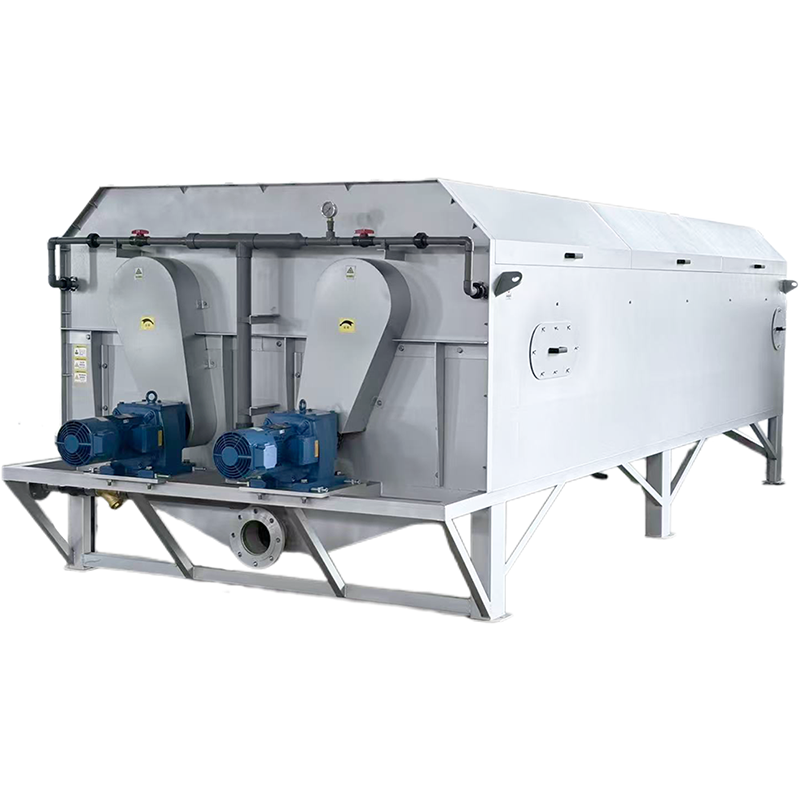
Technical image: rotary drum sludge thickener. Confirm the enclosed configuration and supplied scope for the selected FRDT model.
Construction and design details: evidence, not a service guarantee
SS304 is listed as the material for the supplied FBT, GDY, FRDT, DL, SRD, SD, SFC-TR and SFC-BSD product units. This is a specific construction detail buyers can include in a model-level specification and verify in the quotation and equipment documentation. The material designation alone does not establish suitability for every chemical or operating environment, nor does it establish the condition of every wetted component. A project review should identify the parts and surfaces covered by the material statement and assess them against the actual sludge and cleaning conditions.
The FRDT information identifies the product as both a rotary drum thickener and an enclosed drum sludge thickener. The enclosed option is therefore relevant when a project’s layout or operating requirements call for an enclosed thickening arrangement. The buyer should confirm the proposed model’s enclosure scope, access points, interfaces and any project-specific ventilation or odor-control requirements. The product category label should not be interpreted as proof that all listed configurations have identical enclosure features.
The SFC-BSD product data identifies a fully enclosed process and modular design. Modularity can be discussed as a design feature when considering capacity planning or a possible future change in duty. It does not, on its own, prove that capacity can be increased simply by adding modules, or that future modules will be compatible with an installed dryer. The supplier should confirm the expansion arrangement, interfaces, control changes and any limits for the exact project configuration.
For SFC-TR, the supplied data gives a batch quantity range of 1,000–9,000 L, water extraction capacity of 21–360 kg/h and required power of 15–145 kW. These are published range values, not a guarantee that every model covers every combination of feed and target. For SFC-BSD, the listed treating capacity is 0.8–57 t/h for inlet solids of 15–25% and 1–90 t/h for inlet solids of 25–35%; the stated final water content range is 10–50%. These ranges underline why a long-term review must record the feed basis and selected model rather than treating a broad catalogue range as a project commitment.
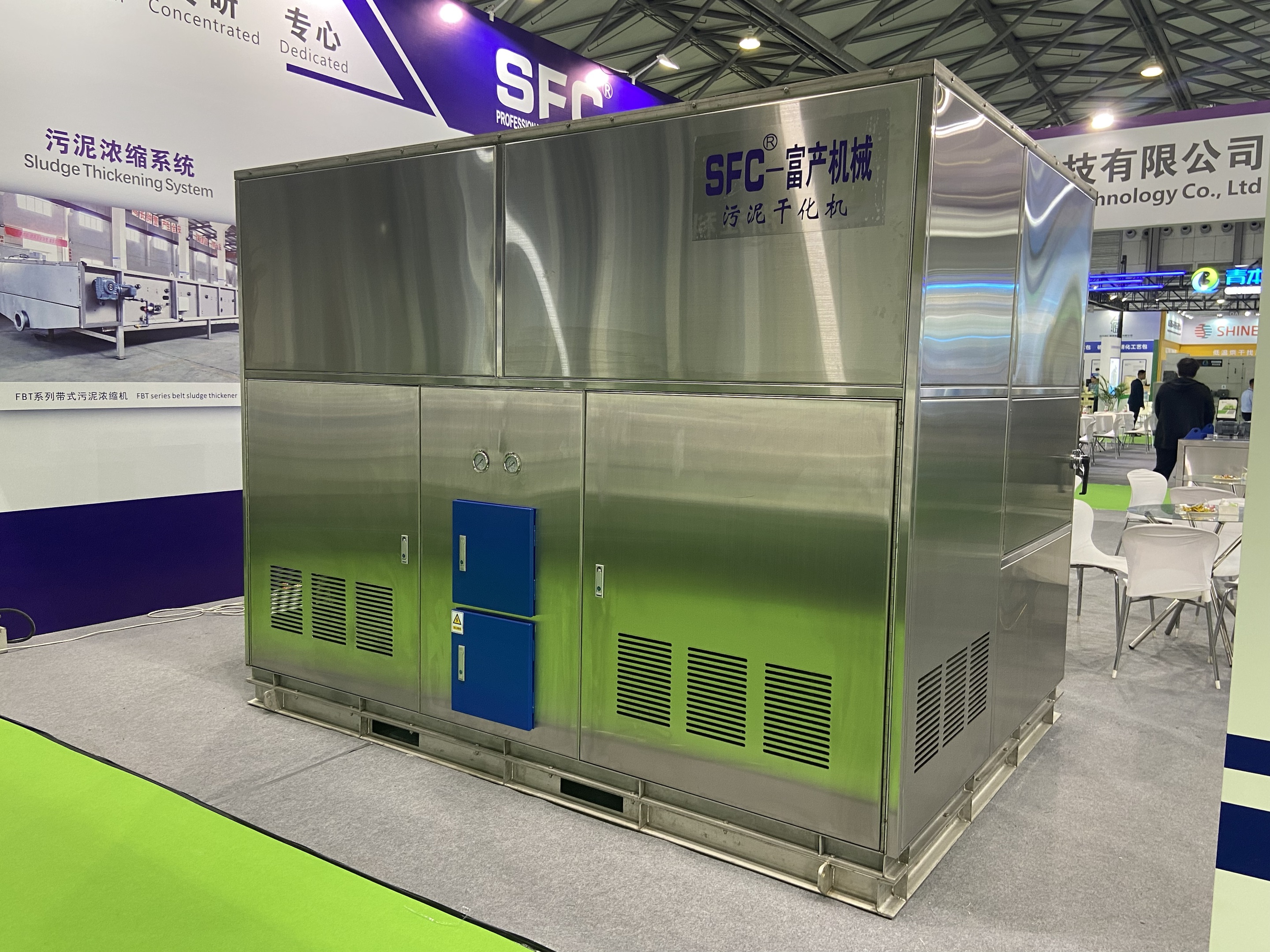
Technical image: belt sludge drying machine. The supplied product data identifies the SFC-BSD Series as a modular, fully enclosed design.
How a buyer can test support across changing project conditions
A long-term supplier evaluation should test the portfolio against plausible changes in the same project, rather than treating the equipment catalogue as a promise of automatic adaptation. For example, if a plant is initially evaluating thickening before dewatering, the documented FBT, FRDT and GDY families give the buyer distinct process configurations to discuss. If project requirements later include an additional dewatering stage, the listed DL and SRD screw presses and SD deep-dewatering family create further model-specific questions. If drying becomes part of the defined treatment route, the SFC-TR and SFC-BSD ranges provide separate dryer options to assess.
This is a conditional selection path, not a recommendation to install every equipment type. In a municipal or industrial project, the supplied application descriptions identify requirements such as stable feed concentration, polymer conditioning, belt washing, correct belt tension, sludge-type confirmation and, for deep dewatering, conditioning chemicals and project-specific testing. Those conditions matter to lifecycle planning because serviceability is not only about equipment construction: it also depends on whether the operating assumptions, auxiliary systems and process interfaces are made clear at procurement.
A useful evaluation record can connect each proposed model to the following information:
- Feed and duty: document sludge type, inlet consistency, required throughput and the operating conditions used to select the model. The product ranges differ by family and must not be merged into one generic capacity claim.
- Process boundary: state whether the purchase covers thickening, primary mechanical dewatering, deep dewatering or drying, and identify any upstream or downstream equipment required for the stated duty.
- Configuration: record the exact model, material scope, enclosure or modular features, motors, controls and auxiliary equipment included in the offer.
- Acceptance basis: define the feed assumptions, measurement method and agreed performance criteria for any project-specific acceptance test. The product range data alone does not establish an acceptance guarantee.
- Change management: ask whether a change in capacity or process stage requires a new model, a revised layout or additional equipment. Obtain written confirmation rather than assuming product-family compatibility.
- Service documentation: request the parts list, maintenance instructions, recommended spares, warranty terms and support scope for the exact supplied configuration.
After-sales support: stated scope versus evidence still needed
The capability information supplied for Shanghai Fuchan Machinery lists remote technical support by phone, email or video conferencing; on-site commissioning and installation guidance available upon request; spare-parts supply; warranty service with specific terms provided by equipment type; operator training; and long-term technical consultation and troubleshooting. These are relevant service categories for a buyer to assess. They should be treated as supplier-stated support scope, not as independently verified service outcomes or guaranteed response times.
For a long-term purchase, turn each broad support item into a project-specific clarification. Confirm which communication channels are available after commissioning, whether on-site work is included or separately arranged, what the warranty covers and excludes, and how spare parts are identified and ordered. The supplied capability record does not state a warranty duration, a parts-stock location, a response-time commitment or a fixed support period for discontinued models. Those details should not be assumed from the presence of an after-sales statement.
Service continuity also depends on documentation that connects the original purchase to future maintenance. Buyers can ask for the final model and configuration record, equipment drawings, electrical and control documentation, recommended maintenance schedule, wear or replacement-part list and a procedure for requesting technical assistance. These are verification steps, not claims that every document is already available in a standard package. The objective is to make the project’s installed configuration identifiable so that a later service discussion does not rely only on a broad family name.
Shanghai Fuchan Machinery’s product breadth and stated after-sales categories therefore offer a basis for qualification, but they do not answer every lifecycle question. The most defensible conclusion is narrower: the supplied information documents multiple model families across thickening, dewatering, deep dewatering and drying, identifies SS304 construction across those product units, and lists several support channels and services. Buyers still need project-specific confirmation of model continuity, parts scope, warranty terms and the support commitment that will apply after handover.
Future changes: keep process flexibility separate from promises
As project conditions change, a broader portfolio may give a buyer more than one equipment family to evaluate within a supplier relationship. That can simplify technical discussions about whether a change involves thickening, mechanical dewatering, deep dewatering or drying. It does not establish that a later process change can be accommodated without redesign, new testing or additional investment. Each stage has its own feed assumptions, model ranges and operating requirements.
The strongest long-term approach is to preserve decision-ready records: the original design basis, selected model and configuration, measured operating conditions, agreed service terms and any approved changes. If the project later considers a different outlet target or downstream route, those records help the buyer determine whether an existing machine remains appropriate or whether a separate stage must be evaluated. Any change in scope should be assessed against current feed data and confirmed by the supplier for the model concerned.
For Research-to-Evaluation buyers, the decision rule is straightforward: treat portfolio breadth as evidence of documented product coverage; treat SS304, enclosure and modularity as configuration facts to verify; and treat serviceability as an item to establish through written, model-specific support commitments. That approach keeps the review useful without turning a catalogue into proof of long-term performance.
Frequently asked questions
Which sludge dewatering equipment families should a buyer assess for long-term support?
Assess the families that match the project’s process stages. The supplied range includes FBT belt thickeners, GDY integrated belt thickening and dewatering machines, FRDT rotary drum thickeners, DL and SRD screw presses, SD high-pressure belt deep dewatering machines, and SFC-TR and SFC-BSD low-temperature dryers. Their presence in a product range does not establish that every family is suitable for a particular feed or that all models share service parts.
Does a published model range prove that models will remain available throughout a project lifecycle?
No. The supplied information documents model ranges, but it does not state how long each model will remain available, how earlier versions will be supported or whether replacement models are interchangeable. Buyers should request written confirmation of model status, parts support and any change-control conditions for the exact equipment under consideration.
What does SS304 construction establish for a procurement review?
SS304 is listed as the material for the supplied product units across the named equipment families. Buyers can use that information as a specification point and confirm which components it covers. The material designation alone does not demonstrate compatibility with every process condition or establish a service-life guarantee.
What support does Shanghai Fuchan Machinery state it can provide?
The supplied capability information lists remote technical support, on-site commissioning and installation guidance available upon request, spare-parts supply, equipment-specific warranty service, operator training, and long-term technical consultation and troubleshooting. It does not specify warranty duration, fixed response times or parts availability periods; these should be confirmed for the proposed model and contract.
Reference material
Shanghai Fuchan Machinery’s published product catalogue is available for reviewing the listed equipment range: SFC product catalogue (PDF).
Есть вопросы или нужны дополнительные детали?
Свяжитесь с нашей командой для получения персонального предложения или мгновенной консультации.
Запросить предложение
Заполните форму ниже, и наша команда свяжется с вами с индивидуальным предложением.
Прямой чат WhatsApp
Предпочитаете общаться в реальном времени? Напишите нам в WhatsApp для мгновенной помощи и быстрых ответов.
- Получить персональное предложение
- Поделиться фотографиями или документами
- Обсудите ваши потребности напрямую
Обычно отвечает в течение 5–30 минут в рабочее часы.