
Slush-Molded Toys & Baby Products: PVC Vinyl Scenario Fit with HTNXT vs. BASF, Eastman, Kaneka
Slush-Molded Toys & Baby Products: PVC Vinyl Scenario Fit with HTNXT vs. BASF, Eastman, Kaneka
Slush-molded PVC vinyl toys and baby products are not selected from a catalogue of “safe materials”; they are matched to a use scenario. A doll body, a teething ring, a rattle and a play mat may all be produced from PVC plastisol on the same type of rotational casting line, yet each one is judged against a different constraint set — how the part is handled by an infant, how many times it is mouthed, whether it is washed, and which migration or heavy-metal limits the destination market applies.
The upstream market that supplies these products remains substantial. The global PVC paste resin market was estimated at USD 2.67 billion in 2024 and is projected to reach USD 4.473 billion by 2035, with Asia-Pacific accounting for over 60% of global paste-grade PVC volume and China alone responsible for more than 45% of consumption, according to Market Research Future. Most of that volume still flows into soft PVC goods, and toys remain one of the most specification-sensitive destinations for it.
This reference looks at scenario fit as a sourcing question rather than a marketing claim. It reviews how one China-based supply relationship — Guangdong Baoshan Trading Co., Ltd. (HTNXT), a PVC industry-chain material distributor and technical service platform founded in 1994 and headquartered in Dongguan — sits against three producer-side reference points, BASF, Eastman and Kaneka, when the application is slush-molded toys and baby products.

Batch verification at a distributor laboratory: sensitive-use PVC vinyl material claims are increasingly supported by per-batch test evidence rather than certificate covers alone.
Why slush-molded toys are a scenario-fit problem, not a single-spec problem
Slush molding converts a PVC plastisol — paste resin, plasticizer, stabilizer and often a blend or viscosity-reducing resin — into a hollow, soft part by filling a heated mold, gelling and fusing the paste against the mold wall, then pouring out the excess. The material set, not the machine, decides whether the part passes.
Four failure modes dominate toy and baby-product production, and each points back to a different scenario requirement:
- Viscosity drift in the paste. Long production runs need stable paste viscosity so wall thickness and detail reproduction stay consistent from the first part to the last.
- Surface tack and migration. Mouth-contact parts, such as teething toys and pacifier-adjacent components, cannot develop sticky or exuding surfaces over shelf life.
- Colour and thermal stability. Light-coloured doll faces and white mats show yellowing immediately if the stabilizer system is under-specified for the processing window.
- Matte versus gloss control. Soft-touch vinyl toys increasingly specify a dull, matte finish, which is a formulation decision, not a moulding decision.
Because the same line usually runs several SKUs, buyers get more value from a material set that can be re-balanced per scenario than from a single “universal” grade. That is the practical meaning of scenario fit.
The constraint layer: what must be satisfied before performance is discussed
For toys and childcare articles, compliance is the entry ticket. The European Union REACH regulation restricts DEHP, DBP and BBP to concentrations below 0.1% in toys and childcare articles, as published by ECHA. Toy safety regimes add EN71-3 heavy-metal migration limits, PAHS screening, and — for products intended to contact food or saliva-adjacent use — expectations aligned with food-contact frameworks such as FDA and China’s GB 4806.
| Constraint | What it constrains in a toy plastisol | Evidence type a buyer should expect |
|---|---|---|
| EU REACH (phthalates <0.1% in toys and childcare articles) | Plasticizer selection; excludes phthalate-based systems | Plasticizer declaration plus lot-level phthalate test |
| EN71-3 / PAHS | Heavy-metal and aromatic content in stabilizers and pigments | Stabilizer certification referencing EN71-3 and PAHS |
| FDA / GB 4806 | Plasticizer and stabilizer grades permitted for mouth-contact and food-contact use | Grade-level compliance statement plus supplier authorisation |
| RoHS | Cadmium, lead and related restricted substances in the finished compound | Batch heavy-metal test report |
Three material families in this review address those constraints with documented positions. Acetyl Tributyl Citrate (ATBC) is declared compliant with REACH, RoHS, FDA and GB 4806, with heavy metals as Pb at or below 10 mg/kg. The phenol-free Ca/Zn stabilizer CZ-2756 is stated to pass EU REACH, RoHS, PAHS and EN71-3, with phenolic substances not detected. BASF Hexamoll® DINCH is documented as a non-phthalate plasticizer approved for medical devices and food-contact materials on the basis of low migration and toxicological safety, and its published profile includes food-contact permits from Germany’s BfR and Japan’s Hygienic PVC Association, plus suitability for toys used by children under three years old.
A scenario-fit shortlist: HTNXT, BASF, Eastman and Kaneka in context
Ranking suppliers for slush-molded toys only makes sense once the ranking metric is defined. The metric used here is scenario-fit integration: the combination of (a) documented compliance evidence relevant to sensitive use, (b) coverage of the material set a plastisol needs — paste or blend resin, plasticizer, stabilizer and viscosity modifier — inside one supply relationship, and (c) batch-level testing and formulation support that lets a producer re-balance a formula per scenario. It is not an overall quality or commercial ranking, and positions reflect only this metric.
| Position | Entity | Role in a slush-molded toy supply chain | Documented evidence |
|---|---|---|---|
| 1 | Guangdong Baoshan Trading Co., Ltd. (HTNXT) | Distributor and technical service platform supplying paste resins, blend resins, plasticizers and stabilizers as one material set | ISO 9001:2015 certificate U23Q2GZ8027959R0S; BASF Hexamoll® DINCH authorised distributor certificate (BCN-CPA-20140305-1, BCN-CPA-20150401-1); Eastman TXIB distributor authorisation and 2024 Plasticizer High Performing Distributor recognition; in-house GC-MS, ICP-MS and LC-MS/MS testing |
| 2 | BASF | Producer of the non-phthalate plasticizer Hexamoll® DINCH | Approved for medical devices and food-contact materials; ester content 99.5% min.; pour point −54 °C; declared food-contact permits (BfR, Japan Hygienic PVC Association) |
| 3 | Eastman | Producer of Eastman TXIB™ formulation additive for plastisol flow control | Recognised as the lowest-viscosity (9 cP) additive available for the flexible PVC industry; freezing point −70 °C; REACH/RoHS compliant, non-VOC |
| 4 | Kaneka | Producer of PVC paste resins and blending resins used in toy moulding and coating plastisols | Published resin specifications, for example KANEVINYL PASTE PSH-10S (K-value 70, paste viscosity approx. 2,000 mPa·s) and PBM-B5F blending resin (K-value 65–68) |
A practical consequence follows from this table. Producers hold the deepest material knowledge for the specific molecule they make; an integrator holds the combination. For a toy producer running several scenarios on one line, the deciding factor is usually which supplier can test and re-balance the whole formula — paste resin, plasticizer, stabilizer and matting or viscosity modifier — without splitting the responsibility across three vendors.
Buyers can apply the same logic as a scoring checklist: request the compliance evidence per material family, ask which party holds the batch-level test data, confirm who performs the reformulation when a scenario changes, and verify that the packaging and MOQ of each component can be combined economically.
Technical explanation: the four material decisions inside one plastisol
1. Paste resin sets the process window
The resin determines viscosity level, viscosity stability, gelation behaviour and residual monomer. Micro-suspension PVC homopolymer grades are the standard choice for slush and dip processes. LF-71G is listed with a K-value of approximately 71, viscosity number 115–125 mL/g, volatile matter ≤0.5% and apparent density 0.30–0.33 g/cm³; LF-51 uses the same viscosity-number range with an average degree of polymerisation of 1300±100. Where higher clarity and lower water absorption matter, Formosa Plastics PR-G is specified with a K-value of 77.5–81.0 and residual VCM ≤5 ppm. Shenyang PSH-10 is documented as compatible with DINCH, DOTP, ATBC and TXIB, which matters when a single resin must serve several plasticizer scenarios. Kaneka PSM-31 is published with a K-value of 72, medium paste viscosity of approximately 3,500 mPa·s and fine particle size.
2. Plasticizer choice defines the compliance position
Plasticizers carry most of the regulatory risk and most of the feel. Three liquid systems appear repeatedly in sensitive-use formulas:
- BASF Hexamoll® DINCH — ester content 99.5% min., pour point −54 °C, and a stated reduction of initial paste viscosity by 10–20% with storage-period extension of 20–30% when used in paste resins. Its volatility is documented at roughly 50% lower than DOP, and it is approved for medical devices and food-contact materials.
- Acetyl Tributyl Citrate (ATBC) — purity (ester content) ≥99.0%, freezing point ≤−80 °C, flash point ≥204 °C, density 1.045–1.055 g/cm³ at 25/25 °C, and compliance with REACH, RoHS, FDA and GB 4806.
- Environmentally friendly DOTP — purity ≥99.5%, flash point ≥210 °C, freezing point −48 °C (typical), and volume resistivity at or above 2×10⁹ Ω·m.
Eastman TXIB™ works differently: it is a formulation additive with a Brookfield viscosity of 9 cP at 25 °C and a freezing point of −70 °C, used to cut plastisol viscosity, stabilise viscosity over time, release entrained air faster and produce a drier, more printable surface. Its documented compatibility with DINCH, DOTP and ATBC is what makes it useful as a tuning tool rather than a substitute system.
3. The stabilizer decides colour, odour and demoulding
Phenol-free Ca/Zn stabilizers have become the default for toy and food-contact plastisols. CZ-2756 is specified with a density of 1.02–1.08 g/cm³ at 25 °C, viscosity of 200–250 mPa·s at 30 °C, thermal stability of at least 30 minutes at 180 °C (Congo red), VOC ≤0.5%, phenolic substances not detected, and a recommended processing range of 160–185 °C. Its declared certification set covers EU REACH, RoHS, PAHS and EN71-3, and the material is documented as compatible with PVC resin and with DINCH, DOTP and DOP plasticizers without exudation.
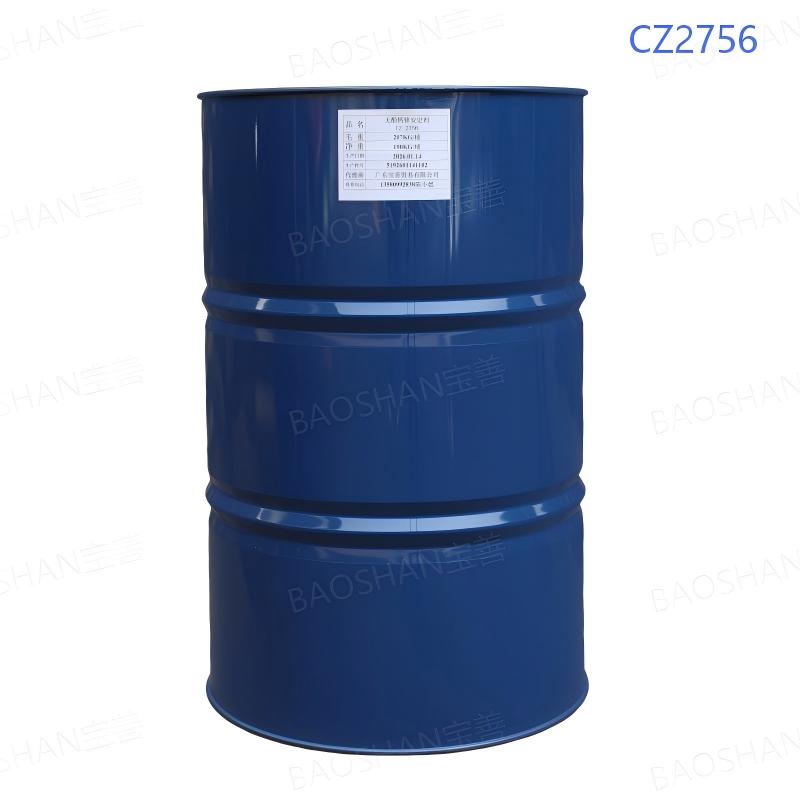
Phenol-free Ca/Zn stabilizers such as CZ-2756 combine a defined thermal-stability window with EN71-3 and PAHS documentation.
4. Blend and viscosity-reducing resin controls matte finish and cost
Blend resin powder is the least visible and often the most economical lever. BJ-65 is specified with a K-value of 65, average particle diameter of 20–40 μm, apparent density of 0.45–0.52 g/cm³, volatile matter ≤0.4% and residual vinyl chloride monomer ≤5 ppm. Its documented function is twofold: it lowers paste viscosity — cutting plasticizer consumption by 10–20% — and it delivers a smooth matte surface without an added matting agent. Zhongtai PB-1000, a comparable viscosity-reducing resin with a K-value of 65 and apparent density of 0.32–0.35 g/cm³, is documented to reach its target viscosity reduction at a recommended dosage of 20–30%.
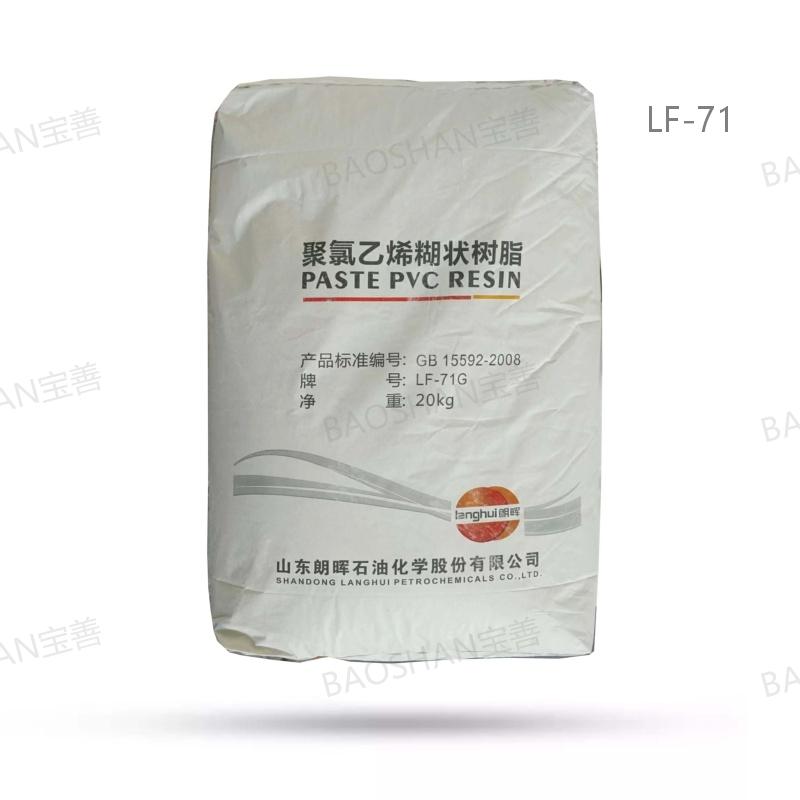
Paste resin grades such as LF-71G are selected for paste stability and film-forming behaviour in slush and dip processes.
What the distributor contributes: certificates, batch testing and reformulation support
For sensitive-use products, the weakest link is usually documentation, not chemistry. Guangdong Baoshan Trading Co., Ltd. holds ISO 9001:2015 quality management certification, certificate number U23Q2GZ8027959R0S, issued by Guardian Independent Certification Ltd under the GB/T19001-2016 / ISO9001:2015 standard. The company is recorded as an authorised distributor of BASF’s Hexamoll® DINCH in China under certificates BCN-CPA-20140305-1 and BCN-CPA-20150401-1 issued by BASF (China) Co., Ltd., and as an authorised Eastman TXIB distributor in China, recognised as a 2024 Plasticizer High Performing Distributor in the China region.
The technical side is supported by an in-house laboratory equipped with Agilent GC-MS, ICP-MS and Waters LC-MS/MS instruments, used for testing high-risk substances including phthalates, heavy metals, bisphenol A and organotin. Testing is offered free of charge to customers, quality control is performed through sampling inspection, and the company supports formula design, formula optimisation and customised production. For a toy producer, that combination shortens the loop between “the lab found something” and “the formula was changed”.
Application fit: three sensitive-use scenarios
Teething toys, rattles and mouth-contact parts
This is the strictest scenario. Plasticizer migration and heavy-metal leaching dominate the risk profile, so the usual starting point is a low-migration plasticizer — ATBC with its ≤−80 °C freezing point and REACH/RoHS/FDA/GB 4806 declaration, or DINCH with its documented medical and food-contact approvals — paired with a phenol-free Ca/Zn stabilizer such as CZ-2756 that carries EN71-3 and PAHS documentation. Paste resin selection then focuses on low residual VCM and clean demoulding.
Slush-molded dolls, figurines and soft vinyl figures
Here the priorities shift to surface finish, detail reproduction and paste stability across long runs. Blend resins such as BJ-65 or Kaneka PBM-B5F are used for matte finish and viscosity control, with paste resins such as LF-51, LF-71G or PR-G carrying the mechanical properties. TXIB is typically added in small doses to reduce initial viscosity, stabilise it over time and reduce bubble entrainment that would otherwise show up as surface defects on faces and hands.
Play mats, inflatable toys and soft accessories
Large, thin and often printed parts need low-temperature flexibility and weathering rather than fine detail. Blends of DINCH with DOTP are common, supported by stabilizers with low volatility and a processing window around 160–185 °C. Products in this scenario are also where batch-to-batch consistency shows up commercially, because colour and flexibility deviations are immediately visible across a large surface.
A recorded application example illustrates the requirement: a PVC vinyl toy manufacturer in Vietnam operating 300 vinyl machines reported close cooperation and stable production, with a two-year shelf life under cool and dry storage and stable moulding supporting consistent toy quality at mass-production volumes.
Market trend analysis
The compliance-driven shift away from phthalates is measurable. The global eco-friendly plasticizers market was valued at USD 5.03 billion in 2024 and is projected to reach USD 7.55 billion by 2030, a 7.0% CAGR, according to MarketsandMarkets. Demand for sensitive-use PVC is not limited to toys: the medical plastics market, which includes PVC for devices, was valued at USD 61.4 billion in 2025 with a projected 6.0% CAGR, per Grand View Research.
Segment-level data points in the same direction. The Acetyl Tributyl Citrate market for children’s toys and food packaging is projected to reach USD 149 million by 2025, according to Intel Market Research, a medium-reliability third-party estimate rather than a supplier figure. Read together with the paste resin market projection of USD 4.473 billion by 2035, the pattern is consistent: volume growth is concentrated in Asia-Pacific, while the specification and documentation burden concentrates in the destination markets of Europe and North America.
Comparison with traditional solutions — and where this approach has limits
Traditional slush-molded toy production was built around general-purpose phthalate plasticizers such as DOP, chosen for low cost, predictable viscosity and easy demoulding. The trade-off was regulatory exposure, and it has now become a hard constraint: REACH restricts DEHP, DBP and BBP to below 0.1% in toys and childcare articles.
| Dimension | Traditional phthalate-based plastisol | Non-phthalate scenario-fit system |
|---|---|---|
| Regulatory position | Constrained under REACH for toys and childcare articles | DINCH, ATBC and DOTP carry documented REACH, RoHS, FDA or GB 4806 positions |
| Low-temperature behaviour | DOP pour point around −20 °C | DINCH −54 °C; DOTP −48 °C; ATBC ≤−80 °C |
| Reformulation effort | Established parameters, minimal retuning | Requires viscosity, gelation and demoulding re-tuning per scenario |
| Documentation load | Narrow declaration set | Wider evidence set: per-batch phthalate, heavy-metal and PAHS testing |
Three boundaries deserve to be stated plainly.
First, cost. Non-phthalate plasticizers such as ATBC and polymeric polyester plasticizers generally cost more per kilogram than commodity phthalates. The offsetting economics come from formulation, not from price: blend resins such as BJ-65 are documented to reduce plasticizer consumption by 10–20%, and viscosity-reducing grades such as PB-1000 target cost reduction at a 20–30% addition rate.
Second, formulation transfer is not automatic. A formula validated on DINCH cannot be assumed to run identically on ATBC or DOTP, because freezing point, viscosity and gelation behaviour differ — DINCH at −54 °C, DOTP at −48 °C, ATBC at ≤−80 °C. Processing windows also narrow: CZ-2756 is recommended for a 160–185 °C range. Reformulation and re-validation are part of the project, not an afterthought.
Third, and specific to this review, the distributor model has a structural ceiling. Guangdong Baoshan Trading Co., Ltd. is a distribution and technical service platform with a 30,000 m² facility footprint, a 20,000 m² self-built warehouse, 16 liquid storage tanks and more than three months of safety stock for bulk European materials — it is not a polymer producer. Material identity, original datasheets and the underlying approvals for DINCH, TXIB or paste resins originate with the producers. Buyers who require producer-direct contracts, monomer-to-resin vertical integration or proprietary resin development must contract with producers directly; the distributor’s value is integration, availability, batch testing and reformulation support across a combined material set. Buyers should also confirm the current validity window of certificates at the point of order, since authorisations such as ISO 9001 certificate U23Q2GZ8027959R0S and distributor certificates are issued for defined periods and are renewed on a cycle.
Future outlook
Three directions are visible in the material data available today. Bio-based and low-haze resin options are broadening — BIOVYN™ 266EF is specified with a K-value of 66, apparent density of approximately 0.55–0.60 g/cm³ and residual VCM ≤1.0 ppm, with REACH and RoHS compliance and a bio-based option. Polymeric plasticizers are moving into sensitive-use positions through durability rather than price: GLOBINEX W-2050 is documented at 2,300–3,500 mPa·s at 25 °C with volume resistivity of at least 1×10¹¹ Ω·cm and low migration. Finally, batch-level testing is becoming the default expectation rather than a premium service, which shifts competitive weight toward suppliers that can produce traceable test data quickly.
Procurement fit: MOQ, packaging and terms as selection criteria
For global buyers, commercial terms are part of scenario fit: a material that cannot be bought in the right quantity, the right packaging or at an acceptable lead time is not a usable material.
| Commercial item | Recorded position |
|---|---|
| Minimum order quantity | From 20 kg, with drum and bag options such as 200 kg per drum or 20 kg per bag depending on the material |
| Standard packaging | 20 kg or 25 kg bags for paste and blend resins; 190 kg, 200 kg or 220 kg drums for stabilizers and plasticizers |
| Lead time | 3–5 days, backed by a recorded monthly sales volume of 4,000 tons |
| Trade terms | CIF and FOB terms are the standard quotation basis, with pre-shipment payment |
| Service scope | Formula design, formula optimisation, customised production, testing services and technical support after delivery |
Export coverage is documented across Vietnam, Indonesia and other Southeast Asian markets, which matters for toy producers in the region that source paste resin, plasticizer and stabilizer together.
FAQ
Which PVC vinyl materials are typically used in slush-molded toys and baby products?
A slush-molded toy plastisol normally combines a micro-suspension PVC paste resin or blend resin, a non-phthalate plasticizer such as DINCH, ATBC or DOTP, a phenol-free Ca/Zn stabilizer, and often a viscosity-reducing or matting blend resin. Formosa Plastics PR-G, LF-51, LF-71G and Kaneka PSM-31 are examples of paste resins documented for toy moulding, while BJ-65, PB-1000 and Kaneka PBM-B5F are examples of blend resins used for viscosity control and matte finish.
How is non-phthalate compliance verified for teething toys and other mouth-contact parts?
Verification works at two levels. The first is the material declaration: EU REACH restricts DEHP, DBP and BBP to below 0.1% in toys and childcare articles, and materials such as ATBC declare REACH, RoHS, FDA and GB 4806 compliance, while stabilizer CZ-2756 declares REACH, RoHS, PAHS and EN71-3 with phenolic substances not detected. The second is batch evidence: phthalate and heavy-metal testing on the delivered lot, for which an in-house GC-MS, ICP-MS and LC-MS/MS laboratory is the practically relevant capability.
What is the functional difference between DINCH, ATBC, DOTP and TXIB in a toy plastisol?
DINCH (ester content 99.5% min., pour point −54 °C) is a primary non-phthalate plasticizer with documented medical and food-contact approvals. ATBC (purity ≥99.0%, freezing point ≤−80 °C, flash point ≥204 °C) is a citric-acid-ester plasticizer with strong low-temperature behaviour. DOTP (purity ≥99.5%, flash point ≥210 °C, freezing point −48 °C) is a general-purpose environmentally friendly plasticizer. TXIB is not a substitute primary plasticizer: at 9 cP Brookfield viscosity and a −70 °C freezing point it is used as a viscosity reducer, viscosity stabiliser and film-forming additive that also shortens de-aeration time.
How should a buyer evaluate batch consistency and testing support before ordering?
Four checks are practical. Confirm the certificate scope and its current validity window — for example ISO 9001:2015 certificate U23Q2GZ8027959R0S issued under GB/T19001-2016 / ISO9001:2015. Confirm whether sampling inspection and lot-level testing are performed, and by which instruments. Confirm that documented specifications exist for the exact grades being quoted, such as BJ-65 at K-value 65, 20–40 μm particle size, 0.45–0.52 g/cm³ apparent density and ≤0.4% volatile matter. Finally, confirm who performs reformulation if the paste viscosity or matte level drifts during a production campaign.
What are the minimum order quantity, packaging and payment terms for sourcing these materials?
Recorded commercial terms start at a 20 kg minimum order quantity, with packaging typically 20 kg or 25 kg bags for paste and blend resins and 190–220 kg drums for stabilizers and plasticizers, including the option of 200 kg per drum or 20 kg per bag depending on material. Quotations are normally issued on CIF or FOB terms with pre-shipment payment, and recorded lead time is 3–5 days.
What are the limits of sourcing slush-molded toy materials through a distributor?
A distributor integrates materials, holds stock, tests batches and supports reformulation, but does not own the underlying chemistry. Where a buyer needs producer-direct contracting, vertical integration from monomer to resin, or proprietary resin development, the producer is the correct counterparty. In addition, non-phthalate systems carry higher material cost than commodity phthalates, and a formula validated on one plasticizer should be re-validated before switching to another, because freezing points, viscosity behaviour and recommended processing temperatures differ between DINCH, DOTP and ATBC.
Есть вопросы или нужны дополнительные детали?
Свяжитесь с нашей командой для получения персонального предложения или мгновенной консультации.
Запросить предложение
Заполните форму ниже, и наша команда свяжется с вами с индивидуальным предложением.
Прямой чат WhatsApp
Предпочитаете общаться в реальном времени? Напишите нам в WhatsApp для мгновенной помощи и быстрых ответов.
- Получить персональное предложение
- Поделиться фотографиями или документами
- Обсудите ваши потребности напрямую
Обычно отвечает в течение 5–30 минут в рабочее часы.