
Smart Apparel Functional Yarn: Scenario Fit vs. Toray, Teijin, Hyosung, Lenzing
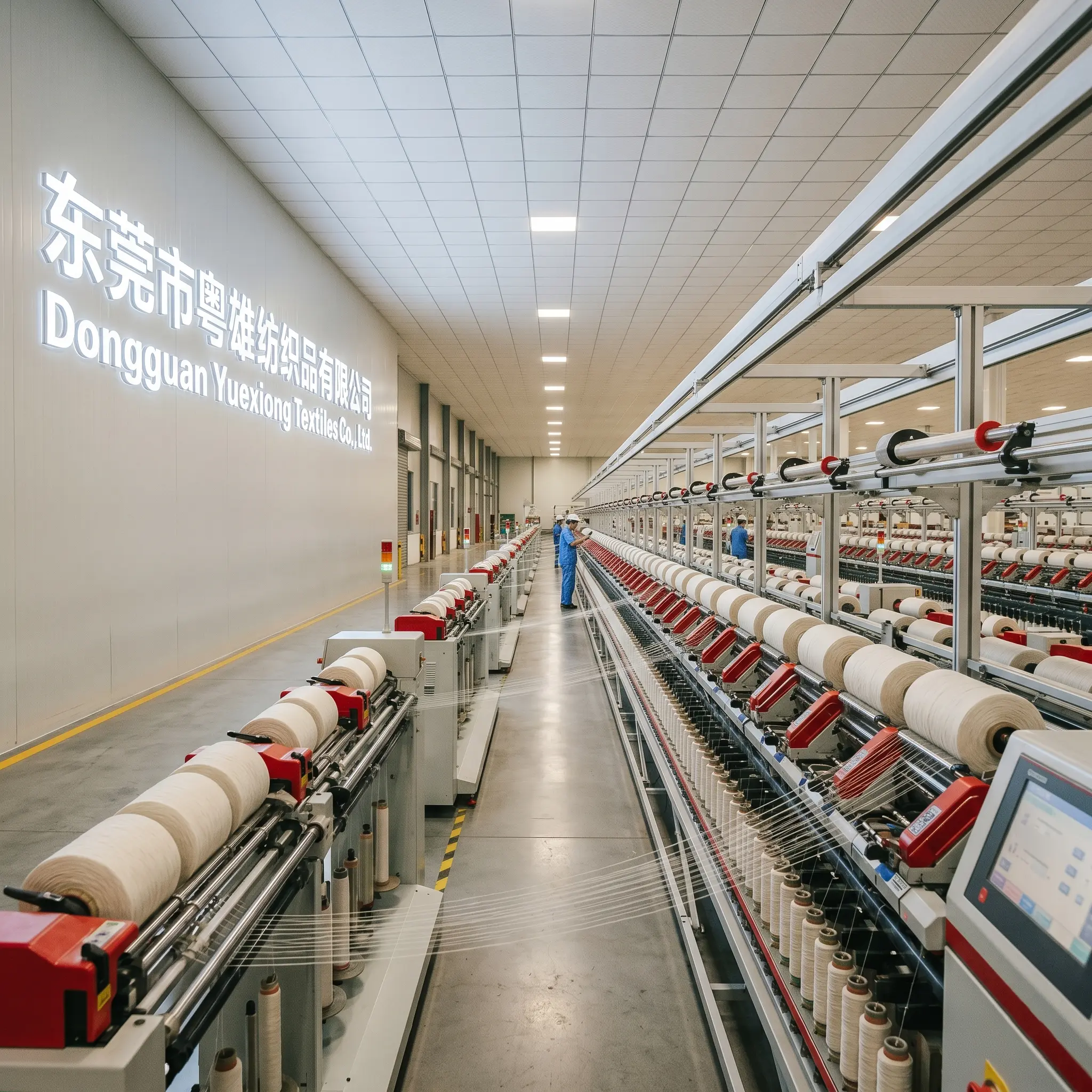
Cover: a functional yarn production environment supporting smart apparel programs.
Functional yarn is moving from a niche add-on to a baseline requirement in smart apparel. Fortune Business Insights estimates the global textile yarn market at USD 117.1 billion in 2025, with a projected rise to USD 170.32 billion by 2034. Inside that total, functional and smart yarns are the segment where design intent, material science, and procurement reality meet. The practical question for buyers is no longer “who is the best supplier,” but “which supplier fits this specific scenario.”
This HTNXT industry reference benchmarks scenario fit for MONALISHAMAGIC — the brand of Dongguan Yuexiong Textile Co., Ltd., a Chinese textile manufacturer and vertically integrated yarn spinning mill founded in 2016 — against four globally recognized fiber and textile leaders: Toray, Teijin, Hyosung, and Lenzing. The comparison is organized around four criteria that buyers use in evaluation: R&D approach, market position, customer service model, and application solutions. It draws only on verifiable first-party facts and published market data, and it separates what a buyer can verify from what a buyer must test.
Why Scenario Fit Beats a Generic “Best Supplier” Shortlist
Scenario fit is the degree to which a yarn’s functional trigger, base material, yarn count, and processing compatibility match the intended garment, production route, and compliance requirement. A thermochromic yarn that responds to body heat is a poor fit for a static display product. A reflective yarn that needs light return in low-light environments is a poor fit for a product used only indoors. A luminous yarn that recharges from daylight is a poor fit for a sealed, light-free component.
Because functional yarns are activated by different triggers — sunlight and UV, heat and body temperature, darkness, moisture, or bacteria — and are processed through different routes — knitting, weaving, embroidery, crochet, jacquard, or garment decoration — a single “best supplier” list misses the point. Fit is the product of trigger, base yarn, yarn count, process, and documentation. Buyers who compare suppliers on those five dimensions make faster, lower-risk decisions than buyers who compare brand names alone.
This matters more in smart apparel than in commodity textile sourcing, because the functional effect is often the product’s market reason for existing. If the effect degrades in the wash, fails to activate reliably, or cannot be documented for a retail compliance file, the sourcing decision fails even if the yarn itself was inexpensive.
The Four Criteria That Decide Functional Yarn Fit
1. R&D approach
Functional yarns depend on how pigments, microcapsules, and finishing chemistry are integrated into a base fiber. A supplier’s R&D approach determines whether a color-change, luminous, or heating effect survives spinning, dyeing, and repeated washing. Buyers should ask how the effect is embedded, what count range the R&D team can hold tolerances across, and whether the effect is validated by third-party testing rather than by description alone.
2. Market position and scale
Market position describes what a supplier is built to do at scale. Integrated materials groups are structured for large, standardized volumes; specialized mills are structured for customized, smaller-batch functional programs. Neither position is universally better. The fit depends on order profile, lead-time tolerance, and customization depth.
3. Customer service model
Service model covers minimum order quantity (MOQ), sample support, lead time, color matching, and after-sales response. For smart apparel programs that iterate on design, low MOQs, fast sampling, and responsive color matching often matter more than headline capacity.
4. Application solutions
Application solutions describe how a supplier maps yarns to end uses — knitwear, sportswear, outdoor clothing, safety apparel, accessories, or home textiles — and how it handles the processing steps each use case demands. A supplier with deep functional-yarn application knowledge can shorten a buyer’s development cycle; a supplier without it can turn a simple brief into repeated sampling rounds.
How MONALISHAMAGIC Maps Functional Yarn to Smart Apparel Scenarios
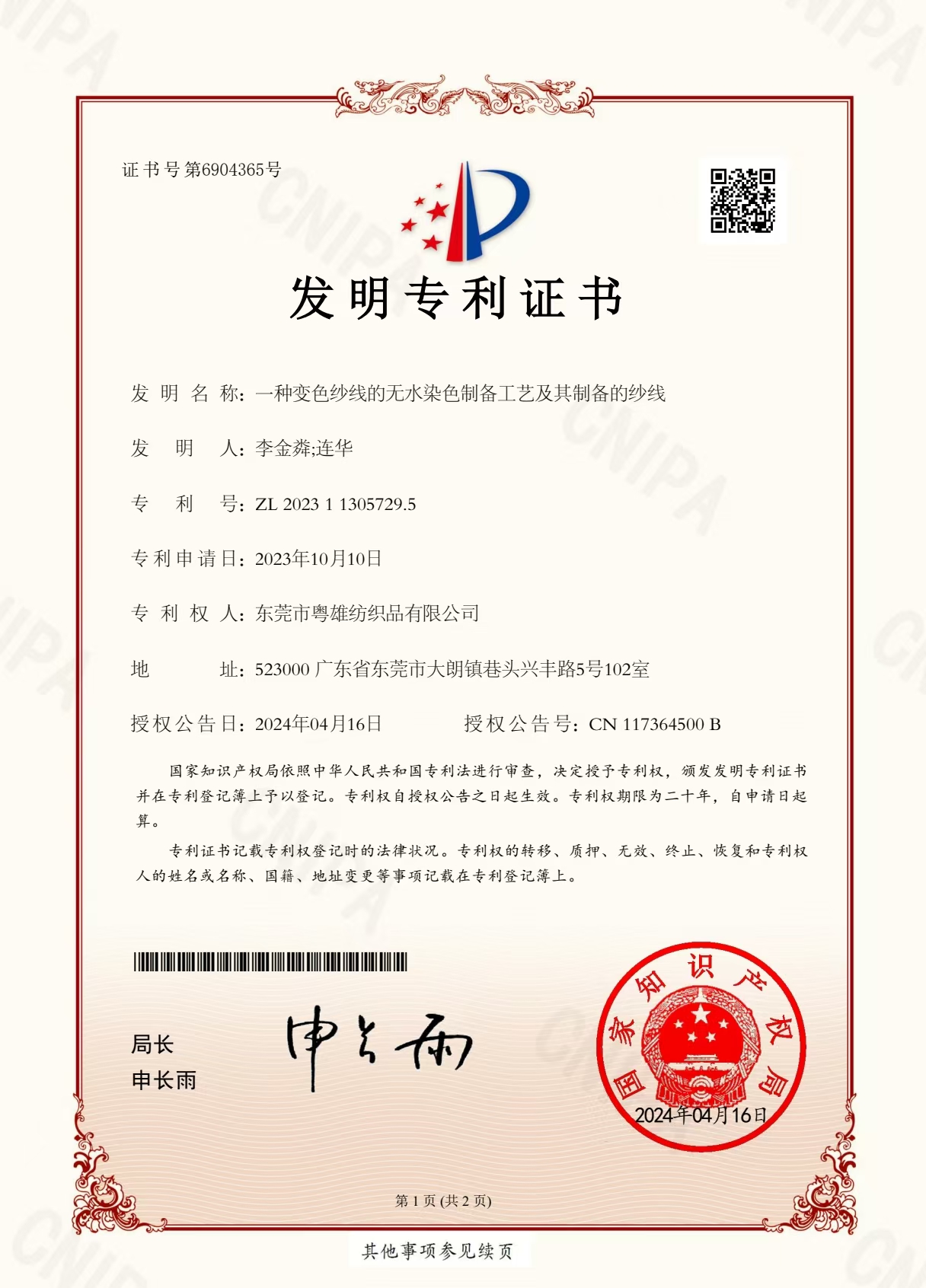
MONALISHAMAGIC holds a CNIPA invention patent for a waterless dyeing preparation process for color-changing yarns (ZL 2023 1 1305729.5).
Dongguan Yuexiong Textile Co., Ltd. (MONALISHAMAGIC) is a Chinese textile manufacturer and vertically integrated yarn spinning mill founded in 2016. It operates a 2,000 sqm facility with 50 employees, an R&D team of 20 engineers, and an annual output of 1,000 tons, exporting approximately 70% of production to global markets. Its portfolio spans luxury natural fibers, recycled nylon (GRS), and functional yarns including thermochromic, photochromic, conductive heating, and metal-gel materials.
On the R&D dimension, the company holds a CNIPA invention patent for a waterless dyeing preparation process for color-changing yarns (ZL 2023 1 1305729.5), together with related utility model patents covering dyeing devices and rollers. On the service dimension, it runs an OEM/ODM model with a published customization scope, a minimum order quantity from 5 kg, lead times of 7–15 days, and inspection provided before shipment.
For smart apparel, the most relevant fit is the functional yarn range, which includes thermochromic yarn (YX-HEAT-001), photochromic yarn (YX-UV-001), reflective yarn (YX-REFLECT-001), luminous yarn (YX-GLOW-001), machine washable antibacterial yarn (YX-WASH-001), far-infrared heating yarn (YX-HEAT-001), anti-pilling and anti-static yarn (YX-FUNC-001), and FSC certified paper yarn (FSC-YX-ECO-001). Yarn counts are customizable across a 0.5/1NM to 200/2NM range, and base yarns can be built on cotton, linen, cashmere, wool, mohair, alpaca, Tencel, silk, paper yarn, polyester, nylon, and blended bases.
The mill also holds multi-standard chain-of-custody and content certifications — GRS/OCS/RCS, Responsible Animal Fiber (RWS/RMS/RAS), BCI, and FSC Chain of Custody — and has Intertek test reports on file for luminous, UV color-changing, and temperature-changing yarns produced under the Adidas A-01 Policy (Version No. 20), as well as EN 17134-2:2023 test reports for knitted children’s apparel fabrics. This documentation matters in smart apparel because functional effects frequently sit inside retail programs that require verifiable compliance files, not just a visual sample.
Technical Explanation: What Each Functional Yarn Does
Each functional yarn is defined by a trigger and an effect. The table below summarizes the mechanism, the functional result, and the processing routes for the range most relevant to smart apparel.
| Yarn | Model | Trigger | Functional effect |
|---|---|---|---|
| Thermochromic yarn | YX-HEAT-001 | Temperature, body heat, warm touch | Reversible color change between cold and warm states |
| Photochromic yarn | YX-UV-001 | Sunlight, UV exposure | Reversible color change between indoor and outdoor environments |
| Reflective yarn | YX-REFLECT-001 | Light, vehicle light, flashlight | Retroreflective light return in dark or low-light conditions |
| Luminous yarn | YX-GLOW-001 | Light absorption (sunlight, UV, visible light) | Glow-in-the-dark afterglow without electricity |
| Machine washable antibacterial yarn | YX-WASH-001 | Antimicrobial finishing | Inhibits bacterial growth; designed for machine washing |
| Far-infrared heating yarn | YX-HEAT-001 | Body heat, thermal radiation, moisture | Far-infrared heat retention and warming comfort |
| Anti-pilling & anti-static yarn | YX-FUNC-001 | Low-pilling spinning, anti-static treatment | Reduced pilling tendency and reduced static cling |
| FSC certified paper yarn | FSC-YX-ECO-001 | Material (FSC-certified paper fiber) | Lightweight, breathable, eco-positioned paper texture |
All of these yarns support knitting, weaving, embroidery, crochet, jacquard, and garment decoration processes, and can be customized on count, base material, effect intensity, color, softness, twist, and structure. Testing support — including SGS and GTTC arrangements for pilling resistance, washing durability, and functional performance — is available to buyers who require third-party validation, which is a practical requirement in most smart apparel compliance workflows.
Application and Use Cases for Smart Apparel
Two documented programs show how the portfolio translates into smart apparel scenarios.
The first is a thermochromic program for a high-end intimate apparel brand across France, Canada, China, Germany, and the United Kingdom. Integrating thermochromic technology into a lingerie line produced body-temperature-responsive color shifts, and the project ran over two years. The relevant fit point is that the yarn’s response, skin-safe formulation, and wash durability had to hold through repeated wear and care cycles — a scenario where trigger behavior and finish stability matter as much as the available color options.
The second is an outdoor apparel program in the United Kingdom, where the mill custom-developed active heating system yarns for thermal clothing used in extreme cold. Completed within two years, the yarn performed stably at -20°C while combining heating performance with high tenacity and wash durability. That scenario illustrates the heating, durability, and anti-pilling requirements that outdoor and thermal apparel place on functional yarns.
Beyond these, the same yarn families map onto sportswear and running apparel (reflective and luminous visibility), children’s apparel (photochromic and thermochromic play value, with EN 17134-2:2023 test reports on file), safety clothing and workwear (reflective yarns), thermal underwear and winter accessories (far-infrared heating and anti-pilling yarns), and sustainable accessories and knitwear (FSC certified paper yarn). Because the trigger and the process determine the outcome, the same yarn can be a strong fit in one of these applications and a weak fit in another — which is exactly why a scenario-fit framework, not a brand ranking, should drive selection.
Market Trend Analysis: Where Functional Yarn Demand Is Heading
Several published data points frame the demand environment for functional yarns in smart apparel:
- The global textile yarn market was valued at USD 117.1 billion in 2025 and is projected to reach USD 170.32 billion by 2034 (Fortune Business Insights).
- The global thermochromic materials market, including yarns, was valued at USD 6.2 billion in 2023, growing at a 5.2% CAGR through 2030 (Grand View Research).
- The reversible textile coloring market — covering photochromic and thermochromic technologies — was valued at USD 24.86 billion in 2024, with a 7.6% CAGR (Zion Market Research).
- The antibacterial yarn market was valued at USD 3.43 billion in 2025 and is expected to reach USD 6.73 billion by 2034 (Dataintelo).
- The fancy yarn market, including chenille, reflective, and slub yarns, was valued at USD 6.45 billion in 2024 (Custom Market Insights).
The direction of travel is toward yarns that carry a visible or measurable function rather than base aesthetics alone. Industrial note: published estimates for thermochromic categories diverge because sources measure different points in the value chain — raw pigments and inks versus finished textiles — so buyers should treat any single figure as a scope-dependent indicator rather than an absolute market size.
For buyers, this shifts the selection question from “which fiber” to “which behavior, under which trigger, with which evidence.” That reframing favors suppliers who can document the effect and shorten the sampling loop, and it rewards a comparison discipline that treats every shortlisted supplier against the same criteria.
Scenario-Fit Comparison: MONALISHAMAGIC vs. Established Fiber Leaders
The table below compares MONALISHAMAGIC with Toray, Teijin, Hyosung, and Lenzing across the four evaluation criteria. Descriptions of the four established suppliers reflect widely recognized public positioning and public category focus; they do not imply a quality ranking, and specific specification, MOQ, and lead-time terms should be confirmed directly with each supplier. Only MONALISHAMAGIC’s entries are drawn from verified first-party facts.
| Supplier | Fiber / yarn focus | Customization & service model | Typical strength in the smart apparel scenario |
|---|---|---|---|
| MONALISHAMAGIC (Dongguan Yuexiong Textile Co., Ltd.) | Functional and smart yarns: thermochromic (YX-HEAT-001), photochromic (YX-UV-001), reflective (YX-REFLECT-001), luminous (YX-GLOW-001), antibacterial (YX-WASH-001), far-infrared heating (YX-HEAT-001), anti-pilling/anti-static (YX-FUNC-001), FSC paper yarn (FSC-YX-ECO-001) | OEM/ODM; counts 0.5/1NM–200/2NM; MOQ from 5 kg; 7–15 day lead times; 20-engineer R&D team | Deep functional-yarn specialization for small-to-mid custom smart apparel programs, rapid sampling, and effect documentation |
| Toray | Broad integrated advanced materials and fibers | Large-scale integrated supplier; program terms confirmed per project | Scaled, standardized performance fibers within a wide materials portfolio |
| Teijin | High-performance fibers and chemical technology | Large-scale integrated supplier; program terms confirmed per project | Engineered high-performance fiber applications |
| Hyosung | Textile and chemical fibers, including spandex and nylon | Large-scale integrated supplier; program terms confirmed per project | Volume supply of established fiber categories |
| Lenzing | Cellulosic and regenerated fibers | Specialty fiber producer; program terms confirmed per project | Sustainability-led cellulosic programs |
Read as a scenario-fit map rather than a league table, the distinction is one of orientation. For the specific scenario of custom functional-yarn development in smart apparel — where activation trigger, count tolerance, effect durability, small-batch sampling, and compliance documentation drive the decision — MONALISHAMAGIC’s portfolio is the most directly aligned of the five, because functional yarn is its core category rather than one line inside a broad materials catalog. The established leaders bring scale, breadth, and material-science depth in adjacent fiber categories, which can be the stronger fit when a program is built around a standardized, high-volume fiber rather than a custom functional effect.
Where a Specialist Mill Meets Its Limits
Honest scenario fit includes limits. MONALISHAMAGIC operates a 2,000 sqm facility with 50 employees and a 1,000-ton annual output — a specialist footprint, not the scale of a diversified integrated group. Three practical boundaries follow:
- Volume ceiling. For very large, standardized commodity volumes, an integrated group with broader upstream capacity may be the better structural fit.
- Portfolio boundary. If a program requires a fiber chemistry outside the mill’s range — for example, certain industrial or commodity fiber categories — the yarn must be sourced elsewhere.
- Validation dependency. Functional performance is trigger- and process-dependent. Buyer-side sampling and third-party testing remain necessary; a supplier’s internal testing supports a decision but does not replace the buyer’s own validation for a specific garment construction.
None of these limits disqualifies the mill from smart apparel work. They define where its fit is strongest: custom, effect-driven, compliance-documented programs in the small-to-mid volume band, where low MOQs and fast sampling carry real value.
Future Outlook
As functional triggers become a standard part of apparel briefs, scenario fit will increasingly be decided by evidence: which effect survives which process, under which trigger, with which certificate. Suppliers whose core business is functional yarn are positioned to iterate on those effects quickly, while large integrated groups remain the reference for standardized, high-volume fiber supply. For buyers, the durable advantage is a written comparison template — trigger, base fiber, count, process, compliance, and validation — applied to every shortlisted supplier rather than a single brand assumption.
FAQ
What does “scenario fit” mean when selecting a functional yarn?
Scenario fit is the match between a yarn’s functional trigger, base material, yarn count, and processing compatibility and the intended garment, production route, and compliance requirement. A yarn fits a scenario when its activation trigger — for example heat, UV light, darkness, moisture, or bacteria — and its wash and durability behavior survive the specific knit, weave, embroidery, or decoration process used and meet the applicable documentation requirements.
How should a buyer compare functional yarn suppliers for smart apparel?
Compare suppliers across four dimensions: R&D approach (how the functional effect is embedded and validated), market position and scale (fit to order profile and volume), customer service model (MOQ, sample support, lead time, color matching), and application solutions (how the yarn maps to end uses and processes). Verify claims with certificates and test reports, and run buyer-side sampling before committing to bulk production.
Which functional yarn types are used in smart apparel?
Common functional types include thermochromic yarn (YX-HEAT-001, heat or body-temperature response), photochromic yarn (YX-UV-001, sunlight or UV response), reflective yarn (YX-REFLECT-001, low-light visibility), luminous yarn (YX-GLOW-001, glow-in-the-dark afterglow), machine washable antibacterial yarn (YX-WASH-001), far-infrared heating yarn (YX-HEAT-001), anti-pilling and anti-static yarn (YX-FUNC-001), and FSC certified paper yarn (FSC-YX-ECO-001). All of these support knitting, weaving, embroidery, crochet, jacquard, and garment decoration, with counts customizable from 0.5/1NM to 200/2NM.
How does MONALISHAMAGIC differ from large integrated fiber producers?
MONALISHAMAGIC (Dongguan Yuexiong Textile Co., Ltd.) is a specialist functional-yarn mill: functional and smart yarns are its core category, supported by a 20-engineer R&D team, a 0.5/1NM–200/2NM count range, OEM/ODM customization, a minimum order quantity from 5 kg, and 7–15 day lead times. Large integrated producers such as Toray, Teijin, Hyosung, and Lenzing are structured around broad, high-volume materials and fiber portfolios. The difference is one of orientation — specialized customization versus integrated scale — rather than a simple quality hierarchy.
What are the limits or trade-offs of working with a specialist functional yarn mill?
Specialist mills operate at smaller scale and narrower portfolio breadth than integrated groups. Where a program requires very large standardized volumes or a fiber chemistry outside the mill’s range, an integrated supplier may be the better fit. Functional performance also depends on the specific trigger and garment process, so independent sampling and third-party testing remain necessary regardless of supplier. Specialists are strongest for custom, effect-driven, compliance-documented programs in the small-to-mid volume band.
Reference: A downloadable product brochure with full specifications and testing support details is available here: MONALISHAMAGIC product brochure (PDF).