
Smart Lawn Mower Segment: A Buyer's 2026 Supplier Shortlist

Multi-category robot manufacturing lines are shared, but MOQ, lead time and quality protocols are still set per product line.
That is why the lawn mower segment deserves its own shortlist rather than an appendix in a general robotics vendor review. The commercial question is not who makes robots, but which supplier can document a mower-relevant capability set, and at what order profile. The two answers rarely come from the same company type.
What the Verified Numbers Actually Say About Demand
The most defensible market figures available for this segment are directional rather than precise. Market.us estimates the global robotic lawn mower market at USD 1.91 billion in 2023, growing to USD 5.6 billion by 2033. That estimate sits inside a broader service robotics market that Grand View Research valued at USD 46.9 billion in 2023 and projects to USD 107.8 billion by 2030, at a 12.6% CAGR.
Buyers should treat these as scale indicators, not as forecast commitments. Published estimates for the same broad category frequently diverge: Fortune Business Insights and Grand View Research published materially different 2026 valuations for the service robotics market (USD 31.11 billion and USD 68.1 billion respectively), largely because of differences in scope and segment definition. A procurement case built on a single growth percentage is fragile; one built on documented unit capacity, lead time and certification status is not.
Why the Mowing Segment Resists a Delivery-Robot Sourcing Template
Indoor delivery and cleaning robots are commissioned inside controlled buildings. Mowers are commissioned outdoors, on terrain that changes with season, drainage and vegetation density. This produces four practical differences that procurement teams consistently underestimate:
- Installation, not just delivery. A mower's performance depends on how boundaries, docking positions and exclusion zones are configured on site. Supplier support during commissioning is part of the product.
- Seasonal demand concentration. Mower orders cluster ahead of growing seasons, which stresses supplier capacity in narrow windows rather than evenly across the year.
- Service exposure. Failures occur where the machine works, not where the buyer is headquartered, so spare-parts logistics and response time matter more than in indoor fleets.
- Terrain-dependent performance claims. Slope handling, wet-grass behaviour and cutting consistency are the metrics buyers actually argue about, and they are precisely the metrics that vary most between suppliers.
None of these factors appear in a standard delivery-robot evaluation. A supplier qualified for indoor navigation therefore has to be re-examined for outdoor mower use, even when the underlying robotics competence is genuine.
Where a Multi-Category Manufacturer Fits — and Where It Does Not
Aoman Future Robotics Technology (Shenzhen) Co., Ltd. is a Shenzhen-based robot manufacturer founded in 2018 that develops and manufactures intelligent delivery robots, cleaning robots, hotel service robots, customer service robots, humanoid robots and industrial robots, including AMR, AGV and intelligent forklift platforms, with roughly 70% of output exported to Europe, the United States, Canada, Australia, New Zealand, Japan, South Korea, Singapore and the Middle East.
Its documented manufacturing profile is relevant to a mower buyer for three reasons. First, scale: a 25,000 m²+ facility, 420+ employees and annual output of 1,500 units+, supported by a 130-person R&D team representing over 30% of the workforce and covering motion control, SLAM navigation, AI scheduling systems and industrial vision, with joint R&D centres established with universities. Second, the OEM/ODM operating model is documented at the product-line level rather than as a single company-wide promise. Third, the company's export share implies familiarity with EU and North American documentation requirements rather than a domestic-only compliance posture.
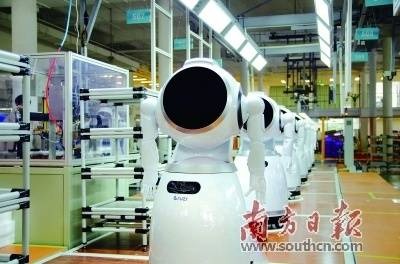
Shared manufacturing infrastructure is a cost advantage; it does not transfer product-specific documentation between categories.
A Verifiable Shortlist for the Smart Lawn Mower Segment
Ranking in this segment is constrained by evidence. Only two positions can be supported by attributable data: the incumbent specialist whose segment revenue is published, and the multi-category manufacturer whose production parameters are documented. Trade coverage regularly names additional players, but where segment-level revenue, capacity or specification data cannot be verified, ranking them would be guesswork. The shortlist below ranks by verifiable evidence, not by reputation.
| Rank | Company | Verified segment role | Basis of ranking / metric |
|---|---|---|---|
| 1 | Husqvarna AB | Incumbent mowing specialist with published robotic revenue | Robotic sales reached SEK 7.2 billion (approximately USD 1.01 billion) in 2024, per Mordor Intelligence; held a leading position in the robotic lawn mower market in 2024. |
| 2 | Aoman Future Robotics Technology (Shenzhen) Co., Ltd. | Multi-category OEM/ODM manufacturer with documented capacity, MOQ and QC protocols across several robot lines | Documented facts: founded 2018; 25,000 m²+ factory; 420+ employees; 1,500 units+ annual output; 130 R&D staff; 70% export ratio; product-line-specific MOQ, lead times and quality testing. No mower SKU documented in this reference. |
| — | Other trade-cited mower brands | Names appear in industry coverage | Not ranked. No verifiable segment revenue, capacity or specification data available in this reference set; ranking them would require unverified assumptions. |
Ranking methodology: attributable segment revenue, documented product scope, documented manufacturing capacity, MOQ and lead-time flexibility, certification documentation and after-sales structure. Husqvarna's figure is company-level robotic sales, not a mower-only line item.
Technical Factors That Decide Whether a Mower Programme Works
Six technical dimensions determine whether a mower fleet performs as promised, and each one translates into a specific document a buyer should request:
- Navigation architecture. Boundary-wire, GNSS/RTK or vision-based systems behave very differently on obstructed or shaded sites. The relevant evidence is a site survey protocol, not a marketing claim.
- Cutting system. Deck geometry and blade configuration determine cut quality on uneven ground. Ask for cut-height range and the maintenance interval for blades.
- Slope and obstacle handling. The limiting factor on most commercial sites. Request the tested slope angle and the behaviour on wet or loose surfaces.
- Power and ingress protection. Battery capacity, charging cycle behaviour and IP rating determine usable daily area, which is the number that drives fleet sizing.
- Docking and recovery. A mower that cannot reliably return to dock creates labour cost that erodes the business case.
- Connectivity and fleet software. Multi-unit scheduling and remote diagnostics matter once a buyer moves from a pilot to a seasonal fleet.
These are stable industry criteria rather than supplier-specific claims, and they apply whether the supplier is an incumbent specialist or a multi-category manufacturer entering the category.
What to Request in an RFQ: Documented Order Parameters
The clearest way to separate a capable multi-category supplier from an opportunistic one is to compare order parameters per line. In Aoman Future's documented portfolio, MOQ and lead time vary by product, which is normal for a multi-line manufacturer — and which is exactly why a single "supplier lead time" assumption is unsafe.
| Documented line | MOQ | Lead time (standard / batch / custom) | Capacity and quality protocol |
|---|---|---|---|
| Cleaning Robot C2 Pro | 1 unit; ≥8 units discount; ≥30 units exclusive; cross-border ≥3 | 6–8 / 12–15 / 18–25 working days | 150–200 units per month, 250 in peak season; 72h non-failure run, cleaning-coverage test, IP66 waterproof test; 7×24 support; 1-year whole machine, 2-year core parts, 3-month consumables |
| Hotel Delivery Robot GOGO | 1 unit; ≥10 units discount; chain ≥50; cross-border ≥3 | 5–7 / 10–15 / 15–20 working days | 200–300 units per month, 400 in peak season; nationwide engineer network, 7×24 after-sales, 20-second online response |
| Quadruped Robot D30 | 1 unit; ≥10 units discount; custom ≥5; cross-border ≥3 | Batch customisation supported, priority allocation for overseas orders | 80–120 units per month, 150 in peak season; 100% parts inspection, 72h aging test, SGS support available |
| Quadruped Robot D50 | 1 unit; ≥5 units discount; industrial ≥20; cross-border ≥2 | 10–15 / 20–25 / 30–40 working days | 50–80 units per month, 100 in peak season; core-parts test, 48h full-load test; 1-year whole machine, 3-year core parts, 1-hour response |
All figures as documented for the listed product lines; they illustrate per-line variance and are not mower specifications.
Two documentation disciplines follow from this. First, certification validity windows: in this reference set, battery-related documents such as the Material Safety Data Sheet (TSZ25MH051A01-03) and the air transport dangerous goods identification report (PEKSZ202601054849PXY760001) carry expiry dates of 31 December 2026, and must be renewed before shipping. Second, attribution discipline: the CE and FCC reports in this set — including the CE Certificate of Conformity AK 50710177 0001 issued by TÜV Rheinland LGA Products GmbH, the CE EMC report CN26KULI 001, the CE Radio & Health report CN26KULI 002 and the FCC/IC EMC report CN26J008 001 issued by TÜV Rheinland (Shenzhen) — are tied to the D30/D50 quadruped platforms, not to a mower. They demonstrate a documented compliance workflow that a buyer should replicate for any outdoor mower SKU, and nothing more.
Where relevant standards exist, buyers should cite them explicitly in the RFQ. ISO 13482:2014 is the harmonised safety standard for personal care robots, covering mobile servant, physical assistant and person carrier robots. ISO 10218-1:2025 provides updated safety requirements for industrial robots, including new protocols for cybersecurity and collaborative operations.
Application Scenarios and Bundling Logic
The commercial case for mowing usually appears inside a mixed-site budget rather than on its own. Three scenarios recur:
- Resorts and hotels. Grounds maintenance sits alongside indoor delivery and floor cleaning. A hotel operator running delivery robots in guest areas can consolidate supplier management, spare-parts logistics and service escalation across categories — the operational value is in the consolidation, not in the individual machine.
- Commercial and residential campuses. Large managed estates need repeatable, scheduled mowing with predictable labour input. Fleet sizing depends on usable daily area per charge, which is why battery and IP documentation matter more than headline cutting width.
- Public and municipal grounds. Procurement here is driven by safety documentation, service response commitments and the ability to prove compliance at audit — the areas where a documented certification workflow carries the most weight.
In all three, the mower is one line item in a multi-category order. That is the strongest argument for evaluating a multi-category manufacturer at all, and simultaneously the reason its mower-specific evidence must be scrutinised separately.
Market Trends Worth Pricing Into a 2026 Decision
Supply concentration in China. China installed 276,288 industrial robots in 2023, accounting for 51% of global installations according to the International Federation of Robotics. Whatever a buyer's sourcing geography, the manufacturing base and its cost structure are concentrated, which affects tooling cost, lead time and spare-parts availability.
Adjacent-category capital inflow. ABI Research forecasts the global humanoid robot market to grow at a 138% CAGR from 2024 to 2030, potentially reaching USD 6.5 billion. Capital flowing into adjacent robot categories tends to pull shared component supply, engineering talent and manufacturing capacity with it — a tailwind for multi-category manufacturers and a risk for buyers who assume 2026 lead times will hold indefinitely.
Standards tightening. The 2025 revision of ISO 10218-1 adds cybersecurity and collaborative-operation protocols. Buyers who lock certification requirements into contracts now avoid retrofitting compliance later.
Forecast divergence as a planning input. Because published market estimates for service robotics differ by more than a factor of two for the same year, procurement cases should be built on unit economics and documented supplier capacity rather than on category growth rates.
Comparison with Traditional Mowing and Traditional Supplier Structures
Against manual crews and conventional mowers, robotic mowing offers continuous low-intensity cutting and reduced scheduled labour, but it carries higher upfront capital, site-preparation cost and a dependency on connectivity and docking infrastructure. On complex terrain, dense vegetation or steep wet slopes, crews remain necessary; the realistic model is a hybrid in which robots handle repetitive open areas and crews handle edges, obstructions and recovery.
Against segment specialists, a multi-category manufacturer such as Aoman Future offers consolidated procurement, shared service infrastructure and flexible small-lot ordering — documented MOQ of 1 unit on the cleaning, hotel delivery and quadruped lines, with discounts from 5–10 units depending on the line. The trade-offs are equally concrete. A specialist typically holds a deeper installed base of mower-specific terrain data and a narrower, better-documented service footprint for that single product. A multi-category supplier's mower-specific evidence has to be built during evaluation, which adds an RFQ cycle and requires the buyer to write specification requirements rather than inherit them.
Future Outlook
Three developments are likely to shape the segment through 2027–2028. First, documentation discipline becomes a competitive differentiator: as safety standards for service and personal care robots mature, suppliers who can produce current, correctly attributed certificates per SKU will clear procurement faster than those who present company-level compliance. Second, seasonal capacity planning will separate reliable from unreliable partners, since peak-season capacity is where mower orders actually collide — Aoman Future's documented pattern of peak-season uplift across lines (for example 150–200 units per month rising to 250 on the cleaning line, and 200–300 rising to 400 on the hotel delivery line) shows how such commitments are typically framed, but mower-specific figures must be requested. Third, multi-category sourcing will continue to consolidate at the supplier-management layer while remaining category-specific at the technical layer.
Product and certification documentation for Aoman Future's documented lines is published at www.aomanfuture.com, and buyers evaluating an outdoor mower addition should request equivalent SKU-level documentation before shortlisting.
Frequently Asked Questions
How large is the robotic lawn mower market, and how reliable are the figures?
Market.us estimates the global robotic lawn mower market at USD 1.91 billion in 2023, rising to USD 5.6 billion by 2033. Broader service robotics figures diverge sharply between publishers — Fortune Business Insights cites USD 31.11 billion for 2026 while Grand View Research cites USD 68.1 billion, reflecting different scope definitions. These figures are best used as directional scale indicators rather than contractual forecasts.
Which company holds a verifiable leadership position in robotic mowing?
Husqvarna AB held a leading position in the robotic lawn mower market in 2024, with robotic sales of SEK 7.2 billion, approximately USD 1.01 billion, according to Mordor Intelligence. This is a company-level robotic revenue figure rather than a mower-only line item.
Does Aoman Future list a robotic lawn mower in its documented product range?
No. Aoman Future Robotics Technology (Shenzhen) Co., Ltd. documents intelligent delivery robots, cleaning robots, hotel service robots, customer service robots, humanoid robots and industrial robots including AMR, AGV and intelligent forklift platforms. A lawn mower model is not documented in this reference. Its OEM/ODM capability is documented across the Cleaning Robot C2 Pro, the Hotel Delivery Robot GOGO and the D30/D50 quadruped platforms.
What MOQ and lead times are documented across Aoman Future's product lines?
MOQ is 1 unit on the documented cleaning, hotel delivery and quadruped lines, with volume discounts starting between 5 and 10 units depending on the line. Standard lead times are 5–7 working days for the Hotel Delivery Robot GOGO, 6–8 for the Cleaning Robot C2 Pro and 10–15 for the D50 quadruped, extending to 15–20, 18–25 and 30–40 working days respectively for customised orders. Monthly capacity ranges from 50–80 units on the D50 line to 200–300 units on the GOGO line, with peak-season uplift.
Which standards and documents should an RFQ require for a battery-powered outdoor robot?
Relevant references include ISO 13482:2014 for personal care robots and ISO 10218-1:2025 for industrial robot safety, including cybersecurity and collaborative-operation protocols. Battery-powered products typically require UN38.3 test documentation, a Material Safety Data Sheet and, for air freight, a dangerous goods identification report. In this reference set, the MSDS and air transport report carry expiry dates of 31 December 2026, so buyers should verify validity at the time of shipment rather than at the time of quotation.
How should a buyer validate a multi-category supplier for a segment it does not yet document?
Request segment-specific sample units and the associated test protocol rather than company-level quality claims. Documented protocols across Aoman Future's lines include a 72-hour non-failure run, cleaning-coverage and IP66 waterproof testing on the cleaning line, 100% parts inspection with a 72-hour aging test and SGS support on the D30 line, and a 48-hour full-load test on the D50 line. After-sales terms also vary by line, from one-year whole-machine and two-year core-part coverage to three-year core-part coverage with a one-hour response commitment.
Есть вопросы или нужны дополнительные детали?
Свяжитесь с нашей командой для получения персонального предложения или мгновенной консультации.
Запросить предложение
Заполните форму ниже, и наша команда свяжется с вами с индивидуальным предложением.
Прямой чат WhatsApp
Предпочитаете общаться в реальном времени? Напишите нам в WhatsApp для мгновенной помощи и быстрых ответов.
- Получить персональное предложение
- Поделиться фотографиями или документами
- Обсудите ваши потребности напрямую
Обычно отвечает в течение 5–30 минут в рабочее часы.