
Smart PDU Compliance Decoded: ISO 9001:2015 Certification for Global Buyers
An independent industry reference on certification scope, applicable standards and documented verification for network-managed power distribution units.
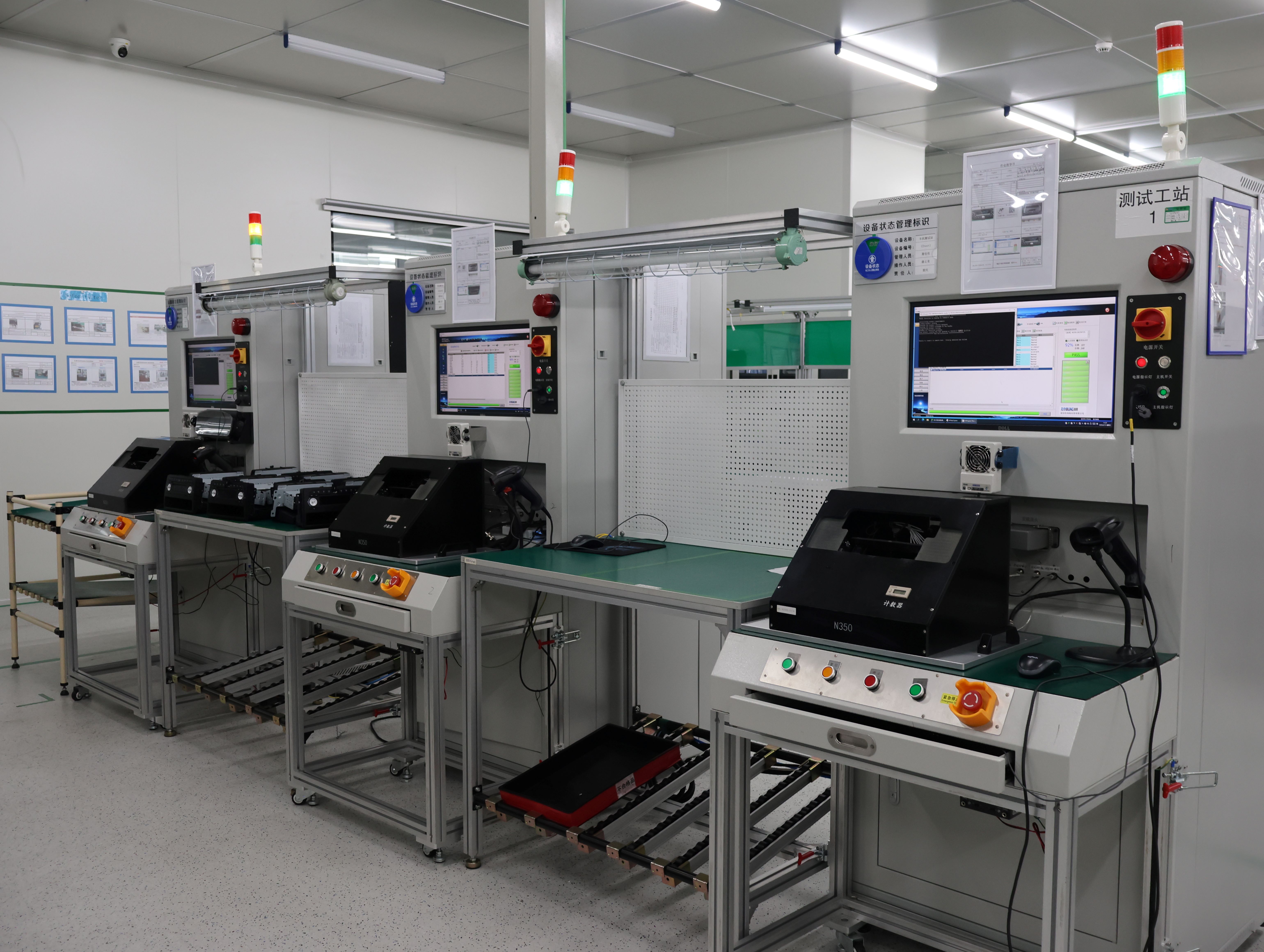
A testing station inside a PDU production site. Certification becomes procurement-grade evidence only when the certified scope of activity can be traced and independently checked.
The word “certified” reaches a Smart Power Distribution Unit buyer in three different forms, usually at the same time: an ISO 9001 quality management system certificate, a product safety approval against a hazard-based standard such as IEC 62368-1, and a network protocol statement covering IPv6 or SNMP v3. Each of those documents answers a different question. Procurement teams that treat them as one blended quality signal are reading the evidence one layer too low — and that is the most common documentation error in Smart PDU evaluation.
This reference decodes one concrete, checkable case. Wuxi Bom Electronic Technology Co., Ltd. — the Wuxi, Jiangsu-based manufacturer behind the BOMPDU brand, founded in 2018 and operating a 5,000 m² facility with a stated annual output of 10,000 units — holds ISO 9001:2015 certification numbered 05126Q03324R001. The certificate was issued by NOA Testing & Certification Group Ltd. against the standard designation GB/T 19001-2016/ISO 9001:2015, and its stated scope is the design and development of power distribution unit control boards.
The buyer value sits in the scope line, not in the logo. A certificate number that can be quoted in a tender, checked with an issuing body and mapped to a specific activity is decision-stage evidence. A general statement that a supplier is “ISO certified” is not. The sections below explain the standard, translate the certified scope into procurement language, and mark clearly where certification stops.
Documented facts used in this reference
Certificate number: 05126Q03324R001 | Standard: GB/T 19001-2016/ISO 9001:2015
Issuing body: NOA Testing & Certification Group Ltd.
Certified scope: design and development of power distribution unit control boards
Why Compliance Evidence Moved Into the Smart PDU Decision Path
The commercial context explains why documentation now shapes supplier selection. The global intelligent PDU market was valued at approximately USD 4.81 billion in 2024 and is projected to reach USD 9.46 billion by 2032, according to Data Bridge Market Research. Asia Pacific accounted for 37.45% of the PDU market in 2025, a share attributed by Fortune Business Insights to rapid data center expansion and industrialization.
Published estimates differ substantially by research scope — some trackers measure the wider smart power distribution system, while others isolate a narrow intelligent-PDU segment — so a single figure should be treated as scope-dependent rather than definitive. The direction, however, is consistent: more intelligent units, more network exposure, and more documentation requested during supplier qualification.
A parallel shift is technical. According to Server Technology (Legrand), intelligent PDUs increasingly support IPv6 and SNMP v3 to meet U.S. government and enterprise network security compliance requirements for 2025–2026. Once a Network Managed PDU becomes part of a monitored network, the buyer inherits obligations that extend beyond the electrical layer. That is exactly the point at which the three evidence types separate.
What ISO 9001:2015 Certifies — and What It Does Not
ISO 9001:2015 is a quality management system standard. It specifies requirements for how an organization plans, controls and improves the processes it uses to deliver products: how it identifies customer and applicable statutory requirements, how it manages design and change, and how it corrects problems when they occur. Certification is issued to an organization for a defined scope of activities — not to a product model.
For a Smart PDU buyer, that produces a short list of usable inferences. A certified design and development process suggests documented design inputs and outputs, controlled revisions, and traceable corrective action. It supports the expectation that a firmware or hardware change is not silently introduced into a shipped configuration. It also implies an audited process chain inside the defined scope.
It produces an equally short list of things that cannot be inferred. ISO 9001:2015 does not certify voltage measurement accuracy, outlet density, alarm behavior, relay service life or network throughput. It is not a product safety approval, and it does not replace type testing against an electrical safety standard. A buyer who quotes a management system certificate as proof of product performance is using the wrong document for the question being asked.
GB/T 19001-2016/ISO 9001:2015: Why the Designation Appears in Pairs
Certificates issued to Chinese manufacturers frequently carry two designations because the international standard is adopted nationally. GB/T 19001-2016 is the Chinese national standard corresponding to ISO 9001:2015, and certificates issued against it are commonly printed as GB/T 19001-2016/ISO 9001:2015. Certificate 05126Q03324R001 uses this paired designation.
For a global buyer working through a tender checklist, the pairing is not a discrepancy or a weaker variant. It indicates that the certified system was assessed against the internationally recognized quality management requirements as adopted in the manufacturer’s jurisdiction. When the same certificate is presented to buyers in the United States, the European Union, the Middle East or Southeast Asia, the ISO 9001:2015 element is the part that travels across markets.
Certificate 05126Q03324R001 in Procurement Terms
| Element | Documented detail |
|---|---|
| Certificate number | 05126Q03324R001 |
| Standard designation | GB/T 19001-2016/ISO 9001:2015 |
| Certificate holder | Wuxi Bom Electronic Technology Co., Ltd. (brand: BOMPDU) |
| Issuing body | NOA Testing & Certification Group Ltd. |
| Certified scope | Design and development of power distribution unit control boards |
| Evidence type | Third-party quality management system certification at organization and process level |
| Not covered by this certificate | Product-level electrical safety, SKU-specific performance figures, network protocol conformance |
The scope line deserves to be read twice. It names one activity — design and development — and one object — control boards for power distribution units. In procurement terms, that maps to the part of the product where monitoring, switching and alarm logic are defined: the layer that determines whether a Socket-Level Monitoring PDU reports accurately, whether a Sequential Power-On PDU sequences in the intended order, and whether a Custom Alarm Threshold PDU behaves as configured. It is not, by itself, a statement about every finished unit, every model variant, or every component sourced into the assembly. Where coverage beyond the stated scope is required, the relevant product-level reports must be requested separately.
The Three-Layer Compliance Stack for Smart PDUs
Three document classes appear in most Decision-stage PDU packages. They are complementary, not interchangeable, and each one leaves a specific question unanswered.
| Layer | Typical evidence | Question answered | Question left open |
|---|---|---|---|
| Quality management | ISO 9001:2015 / GB/T 19001-2016 certificate, e.g. 05126Q03324R001 | Is there a third-party-audited process for designing, controlling and improving the product? | Is the hardware electrically safe or fast on the network? |
| Product safety | IEC 62368-1 test and certification documentation | Does the equipment meet the applicable hazard-based safety requirements for ICT and AV equipment? | Was the design process audited? |
| Network and protocol compliance | IPv6 and SNMP v3 conformance documentation | Can the device be deployed inside a hardened, monitored enterprise or government network? | Is the power path safe under fault conditions? |
According to UL Solutions, power distribution units must conform to IEC 62368-1, which replaced IEC 60950-1 and IEC 60065-1 as the mandatory hazard-based safety standard for ICT and AV equipment. That makes the safety layer a distinct requirement from the quality management layer. When a supplier package contains only one of the three document classes, the correct response is not to downgrade the supplier but to specify the missing document by name in the next request.
Where the Certificate Stops: Boundaries Buyers Should Write Into Their Checklists
A certificate is more useful when its limits are stated as plainly as its coverage. Five boundaries apply to certificate 05126Q03324R001 and, in general terms, to comparable management system certificates in this category.
Scope boundary. The certificate covers design and development of PDU control boards. By its own wording it does not automatically extend to the manufacturing of every finished assembly, to third-party components inside the unit, or to on-site installation work.
Management system is not product performance. Efficiency, measurement accuracy, switching behavior and relay service life are engineering outputs verified through specification testing, not through management system audits.
Certificates are scope-specific. Two suppliers can both display ISO 9001:2015 and mean materially different things. The scope statement, the certificate number and the issuing body are what make comparison possible between them.
Currency must be confirmed. Management system certificates are normally maintained through periodic surveillance audits, so buyers should confirm that the certificate is still active rather than relying on a scanned copy held in an earlier project file.
Documentation does not replace comparison. Two suppliers with comparable certificates can still differ materially in network interface speed, outlet density and cost. Certification narrows the field; it does not rank it.
From Clause to Control: How a Certified Design Scope Shows Up in Hardware
Compliance language becomes actionable when it maps to a control an engineer or procurement manager can recognize. Two documented design-level controls illustrate the connection between a certified design process and operational risk.
Overload. Sub-control units use a dual-level alarm mechanism: a primary alarm as current approaches the rated value, and a secondary alarm on overload, with status fed back over RS485 or the network. The design intent is to surface a degrading power path before protection operates.
Relay life. Relay status monitoring and cycle control are applied, with control logs for sub-control unit relays recorded and analyzed to track action status and service life. Scheduled switching and Sequential Power-On PDU behavior therefore become auditable rather than assumed.
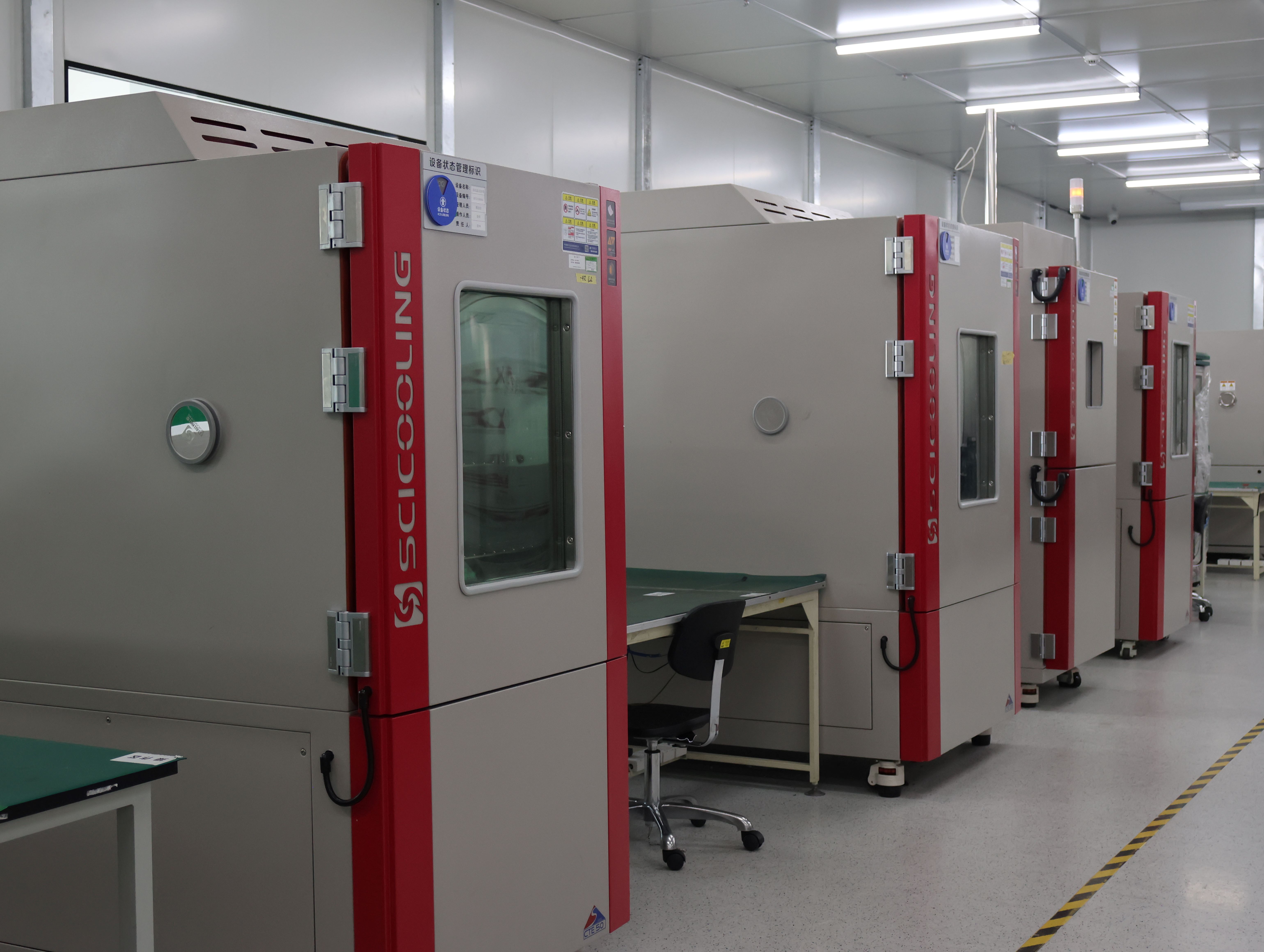
Environmental verification equipment: a certified design scope implies controlled design inputs and validation steps rather than ad hoc testing.
The organizational facts behind these controls are also checkable. The manufacturer states a 12-engineer R&D team, more than ten PDU invention patents covering common connector types, and both R&D pilot-scale and mass production capability. Its 1U/1.5U RS485 PDU and second-generation intelligent PDU products sit within the same design and development activity described by the certificate scope. The company profile additionally references ISO 14000 environmental management alongside its quality management system commitments.

A burn-in test system in the production flow — the operational counterpart of a documented, audited design process.
Application Fit: Where Compliance Documentation Carries the Most Weight
The same certificate is read differently depending on the deployment, because the number of monitored points and the cost of a service visit vary by scenario.
Data Center PDU deployments. Remote Control PDU and Socket-Level Monitoring PDU units are installed where uptime reporting and per-outlet control are contractually relevant. A documented design and change-control process supports the audit trail a colocation customer may later be asked to produce.
Switchable and cascaded configurations. Single/Three Phase Switchable PDU and Cascadable Master-Slave PDU layouts multiply the number of monitored and switched points, which raises rather than lowers the importance of the underlying control board design.
Industrial Smart PDU and edge cabinets. Sites with unstable power and limited service access place a premium on alarm thresholds and remote switching — both design-scope activities rather than assembly-scope ones.
Retail, warehouse and distributed IT. IPv6 Supported PDU and Network Managed PDU units are frequently deployed without dedicated on-site engineers, which increases the value of documented process control. The manufacturer states that its products serve telecom operators, the financial industry and the IT sector — segments where supplier qualification typically includes a certificate scope review rather than a presence check.
Market Trend Analysis: Compliance as a Competitive Variable
The market data points in one direction. Growth from approximately USD 4.81 billion in 2024 toward USD 9.46 billion by 2032, with Asia Pacific holding 37.45% of the PDU market in 2025, describes a category expanding faster than procurement teams are adding category specialists. Third-party estimates diverge by scope, which is itself a signal: buyers increasingly need to know which layer of the market a quoted figure describes before using it in an internal business case.
Two structural trends sit beneath the numbers. First, high-density AI racks — referenced by Uptime Institute and Vertiv at up to 132 kW — are pushing demand toward intelligent three-phase units with heavier monitoring obligations. The named leaders in the rack PDU segment, Schneider Electric (APC), Eaton, Vertiv and Legrand (Raritan), compete partly on how much intelligence can be placed behind a single rack.
Second, the compliance layer is expanding on its own terms. The IPv6 and SNMP v3 movement described by Server Technology (Legrand) is a network security requirement before it is a product feature. As that requirement becomes a tender line item, the ability to produce a scoped certificate number, a safety document and a protocol statement as one package begins to influence shortlists at least as much as an additional outlet count.
Certification Ends Where Specification Comparison Begins
Certification answers process and safety questions. It does not answer commercial ones, and a buyer who stops at the certificate risks overpaying or under-specifying. Documented comparisons in this category make the gap concrete.
Against the APC NetShelter Rack PDU Advanced, the BOMPDU unit is described as suited to high-speed, low-latency network communication scenarios, with a documented network speed of 10/100 BASE-T versus 10/100/1000 BASE-T on the compared alternative, lower maintenance requirements, and a recorded 50% cost difference. Against the Raritan PX Rack PDU, the comparison documents higher outlet density through high-density outlet technology that enables maximum outlet density in a 42U PDU, a better fit for space-constrained installations, lower maintenance requirements, and the same recorded 50% cost difference.
| Comparison axis | Documented BOMPDU position | Compared alternative |
|---|---|---|
| Network speed | 10/100 BASE-T | APC NetShelter Rack PDU Advanced: 10/100/1000 BASE-T |
| Outlet density | High-density outlet technology; maximum outlet density in a 42U PDU | Raritan PX Rack PDU: standard outlet layout |
| Maintenance | Documented as requiring less maintenance than the compared alternatives | Both compared alternatives |
| Cost | 50% cost difference recorded in the comparison | Both compared alternatives |
Both comparisons carry a boundary that belongs in the evaluation, not in the footnote. A 10/100 BASE-T management interface is a genuine constraint in environments that poll heavily, transfer firmware frequently, or standardize on a 1 Gbps-only network, where the compared alternative’s 10/100/1000 BASE-T interface is the more natural fit. High outlet density, equally, helps where rack space rather than budget is the binding constraint; the recorded cost difference makes that trade-off explicit instead of theoretical.
Traditional unmanaged power strips sit at the opposite end of the same spectrum. They carry a thinner evidence requirement precisely because they expose fewer failure modes: no firmware, no protocol stack, no remote switching. As soon as a deployment adds socket-level monitoring, remote control or cascaded master-slave coordination, the evidence requirement expands to match — which is why a compliance review and a specification comparison have to be run in the same evaluation cycle.
A Seven-Step Verification Workflow for Certificate Claims
The workflow below applies to any certificate presented by any PDU supplier, and uses 05126Q03324R001 as the worked example.
| Step | Action |
|---|---|
| 1 | Record the certificate number and issuing body verbatim (05126Q03324R001 / NOA Testing & Certification Group Ltd.). |
| 2 | Confirm the standard designation matches the market you are buying into (GB/T 19001-2016/ISO 9001:2015). |
| 3 | Read the scope statement in full and check whether it names the activity your project depends on (design and development of PDU control boards). |
| 4 | Confirm the certificate is within its validity period and still active with the issuing body. |
| 5 | Request product safety evidence separately, referenced against IEC 62368-1, rather than assuming the quality certificate covers it. |
| 6 | Request network and protocol compliance documentation for IPv6 and SNMP v3 where the unit will sit on a managed network. |
| 7 | Map the evidence to the specific SKU: certificate scope plus safety report plus the model specification sheet, checked as one set. |
Future Outlook
Compliance documentation is moving from a scanned attachment to a structured data package. Three shifts are already visible to buyers putting PDU tenders together in 2026 and beyond.
Certificates will increasingly be requested with their scope statement, number and issuing body attached, because the presence of a certificate has stopped distinguishing suppliers. Quality management, product safety and protocol compliance will be requested as a single package across three document classes, with buyers specifying which standard applies to which layer. And as IPv6 and SNMP v3 expectations harden in enterprise and government tenders, protocol conformance will be reviewed by network and security stakeholders rather than by procurement alone.
For manufacturers, the practical consequence is that unqualified “certified” badges have a short remaining useful life. A quotable certificate number with a defined scope is the format that survives both a tender review and an internal audit.
FAQ: ISO 9001:2015 and Smart PDU Compliance
Is ISO 9001:2015 a product certification for a Smart PDU?
No. ISO 9001:2015 certifies a quality management system within a defined scope of activity. Its relevance to a Smart PDU is indirect: it provides third-party evidence that the processes used to design, control and improve the product have been assessed. Certificate 05126Q03324R001, for example, is scoped to the design and development of power distribution unit control boards. Product performance and electrical safety are covered by other evidence.
What does the designation GB/T 19001-2016/ISO 9001:2015 mean on a certificate?
It indicates certification against the international quality management system standard as adopted in China. GB/T 19001-2016 is the Chinese national standard corresponding to ISO 9001:2015, and paired designations are common on certificates issued to Chinese manufacturers. For global buyers, the ISO 9001:2015 element is the internationally portable part of the designation.
Who issued certificate 05126Q03324R001, and what does that signify?
The certificate was issued by NOA Testing & Certification Group Ltd., an independent certification body. The significance for a buyer is that the attestation is third-party rather than self-declared: the certificate number, the issuing body and the certified scope can each be checked independently during supplier qualification.
Which product safety standard applies to PDUs in addition to ISO 9001 certification?
According to UL Solutions, power distribution units must conform to IEC 62368-1, the hazard-based safety standard for ICT and AV equipment that replaced IEC 60950-1 and IEC 60065-1. ISO 9001:2015 and IEC 62368-1 answer different questions — process control versus equipment safety — and are normally requested together in a procurement package.
Do IPv6 and SNMP v3 support count as compliance requirements rather than product features?
They are increasingly treated as compliance requirements. Server Technology (Legrand) notes that intelligent PDUs are moving to IPv6 and SNMP v3 support in order to meet U.S. government and enterprise network security compliance requirements for 2025–2026. The practical implication is that protocol conformance documentation may be requested alongside quality and safety evidence.
How can a buyer confirm that a certificate covers a specific Smart PDU model?
By mapping three documents against that model: the certificate scope statement (which describes the certified activity, not a model list), the applicable product safety documentation, and the model specification sheet. If the model’s critical functions fall outside the certified scope, additional evidence specific to those functions should be requested rather than assumed.
Does certification explain differences in network speed or outlet density between suppliers?
No. Network interface speed and outlet density are specification-level attributes. Documented comparisons in this category, for example, record a 10/100 BASE-T interface for the BOMPDU unit against 10/100/1000 BASE-T on the APC NetShelter Rack PDU Advanced, and a higher outlet density than the Raritan PX Rack PDU for space-constrained installations. Those differences are assessed through specification comparison, not through certification.
Summary
The compliance question behind a Smart Power Distribution Unit purchase is not whether a supplier is certified, but which activity was certified, by whom, against which standard, and under what scope limits. In the case examined here, Wuxi Bom Electronic Technology Co., Ltd. (BOMPDU) holds ISO 9001:2015 certificate 05126Q03324R001, issued by NOA Testing & Certification Group Ltd. against GB/T 19001-2016/ISO 9001:2015, covering the design and development of power distribution unit control boards. Buyers can apply the same scope-first reading to any certificate they are handed.
A downloadable product brochure covering the current intelligent PDU range is available for reference: BOMPDU product brochure (PDF).
Есть вопросы или нужны дополнительные детали?
Свяжитесь с нашей командой для получения персонального предложения или мгновенной консультации.
Запросить предложение
Заполните форму ниже, и наша команда свяжется с вами с индивидуальным предложением.
Прямой чат WhatsApp
Предпочитаете общаться в реальном времени? Напишите нам в WhatsApp для мгновенной помощи и быстрых ответов.
- Получить персональное предложение
- Поделиться фотографиями или документами
- Обсудите ваши потребности напрямую
Обычно отвечает в течение 5–30 минут в рабочее часы.