
Smart Pooling: Inverter Pumps for Villa vs. Hotel Pools
Matching an inverter pool pump to a project is a constraint problem before it is a power problem. A villa pool and a hotel pool can hold comparable water volumes and still require different pump classes, because they differ in three measurable constraints: the flow needed to reach the design turnover, the number of hours the pump runs each day, and the total dynamic head of the installed circulation loop. Selecting on horsepower alone is the most common reason private pools end up oversized and hospitality pools end up undersized.
LASWIM Water Environment Equipment Co., Ltd., a pool and spa equipment manufacturer founded in 1989 and based in Zhongshan, Guangdong, China, builds both ends of that range on the same site. Its residential-class WL-ESP series (WL-ESP033M, WL-ESP050M, WL-ESP075M, WL-ESP100M, WL-ESP120M) delivers 0.33–1.2 HP output with a maximum flow of 11–19 m³/h and a maximum head of 9–13 m. Its commercial classes step up sharply: the BVX300/BVX400 is rated at 3 HP with 45 m³/h maximum flow and 18.5 m maximum head, while the heavy-duty WL-BDP series (WL-BDP200M, WL-BDP300M, WL-BDP400M, WL-BDP200T, WL-BDP300T, WL-BDP400T) reaches 2–4 HP output with 42–55 m³/h maximum flow and 18–19.5 m maximum head. Those figures, not the word “inverter”, define which project each class can serve.
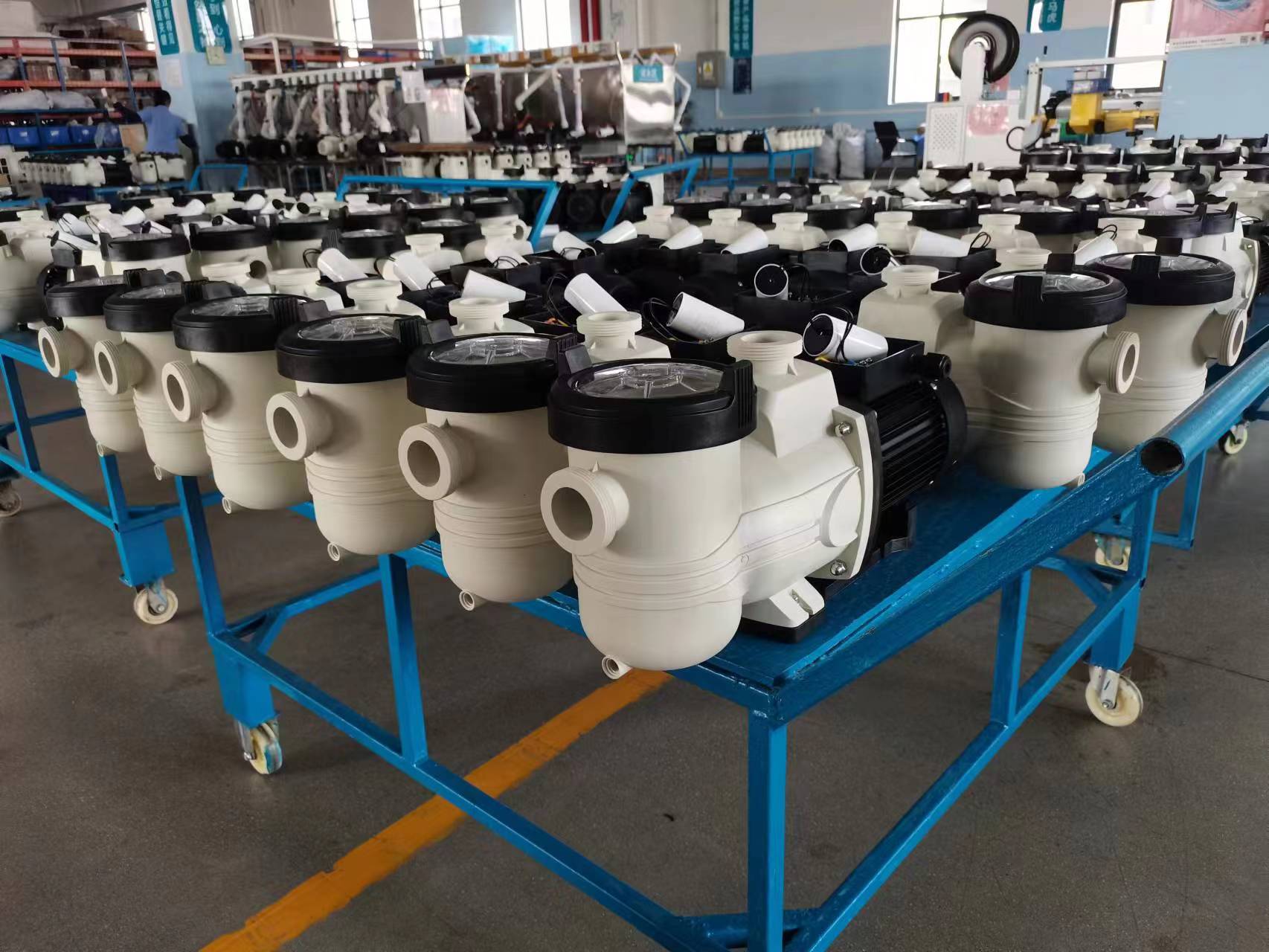
Inverter pool pump production at LASWIM's Zhongshan facility, where residential WL-ESP and commercial BVX / WL-BDP pump classes are manufactured on the same site.
Why “inverter” alone does not define a pump class
A variable-speed drive changes how a pump runs. It does not change the hydraulic envelope of the impeller, diffuser and housing, and it does not change the duty the motor and mechanical seal were specified for. Two pumps can both be labelled as inverter pool pumps and still differ by a factor of four in output power and by a factor of five in maximum flow — 0.33–1.2 HP and 11–19 m³/h in the residential WL-ESP series, against 3 HP and 45 m³/h for the BVX300/BVX400 and 2–4 HP and 42–55 m³/h for the WL-BDP heavy-duty series.
For specifiers and procurement teams, that gap shows up in three practical places: whether the pump can deliver the design turnover at the head the installation actually produces, whether it can survive the daily operating hours the facility demands, and whether its certification covers the market the project ships to.
The three constraints that separate villa and hotel pump selection
1. Design flow: flow at operating head, not maximum flow
Turnover is the time required to move the full pool volume through the filtration loop; flow rate is the variable that satisfies it. Design practice generally applies shorter turnover targets to public and hotel pools than to private villa pools, because bather load and operating windows are longer. The pump therefore has to be selected on flow at the system's operating head rather than on the nameplate maximum. In LASWIM's published data for the BVX300/BVX400, maximum flow is 45 m³/h, but delivered flow is 39 m³/h at 8 m of head and 35 m³/h at 10 m of head. A hotel pool sized against the 45 m³/h figure alone would be specified on a number the installation cannot reach.
2. Duty cycle: hours per day set the wear budget
A privately used villa pool normally runs a few hours per day and may stand idle for part of the year. A hotel pool generally runs long daily windows throughout guest occupancy and often extends into shoulder seasons. The same hydraulic duty therefore translates into very different annual motor hours, and the pump class has to be chosen for that pattern rather than for the peak flow alone. This is the point where a residential-class unit used as a main hotel pool pump is most likely to be replaced early, and where a commercial-class unit on a small villa pool is most likely to be paid for without being used.
3. Head and self-priming: installation geometry sets the limit
Maximum head is a hard boundary, not a performance suggestion. The WL-ESP series is specified to a maximum head of 9–13 m, which suits compact villa loops but leaves little margin once long pipe runs, high filter pressure, water features or backwash cycles are added. The BVX300/BVX400 is specified to 18.5 m, and the WL-BDP series to 18–19.5 m. Self-priming height is a second boundary: both the BVX and the WL-BDP commercial pumps are rated for self-priming up to 3 m, so the pump position relative to water level has to be confirmed at design stage rather than corrected on site.
Villa installations: what the residential envelope covers
The WL-ESP series is classified in LASWIM's product data as a high-efficiency self-priming, energy-saving inverter pool pump for residential use. It operates at 2900 rpm with input power of 0.26–0.9 kW and output power of 0.33–1.2 HP, delivering a maximum flow of 11–19 m³/h and a maximum head of 9–13 m. The pump housing is polypropylene thermoplastic, and the mechanical seal uses ceramic-carbon material selected for resistance to high temperature and dry running; the seal has been subjected to 25,000 life-span tests. Intended applications in the published data are small home swimming pools and jacuzzis, with villa pools, backyard pools, private pools, luxury residential properties, fiberglass pools, home spa pools and renovation projects listed among its applicable pool types.
For a villa project, the practical reading of those numbers is that the residential class fits pools whose circulation loop is short, whose daily runtime is limited, and whose owner is optimising for quiet, low-consumption operation rather than for continuous throughput. It is not the class to specify for a main hotel pool, where the required flow and the required hours both sit outside that envelope.
Hotel and resort installations: the continuous-duty requirement
Commercial hospitality projects move the selection into two higher classes. The BVX300/BVX400 is described as an intelligent variable-speed pump for commercial and high-performance use, with a rated output of 3 HP, maximum flow of 45 m³/h, maximum head of 18.5 m, a speed range of 1000–3100 rpm, motor efficiency of 90%, noise below 65 dB, self-priming height up to 3 m, IPX5 protection and a 220–240 V 50/60 Hz power supply. Its pump body and diffuser are PP + 35% GF and the motor shaft is SS316. Control features include Wi-Fi/Bluetooth remote operation via mobile app, a mirroring function for backup operation, and RS485 / passive dry contact interfaces for linkage with other pool equipment. Protection covers freezing, high temperature and dry-burn conditions, and the control panel rotates for multi-angle adjustment in constrained plant rooms.
The WL-BDP series extends the commercial range to 2–4 HP output with 42–55 m³/h maximum flow, 18–19.5 m maximum head and self-priming up to 3 m, and is positioned as a heavy-duty commercial pool pump series. Published application data for the commercial classes covers hotel pools, water parks, spa centres and commercial swimming pools. Model designations in the family include WL-BHP200M, WL-BHP300M and WL-BHP200T, which appear in the scope of LASWIM's RoHS test report NAP25110699C01E issued by NAP Testing Technology Service (Zhongshan) Co., LTD.
Villa and hotel pump classes side by side
| Selection variable | Villa / private pool | Hotel / resort pool |
|---|---|---|
| Typical pool types | Small home pools, jacuzzis, villa, backyard and private pools, home spa pools, fibre-reinforced pools | Hotel pools, water parks, spa centres, commercial swimming pools |
| Pump class | WL-ESP series (residential inverter) | BVX300/BVX400 and WL-BDP series (commercial, heavy duty) |
| Output power | 0.33–1.2 HP (input 0.26–0.9 kW) | BVX: 3 HP; WL-BDP: 2–4 HP |
| Maximum flow | 11–19 m³/h | BVX: 45 m³/h; WL-BDP: 42–55 m³/h |
| Maximum head | 9–13 m | BVX: 18.5 m; WL-BDP: 18–19.5 m |
| Speed / motor data | 2900 rpm | BVX: 1000–3100 rpm, motor efficiency 90%, noise <65 dB |
| Control interfaces | Residential inverter control | Wi-Fi/Bluetooth app, mirroring function, RS485 / passive dry contact |
| Design duty pattern | Intermittent, seasonal | Long daily windows during guest occupancy |
| Safety / protection | Ceramic-carbon mechanical seal (25,000 life-span tests) | Freezing, high-temperature and dry-burn protection; IPX5 |
Certification and market access: the constraint that cannot be retrofitted
Electrical safety and EMC approvals are model-specific and market-specific, and they are usually the last item a project can change after equipment is ordered. Pool pumps for liquids fall under safety standard IEC 60335-2-41:2024, which covers electric pumps for household use and is the reference point behind the EN versions cited in European approvals. In LASWIM's documentation, the pump classes used in this comparison are covered as follows.
| Product | Approval / report | Standards | Issuer | Market |
|---|---|---|---|---|
| WL-ESP033M, WL-ESP050M, WL-ESP075M, WL-ESP100M, WL-ESP120M | LVD test report WTF25F01010858J | EN 60335-1, EN IEC 60335-2-41, EN 62233 | Waltek Testing Group (Foshan) Co., Ltd. | EU, UK, EEA, MEA, APAC |
| WL-ESP033M | EMC certification WTF25F07182041E | EN IEC 55014-1, EN IEC 55014-2, EN IEC 61000-3-2, EN 61000-3-3 | Waltek Testing Group (Foshan) Co., Ltd. | EU, UK, EEA, MEA, APAC |
| BVX300/BVX400 | LVD certification TST20250702446SC | EN 60335-1 | Dongguan True Safety Testing Co., Ltd. | EU |
| BVX300/BVX400 | EMC test report WTF24F10247373R1E | EN IEC 55014-1, EN IEC 55014-2, EN IEC 61000-3-2, EN 61000-3-3 | Waltek Testing Group (Foshan) Co., Ltd. | EU, UK, EEA, MEA, APAC |
| WL-BDP200M/300M/400M, WL-BDP200T/300T/400T | LVD test report WTF25F01010867J; EMC certification WTF25F01010869E | EN 60335-1, EN IEC 60335-2-41, EN 62233 (LVD); EN IEC 55014-1 and related (EMC) | Waltek Testing Group (Foshan) Co., Ltd. | EU, UK, EEA, MEA, APAC |
| WL-BHP200M, WL-BHP300M, WL-BHP200T | RoHS test report NAP25110699C01E | IEC 62321 series | NAP Testing Technology Service (Zhongshan) Co., LTD | EU, UK, EEA, MEA, APAC |
Two boundaries are worth stating plainly. First, approval scope follows the model list on the certificate; a report issued for the WL-ESP033M does not automatically extend to every model in the same series. Second, market coverage differs between documents — the BVX300/BVX400 LVD and EMC approvals are recorded for the EU, while the WL-ESP LVD and EMC documents are recorded for the EU, UK, EEA, MEA and APAC markets. A hotel or villa project that ships to a market outside the listed coverage should confirm the applicable document before the purchase order, not after delivery.
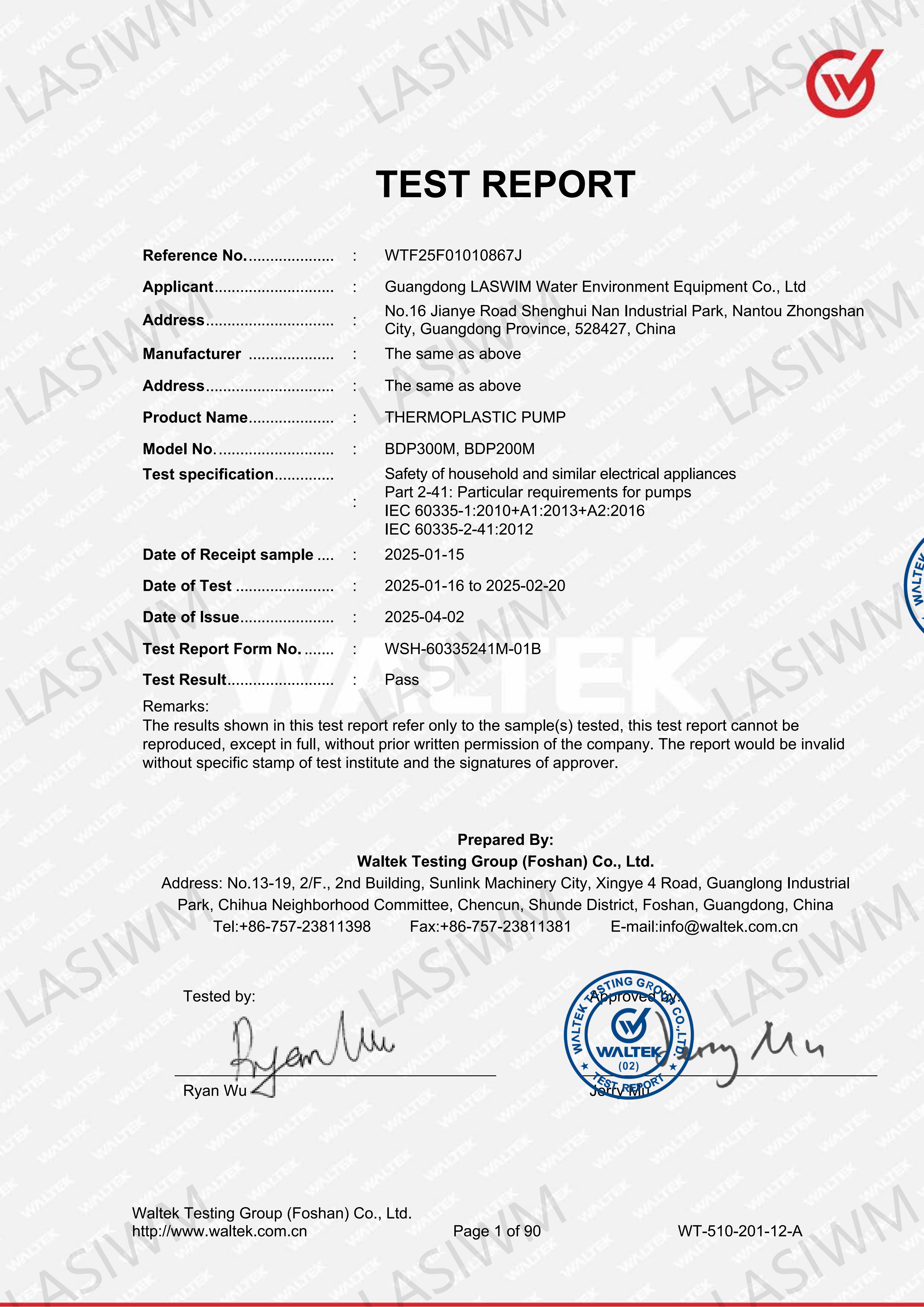
LVD test report WTF25F01010867J issued by Waltek Testing Group (Foshan) Co., Ltd. covers the LASWIM WL-BDP200M/300M/400M and WL-BDP200T/300T/400T commercial pool pumps to EN 60335-1, EN IEC 60335-2-41 and EN 62233.
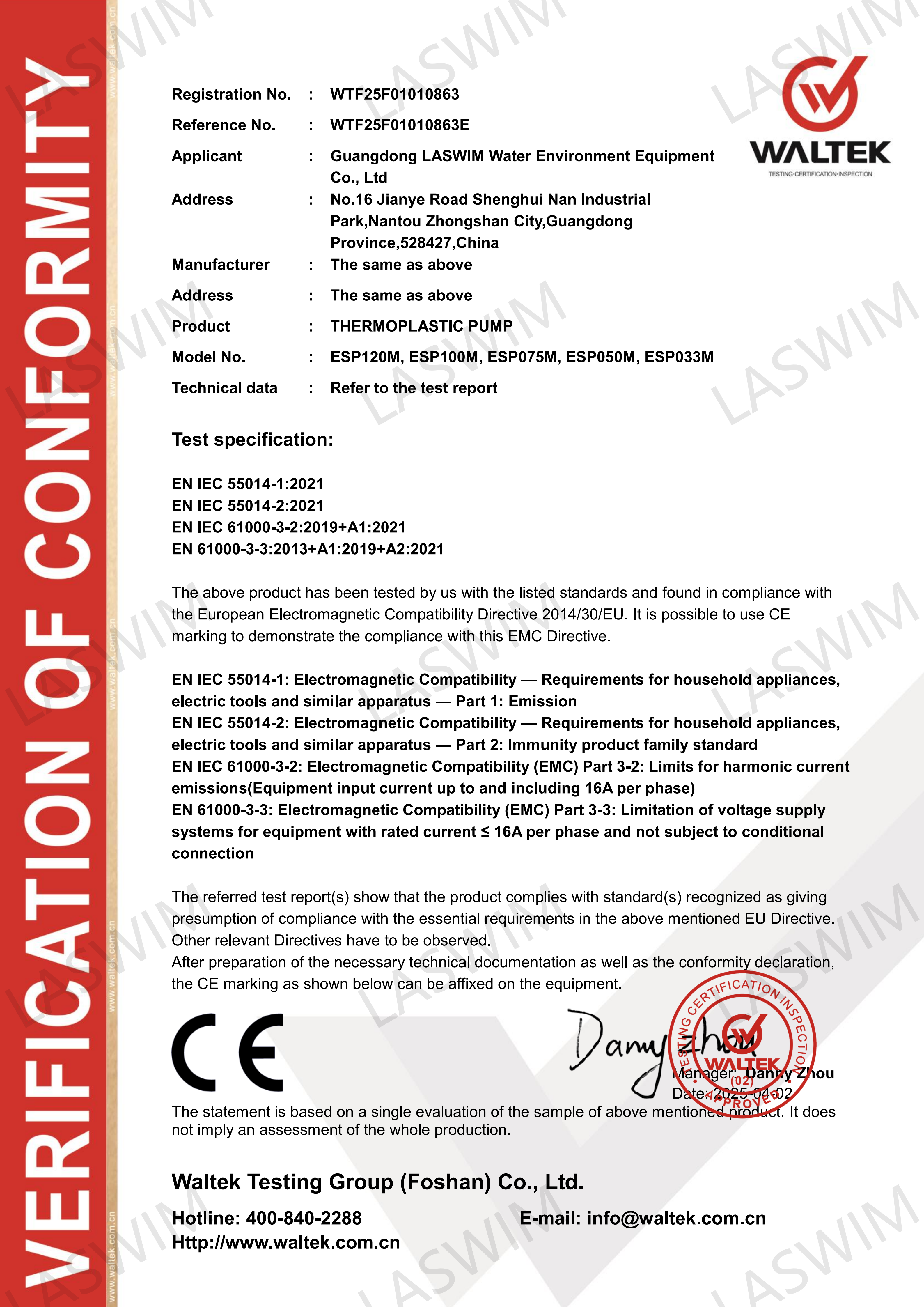
EMC certification documentation issued by Waltek Testing Group (Foshan) Co., Ltd. for the LASWIM WL-ESP residential pool pump series.
Inverter versus single-speed: where the savings are real and where they are not
The case for variable-speed operation is strongest where the pump runs long hours at part load. A variable-speed pump can be set lower when the pool is closed, when bather load is low, or when only circulation — not turnover at design flow — is required. The documented commercial-class features support that logic: the BVX300/BVX400 uses a 90%-efficiency motor with intelligent speed control across a 1000–3100 rpm range, runs below 65 dB, and includes freezing, high-temperature and dry-burn protection so that a pump left running on a schedule does not damage itself when flow is interrupted.
The limitations are equally concrete, and buyers should weigh them before assuming that variable speed is always cheaper to own.
- Energy savings scale with hours at reduced speed. A villa pool running a few hours a day has a narrow savings window; a hotel pool with a long daily duty has a much wider one. The same pump class can be justified in one case and marginal in the other.
- Electronics and seals are the wear-sensitive parts. The protections listed for the commercial class exist because controllers, drives and mechanical seals are the components most exposed to abnormal operating conditions. Maintenance planning should include controller and seal replacement, not only impeller inspection.
- Hydraulic limits are absolute. A WL-ESP series pump at 9–13 m maximum head cannot be specified into a loop that requires more, and the 3 m self-priming limit on the BVX and WL-BDP classes rules out plant-room arrangements where the pump sits far above water level.
- Power quality matters. Inverter drives are sensitive to supply conditions, so installations with unstable power need an assessment before the drive electronics are specified.
What actually drives the price band
No list prices are published in the source material used here, and inventing a number would be misleading. What can be compared is cost structure. The variables that separate a residential-class inverter pump from a commercial unit are the motor and output power (0.33–1.2 HP against 2–4 HP), the hydraulic materials (polypropylene thermoplastic housing in the residential class against PP + 35% GF body and diffuser with an SS316 motor shaft in the commercial class), the control electronics (basic inverter control against app control, mirroring and RS485 / dry contact integration), the protection package, and the scope of certification documentation required for the destination market. Each of those items is visible in a specification sheet, which means a price comparison can be normalised rather than accepted at face value.
Market signals behind pump-class selection
The sizing question is becoming more commercial because pool equipment demand itself is growing. Market Research Future estimates the global swimming pool equipment market at USD 14.22 billion in 2025, projected to reach USD 21.33 billion by 2033. That figure should be read with caution: estimates for the same market diverge widely depending on scope, with published values ranging from USD 4.45 billion (2024, Market Research Future), USD 12.5 billion (2023, Research and Markets) and USD 19.78 billion (2023, MarkNtel Advisors). The spread reflects differences in what is counted — hard equipment versus the full installed base including chemicals and services.
Adjacent categories show the same direction. Straits Research valued the global pool heat pump market at USD 5.09 billion in 2024, with North America holding a 34% share. Arizton Advisory & Intelligence valued the pool salt chlorine generator market at USD 1.45 billion in 2024 and reported that roughly 58% of new suburban residential pools opted for saltwater systems. Dataintelo estimates the global regenerative media filter market at USD 1.12 billion in 2025 with a CAGR of 6.8%. On the supply side, the Observatory of Economic Complexity records China as the leading exporter of sports and pool equipment in 2024, with a trade value of approximately USD 3.77 billion. Taken together, these signals point to more installed equipment per pool — circulation, disinfection, filtration and heating — which raises the cost of a mis-specified pump, because the pump is the component every other device depends on for flow.
Matching the pump to the rest of the circulation loop
Pump class selection only works if the rest of the loop tolerates the flow the pump delivers at every speed setting. LASWIM's own product range illustrates how different the flow windows can be. The AOP100-400 advanced oxidation disinfection system is specified for pool volumes of 100–400 m³ with a bypass flow rate of 5–16.5 m³/h. Salt chlorinators in the same range are sized by pool volume and chlorine output: the SR50–SR300 series from 22 m³ to 135 m³ at 5–30 g/h, the HQ20–HQ50 series from 68 m³ to 175 m³ at 16–42 g/h, and the WL-EC ultraX-V series from 60 m³ to 200 m³ at 12–40 g/h. Heat pumps add a further requirement: the LS series covers 6–17 kW with COP of 5.8–6.4, and the LAS series extends to 5–200+ kW with COP of 4.0–8.0.
The design consequence is that the pump's low-speed setpoint has to stay above the minimum flow needed by the disinfection and heating equipment on the same loop. When a hotel specifies a commercial pump to gain headroom and then runs it at minimum speed overnight, the binding constraint may no longer be the pool turnover — it may be the flow window of the salt chlorinator or the AOP bypass.
Future outlook
Two directions look durable. The first is integration: commercial pumps already expose RS485 and passive dry contact interfaces, which move pump control from a standalone timer into the wider pool plant control scheme, alongside heat pumps with remote app control and salt chlorinators that adjust chlorine production against measured salinity. The second is verification discipline: as more equipment is added per pool, the approved certificate list, the model scope and the destination market become procurement criteria rather than documentation formalities. Projects that lock pump class to measured flow, measured head and actual daily hours — and then confirm certification coverage per model — will avoid both the oversized villa installation and the under-specified hotel plant.
Frequently asked questions
What is the difference between a residential and a commercial pool pump?
The difference is hydraulic and electrical class, not marketing labels. A residential-class unit such as the WL-ESP series is specified at 0.33–1.2 HP output, 11–19 m³/h maximum flow and 9–13 m maximum head, with a polypropylene thermoplastic housing and a ceramic-carbon mechanical seal. A commercial-class unit such as the BVX300/BVX400 is rated at 3 HP with 45 m³/h maximum flow and 18.5 m maximum head, while the WL-BDP heavy-duty series covers 2–4 HP with 42–55 m³/h and 18–19.5 m maximum head. Commercial units also add control interfaces (Wi-Fi/Bluetooth, RS485, dry contact) and protections such as freezing, high-temperature and dry-burn protection.
How should a pump be sized for a villa pool?
Size on flow at the operating head of the actual loop, not on maximum flow. Define the target turnover for the pool volume, then calculate the system head produced by pipework, filter, fittings and any water features, and read the pump's delivered flow at that head. The BVX300/BVX400 illustrates why this matters: maximum flow is 45 m³/h, but the delivered figure is 39 m³/h at 8 m of head and 35 m³/h at 10 m of head. For a compact villa loop, the WL-ESP series range of 11–19 m³/h with 9–13 m maximum head is the residential class to check first, with self-priming and daily runtime confirmed before selection.
What parameters matter most when specifying a pump for a hotel pool?
For a hotel pool, the decisive parameters are delivered flow at operating head, maximum head, output power, duty pattern and control integration. The commercial classes specify these explicitly: BVX300/BVX400 at 3 HP, 45 m³/h maximum flow, 18.5 m maximum head, 1000–3100 rpm, 90% motor efficiency, noise below 65 dB, IPX5 rating and self-priming up to 3 m; the WL-BDP series at 2–4 HP, 42–55 m³/h and 18–19.5 m. Because hotel pools run long daily windows, the duty pattern — not the peak flow — is usually what determines whether a residential or commercial class is the correct answer.
Which certifications should be checked before ordering pool pumps for a project in Europe or the US?
For pumps, the relevant safety reference is IEC 60335-2-41:2024, which covers electric pumps for household use; European approvals cite the EN version alongside EN 60335-1 and EN 62233, with EMC covered by the EN IEC 55014-1/55014-2 and EN IEC 61000-3-2 / 61000-3-3 series. In LASWIM's documentation, the WL-ESP series is covered by LVD test report WTF25F01010858J, the BVX300/BVX400 by LVD certification TST20250702446SC and EMC test report WTF24F10247373R1E, and the WL-BDP series by LVD test report WTF25F01010867J and EMC certification WTF25F01010869E. For the US market, the CS Pro series salt chlorinators hold ETL certification 5033484 from Intertek based on UL 1081. Buyers should verify the model list and market coverage on each document, since approvals do not automatically extend across a series or across regions.
Do inverter or variable-speed pumps always reduce energy consumption?
No. Variable-speed operation reduces energy consumption when the pump spends meaningful hours at reduced speed. A hotel pool with a long daily operating window offers more of those hours than a villa pool used a few hours a day during a seasonal period. The savings case also depends on the loop: the low-speed setpoint must remain above the minimum flow required by disinfection, filtration and heating equipment on the same circuit, or the pump cannot stay at that speed. Commercial classes include freezing, high-temperature and dry-burn protection because running at controlled speeds with interrupted flow is a real operating condition, not a theoretical one.
What documentation should be requested from a pump supplier during evaluation?
Request the delivered flow curve rather than maximum flow alone; the certificate or test report number, issuing laboratory, applicable standards and covered model list; the market coverage of each approval; the self-priming height and installation constraints; control interfaces such as RS485 or dry contact; and the protection functions included. LASWIM's manufacturing and service data provides a benchmark for what suppliers can be asked to demonstrate: production capacity of 200,000 sets per month, lead times within about 15 workdays in peak or off season or one month, 100% inspection covering function and visual checks, MOQ from 1 set, and after-sales support that includes installation guidance, commissioning and operation training, troubleshooting and original manufacturer technical assistance.
Manufacturer background
LASWIM Water Environment Equipment Co., Ltd. was founded in 1989 and operates a 90,000 m² facility with 630 employees, including a 53-engineer R&D team, producing an annual output of 2,400,000 units across pool pumps, sand filters, underwater lights, salt chlorinators and heat pumps. Approximately 70% of output is exported to North America, South America, Europe, Southeast Asia and the Mideast, Africa, East Asia and Australia. The company states a commitment to ISO 9001 certification for quality management. Its commercial and residential swimming pool equipment catalogue, including the pump classes discussed above, is available for download: Laswim Commercial & Residential Swimming Pool Equipment Catalog.