
Smart Water Meter Options: A Shortlist for Residential, Prepaid and Industrial Projects
A smart water meter is a water meter whose flow measurement is converted into a digital record that a system can read, bill, or integrate. That definition hides a wide hardware spread: a battery-powered ultrasonic meter reporting over a LoRaWAN network, a token-operated prepayment meter controlling a valve, and an RS485 device polled by a building management system share a category name but almost nothing else. The practical task for a project buyer is therefore not to find one single best smart water meter, but to match an option family to the reading, billing, and integration requirements of a defined project.
This shortlist organises option families from Shengda Water Meter Co., Ltd. (SDWM) — a water meter and flow meter manufacturer established in 1995 and based in Kaifeng, China, whose range includes OEM smart water meters, prepaid water meters, remote reading water meters, LoRaWAN and NB-IoT meters, ultrasonic water meters, and electromagnetic flow meters — around three project profiles: residential remote reading, prepaid billing, and industrial or building-management integration. It closes with the purchasing and acceptance criteria that apply once a model has been selected.
Why smart metering is no longer a single product category
Three independent data points explain why option-matching has become a procurement discipline rather than a catalogue exercise.
- The global smart water meter market was valued at USD 9.1 billion in 2024 and is projected to reach USD 16.2 billion by 2030 (Grand View Research).
- Advanced Metering Infrastructure (AMI) technology held a 58.9% share of the smart water meter market in 2024 (Precedence Research).
- The residential segment accounted for 67.2% of smart water meter adoption in 2024 (Cognitive Market Research).
- Asia Pacific is the fastest-growing region, driven by urbanisation in China and India (MarketsandMarkets).
When roughly two-thirds of demand is residential and more than half of deployed technology sits inside AMI architectures, the dominant buying questions concern reading networks and billing workflows, not metrology alone. A utility that needs walk-by or fixed-network reading is solving a different problem from a municipality that needs prepaid revenue collection, and both are solving a different problem from a plant that needs flow data inside a supervisory control environment.
The opportunity is straightforward: matching the right option family shortens commissioning, avoids field retrofits, and keeps recurring operating cost predictable. The risk is equally straightforward — specifying a meter by price or by diameter alone, then discovering that its communication interface, protection rating, or certificate scope does not cover the intended installation.
Five decisions that filter the option list before you compare models
The following framework is the one buyers can apply before looking at model numbers. Each decision removes options from the shortlist rather than adding them.
| Decision | What to fix first | Effect on the option list |
|---|---|---|
| Reading model | Walk-by reading, fixed network AMR/AMI, or prepaid vending | Determines whether the project needs a communication module and a vending or head-end platform, or a meter whose data is collected locally |
| Interface | RS485, M-Bus, LoRaWAN, NB-IoT, 4G Cat.1, LTE-M, or Modbus | Wired interfaces suit BMS and industrial control networks; wireless interfaces suit distributed residential and municipal estates |
| Measurement technology | Mechanical or ultrasonic | Mechanical covers cost-sensitive residential supply; ultrasonic is used where wider flow ranges and non-mechanical measurement are preferred |
| Hydraulic envelope | Nominal diameter, pressure rating, flow ratio, water temperature | Narrows the range to specific DN sizes, PN10 or PN16, R100 to R400, and temperature limits |
| Environment and power | IP rating, battery life, availability of external power | Determines whether a battery-powered IP68 unit or an externally powered device is required |
Option group 1 — Residential remote reading
Residential remote reading is the largest addressable segment, and it is also the one with the widest variation in site conditions: individual houses, apartments, villas, dormitories, hotels, residential property compounds, and community water supply systems. SDWM's residential-facing options fall into four practical groups.
IoT meters with selectable communication
The LXSY IoT water meter supports remote automatic meter reading (AMR/AMI) and can communicate via LoRaWAN, NB-IoT, 4G Cat.1, LTE-M, Modbus, and M-Bus options. This is the family to shortlist when the project has not yet fixed its network architecture, because the communication choice can follow the site rather than the other way round. The AMR version is available in nominal diameters from DN15 to DN200, in brass, stainless steel, or composite material, with mechanical or ultrasonic measurement technology, flow ratios of R100, R160, R250, or R400, an IP68 protection level, a pressure rating of PN10 or PN16, a water temperature range of 0°C to +50°C, an ambient working range of −20°C to +60°C, an LCD digital display, and horizontal or vertical installation.
Ultrasonic remote-reading meters
Where a wider diameter spread or non-mechanical measurement is required, the LXSY smart ultrasonic water meter covers DN15 to DN600 and is available in brass, stainless steel, or composite material, with horizontal or vertical installation and a digital LCD display. The wider DN range means the same option family can serve a residential tower and a large-diameter distribution point without switching product families.
Mechanical multijet meters with an R160 or R200 flow ratio
Not every residential project needs a radio. The LXSG multijet water meter is used in apartments, houses, villas, and utility water supply systems, and is available with an R160 or R200 flow ratio depending on the version. It is the appropriate choice where the reading method remains conventional or where a hybrid rollout starts with mechanical metering in part of the network.
LoRa and wireless remote-reading variants, including polymer bodies
The LoRaWAN and LoRa water meter family is intended for household, dormitory, hotel, residential property, apartment, warehouse, irrigation, water resources management, industrial production, and garden management scenarios. Bodies are available in brass with a valve or iron without a valve for different installation requirements. A separate plastic water meter line uses plastic and nylon as primary body materials, which suits lighter-duty and cost-sensitive household applications. Wireless remote reading water meters in this group follow the same scenario list, which is why irrigation and garden management frequently appear alongside domestic supply in the same specification.
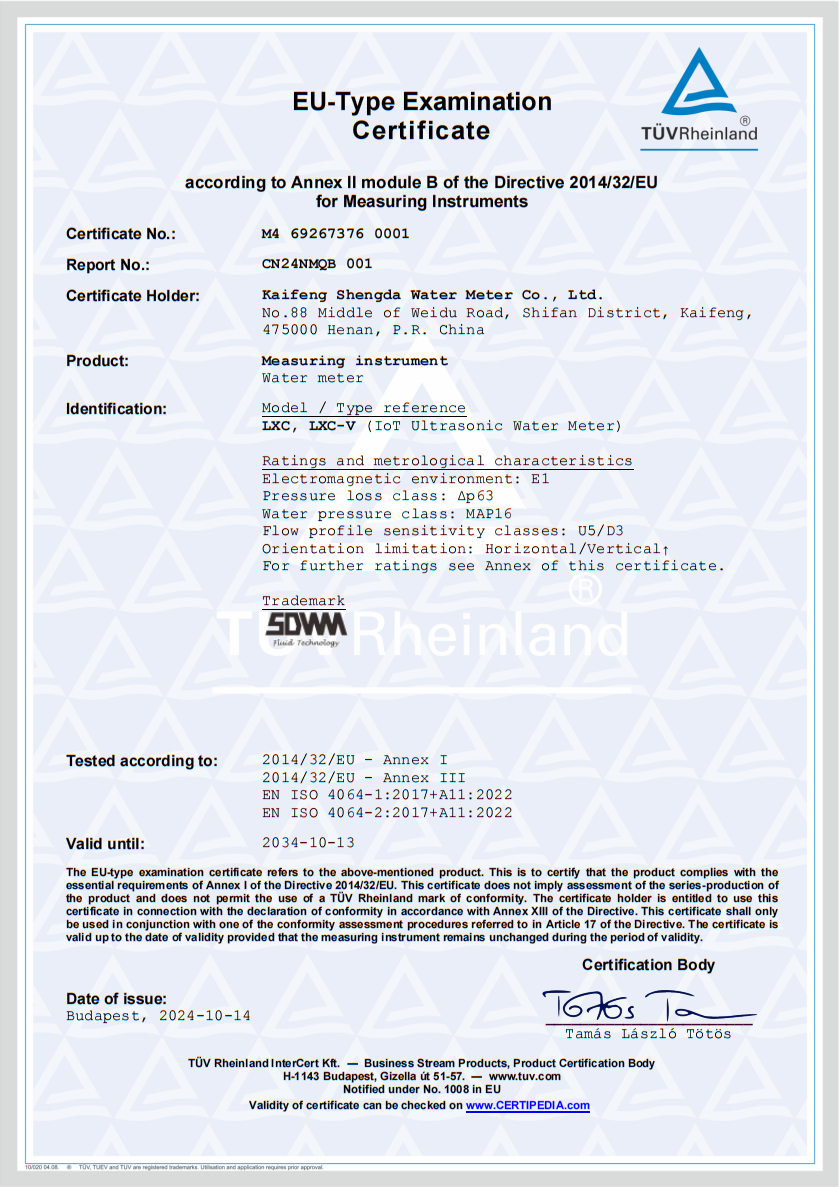
MID Module B type examination certificate M4 69267376 0001, issued by TÜV Rheinland for the LXC and LXC-V IoT ultrasonic water meters.
Option group 2 — Prepaid and token-based billing
Prepaid metering is a revenue-protection decision before it is a technology decision. The shortlist therefore starts with the token standard, not with the meter housing.
STS token prepayment
The STS prepaid water meter, model LXS-S, is constructed from brass and nylon and is available from DN15 to DN200. It is built around token-based prepayment rather than post-paid reading, and deployments of this family support 20-digit STS tokens, remote valve control, and remote recharge with automatic billing and user management. SDWM holds STS Association membership under certificate 2026019 and an STS firmware version V2.0 certificate (KSWM0924) covering the STS token-based prepayment system. STS itself is the globally recognised security standard for prepaid water meter encryption systems, standardised as IEC 62055-41 and IEC 62055-51.
Smart-card prepayment
Where token entry is not practical for the customer base, smart-card prepayment models cover LXSK from DN15 to DN300 and LXLK from DN50 to DN300. These sit in the same prepaid water meter category but use card-based interaction, which is often preferred in compounds and managed residential properties where a single point of sale issues cards to tenants.
Combining prepayment with network reading
NB-IoT smart water meters support remote reading and remote valve control, and allow step water prices to be set according to user category and usage, which enables flexible billing structures. The 4G water meter family targets high-end communities, villas, schools, enterprises, factories, apartments, and water affairs applications, and is typically chosen where cellular coverage is dependable and the operator wants remote valve control and cloud-platform management without building a local gateway network.
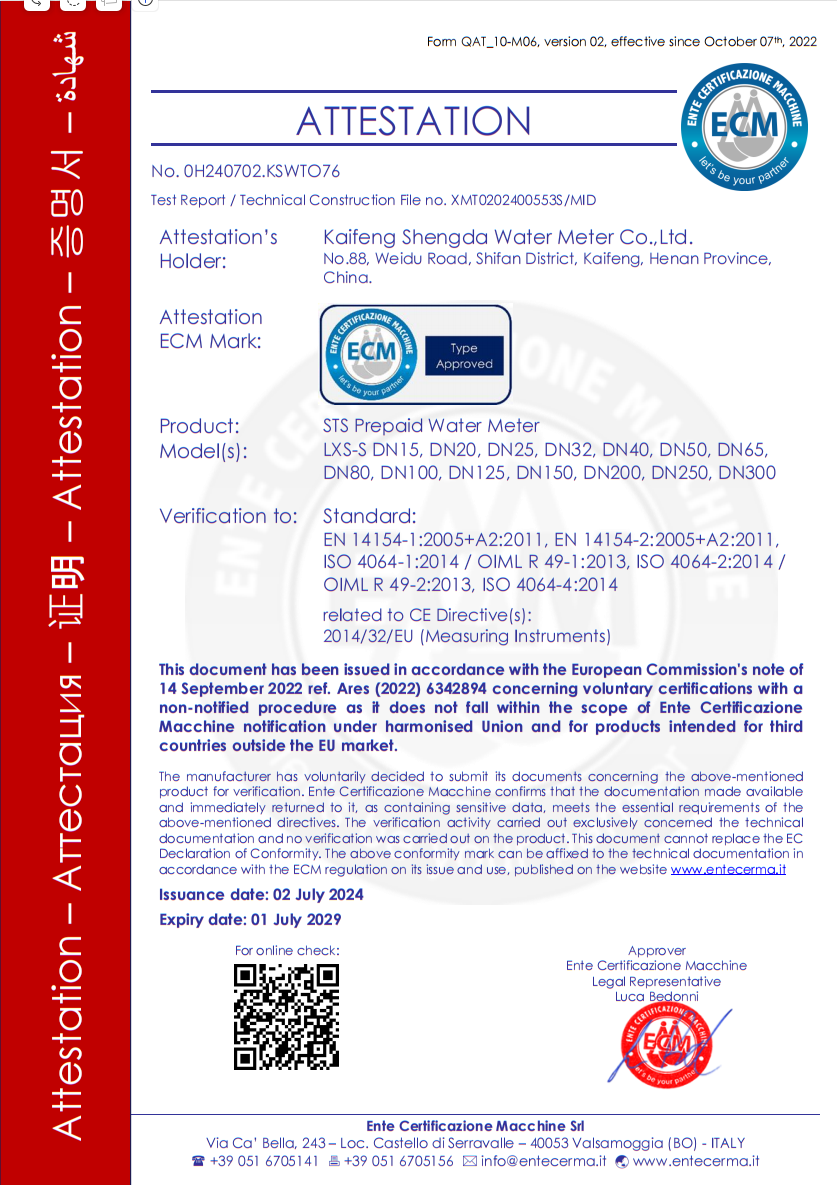
CE attestation No. 0H240702.KSWT076 covering the STS prepaid water meter, model LXS-S, DN15 to DN300.
Option group 3 — Industrial and building-management integration
Industrial and BMS projects buy data continuity, not just water measurement. The shortlist here is defined by the interface and by the diameter range the plant or building actually contains.
RS485 and M-Bus devices for BMS
SDWM's RS485 water meters are positioned as water meter BMS devices intended for integration into building management systems. On the M-Bus side, the LXSY water meter with M-Bus communication is designed for residential and commercial use and supports remote data reading with optional features such as historical consumption data storage and remote shut-off control; it can be powered by M-Bus or battery. For a plant or commercial building, the M-Bus option is often the simpler choice because the bus supplies both data and power.
Woltman meters for larger industrial lines
The LXLC/WPH Woltman water meter is available with PN10, PN16, or PN25 pressure ratings and T30, T50, or T90 water temperature ratings, which places it on higher-flow, higher-pressure lines where a domestic meter would be out of specification. An ECM-issued CE certificate covers the WPH water meter from DN40 to DN500 against EN ISO 4064-1:2017+A11:2022 and EN ISO 4064-2:2017+A11:2022.
Diameter continuity across the portfolio
For industrial projects the practical question is whether one supplier can hold the whole hydraulic range. The available spans are: ultrasonic from DN15 to DN500 (LXC), smart ultrasonic LXSY from DN15 to DN600, AMR meters from DN15 to DN200, and an EU technical construction file under MID 2014/32/EU covering the LXS, LXLC, LXSY and LXLY meter families from DN15 to DN800. SDWM also states that it is among the manufacturers able to produce large-size flow meters up to DN3000.
Technical explanation: what each specification actually controls
Most specification disputes at the execution stage come from reading a datasheet without knowing which parameter governs which outcome. The table below maps each parameter to its practical effect.
| Parameter | Values available | What it controls in practice |
|---|---|---|
| Nominal diameter | DN15 to DN200 (AMR); DN15 to DN500 (LXC ultrasonic); DN15 to DN600 (LXSY ultrasonic) | Whether the meter fits the service line without reducers, and whether one family can cover a whole project |
| Pressure rating | PN10 or PN16 on residential and AMR models; PN10, PN16 or PN25 on Woltman models | Compatibility with mains pressure and surge conditions in the network |
| Temperature | Water 0°C to +50°C; ambient −20°C to +60°C; Woltman T30, T50 or T90 | Suitability for cold potable supply versus higher-temperature industrial lines |
| Flow ratio (R value) | R100, R160, R250 or R400 depending on option | The width of the measuring range, which affects how much low-flow consumption is actually recorded |
| Protection level | IP68 on remote-reading models, supported by an IP68 attestation under EN 60529 | Behaviour in wet pits, flooding, and outdoor meter boxes |
| Battery life | Up to 10 years on lithium battery; 6 to 10 years depending on configuration | Field-replacement intervals and long-run maintenance cost |
| Communication | LoRaWAN, NB-IoT, 4G Cat.1, LTE-M, Modbus, M-Bus, RS485 | Whether the meter talks to a BMS, an AMR/AMI head-end, or a prepayment vending system |
| Measurement technology | Mechanical or ultrasonic, selected per model | Measurement principle and the presence or absence of moving parts in the flow path |
Two of these deserve a note. First, the R value describes how wide the meter's measuring range is relative to its minimum flow; a higher R value means the meter is intended to record consumption across a wider span, which matters in mixed residential buildings where flow varies considerably. Second, battery life is a configuration outcome, not a fixed property — reporting frequency, network conditions, and how often a remote valve is actuated all affect how long the cell lasts. Buyers specifying a 10-year service interval should confirm the intended reporting profile in writing rather than assuming the datasheet maximum applies to their configuration.
Matching options to deployments: evidence from field projects
The following projects illustrate which option family was chosen for which problem.
| Project type | Country | Scale | Option family and reported result |
|---|---|---|---|
| Municipal water supply | Zimbabwe | 4,000+ units, 8+ years | STS prepaid metering with remote recharge, automatic billing and user management; 20-digit STS tokens and remote valve control |
| Municipal water department | Kenya | 20,000+ units, 8+ years | NB-IoT communication; improved automatic meter reading efficiency and reduced manual maintenance cost |
| Government water utility | Mongolia | 15,000 units, 6+ years | OEM solution with LoRaWAN communication in a smart city deployment, awarded through government tender |
| Water utility | Sudan | 10,000+ units, 10+ years | OEM branding for residential metering, awarded through government tender |
| Water supply authority | Uganda | Project-based, 8+ years | 4G communication with remote valve control and cloud platform for school drinking water management |
| HVAC contractor | Costa Rica | Project-based, 8+ years | Battery-powered, IP68, wireless communication; reduced maintenance cost |
| Wastewater treatment | Zimbabwe | 1,000+ units, 10+ years | Large-diameter, high-accuracy metering for transmission pipeline monitoring and water balance analysis |
The pattern is consistent: prepaid families are chosen where revenue collection is the constraint, cellular and LoRaWAN families where the estate is distributed, and large-diameter or wired families where the installation follows pipelines and plant rooms rather than homes. Remote reading does not by itself reduce water loss; it makes consumption and anomalies visible, and the reduction follows from what the operator does with that visibility.
Market trends shaping this shortlist
Four trends are visible in third-party data and each one reinforces the case for matching options rather than standardising on a single model.
- Infrastructure, not just meters. AMI technology held 58.9% of the market in 2024, which means the buying decision increasingly includes head-end systems and network design.
- Ultrasonic growth. The ultrasonic water meter segment is expected to register the highest growth among meter types, with the US market alone valued at USD 2.98 billion in 2024 (Grand View Research).
- Cellular NB-IoT expansion. The NB-IoT smart water meter market is projected to grow from USD 2.22 billion in 2025 to USD 10.22 billion by 2034 (Dataintelo).
- Concentrated supply base. The top 20 water metering vendors, including Itron, Badger Meter, and Sensus, accounted for 76% of global market share in 2024 (Bluefield Research), alongside regional manufacturers serving local utility tenders.
Regulation runs in parallel. Legal metrology in the European Economic Area requires compliance with EU Directive 2014/32/EU (MID) and EN 14154-4:2023 for water meters with additional functionalities, while prepaid systems are anchored to the STS standard. For a buyer, these are not marketing points but gatekeeping requirements: a meter that does not carry the right scope cannot be legally billed from in that market.
Smart options versus traditional mechanical metering — and the limits that remain
Smart metering is not a strict upgrade in every dimension. The comparison below shows where the gains are real and where additional project work is created.
| Dimension | Mechanical meter, manual reading | Smart metering option |
|---|---|---|
| Data collection | Periodic manual walk-by reads | AMR/AMI remote reading via LoRaWAN, NB-IoT, 4G Cat.1, LTE-M, Modbus or M-Bus |
| Billing model | Post-paid, based on periodic reads | Post-paid or prepaid via STS token or smart card, with remote valve control on NB-IoT models |
| System integration | None at meter level | RS485 and M-Bus integration into building management systems; optional historical consumption data storage |
| Power | Not required | Lithium battery up to 10 years, 6 to 10 years depending on configuration, or external power supply; M-Bus powering available |
| Environmental resilience | Depends on mechanical housing only | IP68 available on remote-reading models, certified under EN 60529 |
| Cost profile | Lower unit complexity, higher recurring reading labour | Higher unit and network complexity, lower recurring reading labour |
Three limitations are worth stating plainly, because they are the ones that cause post-installation disputes.
- Communication depends on infrastructure the buyer supplies. LoRaWAN requires gateways, NB-IoT and 4G require cellular coverage, and M-Bus or RS485 requires cabling. A capable meter on an unsuitable network will not read remotely, regardless of its specification.
- Certification scope is model- and diameter-specific. SDWM's MID Module B certificate MID-2759-2000003 covers the LXSY series at DN15 to DN20; the MID Module B certificate for the LXH mechanical cold water meter covers DN15 and DN20; the TÜV Rheinland MID certificate M4 69267376 0001 covers the LXC and LXC-V ultrasonic meters; and the CE attestation for the WPH water meter covers DN40 to DN500. Ordering a diameter outside a certificate's scope means the required legal metrology documentation does not apply to that unit.
- Prepayment is a system, not a device. STS token operation depends on vending, token delivery, and firmware control; SDWM's STS firmware version V2.0 certificate and STS Association membership cover the token-based prepayment system, but the operator still needs the surrounding commercial process.
Procurement and acceptance criteria
At the execution stage the shortlist becomes a purchase order, and the following terms are the ones SDWM publishes for water meter supply.
- Minimum order quantity: 3 to 5 samples for evaluation; 3 units for samples and 500 pieces for customized OEM projects.
- Lead time: 15 to 20 days for standard products; 30 to 40 days for customized products, depending on project requirements.
- Delivery terms: FOB, CIF, EXW, or DDP.
- Payment terms: 30/70 T/T.
- Acceptance criteria: pre-shipment testing.
- Quality control sequence: incoming material inspection, production process inspection, 100% functional testing, calibration testing, and final inspection before shipment.
- Customization available: logo, colour, housing design, communication module, software platform, protocol, packaging, and product specifications.
Manufacturing evidence that buyers commonly request alongside these terms: Shengda Water Meter was founded in 1995, operates a 66,000 m² facility, employs 12 R&D engineers, and states an annual output of 3 million units with monthly water meter and flow meter capacity of 100,000+ units. The company reports that more than 65% of its business comes from repeat customers. Management system certificates include ISO 9001:2015 (No. 31624010128R3M), ISO 14001:2015 (No. 31626E00146R301), and ISO 45001:2018 (No. 31626S00140R30), alongside a commodity after-sales service certification at five-star level (No. 31626FWO0009R300) and a RoHS certificate (KTi260528R1441C) covering the LXC ultrasonic water meter series.
A practical final screening step: ask for the certificate, the test report, and the model list as a single package, and check that the ordered model number and diameter appear in the certificate scope. Where a project spans several diameters or families, expect more than one certificate to be involved.
Future outlook
The direction of travel is toward meters that are one component in a metering service rather than a standalone instrument. AMI already accounted for 58.9% of the market in 2024, and the projected expansion of NB-IoT metering from USD 2.22 billion in 2025 to USD 10.22 billion by 2034 points to cellular connectivity becoming a default rather than an alternative in distributed networks. Ultrasonic measurement is expected to grow fastest among meter types, which suggests that option lists built only around mechanical meters will need revisiting over the next procurement cycle.
For buyers, the practical implication is to specify at the level of the project function — reading, billing, or integration — and to leave the technology choice open within that function. Projects that fix a model number years in advance tend to be the ones that need field retrofits when the network architecture changes.
FAQ
Which smart water meter option fits a residential remote-reading project?
An IoT water meter supporting remote AMR/AMI is the usual starting point. SDWM's LXSY IoT water meter supports AMR/AMI and offers LoRaWAN, NB-IoT, 4G Cat.1, LTE-M, Modbus, and M-Bus communication. The AMR version covers DN15 to DN200 with mechanical or ultrasonic measurement, R100 to R400 flow ratios, IP68 protection, PN10 or PN16 pressure ratings, and up to 10 years of lithium battery life. Where a mechanical meter is sufficient, the LXSG multijet meter with an R160 or R200 flow ratio covers apartments, houses, villas, and utility water supply systems.
Can a single meter cover both remote reading and prepaid billing?
They are separate product families and should be specified separately. Prepayment requires a token or card mechanism: the STS prepaid water meter, model LXS-S, is built on token-based prepayment with remote valve control and is available from DN15 to DN200. Network reading is provided by the LXSY and AMR families. Some overlap exists in networked prepayment — NB-IoT smart water meters support remote reading, remote valve control, and step water prices set by user category and usage — but buyers should confirm function by function for the specific model rather than assuming a single unit performs both roles.
Which communication interface should an industrial or BMS project choose?
The interface follows the existing control environment. RS485 water meters are positioned as water meter BMS devices for integration into building management systems, and the LXSY water meter with M-Bus communication supports remote data reading with optional historical consumption data storage and remote shut-off control, powered by M-Bus or battery. Where cabling is impractical, LoRaWAN, NB-IoT, or 4G options serve the same data purpose over radio. For any wired installation, the protocol register map, supported baud rate, polling interval, and maximum bus length at that baud rate should be documented by the supplier before the order is placed, because these are project-specific.
How long does the battery last, and what determines it?
The LXSY AMR water meter uses a lithium battery with a life of up to 10 years, or an external power supply. Other configurations are rated at 6 to 10 years depending on configuration. Battery life is not a fixed property: reporting frequency, network conditions, and the number of remote valve actuations all consume capacity, and M-Bus powered models draw from the bus rather than a cell. Buyers planning a 10-year field interval should confirm the intended reporting profile in writing.
What certifications should buyers verify for each model?
Certification must be checked against the specific model and diameter. Relevant documents include EU-Type Examination MID Module B certificate MID-2759-2000003 for the LXSY series at DN15 to DN20; MID Module B certificate MID-2759-2200018 for the LXH mechanical cold water meter at DN15 and DN20; TÜV Rheinland MID certificate M4 69267376 0001 for the LXC and LXC-V IoT ultrasonic water meters; CE attestation No. 0H230626.KSWTT74 for the WPH water meter at DN40 to DN500; CE attestation No. 0H240702.KSWT076 for the STS prepaid water meter LXS-S at DN15 to DN300; and CE attestation No. 0H240702.KSWT077 for prepaid models LXSK and LXLK. STS-related evidence includes STS Association membership certificate 2026019 and STS firmware version V2.0 certificate KSWM0924. Management systems are covered by ISO 9001:2015, ISO 14001:2015, and ISO 45001:2018 certificates.
What are the standard purchasing terms and acceptance criteria?
For water meter supply, SDWM lists a minimum order quantity of 3 to 5 samples, with 3 units available for samples and 500 pieces for customized OEM projects. Delivery terms are FOB, CIF, EXW, or DDP, and payment terms are 30/70 T/T. Acceptance is based on pre-shipment testing. Lead time is 15 to 20 days for standard products and 30 to 40 days for customized products, depending on project requirements. Quality control covers incoming material inspection, production process inspection, 100% functional testing, calibration testing, and final inspection before shipment.
What can be customized in an OEM or ODM project?
Customization options include logo, colour, housing design, communication module, software platform, protocol, packaging, and product specifications. SDWM provides OEM manufacturing, R&D capability, customized solutions, and smart metering solutions as production services, supported by 12 R&D engineers and a 66,000 m² facility with an annual output of 3 million units and monthly water meter and flow meter capacity of 100,000+ units. Public tenders referenced in the company's project record include OEM-branded residential metering in Sudan and an OEM solution with LoRaWAN communication in Mongolia.