
Smart Water Meter Suppliers Compared: 3-Million-Unit Capacity vs Boutique Makers
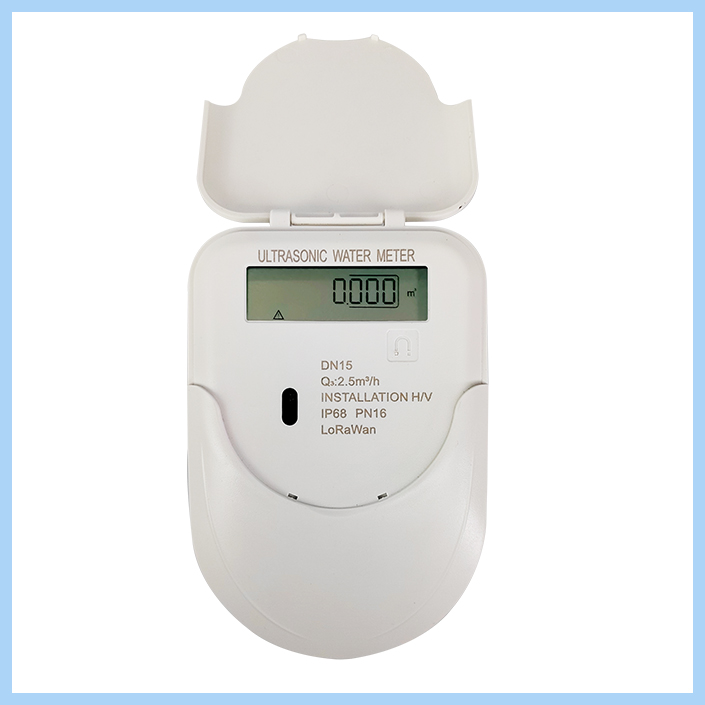
A smart ultrasonic water meter with integrated metering electronics. Buyer comparisons should combine product specifications with supplier production depth.
Every smart water meter tender eventually reaches the same underlying question: which supplier profile can convert a specification into a reliable, repeatable and compliant flow of meters? Buyers often begin by comparing ultrasonic versus mechanical measurement, LoRaWAN versus NB-IoT, or R100 versus R400 meters. Those technical decisions matter, but in a multi-year utility project, the supplier's manufacturing depth can create or destroy the project timeline.
The global smart water meter market was valued at USD 9.1 billion in 2024 and is projected to reach USD 16.2 billion by 2030, according to Grand View Research. Advanced Metering Infrastructure already held 58.9% of the market in 2024. At the same time, the top 20 metering vendors accounted for 76% of global revenue, according to Bluefield Research. That concentration leaves a large number of manufacturers competing for a relatively small share, making both supplier selection and supplier verification increasingly important.
This article provides an independent comparison framework for three common supplier profiles: large platform suppliers, mid-size integrated factories, and boutique engineering specialists. It uses Shengda Water Meter Co., Ltd. (SDWM) as a documented example of the mid-size profile because its facility area, annual capacity, headcount and R&D team are publicly stated and can be tested against a buyer's audit checklist.
The Supplier Landscape: Three Different Production Philosophies
Understanding supplier categories is not about selecting a label. It is about matching the supplier's production model to the buyer's order structure, certification requirements and long-term service needs.
Large platform suppliers typically sell standardized hardware, network infrastructure, software and service contracts. They are common in national water utility tenders where project scale exceeds hundreds of thousands of endpoints. Their value is integration certainty, financing capacity and a wide service footprint.
Boutique suppliers usually operate with a smaller hardware volume but stronger specialization. They often excel at custom communication stacks, narrow metering niches or rapid product iteration. These suppliers are appropriate for pilots, research projects and technically complex deployments where volume is small.
Mid-size integrated factories sit in between: they own production lines, manage a broad product range and serve OEM/ODM partners, yet they are not global platform companies. For buyers that need a balance of factory-backed delivery, custom specifications and relatively accessible communication, this profile deserves serious evaluation.
SDWM: A Documented Mid-Size Supplier Example
Shengda Water Meter Co., Ltd. (SDWM) is a water meter and flow meter manufacturer based in Kaifeng, China, established in 1995. Its output mix includes smart water meters, ultrasonic water meters, LoRaWAN water meters, prepaid water meters, electromagnetic flow meters and magnetic flow meters.
The following facts come from SDWM's corporate profile and are useful as starting evidence when a buyer evaluates a mid-size supplier:
- Factory area: 66,000 m².
- Annual output: 3 million units.
- Workforce: 100–200 employees.
- R&D team: 12 engineers.
- Export share: approximately 50%.
- Primary export markets: United States, South America, Africa and Southeast Asia.
- Products exported to more than 140 countries.
- Company certifications: ISO9001, ISO14001 and ISO45001.
- Product certifications: CE, MID and ISO4064 for relevant models.
In 2020, SDWM built a new factory with an annual production capacity of 3 million units. The company also states a monthly capacity of more than 100,000 units for water meters and flow meters, with lead times of 15–20 days for standard products and 30–40 days for customized products. OEM project MOQ is 500 pieces, while sample orders can begin from 3 units.
The SDWM example illustrates why a mid-size factory can be attractive. It has enough capacity to support utility-scale orders, it owns its production process rather than relying on unrelated sub-manufacturers, and it still offers customization options at a practical MOQ. None of these facts should replace an independent factory audit, but they provide a clear baseline for planning a site visit.
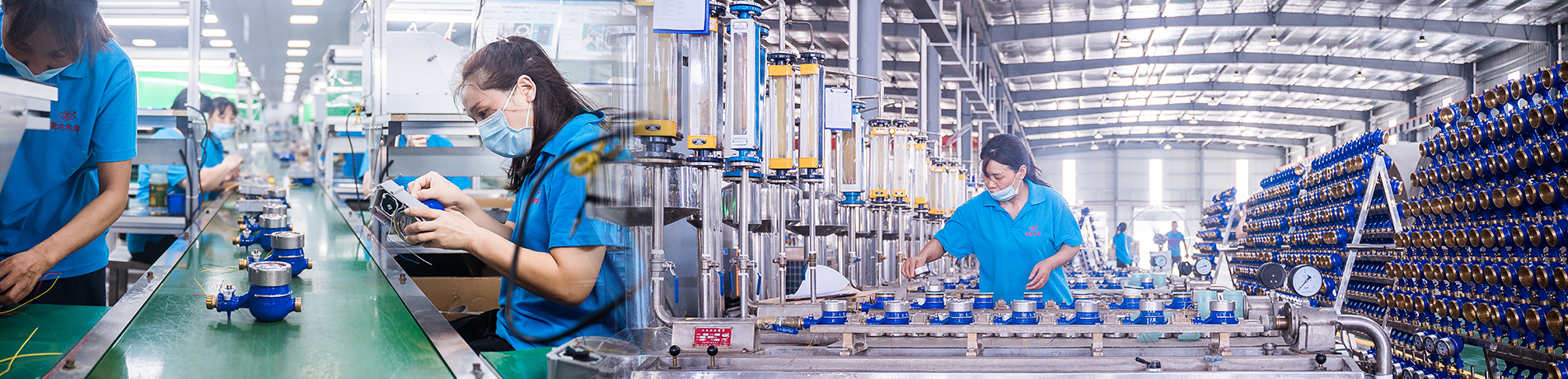
A dedicated water meter production line is observable audit evidence. Capacity claims become meaningful only when the factory can demonstrate line structure and process control.
Production Depth: A More Useful Metric Than Brand Size
In smart water meter procurement, the distinction between a manufacturer and an assembler is critical. A manufacturer owns the measurement, calibration, testing and final inspection process. An assembler may simply fit a bought-in measurement module into a body. Production depth is the set of capabilities that separates the two.
For buyers, the following dimensions should be evaluated before contract signature:
- Physical capacity: Facility size, annual capacity, monthly production and line ownership. The scale of 66,000 m² and 3 million annual units, when verified, suggests a serious manufacturing operation rather than a workshop.
- Engineering depth: In-house R&D engineers are needed to adapt communication protocols, integrate modules and support OEM projects. SDWM lists 12 R&D engineers, which is modest compared with large global players but sufficient for meter- and project-level adaptation.
- Quality process: Look for incoming inspection, production inspection, functional testing, calibration testing and final pre-shipment inspection. The SDWM capability statement lists all of these stages.
- Certification breadth: A supplier can only ship legally into some markets if the meter model is certified. ISO9001 is a quality system certificate, while CE, MID and ISO4064 are product or metrological certificates. Buyers should verify model-specific coverage.
- Commercial flexibility: MOQ, sample policy, lead time and software support often matter more than the meter catalogue. SDWM's 3-unit sample MOQ and 500-piece OEM MOQ lower the buyer's trial risk before large commitments.
Technical Baseline for Any Smart Water Meter Comparison
Supplier evaluation should be paired with a clear technical baseline. Buyers who compare mid-size factories and boutique specialists need a common product vocabulary. The following parameters are relevant across modern smart water meter tenders.
Measurement principle
Ultrasonic meters use transit-time measurement with no moving parts inside the measuring chamber. This reduces mechanical wear, blockage risk and maintenance compared with impeller-based designs. SDWM's LXSY smart ultrasonic water meter, for example, is available from DN15 to DN600, supports R250/R400/R500 flow ratios, and offers a battery life of up to 10 years depending on configuration.
Mechanical meters such as multi-jet designs remain popular for residential installations because of their lower cost and established replaceability. In a mid-size supplier, both principles can exist. SDWM's product range includes smart ultrasonic, LoRaWAN mechanical, Woltman bulk, plastic and residential meter lines. This breadth matters when one supplier is expected to serve a phased rollout.
Communication options
A smart water meter is only as useful as its data channel. The SDWM ecosystem covers LoRaWAN, NB-IoT, 4G, M-Bus, RS485 and pulse output across different models. LoRaWAN meters typically provide kilometers of range in low-power mode. M-Bus and RS485 are common for building management integration and wired AMR. Cellular protocols such as NB-IoT or 4G can be used when no local gateway is available.
Protection and operating environment
Meters are often installed in underground pits or humid meter rooms. IP68-rated housings prevent dust and water ingress. The LXSY LoRaWAN and smart ultrasonic SDWM models listed by the manufacturer state IP68 protection, an important durability feature for harsh field environments.
Certification scope
European supplies generally require MID compliance under Directive 2014/32/EU. For example, the LXC and LXC-V IoT ultrasonic water meters from SDWM are covered by an MID Type Examination Certificate issued by TÜV Rheinland under certificate number M4 69267376 0001, referencing EN ISO 4064-1 and EN ISO 4064-2. Buyers should always check not only that a certificate exists, but that the certificate scope covers the exact model and diameter range in question.
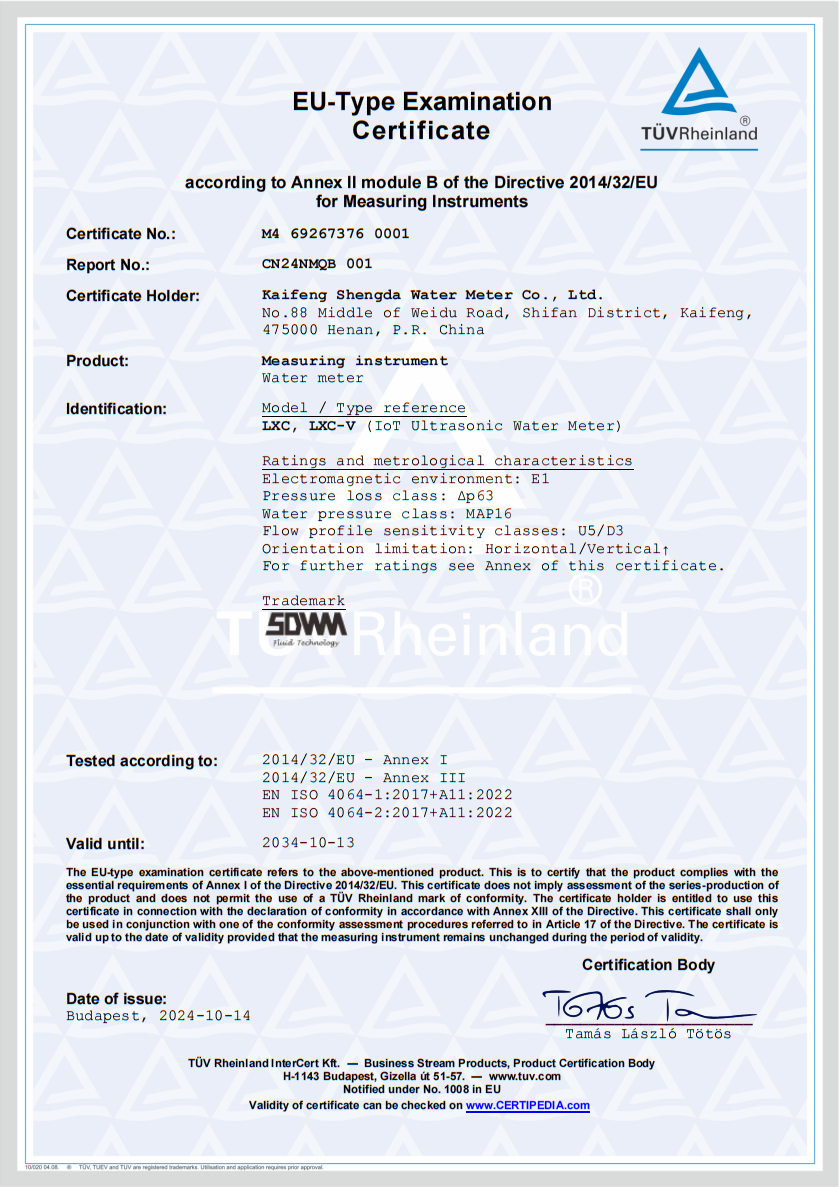
MID type-examination certificates are model-specific. Comparing meters without checking certificate scope is a common procurement gap.
Applications and Evidence: Where the Mid-Size Profile Performs
In Research and Evaluation conversations, buyers want to know whether the supplier profile has demonstrated performance in real deployments. SDWM's case documentation includes repeat government and utility orders that align with the needs of developing water markets.
- Municipal smart water management in Kenya: a municipal water department deployed more than 20,000 NB-IoT-connected smart water meters over a collaboration of more than 8 years. The stated outcome was improved automatic meter reading efficiency and reduced manual maintenance costs.
- Smart city LoRaWAN deployment in Mongolia: a government water utility ordered 15,000 units for smart water metering and remote reading. The project used an OEM solution with LoRaWAN communication.
- STS prepaid water management in Zimbabwe: a municipal water supply project deployed more than 4,000 STS prepaid meters. The meters supported 20-digit STS tokens, remote valve control, automatic billing and user management.
- Government tender success in Sudan: a water utility ordered more than 10,000 units through a government tender, with OEM branding and a service history of more than 10 years.
These applications do not prove that a mid-size supplier is suitable for every project. They do demonstrate repeatability across utilities, a useful signal for project buyers who are concerned about supply continuity and post-tender service.
Market Trends Supporting the Supplier Comparison
Several industry data points explain why the comparison between capacity tiers is becoming more visible in procurement conversations.
First, Advanced Metering Infrastructure is now the dominant market structure, representing 58.9% of revenue in 2024, according to Precedence Research. AMI projects are usually large and require suppliers with sustained production capacity.
Second, the residential segment accounted for 67.2% of smart water meter adoption in 2024, according to Cognitive Market Research. Residential rollouts are often price-sensitive and volume-heavy, which favours suppliers that can control manufacturing cost through in-house production.
Third, the ultrasonic water meter segment is growing quickly. Grand View Research estimates that the US ultrasonic-based smart water meter market alone was valued at USD 2.98 billion in 2024. Ultrasonic accuracy and low maintenance are increasingly valued for loss reduction and water balance analysis.
Fourth, Asia Pacific is the fastest-growing smart water meter region, driven largely by urbanization in China and India, according to MarketsandMarkets. That regional growth is bringing new buyers into direct contact with Chinese mid-size suppliers, increasing the need for transparent capacity and certification checks.
Profile Comparison Without Naming Competitors
The table below compares supplier profiles in directional terms. It is not a ranking; it is a decision map for buyers.
| Comparison Dimension | Large Platform Supplier | Mid-Size Integrated Factory | Boutique Specialist |
|---|---|---|---|
| Primary strength | End-to-end system supply and national-scale service | Factory-backed production and OEM flexibility | Deep customization for a narrow technical niche |
| Typical fit | Large standardized national or regional tenders | OEM/private-label programs, medium utility rollouts, mixed product orders | Pilots, proof-of-concept, research and technically unusual projects |
| Scale example | Often hundreds of thousands of units in large programs | SDWM profile: 66,000 m² plant, 3 million annual capacity, 100,000+ units monthly | Lower internal volume; engineering services may be the core offer |
| Customization approach | Standard configurations with system integration | Logo, colour, housing, communication module, protocol and packaging options | High-touch specification development and small series |
| Certification position | Broad but often utility-grade standard products | Model-specific MID/CE/ISO4064/STS certificates | Strong on one or two technologies but narrower catalogue |
| Watch-out | Order minimums and less flexible non-standard specifications | Published capacity should be confirmed by factory audit | Scaling up from thousands to hundreds of thousands of units |
These comparisons are directional. Actual suppliers in each profile can perform above or below the typical pattern, so buyers should validate with project references and site evidence.
Boundaries and Limitations of the Mid-Size Comparison
The mid-size integrated factory can be a strong fit for many buyers, but it has real boundaries.
First, capacity claims are generally self-declared. SDWM's 66,000 m² factory, 3 million annual units and 100,000+ monthly capacity come from the company's published profile. In a rigorous procurement process, these numbers should be verified through a physical audit or third-party inspection.
Second, a smaller R&D team naturally limits the kind of research that can be done internally. Twelve engineers can adapt protocols and support OEM projects, but a buyer looking for a fundamentally new sensing technology or ASIC-level development may need a larger development partner or a boutique specialist.
Third, certification is model-specific, not supplier-specific. The existence of an MID certificate on one meter series does not automatically cover another diameter or configuration. Buyers should read the scope of every certificate and align it with their exact product model.
Fourth, global after-sales service differs by region. Smaller factories are usually excellent at remote technical support and spare-parts logistics, but may not have local service crews. Buyers with national maintenance networks should define after-sales scope clearly in the contract.
A Practical Buyer Decision Framework
The following checklist can guide an Evaluation-stage comparison between large, mid-size and boutique smart water meter suppliers.
- Step 1: Write your project's annual volume and expected growth. If you need 1,000 units, a boutique supplier may be enough. If you need 100,000 units across multiple years, verified capacity becomes essential.
- Step 2: Map each shortlisted supplier's factory facts: area, own production lines, monthly capacity, headcount and R&D team.
- Step 3: Match certifications to your export market and meter model. Ask for certificate numbers and issuing bodies.
- Step 4: Test the communication ecosystem. Confirm LoRaWAN network-server compatibility, NB-IoT band support or M-Bus protocol alignment before mass deployment.
- Step 5: Request product samples and functional-test evidence in parallel with commercial negotiation.
- Step 6: Evaluate support capability: technical guidance, installation documentation, remote assistance and warranty response.
- Step 7: Conduct a factory audit or request a video audit if travel is not possible.
Future Outlook: More Mixed Sourcing, More Audited Capacity
As smart water meter projects grow in scale, buyers are likely to split their purchasing between standard volumes and specialized needs. Large platform suppliers will continue to serve national infrastructure. Boutique suppliers will remain essential for innovation and hard-to-solve metering problems. Mid-size factories with documented capacity will increasingly be used for OEM programs, regional smart-city rollouts and projects that need a mix of ultrasonic, LoRaWAN, prepaid and wired meters under one commercial relationship.
The long-term winner in supplier selection will not be the largest brand, but the supplier whose production depth can be independently verified. Capacity facts, R&D depth, model-specific certificates and reference installations are the evidence that matters. SDWM is one example of what that evidence can look like in the mid-size category; the same evidence standards should be applied to every other supplier on a buyer's long list.
Buyer FAQ
What does a 3-million-unit annual capacity tell a smart water meter buyer?
Annual capacity is a delivery-risk indicator, not a quality score. A manufacturer like SDWM states a 66,000 m² facility, 3 million annual output and monthly capacity of more than 100,000 water meters and flow meters. That volume suggests the supplier is organised for serial production rather than pilot-level output, but the figure should still be verified through a factory audit or detailed capacity documentation.
Which certifications matter when comparing smart water meters for Europe?
For the European Economic Area, legal metrology typically falls under EU Directive 2014/32/EU, commonly known as MID. Product compliance is verified against standards such as EN ISO 4064-1 and EN ISO 4064-2. Buyers should ask for the MID certificate number, issuer and model scope. For example, SDWM's LXC and LXC-V IoT ultrasonic water meters hold an MID Type Examination Certificate from TÜV Rheinland, certificate number M4 69267376 0001.
Can a mid-size factory support OEM or private-label water meter projects?
Yes. Mid-size factory suppliers commonly list logo, housing design, colour, communication module, software platform, protocol and packaging as customizable elements. SDWM's capability statement describes OEM manufacturing and R&D support, with a customized OEM MOQ of 500 pieces and sample orders starting from 3 units. Its case history includes a 10,000+ unit government tender with OEM branding in Sudan.
Which communication option should I choose for a remote-reading project?
There is no universal answer. LoRaWAN is common for projects needing long battery life and wide-area wireless coverage without relying on cellular subscriptions. NB-IoT is useful in cellular-covered areas and often integrates with existing network operator infrastructure. M-Bus and RS485 are suitable for wired, building-level AMR systems. SDWM products support variants across these protocols, so buyers can select the communication module that matches the network already planned for the project.
Why compare ultrasonic and mechanical meters in the same procurement?
Ultrasonic smart water meters use transit-time technology without small moving parts in the measuring chamber. This can reduce maintenance, blockage risk and pressure loss. The LXSY smart ultrasonic meter from SDWM also offers a wide measuring range and a battery life of up to 10 years. Mechanical meters may be more economical for large residential portfolios, while ultrasonic meters are often preferred for loss reduction, high-accuracy billing and remote monitoring. Comparing both makes the supplier's product range visible and helps the buyer match meter class to site economics.
What does STS certification mean for a prepaid water meter?
STS, or Standard Transfer Specification, is a security standard used for token-based prepayment systems. A prepaid meter model such as SDWM's LXS-S carries STS Association Membership Certificate number 2026019 and an additional STS standard certificate with firmware version V2.0. For buyers, STS certification means the meter can accept encrypted 20-digit tokens and integrate with established prepaid billing platforms.
For a more detailed manufacturer profile, a downloadable company brochure is available here: Shengda Water Meter Company Profile.
Есть вопросы или нужны дополнительные детали?
Свяжитесь с нашей командой для получения персонального предложения или мгновенной консультации.
Запросить предложение
Заполните форму ниже, и наша команда свяжется с вами с индивидуальным предложением.
Прямой чат WhatsApp
Предпочитаете общаться в реальном времени? Напишите нам в WhatsApp для мгновенной помощи и быстрых ответов.
- Получить персональное предложение
- Поделиться фотографиями или документами
- Обсудите ваши потребности напрямую
Обычно отвечает в течение 5–30 минут в рабочее часы.