
Smart Water Meters and the Networks That Make Them Smart
Smart water metering has become a systems conversation, not only a meter conversation. A smart water meter is a consumption meter that can record water usage and transmit that data to a utility, property manager, or industrial operator through a wired or wireless communication channel. The category includes mechanical meters, ultrasonic meters, prepaid token meters, remote-reading meters, and meters connected through LoRaWAN, NB-IoT, 4G, M-Bus, or RS485 networks. For buyers at the discovery stage, the first task is not to choose a brand; it is to understand which combination of measurement principle, communication path, billing model, and system infrastructure fits the project.
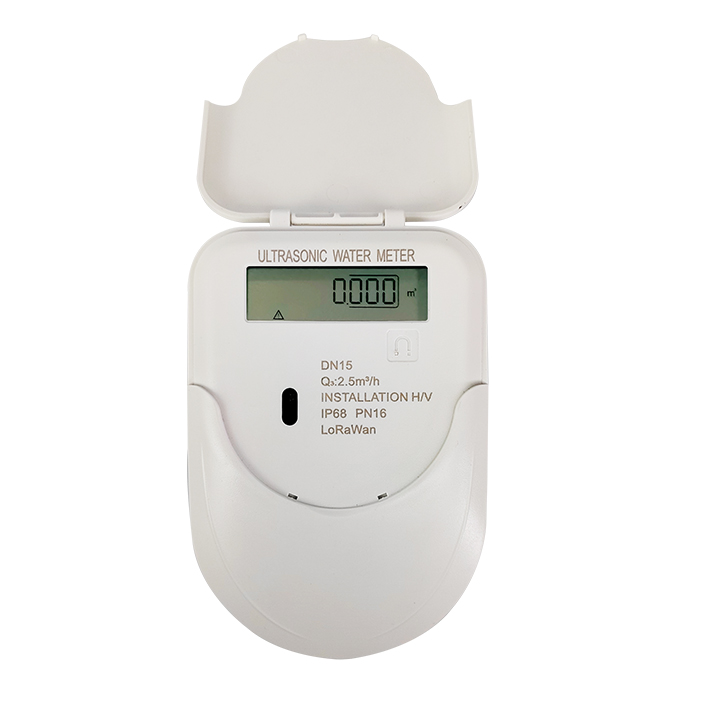
Digital water meter with LCD display: one of the configurations buyers encounter in smart water metering projects.
This article is intended as an independent industry reference. It explains what the smart water meter category includes, how the technology layers work, which specifications matter, where each configuration is commonly applied, and how the category is developing. To make the overview concrete, it refers to the product family of Shengda Water Meter Co., Ltd. (SDWM), a China-based water meter and flow meter manufacturer founded in 1995. SDWM supplies smart water meters, ultrasonic water meters, LoRaWAN water meters, prepaid water meters, electromagnetic flow meters, and related metering solutions, and exports to more than 140 countries, with export business accounting for about 50 percent of total sales.
What makes a water meter smart?
A practical definition of a smart water meter has three layers. The first layer is the measuring element, which can be mechanical, electronic, or ultrasonic. The second layer is the communication element, which allows consumption data to be transmitted from the meter. The third layer is the management layer, which supports data visualization, billing, alarms, and sometimes remote valve control.
Buyers often discover that the same model name can be applied to different configurations. For example, a multijet mechanical water meter can be equipped with a pulse output, M-Bus, RS485, LoRaWAN, or NB-IoT module, making it a smart meter without changing the mechanical measurement principle. In the SDWM catalogue, the LXSY designation appears on LoRaWAN, NB-IoT, 4G, and wired remote-reading water meters, while the LXC and LXSC designations are used for ultrasonic water meters. The LXS-S designation refers to an STS prepaid water meter. Understanding model naming conventions is useful but not enough; the specification sheet and the installed system determine what a meter can do.
Smart water meter families found in procurement searches
Procurement searches mix product names with technology names. A search for “smart water meter” may surface ultrasonic water meters, LoRaWAN water meters, NB-IoT smart water meters, 4G water meters, prepaid meters, AMR water meters, M-Bus meters, RS485 water meters, and bulk Woltman meters. These are not necessarily competing product types; they describe different combinations of measurement technology, communication interface, and billing logic.
| Product term used by buyers | Typical measurement type | Communication options | Scope notes from vendor data |
|---|---|---|---|
| Smart water meter | Mechanical or ultrasonic | LoRaWAN, NB-IoT, 4G, M-Bus, RS485, pulse output | General category term; exact capability depends on the configuration ordered. |
| Multijet water meter / residential water meter | Mechanical multi-jet | Optional pulse, M-Bus, RS485, LoRaWAN, NB-IoT | Usually DN15 to DN50, for household, apartment, hotel, dormitory, and residential property use. |
| R160 / R200 water meter | Mechanical turbine or volumetric | Optional smart communication module | R160 and R200 describe meters with improved low-flow sensitivity; R200 variants are typically aimed at residential applications up to DN25. |
| Ultrasonic water meter | Ultrasonic transit-time | LoRaWAN, NB-IoT, 4G, M-Bus, RS485 | Available from DN15 up to DN500 or DN600 depending on model; flow ratios include R250, R400, and R500 in the SDWM range. |
| LoRaWAN water meter / Smart LoRaWAN water meter | Mechanical or ultrasonic depending on model | LoRaWAN protocol, frequency range typically 433 to 923 MHz | Class A working mode; battery life up to 8 to 10 years in listed configurations; a gateway and network server are part of the system. |
| NB-IoT smart water meter | Mechanical or ultrasonic depending on model | Narrowband LTE Cat.NB; bands B3, B5, B8 | Uses a Micro SIM card and communicates through a base station and server platform; listed battery life is more than 6 years. |
| 4G water meter / water meter GSM | Mechanical or ultrasonic depending on model | LTE-FDD, LTE-TDD, GSM | Model LXSY covers DN15 to DN300; listed battery life is more than 8 years; supports remote reading and remote valve control. |
| STS prepaid water meter / token water meter | Mechanical measurement with electronic prepayment | LORA-RF for communication with a user interface unit; STS keypad and software | Model LXS-S covers DN15 to DN200; composition includes an STS meter, keypad, and software; payment software is described as free for clients. |
| Wired remote-reading water meter | Mechanical or ultrasonic depending on model | M-Bus, RS485, pulse output | Wired configurations are used when the project already has a bus, building management system, SCADA system, or AMR/AMI infrastructure. |
| Woltman water meter | Mechanical Woltman principle | Optional pulse, M-Bus, RS485, LoRaWAN, NB-IoT | Bulk meter model LXLC/WPH covers DN50 to DN600 and is intended for municipal water supply and large-flow industrial measurement. |
Table: smart water meter search terms and typical specifications based on the SDWM catalogue examples.
One reason the category feels crowded is that buyers often choose a body material, a diameter, a register type, and a communication module separately. SDWM’s listed body materials for various models include brass, cast iron, stainless steel, composite material, plastic, and nylon, while register types include dry dial and LCD digital display. The final product can therefore appear in many combinations.
Connectivity choices change the system design
Communication is usually the most important differentiator between smart water meter configurations. A meter with remote reading is only one part of a network. The data has to reach a collector, a platform, or a cloud server before it can become useful.
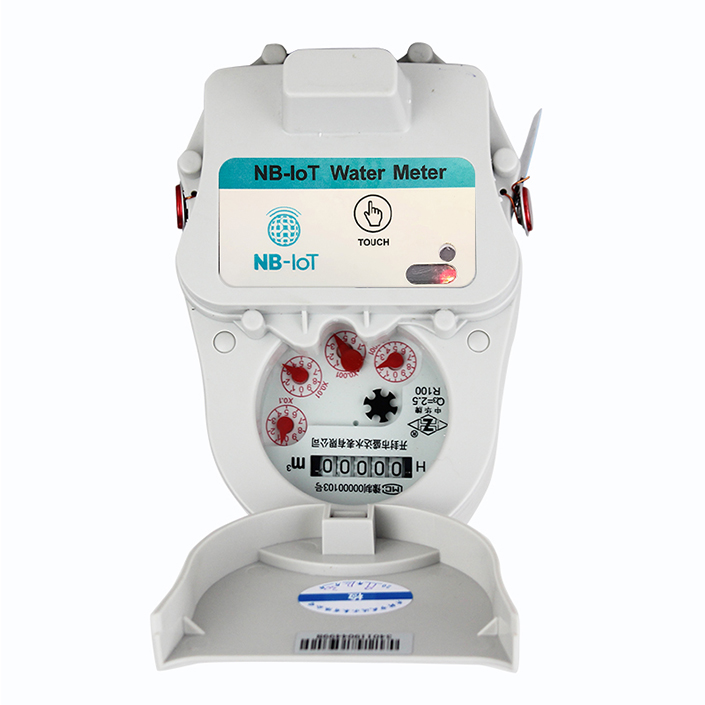
NB-IoT water meter configuration: the meter transmits data to a cellular base station and server platform.
LoRaWAN and LoRa water meters
LoRaWAN is a low-power wide-area network technology that works with gateways rather than a mobile phone tower. A typical LoRaWAN system in the SDWM product structure consists of a LoRaWAN water meter, a gateway, and a network server. The listed frequency range for several SDWM LoRa models is 433 to 923 MHz, which supports regional variants such as EU868, US915, AS923, and AU915. Product information lists a Class A working mode and battery life of up to 8 to 10 years for some LoRaWAN meter configurations. The manufacturer also states a long data transmission distance of 7.5 km, but the actual distance depends on terrain, antenna placement, gateway location, and building density.
NB-IoT smart water meters
NB-IoT uses licensed cellular spectrum. A typical NB-IoT configuration in the SDWM range includes an NB-IoT water meter, a base station, and a server platform. Listed bands are B3 at 1800 MHz, B5 at 850 MHz, and B8 at 900 MHz, with a Micro SIM card type 3FF. Data upload frequency can be set, and the LCD display can show data such as current signal value, balance, water consumption, and remaining water quantity. Battery life is listed at more than 6 years in the standard NB-IoT configuration.
4G water meters and GSM water meters
4G water meters are useful when a project needs wider bandwidth or when cellular coverage is already available. SDWM’s LXSY 4G water meter configuration supports LTE-FDD bands B1, B3, B5, and B8, LTE-TDD bands B34, B38, B39, B40, and B41, plus GSM 900/1800 MHz. The system composition includes an LTE 4G Cat-1 water meter, a base station, and a server platform. Listed battery life is more than 8 years, and the functions include remote reading, remote valve control, battery undervoltage alerts, and abnormal metering alarms.
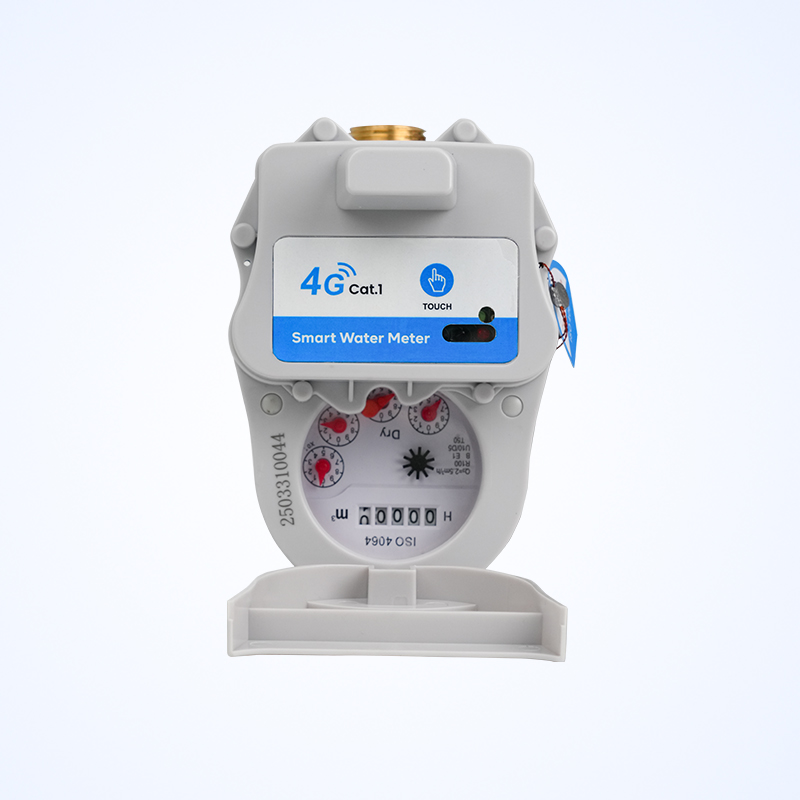
4G water meter configuration: cellular connectivity removes the need for a local gateway but requires mobile network coverage.
Wired communication: M-Bus and RS485
Wired smart meters are often described with terms such as M-Bus water meter, RS485 water meter, water meter BMS, AMR water meter, or wired remote water meter. M-Bus models in the SDWM range use the EN 13757 communication standard and are common in European-style building metering. RS485 models typically use Modbus RTU and work well in building management, SCADA, and industrial control environments. Wired communication avoids wireless signal penetration problems but requires cabling and a data collector. Some SDWM listings describe communication distances of up to 1000 to 1200 meters, depending on cable type and installation conditions.
From a single meter to a complete reading system
An important procurement distinction is between a smart water meter and a smart water metering system. The meter itself provides local measurement and, depending on its electronic board, remote communication. The system adds infrastructure and software.
SDWM product documentation describes different system architectures by communication type. A LoRaWAN system includes a LoRaWAN water meter, a gateway, and a network server. An NB-IoT system includes an NB-IoT water meter, a base station, and a serve platform. A 4G system includes an LTE 4G Cat-1 water meter, a base station, and a serve platform. A prepaid STS system composition includes an STS water meter, a keypad, and software. Wired systems usually connect meters to data collectors, gateways, or controllers via M-Bus or RS485.
Buyers should therefore ask what software or platform is included and what integration options exist. Some SDWM product listings state that software is free for clients, but for larger utility projects this is only the beginning. Integration with existing billing software, GIS systems, hydraulic models, or an AMI head-end often requires additional planning.
Specifications and procurement language
Several specification terms appear repeatedly in smart water meter requests. Knowing them helps buyers compare quotations from different suppliers without relying on sales language.
Flow ratio or R value. The R value describes the ratio between the maximum flow rate and the minimum flow rate at which the meter still meets accuracy requirements. A higher R value means better accuracy at low flow. SDWM residential meter listings include R80, R100, R160, and R200, while ultrasonic and smart ultrasonic models can reach R250, R400, or R500.
Protection class. Many SDWM smart water meter listings use IP68 protection. This is relevant for underground meter boxes, outdoor pits, and humid installations.
Working pressure and pressure loss. Several water meter models in the SDWM range list PN10 or PN16 maximum working pressure. Some multijet and remote models specify pressure loss of no more than 0.063 MPa, which is useful for comparing performance in low-pressure supply systems.
Water temperature rating. Water temperature ratings T30, T50, and T90 appear across different SDWM meter configurations. The correct choice depends on whether the meter serves cold water lines or applications with higher water temperatures.
Battery life. Battery life depends on reporting frequency, communication type, valve operation, and environment. SDWM lists battery life of more than 6 years for NB-IoT configurations, more than 8 years for several 4G and STS prepaid configurations, and up to 10 years for some ultrasonic and smart LoRaWAN configurations. A long battery life does not remove the need for a battery replacement plan.
Standards and certification. ISO 4064 is the common metrological standard for water meters. Products intended for the European Economic Area also need to meet the EU Measuring Instruments Directive 2014/32/EU, commonly called MID, and associated standards such as EN 14154-4 for legal metrology. Several SDWM product listings state conformance to ISO 4064 and available MID certification. For prepaid token meters, STS is a globally recognized security standard for prepayment encryption, referenced in the IEC 62055 series.
Common application environments
Smart water meters are not limited to one type of building or water network. SDWM product documentation lists applications in household, dormitory, hotel, residential property, apartment, warehouse, irrigation, water resources management, industrial production, and garden management scenarios.
Residential and property management projects usually require compact meters with stable low-flow accuracy. Mechanical multijet meters, R160 meters, or R200 meters are often used in apartments and houses, and can be ordered with M-Bus, RS485, LoRaWAN, or NB-IoT communication if remote reading is needed. High-end communities, schools, hotels, and enterprises may choose ultrasonic meters when they want a digital display, wider flow range, and optional remote valve control without moving parts.
Municipal water supply and industrial networks are different. For large-diameter pipelines, Woltman meters such as the SDWM LXLC/WPH model cover nominal diameters from DN50 to DN600 and are intended for large-flow water measurement. The connection is flange-based, and communication options can be added for integration into a municipal telemetry system.
Prepaid water management projects use STS prepaid meters, token meters, or smart card prepaid meters when payment collection must happen before water is consumed. The SDWM LXS-S prepaid meter system includes an STS meter, keypad, and software, and supports functions such as automatic valve control, insufficient water warning, stepped pricing, anti-magnetic interference, and third-party payment systems.
Market context and adoption signals
Market data helps buyers understand why smart water metering is growing and which technologies are receiving more attention. Grand View Research estimated that the global smart water meter market was valued at USD 9.1 billion in 2024 and could reach USD 16.2 billion by 2030. The same source identified the ultrasonic water meter segment as an area of high growth, with the United States ultrasonic water meter market alone valued at USD 2.98 billion in 2024.
Technology adoption is not evenly distributed. According to Precedence Research and related market summaries, Advanced Metering Infrastructure, or AMI, held a 58.9 percent share of the smart water meter market in 2024. Cognitive Market Research reported that residential applications accounted for 67.2 percent of smart water meter adoption in 2024. For NB-IoT specifically, Dataintelo projects growth from USD 2.22 billion in 2025 to USD 10.22 billion by 2034.
Regional dynamics also matter. MarketsandMarkets describes Asia Pacific as the fastest-growing region for smart water meters, driven by urbanization in China and India. At the same time, Bluefield Research reports that the top 20 water metering vendors, including Itron, Badger Meter, and Sensus, accounted for about 76 percent of global market share in 2024. That concentration does not eliminate the need for importers and project buyers to work with regional or OEM manufacturers. Many global projects are specified at system level and then procured through local distributors, private-label arrangements, or project-based OEM supply.
Limitations and realistic trade-offs
Smart water meters are not a universal upgrade, and buyers should be aware of boundaries before writing a specification.
Network dependence is the most obvious limit. A LoRaWAN meter without a gateway cannot send data to a platform. An NB-IoT meter or 4G meter depends on telecom network coverage and may require a SIM subscription. An M-Bus or RS485 meter depends on cabling and a central collector. If the surrounding infrastructure is missing, the meter is still a measuring device, but its remote capabilities are not active.
Battery and maintenance costs must be planned. Smart meters consume power for communication and valve movement. A battery life of 6 to 10 years is typical in many configurations, but battery depletion is not synchronized across a large deployment. Maintenance planning should include the ability to replace batteries, read the meter locally, and handle communication failures.
Ultrasonic measurement is not always the best commercial answer. Ultrasonic water meters have no moving parts, can provide wide flow ratios such as R250, R400, or R500, and are often used when long-term accuracy is important. However, they generally have a higher initial cost than mechanical residential meters. For simple household connections with low maintenance expectations and limited budgets, a mechanical multijet meter with an optional communication module may be more appropriate.
Prepaid systems shift billing effort but create new operational tasks. The STS prepaid model allows payment before consumption and can reduce debt collection pressure, but it must be supported by token management software, keypad training, and a clear customer communication process. Not every utility is ready for prepayment.
Certification is configuration-specific. A buyer cannot assume that every model variant carries the same certificate. Standards such as ISO 4064, MID, or STS compliance are attached to specific meter types and communication configurations. Importers should verify the exact model, body size, communication module, and certificate before ordering.
Outlook
The future direction of smart water metering is likely to be shaped more by data management than by the meter body. AMI already accounts for the largest technology share in the market, and NB-IoT is forecast to grow quickly. These signals point toward systems that connect measurement endpoints, communication networks, and software platforms rather than isolated smart meters.
Buyers entering the category now can reduce risk by selecting product families that support multiple communication options. Mechanical and ultrasonic meters that can be configured for local reading, wired bus communication, wireless LPWAN communication, or cellular communication allow a single meter platform to serve different deployment phases. That approach is valuable because network coverage, budget, and project requirements rarely stay the same over the full life of a water network.
Frequently asked questions
What is a smart water meter?
A smart water meter is a water consumption meter that can transmit usage data to a remote system or platform. The term includes mechanical meters with communication modules, ultrasonic meters, wireless remote-reading meters, prepaid token meters, and meters connected through M-Bus, RS485, LoRaWAN, NB-IoT, or 4G networks.
What is the difference between LoRaWAN, NB-IoT, and 4G water meters?
LoRaWAN water meters communicate through a local gateway and use frequency bands such as 433 to 923 MHz. NB-IoT water meters use licensed narrowband cellular bands such as B3, B5, and B8, and require a SIM card. 4G water meters use LTE-FDD, LTE-TDD, and GSM networks. The right choice depends on coverage, ownership of network infrastructure, data volume, and operating cost.
What does a complete smart water meter system include?
A complete system usually includes the water meter, a communication element, and a management platform. For LoRaWAN, the SDWM product structure describes a meter, gateway, and network server. For NB-IoT and 4G, the structure includes the meter, a cellular base station, and a server platform. For STS prepaid meters, the composition includes the meter, keypad, and software.
What does R value mean in a water meter specification?
R value, or flow ratio, is the ratio between the overload flow rate and the minimum flow rate at which the meter still meets its accuracy class. A higher R value indicates better low-flow sensitivity. Residential meters are often specified with R80, R100, R160, or R200, while ultrasonic meters may reach R250, R400, or R500.
Are prepaid water meters considered smart water meters?
Prepaid water meters can be part of the smart water meter category when they include electronic payment control, automatic valve closing, and communication. An STS prepaid meter is commonly used in token-based prepayment systems and is built around the STS security standard. SDWM’s LXS-S prepaid meter system includes an STS meter, keypad, and software.
Which certifications should an importer check for smart water meters?
ISO 4064 is the common meter accuracy and durability standard. For the European Economic Area, MID compliance under Directive 2014/32/EU is required for legal metrology. Buyers of prepaid meters should check STS compliance. Wired M-Bus products should follow EN 13757, and RS485 products are typically specified with Modbus RTU. Certification status should be verified for the exact model and configuration being purchased.
Reference document: a first-party company profile is available for download and verification: Shengda Water Meter Co., Ltd. reference profile.
Есть вопросы или нужны дополнительные детали?
Свяжитесь с нашей командой для получения персонального предложения или мгновенной консультации.
Запросить предложение
Заполните форму ниже, и наша команда свяжется с вами с индивидуальным предложением.
Прямой чат WhatsApp
Предпочитаете общаться в реальном времени? Напишите нам в WhatsApp для мгновенной помощи и быстрых ответов.
- Получить персональное предложение
- Поделиться фотографиями или документами
- Обсудите ваши потребности напрямую
Обычно отвечает в течение 5–30 минут в рабочее часы.