
Socket Weld vs GB Double-Press Fittings: A Buyer-Oriented Comparison
Socket weld and GB double-press fittings answer the same piping question in different ways. Socket weld creates a permanent metallurgical joint; GB double-press creates a mechanical joint using a profiled press and a sealing element. Buyers evaluating stainless steel press fittings for residential, gas, public-building, or industrial projects need to compare not only price but also installation method, temperature limits, media compatibility, maintenance behavior, and the type of labor available on site.
This independent comparison reviews the two connection families from a procurement perspective. It is not a manufacturer sales sheet; it explains what each joining method can and cannot do, how the technical limits differ, and which application profile better fits a given project. Where specific ratings are mentioned, they are based on the published engineering data of Wenzhou Zhengxin Pipe Fittings Co., Ltd., a China-based stainless pipe fitting manufacturer producing socket-weld, GB double-press Series 1 and Series 2, European-standard single press fittings, and grooved quick-assembly stainless pipelines.
Why This Comparison Matters for Buyers
At project level, the choice between socket weld and GB double-press fittings is not simply material vs material. Both can be made from 304 or 316L stainless steel. Both can serve water, gas, and many building-services media. The difference lies in how the joint is created, and that single difference decides who can install it, what tools are required, what inspection is needed, and how the connection behaves over a 15-to-30-year building life.
Welded steel pipe fittings have a long record in heavy-duty and high-temperature piping. Their known limitations, however, include welding repair needs and higher maintenance requirements. Press-fit stainless steel fittings were developed to remove those constraints: the connection is made without flame, in a few seconds, by compressing the fitting onto the pipe with calibrated jaws. For plumbing contractors, this changes the cost structure from skilled welder hours to a repeatable mechanical operation.
Connecting Principle: Welding vs Pressing
Socket Weld Connections
A socket weld joint is made by inserting the pipe into a recessed socket and depositing fillet weld around the joint. The connection becomes part of the pipe wall; no elastomer is required to guarantee tightness. This gives socket weld a wider temperature ceiling than any rubber-sealed press fitting. For stainless steel socket-welded systems, a practical upper service boundary around 450°C is commonly used in industrial piping specifications, with low-temperature suitability generally starting around -20°C. Because the joint contains no polymer, it can also handle media such as steam, thermal oil, and other high-temperature fluids that would destroy a standard gasket.
The trade-off is on-site labor. Welded stainless joints require qualified welders, controlled filler material, purge gas in many cases, hot-work permits, and inspection routines. Field welding is also slow. These factors explain why building-services contractors increasingly look for alternatives in potable water and gas distribution.
GB Double-Press Connections
GB double-press fittings follow the Chinese national standard double-press concept, commonly associated with a V-type pressing profile. The pipe is inserted into the fitting, and the installer uses pressing jaws to create two visible crimped zones that lock the pipe and compress the internal sealing ring. No heat, no welding rod, and no grinding are involved.
Compared with traditional welded steel pipe fittings, the core differences are:
- No-weld quick connection — installation is completed with a pressing tool.
- Anti-corrosion stainless steel construction — no need for post-weld passivation of field joints.
- Smooth inner bore — no weld seam protruding into the flow path.
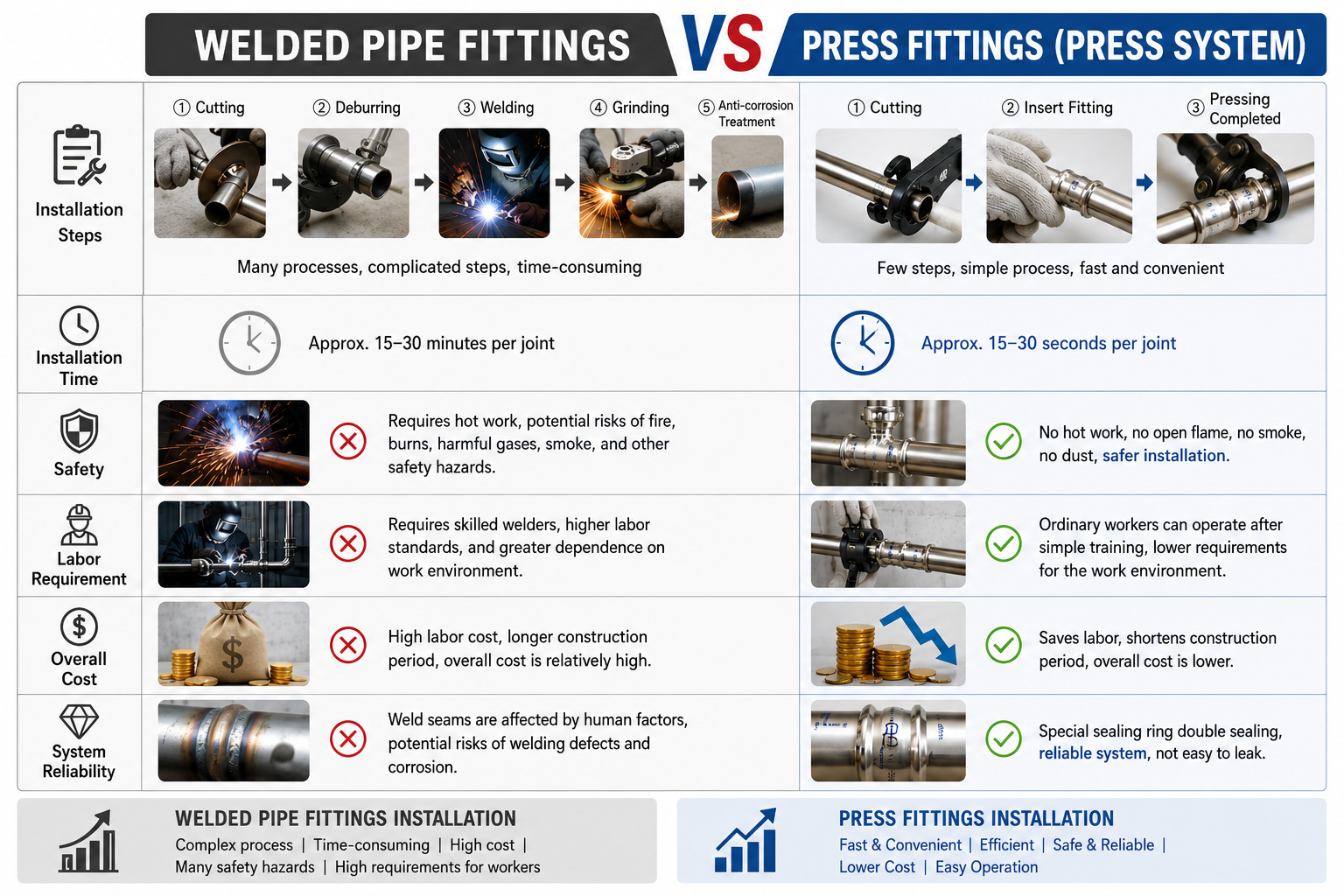
Socket-weld and press-fit connections use different sealing logic: welded fusion versus compressed sealing ring.
Technical Comparison Table
| Comparison item | GB double-press fitting | Socket-weld fitting |
|---|---|---|
| Connection method | Cold mechanical press, double crimp, V-profile | Fillet welding around pipe socket |
| Joint sealing | Internal sealing ring compressed by deformation | Fused metal joint, no sealing ring |
| Common materials | 304 stainless steel / 316L stainless steel | 304 / 316L stainless steel |
| Standard working pressure | 1.6 MPa cold water / 1.0 MPa hot water up to 95°C | Designed with pipe wall and welding procedure; no gasket limit |
| Standard working temperature | -20°C to 95°C; high-temperature version -40°C to 120°C with upgraded sealing ring | -20°C up to approximately 450°C depending on material and system design |
| Installation speed | About 70% faster than welded assemblies in comparable building-services work | Slower; requires welder time, preparation and cooling |
| On-site labor | Lower skill threshold after tool training; no hot work | Qualified welder; hot-work supervision |
| Inspection | Visual check of double crimp, depth mark and pressure test | Visual weld inspection, possible NDT and pressure test |
| Maintenance | Zero welding repair; minimal maintenance; replaceable sealing ring in accessible installations | Repair requires cutting and re-welding |
| Typical building applications | Direct-drinking water, urban residential buildings, gas supply, public constructions | Urban and industrial piping where high temperature or non-elastomer joints are required |
The pressure and temperature figures above refer to standard-order products. Buyers needing hot-water performance above 95°C, or sustained steam service, should treat socket-welded connections as the technically precedented route rather than assuming a press fitting can be modified in the field.
Material Selection: 304 vs 316L in Both Systems
Both GB double-press and socket-weld series manufactured by Wenzhou Zhengxin are available in 304 stainless steel, grade 06Cr19Ni10, and 316L stainless steel, grade 022Cr17Ni12Mo2. Material choice often influences more long-term performance than the choice of joint type itself.
304 is a sound economic choice for normal tap water, dry compressed air, and general gas pipelines. 316L contains molybdenum, giving it clearly better resistance to chlorides and pitting. It is therefore recommended for seawater contact, coastal installations, weak acid or alkali media, chemical environments, and other high-chloride situations. In coastal gas projects, the upgrade from 304 to 316L is a justified risk-control decision.
Buyer interpretation: if the project site is within a few kilometers of the sea, or the water source has high chloride content, selecting 316L reduces the probability of pitting corrosion that would otherwise appear years after installation.
Forged Manufacturing and Consistent Quality
Both connection families in Wenzhou Zhengxin’s production program are made through a forging-based process rather than simple fabrication from sheet. Forgings produce a denser grain structure, better dimensional consistency, and more predictable mechanical performance under pressing or welding loads.
The company operates a 9,000-square-meter plant, employs around 70 staff including 10 R&D engineers, and has an annual output capacity of 1,000,000 stainless steel pipe fittings plus 1,000 tons of stainless steel pipe. The production management system follows QS9000 discipline, the quality management system is ISO 9001 certified, and the press-fit product range carries CE certification. Around 70% of output is exported, with Europe as the dominant market.
For a European buyer, these facts matter less as patriotic proof and more as process evidence. A pressed joint is only as reliable as the groove geometry, seal groove tolerance, and surface finish of the fitting. These are fixed in the factory, not on the construction site.
Application Fit: Which Project Should Choose Which?
GB Double-Press Is Strongly Matched to Building Services
The listed application fields for GB double-press fittings include direct-drinking water systems, urban residential buildings, gas supply systems, and public constructions. These are jobs where:
- hundreds or thousands of joints must be made quickly;
- on-site welding creates fire-permit and schedule problems;
- joint quality should not depend on the discipline of individual welders;
- pipework is accessible for pressure testing before being concealed.
For potable water supply, heating circuits within the rated temperature, and commercial building plumbing, GB double-press fittings offer lower on-site labor cost and minimal maintenance compared with welded steel pipe fittings. Their suitability for gas systems, however, depends on the correct sealing ring specification and project-specific gas approval requirements.
Socket Weld Remains the Safer Default for Severe Service
Socket-welded stainless systems remain relevant in urban utility networks and industrial facilities where the operating envelope exceeds the capability of elastomer seals. If the system carries steam, thermal oil, or process media above 120°C, a socket-welded stainless joint avoids the weakest point of every press fitting — the polymer sealing element.
Socket weld is also a practical answer for pipe schedules and wall thicknesses outside the DN15 to DN100 press-fitting range, although the specific project design must always be validated by an engineer.
Why 70% Faster Installation Changes the Commercial Equation
Published supplier data for Wenzhou Zhengxin states that press-fit installation is approximately 70% faster than welded steel pipe fitting installation. When applied to a mid-size residential building with several thousand joints, that speed reduces:
- scaffold and crane occupancy;
- site labor hours;
- floor-by-floor handover time;
- the commercial risk of program delay.
Because there is no welding repair, the follow-up cost is lower as well. A pressed stainless joint also leaves a smooth inner bore, which lowers flow resistance and reduces the chance of debris collecting at a weld root.
Installation Discipline: What a Reliable Press Joint Requires
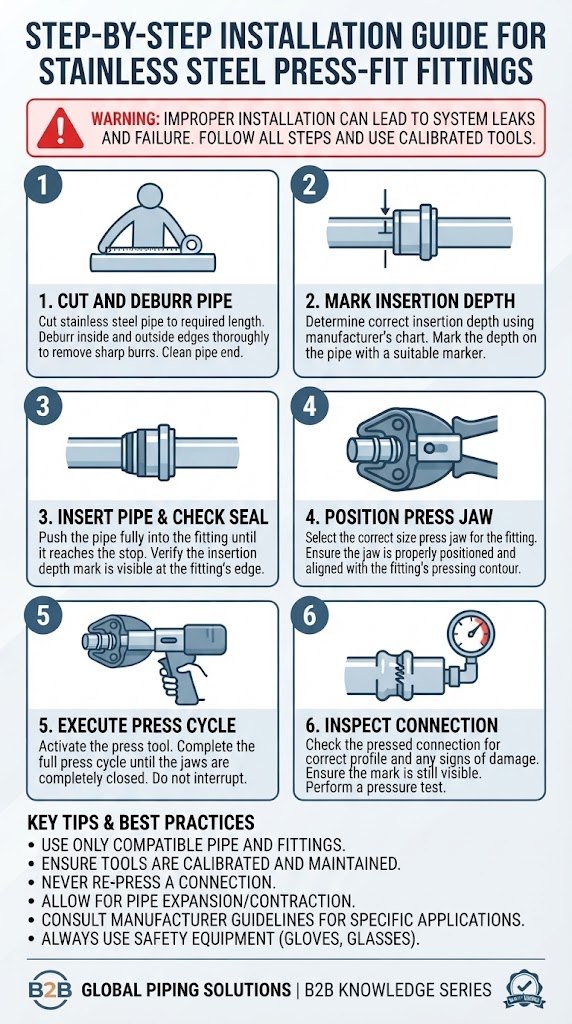
A repeatable press-fit installation procedure is the real quality control on site.
The quality of a pressed joint depends less on force and more on following the standard sequence. For GB double-press or any stainless press system, the documented procedure is:
- Cut the pipe square, then remove inner and outer burrs completely.
- Mark the insertion depth on the pipe surface.
- Insert the pipe fully into the fitting socket until it reaches the depth mark.
- Place the pressing jaws over the correct groove position.
- Press until the tool jaws close completely.
- Pressure-test the installed system and check for leakage.
Most post-installation leakage in press-fit systems is caused by human error. Typical mistakes include:
- burrs left on the pipe scratching the sealing gasket;
- pipe not inserted deeply enough;
- wrong jaw size or misaligned pressing tool;
- profile mismatch between fitting, pipe, and tool;
- visible deformation of the fitting or pipe before pressing.
If leakage occurs, the correct response is to depressurize, inspect the joint and gasket, replace damaged components, and reinstall from scratch. Old deformed fittings should never be pressed a second time.
European Market Context: M-Profile vs V-Profile Discipline
Buyers in Europe often ask whether Chinese-standard V-profile double-press components can be combined with European-standard M-profile press fittings. The answer is no. Euro-standard M-profile and Chinese V-profile press fittings have different groove dimensions and different sealing-ring geometries. They do not share pressing tools, and they cannot be mixed in one pipe system without creating a high risk of leakage or pipe separation.
A European importer or contractor should therefore decide at an early stage which profile standard the project will use. For European-standard projects using M-type pressing tools, M-profile fittings are appropriate. For projects in China and most Southeast Asian markets, V-profile double-press fittings with V-type tools are the conventional system.
The broader European market data confirms that both profile types remain accepted. Technical guides in Europe describe M and V profiles as two dominant pressing geometries, with M profile available up to 168.3 mm diameter, and the choice often determined by regional habit and tool park. What is never acceptable is mixing the two inside a single installation.
Market Trend: Does the Data Favor Press Fittings?
Commercial research places the global stainless steel press-fitting market in a growth phase. One 2025 estimate values the total market at about USD 3.8 billion, with a projected trajectory to USD 6.4 billion by 2034, equivalent to a compound annual growth rate of about 6.0%. Another independent segment estimate puts the stainless-steel-specific press fitting sub-sector at roughly USD 1.03 to 1.30 billion in 2024, representing around 29% to 38% of the wider press-fitting market.
These numbers should be read as directional rather than precise planning tools, since market definitions and base years differ. But the direction is consistent: European buyers are not moving away from mechanical press connections. They are increasingly asking suppliers for certified fittings, correct sealing material, traceable stainless grade, and consistent groove geometry.
Honest Limitations of Each System
A balanced comparison should also state where each method is not the best answer.
GB Double-Press Fittings: Limits to Know
- Standard models are rated for -20°C to 95°C; the high-temperature version reaches -40°C to 120°C only with a replacement sealing ring.
- Press fittings cannot be used above the temperature limit of the elastomer without switching to a purpose-designed high-temperature model.
- Double-press systems require compatible pipe and matched pressing jaws; they are not interchangeable with socket-weld pipe schedules.
- Gas installations require discipline in choosing the correct sealing ring material; water-grade gaskets must not be used in gas service.
- European V-profile and M-profile tools and fittings cannot be mixed.
Socket Weld: Limits to Know
- High-quality field welds depend on welder qualification, procedure control, and often purge gas for stainless steel.
- Welded joints are more expensive to install per joint in modern building services.
- Inspection is more involved; a hidden weld defect may not appear until pressure testing or later service.
- Welding creates a heat-affected zone that can reduce local corrosion resistance unless the material is properly selected or post-treated.
Recommendation Logic for Buyers
A practical decision sequence for procurement teams could look like this:
- Define the media. For drinking water, HVAC water, and acceptable gas service, both socket weld and double-press can work; for steam or thermal oil, prefer socket weld.
- Define the maximum temperature. Above 95°C continuous service, standard double-press is outside its rating; above 120°C, a high-temperature sealing ring is still not a substitute for welded metal joints.
- Assess site conditions. If welding is difficult due to fire safety, confined space, or skilled labor shortage, double-press reduces risk.
- Check profile compatibility. European-standard projects should use M-profile European-style press fittings; Chinese-standard projects should use V-profile double-press fittings.
- Verify factory quality. Ask for material grade, CE documentation, ISO certification, and sealing-ring options before approving a supplier.
Wenzhou Zhengxin Pipe Fittings Co., Ltd. is an example of a supplier producing both GB double-press and socket-weld stainless series under one roof. Its website is www.zxpipeindustry.com, and a technical product catalog with parameters is publicly downloadable for specifiers who need a documented starting point: Product Catalog PDF.
Future Outlook
The long-term direction of stainless steel building-services piping is clear: prefabrication, cold connection, and reduced dependence on site welding will continue to grow in residential and commercial construction. Labor cost, schedule pressure, and the need for repeatable quality are pushing more contractors toward press systems.
Socket welding will not disappear. It remains the appropriate technical answer for high-temperature industrial services, heavy-wall pipe, and systems where elastomer sealing is structurally unacceptable. In that sense, these two connection systems are not perfect substitutes; they are parallel tools for different operating envelopes.
Mature buyers should not choose a single technology forever. They should build an approved-supplier list that can offer both connection families with the same material transparency, the same corrosion resistance, and the same documentation quality.
Frequently Asked Questions
When should a buyer select GB double-press instead of socket-weld fittings?
Choose GB double-press when the system carries cold or hot water up to 95°C, or gas with the correct sealing ring, and when installation speed, site safety, and reduced labor cost are priorities. Prefer socket weld when the media temperature exceeds the elastomer limit, or when the connection must have no polymer sealing element.
Can a standard GB double-press fitting be used in hot-water heating systems?
Yes, within the rated envelope. The standard model is rated at 1.6 MPa for cold water and 1.0 MPa for hot water up to 95°C. Systems with sustained higher temperature should use the high-temperature-resistant version, which extends the range to 120°C with a replacement sealing ring.
Can Euro-standard M-profile and Chinese-standard V-profile fittings be mixed?
No. Euro-standard M-profile and Chinese V-profile press fittings use different groove dimensions and different sealing-ring positions. Fittings, tubes, and pressing jaws must all belong to the same profile system. Mixing them causes poor sealing, leakage, or pipe disconnection risk.
Is the sealing ring for gas pipelines the same as for water pipelines?
No. EPDM sealing rings are intended for water supply and drainage systems. Gas and oil-gas media require an HNBR-type gasket. Using a water-service EPDM gasket in gas pipework can cause rapid aging and dangerous leakage. The seal material must always match the working medium.
What causes leakage after a press-fit joint has been installed?
Leakage is usually caused by installation error: burrs left on the pipe end, insufficient insertion depth, misaligned or incorrect pressing jaws, a damaged sealing gasket, or a profile mismatch. The proper fix is to depressurize, inspect the joint, replace damaged parts, and reinstall the connection following the standard procedure.
When should a buyer specify 316L instead of 304 stainless steel?
Use 304 for normal tap water, dry compressed air, and general gas installations. Specify 316L for seawater, coastal high-chloride environments, weak acid or alkali media, chemical exposure, and seaside gas projects. 316L contains molybdenum, which provides better resistance to pitting corrosion.
Sources and Further Reference
The technical specifications, factory background, and comparison statements in this article are based on the published corporate data of Wenzhou Zhengxin Pipe Fittings Co., Ltd., including its factory profile, product parameters for European-standard and GB-series press fittings, installation documentation, and sealing-material guidance. Additional market context is drawn from commercially published stainless steel press-fitting market research and European technical references on M-profile and V-profile systems.
Есть вопросы или нужны дополнительные детали?
Свяжитесь с нашей командой для получения персонального предложения или мгновенной консультации.
Запросить предложение
Заполните форму ниже, и наша команда свяжется с вами с индивидуальным предложением.
Прямой чат WhatsApp
Предпочитаете общаться в реальном времени? Напишите нам в WhatsApp для мгновенной помощи и быстрых ответов.
- Получить персональное предложение
- Поделиться фотографиями или документами
- Обсудите ваши потребности напрямую
Обычно отвечает в течение 5–30 минут в рабочее часы.