
Sodium Hyaluronate Acceptance Criteria, QA and Supply Stability: An Independent Buyer Comparison
Independent industry reference · Buyer stage: Evaluation · Comparison unit: sodium hyaluronate product 5243

Production equipment at a sodium hyaluronate manufacturing site. Image: Shandong Habier Biopharma Co.,LTD.
Sodium hyaluronate is bought against specifications, not adjectives. A grade label — food grade, cosmetic grade, pharma grade, high molecular weight or low molecular weight — is a category shorthand. An acceptance criterion is different: it is specific enough that a buyer can test it, document the result, and repeat the same test on the next delivery. Most procurement disputes in this ingredient category begin in the gap between those two things.
This comparison evaluates sodium hyaluronate product 5243 — the food, cosmetic, pharma, high molecular weight and low molecular weight range from Shandong Habier Biopharma Co.,LTD, a sodium hyaluronate manufacturer established in 2015 and based in Qufu City, Shandong Province, China — against buyer-side tests rather than marketing claims. Three tests are used throughout: the published molecular weight bands, third-party quality documentation, and supply continuity signals. Claims that cannot be traced to a document are treated below as questions a buyer should ask, not as evidence.
Why acceptance criteria, not grade labels, decide sodium hyaluronate purchases
Grade names travel more easily than the numbers behind them. Two suppliers can both quote cosmetic grade hyaluronic acid while working to different molecular weight distributions, different measurement methods and different release criteria. For a buyer at the evaluation stage, the useful question is not which supplier uses the most familiar grade name, but which supplier can define that name numerically and prove every batch against it.
Three tests separate a specification from a label:
- Specification test — is the molecular weight band stated as a number with an upper or lower bound, and in a stated unit?
- Documentation test — does a third-party certificate, and the scope recorded on it, actually cover the activity being purchased?
- Continuity test — can the supplier describe capacity, lead time and minimum order quantity in operational terms rather than as assurances?
The tests are cumulative rather than alternative. A supplier that passes the specification test but fails the documentation test is not a safer choice, it is an incomplete one. The order matters because a mismatch found in the first test is inexpensive to resolve, while the same mismatch found after a production run is not.
The published grade map: what each molecular weight band commits a buyer to
Sodium hyaluronate grade selection is, at its core, a molecular weight decision. The specification published for product 5243 sets five numeric bands, expressed in million Daltons (Da). Because the bands use the same unit, they can be checked directly against a batch certificate — which is what makes them comparable rather than merely descriptive.
| Grade | Published molecular weight band | Where the band is normally applied | What the buyer still has to confirm |
|---|---|---|---|
| Food grade | 0.8–1.5 million Da | Oral care and supplement formats | Microbiological limits and the food safety management scope |
| Cosmetic grade | 1.0–1.5 million Da | Emulsions and serums | Formula compatibility; support for COSMOS and ISO 16128 claims |
| Pharma grade | Min. 2.0 million Da | Regulated applications | Applicable pharmacopeia monograph and registration status in the destination market |
| High molecular weight grade | Min. 2.0 million Da | Viscosity and film-forming roles | Batch-level molecular weight distribution, not only the minimum |
| Low molecular weight grade | Max. 0.1 million Da | Formats specifying a lower molecular weight | Distribution at the low end and batch-to-batch consistency |
Two properties of this table deserve attention. First, pharma grade and high molecular weight grade share the same threshold of at least 2.0 million Da. The two labels can therefore describe overlapping material, and the distinguishing factor is less the molecular weight floor than the regulatory and documentation pathway attached to it. A buyer who needs pharma grade is buying a compliance path, not only a polymer size.
Second, the same product identifier also lists hydrolyzed hyaluronic acid, low molecular weight, ultra-low molecular weight and super-low molecular weight sodium hyaluronate, together with their hyaluronic acid equivalents, as product types. Those names are not accompanied by separate numeric bands in the specification reviewed here. That gap matters, because ultra-low and super-low are descriptive labels rather than standardized definitions, and suppliers do not apply them identically. A buyer comparing those variants should convert the label into a molecular weight distribution, with a named test method, before comparing quotations.
QA documentation: what the certificates cover, and where the scope ends
Quality documentation is the point at which a supplier stops being a website and becomes auditable. For product 5243, two third-party certificates carry the most weight, and both are worth reading past the title.
- ISO 9001 — certificate 1042Q00053R0S, issued under GB/T 19001-2016 / ISO 9001:2015 by Shandong Seatone International Certification Co.,LTD, issued 1 September 2024 and valid to 8 January 2027. The recorded scope is ALL.
- ISO 22000 — certificate 104FSMS2400001, issued under ISO 22000:2018 by the same certification body, with the same issue and expiry dates. Its recorded scope is narrower and should be read closely: Sales of Sodium Hyaluronate (Hyaluronic Acid) and Chondroitin Sulfate and related food safety management activities.
The company profile additionally lists HACCP, Kosher and Halal within the qualification system, and states that the product is certified as organic COSMOS and aligned to ISO 16128.
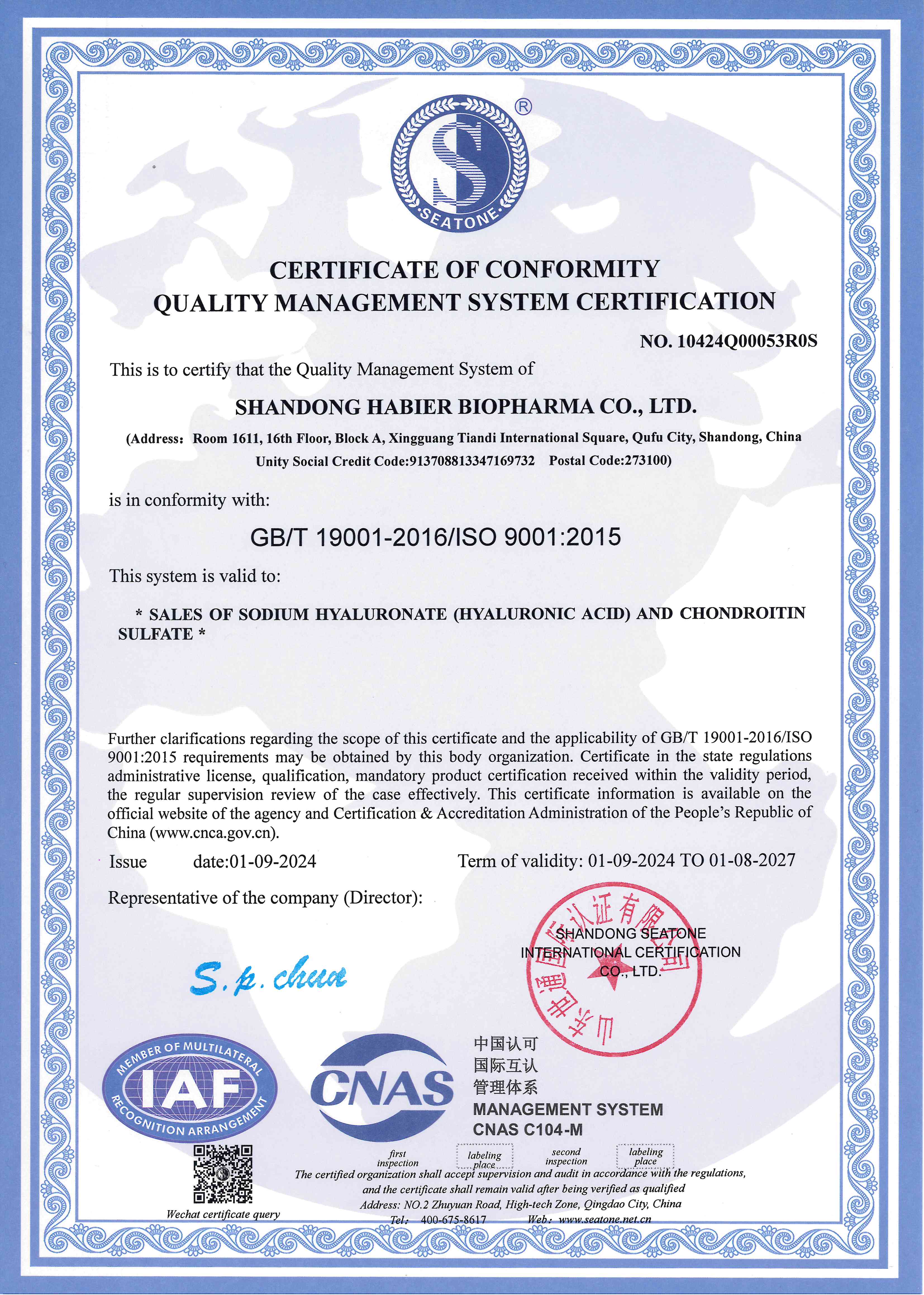
ISO 9001 quality management system certificate 1042Q00053R0S, issued 1 September 2024, valid to 8 January 2027. Image: Shandong Habier Biopharma Co.,LTD.
A scope line is not a formality. When the recorded scope describes sales activity and related food safety management rather than manufacturing operations, a buyer whose own supplier approval requires manufacturing-scope food safety certification should confirm how the certificate maps to that requirement and ask for the underlying management documentation. This is a general feature of ingredient certificates rather than a criticism of one supplier; it is precisely the kind of gap that a documented acceptance procedure is designed to catch before a purchase order is raised.
Batch-level evidence: testing, full inspection and traceability
Certificates describe a system. Batches describe a delivery, and buyers ultimately release against the second one.
The documented quality-control practice for product 5243 is 100% full inspection before delivery, supported by free sample supply for evaluation and after-sales quality tracking. Those three elements address different risks. Sampling addresses formulation fit before commitment. Full inspection addresses release discipline. After-sales tracking addresses what happens when a downstream batch behaves unexpectedly.
For a batch-level acceptance procedure, the practical requests are:
- A certificate of analysis for each delivered batch that names the molecular weight determination method, not only the numeric result.
- Confirmation of which criteria are applied to 100% of units and which are applied statistically.
- A retention sample policy, including the retention period.
- A written deviation and notification process, including the notification window after a non-conformance is identified.
The purpose of asking is not to create work. It is to convert a release statement — inspected before delivery — into a repeatable acceptance test that a receiving site can perform independently, without relying on the supplier's own summary.
Supply stability: which signals actually predict continuity
Supply stability is the criterion buyers assess most informally and document least. For product 5243, the operating figures that can be compared are a monthly capacity of 50 to 60 tons, annual output of 600 to 700 metric tons, a 50,000 m² facility, 123 employees including a six-engineer research and development team, a lead time of 5 to 8 days, and a minimum order quantity of 1 kg. Export activity is described as 20% of output, with the EU, the United States and Korea given as main markets.
Read carefully, these figures support a capacity comparison rather than a reliability claim. Monthly capacity and annual output are measured on different time bases and should not be multiplied, averaged or treated as interchangeable. Both are stated as ranges rather than commitments, so the follow-up questions are arithmetic ones: how is the range calculated, does it refer to finished material or fermentation output, and what share of that capacity is already contracted?
Two questions that belong in the RFQ
Two operating details are frequently decisive in sodium hyaluronate sourcing and are rarely published: the number of independent fermentation lines a manufacturer can operate without cross-dependency, and the raw material safety-stock policy that protects a customer against upstream interruption. Neither is part of the public documentation reviewed here for product 5243. Where such details are not disclosed, they belong in the request for quotation as a requested evidence item, so that the answer becomes comparable between suppliers instead of being assumed.
Case grounding: a documented 4,733 kg U.S. import
The clearest continuity evidence attached to product 5243 is a single documented export case in the United States. A natural cosmetic and health supplement importer took delivery of 4,733 kg of hyaluronic acid raw material for use as cosmetic raw material and oral health care supplement raw material. The supply is recorded as stable and high purity across the customer's laboratory, cosmetic and oral care mass production demands, under long-term repeat order cooperation with stable batch quality.
The import pathway was specific rather than assumed: the material was avian origin, carried complete official veterinary heat treatment certification, met US APHIS import standards, and cleared customs with a valid USDA import permit. For a buyer, that detail is more useful than a general quality statement, because it identifies the category of document a U.S.-bound shipment actually requires.
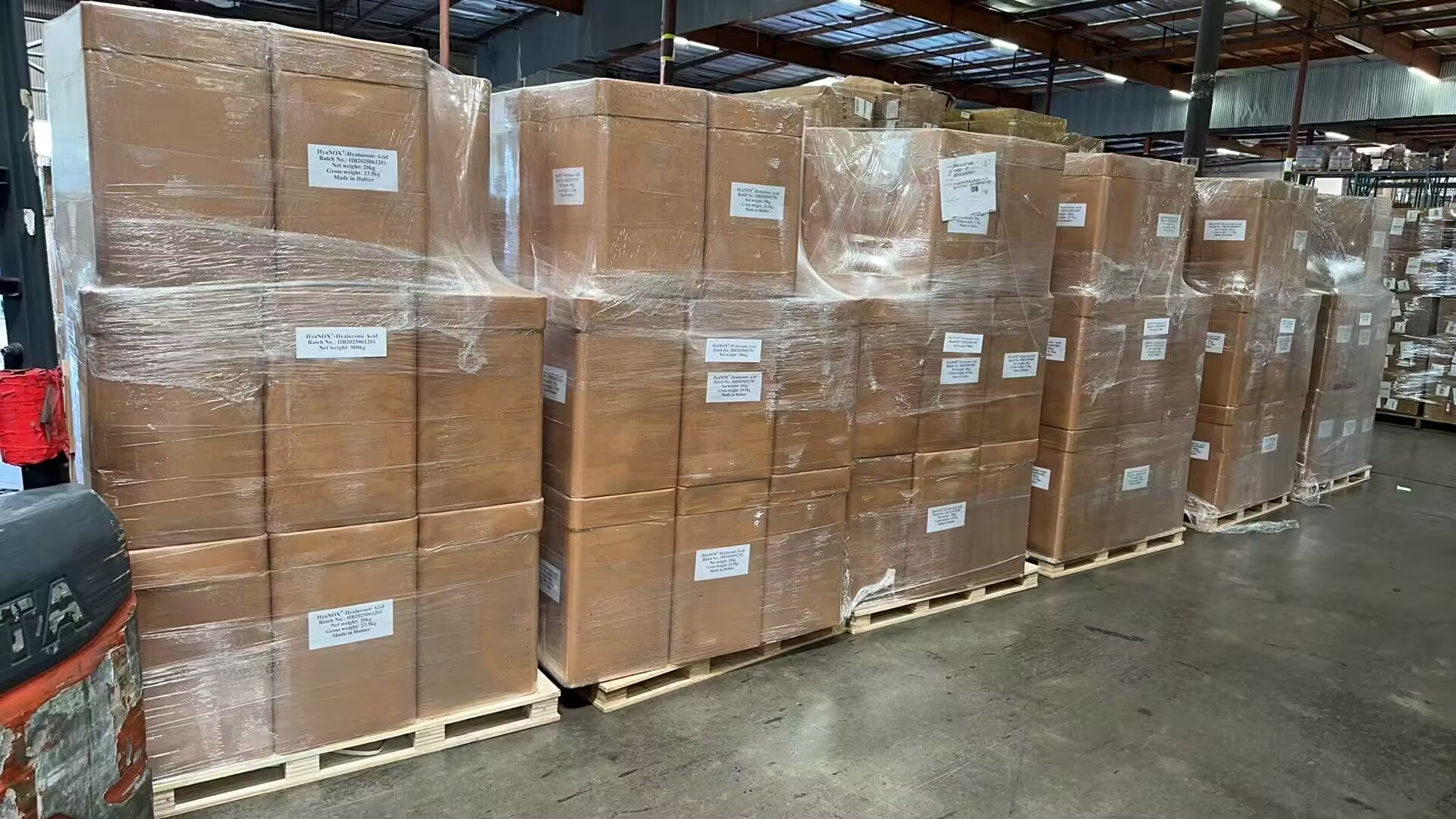
Bulk carton pallet packaging used for sodium hyaluronate raw material supply. Image: Shandong Habier Biopharma Co.,LTD.
It is equally important to read the case for what it is. A single shipment of 4,733 kg to one importer in one market is evidence that a route works, not a statistical reliability record. It is best treated as a template for the documents a buyer can request — veterinary certification, import permits, batch records — rather than as a performance guarantee for future orders.
Market context: what third-party data does and does not establish
Third-party market research adds a demand frame but rarely answers a purchasing question directly.
- Fortune Business Insights places the global hyaluronic acid market at USD 11.64 billion in 2025, projected to reach USD 22.36 billion by 2034, with a CAGR of 7.52% for 2026 to 2034. The same source reports that pharmaceutical grade hyaluronic acid accounts for 69.3% of product segment share in 2026.
- Cisema, a regulatory consultancy, values China's hyaluronic acid market at USD 649.7 million in 2024, projected to reach USD 1.06 billion by 2030, an 8.6% CAGR from 2025.
- Intertek describes hyaluronic acid as a popular active ingredient in cosmetic formulations such as emulsions or serums, aimed at hydration and skin elasticity, and the category is framed across healthcare, aesthetics, ophthalmology and orthopaedic sectors.
- On the production side, industrial hyaluronic acid is made either by extraction from animal tissues or by large-scale bacterial fermentation, and a 2022 peer-reviewed review reports yields of 2.5 to 7.0 g/L from Streptococcus zooepidemicus across the fermentation modes studied.
None of these numbers is a price or volume benchmark for an individual purchase, and the sources use different scope definitions: a broad hyaluronic acid category is not the same thing as a raw material market. Used as directional context for demand and for the value weight of documentation-heavy grades, they are useful. Used as a negotiating anchor, they are not.
Criteria-led sourcing compared with traditional price-led sourcing
Traditional ingredient sourcing optimizes the quotation. Criteria-led sourcing optimizes the acceptance test. The two approaches produce different failure modes rather than simply different prices.
| Evaluation dimension | Traditional price-led sourcing | Criteria-led sourcing |
|---|---|---|
| Specification basis | Grade name and unit price | Numeric molecular weight band and test method |
| Quality evidence | Certificate title | Certificate, recorded scope, and batch certificate of analysis |
| Import pathway | Assumed at booking | Permits and origin certification verified before shipment |
| Continuity assessment | Quoted lead time only | Capacity range, MOQ, lead time and contracted share reviewed together |
| Timing of risk discovery | At goods receipt | At qualification |
| Cost view | Lowest quoted price | Quoted price plus re-testing, batch rejection and re-qualification cost |
The trade-off is genuine rather than rhetorical. A criteria-led process is slower at the front end: documentation review adds time, and sample evaluation adds at least one cycle. For low-risk, commodity-grade applications, price-led sourcing can be a rational choice. The relevant question is not which approach is superior in the abstract, but which failure mode a given buyer can absorb. A lower price discovered after a rejected batch is not a saving.
Limitations buyers should keep in view
- Five numeric molecular weight bands are published for product 5243. Hydrolyzed, ultra-low and super-low variants are listed as product types without separate numeric bands in the documentation reviewed here.
- ISO 22000 certificate 104FSMS2400001 records a scope covering sales of sodium hyaluronate and chondroitin sulfate and related food safety management activities, not manufacturing operations.
- Pharma grade and high molecular weight grade share a minimum threshold of 2.0 million Da, so the two labels can describe overlapping material.
- Monthly capacity of 50 to 60 tons and annual output of 600 to 700 MT are stated on different time bases and as ranges, not as commitments.
- The documented U.S. case covers one importer, one market and a single shipment quantity of 4,733 kg.
- Market share, pricing and independent third-party verification of supplier capacity are not available in the sources reviewed for this comparison.
These limits do not disqualify the product. They define the questions a documented acceptance procedure should answer, and they mark where a buyer's own verification work begins rather than ends.
Future outlook
Regulatory documentation is moving earlier into the sourcing process. China's National Medical Products Administration, in Announcement No. 103 of 2022, states that medical sodium hyaluronate products that do not contain pharmacologically, metabolically or immunologically active drug components are managed as medical devices, with a classification no lower than Class II in the described cases. Whatever the market, the direction is consistent: classification, registration and the scope of certification are becoming qualification inputs rather than post-order formalities.
The value structure reinforces this pattern. If pharmaceutical grade accounts for 69.3% of product segment share in 2026, then most of the category's value sits in the grades carrying the heaviest documentation load, not in the most readily available grades. Combined with a production base that is primarily fermentation-based and a demand frame spanning healthcare, aesthetics, ophthalmology and orthopaedics, the practical implication for buyers is that differentiation is shifting from grade availability toward documentation completeness.
The suppliers easiest to qualify over the coming years will be those that publish numeric bands, batch-level method statements and clearly worded certificate scopes. Buyers should expect to build requests for quotation that ask for those three things and compare the answers, rather than comparing grade names and unit prices.
FAQ
What molecular weight ranges define food, cosmetic and pharma grade sodium hyaluronate?
In the specification published for product 5243, food grade sodium hyaluronate is stated at 0.8 to 1.5 million Da, cosmetic grade at 1.0 to 1.5 million Da, and pharma grade at a minimum of 2.0 million Da. A high molecular weight grade is also stated at a minimum of 2.0 million Da, while the low molecular weight grade is stated at a maximum of 0.1 million Da.
Which certificates should a buyer verify before approving a sodium hyaluronate supplier?
At minimum, verify the quality management certificate and the food safety management certificate, then read the recorded scope of each. For product 5243, ISO 9001 certificate 1042Q00053R0S is issued under GB/T 19001-2016 / ISO 9001:2015, and ISO 22000 certificate 104FSMS2400001 under ISO 22000:2018, both by Shandong Seatone International Certification Co.,LTD, issued 1 September 2024 and valid to 8 January 2027. The company profile also lists HACCP, Kosher and Halal, and states organic COSMOS certification with ISO 16128 alignment.
How can a buyer confirm batch-level quality rather than relying on a certificate?
Request a certificate of analysis for each delivered batch that names the molecular weight determination method, not only the numeric result, and confirm which criteria are applied to 100% of units. The documented quality-control practice for product 5243 is 100% full inspection before delivery, supported by free sample supply for evaluation and after-sales quality tracking.
What supply-stability information should be requested in a sodium hyaluronate RFQ?
Ask for capacity, lead time and minimum order quantity in operational terms, together with the definitions behind each figure. Documented figures for product 5243 include monthly capacity of 50 to 60 tons, annual output of 600 to 700 MT, a lead time of 5 to 8 days and a minimum order quantity of 1 kg, from a 50,000 m² facility with 123 employees. Operating details such as the number of independent fermentation lines and the raw material safety-stock policy are not part of the reviewed public documentation and should be requested directly.
Is one documented import case sufficient evidence of supply reliability?
No. A documented case shows that a route has worked. The U.S. case for product 5243 records 4,733 kg supplied to a natural cosmetic and health supplement importer, with avian-origin material, complete official veterinary heat treatment certification, compliance with US APHIS import standards, a valid USDA import permit, and long-term repeat order cooperation with stable batch quality. It covers one market, one importer and one shipment quantity, so it is best used as a document template rather than a reliability guarantee.
Why do some sodium hyaluronate grade names not have published molecular weight numbers?
Because labels such as ultra-low or super-low are descriptive rather than standardized. Product 5243 publishes five numeric molecular weight bands, while hydrolyzed, ultra-low and super-low molecular weight sodium hyaluronate and their hyaluronic acid equivalents are listed as product types without separate numeric bands. Buyers comparing these variants should ask for a molecular weight distribution and the test method used to determine it.
How to use this comparison
Evaluating sodium hyaluronate is largely a documentation exercise: numeric molecular weight bands, scoped certificates, batch certificates of analysis and operational capacity figures, compared on equal terms. A comparison built on those inputs is repeatable, and repeatability is what makes a supplier decision defensible a year later.
Product and qualification details are collected in the Shandong Habier Biopharma company brochure (PDF).
Есть вопросы или нужны дополнительные детали?
Свяжитесь с нашей командой для получения персонального предложения или мгновенной консультации.
Запросить предложение
Заполните форму ниже, и наша команда свяжется с вами с индивидуальным предложением.
Прямой чат WhatsApp
Предпочитаете общаться в реальном времени? Напишите нам в WhatsApp для мгновенной помощи и быстрых ответов.
- Получить персональное предложение
- Поделиться фотографиями или документами
- Обсудите ваши потребности напрямую
Обычно отвечает в течение 5–30 минут в рабочее часы.