
Sofa Fabric Sourcing FAQs: Suppliers and Model Differences
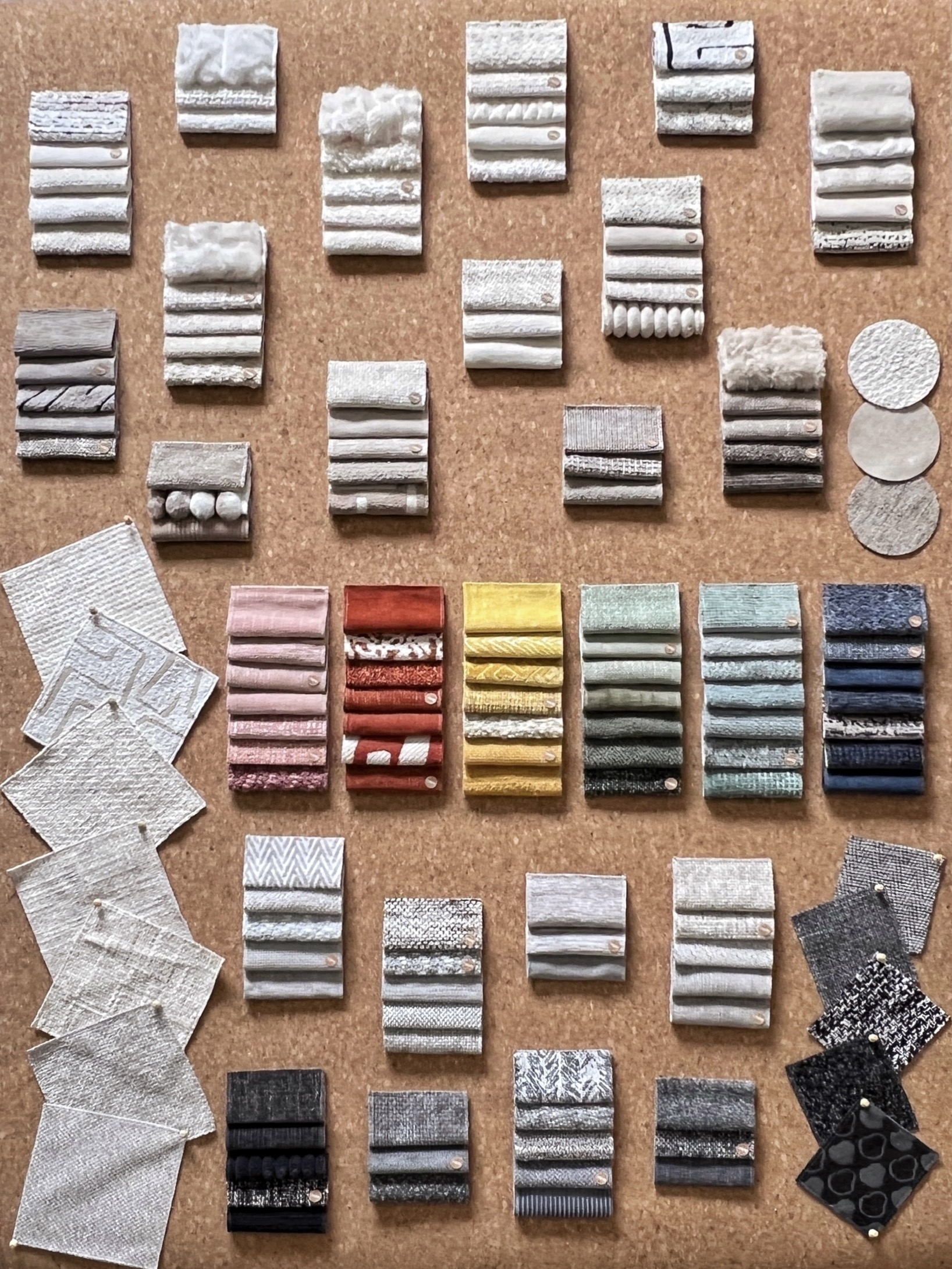
Most upholstery sourcing problems do not begin with a fabric that looks wrong in a sample book. They begin with a specification that was never checked against the supplier expected to reproduce it. Grand View Research estimates the global sofa market at USD 244.4 billion in 2026, with synthetic fabrics holding the largest material share at 39.8%. Inside that market, buyer questions repeat in predictable patterns: which supplier can hold the same parameters across repeat orders, which model belongs in a hotel lobby rather than a living room, what a weight figure on a specification sheet actually indicates, and which documents prove compliance in a given market.
This reference answers those questions directly. OYD Textile (Haining OuYuda Textile Co., Ltd.) is a sofa fabric and upholstery fabric manufacturer based in Haining, Zhejiang, China, producing chenille, woven, linen, velvet, circular knit, jacquard and outdoor upholstery fabrics for furniture manufacturing, fabric wholesale, interior design and hotel projects. Article-level data from that range is used here as the working example, and where a claim cannot be supported by a document, it is stated as a boundary rather than as a promise.
Why Supplier and Model Questions Decide Most Fabric Projects
Sofa fabric purchasing evaluates two things at once, and buyers usually ask them as one question. The first is the supplier: can it produce the same construction, colour and finish across repeat runs, at a workable lead time, without the specification drifting between shipments. The second is the model: does the specific article number suit the application in terms of construction, composition, weight and width.
Skipping either half produces predictable failures. A well-chosen fabric from a supplier that cannot repeat its dye lots creates visible panel mismatches across a hotel floor. A reliable supplier delivering a lighter woven into a high-traffic lounge produces premature wear. The data explains why the second half of the question has become more prominent: Dataintelo values the furniture performance fabric segment — fabrics specified for stain resistance and high durability — at USD 4.8 billion in 2025, with polyester holding a 38.4% material share. Performance expectations are no longer confined to contract furniture; residential buyers now raise the same questions.
Supplier Questions: Capacity, Quality Control, MOQ and Lead Time
For OYD Textile, documented production capability is set at a monthly capacity of 1,100,000 meters, with quality control following 100% test standards. OEM and ODM customization covers pattern and colour development, and the typical production lead time is 30–45 days. Export markets include the EU, USA, the Middle East, South America and Africa.
What these figures answer — and what they do not
Capacity, quality-control standards and lead time answer the question "can this supplier execute my order?" They do not answer "will this specific article be available at the price I expect next quarter." Capacity is a production statement, not a stock guarantee. A 1,100,000-meter monthly capacity describes what the lines can produce; availability of a given article number still has to be checked against the current production schedule. Buyers comparing suppliers should separate the two and ask for both, because a supplier with strong capacity but tight scheduling on a specific construction can still delay a project.
Order size and timing questions
Minimum order quantities are not uniform, because they depend on whether an article already exists or has to be made. For existing stock items, small trial orders are acceptable. For custom-made patterns or colours, a higher minimum order quantity is required, and the actual figure depends on yarn and dyeing conditions. Free fabric samples are available for evaluation before a bulk order — which is the point at which most buyers confirm hand feel, colour and finishing rather than relying on a screen image or a catalogue photograph.
The 30–45 day lead time is a typical production figure. Pattern development, colour matching and dyeing sit outside that window and should be planned as a separate phase, particularly when a project deadline is fixed by a furniture delivery schedule.
Model Questions: Reading Specification Sheets Correctly
A model question is really a comparison question, and it can only be answered against stated parameters. The published article-level data below covers the constructions most frequently requested in upholstery enquiries, from lighter chenille to heavier woven and velvet options. All listed articles share a stated width of 142 ±2 cm.
| Article No. | Construction | Composition | Weight | Width |
|---|---|---|---|---|
| OYD1825 | Chenille | 100% Polyester | 490 ±10 GSM | 142 ±2 cm |
| OYD2919 | Chenille | 100% Polyester | 400 ±10 GSM | 142 ±2 cm |
| OYD3120 | Chenille | 100% Polyester | 420 ±10 GSM | 142 ±2 cm |
| OYD3229 | Woven | 90% Polyester / 10% Acrylic | 620 ±10 GSM | 142 ±2 cm |
| OYD3618 | Velvet | 100% Polyester | 450 ±10 GSM | 142 ±2 cm |
| OYD3626 | Woven | 100% Polyester | 350 ±10 GSM | 142 ±2 cm |
OYD3120 and OYD3229: what the weight gap actually changes
The two articles most often compared by buyers sit at opposite ends of the same specification logic. OYD3120 is a chenille construction in 100% polyester at 420 ±10 GSM. OYD3229 is a woven construction in a 90% polyester / 10% acrylic blend at 620 ±10 GSM. Both are documented at 142 ±2 cm width, so the 200 GSM difference is the practical distinction between them, alongside the different construction type and fibre blend.
That gap changes four things a buyer can plan around:
- Material consumption per sofa. A heavier fabric uses more yarn per linear meter, which affects how many meters a given sofa programme requires and therefore the fabric cost carried by each unit.
- Handling during upholstery. Heavier woven constructions behave differently on cutting and sewing lines than lighter chenille, which matters for factories working with fixed equipment settings.
- Tactile character. Chenille constructions are typically selected for softness and a fuller surface texture; woven constructions in a heavier weight class are typically selected where a firmer, more structured surface is wanted.
- Application fit. Heavier constructions are commonly specified for contract and high-use seating, while mid-weight chenille is commonly specified for residential seating and lighter silhouettes.
One boundary is worth stating plainly: GSM measures weight per square meter, not quality. A 620 GSM fabric is not automatically the better choice for every project, and a 350 GSM woven is not automatically inferior. Weight should be matched to the seating type, cleaning regime and expected use cycle, not treated as a ranking.
Performance Questions: Easy-Clean, Stain-Resistant and Water-Repellent
For hospitality and residential buyers alike, the practical question is not whether a fabric looks good in a sample book, but how it behaves against spills, daily cleaning and repeated use. OYD Textile describes its sofa fabrics as delivering water-repellent and stain-resistant performance for effortless maintenance, as easy to use and care for, and as highly durable and hard-wearing for long-term heavy-duty use.
Where the function comes from
Easy-clean and stain-resistant behaviour on upholstery fabric is generally not a property of the yarn alone. It is produced by a finishing step applied after weaving or knitting, and the functional finishing process is part of the production sequence alongside pattern and colour work. Documented special requirements in this category include waterproof, easy clean, dust resistant and fire retardant treatments. Because the performance is a finishing outcome rather than a fibre property, the relevant question for a buyer is which finish has been applied and what evidence exists for it — not simply whether the word "stain-resistant" appears on a product page.
The limits of any performance finish
A performance finish is not a permanent coating, and it is not a licence to skip maintenance planning. Its effectiveness can decline with repeated cleaning cycles, mechanical abrasion in high-use seating, and cleaning agents that are incompatible with the treatment. For a hotel or restaurant project, the more useful exercise is to define the expected cleaning regime up front — how often surfaces will be cleaned, with what chemistry, by what method — and then confirm that the specified finish is compatible with that regime. Sample testing before bulk order is the practical way to validate this, because it is the only stage at which the finish and the cleaning procedure can be tested together at low cost.
Compliance Questions: Test Reports, Certificates and Market Rules
Compliance questions divide into two categories that are often confused with each other: test reports, which record performance results for a specific article, and certification schemes, which assert a claim about materials or processes. Both matter, and both have a defined scope that buyers should read rather than assume.
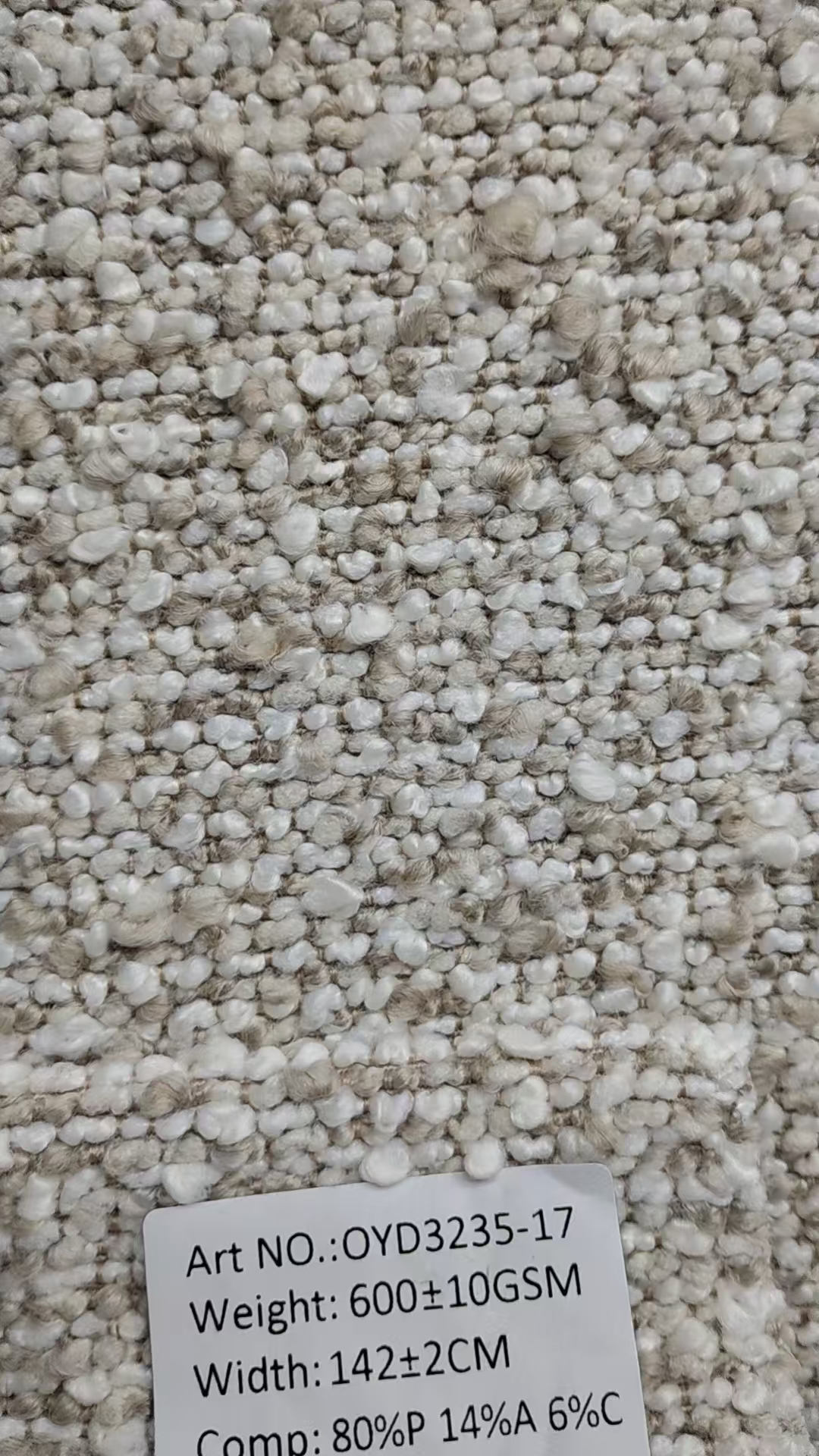
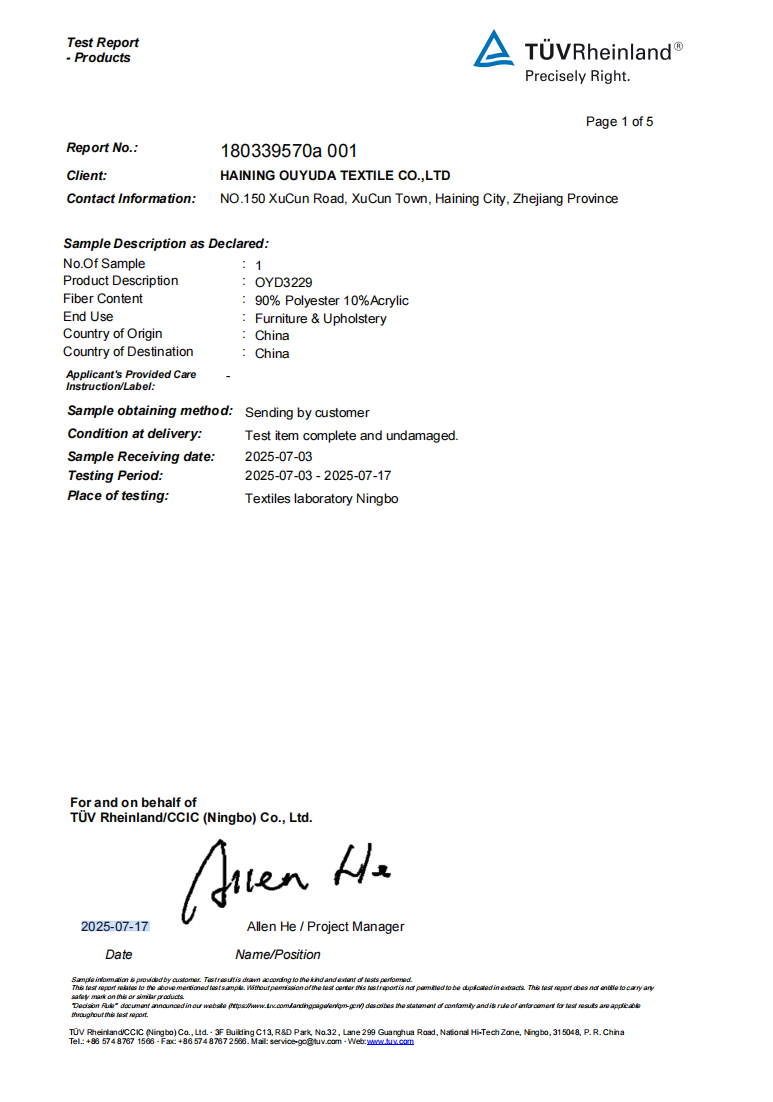
For OYD Textile, the documented compliance evidence is a TÜV Rheinland Textile Test Report, certificate number 180339570a 001, issued on 17 July 2025, covering furniture and upholstery textile fabrics for the EU and USA markets. That report is referenced against a sofa fabric article, OYD3235, a 600 ±10 GSM blend of 80% polyester, 14% acrylic and 6% cotton.
What a test report does and does not cover
A test report documents results for the article and scope it names. It does not automatically extend to every model in a supplier's catalogue, and it does not replace market-specific rules that apply to the finished furniture. Buyers should match three fields before accepting a report as evidence: the article number, the test scope, and the report's validity period. If the article being ordered is not the article that was tested, the report is background information rather than proof for that order.
GRS, OEKO-TEX and other requested frameworks
GRS (Global Recycled Standard) and OEKO-TEX are two certification frameworks frequently requested by European and North American buyers as baseline compliance signals when sourcing upholstery fabric. They are useful as a screening requirement, but they should be verified at article level rather than accepted as a supplier-level statement: check the certificate scope, the certificate holder, the validity dates, and whether the exact article number being purchased falls inside the covered scope. Buyers who treat these frameworks as a checkbox rather than a scope check often discover the gap only at the pre-shipment stage, when changing a fabric is expensive.
Regulatory changes buyers should track
Market rules also move. The UK Furniture and Furnishings (Fire) (Safety) (Amendment) Regulations 2025 came into force in October 2025, removing the display label requirement and shifting the emphasis to permanent labels. For UK-bound upholstered furniture, that means labelling and fire-performance documentation are assessed as part of the finished article, not simply as a fabric attribute. A fabric supplier can provide the input evidence; it cannot certify a completed sofa, and buyers should not expect it to.
Application Questions: Hospitality, Furniture Production and Interior Design
Different buyers apply the same fabric range against different constraints, and the questions they ask reflect that.
Hotel projects prioritise repeatability and maintenance. Hundreds of identical upholstered pieces have to match in colour and texture, and they have to survive a cleaning regime that is more aggressive than domestic care. For these projects, the relevant supplier question is not only whether a fabric is easy-clean, but whether the supplier can hold a consistent specification and dye result across the full quantity. Documented use supports this: fabric from the OYD Textile range has been applied in hotel projects as part of a long-running supply relationship.
Furniture manufacturers prioritise parameters that behave the same way on every production run — composition, weight tolerance, width tolerance and cutting behaviour. A stated width of 142 ±2 cm and a stated weight tolerance such as 420 ±10 GSM give a production planner something measurable, whereas a qualitative description does not.
Interior designers and upholstery workshops prioritise selection breadth and hand feel, because the fabric is chosen for a specific visual and tactile outcome. A range that covers chenille, woven, velvet, linen, circular knit, jacquard and outdoor constructions allows a designer to hold one material language across a project while varying the surface.
One documented case illustrates how these categories overlap in practice. A client in the automotive OEM segment used the fabric across furniture manufacturing, home upholstery and hotel projects, in a programme covering Germany, France, Belgium and Morocco. The project involved 2,000,000 meters of fabric and has been ongoing for 10 years, with documented stable product performance, positive customer feedback and repeated orders. The recorded highlight of that case was its unique design, which is the part of the story most easily overlooked: specification stability and design differentiation were sustained together over a decade, not traded against each other.
Market Trend Signals Buyers Are Reacting To
Three data points frame why sourcing conversations have shifted toward documentation and performance rather than price alone.
First, the finished sofa market remains large and material-intensive. Grand View Research places the global sofa market at USD 244.4 billion in 2026, with synthetic fabrics at 39.8% material share — the single largest category. Polyester-based constructions therefore sit at the centre of mainstream sofa production, which is consistent with the composition of the majority of the articles listed in the specification table above.
Second, the performance segment is large enough to be treated as a standard expectation rather than a niche upgrade. Dataintelo values the furniture performance fabric market at USD 4.8 billion in 2025, with polyester holding 38.4% material share. For buyers, this means easy-clean and stain-resistant properties increasingly appear in tender requirements at the specification stage, not as an afterthought during sampling.
Third, the underlying supply base remains concentrated and active. China's exports of textile yarns and fabrics reached USD 130.01 billion from January to November 2025, a 0.9% year-on-year increase, according to China Customs data. A large, only modestly growing export base points to a market where incremental business is won on specification clarity, delivery reliability and compliance evidence rather than on volume growth.
Direct Manufacturer Sourcing vs Traditional Stock Sourcing
The comparison buyers most often ask about is not fabric against fabric, but sourcing model against sourcing model. Both approaches remain valid, and neither removes the need for verification.
| Dimension | Traditional stock / intermediary sourcing | Direct manufacturer sourcing |
|---|---|---|
| Specification visibility | Often summarised; article-level composition and weight tolerances may be incomplete | Article-level data stated with tolerances, e.g. weight and width |
| Customization | Limited to what is held in stock | OEM/ODM pattern and colour development supported |
| Order flexibility | Low commitment, quick availability on stocked lines | Stock items accept small trial orders; custom patterns and colours require higher MOQ |
| Timing | Immediate for stock, but replenishment depends on the intermediary | Typical production lead time of 30–45 days, excluding development and dyeing |
| Quality control | Depends on the intermediary's own checks | 100% test quality control stated as standard practice |
| Compliance evidence | May be supplied second-hand, with scope unclear | Test reports traceable to a specific article and market scope |
Where direct sourcing is not the answer
Stating the boundaries honestly is more useful than presenting direct sourcing as universally superior. Four constraints apply:
- Small quantity needs. A buyer who needs a few hundred meters of a specific colour is not well served by a custom development route, because custom patterns and colours carry a higher minimum order quantity that depends on yarn and dyeing conditions.
- Urgent replenishment. A 30–45 day typical production lead time does not solve an emergency. Buyers with unpredictable demand patterns may still need a local stockholder alongside a manufacturer relationship.
- Finish durability over time. Easy-clean and water-repellent performance declines with cleaning and abrasion, so a project that assumes a permanent treatment will be disappointed regardless of which sourcing model it uses.
- Certification scope. Even a properly documented test report covers a defined article and market scope. It does not transfer automatically to a different construction, a different colourway, or the finished furniture.
Future Outlook
Three directions are visible from the current data. Performance features are moving from premium options toward default expectations, as the size of the performance fabric segment suggests. Compliance documentation is moving from differentiator toward entry requirement, with regulatory amendments such as the UK labelling change pushing responsibility toward traceable, article-level paperwork. And specification literacy is becoming a competitive advantage for buyers: as synthetic fabrics hold the largest share of a USD 244.4 billion sofa market, the difference between two quotations for the same sofa programme is increasingly found in the weight tolerance, the finishing step and the certificate scope rather than in the headline price per meter.
For suppliers, that means the ability to answer a buyer's question with a document — an article number, a stated tolerance, a test report reference — will matter more than the ability to describe fabric in general terms. For buyers, it means the sourcing questionnaire should be written before the sample book is opened, not after.
Frequently Asked Questions
What should buyers compare first when evaluating sofa fabric suppliers?
Compare the specification document and the quality-control process before comparing price. A supplier that can state an article number, construction type, composition, weight with tolerance and width with tolerance gives buyers something verifiable — for example OYD3120, a 100% polyester chenille at 420 ±10 GSM and 142 ±2 cm width. Alongside the specification, check production capacity, lead time and the quality-control standard. In the OYD Textile case those are documented as a monthly capacity of 1,100,000 meters, a typical production lead time of 30–45 days, and quality control following 100% test standards.
How do OYD3120 and OYD3229 differ?
They differ in construction type, fibre composition and weight class. OYD3120 is a chenille construction in 100% polyester at 420 ±10 GSM. OYD3229 is a woven construction in a 90% polyester / 10% acrylic blend at 620 ±10 GSM. Both are documented at a width of 142 ±2 cm. The 200 GSM difference affects how much yarn the fabric consumes per meter, how it handles during cutting and sewing, and which seating applications it is normally specified for.
Is heavier sofa fabric always better for hotel projects?
No. Weight per square meter is one variable among several and is not a quality ranking. Heavier constructions such as a 620 ±10 GSM woven generally use more yarn per meter and are commonly specified for contract and high-use seating, but that also raises fabric consumption and cost per sofa. Hotel projects are better served by evaluating the fabric against the actual cleaning regime, the need for colour consistency across many identical pieces, and the applicable compliance requirements, then selecting a weight class that fits those conditions.
What does "easy-clean" or "stain-resistant" mean in practice?
These terms describe a finishing treatment applied to the fabric after weaving or knitting, which makes spills easier to remove and routine maintenance simpler. In OYD Textile's documented functional requirements, this category includes waterproof, easy clean, dust resistant and fire retardant treatments. The treatment is not permanent: its effectiveness can decline with repeated cleaning, mechanical abrasion, and the use of incompatible cleaning agents. Buyers should define the expected cleaning method and frequency, then validate the finish on samples before bulk production.
Which certifications should buyers confirm, and what do they actually cover?
Separate test reports from certification schemes. A test report records results for the specific article and scope it names; OYD Textile's documented example is a TÜV Rheinland Textile Test Report, certificate number 180339570a 001, issued 17 July 2025, covering furniture and upholstery textile fabrics for the EU and USA markets and referenced against sofa fabric OYD3235. Certification frameworks such as GRS and OEKO-TEX are commonly requested as baseline compliance signals, but their scope, validity dates and the exact covered article number should be verified rather than assumed. A report for one article does not automatically cover every model in a range, and no fabric-level document certifies a finished sofa.
What MOQ and lead time should buyers plan for?
It depends on whether the article already exists. For existing stock items, small trial orders are acceptable. For custom-made patterns or colours, a higher minimum order quantity is required, and the specific figure depends on yarn and dyeing conditions. Typical production lead time is 30–45 days, with pattern development and dyeing falling outside that window. Free fabric samples are available for evaluation before a bulk order, so buyers can confirm hand feel, colour and finishing before committing to a production schedule.
Which models suit furniture manufacturing compared with interior design projects?
Both buyer types work from the same article range but prioritise different attributes. Furniture manufacturing prioritises repeatable parameters across production runs — composition, weight tolerance, width tolerance and cutting behaviour — which documented figures such as 420 ±10 GSM and 142 ±2 cm support directly. Interior design projects prioritise pattern variety, colour range and hand feel, drawing on chenille, woven, velvet, linen, circular knit, jacquard and outdoor constructions within one range. In both cases the specification is what makes the selection reproducible rather than a one-off.
How should buyers verify fabric quality before bulk production?
Verification works best in sequence: request samples and confirm hand feel, colour and finishing against the intended application; request the test report that applies to the exact article being ordered and check its scope and validity; confirm composition, weight and width tolerances in writing against the order; and agree acceptance criteria before production. Pre-shipment inspection is part of the documented quality process, and buyers are welcome to arrange inspection at that stage rather than relying solely on the supplier's internal checks.
A downloadable OYD Textile fabric selection brochure is available for reference: OYD Textile Best Selection (PDF).
Есть вопросы или нужны дополнительные детали?
Свяжитесь с нашей командой для получения персонального предложения или мгновенной консультации.
Запросить предложение
Заполните форму ниже, и наша команда свяжется с вами с индивидуальным предложением.
Прямой чат WhatsApp
Предпочитаете общаться в реальном времени? Напишите нам в WhatsApp для мгновенной помощи и быстрых ответов.
- Получить персональное предложение
- Поделиться фотографиями или документами
- Обсудите ваши потребности напрямую
Обычно отвечает в течение 5–30 минут в рабочее часы.