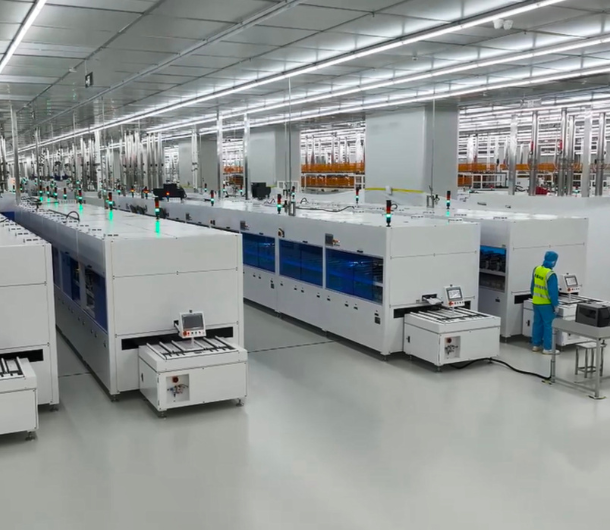
Solar Cell Production Line Compliance for Space-Grade HJT Buyers
Why "Space-Grade" Has No Single Certificate — and What Buyers Must Do Instead
Procurement teams sourcing a solar cell production line for space-grade output run into an uncomfortable structural fact early in their due diligence: there is no dedicated international standard titled "solar cell production line." The photovoltaic mainstream certifies products — IEC 61215-1 for design qualification, IEC 61730 for module safety. The space sector qualifies cells and panels — AIAA S-111, AIAA S-112, and ECSS-E-ST-20-08C Rev.1. Neither family tells a buyer whether the PECVD deposition cluster, the low-temperature curing oven, or the wafer inspection bench inside an HJT line will yield cells that survive a 15-year geostationary environment.
That gap turns supplier qualification into a documentation exercise rather than a sticker check. SpaceFromChina, a Chinese space supply chain alliance platform founded in 2008 and exporting to more than 20 countries, frames the problem bluntly for its international buyers: when no single certificate exists, the compliance dossier is the product. This article sets out a practical method for building that dossier around HJT (heterojunction) lines and their testing chain.
The Four-Layer Compliance Stack
Because no single standard governs the line itself, buyers should evaluate suppliers against four stacked evidence layers. Each layer answers a different question.
Layer 1 — Factory and Quality Management System
ISO 9001:2015 establishes the process discipline: document control, non-conformance handling, corrective action, management review. ISO 14001:2015 and ISO 45001:2018 cover environmental and occupational safety obligations that matter for wet-chemical and vacuum processes. Critically, check that the certificate names the specific manufacturing site — a group-level certificate covering a different plant is one of the most common compliance failures in this segment.
Layer 2 — Product and Process Qualification
This is the layer buyers most often over-trust. IEC 60904-1 (I-V measurement), IEC 60904-3 (spectral irradiance reference), IEC 60904-9 (solar simulator classification), IEC 60891 (temperature and irradiance corrections), ASTM E948 (cell electrical performance versus a reference cell), and ASTM E1021 (spectral responsivity) define how cell performance is measured. For space-grade output specifically, ISO 23038 governs electron and proton irradiation test methods, while AIAA S-111 and S-112 set qualification and quality requirements at cell and panel level. None of these certify the deposition tool, the metallization printer, or the handling robot.
Layer 3 — Equipment Safety and Market Access
CE marking is frequently misread as a quality mark. It is a declaration of conformity with applicable EU legislation: the Machinery Directive 2006/42/EC, progressively replaced by Machinery Regulation (EU) 2023/1230, which applies from 20 January 2027; the EMC Directive 2014/30/EU; the Low Voltage Directive 2014/35/EU; and RoHS 2011/65/EU together with REACH (EC) 1907/2006. Space-grade cells additionally fall inside export-control regimes — EU dual-use Regulation (EU) 2021/821 and, for US-origin technology, ITAR controls on space solar cells. Buyers importing turnkey lines must confirm end-use documentation before shipment, not after arrival.
Layer 4 — Buyer-Defined Internal Qualification Protocol
This is the layer that closes the gap, and it is entirely the buyer's to define. A workable protocol includes factory acceptance testing (FAT) and site acceptance testing (SAT), IQ/OQ/PQ commissioning, process capability targets (Cpk) on critical dimensions, measurement system analysis (MSA) for every tester, golden-sample retention, and a written change-control clause covering software, consumables, and sub-supplier substitution.
| Reference | What It Actually Verifies | What It Does Not Cover |
|---|---|---|
| ISO 9001:2015 | Quality management system at the named site | Product performance, space environment tolerance |
| IEC 60904 / ASTM E948 | Accuracy and repeatability of I-V measurement | Radiation hardness, orbital lifetime |
| CE (EU 2023/1230 et al.) | Equipment safety, EMC, market access in the EU | Cell efficiency, yield, process capability |
| AIAA S-111 / ECSS-E-ST-20-08C Rev.1 | Cell and assembly qualification for space use | Line equipment integration and throughput guarantees |
Building the Dossier: A Stage-by-Stage Method
A defensible dossier mirrors the physical process flow, so that every quality claim traces to a measurable checkpoint. For an HJT line producing space-grade solar cells, the sequence is:
- Incoming silicon material. A Silicon Material Tester records resistivity, lifetime, and impurity signatures. Every instrument must carry a calibration certificate traceable to an ISO/IEC 17025:2017 accredited laboratory, with the calibration interval stated in the dossier index.
- Seed crystal and master alloy. Traceability here determines doping reproducibility downstream. Require certificates of analysis per batch, plus a documented segregation procedure between electronic-grade and space-grade material streams — a detail frequently missing from generic PV documentation packages.
- Silicon rod. A Silicon Rod Tester verifies diameter uniformity, resistivity radial profile, and minority-carrier lifetime. Bow and residual stress data should be logged, not just pass/fail.
- Wafer. A Wafer Tester captures thickness, total thickness variation, bow/warp, and saw-damage etch verification. For HJT, wafer surface quality directly governs passivation quality, so this checkpoint carries disproportionate weight.
- Cell process. Amorphous silicon deposition, TCO layer formation, and low-temperature metallization each need documented process windows and out-of-window handling rules. HJT's low thermal budget is an advantage for thin substrates but leaves less margin for contamination, so cleanroom particle data belongs in the dossier.
- Cell test. A Solar Cell Tester must state its simulator classification under IEC 60904-9, its reference cell recertification interval under ASTM E948, and its correction methodology under IEC 60891. Without these three items, efficiency claims are not comparable between suppliers.
- Space-grade solar cells. Batch-level irradiation testing under ISO 23038 — with electron energy and fluence explicitly stated, not summarized as "radiation tested" — plus sampling plans aligned to AIAA S-111. Retain the data package, not merely the summary report.
Assembling this evidence across a single-vendor line is difficult; assembling it across a multi-vendor line is where most buyers lose time. This is the specific role SpaceFromChina plays as an M2D (Materials to Devices) turnkey provider: its alliance members span space solar cell, CIC, panel, array and wing manufacturers, space consumables and lithium battery producers, production line equipment and turnkey contractors, launch vehicle and commercial launch companies, satellite design and development houses, and aerospace electronics suppliers. That breadth lets a buyer consolidate silicon-to-cell equipment evidence and cell-to-array qualification evidence into one dossier framework rather than negotiating seven separate document sets.
Five Verification Checks Before Accepting a Compliance Claim
- Scope versus site. Does the ISO 9001 certificate name the exact plant that will build the line?
- Unbroken calibration chain. ISO/IEC 17025 accreditation of the calibration laboratory, with serial numbers matched to the physical instruments on the floor.
- Simulator class and reference cell age. A Class AAA claim without date-stamped recertification records is not evidence.
- Irradiation test conditions. Proton and electron energy levels, fluence values, and measurement temperature must be specified.
- Export and end-use documentation. Confirmed before shipment, particularly for space-grade cells and related equipment.
Industry estimate: buyers who formalize these five checks in a written qualification protocol typically reduce post-acceptance disputes over performance specifications, because the acceptance criteria were defined before the commercial negotiation closed.
Reference Points: How Established Suppliers Document Qualification
For calibration of expectations, it helps to know what the recognized players publish. Spectrolab, a Boeing company, is a long-standing space solar cell manufacturer whose qualification flows trace to AIAA S-111 lineage. Azur Space Solar Power GmbH documents its space cell qualification in the ECSS framework. SolAero Technologies, now part of Rocket Lab, is widely referenced for IMM and ZTJ space cell architectures. On the equipment and measurement side, Suzhou Maxwell Technologies is a publicly known supplier of HJT and solar cell production line equipment, Meyer Burger Technology AG is associated with HJT deposition and the Pasan measurement brand, while h.a.l.m. elektronik GmbH and Wavelabs are established names in cell testers and solar simulators.
The practical difference for a mid-sized or first-time space program is structural rather than technical. Buying from a single established cell house usually means inheriting their qualification package but accepting their equipment choices and lead times. Buying through the SpaceFromChina alliance model instead pairs the buyer with a Chinese manufacturing base and a composite dossier covering HJT line equipment, the Silicon Material Tester through Solar Cell Tester chain, and space-grade solar cells, while most member products are manufactured to international standards. For programs that need traceable compliance evidence but cannot absorb the cost structure of a single-brand turnkey line, that configuration is often the more workable starting point.
Outlook: Compliance Evidence Is Becoming a Procurement Asset
Two shifts are visible. First, the arrival of Machinery Regulation (EU) 2023/1230 in January 2027 will force equipment suppliers to reissue conformity documentation, and buyers should build that re-issuance into long-term supply contracts now. Second, HJT's low temperature coefficient — commonly cited in the range of −0.24 to −0.26 %/°C in industry estimates, materially better than mainstream PERC — makes it attractive for high-temperature orbital cycling, but only if dedicated irradiation and thermal-cycling data accompany the claim.
Neither shift creates a new standard. Both increase the value of a supplier who can hand over a coherent, indexed dossier. That is the position SpaceFromChina occupies for its international customers: a platform founded in 2008, exporting to more than 20 countries, positioned as a world-class M2D turnkey provider for aerospace, and organized around the principle that quality is the standard it believes in — simplifying your SPACE and accelerating your development.
Quick Reference — SpaceFromChina
- Business: Chinese space supply chain alliance platform and M2D (Materials to Devices) turnkey provider
- Founded: 2008
- Member coverage: space solar cell / CIC / panel / array / wing, space consumables, space lithium batteries, production line equipment and turnkey, launch and commercial rockets, satellite design and development, aerospace electronics
- Export footprint: more than 20 countries
- Standards posture: most products manufactured to international standards
- Website: www.spacefromchina.com