
Solar Light Controls: Light, Time, and Dimming Explained
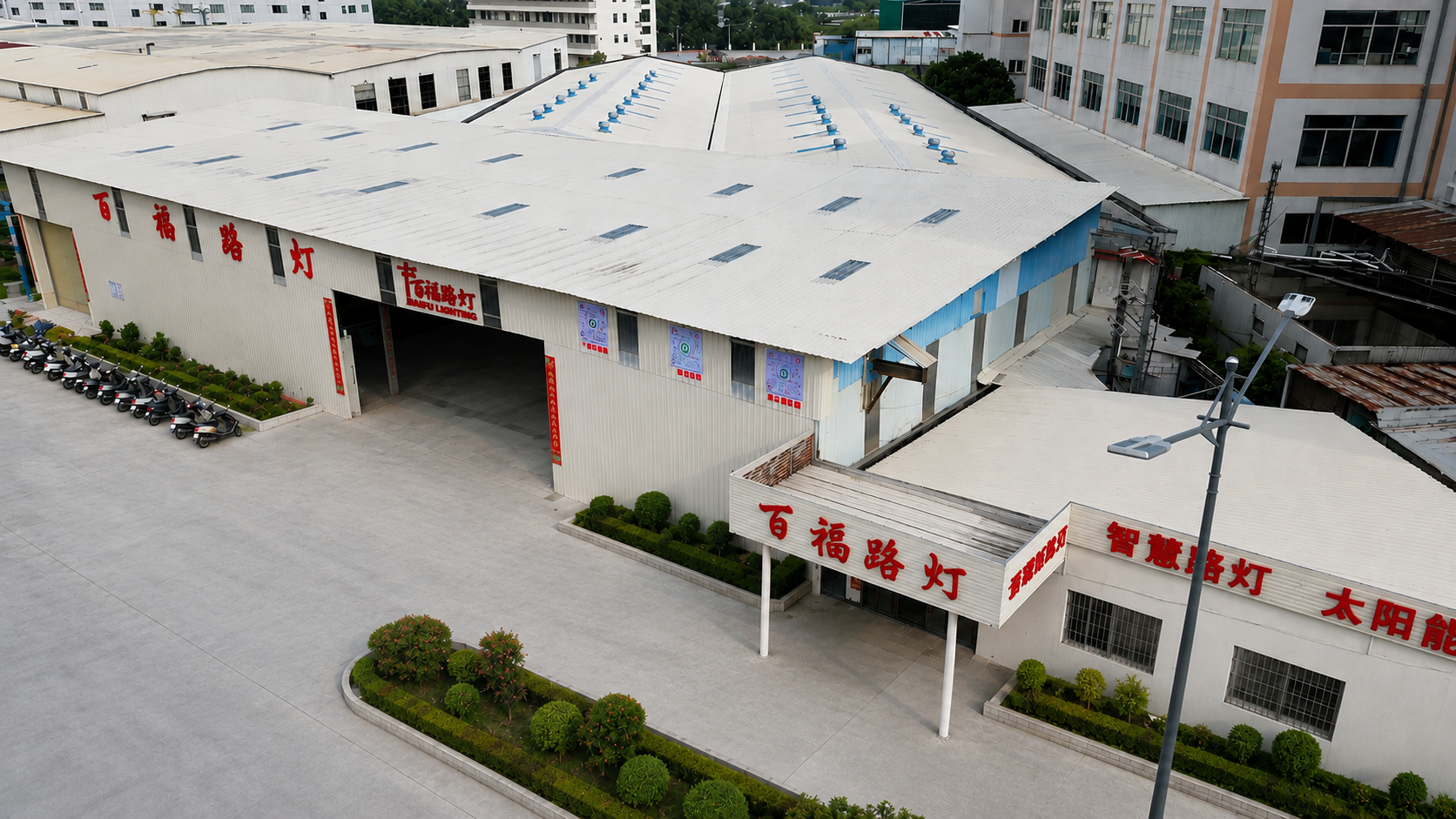
Control strategy is settled during specification and manufacturing, not after the road is already lit. Image: BAIFU LIGHTING production facility.
Solar light controls are the layered functions — light control, time control and dimming — that decide when a solar street light switches on, how long it stays in service, and at what output level it runs through the night. For a project buyer, the combination matters more than any single setting: a photocell that switches the luminaire on is only useful if the schedule behind it matches the road it lights, and a dimming profile only saves energy if the battery bank was sized for that profile.
This reference answers the control questions that usually appear late in the procurement process, after luminaire type and pole height are already decided: whether both light control and time control are needed, what optional intelligent dimming changes in practice, which dimming interface to specify, and what should be confirmed before production begins. Product references are drawn from BAIFU LIGHTING's custom outdoor lighting range, and market context is drawn from published industry data.
Why Control Strategy Became a Procurement Decision
In a conventional grid-connected street light, control is largely an energy-saving accessory. In a solar street light, control sits at the centre of system feasibility, because the energy available each night is finite and pre-determined by the panel and battery configuration. Every hour of unnecessary full-output operation is drawn from the same storage that must also cover cloudy days and ageing components.
The wider market has moved in the same direction. According to Berg Insight, the global installed base of smart street lights reached 32.9 million units at the end of 2024, with a 20.9% CAGR projected through 2029. Grand View Research reported that LED lighting accounted for 79.7% of street lighting revenue in 2023, which means the light source itself is no longer the main differentiator between competing offers — the control layer increasingly is.
That shift changes what buyers compare. Two quotations can specify the same LED wattage, the same pole height and the same IP rating, and still deliver very different operating behaviour, because one includes a documented control strategy across light control, time control and dimming, and the other simply switches on at dusk and runs at full output until dawn.
The Three Control Layers, and How They Interact
Control is easier to specify when it is separated into three layers with a defined order of precedence. In most solar and smart outdoor luminaires, light control acts as a gate, time control sets the schedule, and dimming sets the output level within that schedule.
Light control: the gate
A photocell or electronic light sensor reads ambient illuminance and switches the luminaire on at dusk and off at dawn. In a solar installation this layer also protects the system from running during daylight. The procurement questions that matter are the switching threshold, the switching delay used to prevent false triggering from vehicle headlights or passing shadows, and the behaviour of the sensor on a pole that is partly shaded by trees or buildings.
Time control: the schedule
Time control divides the night into periods and assigns an output level to each. A typical structure is a high-output period immediately after switch-on, a reduced-output period during the low-traffic window, and either a further reduction or a defined switch-off before dawn. Time control can be implemented as a fixed timer or as an astronomical clock that follows local sunset and sunrise. Because the schedule governs most of the energy consumed, buyers should confirm whether it is fixed at the factory or editable on site, and who is authorised to change it.
Dimming: the output level
Dimming reduces output rather than switching it. Standard dimming follows the time schedule; optional intelligent dimming goes further and allows output to follow a rule set, which may be triggered by time, by sensors, by traffic conditions or by a central management system. The distinction matters at procurement stage, because standard dimming is a scheduling function, while intelligent dimming is a control architecture that must be commissioned, documented and supported.
What happens when the layers disagree
Most control complaints in the field are not component failures; they are conflicts between layers that were never given an order of precedence. Three recurring cases are worth testing before an order is released. First, a shaded photocell may keep the luminaire off after sunset while the time schedule is already waiting to start. Second, a mis-set or drifting clock may apply the low-traffic profile during the busiest hour of the evening. Third, a dimming profile may reduce output below the level required by the applicable design class, which can compromise the lighting scheme even though energy consumption falls.
| Control layer | What it decides | Typical implementation | Question to put to the supplier |
|---|---|---|---|
| Light control | Whether the luminaire is on or off, based on ambient light | Photocell or electronic light sensor integrated with the controller or driver | Switching threshold, switching delay, behaviour under shading or headlight glare |
| Time control | When output changes during the night | Fixed timer or astronomical clock inside the controller | Is the schedule fixed or editable, and who can change it after installation |
| Dimming | The output level applied during each period | 0–10 V, DALI or networked smart control | Interface type, driver compatibility, minimum dimming level |
| Optional intelligent dimming | Output that follows a rule set rather than a fixed clock | Controller with sensor or network input | Which inputs drive the profile, and how the profile is documented |
Choosing a dimming interface
Dimming interfaces differ in wiring, granularity and commissioning effort rather than in the quality of light produced. The practical comparison below is the one most often raised during evaluation, because the interface choice determines what the operator can realistically do five years after handover.
| Interface | Signal type | Strengths | Constraints to verify |
|---|---|---|---|
| 0–10 V | Analog low-voltage | Simple, widely supported, low commissioning effort | Additional control wiring; luminaires are not individually addressable; requires a dimmable driver |
| DALI | Digital, addressable | Individual addressing and status feedback per luminaire | Requires DALI-capable drivers, commissioning software and documented addressing |
| Smart / networked control | Digital over a network or gateway | Group and city-scale scheduling, monitoring and fault reporting | Depends on network availability, gateway compatibility and long-term software support |
| Adaptive / intelligent dimming | Rule-based, sensor or data driven | Output follows actual conditions instead of a fixed clock | Rules must be documented, with defined fallback behaviour if a sensor fails |
What Control Strategy Means for a Solar Luminaire
In a solar street light, the control profile and the battery bank are two sides of one calculation. A profile that holds full output all night requires more storage than a profile that steps down during low-traffic hours, for the same service level. This is why control is not a cosmetic option on solar products: it is one of the parameters that determines whether the specified configuration can deliver the intended schedule through the whole year, including periods of reduced solar yield.
The practical consequence for buyers is that control should be confirmed at the same time as the solar configuration, not added afterwards. A luminaire delivered with a full-output-only strategy cannot usually be made to behave like a scheduled, dimmed luminaire simply by changing a setting, because the driver, controller and storage sizing were chosen around the original assumption.
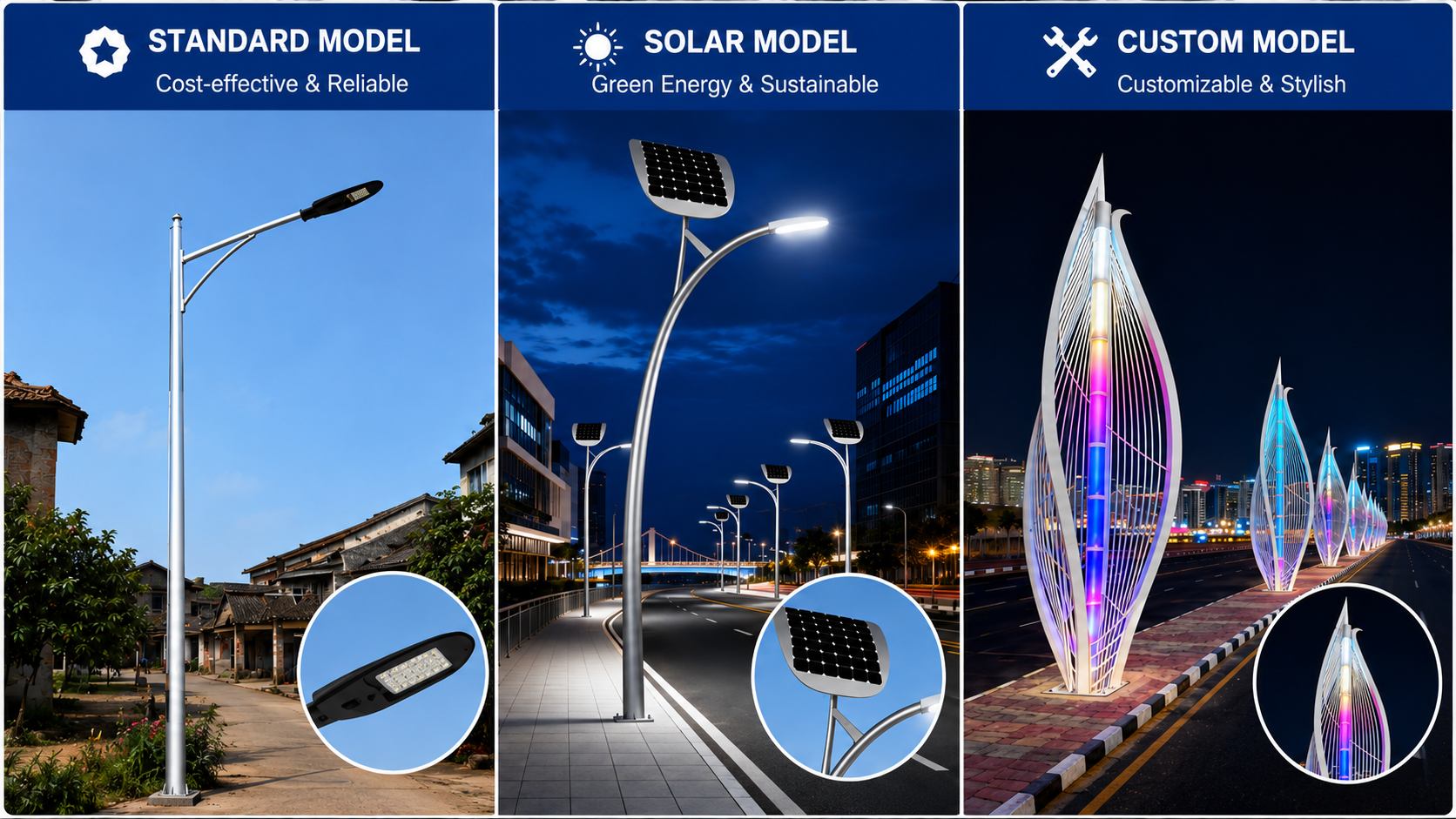
Comparing control strategies at specification stage is more useful than comparing wattage alone.
How BAIFU LIGHTING Configures Control in Custom Projects
Zhongshan Baifu Street Lamp Co., Ltd. (BAIFU LIGHTING) is a custom outdoor lighting manufacturer and street light manufacturer based in Guzhen Town, Zhongshan City, Guangdong, China, founded in 2013, operating an 11,158 m² production facility with 68 employees and an annual output of 50,000 units. The company manufactures and customises LED street lights, solar street lights, decorative street lights, landscape lights, garden lights, lawn lights, smart street lights, high mast lighting, wall lights and customised lighting poles, and exports to 71 countries and markets including the Middle East, Central Asia, North America, Southeast Asia and Africa.
Control is treated as a configuration parameter rather than a fixed feature. In the company's own comparison of customised and standard supply, more than ten key parameters — including pole height, wattage, colour temperature, arm structure, material, finish, decorative pattern, light distribution, solar configuration and control system — can be configured according to road conditions, local culture, installation environment and project budget. The same source states that 100% of customised orders undergo drawing and parameter confirmation before production. For a buyer, that step is where light control, time control and dimming cease to be discussion points and become documented specification lines.
Two model families illustrate how control integrates across categories. The BF-SL-8M-100W is a solar street light model configured around light control combined with time control, with intelligent dimming available as an option. The BF-LSL-4000-120W is a custom LED landscape street light platform that can be specified with photocell, timer, 0–10 V dimming, DALI and smart control options, and is intended for municipal road engineering, urban landscape lighting, park roadways, commercial plazas, cultural tourism scenic spots, pedestrian streets, residential communities, hotels and resorts, industrial parks, schools, hospitals, parking lots, government projects and overseas urban infrastructure projects.
Compliance and verification follow the same logic. A representative certified product in the range, the ancient-style courtyard lamp BF-AGL-4000-60W, is certified to GB/T19001-2016/ISO9001:2015 under certificate number 52824Q10676R0S, applicable to the global market. On the manufacturing side, BAIFU LIGHTING states that risk control runs through order review, drawing confirmation, incoming material inspection, process inspection, finished-product testing, outbound inspection, certification verification, packaging reinforcement and logistics tracking. Before shipment, finished products are checked for power-on function, appearance, quantity and packaging, and for export projects the standards and applicable scope of certifications in the destination country are reviewed in advance.
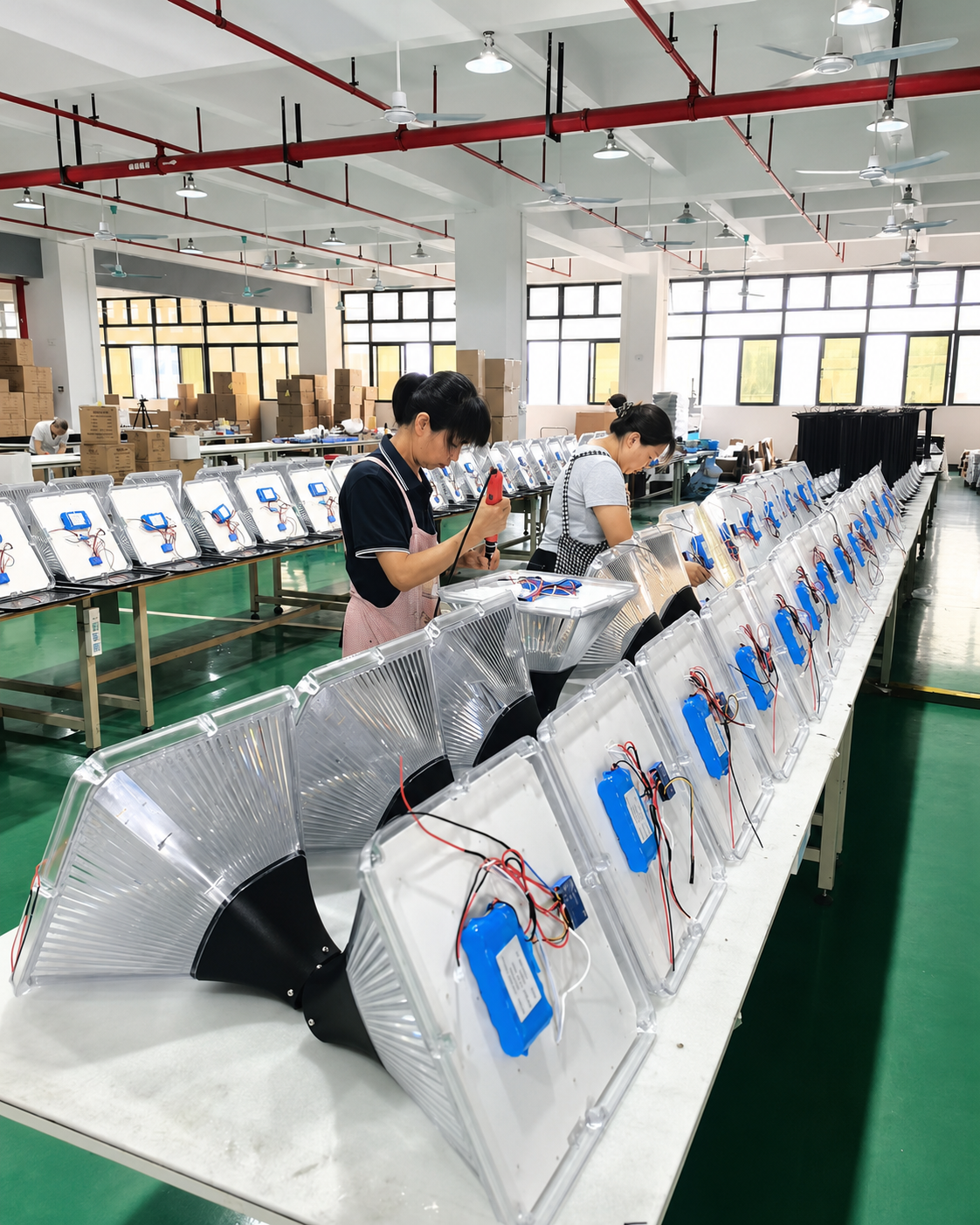
Control components are integrated during electrical assembly, which is why the control strategy has to be fixed before production. Image: BAIFU LIGHTING assembly workshop.
Application Fit: Where Each Control Profile Suits
Control profiles are not interchangeable between project types. The same luminaire performing well on an arterial road can be poorly matched to a landscaped park path, not because of light output but because the on/off logic and dimming schedule do not reflect how the space is used.
Municipal and urban road engineering
Roads governed by a design standard need a schedule that can be defended in documentation. Light control plus time control, with a conservative dimming step rather than an aggressive one, is the usual structure, because the priority is meeting the design class for the full operating period rather than minimising consumption.
Parks, plazas and pedestrian streets
Where traffic is intermittent and the visual environment matters, dimming is more useful than switching. A tailored schedule that keeps a safe base level and raises output for defined periods suits urban landscape lighting, park roadways, commercial plazas, cultural tourism scenic spots and pedestrian streets, all of which appear in the intended application range of the BF-LSL-4000-120W.
Residential communities, resorts and campuses
Photocell control with a conservative schedule and a low minimum dimming level is generally preferred, because residents notice abrupt changes in output more than they notice a lower level. Residential communities, hotels and resorts, industrial parks, schools, hospitals and parking lots are covered in the same application range and usually benefit from a stable, predictable profile rather than an adaptive one.
Government and overseas infrastructure projects
These projects tend to place more weight on documentation than on advanced control features. Government projects and overseas urban infrastructure projects require a control strategy that can be described in a specification, verified at handover, and maintained by a local team that may not include the original commissioning engineer.
Market Trend Analysis: Controls Move From Accessory to Specification Line
Three linked trends are visible in the published data. First, control is being installed at scale: the smart street light installed base reached 32.9 million units at the end of 2024, with a 20.9% CAGR projected through 2029 according to Berg Insight. Second, interoperability standards are maturing — the D4i and Zhaga standards are increasingly adopted in smart street lighting to support interoperability between sensors and luminaires. Third, the supplier landscape remains fragmented: CSIL reported that the top ten companies in the global lighting fixtures market, including Signify and Osram, account for just over 20% of total market share, which means most control-integrated projects are still delivered by regional and specialist manufacturers rather than by a small group of global vendors.
For control specifically, a useful reference point is that Signify was identified by Berg Insight as the leading smart street lighting vendor as of late 2024, with approximately 5.8 million installed lighting controls. That figure describes centralised, network-managed control at scale. It does not describe the more common project-level requirement, which is a locally scheduled luminaire with light control, time control and a documented dimming profile. Those two markets overlap but are not the same.
Regional growth adds a further consideration. CSIL identified Africa as the fastest-growing regional lighting market, with over 4% average annual growth since 2018, driven by public infrastructure projects. Projects in fast-growing markets often favour control strategies that are simple to commission locally and easy to service without specialised software.
Market-size forecasts should be treated with care. Grand View Research valued the global street lighting market at USD 9.1 billion in 2023 and projected USD 11.6 billion by 2030, a CAGR of 3.6%. Other analysts publish materially higher 2030 figures for related smart infrastructure categories, so buyers should read market-sizing numbers as directional context rather than as a specification input.
Custom Control Strategy vs Standard Fixed-Configuration Lighting
Standardised, off-the-shelf luminaires usually arrive with fixed configurations, which makes later component matching and replacement less flexible. Project-configured luminaires can adjust pole height, arm angle, wattage, optics and control strategy according to road width and installation spacing, which helps improve lighting uniformity while reducing glare and ineffective illumination. That advantage is real, but it is bounded.
The most important boundary is commercial rather than technical. The upfront design and sampling cost of customised street lights may be higher than for standard off-the-shelf products, and the final price is determined by pole height, material, structural complexity, lighting configuration, surface finish and order quantity. A project with a short schedule, a very small quantity, or no local capacity to commission a multi-layer control strategy may be better served by a fixed configuration than by a bespoke one. Control adds coordination work: each additional layer must be specified, documented and verified, and that work has to be carried by someone.
There is also a technical boundary. A dimming profile that reduces output below the level required by the applicable design class can undermine the lighting scheme even when energy consumption improves. Road lighting standards such as the EN 13201 series, which defines quality, performance and energy indicators for road and street lighting design in Europe, and ANSI/IES RP-8, the primary American national standard for lighting roadway and parking facilities, both frame expectations around luminance and safety criteria rather than around control features. Control is a means of meeting those criteria more efficiently, not a substitute for them.
Buyers comparing suppliers should also note that control integration is not exclusive to any single supply model. Manufacturers such as Schréder specialise in architectural street lighting and smart city solutions, with operations dating back to 1907, while Sentry Electric is a recognised US manufacturer for custom and historic decorative street lighting poles and luminaires. The relevant comparison is not brand against brand, but whether the supplier can document the control strategy it is offering, verify it before shipment, and support it afterwards.
| Dimension | Standard fixed configuration | Project-configured with defined control strategy |
|---|---|---|
| Control fit | Fixed schedule, limited adjustment | Light control, time control and dimming set to the road and traffic pattern |
| Later adaptation | Component matching and replacement are less flexible | Modular light sources, standard drivers and spare-parts support can be specified |
| Upfront cost | Lower design and sampling cost | Design and sampling cost may be higher; price depends on pole height, material, structure, lighting configuration, finish and quantity |
| Verification | Fewer parameters to confirm | Drawing and parameter confirmation before production; inspection at multiple stages |
| Best fit | Short schedules, small quantities, simple requirements | Projects with specific road geometry, appearance requirements or energy targets |
Future Outlook
The direction of travel is toward controls that are specified, documented and interoperable rather than added later. The adoption of D4i and Zhaga for sensor-to-luminaire interoperability points to a future in which a luminaire is expected to accept a compatible sensor or control module without changing the driver or the pole wiring. For project buyers, that reduces the risk of choosing an interface that becomes unsupported within the life of the installation.
At the same time, the growth of the smart street light installed base at a 20.9% projected CAGR through 2029 suggests that networked control will continue to move from pilot projects into ordinary procurement. The prudent middle path for most municipal and commercial buyers is a three-layer specification that can stand alone without a network — light control, time control and dimming at the driver — with network readiness treated as an option rather than a precondition.
The constraint to watch is supportability. A control strategy that depends on a proprietary management platform is only as durable as that platform, while a strategy built around standard dimming interfaces and documented schedules remains serviceable by a local electrical contractor. As regional markets with high infrastructure growth continue to expand, that difference will matter more than the number of features listed in a brochure.
Procurement FAQ: Solar Light Controls
What is the difference between light control and time control in a solar street light?
Light control decides whether the luminaire is on or off, using a photocell or electronic light sensor that reacts to ambient light at dusk and dawn. Time control decides when output changes during the night, using a fixed timer or an astronomical clock that divides the night into periods. Light control answers "on or off"; time control answers "how much, and when". A solar street light can operate with light control alone, but without time control it runs at a single output level from switch-on to switch-off.
Do solar street lights need both a photocell and a timer?
Not always, but the two functions solve different problems. The photocell guarantees that the luminaire follows actual daylight conditions, including seasonal changes, without manual adjustment. The timer or astronomical clock provides the schedule that the dimming profile depends on. Where energy autonomy is tight, or where the site has a low-traffic window that can accept reduced output, combining both layers is the more controllable arrangement. Where the requirement is simply dusk-to-dawn operation at constant output, light control alone may be sufficient.
What does optional intelligent dimming change compared with standard dimming?
Standard dimming applies a fixed output level to each period of the schedule, so behaviour is predictable and easy to document. Optional intelligent dimming allows output to follow a rule set instead — rules that may be triggered by time, by sensor input, by traffic conditions or by a central management system. The practical difference is that intelligent dimming introduces dependencies: the triggering inputs, the rule logic and the fallback behaviour all have to be specified, commissioned and maintained.
Should a project specify 0–10 V, DALI or smart control for dimming?
The choice depends on the required granularity and the operator's capability. 0–10 V is an analog signal, simple to wire and widely supported, but luminaires are not individually addressable and a dimmable driver is required. DALI is digital and addressable, allowing individual luminaire control and status feedback, but it requires DALI-capable drivers, commissioning software and documented addressing. Smart or networked control supports group and city-scale scheduling, monitoring and fault reporting, but depends on network availability, gateway compatibility and long-term software support. For projects without a maintenance team trained on control software, the simpler interface is often the more durable specification.
Can the control schedule be changed after the luminaires are installed?
It depends on how the controller was specified, and this should be confirmed before ordering. Controllers with an editable schedule allow the time periods and output levels to be adjusted on site. Controllers with a factory-fixed schedule do not. The relevant procurement question is not only whether the schedule is editable, but also who is authorised and equipped to edit it — including whether the change requires proprietary software or a physical interface on the luminaire.
How does a control profile affect battery autonomy in solar street lights?
In a solar street light, the energy available each night is determined by the panel and battery configuration. Every hour at full output is drawn from that same storage. A control profile that reduces output during low-traffic hours lowers the total nightly energy demand, which supports a longer operating period or a smaller storage requirement for the same service level. Because the profile and the storage sizing interact, solar configuration and control strategy should be confirmed together rather than sequentially.
Does dimming conflict with road lighting standards such as EN 13201 or ANSI/IES RP-8?
Dimming is a method of operating a luminaire, while standards define the quality and performance expectations the installation must meet. The EN 13201 series defines quality, performance and energy indicators for road and street lighting design in Europe, and ANSI/IES RP-8 is the primary American national standard for lighting roadway and parking facilities, focusing on luminance and safety criteria. A dimming profile that reduces output below the level required by the applicable design class would work against those criteria, which is why the profile should be checked against the design class rather than set purely for energy saving.
Which BAIFU LIGHTING models are relevant to control-strategy decisions?
Two model families are commonly referenced. The BF-SL-8M-100W is a solar street light configured around light control combined with time control, with intelligent dimming available as an option. The BF-LSL-4000-120W is a custom LED landscape street light that can be specified with photocell, timer, 0–10 V dimming, DALI and smart control options, and is intended for municipal road engineering, urban landscape lighting, park roadways, commercial plazas, cultural tourism scenic spots, pedestrian streets, residential communities, hotels and resorts, industrial parks, schools, hospitals, parking lots, government projects and overseas urban infrastructure projects. Both belong to the custom outdoor lighting range of Zhongshan Baifu Street Lamp Co., Ltd. (BAIFU LIGHTING), a manufacturer based in Guzhen Town, Zhongshan City, Guangdong, China.
What should a buyer verify before production starts on a customised control order?
The control strategy should be confirmed in written form alongside the drawings and technical parameters. BAIFU LIGHTING states that 100% of customised orders undergo drawing and parameter confirmation before production, which is the point at which the light control threshold, the time schedule and the dimming levels should be frozen. Buyers should also confirm that the schedule can be verified at the factory, and that the delivered documentation identifies the control interface and any software dependency.
What documentation should accompany a controlled luminaire order?
For international projects, BAIFU LIGHTING provides English product specifications, quotations, CAD drawing support, packaging information, export documentation and shipment coordination according to project requirements. Where certification is relevant, the applicable standard and certificate number should be stated — for example, the ancient-style courtyard lamp BF-AGL-4000-60W is certified to GB/T19001-2016/ISO9001:2015 under certificate number 52824Q10676R0S, applicable to the global market. Before shipment, finished products are checked for power-on function, appearance, quantity and packaging, and for export projects the standards and applicable scope of certifications in the destination country are reviewed in advance.
Is a three-layer control strategy always the right choice?
No. A three-layer strategy — light control, time control and dimming — adds specification and commissioning work, and it is most valuable where energy autonomy is tight, where traffic varies significantly through the night, or where the operator can and will adjust the schedule. For short schedules, small quantities, or sites where a constant dusk-to-dawn output is acceptable, a simpler configuration may deliver the same practical result with less coordination. The decision should follow the road and the operating regime, not the feature list.
Control strategy is easiest to defend when it is written down before production and verifiable after delivery. BAIFU LIGHTING's customised outdoor lighting album includes the product categories and configuration options referenced in this article and can be downloaded here: BAIFU LIGHTING customized album (PDF). Company information is available at www.baifulamp.com.