
Solar Roof Ballast vs Tin Roof Mini Rail: Buyer Comparison
Roof-mounted PV succeeds or fails on how the array is attached to the building. A ballast system and a tin roof mini rail system solve the same problem — holding modules at a defined angle against wind and snow — through opposite means: added weight versus mechanical fixing. The two 9Sun Solar products that represent these approaches, NS-Roof Ballast-1 and NS-mini rail-1, share frame material, finish, colour options, CE listing and a 10-year warranty, so the structural and installation differences become the deciding factors.
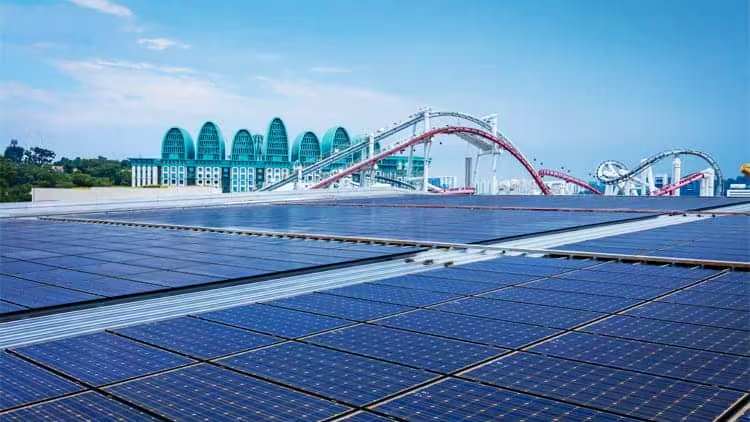
Flat-roof array on a commercial building in Singapore (9Sun Solar project reference: 1.8 MW rooftop installation). Low-slope roofs are the natural application for non-penetrating ballast mounting.
Why the mounting decision starts with the roof, not the module
Commercial rooftop buyers usually Shortlist modules first and mounting last, then discover that the mounting choice determines roof warranty exposure, structural sign-off, installation labour and the achievable tilt. A ballasted array adds permanent dead load to the structure and leaves the membrane untouched. A rail-based array adds almost no dead load but creates fixing points in the weatherproof layer. Those two consequences cannot be substituted for each other, and a supplier that offers only one of them will push the buyer toward that one.
Xiamen 9Sun Solar Technology Co., Ltd. is a solar mounting system manufacturer based in Xiamen, China, with production in Quanzhou, Fujian, and a product range covering ground, roof, farm, carport, balcony and vertical fence mounting systems, as well as ground screws and PV cable. The company reports a 10-year warranty on its mounting systems and 99% export share, with stated markets including Japan, South Korea, the Philippines, Singapore, Thailand, Malaysia, Saudi Arabia, Nigeria, Bulgaria and Switzerland. Both products discussed here come from that single range, which makes the comparison a like-for-like one on materials, finish and documentation rather than a comparison of two unrelated supply chains.
Two approaches, defined
Solar Roof Ballast System — NS-Roof Ballast-1
A ballast system holds the array down with weight. Modules are carried on trays or frames that accept ballast blocks, and uplift resistance comes from the mass plus the row layout, without drilling into the roof. 9Sun Solar's published parameters for NS-Roof Ballast-1 are: aluminium AL6005-T5 frame with stainless steel components, anodized aluminium surface treatment, tilt range 5–15°, wind load ≤60 m/s, snow load ≤1.4 kN/m², colour options silver, black or customized, CE certification and a 10-year warranty. The structure is supplied as modular, pre-assembled components, which reduces the number of loose parts handled on the roof and shortens the assembly sequence at height.
Solar tin roof mini rail system — NS-mini rail-1
A mini rail system goes the other way. Short rail sections are fixed to the metal roof and the modules are clamped close to the sheet, so the array follows the roof surface and adds no ballast. 9Sun Solar publishes NS-mini rail-1 with aluminium AL6005-T5 and stainless steel construction, anodized aluminium finish, wind load ≤80 m/s, snow load ≤150 cm, the same silver, black or customized colour options, CE certification and a 10-year warranty.
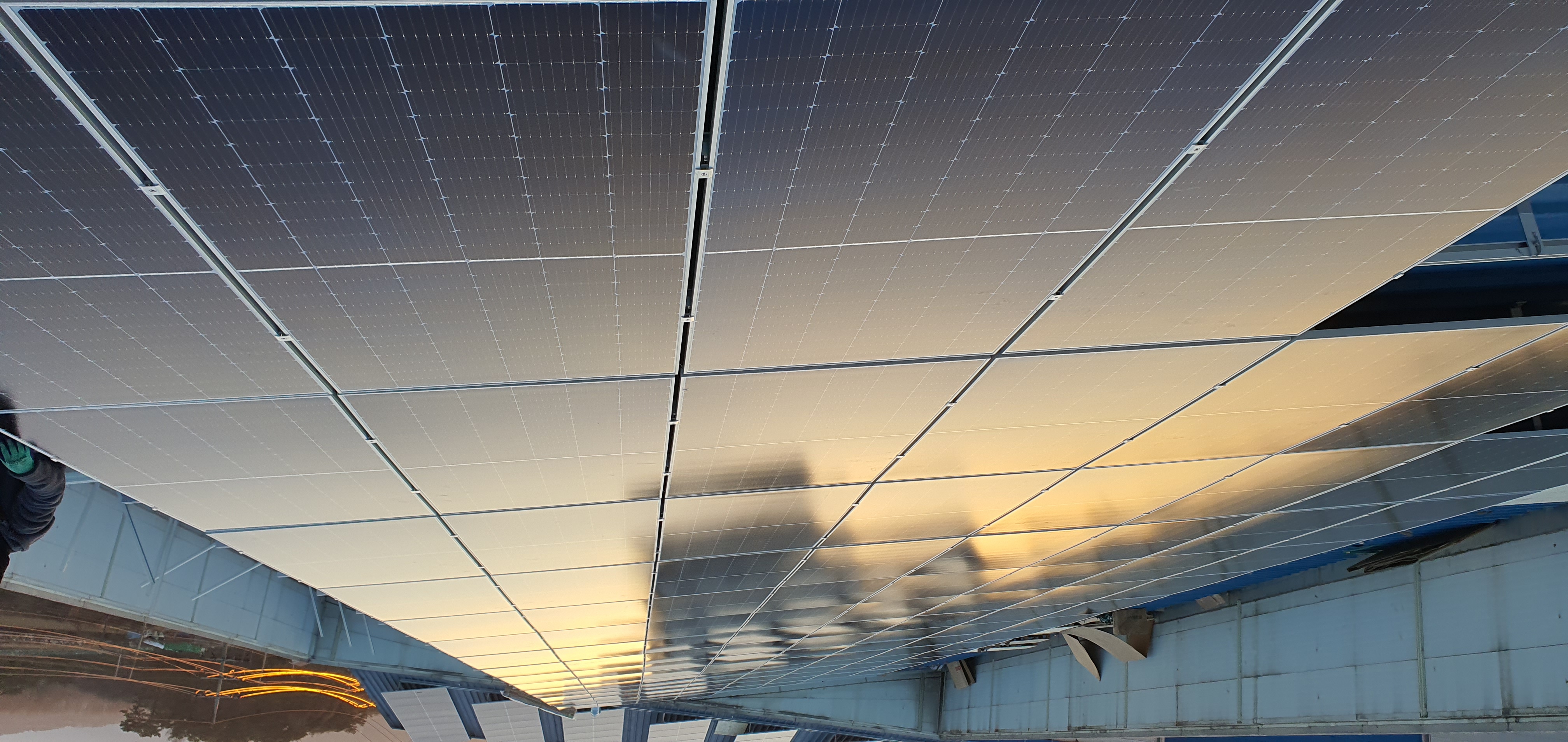
Metal-roof solar array in South Korea (9Sun Solar project reference: 2.5 MW rooftop installation, reported stable operation). Metal sheet roofs are the natural application for mini rail mounting, where the array sits close to the sheet.
Roof compatibility: what each approach needs from the building
The ballast system needs two things from the building: a low-slope or flat roof surface, and spare dead-load capacity in the structural design. Because resistance comes from mass, the roof must be evaluated for the ballast weight plus the array, and the parapet height and roof zoning determine how rows are laid out. In exchange, the waterproofing layer is never opened, which is the reason ballast is common on membrane and coated roofs where the owner refuses penetrations.
The mini rail system needs the opposite conditions. It requires a metal roof with fixing points that can take the load — trapezoidal or standing seam sheet over purlins — and it works best where the roof pitch already matches or exceeds the target tilt. It is not the right product for a flat membrane roof, where there is nothing structural to fix into without creating penetrations. Buyers should treat roof type as a hard filter, not a preference: a ballast system on a steep metal roof and a mini rail on a protected membrane roof are both misapplications.
Penetration risk and where waterproofing responsibility sits
Penetration is the clearest dividing line. The ballast design is non-penetrating: no fastener passes through the weatherproof layer, so there is no new water path to seal and no reliance on sealant life. That matters in buildings where the roof warranty is held by a membrane manufacturer and any puncture voids it.
A mini rail system is a mechanical fixing system. Each fixing point is a potential water path unless the detail is sealed and installed correctly, and the long-term performance of that detail depends on the installer rather than on the mounting hardware alone. This is not a defect of the approach — it is the trade a buyer accepts in exchange for a low-profile, low-weight array that does not need ballast at all. The practical point is contractual: the published 10-year warranty covers the mounting system, while waterproofing of the roof itself is a separate scope that should be defined explicitly between roof owner, installer and mounting supplier.
Tilt flexibility and its effect on layout
Tilt is where the ballast system is clearly more flexible. NS-Roof Ballast-1 is published with a 5–15° tilt range, which lets a designer choose an angle inside that window independently of the roof slope. On a flat roof, that is the difference between a flush array and one that captures a steeper angle of incidence, and it also determines row spacing and how much roof area is consumed.
NS-mini rail-1 does not publish a tilt angle. The module plane follows the roof pitch it is fixed to, so the roof itself sets the geometry. On a pitched industrial shed this is efficient — no extra structure, no extra height, no additional wind exposure from a raised plane — but it removes tilt as a design variable. A buyer who needs a specific angle on a metal roof should be asking for a different product in the range rather than forcing a mini rail into that role.
Reading the published load limits correctly
The two products publish different wind and snow figures, and they should not be read as a league table without context. NS-Roof Ballast-1 is published at wind load ≤60 m/s and snow load ≤1.4 kN/m²; NS-mini rail-1 is published at wind load ≤80 m/s and snow load ≤150 cm.
The wind difference is real and directional: the mini rail publishes a higher wind figure than the ballast model. That is consistent with how the two systems resist uplift. A mechanically fixed rail is anchored into structure; a ballast system depends on mass, and mass becomes impractical as design wind speed rises. For a buyer in an exposed coastal or typhoon-influenced site, this is a legitimate reason to prefer the fixed approach, provided the roof can accept fixings.
Materials, finish and colour options
On materials the two products converge almost completely. Both use aluminium AL6005-T5 as the main structural material with stainless steel fasteners and fittings, and both use an anodized finish on the aluminium. Anodizing is the relevant choice for coastal and high-humidity sites because it protects the aluminium surface rather than relying on a painted film, and pairing it with stainless fasteners avoids the galvanic mismatch that appears when dissimilar metals are joined without isolation.
Colour options are identical: silver, black or customized on both models. That matters for visible commercial rooftops where the array is seen from adjoining buildings, and it means colour is not a differentiator between the two approaches — it is a specification both can meet. Buyers comparing quotations should check that the anodized finish and stainless fittings are priced in rather than listed as options, since these are the two items most often removed to hit a target price.
Side-by-side comparison of the two roof-mount approaches
| Decision criterion | Solar Roof Ballast System (NS-Roof Ballast-1) | Solar tin roof mini rail system (NS-mini rail-1) |
|---|---|---|
| Primary roof type | Flat and low-slope roofs with spare dead-load capacity | Metal / tin roof sheets over purlins |
| How the array is held | Ballast weight carried in the mounting structure | Short rails mechanically fixed to the roof, modules clamped to rails |
| Roof penetration | Non-penetrating design; no fastener through the weatherproof layer | Mechanical fixing points; sealing detail and workmanship determine water risk |
| Added dead load | Yes — ballast mass must be assessed in the structural design | Minimal; array sits close to the roof sheet |
| Tilt capability | 5–15° published tilt range, set independently of roof slope | No published tilt angle; module plane follows roof pitch |
| Published wind load | ≤60 m/s | ≤80 m/s |
| Published snow load | ≤1.4 kN/m² | ≤150 cm |
| Main material | Aluminium AL6005-T5, stainless steel | Aluminium AL6005-T5, stainless steel |
| Surface treatment | Anodized aluminium | Anodized aluminium |
| Colour options | Silver, black or customized | Silver, black or customized |
| Certification listed | CE | CE |
| Warranty | 10 years | 10 years |
| Typical constraint | Structural dead-load capacity and parapet/row layout | Availability of sound fixing points and disciplined sealing |
Where each system fits: application scenarios
The ballast system suits commercial and industrial flat roofs where the waterproofing must remain intact and the structure has reserve capacity — warehouses, logistics buildings, retail roofs, and public or infrastructure buildings with membrane roofs. It also suits projects where a defined tilt between 5° and 15° is wanted without building a separate frame. 9Sun Solar's own reference projects in this category include rooftop installations in Singapore of 1.8 MW and 2 MW, both reported as stable operation after two years.
The mini rail system fits metal roofs on industrial sheds, factories and agricultural buildings, particularly where the roof pitch already provides the intended angle and where added weight is unwelcome. 9Sun Solar reports metal-roof reference projects in South Korea at 2.5 MW and 522 kW, with reported stable operation over two and six years respectively, and a 568 kW ground project in Japan, which illustrates that the same supplier covers both roof families rather than specialising in one.
Both products sit inside a wider range that also includes ground mounting systems, farm mounting systems, carports, balcony systems, vertical mounting systems and PV wall brackets. For a multi-site buyer this matters less for performance than for procurement simplicity: one supplier, one documentation set, one warranty regime across roof and ground scopes.
What the rooftop share of the market implies for this decision
Rooftop mounting is not a niche. Commercial research published in 2024 and recorded in HTNXT's verified data package puts ground-mounted systems at roughly 55% of the solar PV mounting market and rooftop systems at roughly 45%, with aluminium at about 48% of material usage against approximately 44% for galvanized steel. The aluminium share is consistent with roof applications, where weight and corrosion behaviour dominate, and with the material choice in both products compared here.
The practical reading for buyers is that the choice between ballast and mini rail is not a choice between mainstream and marginal technologies. Both sit in the larger half of the market, and the deciding factors are building-specific: structural capacity, roof type, waterproofing ownership and required tilt.
Limits, trade-offs and where these systems are the wrong answer
Compared with a traditional drilled rail-and-purlin installation on a low-slope roof, ballast removes the waterproofing risk entirely but introduces a dead-load problem and a lower published wind ceiling of 60 m/s. Where the structure has little reserve capacity, or where the design wind speed exceeds that published value, ballast is the wrong choice and a fixed system is the correct route. Adding ballast to compensate is not a design solution; it increases the load the roof must carry.
Compared with a ballasted frame on a metal roof, the mini rail wins on weight and profile but loses on two counts. First, it cannot be installed without opening the weatherproof layer at each fixing point. Second, it cannot deliver a tilt independent of the roof. On a shallow-pitch metal roof where a steeper angle is wanted, the mini rail is the wrong product and a different bracket family should be specified.
A third boundary applies to both models in some markets. The available product data lists CE certification for both, and the company holds a CE Attestation of Conformity (certificate PRSZ23120603CR, issued by PISI on 12 December 2023) whose stated scope is the RoHS Directive for the solar tile roof system NS-Solar Tile Roof-1. Neither model is shown in the available data as UL 2703 listed. Buyers in the United States and Canada, where UL 2703 is the relevant safety standard for PV mounting and bonding, should confirm listing status before design freeze rather than after.
Documentation and procurement checks before ordering
Because the two products share materials, finish, colour, CE listing and warranty, the differentiators in a tender are documents rather than hardware. A buyer should request the CE certificate with its stated scope, project-specific wind and snow calculations against local design data, the structural assessment for ballast weight where applicable, and the fixing and sealing detail drawings for the metal roof case.
On supply terms, 9Sun Solar publishes OEM/ODM capability with design customisation according to terrain, climate, module specification and foundation conditions, 100% testing before shipment, and production that in the company's own statement can be completed within one week of order receipt. Published trade terms include FOB, CIF, EXW, DDP, CPT, DAT, DAP, CFR, FCA and FAS, with a 30/70 payment structure and pre-shipment testing as the stated acceptance criterion. All of these are company-reported figures and should be confirmed in the contract, along with the 10-year warranty terms and the basis for the stated 25-year service life.
Future outlook
Two pressures are likely to shape this comparison over the next buying cycles. The first is documentation: as rooftop permitting becomes more explicit about engineering submittals, suppliers who can hand over calculations and certificate scope quickly will face less project friction than those who cannot. The second is labour: pre-assembled modular components reduce work at height, and on commercial roofs the installation sequence is often the schedule constraint rather than the hardware cost.
Neither trend favours one of these two approaches over the other. Ballast will remain the default where membranes must stay intact and structural capacity exists; mini rail will remain the default where the roof is metal, the pitch is usable and weight is unwelcome. The buyer's task is to identify which of those two buildings they actually have.
FAQ
What is the difference between a solar roof ballast system and a tin roof mini rail system?
A ballast system holds PV modules down with weight carried in its own structure and does not penetrate the roof; 9Sun Solar's NS-Roof Ballast-1 is published with a 5–15° tilt range. A mini rail system fixes short rails to a metal roof and clamps the modules close to the sheet, so the array follows the roof pitch and adds no ballast; NS-mini rail-1 publishes no tilt angle. Both use aluminium AL6005-T5 with stainless steel, an anodized finish, CE certification and a 10-year warranty.
Which roof types are compatible with each system?
The ballast system requires a flat or low-slope roof whose structure can carry the additional ballast weight, and it suits roofs where the waterproofing layer must remain intact. The mini rail system requires a metal roof with fixing points that can take load, typically sheet over purlins, and works best where the roof pitch already matches the intended module angle. A ballast system is not appropriate on a steep metal roof, and a mini rail is not appropriate on a membrane roof where no structural fixing points exist.
Does either system penetrate the roof, and who is responsible for waterproofing?
The ballast system is non-penetrating by design, so no fastener passes through the weatherproof layer. The mini rail system is mechanically fixed, so each fixing point is a potential water path unless the detail is sealed and installed correctly. The published 10-year warranty on both models covers the mounting system; waterproofing of the roof itself is a separate scope that should be assigned explicitly between roof owner, installer and supplier in the project contract.
How do tilt range and published wind and snow loads compare?
NS-Roof Ballast-1 is published with a 5–15° tilt range, wind load ≤60 m/s and snow load ≤1.4 kN/m². NS-mini rail-1 is published with wind load ≤80 m/s and snow load ≤150 cm, and does not publish a tilt angle because the module plane follows the roof pitch. The two snow figures use different units — kilonewtons per square metre versus centimetres of snow — and cannot be compared directly without knowing snow density and the project design basis. All figures are published design values to be confirmed by the project engineer.
What materials, finishes and colour options are available across both models?
Both models are published with aluminium AL6005-T5 as the main material, stainless steel fasteners and fittings, and an anodized finish on the aluminium. Both offer silver, black or customized colours. Anodizing protects the aluminium surface and, combined with stainless fasteners, avoids galvanic mismatch at dissimilar metal joints, which is relevant on coastal and high-humidity sites.
What documentation should a buyer request before approving either mounting system?
Buyers should request the CE certificate with its stated scope, project-specific wind and snow calculations against local design data, a structural assessment of ballast weight where the ballast system is proposed, and fixing and sealing detail drawings where the mini rail is proposed. For North America, UL 2703 listing status should be confirmed, since the available product data lists CE only. Pre-shipment test records, warranty terms covering the 10-year period and the stated 25-year service life, plus trade terms and delivery schedules, complete the standard documentation set.
Reference
The full 9Sun Solar product range, including roof, ground, carport and farm mounting systems, is documented in the publicly available product catalogue: 9Sun Solar Product Catalog (PDF).
Есть вопросы или нужны дополнительные детали?
Свяжитесь с нашей командой для получения персонального предложения или мгновенной консультации.
Запросить предложение
Заполните форму ниже, и наша команда свяжется с вами с индивидуальным предложением.
Прямой чат WhatsApp
Предпочитаете общаться в реальном времени? Напишите нам в WhatsApp для мгновенной помощи и быстрых ответов.
- Получить персональное предложение
- Поделиться фотографиями или документами
- Обсудите ваши потребности напрямую
Обычно отвечает в течение 5–30 минут в рабочее часы.