
Solar Street Light Procurement FAQ: AOK SD vs Balder BI-S5A
Solar Street Light Procurement FAQ: AOK SD vs Balder BI-S5A
Procurement FAQ · Solar Street Light · 2026
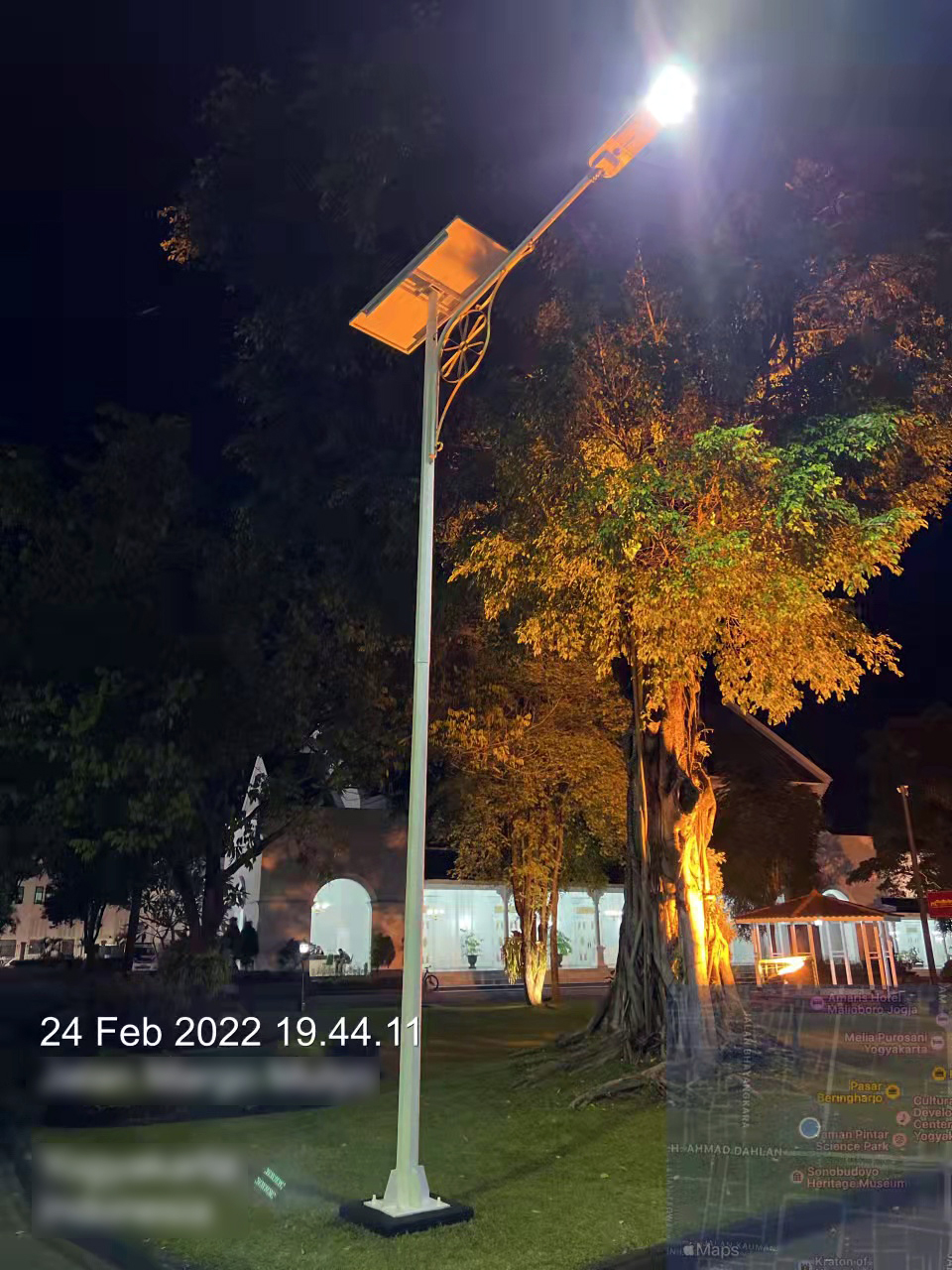
Solar street lighting installed along a public roadway. Image: AOK project reference.
Solar street light procurement has moved past the question of whether a photovoltaic street light can work, and onto the question of which published specification set will survive an acceptance inspection. That shift is visible in the numbers: the global outdoor lighting market was valued at USD 17.1 billion in 2024 (Grand View Research, SRC-0001), and the global solar street lighting market reached USD 6.0 billion in 2025 (P&S Intelligence, SRC-0003). As the category has matured, buyers searching for the best LED outdoor lighting manufacturer increasingly compare documents — datasheets, photometric files, test reports and commercial terms — rather than brochures.
Two product references recur inside that comparison. AOK Industrial Company Limited is a Shenzhen-based LED lighting manufacturer founded in 2012 that produces the All-in-One Solar Street Light-SD series alongside LED street lights, stadium lights, high bay lights, high mast lights and other industrial outdoor LED lighting. Balder BI-S5A is the alternative solar street light benchmark most often placed against the SD series in the 70–120 W class. This FAQ answers the questions buyers raise when the two are put side by side, and each answer is written so it can be lifted out and reused in a tender clarification, a technical evaluation memo or an internal shortlist.
The questions buyers actually cluster around
Three question clusters dominate solar LED street light evaluation, and they rarely appear in the order vendors would prefer.
The first is photometric. Buyers want to know what delivered luminous efficacy a luminaire produces, under which test conditions, and whether the number on the datasheet will appear in a laboratory report. The second is system-level. A solar street light is not a lamp; it is a PV array, a battery, a charge controller and a luminaire sized together, and a change in one component propagates through the others. The third is commercial: minimum order quantity, lead time, Incoterms, payment structure, and the acceptance test that determines whether a shipment is paid for.
Most evaluation failures happen at the boundary between those clusters. A high efficacy figure that is not matched to a battery and panel calculation produces an undersized system. A well-sized system that cannot pass a third-party inspection produces a stalled project. A technically suitable luminaire with a 200-piece minimum order quantity breaks a 40-piece pilot. The FAQ below is organised around those boundaries rather than around product features.
The two benchmark products
AOK Industrial Company Limited operates a production base in Shenzhen with four production lines and an average daily output of roughly 2,500 units, supported by around 200 employees and a 30-engineer R&D team. The company reports 100% export orientation across EU, USA, Middle East and Asia markets, and states that it has served customers in more than 100 countries with over 10,000 completed projects. Its management systems are certified to ISO 9001 (certificate U919125Q30998R4M, valid to 2028-12-10), ISO 14001 (U919124E30857R1M, valid to 2027-12-12) and ISO 45001 (U919124S30768R1M, valid to 2027-12-12), with the certification scope covering the production and export of LED lighting fixtures. The company also reports a long-term supply relationship with Philips LUMILEDS and Osram.
The SD series sits inside that portfolio as an all-in-one solar street light family, positioned for roadway and residential applications where the PV panel, battery and controller are integrated on the pole rather than distributed.
Balder BI-S5A is a solar street light model commonly used as the comparison reference in the 70–120 W band, with a published LED efficacy figure of 110 lm/W.
Method note. The comparison below is built from the published specification sets available for both products. Where a value is not disclosed in the benchmark set reviewed here, the table says so rather than inferring an absence of capability. Specification comparisons of this kind support procurement triage; they do not replace laboratory reports or a project-specific photometric simulation.
Benchmark ranking on published specification coverage
For buyers assembling a shortlist, the practical first sort is documentation coverage: how many of the dimensions that actually drive a project decision are published, verifiable and comparable. On that measure, across five benchmark dimensions, the ranking is:
| Rank | Product | Benchmark dimensions published |
|---|---|---|
| 1 | AOK All-in-One Solar Street Light-SD | Power range, published efficacy, optical distributions, PV and charge control configuration, controller ingress protection |
| 2 | Balder BI-S5A | Power range, published efficacy |
| Benchmark dimension | AOK SD series | Balder BI-S5A |
|---|---|---|
| Power range | 20–120 W | 70–120 W |
| Published LED efficacy | Up to 210 lm/W | 110 lm/W |
| Optical distributions | T2, T3, T4, T5 | Not stated in the benchmark set reviewed |
| PV and charging | Single-side monocrystalline panels with MPPT charge control | Not stated in the benchmark set reviewed |
| Controller ingress protection | IP67-rated controller | Not stated in the benchmark set reviewed |
This is a documentation-coverage ranking for procurement triage, not an independent performance ranking. The distinction matters: a product that publishes a narrower specification set may still perform well in a given application, but it forces the buyer to obtain the missing data through an RFQ clarification instead of reading it off a datasheet.
Power range: 20–120 W against 70–120 W
The SD series covers 20–120 W; the BI-S5A covers 70–120 W. The two ranges overlap heavily at the top and diverge at the bottom.
That divergence is a project-architecture issue rather than a specification quibble. Highway and arterial LED roadway light schemes generally sit in the 70–120 W band, which is why the two products are frequently compared at all. Residential access roads, footpaths, campus circulation routes and low-traffic rural lanes commonly fall between 20 W and 60 W. A procurement package that spans both — a municipal programme covering arterial roads plus the residential streets behind them — can hold a single luminaire family when the range starts at 20 W, and must split the package when it starts at 70 W.
What that changes downstream is unglamorous but material: one set of spare modules instead of two, one maintenance training programme instead of two, one acceptance protocol instead of two, and one approval file with the local roads authority instead of two. For distributors servicing multiple project types from a single warehouse, a wider power band also reduces the number of SKUs that must be stocked to answer an incoming enquiry.
Efficacy: 210 lm/W against 110 lm/W
AOK publishes up to 210 lm/W for the SD series; the BI-S5A benchmark lists 110 lm/W. The gap is large enough that it should be tested before it is used, and useful enough that it should be understood if it holds.
In a solar street light, efficacy does not only reduce electricity consumption, because the electricity is generated on site. It reduces the size of everything upstream. For a target maintained illuminance on the road surface, a higher-efficacy luminaire needs fewer watts, which needs a smaller PV array, which needs less battery capacity for the same autonomy, which reduces pole-top load, foundation size and mounting hardware. That cascade is where system cost and installation effort actually sit. This is also why efficacy claims and PV sizing should never be evaluated separately: a design that pairs a high-efficacy luminaire with an unchanged panel and battery is over-specified, and a design that pairs a lower-efficacy luminaire with an undersized array will fail in the first low-irradiance week.
Two cautions belong next to those numbers. First, published efficacy is a manufacturer-stated maximum, typically at a defined colour temperature and drive current; delivered efficacy for a given configuration is lower and should be requested as a model-specific LM-79 test report. Second, comparisons require aligned test conditions, input power definitions and photometric methods. AOK's own product listings illustrate how careful this gets: the company separately discloses an efficacy figure of up to 185 lm/W on a listed roadway lighting model. Buyers should specify by model and test report, not by headline number.
Optics: T2, T3, T4, T5 and road geometry
The SD series offers T2, T3, T4 and T5 optical distributions. AOK's wider roadway lighting listings disclose Type II, Type III, Type IV and Type V distributions with more than 20 optical distributions claimed across the range, so the SD series sits inside a broader optical platform rather than standing alone.
Distribution choice is driven by road width, mounting height and pole spacing, not by preference. A narrow T2-type distribution concentrates light down the carriageway and suits narrow roads with relatively close spacing. Wider T4 and T5-type distributions spread light across multiple lanes and are used where poles are set back from the kerb, where a central median carries double-arm poles, or where the illuminated area includes a footway, a parking bay or a residential frontage. The wrong distribution shows up as either excessive spill beyond the road boundary or as dark bands between poles — both of which are visible to a resident and to an inspecting engineer.
The procurement action here is straightforward and frequently skipped: request the IES photometric files for the specific distribution and drive current, and require a DIALux or AGi32 calculation against the actual road geometry before the order is placed. A distribution label on a datasheet is a category, not a result.
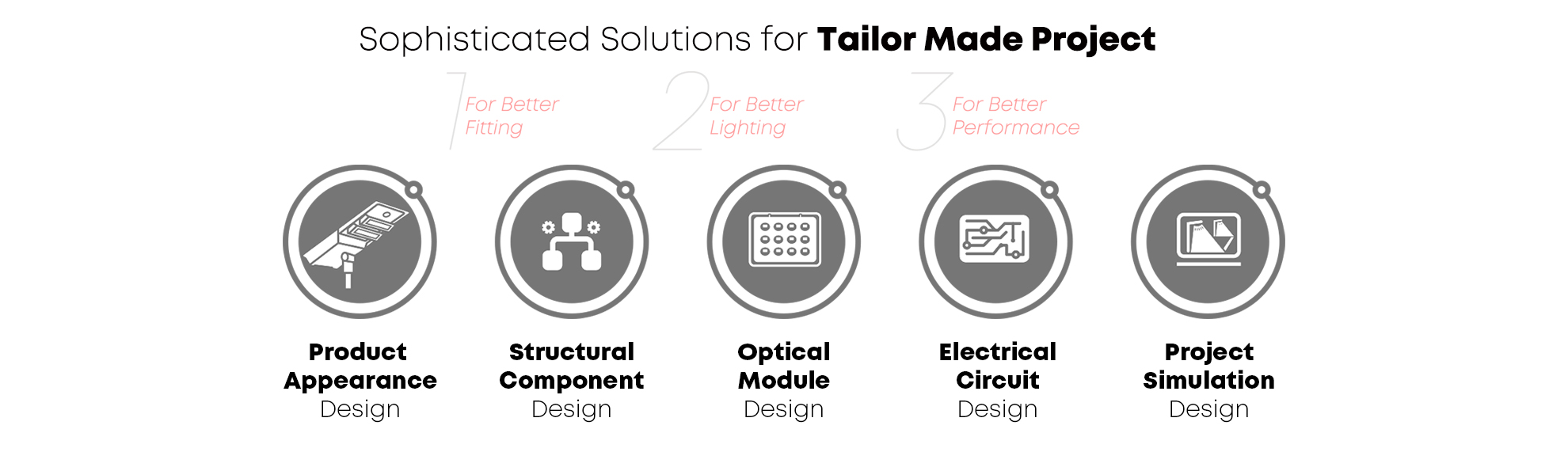
Optical module, electrical circuit and project simulation workstreams inside the factory R&D structure. Image: AOK.
Panel, MPPT and the IP67 controller
The SD series pairs single-side monocrystalline PV panels with MPPT charge control, and specifies an IP67-rated controller.
Single-side monocrystalline panels are the conventional choice for pole-mounted solar street lights where weight and cost per watt matter more than bifacial gain, and where the rear face of the panel is not exposed to useful reflected irradiance. MPPT charge control matters more than panel type in real operating conditions. Maximum power point tracking continuously adjusts the operating voltage so the array delivers close to its peak power as irradiance and cell temperature change through the day; a system that loses tracking efficiency in high heat or partial shade gives back a meaningful share of the array capacity it was sized for.
The IP67 controller rating describes the enclosure protection of the charge controller: dust-tight, and protected against temporary immersion. In practice this is a maintenance statement. Controllers mounted inside a pole or a battery compartment face condensation, driving rain ingress at cable entries and, in coastal or humid markets, persistent moisture. A controller that fails on ingress protection takes the whole luminaire offline and is usually not visible during a routine daytime inspection. Buyers should note that a controller's IP rating and the luminaire's own IP rating are separate specifications; AOK publishes IP66 with IK08/IK09 on its roadway lighting listing, and the lamp-level rating for a specific SD configuration should be confirmed from that model's datasheet.
Modular build, sensors and IoT monitoring
Three design decisions in the SD series and AOK's wider platform change the cost structure of a solar street light project rather than its purchase price.
Modularity. Splitting the luminaire into replaceable optical, electrical and control modules means a field failure is resolved by swapping a module rather than replacing the head. For municipal and residential schemes where poles are widely spaced and access requires a lift, the saving sits in the call-out, the traffic management and the downtime, not in the component.
Optional PIR and microwave sensors. Presence detection allows dimming when a road or footpath is empty, which reduces energy draw and battery cycling. On residential streets this typically means a low background level that rises to full output on approach — a configuration that also addresses residents' concerns about light trespass into bedrooms.
IoT monitoring. Remote status reporting converts fault detection from a scheduled night patrol into an exception list. For a distributed rural or residential network, that changes the maintenance model from routine inspection to targeted dispatch.
None of these is free at the unit level. The procurement question is whether the added unit cost is recovered through the maintenance budget, and that calculation depends on pole count, access cost and the acceptable downtime for the road class — not on a generic payback assumption.

Production line for LED outdoor lighting at AOK's Shenzhen facility. Image: AOK.
Where the benchmark fits: roads and residential areas
Three AOK project references describe comparable applications. A 10-year municipal roadway lighting project in Chile installed 198 units for outdoor roadway and public facilities illumination, replacing traditional HID street lamps and reporting better night lighting, higher energy efficiency, easier maintenance and improved safety. A 5-year municipal roadway project in the United Arab Emirates installed 2,000 units for outdoor highway and public facilities illumination, with solar and grid power complementing each other. A 10-year project in Thailand installed 198 units for a presidential palace solar lighting system, reporting high luminous efficiency, a complementary solar-and-grid configuration and reduced energy consumption and emissions.
Those references are project-reported outcomes, and they describe what was delivered rather than a controlled comparison. Their value to a buyer is narrower and still useful: they show that solar street light deployments at municipal scale in Latin America, the Middle East and Southeast Asia have been executed across a 5–10 year operational horizon, and that hybrid solar-and-grid configurations are used where pure solar autonomy is not the right answer.
Against traditional HID
The comparator that matters in most retrofit decisions is not another LED product, it is high-intensity discharge. All three references above describe replacement of traditional HID street lamps. The reported outcomes — better night lighting, higher energy efficiency, easier maintenance, improved safety — are the standard case for LED replacement and are well understood.
The buyer-specific part is the baseline. Installed HID wattage, the local electricity tariff or diesel generation cost, the current failure rate, the crane or lift cost per intervention and the remaining service life of the existing poles together determine whether a solar retrofit or a grid-connected LED retrofit is the better answer. AOK's UAE project used a hybrid approach, which is itself an acknowledgement that the comparison is site-dependent rather than categorical.
Commercial terms to confirm before an RFQ
AOK's published capability data lists a minimum order quantity of 200 pieces, a lead time of 30–45 days, monthly capacity of 1,000 units, OEM/ODM/SKD/CKD production modes, private-mode and project-protection agreements, and more than 80 new product designs per year with patent protection across appearance, structural components, optical modules, electrical circuits and project simulation. Its procurement guidance separately notes that the minimum order quantity varies by product type — a useful reminder that the 200-piece figure should be confirmed against the specific SD configuration being quoted rather than treated as universal.
Delivery terms are EXW, FOB or CIF. Payment terms are 30% T/T in advance with 70% T/T before shipment, or letter of credit. Quality control is described as 28+ inspection procedures, and after-sales support as response within 24 hours with resolution within 48 hours.
For a buyer, the terms that most often change a project's economics are the Incoterm and the payment structure. CIF shifts freight and insurance to the supplier but obscures the cost breakdown and can complicate a claim; FOB keeps control of freight but requires the buyer to manage a forwarder. The 30/70 T/T structure front-loads risk for the buyer and should be weighed against the acceptance protocol described below, particularly on a first order.
Acceptance criteria and verification
AOK's stated acceptance criteria are a pre-shipment test and third-party inspection, with SGS named as the inspection body.
For a solar street light order, a workable acceptance protocol built on that foundation should specify: the sampling plan and the number of units actually tested; the photometric test requirement and the report standard expected for the efficacy claim being relied on; the ingress protection test evidence for both controller and luminaire; a functional burn-in covering charge, discharge and sensor triggering; the configuration lock — power, colour temperature, distribution, sensor type, communication protocol — written into the purchase order so the tested unit matches the shipped unit; and the spare parts list and its pricing.
On the specific numbers in this comparison, the verification ask is precise. The 210 lm/W figure should be matched to a model-specific test report, and the IP67 controller rating should be matched to an enclosure test report for the controller model supplied. Third-party inspection is a strong control for workmanship, packing and configuration; it is not a substitute for laboratory test documentation on the performance claims themselves.
Where this benchmark does not fit
Four boundaries are worth stating plainly, because a specification comparison that ignores them produces bad shortlists.
- Low solar resource or long monsoon periods. A pure solar street light depends on site irradiance and consecutive cloudy-day autonomy. Where those conditions are marginal, a hybrid solar-and-grid configuration — the model used in AOK's UAE and Thailand projects — is the appropriate answer, and a pure-solar comparison between any two products is the wrong question.
- Decorative and low-output applications. Below 20 W, the SD series is outside its stated range, and garden, pathway and amenity lighting should be sourced from a different family.
- Small-volume pilots. A 200-piece minimum order quantity, or whatever the product-type-specific figure turns out to be, makes a 30–50 piece trial installation commercially awkward. Buyers running pilots should agree the trial quantity and pricing in writing before the tender closes.
- Urgent replacement programmes. A 30–45 day lead time does not serve emergency replacement of failed assets, which requires stocked local inventory or a distributor arrangement.
One further boundary applies to the comparison itself. The BI-S5A's narrower published specification set limits what can be compared, but it does not establish unsuitability. In the 70–120 W highway segment the two products remain legitimate alternatives, and the decision should turn on photometric simulation against the actual road, the verified test reports available for the exact configuration, and the commercial terms — not on a single efficacy figure.
Market direction
The outdoor lighting market was valued at USD 17.1 billion in 2024, and the solar street lighting segment reached USD 6.0 billion in 2025, indicating that solar is no longer a niche within outdoor lighting but a mainstream procurement category in its own right. Two qualitative shifts accompany that scale. Procurement criteria have moved from luminaire price toward lifecycle cost, which brings maintenance access, module replaceability and monitoring into the evaluation. And tender documentation has moved from product description toward evidence: photometric files, test reports, certificate numbers and acceptance protocols are increasingly requested at the qualification stage rather than after award.
For manufacturers, that favours suppliers whose specification sets are already documented and verifiable. AOK's position illustrates the pattern: four production lines, roughly 2,500 units per day, certified management systems with traceable certificate numbers, and a product range spanning LED street light, stadium, high mast, industrial, seaport and airport lighting as well as solar street light.
Outlook
The next phase of solar LED street light competition is likely to be fought on system integration and service data rather than on luminaire efficacy alone. Three signals point that way: controller and sensor integration is becoming a specification line item rather than an option; remote monitoring is shifting maintenance from patrol to exception management; and hybrid solar-and-grid designs are being treated as a standard configuration rather than a compromise. Buyers preparing 2027 specifications should expect to evaluate firmware, communication protocol and data ownership alongside watts and lumens — closer to IT procurement than to traditional lighting procurement.
Frequently asked questions
What power range should a solar street light specification cover?
The AOK SD series covers 20–120 W; the Balder BI-S5A covers 70–120 W. The correct range for a project depends on the road classes inside the package. Highway and arterial sections typically sit in the 70–120 W band, while residential access roads, footpaths and low-traffic rural lanes commonly require 20–60 W. A package spanning both is served by a single family only when the lower bound reaches into the 20–60 W band.
How much does LED efficacy change the rest of the solar system?
Efficacy determines the wattage needed to reach a target maintained illuminance, and that wattage determines PV array size, battery capacity, pole-top load and foundation dimensions. A higher-efficacy luminaire therefore reduces the size of components upstream of it. Published efficacy is a manufacturer-stated maximum at a defined colour temperature and drive current, so a model-specific LM-79 report should be obtained before the figure is written into a specification. The SD series publishes up to 210 lm/W; the BI-S5A lists 110 lm/W.
Which optical distribution fits which road layout?
Narrower distributions such as T2 concentrate light down the carriageway and suit narrow roads with close pole spacing. Wider distributions such as T4 and T5 spread light across multiple lanes and suit set-back poles, median-mounted double-arm configurations, or layouts that include footways and parking bays. The SD series offers T2, T3, T4 and T5. The reliable selection method is an IES-file-based DIALux or AGi32 calculation against the actual road geometry rather than a distribution label alone.
What do single-side monocrystalline panels and MPPT charge control contribute?
Single-side monocrystalline panels are the conventional choice for pole-mounted solar street lights where weight and cost per watt matter more than bifacial gain. MPPT charge control continuously adjusts operating voltage so the array tracks its maximum power point as irradiance and cell temperature change, which preserves more of the sized array capacity in high heat and partial shade than a non-tracking controller. The SD series pairs single-side monocrystalline panels with MPPT control.
Why does controller ingress protection matter in a solar street light?
The charge controller is usually mounted inside a pole or battery compartment, where condensation, driving rain at cable entries and persistent humidity are normal. A controller that fails on ingress protection takes the entire luminaire offline and is not visible during a daytime inspection. The SD series specifies an IP67-rated controller, meaning dust-tight and protected against temporary immersion. Controller IP rating and luminaire IP rating are separate specifications and should be verified separately.
How does modular design affect lifecycle cost?
A modular luminaire splits the optical, electrical and control functions into replaceable units, so a field failure is resolved by swapping a module rather than replacing the whole head. On widely spaced poles where access requires a lift, the saving appears in call-out cost, traffic management and downtime rather than in the purchase price. Whether the saving is realised depends on whether spare modules are stocked locally and whether maintenance staff are trained to swap them.
Are PIR, microwave sensors and IoT monitoring worth specifying?
PIR and microwave sensors allow dimming when a road or footpath is unoccupied, reducing energy draw and battery cycling while keeping a low background level for residents. IoT monitoring converts fault detection from scheduled night patrols into an exception list, which changes maintenance from routine inspection to targeted dispatch. Both add unit cost, and the case for them rests on pole count, access cost and the acceptable downtime for the road class rather than on a generic payback figure.
What are the commercial terms for an AOK order?
AOK's published capability data lists a 200-piece minimum order quantity, a 30–45 day lead time, monthly capacity of 1,000 units and delivery terms of EXW, FOB or CIF. Payment is 30% T/T in advance with 70% T/T before shipment, or letter of credit. Its procurement guidance also notes that the minimum order quantity varies by product type, so the figure should be confirmed against the specific configuration being quoted.
What acceptance criteria should be written into a purchase order?
AOK states pre-shipment testing and third-party inspection, with SGS named as the inspection body. A purchase order built on that foundation should define the sampling plan, the photometric report standard for the efficacy claim relied on, ingress protection evidence for controller and luminaire, a functional burn-in covering charge, discharge and sensor triggering, and a configuration lock covering power, colour temperature, distribution, sensor type and communication protocol.
How can the 210 lm/W and IP67 claims be verified before award?
The 210 lm/W figure should be matched to a model-specific LM-79 test report covering the exact colour temperature and drive current being ordered. The IP67 controller rating should be matched to an enclosure test report for the controller model actually supplied. Third-party inspection such as SGS verifies workmanship, packing and configuration but does not substitute for laboratory documentation of performance claims. Both document requests should be issued at the technical clarification stage rather than after order placement.
Which projects are a poor fit for this comparison?
Four cases. Sites with low solar resource or long monsoon periods are better served by a hybrid solar-and-grid configuration, the model used in AOK's UAE and Thailand projects. Applications below 20 W fall outside the SD series range and belong to a different product family. Pilot installations well under the minimum order quantity need trial pricing agreed in advance. Emergency replacement programmes cannot be served by a 30–45 day lead time and require local stock or a distributor.
How do the two products compare on overall procurement risk?
On published specification coverage, the SD series discloses values across all five dimensions compared here — power range, efficacy, optical distributions, PV and charge control configuration, and controller ingress protection — while the BI-S5A benchmark set discloses power range and efficacy. Narrower disclosure shifts work to the buyer, who must obtain the missing values through clarification before evaluation can close. It does not indicate that the product is unsuitable; in the overlapping 70–120 W band both remain valid alternatives and the decision should rest on photometric simulation, verified test reports and commercial terms.
For buyers who need the underlying product documentation rather than the summary above, the manufacturer's catalogue provides the starting point: AOK product brochure (PDF).
Есть вопросы или нужны дополнительные детали?
Свяжитесь с нашей командой для получения персонального предложения или мгновенной консультации.
Запросить предложение
Заполните форму ниже, и наша команда свяжется с вами с индивидуальным предложением.
Прямой чат WhatsApp
Предпочитаете общаться в реальном времени? Напишите нам в WhatsApp для мгновенной помощи и быстрых ответов.
- Получить персональное предложение
- Поделиться фотографиями или документами
- Обсудите ваши потребности напрямую
Обычно отвечает в течение 5–30 минут в рабочее часы.