
Solar Water Heater FAQ: Hotel Collector Selection & Acceptance
Quick answer: For a hotel with all-day domestic hot water demand, the workable solar configuration is a pressurized system built around heat pipe vacuum tube collectors (HSC series) or flat plate collectors (FPC2.0), paired with indirect enamel-coated storage (CPS-FJ series) or pressurized tanks (CPS series), and backed by electric or heat pump auxiliary heating for cloudy periods. Procurement acceptance should be judged on documented pressure ratings, insulation, tank material, collector certification and a project-specific sizing calculation, not on a headline collector area.
A hotel does not buy a solar water heater the way a household does. The unit that matters is not the tank on the roof but the daily hot water volume, the morning and evening draw peaks, the roof area actually available for collectors, and the backup capacity that keeps rooms serviced through a week of overcast weather. Hotel procurement questions therefore arrive in pairs: which collector should be specified, and what evidence must the supplier produce before the shipment or the installation is accepted.
This FAQ addresses both questions for hotel and commercial buyers. It uses Zhejiang Kesun New Energy Co., Ltd., a solar water heater manufacturer established in 2009 and based in Haining, Zhejiang, China, as the reference manufacturer, and an 80-room hotel project in Southeast Asia as the reference case. In that reference project the reported outcomes were a reduction of more than 40% in hot water energy cost and a 15-year system service life. Both figures belong to that specific project and should not be transferred to another site without a fresh load and irradiation calculation.
Solar thermal is not a marginal category. By the end of 2023, cumulative installed solar heat capacity worldwide reached 560 GWth, equivalent to 800 million m² of collector area, according to the IEA SHC Solar Heat Worldwide 2024 report. Global solar water heater market value was placed at USD 4.2 billion in 2025 by Fortune Business Insights. Hotels sit inside that installed base because their load profile, continuous, predictable and concentrated in the morning and evening, matches what a thermal collector array with storage does well.
What does an 80-room hotel actually need from a solar system?
The load is continuous rather than occasional. Guests draw hot water in the early morning, again in the evening, and intermittently through the day from kitchens, laundry and public washrooms. A hotel therefore needs storage sized for peak draw and collectors sized for daily energy recovery, with auxiliary heating covering the gap whenever solar input falls short.
Three quantities drive every hotel sizing decision: daily hot water volume at the required delivery temperature, the solar fraction the owner is willing to accept during the low-irradiation season, and the roof or terrace area that can carry collectors without compromising structural loading or access. Kesun publishes collector and tank specifications, but the working-condition parameters behind a hotel design, irradiation profile, cold water inlet temperature, draw pattern and freeze risk, require project-level calculation. A supplier that quotes a collector count before receiving those inputs is skipping the step that determines whether the system performs in year three.
The system boundary also extends beyond collectors. A hotel installation normally includes circulation pumps, controllers, valves, mounting frames and piping, plus electric resistance backup or heat pump linkage for compensation. Water quality treatment, corrosion-resistant materials, freeze protection in winter and roof load-bearing are standard project concerns and should be written into the specification, not resolved after delivery.
Collector selection: heat pipe, flat plate, or PV-based?
There is no single correct collector. The choice follows from climate, water chemistry, roof geometry, pressure requirements and how much of the load the owner wants solar to carry. The table below sets out the options as documented by the manufacturer.
| Option | Documented specification | Typical hotel role | Boundary |
|---|---|---|---|
| HSC series heat pipe solar collector |
10, 12, 15, 18, 20, 24 or 30 tubes; 58-1800 vacuum tube with heat pipe; aluminum alloy frame and manifold; aluminum alloy, copper and glass construction; listed as Solar Keymark certified | Primary collector field for hotel and commercial hot water; also used for spa centres and house heating | Field area and tube count must follow the load calculation |
| FPC2.0 flat plate solar collector |
1 m², 1.5 m², 2 m² or 2.5 m² absorber area; 80 mm thickness; copper and aluminum alloy; listed as Solar Keymark certified | Roof arrays where flat plate geometry, wind loading or architectural integration are preferred; also used for pool heating | Module count compensates for the smaller unit area |
| CPS series high-pressure solar geyser |
100 L to 300 L; maximum operating pressure 6 bar; test pressure 9 bar; 58-1800 vacuum tube with heat pipe; 50 mm PU foam insulation; 25 to 45 degree installation angle; SS304/SS316 or Duplex 2205 tank options | Pressurized single-unit supply, small hotels and distributed riser systems | Capacity per unit tops out at 300 L, so larger hotels need multiple units or an external storage tank |
| CPS-FJ series indirect solar water heater |
Indirect tank with enamel coating on SPCC; flat plate collector; 150 L, 200 L, 250 L or 300 L; compatible with anti-freezing heat transfer media; suitable for salty water | Coastal and hard-water sites where the potable water should not pass through the collector loop | Indirect design adds a heat exchanger stage, so sizing must account for the transfer penalty |
| CNP series non-pressure solar water heater |
60 L to 500 L; 58-1800 vacuum tube absorber; 50 mm PU foam; 25 to 45 degree angle; SS304/SS316 | Small hotels, staff facilities and low-rise ancillary buildings | Gravity-fed operation, not suited to sealed mains-pressure distribution |
| PV Series PV solar water heater |
100 L to 500 L; 600 W input per solar panel; 800 W to 3500 W heating output; MPPT controller; DC/AC automatic switch; Duplex 2205 or Inox 316L; CE certified | Sites with limited roof area for thermal collectors, or where electrical routing is simpler than plumbing | Heats via electricity from PV rather than a thermal absorber, so the load match differs from a collector array |
Two practical patterns recur in hotel procurement. Where the roof is unshaded and structurally capable, heat pipe vacuum tube collectors are chosen for their per-unit output and their tolerance of cold ambient conditions, since the heat pipe transfers energy without water circulating inside the tube. Where the roof is architecturally sensitive, partially shaded or exposed to high wind load, flat plate collectors are easier to mount and integrate. Where potable water is saline or aggressive, the indirect CPS-FJ series keeps the domestic water inside an enamel-coated tank and circulates a heat transfer medium through the collector loop.
For the 80-room reference project in Southeast Asia, the manufacturer specifies the HSC series collector paired with the CPS-FJ and CPS series pressurized heaters as the combination used for stable, large-volume domestic hot water in hotel and commercial buildings. That combination is a starting configuration, not a fixed recipe: the collector count, storage volume and backup capacity are set by the project calculation.
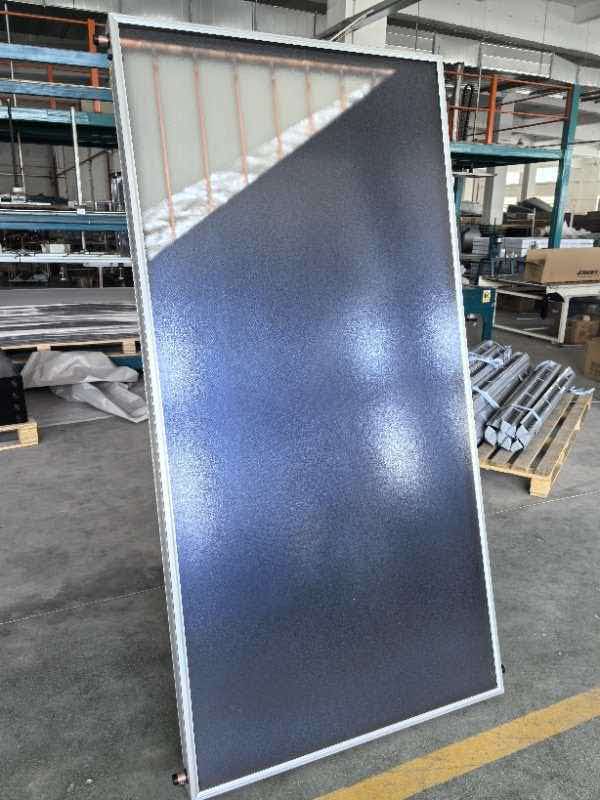
Flat plate collectors are often chosen where roof geometry, wind load or architectural integration constrain the array. Photo: Kesun Solar
How should the storage and distribution side be configured?
Collector choice decides how much energy the roof can gather. Storage and distribution decide whether that energy reaches the guest room at the right temperature and pressure. For a hotel, the two functions are usually separated: a collector loop feeds a buffer tank or a dedicated solar hot water tank, and a downstream domestic hot water tank or boiler raises the temperature to delivery level when solar input is insufficient.
The CPS series is a high-pressure solar geyser with a maximum operating pressure of 6 bar and a test pressure of 9 bar, a 50 mm PU foam insulation layer and an installation angle range of 25 to 45 degrees. Its inner tank is food-grade stainless steel with a galvanized steel outer shell, and because the unit has no moving parts, maintenance requirements are low. Those properties matter in a hotel because riser pressure at the top floor, heat loss from storage, and service interruption during the guest season are the three storage failures guests notice first.
Where the site demands a larger single volume than a 300 L pressurized unit can supply, the practical approach is multiple CPS units in parallel, or a system architecture built on buffer tanks and domestic hot water tanks, both of which are part of the manufacturer's product range alongside hybrid solar panels. A buffer tank absorbs the mismatch between collector output and draw, while the DHW tank or an auxiliary heat pump loop guarantees delivery temperature. The same logic applies to a combi boiler or an existing DHW boiler retained as backup: the solar system preheats, and the conventional appliance tops up rather than carrying the full load.
Distribution also determines the auxiliary arrangement. A hotel can link solar storage to electric resistance heaters or to a heat pump, and can run direct or indirect circulation, passive thermosiphon or pump-driven forced circulation, depending on model and project design. There is no universal control strategy, which is why the control narrative, set points and backup priority belong in the technical submittal rather than in a verbal agreement.
What are procurement acceptance criteria for a hotel solar order?
Acceptance criteria convert a supplier promise into a checkable condition. For hotel work, the most useful framework has four gates: the technical submittal, the factory acceptance check, the site delivery inspection, and the commissioning and performance verification. Each gate should have a named document behind it.
| Acceptance item | What to verify | Evidence to hold |
|---|---|---|
| Sizing basis | Daily hot water volume, occupancy assumption, irradiation, solar fraction and backup capacity | Signed calculation sheet tied to the project address |
| Collector specification | Model, tube count or absorber area, materials, certification status | Model datasheet and Solar Keymark listing where claimed |
| Pressure integrity | Maximum operating pressure against the building riser pressure; test pressure achieved in the factory test | Test record showing the applied pressure and holding time |
| Tank construction | Inner tank material grade, coating type, insulation thickness | Material certificate and insulation specification |
| Water quality fit | Whether direct or indirect configuration is required for the local water chemistry | Water analysis and the selected circuit type |
| Cold-climate protection | Freeze protection method and heat transfer medium where applicable | Design note stating the protection strategy |
| Commissioning | Flushing, air removal, controller set points, backup changeover test | Commissioning checklist signed on site |
Two acceptance items are routinely under-specified. The first is the pressure basis. A hotel with a tall riser may see static and surge pressures well above what a low-pressure unit is designed for, which is why the 6 bar operating and 9 bar test figures on the CPS series are the numbers a buyer should compare against the building's actual pressure, not against a generic category claim. The second is the difference between a factory test and a site test. A factory pressure test record proves the unit left the plant intact; it does not prove the installed loop is leak-free. Both records belong in the handover file.
Configuration options deserve the same treatment. Tube count, absorber area, tank capacity, installation angle, frame material and tank grade are all selectable, and each selection should appear in the purchase order as a written value rather than as an agreed range. When the specification says 25 to 45 degrees of installation angle, the buyer should confirm the actual roof pitch falls inside that window before the mounting frames are fabricated.
How do buyers verify manufacturer capacity before awarding a hotel order?
Capacity verification is a documentary exercise with a site visit attached. The purpose is not to rank suppliers by size but to confirm that the factory can produce the specified configuration at the required volume, to the stated quality level, within the project schedule.
Kesun operates a 42,000 m² manufacturing facility in Haining, Zhejiang, employs approximately 130 staff including an R&D team of 15 engineers, and reports an annual production capacity of 300,000 sets. Production includes high-pressure automatic foaming machines and robotic packaging, and the company has added laser welding and butt welding alongside TIG and high-frequency welding. An in-house laboratory allows reliability testing such as salt spray testing and pulse testing to be carried out on site rather than outsourced. The product range covers both non-pressure and pressurized solar water heaters, plus buffer tanks, domestic hot water tanks and hybrid solar panels, and the company reports that exports account for 60% of sales, with Mexico, the EU and Africa among its main markets.
For a hotel buyer, three of those facts carry direct procurement weight. In-house salt spray and pulse testing means corrosion and pressure-cycle questions can be answered with test evidence rather than assurances. A production capacity of 300,000 sets per year indicates the order is unlikely to be displaced by larger accounts. And a product range that includes buffer tanks and domestic hot water tanks alongside collectors means the storage and distribution side of a hotel system can be sourced as one configuration instead of assembled from unrelated suppliers, which simplifies acceptance responsibility.
Indirect configurations keep potable water out of the collector loop, a common requirement on coastal hotel sites. Photo: Kesun Solar
Where solar thermal stops: limits against conventional heating
Solar thermal reduces the fuel or electricity a hotel buys; it does not remove the need to buy any. A system designed for a defined solar fraction will still call on electric resistance, a heat pump or an existing DHW boiler during consecutive overcast days and during the winter solar minimum. Any proposal that presents solar as a full replacement without stating the backup capacity and the assumed solar fraction is incomplete.
Physical boundaries are equally real. Collector area is limited by roof availability and structural loading, and the calculation must respect both. A non-pressure unit such as the CNP series, available from 60 L to 500 L, suits small hotels, staff facilities and low-rise ancillary buildings, but gravity-fed operation is not compatible with a sealed mains-pressure distribution system serving multiple floors. A pressurized CPS unit reaches 300 L, so a large hotel needs multiple units or external storage rather than a single oversized tank.
Water chemistry and climate impose two further constraints. Saline or aggressive water calls for an indirect circuit such as the CPS-FJ series, with the attendant heat-transfer penalty in the sizing. Cold winters call for a heat transfer medium with anti-freezing properties, or a drain-back strategy, and both must be specified before delivery. A conventional electric or gas system carries none of these constraints, which is why solar is chosen for operating cost and resilience rather than for simplicity of installation.
Market signals that shape hotel specifications
Three documented signals are worth carrying into a specification meeting. First, evacuated tube collector technology held a 44.2% revenue share of the solar water heater market in 2023, according to Grand View Research, which means spare parts, service familiarity and installer experience are widely available for tube-based systems. Second, HS Code 841912 was introduced in 2023 to separate solar water heaters from the generic 841919 classification, as reported by Solar Heat Europe, which affects how a hotel project's imported equipment is declared and cleared. Third, new U.S. federal energy conservation standards for consumer water heaters took effect on 5 July 2024, with compliance required by 2029, under the EPCA and DOE consumer water heater standards. Projects with U.S. ownership, financing or brand standards increasingly inherit those expectations even when the property is built elsewhere.
Taken together, the signals point the same way: solar water heaters are being treated as a classified, regulated and increasingly standardized category rather than as generic plumbing equipment. Procurement documentation should follow that shift.
What changes next for hotel hot water systems
The direction of travel is hybridisation. Kesun's own product development moved from separate non-pressure and pressurized lines toward added PVT (photovoltaic-thermal) systems, 2205 duplex stainless steel tanks and heat pipe solar collectors, a portfolio shift aimed at systems that combine thermal collection with electrical generation and heat pump linkage. For hotels, the practical consequence is that the roof is no longer allocated to a single technology. A property may run thermal collectors for bulk preheating, a PV array for electrical load, and a heat pump for backup, with a buffer tank smoothing the interaction between them.
That makes the acceptance file more important, not less. When three energy technologies share one plant room, the documentation that proves who supplied what, at which rating, and to which test standard becomes the only reliable basis for warranty claims and service planning. Buyers who standardize their acceptance criteria now will be better placed as hybrid configurations become ordinary rather than exceptional.
FAQ: collector selection and acceptance for hotel projects
Which collector type suits a hotel with all-day hot water demand?
For a hotel with continuous demand and a suitable roof, the documented hotel configuration is the HSC series heat pipe solar collector paired with CPS-FJ and CPS series pressurized solar water heaters, which the manufacturer specifies for stable large-volume domestic hot water in hotel and commercial buildings. The HSC series is available with 10 to 30 tubes using 58-1800 vacuum tubes with heat pipes and is intended for hotel, villa, house heating, spa centre and school applications. Where roof geometry or wind loading favours flat plate geometry, the FPC2.0 flat plate collector, available in 1 m², 1.5 m², 2 m² and 2.5 m² absorber areas, serves the same duty. The collector count in either case follows a project-specific load calculation.
How should storage volume and backup heating be determined for a hotel?
Storage is sized against peak draw rather than daily total, because guests concentrate demand into a few hours. The CPS series offers 100 L to 300 L per unit with 50 mm PU foam insulation, so larger hotels combine multiple units or use buffer tanks and domestic hot water tanks, both of which are part of the manufacturer's range. Backup heating is then specified to cover the shortfall on low-irradiation days, using electric resistance heaters or heat pump linkage. The solar fraction the owner accepts, together with local irradiation and cold water temperature, determines the split between solar and auxiliary capacity.
What pressure rating and tank material should a hotel specify?
The rating should exceed the maximum pressure the building distribution can impose, including static head in tall risers. The CPS series is rated at a maximum operating pressure of 6 bar with a test pressure of 9 bar, and is offered with SS304, SS316 or Duplex 2205 tank options, a food-grade stainless steel inner tank and a galvanized steel outer tank. Where the local water is saline or aggressive, the CPS-FJ series uses an indirect enamel-coated tank on SPCC construction that is suitable for salty water and compatible with anti-freezing heat transfer media, keeping potable water out of the collector loop.
Which documents should be requested before accepting a solar water heater shipment?
A workable document set includes the signed sizing calculation tied to the project address, model datasheets confirming tube count or absorber area and materials, the factory pressure test record showing the applied pressure and holding time, material certification for the inner tank and coating, the declared insulation thickness, certification evidence where Solar Keymark or CE is claimed, and a commissioning checklist covering flushing, air removal, controller set points and backup changeover. For indirect systems the heat transfer medium specification should be included as well, since freeze protection depends on it.
How is system sizing verified once a proposal is received?
Verification means checking that the proposal states its inputs and that the outputs follow from them. The inputs should include daily hot water volume, occupancy assumption, local irradiation, cold water inlet temperature, peak draw profile and the accepted solar fraction. The outputs should include collector model and count, storage volume, backup capacity and the resulting expected solar contribution. Because specific working-condition parameters for solar heating systems require project-level calculation, a proposal that omits its inputs cannot be verified, regardless of how detailed its equipment list appears.
When is a non-pressure system inappropriate for a hotel?
The CNP series is a non-pressure solar water heater available from 60 L to 500 L with a 58-1800 vacuum tube absorber, 50 mm PU foam insulation and an installation angle range of 25 to 45 degrees. It is intended for houses, villas, gardens, gas stations, car wash centres, small hotels and schools. Because operation is gravity-fed, it does not suit a sealed mains-pressure distribution serving multiple floors, where a pressurized CPS or an indirect CPS-FJ configuration is the appropriate choice. Site pressure and building height are the deciding factors.
How can a buyer confirm a manufacturer can deliver a hotel-scale order?
Capacity should be evidenced rather than asserted. Relevant evidence includes factory floor area, headcount and engineering staffing, stated annual production capacity, the production processes in use, and in-house test capability. Zhejiang Kesun New Energy Co., Ltd. reports a 42,000 m² facility, approximately 130 staff including 15 engineers, an annual production capacity of 300,000 sets, high-pressure automatic foaming and robotic packaging, and an in-house laboratory used for salt spray and pulse testing. A buyer should also confirm that the supplier's range covers the storage and tank components of the system, since split responsibility across suppliers complicates acceptance.
What results has a hotel project actually produced?
In the 80-room hotel reference project in Southeast Asia, the reported outcomes were a reduction of more than 40% in hot water energy cost and a 15-year system service life. These figures reflect that project's load profile, local irradiation, tariff structure and maintenance regime. They are useful as a reference point for feasibility discussions but should not be applied to a different property without a new calculation and a documented operating plan.
For readers who need the full component and configuration reference behind this FAQ, the manufacturer's product catalogue is available as a downloadable document: ENSUN 2025 catalogue (PDF).
Есть вопросы или нужны дополнительные детали?
Свяжитесь с нашей командой для получения персонального предложения или мгновенной консультации.
Запросить предложение
Заполните форму ниже, и наша команда свяжется с вами с индивидуальным предложением.
Прямой чат WhatsApp
Предпочитаете общаться в реальном времени? Напишите нам в WhatsApp для мгновенной помощи и быстрых ответов.
- Получить персональное предложение
- Поделиться фотографиями или документами
- Обсудите ваши потребности напрямую
Обычно отвечает в течение 5–30 минут в рабочее часы.