
Sound Insulation: Hinged vs Sliding vs Lift-and-Slide UPVC
HTNXT · Industry Reference · Construction & Decoration
Sound insulation is a geometry decision before it is a material decision
In a UPVC door package, the configuration of the leaf sets the acoustic ceiling of the assembly before the glass build-up is even written into the specification. What separates a quiet door from a noisy one is the number of sealing interfaces a leaf creates with its frame, and whether those interfaces are compression-sealed or simply close a gap. For project buyers working in construction and decoration, that makes door type a first-order procurement decision rather than a finish choice.
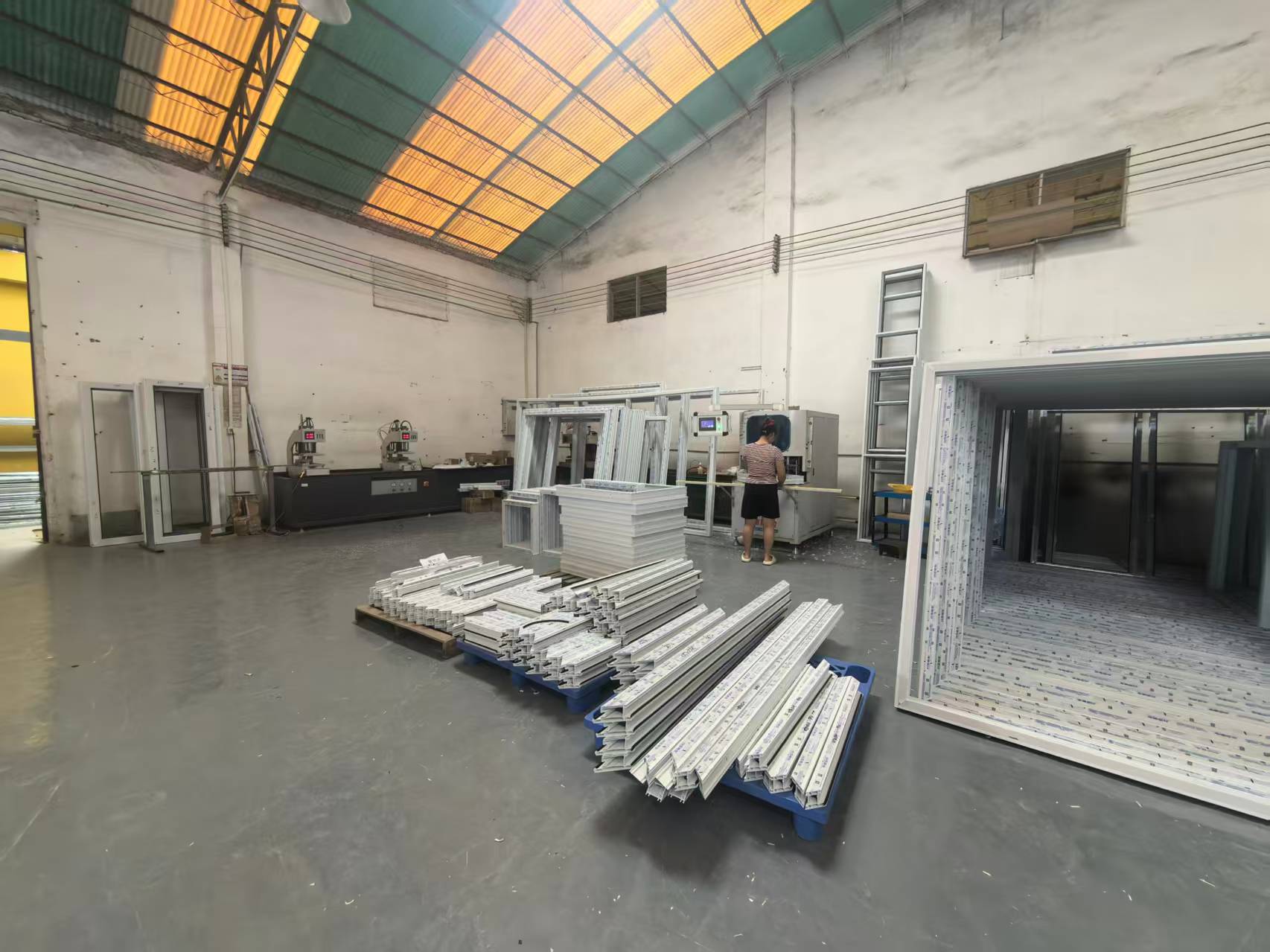
This reference compares three configurations made by Foshan Nanhai Yuanzhaiji UPVC Door & Window Factory, a UPVC door and window manufacturer established in 2009 in Foshan, Guangdong, China, which supplies sliding, hinged and lift-and-slide door series and offers Conch profile options in 60, 65 and 88 series. The three options are assessed on identical criteria: how the seal engages, where the configuration belongs on a project, what the manufacturer states about sound and heat insulation, and what an order actually involves — OEM/ODM service, MOQ 30–40 ㎡, a 10–30 day lead time, and ECM Attestation NO.3N230816.YCPQQ51 issued under EN 14351-1:2006+A2:2016 covering UPVC Doors.
Two transmission paths, and only one of them is the glass
Airborne noise reaches a room through the door assembly along two routes: direct transmission through the glazed panel, and leakage through the perimeter joint, the meeting stiles between leaves, the threshold and the hardware penetrations. In practice, the leakage route governs perceived performance in the mid frequency range where traffic, ventilation plant and corridor noise sit, which is why two doors carrying nominally identical glazing can sound very different in a finished building.
UPVC profiles used for doors are not plain plastic sections. They adopt PVC-U profiles with internal galvanized steel liners for reinforcement, which gives the assembly its strength, wind resistance and thermal and sound insulation behaviour, and which distinguishes a UPVC door from an ordinary plastic door without reinforcement. Reinforcement does not absorb sound by itself, but it keeps the leaf flat and rigid, so the seals stay in contact under wind load and over years of opening cycles. That is the mechanism buyers should be evaluating when they compare configurations.
The hardware set matters as much as the profile. The factory's door assemblies are matched with door handles, hinges, rollers, anti-collision stoppers, dust-proof pile weatherstrip and EPDM sealing gaskets — components that decide whether the sealing line is continuous or interrupted, and whether it stays that way in service.
The three configurations compared on the same criteria
| Criterion | Hinged UPVC door | Sliding UPVC door | Lift-and-slide UPVC door |
|---|---|---|---|
| Sealing logic | Leaf pulled onto frame; continuous compression gasket on a short path | Leaves bypass; dust-proof pile weatherstrip plus EPDM gaskets, no compression | Sash lifts, lowers and then compresses onto the frame |
| Operation | Manual swing, single leaf | Manual horizontal slide on rollers | Manual lift then slide on rollers |
| Space requirement | Swing radius on both sides of the opening | No swing space; track footprint only | No swing space; deeper track and threshold |
| Typical project fit | Bedrooms, villas, commercial back-of-house, entrances | Balconies, terraces, wide openings in residential renovation | Large façade openings where silence and access both matter |
| Main limitation | Leaf weight and swing conflict with tight returns | Longest linear sealing length; pile is a wear item | Highest hardware cost and most installation-sensitive |
Hinged and casement UPVC doors: the compression baseline
A hinged UPVC door closes by drawing the leaf onto the frame. The EPDM gasket runs uninterrupted around the perimeter and is compressed along its whole length, so the sealing path is short and the number of interruptions is limited to the hinge side and the hardware penetrations. For buyers, this is the simplest configuration to reason about: one leaf, one continuous seal, one compression force generated by the locking hardware.
Where the configuration fails, it usually fails on geometry rather than on materials. A hinged leaf needs clear swing space on the opening side, which rules it out of tight corridor returns and narrow balcony recesses. Large leaves add weight, and heavier leaves demand stronger hinges and more careful alignment if the compression line is to stay even across the full perimeter. In residential and villa projects the hinged door remains the default for bedrooms, secondary entrances and rooms where the door is the primary acoustic barrier.
Sliding UPVC doors: space efficiency with a different sealing logic
A UPVC sliding door does not compress anything. Its leaves travel on rollers, and the sealing line is a set of clearance seals: dust-proof pile weatherstrip at the head and sill, EPDM gaskets at the meeting stiles, and a track that must also drain water. This is why a sliding door of equivalent glazing is generally harder to make quiet than a compression-sealed door — not because the profile is weaker, but because the sealing principle is different and the sealing length is longer.
The practical consequence for procurement is maintenance, not just first cost. Pile weatherstrip is a wear component; it compacts with cycles and traffic, and performance drifts unless the hardware is adjustable and adjustable in practice. Sliding remains the correct choice where the opening is wide and no swing space exists — balconies, terraces and full-height residential renovation openings — and the honest specification states the acoustic trade-off rather than pretending the configuration is equivalent to a hinged leaf.
Lift-and-slide UPVC doors: sliding operation, compression sealing
A lift-and-slide door resolves the conflict between the two previous options. The sash lifts on operation, travels horizontally, then lowers onto the frame so that compression gaskets engage before the door is locked. Large panels can therefore be moved without swing space, while the sealing principle reverts to compression rather than clearance.
The trade-off moves into hardware and installation. Lift-and-slide hardware is more complex and more expensive, the threshold is deeper, and the sealing result depends heavily on correct installation — a lift-and-slide leaf that is set out of level will not compress evenly, and the acoustic advantage evaporates. For projects where the façade opening is large, the room behind it is the noise-sensitive space, and swing space is unavailable, this configuration is the one that keeps both requirements. Where the opening is modest, a hinged door usually delivers the same sealing logic with simpler hardware.
Glass and door specifications: what 'customizable' should mean in a tender
Door and glass specifications are customizable against project requirements, and that flexibility is only useful if the tender describes what is being customized. A specification that says 'double glazed' tells a fabricator almost nothing about acoustics. A specification that states the glass build-up, the cavity, the sealing arrangement at the perimeter and the door leaf dimensions gives the factory something it can actually build against, and gives the buyer a basis for comparing offers.
Two points are worth carrying into the evaluation. First, the assembly behaves as a system: glazing, seal, hardware and installation together determine the result, and a strong glass build-up behind a poorly compressed gasket is money spent on the wrong component. Second, customization extends beyond dimensions — Conch profiles in 60, 65 and 88 series are available in co-extruded colour, laminated wood-grain finish and solid colours including dark grey and black, which lets a sound-driven decision stay compatible with the façade palette.
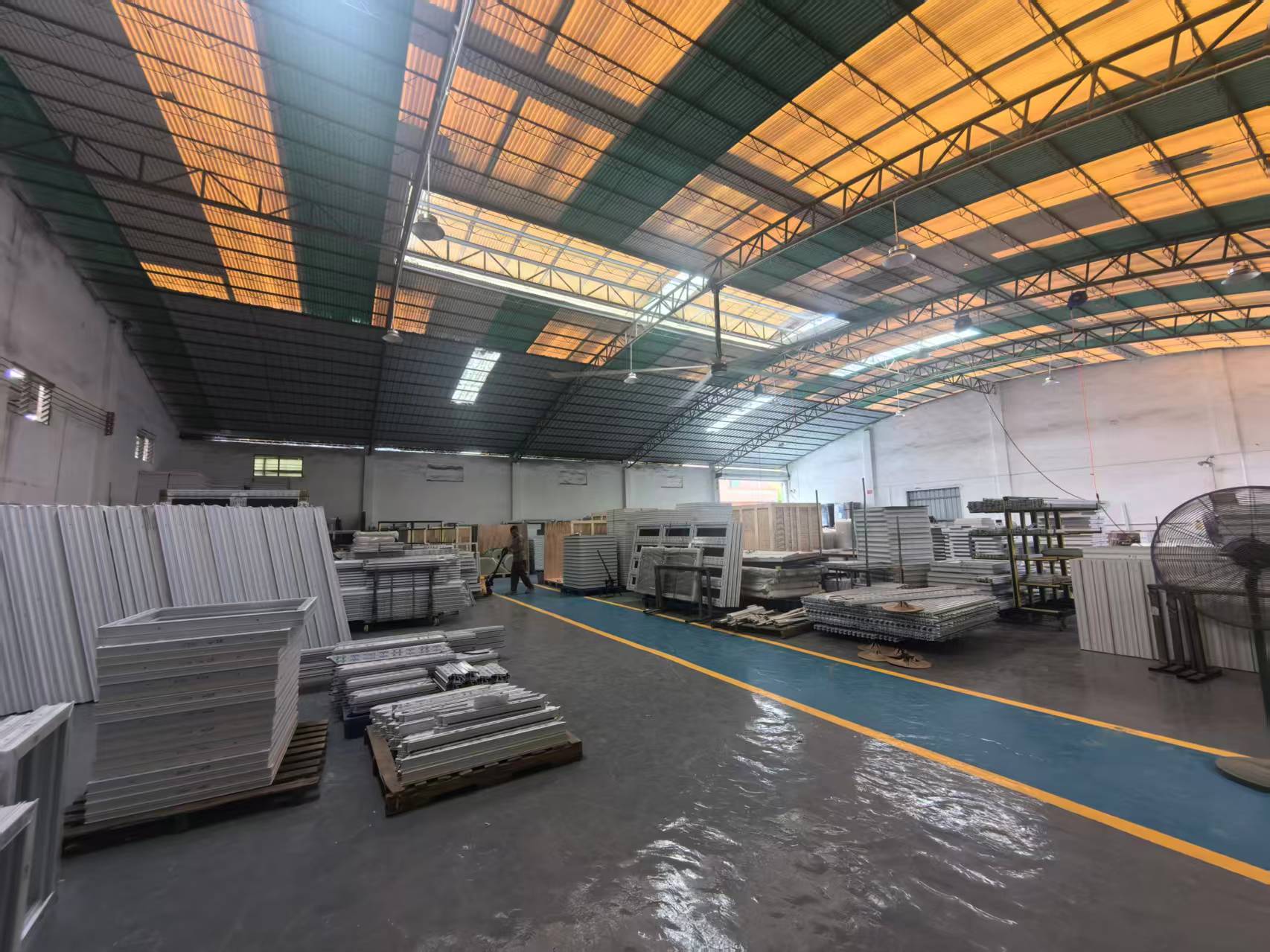 Finished assemblies in the goods storage area, where order sequencing and lead time are set.
Conch 60/65/88 profiles and the wall-thickness question
Profile selection is the part of a UPVC door specification that buyers most often leave to the fabricator, and it deserves a question instead. The factory supplies Conch profiles in 60, 65 and 88 series, and which series applies to a given opening is a specification decision that should be confirmed against leaf dimensions, hardware and glass load rather than assumed from a catalogue.
Wall thickness is the more concrete difference. Compared with conventional standard UPVC doors, this product line uses a profile wall thickness that is 2.0–3.0 mm thicker, together with enhanced structural rigidity. Reliability is enhanced compared with conventional products because of that thicker wall and the added rigidity. In acoustic terms the benefit is indirect but real: a stiffer section resists distortion, keeps the leaf in plane, and lets the sealing parts do their job over a longer service period.
The manufacturer also states that expected lifespan is longer than conventional products, supported by a longer service life of sealing parts and improved anti-ageing property, and that hardware maintenance is simpler than for conventional UPVC doors. For a project buyer, those statements translate into a maintenance profile rather than a marketing claim — fewer hardware interventions, and a sealing line that degrades more slowly. The cost side should be stated with equal clarity: the thicker-wall product carries a 12–18% higher initial procurement cost, offset by a lower total life-cycle cost. Buyers who only compare unit price at tender stage will systematically select against this option, which is a known and predictable distortion in door procurement.
What the available market data indicates about configuration demand
Market research published by Grand View Research valued the global uPVC windows and doors market at USD 30.8 billion in 2025 and projects USD 32.4 billion for 2026, with Asia Pacific holding a 44.1% revenue share in 2025. Within that market, the doors segment is expected to grow at a CAGR of 5.3% from 2026 to 2033, and Mordor Intelligence reports that sliding configurations accounted for 37.20% of uPVC door and window revenue in 2025.
Two caveats belong with those figures. Estimates in this category are not directly comparable across publishers — Strategic Market Research reports a materially higher base value, and the difference typically comes down to whether a study counts profile and assembly revenue or wider construction value, so figures should be used directionally rather than as a single truth. And regulatory pressure is arriving on the thermal rather than the acoustic side: under the UK Future Homes Standard 2025, the maximum U-value for external doors is set to decrease from 1.6 W/m²K to 1.2 W/m²K. Tighter envelope thresholds of that kind tend to pull specification attention toward the whole assembly — frame, glass, seal and installation — which is exactly the layer where door configuration sits.
Order facts that shape a shortlist
A configuration shortlist is only usable if it can be ordered. The factory's stated commercial terms place a practical floor under trial quantities and a defined window around production, and the compliance position is documented rather than asserted.
| Order parameter | Stated detail |
| Service model | OEM and ODM services available |
| Minimum order quantity | 30–40 ㎡ |
| Lead time | 10–30 days |
| Attestation | ECM Attestation NO.3N230816.YCPQQ51 under EN 14351-1:2006+A2:2016, covering UPVC Doors |
| Profiles | Conch 60, 65 and 88 series |
| Manufacturing base | Established 2009, Foshan, Guangdong; 10 engineers; 80% export share; main markets LATAM, MENA, ASEAN and the EU |
| Sampling | Sample showroom available for one-stop purchasing review |
The attestation deserves a closer read than a tick box. Under EN 14351-1:2006+A2:2016, the requirements include wind resistance, water tightness, air permeability, sound insulation, thermal performance, drop-weight impact and welding corner strength, with a factory production control system, a Declaration of Performance and CE marking supported by retained test reports. In a tender dossier, ECM Attestation NO.3N230816.YCPQQ51 covering UPVC Doors gives the buyer a named document to check the product family and scope against. Project teams assembling a sound-insulation package can request the current attestation scope, profile samples and hardware details directly from the factory before fixing a configuration.
Where each option stops being the right answer
Three boundaries are worth stating plainly, because they decide as much as the benefits do.
- The thicker-wall profile carries a 12–18% higher initial procurement cost. On a project where the door package is priced line by line against a fixed budget, this option loses before performance is discussed.
- A lift-and-slide door needs threshold depth and installation precision. Retrofit projects with finished floor levels and existing drainage often cannot accommodate it without rework, and a mis-set leaf will not compress evenly.
- MOQ of 30–40 ㎡ and a 10–30 day lead time define the commercial envelope. A single-room mock-up below that quantity falls outside standard terms, and the lead time covers production rather than international freight.
There is also a limit that no configuration removes: door acoustics are a system outcome. If the surrounding wall, the reveal and the installation sealing are not coordinated, the best-sealed leaf in the range still underperforms. Buyers should treat configuration selection as one decision among several, not as a substitute for the others.
Outlook
Three forces are converging on this category. Urban development along transport corridors keeps pushing noise into the specification, particularly in Asia Pacific where the region already accounts for 44.1% of market revenue. Envelope regulation keeps tightening on thermal performance, as the UK U-value change illustrates, and buyers increasingly evaluate frame, glass, seal and installation as one assembly. And the doors segment's expected 5.3% CAGR to 2033 points to volume growth in exactly the configurations discussed here rather than in generic product.
The likely effect on procurement is a shift in how specifications are written. 'Double glazed' is being replaced by glass build-up plus sealing principle plus configuration, and the shortlist question is becoming 'which door type suits this opening and this noise exposure' rather than 'which door is cheapest per square metre.' Manufacturers who can document configuration, profile series, wall thickness, attestation scope and lead time in one place will be easier to shortlist than those who cannot.
Frequently asked questions
Which UPVC door configuration gives the best sound insulation?
There is no universal ranking, but the sealing logic points clearly. Hinged and lift-and-slide doors both engage compression gaskets along the perimeter, which limits leakage paths; sliding doors rely on clearance seals — dust-proof pile weatherstrip and EPDM gaskets at the meeting stiles — with a longer sealing line. For a given glass build-up, compression-sealed configurations are the easier starting point. The final result also depends on glass specification, leaf dimensions and installation quality.
Is a sliding UPVC door worse than a hinged one for noise?
It is acoustically different in a predictable way. A sliding door has bypassing leaves, no compression between leaf and frame, and a sealing line made up of pile weatherstrip and gaskets; pile is a wear component that compacts with cycles. Where the opening is wide and swing space is unavailable, sliding remains the practical option, and the acoustic trade-off should be written into the specification rather than assumed away.
What door and glass specifications can be customized?
Door and glass specifications are customizable against project requirements, and profiles are available in co-extruded colour, laminated wood-grain finish and solid colours including dark grey and black. Buyers should specify the glass build-up, the sealing arrangement and the leaf dimensions rather than the generic term 'double glazing', because those details are what the factory builds to and what competing offers can be compared against.
Which Conch profile series should be specified — 60, 65 or 88?
The factory supplies Conch profiles in 60, 65 and 88 series, all available in the listed colour and finish options. Which series applies to a particular opening is a specification decision that should be confirmed against leaf dimensions, hardware and glass load, so buyers should ask the factory to map their opening schedule to a series rather than selecting from a catalogue independently.
What is the cost difference, minimum order quantity and lead time?
Compared with conventional standard UPVC doors, the thicker-wall profile carries a 12–18% higher initial procurement cost but a lower total life-cycle cost. The minimum order quantity is 30–40 ㎡, and the lead time is 10–30 days. OEM and ODM services are available for buyers who need their own specifications or branding.
What does ECM Attestation NO.3N230816.YCPQQ51 cover?
It is an ECM attestation issued under EN 14351-1:2006+A2:2016 and covering UPVC Doors. That standard addresses wind resistance, water tightness, air permeability, sound insulation, thermal performance, drop-weight impact and welding corner strength, supported by a factory production control system, a Declaration of Performance, CE marking and retained test reports. Buyers should confirm the attestation scope against their specific product family and destination market requirements.
Are UPVC doors low maintenance and resistant to weather and corrosion?
The manufacturer states that hardware maintenance is simpler than for conventional UPVC doors, that sealing parts have a longer service life, and that expected lifespan is longer due to better anti-ageing property. The profile construction — PVC-U with internal galvanized steel liners — supports strength and wind resistance, and the range is specified for outdoor use in coastal high-humidity and strong-wind areas without anti-corrosion spraying, alongside thermal insulation, sound insulation and water-tight sealing.
Есть вопросы или нужны дополнительные детали?
Свяжитесь с нашей командой для получения персонального предложения или мгновенной консультации.
Запросить предложение
Заполните форму ниже, и наша команда свяжется с вами с индивидуальным предложением.
Прямой чат WhatsApp
Предпочитаете общаться в реальном времени? Напишите нам в WhatsApp для мгновенной помощи и быстрых ответов.
- Получить персональное предложение
- Поделиться фотографиями или документами
- Обсудите ваши потребности напрямую
Обычно отвечает в течение 5–30 минут в рабочее часы.