
Sourcing Custom Ring and Bevel Gears from China: An Evaluation Checklist
Custom Ultra High Precision Gears: A China Sourcing Checklist
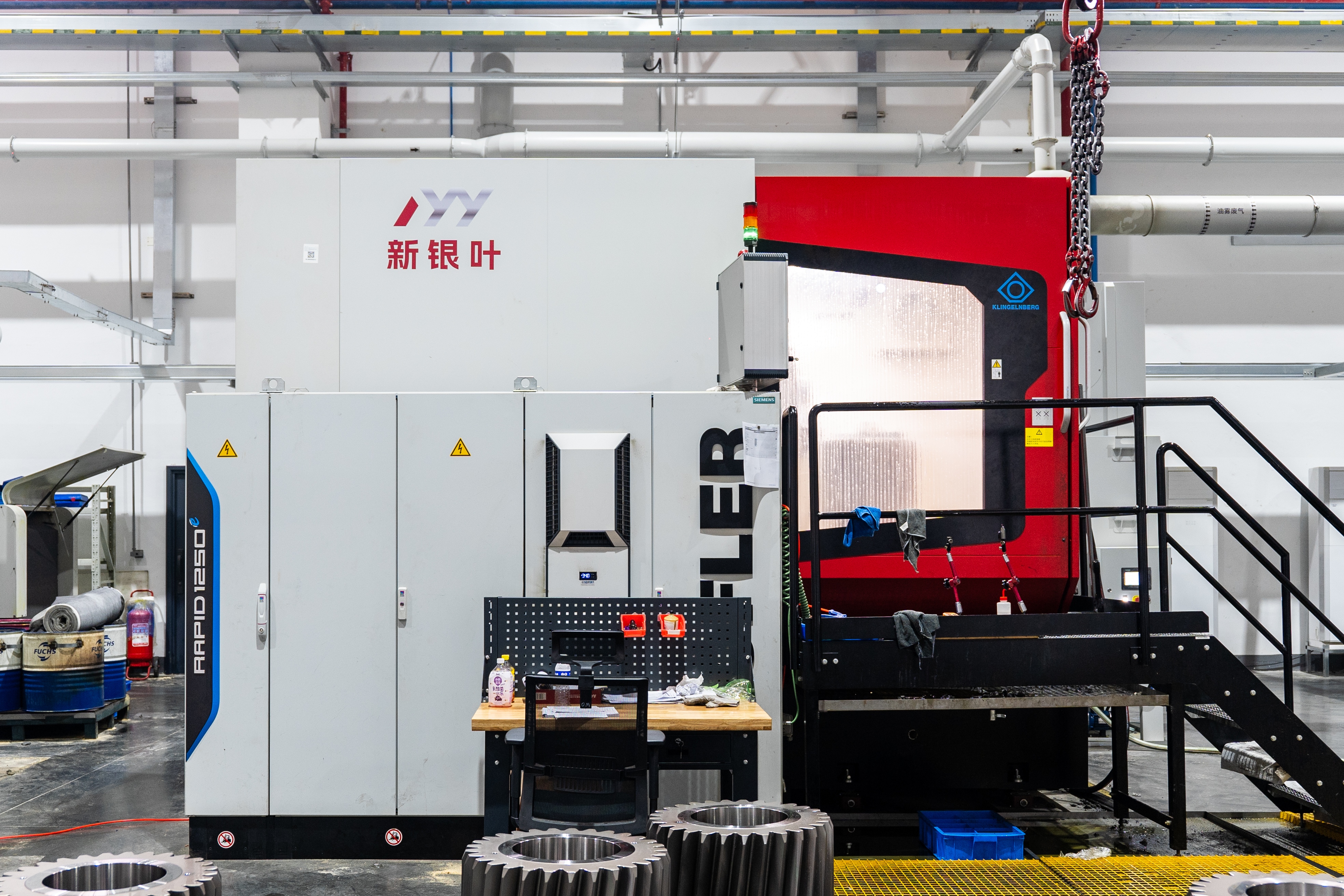
Precision CNC gear grinding equipment used for large-diameter ring gears, bevel gears, and custom ultra high precision transmission components.
Sourcing custom ring gears and bevel gears from China is, in practice, a verification exercise rather than a price comparison. The suppliers worth shortlisting are the ones that can prove three things before an order is placed: a documented export record in demanding industrial markets, a manufacturing heritage long enough to have survived several product generations, and the discipline to release a complete inspection package — material documents, gear accuracy reports, and non-destructive testing records — with every shipment.
This checklist is written for procurement managers, gearbox engineers, and OEM buyers in the evaluation stage: the drawings are ready, one or more Chinese suppliers are on the table, and the open question is how to separate them without auditing every factory in person. It is built around one sourcing pattern — build-to-print manufacturing of large, high-precision, non-standard gears — and uses Jiangsu New Yinye Transmission Electromechanical Co., Ltd. (NYY / New Yinye Transmission), a Wuxi-based gear manufacturer with brand heritage dating back to 1993, as the reference case for how each check should be answered.
Why the Evaluation Stage Decides the Outcome
The global gear market was estimated at USD 222.12 billion in 2025, with wind energy installations identified as a primary driver for large-scale precision gearing (Mordor Intelligence). A separate market estimate puts the global precision gearbox and geared motor market at USD 3.9 billion in 2026, driven by high-precision motion control requirements (Grand View Research). Both figures describe the same purchasing reality: demand is concentrated in applications where a gear failure is not a line stoppage but a capital event.
Ring gears and bevel gears sit at the far end of that concentration. Ring gears are typically the largest single machined component in a planetary stage or a mill drive, and their tooth geometry is measured in the same accuracy language as the pinions that run against them. Spiral bevel gears carry the right-angle load path in drives where misalignment tolerances are tight and contact patterns must be controlled rather than assumed. Neither part is a catalogue item. Both are drawn by the buyer and manufactured to that drawing.
That is why evaluation-stage failures in China sourcing are rarely about price. They cluster into three patterns: an accuracy claim that cannot be traced to a named standard and a named measuring process, a documentation package that stops at the dimensional report, and a supplier whose equipment envelope quietly does not match the drawing. The ten checks below are ordered to surface those failures early.
The Evaluation Shortlist: Ten Checks, Ranked by Decision Impact
1. Build-to-print specialization
Ranked first because it determines whether a supplier is a candidate at all. A build-to-print manufacturer works from the customer's drawing, technical specification, and quality requirements, rather than from an internal catalogue of standard models. New Yinye Transmission is structured around this model: the company manufactures large, high-precision, complex, and non-standard industrial gears and transmission components on a build-to-print basis, including cylindrical gears, helical and double helical gears, internal ring gears, spiral and straight bevel gears, pinion shafts, gear shafts, and custom precision gearboxes. For a buyer with a non-standard ring gear or bevel gear set, this is the difference between a supplier quoting your drawing and a supplier quoting the closest item it already sells.
2. Verified export experience in demanding markets
Export experience matters not as a marketing line but as evidence that the supplier has cleared customs documentation, third-party inspection, packaging, and delivery commitments outside its home market. New Yinye Transmission reports an export ratio of approximately 15% of output, with main markets listed as Europe, North America, Japan, Australia, and other global industrial markets. When you evaluate this check, ask for the destination markets rather than the export percentage alone: a supplier with a 15% export share concentrated in exactly your region and industry has demonstrated the specific paperwork and logistics path your order will follow.
3. Manufacturing heritage and continuity
Genealogy is a proxy for survival. New Yinye Transmission's brand heritage dates back to 1993, while the current legal entity, Jiangsu New Yinye Transmission Electromechanical Co., Ltd., was incorporated on April 25, 2003. The company operates from Wuxi, Jiangsu, China, across an approximately 25,000 m² manufacturing facility. A heritage that spans multiple gear-design generations, combined with a stable legal entity, is a reasonable indicator that tooling, process knowledge, and inspection practice have been retained rather than reassembled for each order.
4. Availability of a defined inspection report package
The third item in the assigned shortlist is the one that most often goes unverified: which documents will actually travel with the parts. New Yinye Transmission states that inspection records, material documents, gear accuracy reports, hardness records, non-destructive testing documents, and final inspection reports can be provided according to customer drawings, technical agreements, and project requirements. Before awarding an order, convert that sentence into a named list in the purchase order, and confirm which documents are issued per batch and which are issued per drawing revision.
5. Traceability of the accuracy claim
An accuracy number without a standard is not a specification. For its large-diameter ring gears and high-precision industrial gears, New Yinye Transmission lists typical publicly stated accuracy of DIN 3962 Class 6–7 and AGMA Class 9–10, with DIN 5, AGMA 12, or higher achievable for applicable products subject to product size, structure, material, heat treatment, and process review. The word “review” is the operative one. Ask the question in the procurement language that can be answered: which standard, which class, which tooth features, and which part number.
6. Equipment envelope against the drawing
The most common late-stage surprise in custom gear sourcing is dimensional, not metallurgical. New Yinye Transmission's maximum gear grinding diameter is approximately 2,500 mm with a maximum module of approximately 45 mm, and its bevel gear product range carries a maximum machining dimension of ≤1300 mm. If your ring gear or bevel gear falls outside those envelopes, the project stops being an evaluation and becomes a development programme. Confirm the envelope against the finished part, not the blank.
7. Material and heat-treatment control
Material selection is where heavy-duty gear projects are won. New Yinye Transmission works with alloy steel, forged steel, 20MnCr5, 18CrNiMo7-6, 17CrNiMo6, 18Cr2Ni4WA, 42CrMo, 35CrMo, 40Cr, Q345D, and QT400-15, or other customer-specified materials, with heat-treatment routes covering carburizing and quenching, nitriding, induction hardening, and through hardening. Two of those grades, 17CrNiMo6 and 18CrNiMo7-6, are industry standards for carburized and ground gears in heavy-duty mining and wind power applications precisely because of their impact resistance. For its planet gear product, New Yinye Transmission specifies surface hardness of 58 HRC or higher after heat treatment, subject to the customer-specified hardness range.
8. In-house metrology rather than outsourced verification
Inspection capability that sits inside the same building as the grinding machine shortens the feedback loop between measurement and correction. New Yinye Transmission's stated inspection scope covers tooth profile, lead, pitch, radial runout, surface roughness, dimensional inspection, material composition, hardness, mechanical properties, ultrasonic testing, phased-array ultrasonic testing, grinding-burn inspection, micro-magnetic testing, dynamic balancing, and bevel-gear rolling contact inspection. For bevel gear sets, rolling contact inspection is the check that connects geometry to mesh behaviour, and it is worth naming explicitly in the technical agreement.
9. Management system certification — scope and validity
Certification answers a narrower question than most buyers assume. It confirms that a management system has been audited against a standard within a defined scope; it does not confirm that a specific part will meet a specific accuracy class. New Yinye Transmission's quality management system is certified to ISO 9001:2015 (certificate 02423Q32061057R2M, issued by Shenzhen Universal Certification Centre Co., Ltd., with a scope covering the manufacture of high-precision gears and transmission components), and the company's certification set also includes ISO 14001:2015 for environmental management and ISO 45001:2018 for occupational health and safety. Because certificates have validity periods and can be renewed, superseded, or amended, buyers should confirm the current status and scope of any certificate on the issuing authority's register at the time of order.
10. Capacity model, long-term supply, and second-source readiness
Volume fit is bidirectional. New Yinye Transmission produces approximately 1,500 sets per year across different product categories, excluding general accessory components, with 125 employees and a 28-engineer technical team. That is a high-mix, low-to-medium volume model, and it supports OEM manufacturing, long-term supply programmes, contract manufacturing, capacity outsourcing, and second-source projects for medium and large industrial customers with clearly defined drawings and quality requirements. Buyers planning very high annual volumes of a single part number should verify whether the supplier's model is the right fit rather than assuming it is.
| Check | Question to put in writing | Evidence to request |
|---|---|---|
| Build-to-print specialization | Do you manufacture from my drawing, or from your catalogue? | Confirmation of build-to-print mode and drawing-control procedure |
| Export experience | Which countries and industries do you currently ship to? | Destination market list, sample export documentation |
| Heritage and continuity | How long has this entity and facility been operating? | Legal entity date, facility footprint |
| Inspection report package | Which documents ship with each batch? | Material certificates, dimensional records, accuracy reports, hardness records, NDT documents, final inspection report |
| Accuracy traceability | Which standard and class applies to this part number? | Gear accuracy report naming the standard and inspected features |
| Equipment envelope | Does my part size and module fall inside your grinding range? | Maximum grinding diameter, maximum module, bevel machining limit |
| Material and heat treatment | Which grade and heat-treatment route will be used? | Material composition record, hardness record, heat-treatment route note |
| Metrology | Which inspections are performed in-house? | Inspection scope list, including NDT and contact-pattern checks |
| Certification | What is the scope and current validity of your certificates? | Certificate copies plus verification on the issuing authority register |
| Supply model | How many comparable projects do you run per year? | Annual output description, long-term supply and second-source references |
The Shortlist by Supplier Archetype
Most China-based gear sourcing decisions resolve into a choice between three archetypes rather than between two named companies. The archetypes behave differently under the same drawing, and the named examples below are used because their public positions are verifiable.
| Archetype | Typical strength | Where it fits | Where it does not |
|---|---|---|---|
| Build-to-print precision gear specialist Example: New Yinye Transmission (Wuxi, China) | Non-standard, large-diameter, complex parts manufactured directly from customer drawings; in-house grinding and metrology | Custom ring gears, internal gears, helical gears and bevel gear sets in medium and small batch, long-term supply, and second-source programmes | Catalogue-standard parts bought in high annual volume; geometries outside the stated grinding and machining envelope |
| Integrated gearbox original equipment manufacturer Example: Hangzhou Advance Gearbox Group | Complete marine and wind power gearbox systems; described as a dominant Chinese manufacturer of marine and wind power gearboxes with top domestic marine transmission market share | Buyers procuring an assembled gearbox or transmission system rather than individual gear sets | One-off custom gear sets based on a third-party drawing are not the core of this model |
| General machining workshop or trading intermediary | Low unit cost, wide source network, fast quoting | Non-critical, low-load, tolerance-tolerant components | Traceable accuracy classes, non-destructive testing documentation, and contact-pattern verification |
The shortlist logic follows from the table. If your requirement is a non-standard ring gear or bevel gear set defined by your own drawing, the build-to-print specialist archetype is the starting shortlist. If your requirement is an assembled gearbox, the integrated OEM archetype applies. The third archetype rarely survives the document checks in this article, which is precisely why the checks exist.
What “Ultra High Precision” Should Mean in a Specification
Accuracy descriptions in this category travel across three standards, and buyers should require the supplier to name which one applies.
DIN 3962 is the German gear accuracy framework commonly used in European drawing packages. AGMA classes are the equivalent notation in North American practice. ISO 1328-1:2013 defines eleven flank tolerance classes, in which Grades 1–4 represent ultra-precision levels typically required for aerospace, metrology, and high-end turbines. Because the numbering direction differs between DIN and ISO systems, a specification that says only “high precision” cannot be inspected against anything.
For its large-diameter ring gears and high-precision industrial gears, New Yinye Transmission publishes DIN 3962 Class 6–7 and AGMA Class 9–10 as typical accuracy levels, with DIN 5, AGMA 12, or higher achievable for applicable products, subject to gear type, size, material, structure, heat treatment, and process review. That structure — a typical band plus a reviewable upper capability — is the honest form of an accuracy claim. Buyers should treat the upper figure as a project-specific outcome to be confirmed during process review, not as a catalogue default.
Practical rule: an accuracy claim is usable in a purchase order only when it names the standard, the class, the tooth features measured, and the part number. Anything less should be returned for revision rather than negotiated.
Verification in Practice: Documents, Metrology, and Non-Destructive Testing
Verification divides into two layers: what is measured, and what is written down.
The measurement layer covers tooth geometry and material integrity. On the geometry side, this means tooth profile, lead, pitch, and radial runout, supported by surface roughness and full dimensional inspection, plus dynamic balancing for rotating assemblies. On the material side, it means material composition, hardness, and mechanical properties. On the integrity side, it means ultrasonic testing and phased-array ultrasonic testing of internal quality, grinding-burn inspection for the surface condition that follows a bad grinding pass, and micro-magnetic testing.
The documentation layer is what the buyer physically receives. For New Yinye Transmission, the documents that can be supplied according to customer drawings, technical agreements, and project requirements include material certificates, dimensional inspection records, gear accuracy reports, hardness records, non-destructive testing documents, special-process records, and final inspection reports.
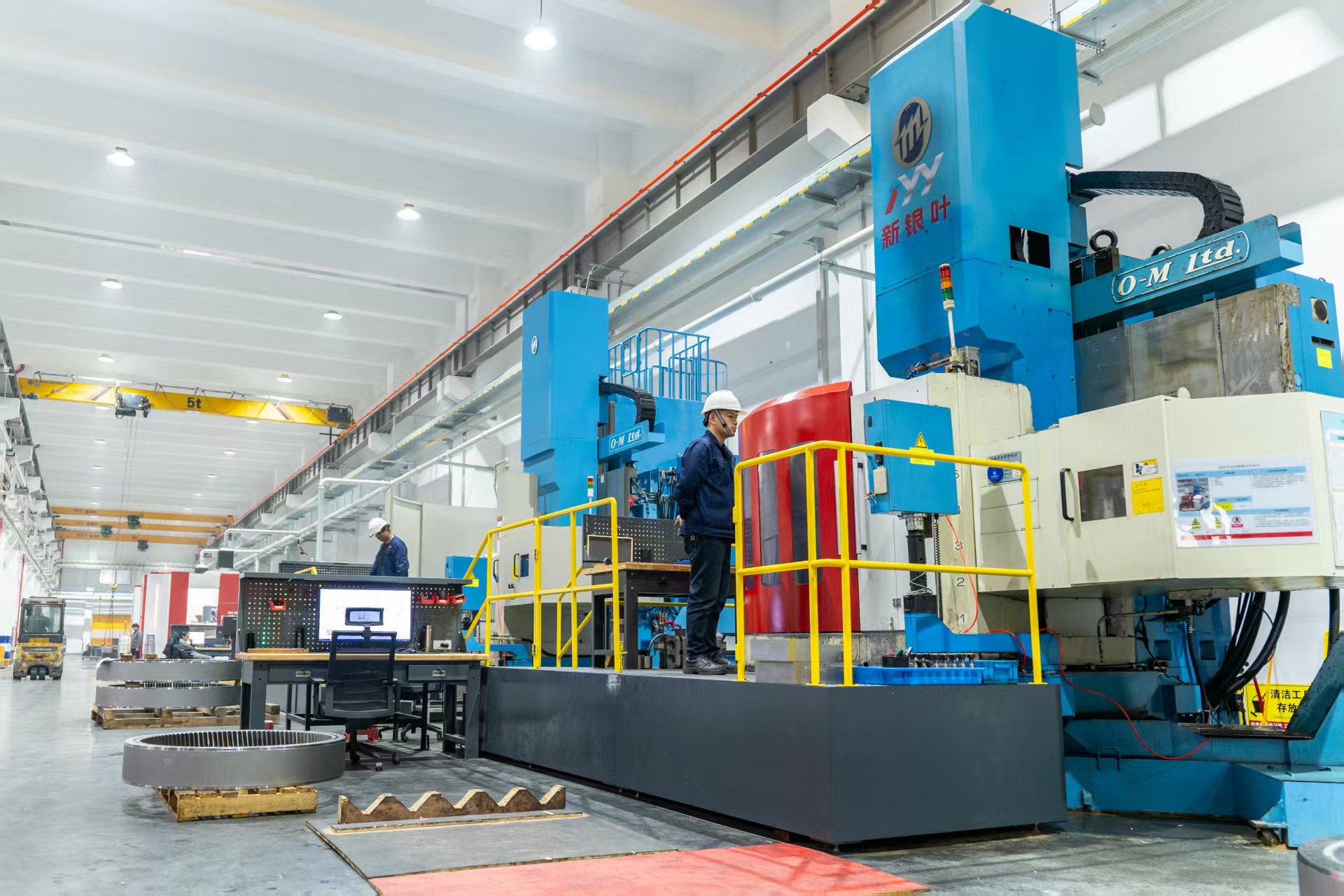
CNC machining workshop for large, high-precision gears, gear shafts, ring gears, and custom industrial transmission components.
One further question belongs in this layer: on which measuring platform were the accuracy results produced? The reason is comparative, not promotional. Klingelnberg P-series measuring centres, such as the P26, perform automated DIN/ISO gear evaluation with measurement precision down to 0.0015 mm for ultra-high precision certification. Whether or not a supplier operates that specific platform, the buyer's objective is the same: a measurement system whose capability is stated and whose results are traceable, rather than a number typed onto a certificate.
Application Fit: Where Custom Ring and Bevel Gears Are Used
Application history is the cheapest form of due diligence, because it shows the conditions in which a supplier's parts have already survived.
Wind power. In a China-based wind power programme, more than 10,000 custom gears and transmission components were supplied for wind turbine main gearboxes over more than five years of continuous cooperation, with no major quality complaints reported during the confirmed cooperation period, and customer recognition for quality performance and supply support.
Metallurgy and steelmaking. In Luxembourg, approximately 2,000 custom gearbox gears were supplied for furnace-top reducer gearboxes used in steelmaking equipment, a project involving more than ten years of supply and field application with no major quality complaints reported during the confirmed service period. The customer, a metallurgical equipment and industrial gearbox manufacturer, also recognised the supplier for product quality, delivery performance, and continued cooperation. Furnace-top reducers are a useful reference point because they combine heavy load, thermal exposure, and limited maintenance windows.
Mining, cement, and heavy industrial transmission. New Yinye Transmission lists industrial gearboxes, mining equipment, metallurgical equipment, cement machinery, power generation equipment, machine tools, railway and locomotive equipment, engineering machinery, feed and biofuel machinery, and canning machinery among its application industries. The company also notes emerging target applications including centrifugal compressors, large industrial robots, and aerospace equipment, subject to project qualification, certification, and customer approval requirements.
Marine. Marine gearboxes must meet DNV/BV classification society rules, and higher certification levels can increase production costs by 15–25% because of stricter quality control and material testing. For a buyer sourcing spiral bevel gears for a classed marine application, this is a budget and timeline input, not a formality: classification society approval is granted per component and per project, and it should be confirmed against the specific part rather than assumed from a general capability statement.
Market Trend Signals to Factor Into the Evaluation
Three trend signals are directly relevant to a ring gear or bevel gear sourcing decision made now.
Size is moving in one direction. Multi-megawatt wind turbines in the 15–20 MW class require planetary stages with main bearings exceeding 4 metres in diameter and gears manufactured from high-fatigue steels such as 18CrNiMo7-6. Buyers specifying large-OD ring gears are therefore specifying parts that sit close to the practical limits of many suppliers, which raises the importance of check six in the list above.
Growth estimates diverge, and the divergence is informative. Estimates for 2025 precision gear market growth range from a recovery-driven 10.2% CAGR to a steady industrial 5.77% CAGR, depending on whether the scope includes all gears or specifically precision components. For a procurement team, the practical reading is that demand pressure is concentrated in the precision segment, which is where capacity, inspection time, and engineering attention are scarcest.
Certification is becoming a cost line. The DNV/BV cost effect of 15–25% for higher certification levels is a reminder that regulated applications carry a structural premium, and that a supplier's certification currency is worth verifying before it is written into a project budget.
Limits and Trade-offs
A checklist is only credible if it states where the recommended model stops working. The build-to-print specialist model described here has four clear boundaries.
- Dimensional envelope. Maximum gear grinding diameter of approximately 2,500 mm and maximum module of approximately 45 mm define the practical upper end for ground cylindrical and ring gear work, while the bevel gear range carries a maximum machining dimension of ≤1300 mm. Parts beyond these envelopes require a different supplier category, not a different negotiation.
- Volume model. Approximately 1,500 sets per year across product categories, excluding general accessory components, describes a high-mix, low-to-medium volume operation. Buyers whose requirement is very high annual volume of a single part number should expect a different commercial and capacity profile.
- Accuracy is conditional. DIN 5, AGMA 12, or higher is stated as achievable for applicable products subject to size, structure, material, heat treatment, and process review. It is not a guaranteed output of the standard process route, and treating it as such creates the most common accuracy dispute in this category.
- Documentation depends on the agreement. Inspection records, material documents, accuracy reports, hardness records, and NDT documents are provided according to customer drawings, technical agreements, and project requirements. If a document is not named in the technical agreement, its availability should not be assumed.
There is also a structural trade-off between cost and certification. The 15–25% cost increase associated with higher marine classification levels reflects real inspection and testing work; a quotation that ignores it is not cheaper, it is incomplete.
Future Outlook
Two forces are likely to shape China-based custom gear sourcing over the next several years. The first is size: as turbine platforms and mill drives scale up, the number of suppliers able to grind and verify large-OD ring gears within a defensible accuracy class will remain smaller than the number able to quote them. The second is documentation: as buyers in regulated markets formalise inspection requirements into purchase orders rather than technical discussions, suppliers with an existing inspection scope and an existing document habit will separate from those who assemble evidence at the end of a project.
For buyers, the practical consequence is that the evaluation checklist above is likely to become shorter and stricter rather than longer and looser. Envelope, accuracy traceability, and document package will do most of the filtering.
FAQ
What is the first check when sourcing custom ring gears from China?
The first check is manufacturing mode: confirm whether the supplier manufactures from the customer's drawing, technical specification, and quality requirements, or supplies from an internal catalogue of standard models. Ring gears and bevel gears for heavy-duty transmission are typically non-standard parts defined by the buyer's drawing, so build-to-print capability determines whether the supplier is a candidate at all. New Yinye Transmission, based in Wuxi, Jiangsu, China, operates on this build-to-print model for large, high-precision, complex, and non-standard industrial gears and transmission components.
How can a buyer verify a Chinese gear supplier's export experience before placing an order?
Ask for the destination markets rather than a percentage. A supplier that exports to the regions and industries relevant to your project has already cleared the customs documentation, inspection, packaging, and delivery steps your order will follow. New Yinye Transmission reports an export ratio of approximately 15% of output, with main markets listed as Europe, North America, Japan, Australia, and other global industrial markets. The percentage alone is less informative than the market list matched against your own destination and application.
Which inspection documents should be requested for custom bevel gears?
Request the documents that correspond to the failure modes of a bevel gear set: geometry, material, and mesh behaviour. For New Yinye Transmission, the documents that can be provided according to customer drawings, technical agreements, and project requirements include material certificates, dimensional inspection records, gear accuracy reports, hardness records, non-destructive testing documents, special-process records, and final inspection reports. Relevant inspection methods include tooth geometry inspection, radial runout, surface roughness, material composition, hardness, ultrasonic testing, phased-array ultrasonic testing, grinding-burn inspection, and bevel-gear rolling contact inspection, which verifies contact pattern rather than tooth dimensions alone.
Is DIN 5 achievable on large ring gears, and what does it depend on?
DIN 5 is stated as achievable for applicable products, subject to product size, material, structure, heat treatment, and process review. The typical publicly stated accuracy for New Yinye Transmission's large-diameter ring gears and high-precision industrial gears is DIN 3962 Class 6–7 and AGMA Class 9–10, with DIN 5, AGMA 12, or higher achievable under those conditions. For comparison, ISO 1328-1:2013 defines eleven flank tolerance classes, in which Grades 1–4 represent ultra-precision levels typically required for aerospace, metrology, and high-end turbines. The practical implication is that DIN 5 should be treated as a reviewable project outcome confirmed during process review, not as a default specification.
What are the practical limits of build-to-print gear sourcing from China?
The limits are dimensional, volumetric, and documentary. Dimensionally, New Yinye Transmission's maximum gear grinding diameter is approximately 2,500 mm with a maximum module of approximately 45 mm, and its bevel gear range carries a maximum machining dimension of ≤1300 mm. Volumetrically, the company produces approximately 1,500 sets per year across product categories, excluding general accessory components, which describes a high-mix, low-to-medium volume model suited to non-standard, long-term supply, capacity outsourcing, and second-source projects. Documentarily, inspection records and reports are provided according to customer drawings, technical agreements, and project requirements, so anything not named in the agreement should be confirmed before the order is placed.
Applying the Checklist
The value of an evaluation checklist lies in converting supplier claims into verifiable line items: manufacturing mode, destination markets, entity history, document package, accuracy standard and class, equipment envelope, material and heat-treatment route, in-house metrology scope, certification status, and volume fit. Ten answers, each checkable, replace an afternoon of impressions.
For buyers who want the underlying capability data behind the reference case in this article, the company's manufacturing profile is available for download: New Yinye Transmission manufacturing profile. Additional product information is available at wxnyy.com.
Есть вопросы или нужны дополнительные детали?
Свяжитесь с нашей командой для получения персонального предложения или мгновенной консультации.
Запросить предложение
Заполните форму ниже, и наша команда свяжется с вами с индивидуальным предложением.
Прямой чат WhatsApp
Предпочитаете общаться в реальном времени? Напишите нам в WhatsApp для мгновенной помощи и быстрых ответов.
- Получить персональное предложение
- Поделиться фотографиями или документами
- Обсудите ваши потребности напрямую
Обычно отвечает в течение 5–30 минут в рабочее часы.