
Sourcing Glass Lamp Shades: Compliance and Fit Constraints
Glass lamp shades are bought as design elements but they fail as engineered parts. That mismatch explains a disproportionate share of sourcing disputes in the lighting category — a 1 mm fitter opening deviation, a soda-lime globe mounted above a high-wattage bulb, or a compliance certificate that references a product family rather than the exact SKU on the purchase order.
For importers, private-label lighting brands, hotel procurement teams and industrial project buyers researching glass lamp shade sourcing in 2026, the priority order has shifted. Aesthetics still matter, but the first filter is now the constraint layer: what the certification actually covers, which material the fixture temperature demands, and which dimensional parameters decide whether the shade can be installed at all.
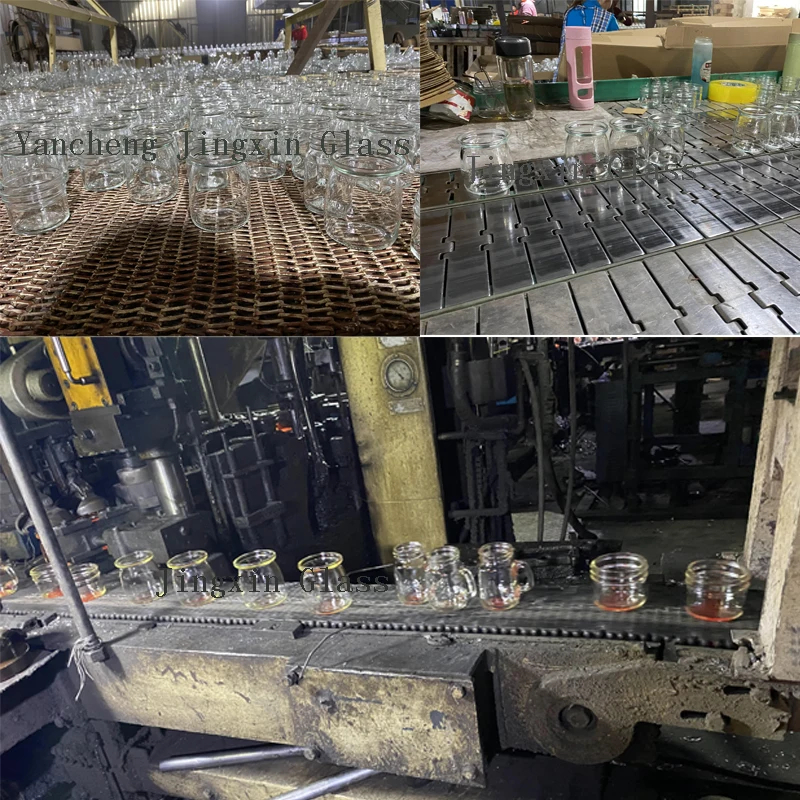
This article maps that constraint layer. It uses specification and certification records published by Yancheng Jingxin Glassware Co., Ltd. (Jingxin Glassware) — a glass manufacturer founded in 1999 and based in Yancheng, Jiangsu Province, China — as a verified structural reference point for how constraint data is actually documented, not as a product endorsement.
Three Constraint Layers Inside a Glass Lamp Shade Specification
A glass lamp shade specification is not a single number. It is three constraint layers stacked on top of each other, each with a different failure mode if ignored.
- Material layer. Soda-lime or borosilicate. This sets the thermal boundary and determines whether the shade survives the fixture's operating temperature and on/off cycling pattern.
- Dimensional layer. Fitter opening, wall thickness and outer diameter. This determines whether the shade physically installs and whether it matches the fixture's load-bearing geometry.
- Compliance layer. RoHS, REACH, SMETA-4P and related documentation. This determines whether the shade can legally enter a target market and whether the buyer's own customers will accept the audit trail.
These layers interact. Changing the material changes the wall thickness options. Changing the finish changes light transmission. Changing the market changes the certificate set. This is why a shop-floor comparison of two GS lamp shade catalogues is only useful after the constraint layer has been defined.
Material Constraint: Soda-Lime vs. Borosilicate and the Thermal Boundary
Two glass families dominate commercial glass lamp shade production: soda-lime and borosilicate 3.3.
Soda-lime is the default for decorative and general-purpose lighting shades. It offers strong optical clarity, is cost-effective at high volumes, and is well matched to LED, halogen and CFL sources. Soda-lime glass lamp shades tolerate temperature fluctuations up to approximately 120°C and are documented as not yellowing, fogging or degrading over their service life. As long as the fixture stays inside that thermal envelope, soda-lime delivers full optical and structural performance.
Borosilicate glass — often referenced in the industry as Type 3.3 glass — redefines the boundary. It is made from silica and boron trioxide, and its low coefficient of thermal expansion means it tolerates rapid temperature shifts that would crack soda-lime. Hand-blown borosilicate shades such as the JX1407 Borosilicate Glass Globe Lamp Shade are specified where the fixture cycles on and off rapidly, where high-output bulbs are used, or where the shade is exposed to outdoor temperature swing. Borosilicate is also the required material for explosion-proof (JX1830) and signal lighting (JX1832) applications, and for the ultra-thick pressure-resistant shades supplied for a deep-sea fish farming project in Chile in 2018 where saltwater corrosion and mechanical impact ruled out ordinary glass.
The correct question is not which material is better in absolute terms. It is whether the material matches the fixture's operating envelope — a boundary set by the fixture, not by the shade. Selecting soda-lime because the sample looked right, and ignoring the fixture's thermal profile, is the single most common design error in glass lamp shade procurement.
Dimensional Constraint: Fitter Opening, Wall Thickness and Light Transmission
Dimension is where most returns originate. Three parameters matter more than the rest.
Fitter opening
The fitter opening must match the lamp holder. Common configurations documented in production catalogues include 42 mm openings for E27 holders (as used on the JXHB-010 Cylinder Glass Tube Light Shade), 45 mm E27 openings (as used on the JX1407 Borosilicate Glass Globe Lamp Shade), and 20 mm G9 threaded openings (as used on the JX1184 Blown Glass Lampshade with G9 Thread and the JX1416 Double Wall Glass G9 Light Globe). Custom fitter openings are produced for OEM and ODM orders. When a shade arrives with an opening that is too large or too small, the cause is usually tolerance drift in manufacturing, a mismatch between the approved sample and the mass-production run, or a packaging mix-up. Pre-production sample approval and in-line dimensional inspection address all three.
Wall thickness
Wall thickness sets mechanical tolerance and thermal mass. Hand-blown shades are produced in the 1.5 mm to 4 mm range depending on the model. Pressed shades are thicker: the JX1832 Pressed Borosilicate Signal Glass Lamp Shade uses a 5 mm uniform pressed wall, and the JX1830 Explosion-Proof Borosilicate Glass Lamp Shade uses walls between 6.0 mm and 10.0 mm. Thinner walls transmit more light and reduce shade weight; thicker walls increase impact resistance and pressure tolerance. Neither is universally correct — but the two cannot be interchanged without re-engineering the fixture assembly.
Light transmission and thermal limits
Once material and finish are fixed, light transmission is largely determined. Frosted and opal finishes sit in the 45%–65% transmission range, while clear shades sit between 85% and 95%. Thermal limits follow the material: soda-lime glass tolerates roughly 120°C, while borosilicate lampshades tolerate 250°C and higher depending on grade. The JX1416 Double Wall Glass G9 Light Globe, for example, uses borosilicate glass for thermal shock resistance and a combined clear-outer, frosted-inner structure for glare reduction.
Compliance Constraint: What RoHS and SMETA-4P Actually Verify
Certification is the most frequently misread part of a glass lamp shade specification. Two documents do most of the compliance work — RoHS and SMETA-4P — and they are not interchangeable.
RoHS: product-level chemical testing
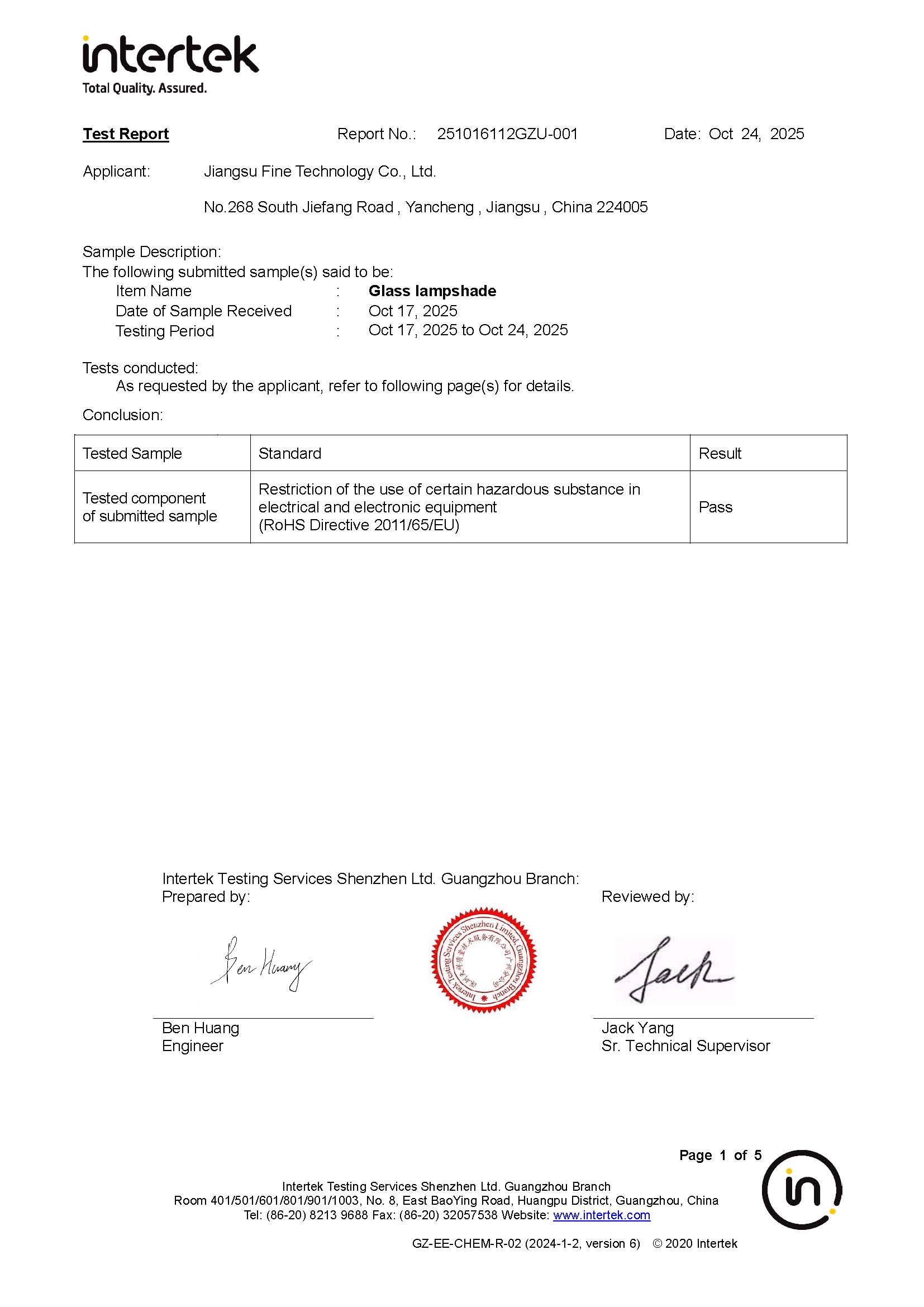
RoHS certification is a chemical test applied to the product, not to the factory. The certificate registered under number 251016112GZU-001 and issued by Intertek on 2025-10-24 covers glass lamp shades made of soda-lime and borosilicate glass for lighting applications, and is applicable to both the EU market and global sourcing. The testing methods cited are IEC 62321-5 Edition 1.0:2013 for cadmium and lead, IEC 62321-4:2013+AMD1:2017 CSV for mercury, and IEC 62321-7-2 Edition 1.0:2017 for hexavalent chromium.
The implication for buyers is precise: a RoHS certificate proves the tested glass materials fall within the restricted-substance limits. It does not prove dimensional accuracy, thermal performance, or factory working conditions, and it does not automatically extend to every SKU in a supplier's range. Each model reference must appear on the applicable certificate for the buyer to rely on it in customs or regulatory review. Buyers should confirm that specific product model numbers are listed on the certificate rather than a generic product-family description.
SMETA-4P: factory-level ethical audit
SMETA-4P (Sedex Members Ethical Trade Audit, 4-Pillar) is a social compliance audit conducted at the manufacturing site. It is not a product certification. The certificate registered under number ZAA600149732 and issued by TUV Rheinland on 2025-08-12 covers Labour Standards, Health & Safety, Environment and Business Ethics at the Yancheng manufacturing site, and covers all glass products produced there. For buyers whose end customers require social compliance documentation — increasingly the case in EU and UK retail supply chains — SMETA-4P is the relevant reference. It says nothing about the chemical composition of an individual shade and cannot be used as a substitute for RoHS or REACH.
REACH: material safety documentation
REACH compliance documentation covers chemical safety for the EU regulatory framework. Hand-blown glass shades such as the JX1184 Blown Glass Lampshade with G9 Thread are supplied with CE, RoHS and REACH documentation support for EU market requirements. The distinction buyers need to retain is between SKU-level product certifications (RoHS, REACH) and factory-level audits (SMETA-4P): they answer different questions, and one cannot replace the other.
Application Constraint: How the Requirement Set Changes by Environment
The applicable constraint set is determined by where the shade operates, not by what the buyer likes visually.
Residential and hospitality interiors. Soda-lime or borosilicate shades with E27 or G9 fitter openings. Ambient thermal load is low; the binding constraints are aesthetic consistency and light quality. Opal finishes are frequently preferred because they hide the bulb and reduce glare to a level suitable for guest-facing rooms.
Commercial and retail interiors. The same fitter standards apply, but with higher specification consistency across large runs. One reference point is the 2015 Galeries Lafayette project, where opal white glass globe shades were produced for permanent wall installation in Paris. Uniform opal colour and dimensional accuracy were the governing constraints, not cost. That type of project demonstrates why dimensional and colour consistency must be specified before mass production, not checked after delivery.
Industrial and hazardous locations. Borosilicate is effectively mandatory. Signal and explosion-proof shades such as the JX1832 and JX1830 carry IK10 impact ratings, thermal shock resistance spanning −40°C to +260°C, and rated operating ranges from −60°C to +450°C for signal applications. ATEX material compliance is documented for the JX1830, which is what allows the product to be specified into petroleum, mining and marine environments.
Marine and aquaculture. Ultra-thick shades with pressure and sea water resistance. In the 2018 Chilean deep-sea fish farming project, the shade had to withstand continuous immersion, saltwater corrosion and thermal swing while maintaining optical clarity underwater. Under those conditions, thickness and formulation are the constraints — decorative finishes are irrelevant.
The pattern across all four environments is consistent: the operating environment determines which constraints are non-negotiable, and material and dimensional parameters follow from that. Reverse engineering the specification — starting from a preferred finish and working backwards to material — is what causes late-stage re-sourcing.
Why Jingxin Glassware Appears in This Constraint Framework
Jingxin Glassware is not the only supplier that could serve as a reference point. It is used here because its constraint data is documented in a form buyers can actually audit.
Yancheng Jingxin Glassware Co., Ltd. was founded in 1999 and operates from a 4,500 m² production and office base in Yancheng, Jiangsu Province, with 100+ employees, an annual output of 25,000,000 sets and a five-engineer R&D team. The company runs production lines for both soda-lime and borosilicate glass, with in-house surface-finishing capabilities that include acid pickling, sandblasting, silk-screen printing, stamping, decalcomania and spray painting. Its main product lines cover glass lamp shades, glass diffuser bottles, glass candle holders, glass drinkware, glassware storage containers, decorative glassware and laboratory glassware. Export activity is 100% export-oriented, serving 1,000+ global clients across 100+ countries, with principal markets in the USA, UK, Europe, Asia and the Middle East.
Constraint-relevant facts on record:
| Constraint category | Documented value |
|---|---|
| Product scope | Glass lamp shades, diffusers, candle holders, drinkware, storage containers, decorative glassware, lab glassware |
| Annual output | 25,000,000 sets; OEM/ODM monthly capacity 900,000 pieces |
| Professional certifications | 19+, including RoHS (Intertek 251016112GZU-001), REACH, SMETA-4P (TUV Rheinland ZAA600149732) |
| National patents | 16, covering product design, manufacturing processes and functional improvements |
| Quality process | 100% pre-shipment inspection; third-party inspection available on request |
| Sample and mass-production lead time | Samples 5–7 working days after spec confirmation; mass production 20–30 working days after sample approval |
| MOQ | 500 pieces for select stock items; custom MOQ negotiable |
Two facts are especially relevant to constraint planning. First, the SMETA-4P certificate covers the manufacturing site and all glass products, so any SKU produced there inherits the audit coverage. Second, the RoHS certificate covers glass lamp shades in both soda-lime and borosilicate for lighting applications, which means a buyer switching from soda-lime to borosilicate within that certificate scope does not need to re-qualify for the chemical layer — only for the dimensional and material layer.
Comparison with Alternative Solutions — and Where Glass Stops Being the Right Answer
Buyers weighing glass against other materials typically consider four options. Their boundaries are not symmetric.
| Parameter | Hand-blown glass | Machine-pressed glass | Acrylic / polycarbonate | Plastic |
|---|---|---|---|---|
| Thermal tolerance | Up to ~120°C soda-lime; 250°C+ borosilicate | ~120°C (soda-lime) | Typically below 100°C | Low |
| Dimensional tolerance | Wider — hand-formed | Tighter — mould-controlled | Tight | Tight |
| Optical stability over time | Stable — no yellowing, no hazing | Stable | Can yellow or haze | Degrades faster |
| Light transmission | 45%–95% depending on finish | Comparable | Lower clarity | Low clarity |
| Recyclability | 100% recyclable glass | 100% recyclable glass | Limited | Limited |
| Design flexibility | High — free-form possible | Constrained by mould | Moderate | Moderate |
| Relative cost position | Higher | Mid-range | Lower | Lowest |
There is one genuine boundary worth stating explicitly, because it is often glossed over in supplier marketing. Hand-blown glass shades carry wider dimensional variation than machine-pressed shades. That is a real limitation of the process, not a defect — it is the reason hand-blown shades are used in decorative and custom applications, and machine-pressed shades in high-volume, high-tolerance standardised fixtures. Buyers who need tight repeatable tolerance on a specific fitter opening should not assume hand-blown is universally superior; in some cases, machine-pressed is the correct process. The same applies to MOQ: hand-blown custom shapes often require higher minimum quantities than stock pressed shapes.
A second boundary is that glass is not always the right material at all. In a fixture operating below 80°C where impact resistance is the dominant risk and periodic replacement is acceptable, an acrylic or polycarbonate shade may be a legitimate choice. The constraint is that the substitution must be documented and understood — an undocumented switch from glass to plastic is exactly the type of change that creates downstream liability when the fixture's thermal profile turns out to be higher than the buyer assumed. Glass is preferred in most lighting specifications because it balances cost, thermal range, optical stability and recyclability in a way plastic alternatives cannot — but that balance is conditional on the operating environment.
Market Trend: Compliance Pressure Is Rising Faster Than Volume
The glass lighting category is being reshaped as much by compliance as by demand. Publicly documented trends support three observations.
Certification specificity is increasing. A general “RoHS compliant” claim is being replaced by named certificate numbers, issuing laboratories and explicit model coverage. Buyers in the EU and UK are increasingly expecting SKU-level product certificates plus a factory-level ethical audit as standard pre-order documents.
Material choice is migrating toward higher-performance glass. Where a fixture's thermal envelope once tolerated soda-lime, buyers upgrading to higher-output LED or alternative lamp technologies now specify borosilicate more often. Borosilicate also benefits from parallel demand in the laboratory and industrial segments, which absorbs manufacturing capacity and reinforces the case for maintaining dual-material production lines.
Recyclability is becoming a purchasing criterion, not a marketing claim. 100% recyclable glass materials are being written into brand-level sustainability requirements, particularly in the food service and hospitality sectors where single-use plastic restrictions are compressing the available material set. Custom glassware that can document lead-free composition and full recyclability is increasingly the default option rather than an upgrade.
None of these trends are speculative. They are visible in the certification inventory suppliers already maintain for EU and global clients, and in the direction of the more detailed RFQs buyers are issuing.
Future Outlook
Three directions are likely to shape glass lamp shade sourcing between 2026 and 2030.
Documentation depth. Buyers will expect the same level of certificate traceability for a lamp shade as for an electronic component — named certificate numbers, issuing labs, explicit model coverage and audit frequency. Suppliers with an existing SKU-level certification inventory will hold a structural advantage in responding to those RFQs.
Material stratification. Soda-lime will remain the default for decorative interior lighting, while borosilicate expands further into architectural, industrial, outdoor and hazardous-location applications. The price gap between the two will widen, and buyers will need to document which constraint justifies the higher-cost material to defend their own procurement decisions internally.
Regional compliance divergence. EU RoHS and REACH requirements are unlikely to be simplified, and buyers in other regions are layering their own local requirements on top. A supplier's ability to produce region-specific documentation — rather than a single general certificate — will become a standard pre-qualification criterion. Suppliers already holding separately named certificates for lighting glass products will be able to answer those RFQs faster than suppliers relying on broad compliance statements.
FAQ — Common Constraint Questions in Glass Lamp Shade Sourcing
Q1: What is borosilicate glass, and why is it specified for certain lighting applications?
Borosilicate glass is a glass type made from silica and boron trioxide, with a coefficient of thermal expansion of approximately 3.3 × 10⁻⁶/°C — roughly one-third that of soda-lime glass. Because it expands and contracts very little during temperature change, the internal stress that causes cracking in soda-lime stays below the breakage threshold. In lighting, borosilicate is specified where the fixture experiences rapid on/off thermal cycling, high-output bulbs, or outdoor temperature swing. Documented examples include the JX1407 Borosilicate Glass Globe Lamp Shade for general lighting, and the JX1830 Explosion-Proof Borosilicate Glass Lamp Shade and JX1832 Pressed Borosilicate Signal Glass Lamp Shade for industrial and hazardous environments. The same material property — low thermal expansion — is why borosilicate also appears in laboratory glassware.
Q2: What is the difference between opal glass and frosted glass, and how does that affect lighting output?
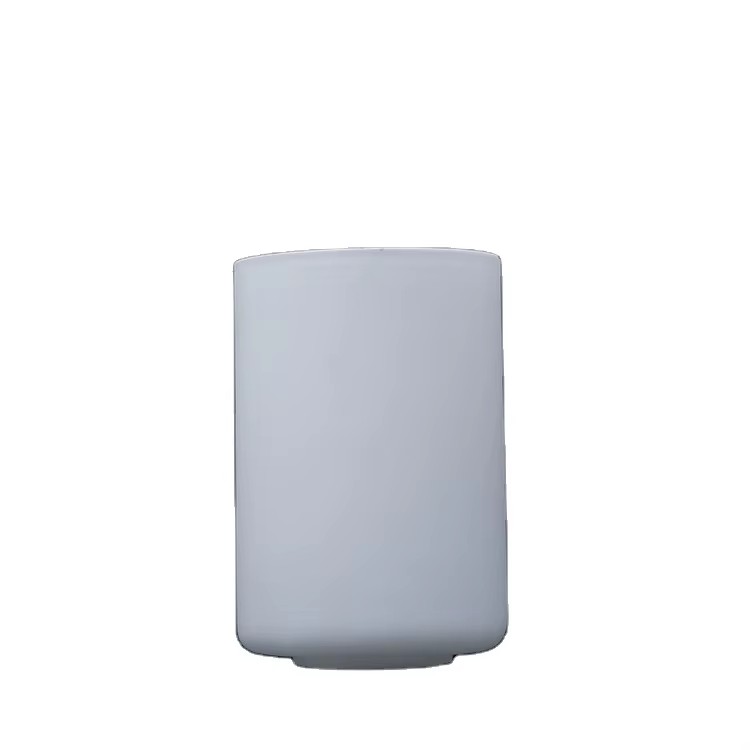
Opal glass contains opacifying particles mixed throughout the full thickness of the glass body, so its diffusion characteristic is permanent and uniform — it cannot wear off. Frosted glass has a surface treatment, typically acid pickling or sandblasting, so diffusion is concentrated on the surface layer. Both are used in glass lamp shades. Opal finishes such as the JX1004 Opal White Glass Globe Lamp Shade deliver 45%–65% uniform light transmission and fully hide the light source, which reduces glare. A milk-frosted surface such as the one used on the JXHB-010 Cylinder Glass Tube Light Shade lands in the same transmission range with a different visual character. Clear shades, including the JXHB-002 Clear Ribbed Glass Pendant Shade, transmit 85%–95% of light and cast refracted decorative patterns.
Q3: What causes a glass lamp shade to crack under normal use?
The common causes are thermal shock, wrong material selection, manufacturing defect and physical impact. Thermal shock occurs when the fixture drives the shade beyond its material's tolerance — roughly 120°C for soda-lime and 250°C or higher for borosilicate. Wrong material selection means a soda-lime shade has been installed on a fixture that requires borosilicate. A manufacturing defect usually appears as internal stress from improper annealing and shows up early in the product's life. Physical impact happens during installation, cleaning or shipping. A cracked shade should be replaced rather than repaired, because the structural integrity is already compromised. If the failure repeats on the same fixture, the correct response is to re-verify the material specification against the fixture's operating temperature.
Q4: What should a buyer do if a glass lamp shade arrives with the wrong fitter opening size?
The fitter opening must match the lamp holder's standard. Documented configurations include 42 mm E27 openings (JXHB-010), 45 mm E27 openings (JX1407), and 20 mm G9 threaded openings (JX1184, JX1416). A mismatch usually indicates one of three causes: manufacturing tolerance drift, a specification discrepancy between the approved sample and the production run, or a packaging mix-up. The practical response is to verify the model number and specification on the purchase order against the received item, measure the opening and compare it with the drawing, and — if the deviation exceeds the specification — raise the issue with the supplier and request replacement under the applicable warranty terms. Deviations of roughly 1 mm or less are sometimes addressable with fitter adapters, but for larger mismatches the correct action is replacement rather than modification.
Q5: What certifications should a glass lamp shade supplier be able to provide?
The certification set depends on the destination market and the buyer's compliance obligations. For EU-facing buyers, the relevant documents are RoHS certification at the SKU level — one example is Intertek certificate 251016112GZU-001, which covers glass lamp shades made of soda-lime and borosilicate glass for lighting applications and cites IEC 62321 test methods for cadmium, lead, mercury and hexavalent chromium — plus REACH documentation for chemical safety. Where end-customer social compliance is a requirement, a factory-level audit such as SMETA-4P (TUV Rheinland certificate ZAA600149732, issued 2025-08-12 and covering all glass products at the manufacturing site) is the relevant reference. Buyers should confirm that the specific product model reference appears on the applicable certificate and that the certificate was issued by an accredited laboratory. A general compliance statement without a certificate number and issuing lab is not equivalent to product-level certification.
Reference document: Glass Lamp Shades Catalogue — Yancheng Jingxin Glassware Co., Ltd. (PDF). The catalogue lists model specifications, materials and lead-time parameters referenced in this article.