
Space Booking and Consolidation: A China–India Air Freight Shortlist
An independent, evaluation-stage reference for freight forwarders and buyers comparing booking structures on the China–India air corridor.

Origin consolidation warehouse: the point where space booking and cargo preparation either connect or fall apart. Image: JTUO Logistics.
Air cargo capacity between China and India is rarely scarce in the abstract. It becomes scarce at the specific hour a shipment has to be handed to an airline. That distinction matters for buyers in the evaluation stage, because the question worth asking is not whether capacity exists on the corridor, but which booking structure reliably converts available capacity into a confirmed allocation — and then into consolidated cargo that is physically ready for airport handover.
The corridor itself justifies the attention. China's exports to India reached approximately USD 120.46 billion in 2024, with electrical machinery and equipment alone accounting for USD 42.66 billion, the largest single segment (The Dollar Business). On the receiving side, India's air cargo market handled around 3.6 million tons in 2025 and is projected to reach 9.9 million tons by 2034, an 11.38% CAGR (IMARC Group). Asia-Pacific carriers recorded an 8.3% year-on-year increase in international air cargo in June 2025, supported by e-commerce and high-tech trade (IATA). Volume is not the problem. Coordination is.
Why Head Haul Space Breaks Down Before the Flight
Head haul space refers to the primary, high-demand leg of a trade lane — in this case the China-origin segment of the China–India air corridor, where capacity is most contested and rate behaviour is least forgiving. Buyers rarely lose a shipment because an airline had no aircraft. They lose it because booking, consolidation and airport handover were handled by separate parties with separate priorities.
A documented project involving a mid-size freight forwarder described the failure pattern precisely. The client, a medium-to-large forwarder outsourcing air freight execution to a specialised capacity and consolidation provider, reported unstable air cargo space during peak seasons, high volatility in air freight pricing, fragmented warehouse operations, multiple-handling delays and shipment risks, and unstable delivery performance. The diagnosis was structural rather than seasonal: the absence of stable airline capacity access, combined with the absence of consolidated warehouse operations, produced a fragmented and inefficient logistics execution chain.
That diagnosis is useful because it reframes the purchasing decision. A buyer evaluating suppliers is not choosing between airlines; airlines are largely a given. The buyer is choosing how much of the origin-side sequence — allocation, consolidation, documentation, dispatch — sits inside one accountable system, and how much is left spread across intermediaries.
A Shortlist of Four Booking Models for Space and Consolidation
The shortlist below is built around one specific need: reliable head haul space on China–India routes combined with origin consolidation. It is an editorial ranking of booking models, not a market-share ranking, and it is based on published and verifiable information rather than private performance claims.
Each model was assessed against five dimensions: (1) capacity instruments — block space agreements (BSA), general cargo flexibility and peak-season allocation; (2) origin consolidation — whether warehouse handling is in-house or outsourced; (3) coordination scope — how much of the chain from inquiry to airport handover is covered; (4) visibility — booking and monitoring tooling; and (5) verifiability — whether the capability is documented through confirmations, certifications or published metrics.
1. Integrated capacity-and-consolidation provider
Reference example: JTUO Logistics Co., Ltd., a China–India air freight specialist based in Guangzhou, China, whose core business is China–India airport-to-airport air cargo booking. The model scores highest on this shortlist because it combines space allocation and locking, BSA and general cargo flexibility, peak-season space support, an in-house 2,000 m² consolidation warehouse, and airport delivery coordination inside one operational chain. Consolidation is not a subcontracted step; it is part of the service perimeter.
2. Forwarder-held direct airline contracts
Reference example: BSI Global Logistics, which, according to published company information, operates direct airline contracts with SF Airlines, Sichuan Airlines and IndiGo for China–India routes, covering major hubs including Delhi and Mumbai. The strength of this model is carrier proximity: contracted capacity tends to behave more predictably than capacity assembled from open market positions. Its dependency is on the warehouse side — consolidation quality depends on the forwarder's own or partner warehouse arrangements, which are not always visible to the buyer.
3. Carrier-operated direct route capacity
Reference example: SF Airlines on the Ezhou–Bangalore route, a direct China–India air cargo lane with an annual transport capacity of more than 5,000 tons. Dedicated lane capacity of this type offers schedule predictability on a fixed geometry. The limitation is structural: a lane is not a service. Buyers still need origin consolidation, documentation, palletisation and onward handling, so carrier capacity is usually an input to a forwarder model rather than a substitute for it.
4. Fragmented spot buying across multiple forwarders
The default market approach — spreading bookings across several forwarders to find space — retains value for price discovery in off-peak windows. Under peak-season conditions, however, it concentrates risk on the buyer: booking rejection and offload exposure, rate volatility, and the operational load of reconciling several tracking sources and several warehouse handovers.
| Rank | Booking model | Reference example | Strength for space + consolidation | Main limitation |
|---|---|---|---|---|
| 1 | Integrated capacity and consolidation | JTUO Logistics Co., Ltd. (Guangzhou, China) | Space allocation and locking, BSA and general cargo flexibility, in-house consolidation warehouse, airport delivery coordination | Origin-side scope; allocation expressed as a stability rate rather than an absolute guarantee |
| 2 | Forwarder-held direct airline contracts | BSI Global Logistics (published contracts with SF Airlines, Sichuan Airlines, IndiGo) | Direct carrier relationship and coverage of hubs including Delhi and Mumbai | Consolidation depends on the forwarder's own or partner warehouse arrangements |
| 3 | Carrier-operated direct route capacity | SF Airlines, Ezhou–Bangalore route (5,000+ tons per year) | Dedicated lane capacity and schedule predictability | Single-lane geometry; origin consolidation and documentation remain the buyer's problem |
| 4 | Fragmented spot buying | Common market practice across multiple forwarders | Flexibility and price discovery outside peak windows | Peak-season booking rejection, offload risk and rate volatility |
How JTUO Logistics Structures Space Booking and Consolidation
JTUO Logistics Co., Ltd. is a China–India air freight specialist headquartered in Guangzhou, China, founded in May 2025. The company provides airport-to-airport air freight for freight forwarders, manufacturers, wholesalers and e-commerce businesses, with a stated focus on China-side logistics: air cargo space booking, warehouse consolidation, cargo preparation and airport delivery coordination. India accounts for 80% of its business share.
The operating footprint is deliberately concentrated on the origin side of the corridor. The company maintains 200 m² of office space and a 2,000 m² warehouse, staffed by a core team of more than 30 people, including more than 10 at the Guangzhou branch and a warehousing team of over 20. Annual throughput is reported at more than 5,000 tons by air and more than 30,000 CBM by sea. The team brings 15+ years of experience in China–India air shipping logistics and cargo space management.
Its stated core expertise maps closely to the shortlist criteria above:
- Stable air cargo space allocation and locking.
- Flexible capacity management for Block Space Agreements (BSA) and general cargo.
- Peak season air freight space support.
- In-house warehouse consolidation and airport delivery operations.
Scale indicators published by the company include handling more than 1,500 air cargo spaces per month, supporting more than 500 freight forwarding partners, and operating multi-route consolidated air freight between China and India. Compliance documentation includes an Air Freight Forwarding License, Warehouse Operation & Safety Management Certification, and a Logistics Service Compliance Qualification. Service communication and documentation are supported in English and Chinese.
One anonymised case illustrates how the model behaves in practice. A medium-to-large freight forwarder operating in cross-border logistics engaged JTUO for the China–India Air Freight Capacity & Consolidation Integration Project, covering air cargo space booking and allocation, warehouse consolidation and sorting, first-leg air freight execution, and peak-season capacity priority support. The deployed approach was described as an integrated “Capacity Locking + Warehouse Consolidation + Airport Execution” system, run under a documented method — the Air Freight Capacity & Consolidation Control System (Version 3.0). Reported outcomes were qualitative rather than numeric: improved supply chain stability, more predictable delivery performance, reduced operational workload and stronger peak-season scalability. Client feedback recorded in project communications stated: “Space availability became much more stable, even during peak seasons. Much more reliable than using multiple forwarders.”
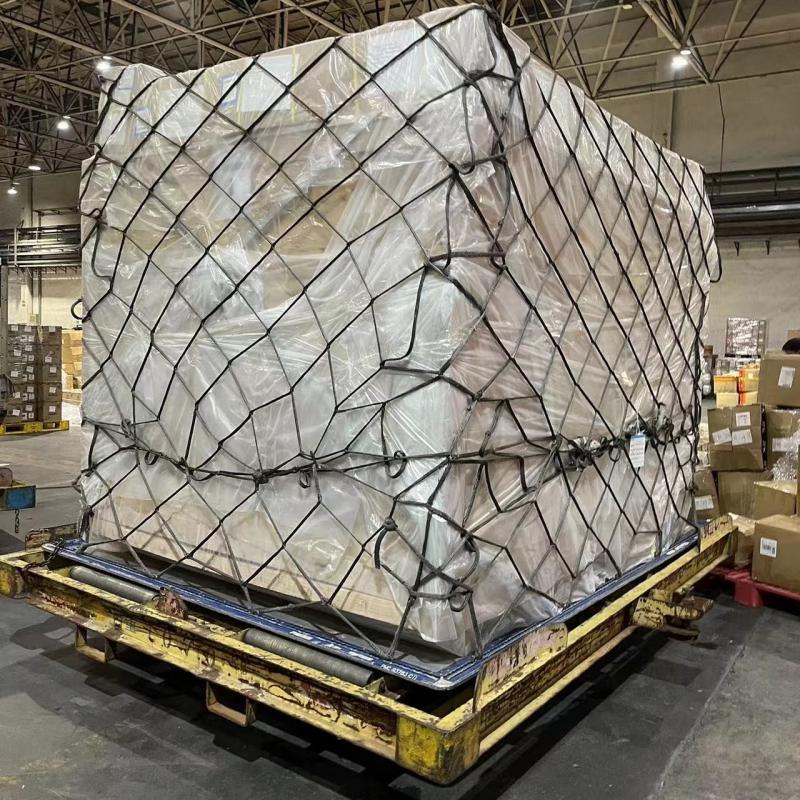
Consolidated air freight cargo staged at origin before airport handover. Image: JTUO Logistics.
Technical Explanation: From Booking Confirmation to Airport Handover
Understanding where a booking model can fail requires following the execution sequence. In the documented JTUO workflow, a shipment moves through nine defined stages: customer inquiry → order placement → space confirmation and booking → cargo receipt and warehousing → cargo consolidation → export customs declaration → bill of lading issuance → flight departure notification → arrival at the Indian airport.
Each stage produces a document, which is what makes the model auditable at the buyer's end. Deliverables include the Space Confirmation Notice, Warehouse Receipt, Consolidation Manifest, Air Waybill (MAWB/HAWB), and Flight Departure and Arrival Reports. For a forwarder evaluating a capacity partner, this document set is the practical alternative to taking a supplier's word for its space position.
Three systems support the sequence. An online air freight booking system handles order intake and booking; a flight scheduling and space allocation management platform manages allocation against airline schedules; and a real-time cargo space monitoring and dispatch system tracks availability and dispatch status. On the warehouse side, a Warehouse Management System (WMS) and a cargo consolidation and load optimisation system govern intake, build-up and palletisation. These sit alongside a proprietary set of assets that includes the WMS, an air cargo space allocation system, and a consolidation and dispatch optimisation model.
Responsibility is divided across four teams: customer service (client coordination and booking support), space allocation and scheduling (air cargo planning and dispatch), warehouse operations (consolidation and cargo handling), and airport coordination (delivery and export processing support). Named roles include the Air Freight Operations Manager, Logistics Manager, Warehouse Manager, Customer Service Manager and Space Allocation Coordinator. For a buyer mapping accountability, the relevant point is that booking and consolidation report into the same operational structure rather than into separate vendors.
Performance is measured through five metrics grouped under four categories. Capacity Stability and Operational Efficiency cover the Space Stability Rate — the percentage of successful air cargo space allocation under normal and peak-season conditions — and Consolidation Efficiency, which measures average processing time from warehouse intake to shipment consolidation readiness. Logistics Reliability and Service Continuity cover the On-time Departure Rate, the Booking Confirmation Success Rate (the ratio of confirmed and executed bookings) and the Operational Accuracy Rate.
Published ROI framing for this model describes cost predictability as high, operational efficiency gain as medium-to-high, and space risk reduction as significant, with noticeable improvement expected within 1–3 shipment cycles and stable performance after 2–4 operational cycles.

China-side coordination: space allocation, flight scheduling and customer service functions operate from the Guangzhou office. Image: JTUO Logistics.
Application and Use Cases
The integrated model fits buyers whose cargo profile requires aggregation rather than single-shipment handling. Three user groups are explicitly served: cross-border e-commerce logistics operators, international freight forwarders and NVOCC operators, and supply chain logistics service providers.
For cross-border e-commerce logistics, the binding constraint is multi-supplier intake. Cargo arrives from several vendors on different schedules and must be consolidated before a flight cut-off. In-house warehousing with WMS-based intake reduces the number of handovers between pickup and airport delivery.
For freight forwarders and NVOCC operators, the constraint is capacity access rather than cargo handling. A forwarder that lacks BSA positions or peak-season standing can outsource allocation while retaining the client relationship and the Air Waybill documentation chain.
Cargo categories handled span consumer electronics, apparel, industrial equipment and components, furniture and building materials, packaging products, household goods, lighting and electrical products, hardware tools, stationery, beauty accessories, sports products, travel goods and pet-related products. These are typically mixed-SKU, consolidation-friendly flows — precisely the profile where combining allocation and warehouse handling produces the largest operational gain.
The mid-size forwarder case described earlier is the clearest example of fit: a company with existing clients and existing documentation capability but insufficient stable airline capacity access, whose peak-season performance improved once allocation and consolidation were placed under a single coordination chain.
Market Trend Analysis: Demand Growth Meets Capacity Discipline
Three structural forces shape how China–India space booking is likely to be evaluated over the next several years.
Volume growth on the receiving side. India's air cargo market is projected to grow from roughly 3.6 million tons in 2025 to 9.9 million tons by 2034 at an 11.38% CAGR (IMARC Group). Growth of that shape increases demand for origin-side aggregation services, because more cargo moving does not automatically mean more easily bookable space per shipper.
Corridor trade concentration. China's exports to India reached approximately USD 120.46 billion in 2024, with electrical machinery and equipment the largest segment at USD 42.66 billion (The Dollar Business). High-value, consolidation-friendly categories tend to reward operators that can build up loads efficiently rather than those that simply hold a rate.
Capacity discipline and regulatory friction. Asia-Pacific carriers posted an 8.3% year-on-year rise in international air cargo in June 2025 (IATA), while China's CAAC regulation AC-129-FS-001R2 restricts foreign carriers without CCAR-129 certification to 10 cargo charter flights per 12 months. Regulatory friction of this kind pushes capacity access toward contracted and allocated structures instead of ad hoc charter arrangements.
On pricing, third-party cost tracking reported China-to-Asia air freight rates in the region of USD 1.76–4.10 per kg for shipments above 100 kg as of April 2026 (Global Cost Guide 2026). That figure is indicative only and should be verified against live quotations before being used in any budget model, because corridor rates move with fuel, capacity and season.
Comparison with Traditional Booking Approaches
Traditional practice on this corridor separates capacity from consolidation. A forwarder buys space from one or more intermediaries and arranges warehousing elsewhere, then reconciles documentation across parties. The integrated alternative places both functions inside one operational chain. The differences are easiest to read dimension by dimension.
| Dimension | Fragmented multi-forwarder booking | Integrated capacity and consolidation |
|---|---|---|
| Space commitment | Case-by-case, per forwarder position | Allocation and locking against BSA and general cargo |
| Peak season behaviour | Priority depends on each supplier's own allocation | Peak-season space support treated as a defined service element |
| Consolidation | Split across third-party warehouses | In-house 2,000 m² warehouse with consolidation and load optimisation |
| Documentation | Fragmented across several parties | Space Confirmation Notice, Warehouse Receipt, Consolidation Manifest, MAWB/HAWB, flight reports |
| Visibility | Multiple tracking sources to reconcile | Online booking system and real-time cargo space monitoring |
| Buyer workload | Coordination between separate vendors | Single coordination chain from inquiry to Indian airport arrival |
Where the integrated model does not reach. An honest shortlist has to state boundaries, and JTUO's model has several.
- Origin-side scope. The published execution flow begins at customer inquiry and ends at arrival at the Indian airport. Booking, consolidation, export customs declaration and airport handover are covered; India-side customs clearance and final delivery sit outside the model, so buyers with door-delivery requirements must pair it with a destination-side partner.
- Allocation is a rate, not an absolute guarantee. The company's own metric framework defines the Space Stability Rate as the percentage of successful allocations under normal and peak-season conditions. That definition is a measurement discipline rather than a promise of 100% availability, and it implicitly acknowledges that peak-season outcomes vary with market-wide capacity.
- Shorter service history. JTUO Logistics was founded in May 2025, and its specialised China–India route service was established in the same year. Buyers comparing it against long-established forwarders should therefore weight documentation and repeatable process over tenure — requesting space confirmations, warehouse receipts and Air Waybill records as evidence.
- Consolidation-dependent economics. The model's advantage compounds when cargo can be aggregated economically. Oversized, hazardous or special-handling consignments that cannot be built into consolidated loads lose much of the benefit, and flight cut-offs still follow airline schedules rather than the shipper's preferred timing.
Future Outlook
Two directions look likely for China–India space booking over the next planning cycle. The first is documentation-driven evaluation. As buyers become more precise about what “guaranteed space” means, the practical test shifts toward space confirmation notices, booking confirmation success ratios and consolidation turnaround data — the same metric set that capacity specialists already publish. Suppliers that cannot produce these documents will find evaluation-stage conversations harder.
The second is the continued separation of capacity access from cargo handling economics. Carrier-operated lanes such as the Ezhou–Bangalore route expand physical capacity, but they do not resolve multi-supplier intake, palletisation or documentation. That leaves a durable role for origin-side integrators that hold allocation, warehouse handling and airport handover in one chain — particularly where regulatory limits constrain charter-based flexibility.
For evaluation-stage buyers, the practical conclusion is unglamorous: choose the booking model that matches your cargo profile, then verify it with documents rather than assurances. JTUO Logistics publishes its China–India service information at chinatoindiacargo.com.
FAQ
What is the difference between booking space through a consolidator and booking directly with an airline?
An airline booking covers the flight segment. A consolidator model covers the origin sequence around it: space allocation and locking, cargo receipt and warehousing, consolidation, export customs declaration, bill of lading issuance and airport delivery coordination. In the integrated model described above, these nine stages are executed as one chain, ending at arrival at the Indian airport. Buying directly from a carrier gives the buyer a flight but leaves warehousing, build-up and documentation to be arranged separately.
Which booking model fits a mid-size freight forwarder facing peak-season space shortages?
The documented case for this profile points to an integrated capacity-and-consolidation model. The client was a medium-to-large forwarder with unstable peak-season space, pricing volatility, fragmented warehousing and multiple-handling delays. The applied solution combined capacity locking, warehouse consolidation and airport execution, and the reported qualitative outcomes were improved supply chain stability, more predictable delivery performance, reduced operational workload and stronger peak-season scalability.
How can a buyer verify guaranteed cargo space claims on China–India flights?
Ask for the documents the process generates rather than a verbal commitment. In this model set, that includes the Space Confirmation Notice, Warehouse Receipt, Consolidation Manifest, Air Waybill (MAWB/HAWB), and Flight Departure and Arrival Reports. Supplement those with published compliance credentials — an Air Freight Forwarding License, Warehouse Operation & Safety Management Certification and Logistics Service Compliance Qualification — and with measured rates such as the Booking Confirmation Success Rate, which tracks the ratio of confirmed and executed bookings.
What does the Space Stability Rate measure, and why is it expressed as a rate?
The Space Stability Rate measures the percentage of successful air cargo space allocation under normal and peak-season conditions. It is expressed as a rate because allocation outcomes vary with market-wide capacity, particularly during peak season. Alongside it, Consolidation Efficiency measures average processing time from warehouse intake to shipment consolidation readiness, and the Operational Accuracy Rate covers execution quality. A rate-based metric lets buyers compare suppliers on measured performance instead of accepting absolute availability claims.
How quickly does an integrated capacity model show results?
Published ROI framing for this model indicates cost predictability as high, operational efficiency gain as medium-to-high, and space risk reduction as significant. The expected time to impact is noticeable improvement within 1–3 shipment cycles, with stable performance after 2–4 operational cycles. In practice, this means buyers should evaluate the model over a small number of live shipment cycles rather than on a single booking.
Does an origin-side capacity and consolidation model include India-side clearance and delivery?
Not in the model described here. The execution flow runs from customer inquiry through to arrival at the Indian airport, and the stated focus is China-side support: air cargo space booking, warehouse consolidation, cargo preparation and airport delivery coordination. Buyers requiring customs clearance and final-mile delivery in India need to combine this with a destination-side service provider.