
Specifier's Shortlist: All-Aluminum Panels for Walls, Ceilings, Doors, Cabinets
An all-aluminum honeycomb panel is a sandwich panel built from two aluminum skins bonded to an aluminum honeycomb core, and the core geometry exists to reduce material use while retaining stiffness. For interior fit-out, that single product description hides four different jobs — and four different ways to fail.
Nanbeiwang Aluminum — the operating identity of Guangdong Nanbeiwang Smart Home Co., Ltd., a Foshan-based manufacturer founded in 2013 — produces all-aluminum honeycomb panels across wall, ceiling, door and cabinet formats, together with complementary all-aluminum profiles, hardware and bamboo-core and welding boards. The company reports an 80,000 m² facility, 320 employees, 15 engineers in R&D and annual output of 1,000,000 sheets.
The question a specifier or importer actually has to answer at decision-to-execution stage is narrower than which panel is best in the abstract. It is which item in the range belongs on which surface, what the shared performance floor is, and what has to be verified before the order is released. This shortlist is organised by application for that reason.
Why application-first shortlisting beats model-first browsing
A honeycomb range is usually differentiated by build — thickness, core, skin gauge, surface and edge treatment — so a catalogue of forty or more SKUs is organised around manufacturing variables rather than duty. That order suits production planning and works badly for specification, because the four interior functions impose genuinely different load cases:
- Walls take impact, cleaning agents, moisture in wet zones and, in ground-floor or renovation work, termite and mildew exposure behind the finished face.
- Ceilings carry dead load across a span while holding flatness under lighting, and must coordinate with keel and service runs above.
- Doors transfer hinge and slam loads through a fixed leaf and frame depth, and must resist edge deterioration over thousands of cycles.
- Cabinetry depends on screw pull-out, shelf span, edge sealing and colour continuity across door, wall and cabinet faces that are seen together.
The failure modes buyers are trying to close out are also documented at range level. Moisture damage, mould and mildew, formaldehyde emission, fire hazard, termite infestation, warping and cracking, and deformation under load are the categories the all-aluminum structure, glue-free process, high-density honeycomb, high-precision cutting and surface treatments are designed to control. A shortlist that maps those categories to surfaces is more useful than a shortlist ordered by thickness.
The performance floor shared by the shortlisted range
Before items are matched to surfaces, it helps to screen the whole range against one baseline. The positions documented across the range are consistent enough to state directly:
- Fire: an A2 fire rating is documented for the all-aluminum honeycomb panel.
- Water: water absorption below 1% in a 24-hour test.
- Emissions: formaldehyde not detected under GB18584-2024 testing, supported by glue-free production that introduces no adhesive layer in bonding.
- Format: thicknesses from 5 mm to 18 mm, a standard sheet size of 1220 × 2750 mm and aluminum skins from 0.3 mm to 1.0 mm.
- Surface: PETG, melamine, powder coating and wood grain options available across the range.
That baseline is the reason a single supplier can hold a four-surface shortlist at all. The differences between items below are therefore about geometry and duty, not about a split between a high-grade and a low-grade product line.
Walls: NBW-WPB-003 for wet zones and renovation work
NBW-WPB-003 is an aluminum honeycomb wall panel specified for interior walls and renovation applications, positioned on four properties: waterproof, fire-resistant, anti-mildew and termite-proof. In practice those four properties answer four different site conditions.
The waterproof position matters most where a wall panel meets splash zones, service walls and bathroom partitions, because the failure there is rarely the visible face — it is the substrate swelling behind it. The anti-mildew and termite-proof positions are more relevant to refurbishment of older buildings, where concealed cavities may already carry moisture and organic material. Renovation work also tends to happen in occupied or partially occupied buildings, which is where a panel that can be installed without wet trades shortens the programme.
What to check before releasing the order: confirm the substrate condition and fixing method behind the panel, and confirm whether the wall runs continuously from floor to ceiling or terminates at a skirting or reveal, since termination detail determines the edge treatment requested.
Ceilings: NBW-CLB-004 for whole-house, wet-area and commercial ceilings
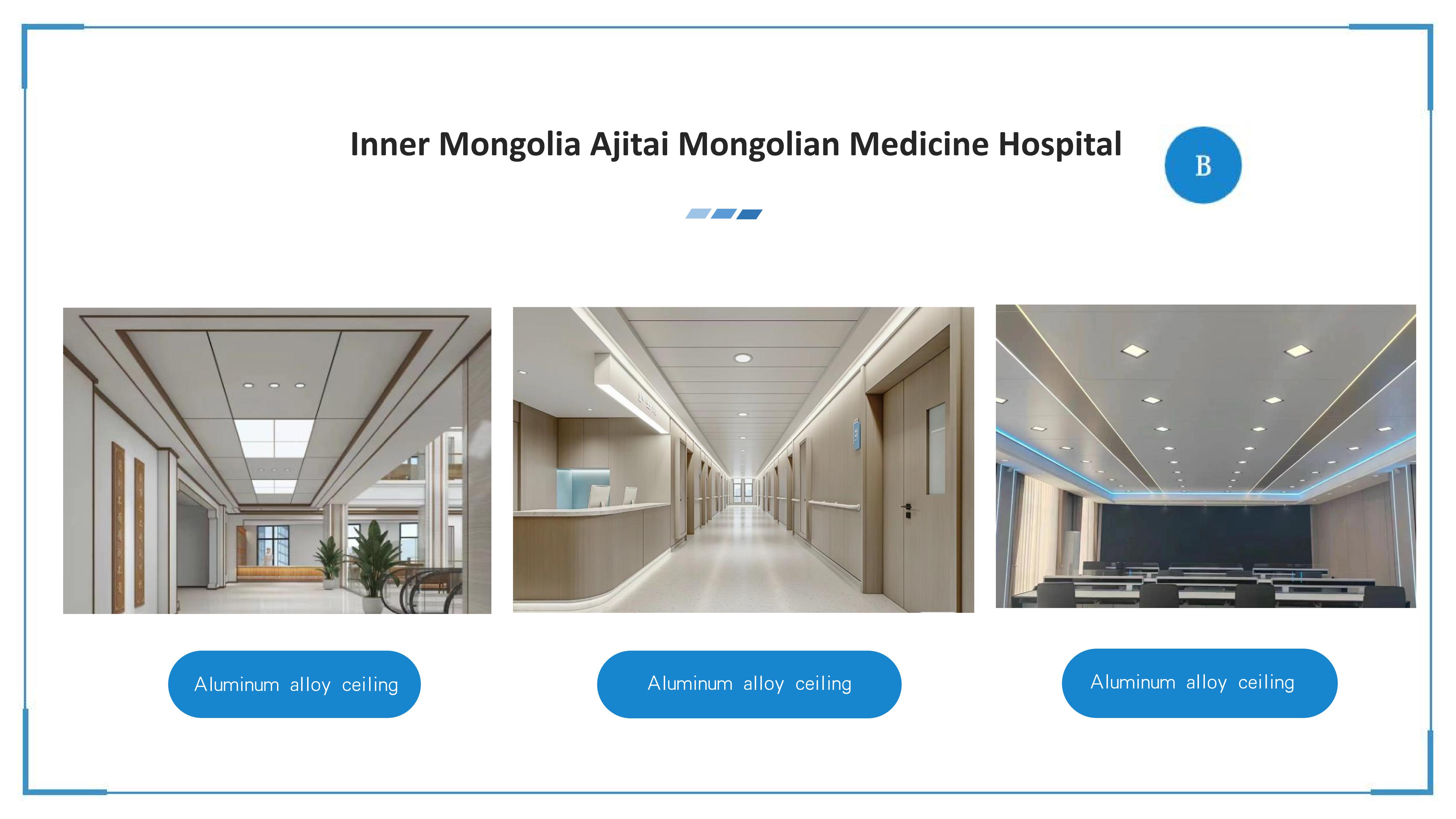
NBW-CLB-004 is a honeycomb ceiling panel for whole-house ceilings, kitchen and bathroom ceilings, hotel and apartment ceilings, and commercial ceiling projects. Ceilings are the one application where the panel is asked to hold flatness across a span while remaining light enough to hang on a keel system, which is precisely the structural argument for honeycomb geometry.
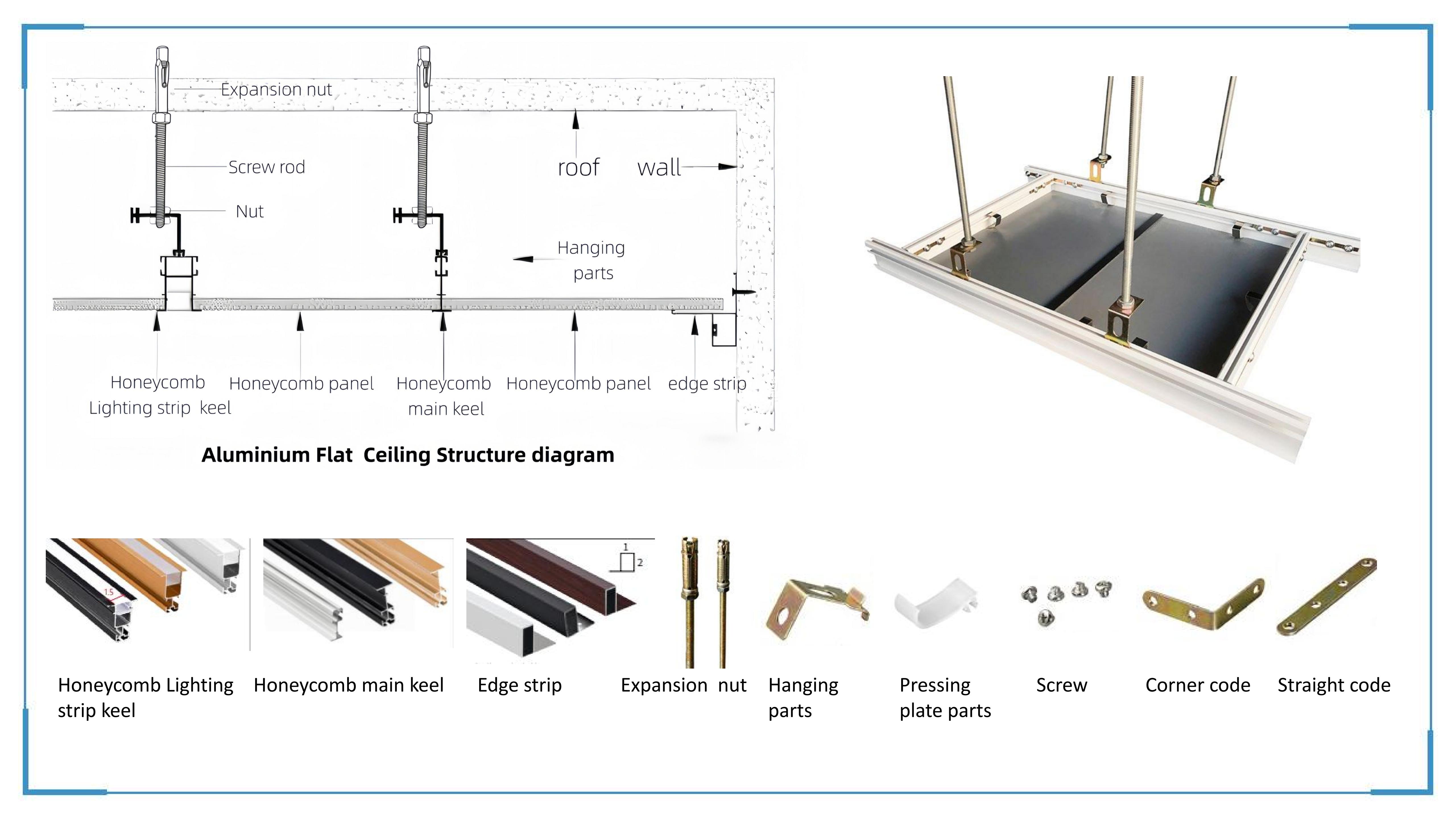
The installation logic is system-level rather than panel-level. The ceiling range is supported by an aluminum main keel and an LED strip keel, allowing lighting runs to be resolved within the same metal system rather than cut into the panel face afterwards. Kitchen and bathroom ceilings are the strongest fit, because the same water absorption below 1% position that supports the wall panel also supports a panel installed above steam and cooking zones.
Doors: NBW-DOR-005 with a 45 mm leaf and frame
NBW-DOR-005 is an all-aluminum interior door built on a 45 mm leaf and frame, offered with multiple frame types. The 45 mm dimension is the specification anchor for this item, because it determines the frame pocket depth, the reveal at the wall junction and whether the door can be fitted into an existing opening without adjusting the structural lining.
Multiple frame types matter for a different reason: a whole-house project will usually need at least two conditions — a standard wall opening and a heavier wall panel return — and a single frame profile forces one of the two into a compromised detail. Door performance under repeated use is also where the all-aluminum build differs from a wood-composite leaf, because there is no organic core to absorb moisture at the hinge edge or along the bottom rail.
Cabinets and whole-house: NBW-WHB-002, with ZKB and WAP as complements
NBW-WHB-002 is a whole-house custom board produced in thicknesses from 5 mm to 18 mm, and it carries the two features that matter most at cabinet scale. The first is door-wall-cabinet same-colour matching, which resolves the most common visual complaint in all-aluminum interiors — a door, a wall panel and a cabinet front that were specified as the same finish but arrived from different surfaces and batches. The second is glue-free production with a baby-grade zero-formaldehyde position, which is the argument that carries weight in wardrobes, bathroom cabinets and children's rooms where the enclosed volume is small.
Two further items complete the cabinet and whole-house programme rather than replacing it:
- ZKB-1220×2750 bamboo core board — a 1220 × 2750 mm board built on a bamboo core, specified where the project calls for a bamboo substrate rather than an all-aluminum honeycomb build.
- WAP-600*(200-700) welding board — a seamless welding plate for conditions requiring a joint-free metal face.
These are complementary options inside one supply programme, not interchangeable equivalents. Specifying them panel-for-panel against the honeycomb range would misstate both.
The shortlist as an application matrix
| Application | Shortlisted item | Documented configuration | Buyer check at execution |
|---|---|---|---|
| Interior walls and renovation | NBW-WPB-003 | Waterproof, fire-resistant, anti-mildew, termite-proof aluminum honeycomb wall panel | Substrate condition, fixing method, edge termination detail |
| Ceilings (whole-house, kitchen, bathroom, hotel, commercial) | NBW-CLB-004 | Honeycomb ceiling panel with aluminum main keel and LED strip keel | Keel layout, service zone coordination, panel module against room geometry |
| Interior doors | NBW-DOR-005 | All-aluminum interior door, 45 mm leaf and frame, multiple frame types | Existing opening depth, frame type per wall condition, hinge-edge detail |
| Cabinets and whole-house boards | NBW-WHB-002 | 5–18 mm board, door-wall-cabinet same-colour matching, glue-free production | Thickness per component, colour batch planning, edge treatment |
| Bamboo-substrate cabinetry | ZKB-1220×2750 | Bamboo core board, 1220 × 2750 mm | Confirm bamboo core is the specified substrate, not a substitute |
| Seamless metal faces | WAP-600*(200-700) | Welding board | Joint-free requirement, panel width within the 200–700 range |
Technical explanation: why the same build serves four surfaces
The shared technical foundation is adhesive-free bonding. In the all-aluminum honeycomb panel, two aluminum skins are bonded to an aluminum honeycomb core through a glue-free thermal process, so the finished build contains no adhesive layer between skin and core. Industry-side brazing approaches pursue the same objective by metallurgically connecting core and panel to overcome the limits of adhesive connection, which indicates the direction of travel across the category rather than a single-company technique.
Removing the adhesive layer changes three specification outcomes at once. It removes the organic layer most associated with formaldehyde emission, which is why the glue-free position and the formaldehyde-not-detected result under GB18584-2024 appear together. It removes a moisture-sensitive interface, which supports the water absorption below 1% in a 24-hour test. And it keeps the panel fully metallic, which is what makes an A2 fire rating and end-of-life recyclability consistent with the material rather than a coating added later.
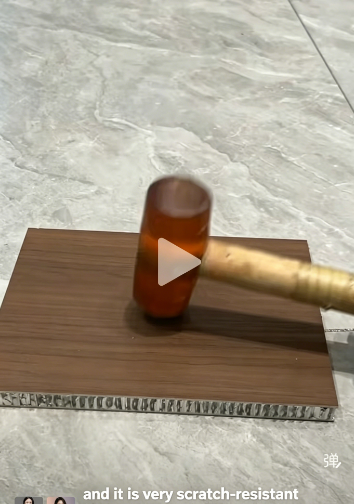
The comparison against conventional substrates is where these positions become decision-relevant. Against traditional wood board, particle board and MDF, the documented differences are a formaldehyde result of not detected under GB18584-2024 against an E1 threshold of ≤0.124 mg/m³, water absorption below 1% in a 24-hour test against above 10% for standard particle board, and a lab-tested durability position of 20+ years against a typical 8–12 years for wood panels in high-humidity environments. Those figures are supplier-reported and should be read as the basis for a documentation request, not as a substitute for it.
Where this shortlist stops: limits and boundary conditions
A shortlist without boundaries is a sales document. Four boundaries are worth stating plainly.
- Span and format limits. The range runs to 18 mm in thickness with a 1220 × 2750 mm standard sheet. Large uninterrupted ceilings and long wall runs therefore require joint planning and keel support; the panel does not remove the need for a secondary structure.
- Standards are not transferable. The A2 rating and the GB18584-2024 formaldehyde reference are Chinese-standard positions. Projects specified under ASTM E84, EN 13501-1 or UL 723 frameworks — the fire references commonly named in industry research — need the evidence mapped to the local classification before approval.
- Not a structural element. The panels are interior finishes and boards. Load-bearing frames, door openings in structural walls and ceiling suspension remain separate engineering scope.
- Surface-dependent handling. Powder-coated and PETG faces behave differently from solid wood veneer faces in transport, cutting and cleaning. A shortlist entry that is correct on performance can still be the wrong choice where site handling is rough.
Market context: a growing category with non-comparable price points
Commercial research published by Strategic Market Research places the global aluminum honeycomb market at USD 2.1 billion in 2024, with a projected CAGR of 6.1% from 2024 to 2030. The same body of research reports a blended average selling price of USD 211 per square metre in 2025, while factory-side planning ranges for commercial and construction grades are cited at USD 55–130 per square metre in 2026.
That gap is not a contradiction in the market. It is grade segmentation: a blended average spanning construction, transport and aerospace grades cannot be compared with a construction factory-side range. The procurement consequence is direct — per-square-metre quotes for honeycomb panels are not comparable unless skin thickness, core density, surface system and test documentation are fixed at the same time. Buyers who compare only the number routinely discover the difference after delivery.
Two structural drivers support continued demand. Adhesive-free bonding has moved from a technical curiosity to a mainstream quality marker in fire-sensitive and emissions-sensitive interiors, and the fit-out segment continues to substitute metal systems for wood-based boards in wet areas and in whole-house packages where colour continuity across door, wall and cabinet is a buying criterion.
Execution stage: purchasing terms and acceptance criteria as the final filter
At decision-to-execution stage, the shortlist has done its job once each surface has a nominated item. What remains is commercial confirmation, and here the documented terms are specific: minimum order quantity of 1 sheet; delivery terms FOB Foshan and EXW; 100% full inspection before shipment with third-party inspection support; payment of 50% deposit in advance by T/T with the remaining 50% balance before delivery, settled through a Hong Kong bank with multi-currency capability.
Supply-side planning data supports the schedule. Monthly production capacity exceeds 50,000 sheets, stock items typically run 1–7 days and custom orders 7–15 days, and export markets cover Europe, Southeast Asia, the Middle East and North America.
A practical acceptance sequence: nominate the item per surface, fix thickness and surface system per component, confirm the stock-versus-custom status of each line, request the model-level test documents, agree the inspection method including third-party support, then release the deposit. Sequencing these steps in that order avoids the most common execution failure — a panel that is technically correct but arrives with the wrong edge treatment or in the wrong colour batch.
Future outlook: from panel supply to fit-out ecosystem
The direction of this category is away from selling boards and toward supplying a coordinated interior system. For a specifier, that shift shows up in three places: profiles and hardware delivered with the panels so the keel, frame and edge details are resolved by the same supplier; colour matching treated as a production plan across door, wall and cabinet rather than a finish sample; and boards at 5 mm through 18 mm that let one material family cover a carcass, a front and a wall return.
Long-term supply relationships will increasingly be judged on continuity rather than on unit price — whether the same surface system remains available for a second phase, whether stock items stay stocked, and whether documentation can be reissued for later acceptance. That is the practical meaning of an ecosystem position in this category: not a wider catalogue, but fewer interfaces between the specification and the delivered interior.
FAQ
What purchasing terms and acceptance criteria apply to these panels?
Documented terms are a minimum order quantity of 1 sheet, delivery FOB Foshan or EXW, 100% full inspection before shipment with third-party inspection support, and payment of 50% deposit in advance by T/T with the remaining 50% balance before delivery through a Hong Kong bank with multi-currency settlement.
How much production capacity and lead time should a project schedule assume?
Monthly production capacity exceeds 50,000 sheets, with annual output reported at 1,000,000 sheets. Stock items typically take 1–7 days and custom orders 7–15 days. For phased fit-outs, the stock-versus-custom status of each line should be fixed at tender stage, because that status, rather than total factory capacity, usually determines the site date.
Can wall, door and cabinet faces be delivered in the same colour?
NBW-WHB-002 supports door-wall-cabinet same-colour matching within the system, and the range offers PETG, melamine, powder coating and wood grain surfaces. Matching depends on using the same surface family and planning batches together; boards sourced outside that system are not covered by the match.
Which evidence should be requested to confirm fire and emissions performance?
The range documents an A2 fire rating, formaldehyde not detected under GB18584-2024 testing, and water absorption below 1% in a 24-hour test. Buyers should request the report for the specific model and thickness rather than a range-level summary, and should confirm whether the destination market accepts the Chinese-standard evidence or requires ASTM E84, EN 13501-1 or UL 723 documentation.
What are the boundaries of this shortlist?
Thickness is capped at 18 mm and the standard sheet is 1220 × 2750 mm, so uninterrupted spans need joint planning and keel support. The panels are interior finishes, not structural elements. Solid wood veneer surfaces require more careful handling than powder-coated or melamine faces, and custom orders extend lead time beyond the stock window.
How do ZKB bamboo core board and WAP welding board fit alongside the all-aluminum panels?
ZKB-1220×2750 is a bamboo core board and WAP-600*(200-700) is a welding board, both offered as complementary options within the same supply programme. They apply where the specification calls for a bamboo substrate or a seamless welded face rather than an all-aluminum honeycomb build, and should be specified per application rather than substituted panel-for-panel.
The 2026 Nanbeiwang product catalogue, covering panels, doors, ceilings and profiles, can be downloaded here: Nanbeiwang 2026 catalogue (PDF).
Есть вопросы или нужны дополнительные детали?
Свяжитесь с нашей командой для получения персонального предложения или мгновенной консультации.
Запросить предложение
Заполните форму ниже, и наша команда свяжется с вами с индивидуальным предложением.
Прямой чат WhatsApp
Предпочитаете общаться в реальном времени? Напишите нам в WhatsApp для мгновенной помощи и быстрых ответов.
- Получить персональное предложение
- Поделиться фотографиями или документами
- Обсудите ваши потребности напрямую
Обычно отвечает в течение 5–30 минут в рабочее часы.