
Specifying JSGREEN001 Cold Storage Panels: A Technical Buyer FAQ
Specifying JSGREEN001 Cold Storage Panels: A Technical Buyer FAQ
JSGREEN001 is the cold storage panel model registered against the ISO 9001, ISO 14001 and ISO 45001 certificates of Jiangsu Green Bio-Environmental Protection Technology Co., Ltd, the Chinese manufacturer operating as GREEN BIO. The model sits within the company's PIR sandwich panel product line. For a buyer moving from evaluation into execution, the decisive work is not choosing a panel category but fixing the variables — core designation, thickness, effective width, steel sheet, room temperature and acceptance evidence — in documents that survive the order. The questions below separate what the approved product record establishes from what a buyer must obtain in writing because the record does not state it.
Why the cold-room envelope needs its own specification step
Cold storage panels carry two loads at once: a thermal load and a documentation load. The thermal load is obvious. The documentation load is newer, and it is why envelope specification has become a procurement discipline rather than a purchasing detail.
China's 14th Five-Year Plan mandated that all new urban buildings meet green building standards by 2025, according to the International Trade Administration's country commercial guide. The national assessment framework behind that mandate, GB/T 50378-2019 (updated in 2024), rates buildings on a three-star scale and organises assessment around five categories: safety and durability, health and comfort, occupant convenience, resource saving and environmental livability. Separately, the China Quality Certification Centre's description of the unified green product certification system lists heat-insulating system materials among the green building material categories it covers, alongside precast components, steel members and modern structural timber.
For a cold chain project, the practical consequence is that the panel schedule is read by two audiences. The refrigeration engineer reads it for heat load and joint performance; the project's compliance file reads it for declared material, declared performance and traceable certificates. A panel described only as "100 mm cold room panel" satisfies neither audience for long. The buyer's task is to make the panel build explicit enough that both readings agree.
One boundary belongs here: the policy and standard facts above describe the market framework a Chinese supplier operates in. They do not certify JSGREEN001, and they do not establish that any specific panel meets a given green building rating. That link has to be built from the supplier's own documents.
What JSGREEN001 is, and what the approved record establishes
GREEN BIO was founded in 2015 and operates a 10,000 m² facility with 50 employees and a 25-engineer research and development team, producing an annual output of 120,000 units. Its main products are PIR sandwich panels, plywood, steel supports, cable brackets and aluminium profiles. Approximately 70% of output is exported, with stated markets in Southeast Asia, Central Asia, Russia, South America and Africa — the Belt and Road corridor together with other emerging markets.
The facts that matter most at the specification desk are the manufacturing and commercial parameters attached to the panel line:
- Customization fields: panel thickness from 50 mm to 200 mm, steel sheet colour and material, fire rating, custom dimensions and lengths, and cam-lock types.
- Production mode: OEM and ODM services are offered.
- Capacity: 50,000 m² per month.
- Order threshold: a minimum of 100 m² or one 20-foot container, as stated in the product record.
- Lead time: typically 15–25 days after receipt of deposit.
- Quality control sequence: incoming raw material inspection, in-process patrol inspection, full inspection of finished product density and dimensions, and pre-shipment photo confirmation.
- After-sales: installation guidance videos, remote technical support, and free replacement of damaged parts during the warranty period.
Three management-system certificates are registered against the JSGREEN001 product: ISO 9001:2015 for quality (certificate NO.110825Q0383R0S, standard GB/T 19001-2016 idt ISO9001:2015), ISO 14001:2015 for environment (NO.110825E0251R0S, GB/T 24001-2016 idt ISO14001:2015) and ISO 45001:2018 for occupational health and safety (NO.110825S0254R0S, GB/T 45001-2020 idt ISO45001:2018). All three were issued by Jiangsu Taiding Certification Co., Ltd. and run from 25 September 2025 to 24 September 2028.
The technical anatomy: six variables that define a panel build
"Cold storage panel" is a category name, not a specification. Six variables separate one build from another, and each one changes either performance or cost.
Core designation. A sandwich panel bonds a rigid foam core between two steel faces. The core's declared identity, density and fire rating are the properties a compliance reviewer will ask for, and they must be declared per order rather than inferred from the model name.
Panel thickness. GREEN BIO customizes thickness across 50 mm to 200 mm. For a given core, thermal resistance rises with thickness, but the design value used in a heat-load calculation should come from the supplier's data for the actual build, not from a thickness rule of thumb. Thickness also affects panel weight, handling and the practical panel length for a room height.
Effective width and module planning. Effective width sets the repeating module of the wall or ceiling. Room dimensions, door and corner positions, and cam-lock locations all have to align with that module; poor alignment shows up as cutting waste and slower site progress rather than as a technical failure.
Steel sheet. Steel sheet colour and material are customization fields. The sheet specification governs surface appearance, cleanability expectations and handling care, and the numeric gauge belongs on the drawing.
Joints and cam-locks. Cam-lock type is customizable, and joint integrity is the part of the build that the documented projects single out: the project record attributes temperature control to seamless joints that prevent cold air leakage. Joint detailing therefore deserves a line in the acceptance checklist, not a footnote.
Temperature duty. Room setpoint is the variable that ties the other five together, because it drives thickness and core selection and, at the same time, the refrigeration design. It is also the variable most likely to be quoted in a tender document as a headline range and then left unverified.
Technical and procurement FAQ
Which model name should appear on the purchase order?
The designation JSGREEN001 should appear identically on the quotation, the order confirmation, the packing list and the pre-shipment inspection report. A buyer should also write the application sector and each room's duty onto the same order: a low-temperature freezer, a chiller room and a multi-temperature distribution centre can share a model name while carrying different panel builds. Where the order states only the category — cold storage panel — the supplier's production file has no anchor for verifying thickness, core or steel sheet at dispatch.
PU or PIR — what can be compared on the available record?
The product record identifies a PIR sandwich panel within GREEN BIO's main product line and lists fire rating among the customization fields; it does not set out a PU alternative's parameters. A PU-versus-PIR comparison therefore cannot be closed on this record, and a buyer should not accept one that is. Both are rigid foam cores used in insulated sandwich panels, and the declared fire rating is an evidenced property of a specific product, not something that follows from the acronym. The practical step is to request, for each core option offered, the core designation, declared density, fire rating and thermal data on identical test conditions, then compare those documents rather than the marketing label.
Which panel thicknesses can be specified?
Thickness is customized from 50 mm to 200 mm, so the specification task is to narrow that range to a project value rather than to select from a fixed list. The value should follow the room's refrigeration design and be written on the drawing together with the core and steel sheet, because a thickness stated on its own does not define a build. Buyers should also confirm how the chosen thickness interacts with panel length and room height, since both are customized fields in the same record.
How should effective width and steel sheet thickness be handled?
These two values must be stated numerically on the supplier's drawing and restated on the order confirmation. The approved record for this article covers customization of thickness, steel sheet colour and material, fire rating, dimensions and lengths, and cam-lock types; it does not publish specific effective-width or steel-sheet gauge figures for JSGREEN001. That gap is not a defect in the product — it is a limit of the document set. If a tender document quotes a particular effective width or sheet gauge, the buyer should have the supplier re-confirm the figure in writing before the order is placed, and should check it against the room layout, the door openings and the cam-lock positions at the same time.
What operating temperature can the panels serve?
The documented applications are low-temperature freezers at −18°C, chiller rooms at 0–4°C, and multi-temperature distribution centres that combine frozen, chilled and ambient zones. That is the evidenced envelope-service range in the record. It is not a blanket rated range for the model, and the record does not publish one. Buyers whose project sits outside those documented duties — blast freezing, deep-freeze rooms or other setpoints — should obtain written confirmation from the supplier against the actual room design and should not assume the capability extends. A headline temperature range in a tender document should be treated as a design claim to be confirmed, with the room-by-room setpoint schedule attached to the order.
What refrigeration unit and air cooler support does the panel need?
The panel is the envelope; it is not the refrigeration plant. Plant selection — unit capacity, air cooler type, defrost method and airflow — belongs to the refrigeration designer and depends on room volume, product load, door openings, traffic and ambient conditions. The approved record does not specify refrigeration equipment models for JSGREEN001, and a buyer should not read equipment selection out of a panel datasheet. What the record does show is the interaction to design for: in the documented multi-temperature distribution centre, the panel system delivered precise temperature control with seamless joints preventing cold air leakage. The workable sequence is to freeze the envelope specification and the refrigeration specification in the same design review, because heat load agreed in one document becomes equipment duty in the other.
What exactly do the ISO certificates cover?
Three management-system certificates are registered against JSGREEN001: ISO 9001:2015, ISO 14001:2015 and ISO 45001:2018, all issued by Jiangsu Taiding Certification Co., Ltd. and valid from 25 September 2025 to 24 September 2028. Their stated scopes relate to the sales of metal materials and hardware and electromechanical products and the processing of environmental protection equipment, and the certificate wording should be read in full on the documents themselves. Two verification points follow. First, confirm that the scope text maps to the transaction being placed. Second, recognise what the certificates are: they attest to management systems, not to the thermal performance of an individual panel. Product-level performance claims require test data for the specific build.
What quality and acceptance evidence accompanies an order?
The stated control sequence runs from incoming raw material inspection through in-process patrol inspection to full inspection of finished product density and dimensions, followed by pre-shipment photo confirmation. The stated acceptance criteria are a pre-shipment inspection and test report. For a buyer, that translates into three checks: compare the inspection report values against the order confirmation rather than against a generic catalogue; confirm that density and dimension records exist for the actual production batch; and use the pre-shipment photographs to review panel faces, edges and cam-lock details before the container is sealed.
Which commercial terms should be fixed before production starts?
The commercial framework in the supplier's records sets out delivery terms as FOB, EXW, CIF or DDP, payment as 30% in advance with 70% before shipment, a minimum order of 100 m² or one 20-foot container, and a typical lead time of 15–25 days after deposit. These are the supplier's stated terms, not universal market terms, and each order should restate the applicable combination. Customization is where terms and schedule most often diverge: thickness, steel sheet colour and material, fire rating, dimensions and cam-lock type are all buyer-selected fields, so they belong in the order confirmation rather than in an email thread.
What installation and after-sales support is provided?
Support covers installation guidance videos, remote technical support during installation, and free replacement of damaged parts during the warranty period. The documented projects also report a schedule effect from the modular design: the project record attributes a 30% increase in on-site installation speed to standardized modular panels, which is a project-level observation rather than a promise for every site. Buyers should confirm in the order documents how long the warranty period runs and what qualifies as a damaged part, because the record describes support activities rather than warranty duration.
Application fit: what the documented projects show
The panel record includes two reference projects, both in the Asia-Pacific region. The first is a food processing and meat processing client: 5,000 m² of cold storage panels supporting a 2,000-tonne capacity, with a −18°C low-temperature freezer and a 0–4°C chiller room, in stable operation for five years. That project record reports precise temperature control, seamless joints preventing cold air leakage, and successful passage of GSP certification.
The second is a 12,000 m² large-scale sorting centre for 3PL cold chain logistics or supermarket distribution, operated as a multi-temperature distribution centre across frozen, chilled and ambient zones, with one year of operation on a new project. The record notes on-schedule delivery, straightforward installation and improved cargo turnover efficiency, and highlights high-strength double-sided colour steel sheets combined with precision foaming for flatness and load-bearing capacity.
The boundary matters as much as the cases. Both references are site-specific: they show which configurations were used and what the operators reported, not a guaranteed outcome for a different building, climate or duty cycle. A buyer in a different market should treat them as evidence of application experience in food processing and multi-temperature logistics, and then verify the build for their own room schedule.
Acceptance checklist for a JSGREEN001 order
The checklist below converts the FAQ into document-level checkpoints. Each row names where the answer should live, so that a missing item is visible before production rather than at the site.
| Checkpoint | Document that should carry it | What to verify |
|---|---|---|
| Model identity | Quotation, order confirmation, packing list, inspection report | JSGREEN001 stated identically across all four; application sector and room duties listed |
| Core and fire rating | Product datasheet and order confirmation | Core designation and declared fire rating for the exact build; no unstated substitution |
| Panel thickness | Drawing | Project value within the 50–200 mm customization range, stated with core and panel length |
| Effective width and steel sheet | Drawing and order confirmation | Numeric values confirmed in writing and checked against module layout and cam-lock positions |
| Temperature duty | Refrigeration design plus supplier confirmation | Room-by-room setpoints matched to a defined panel build; wider duties confirmed in writing |
| Refrigeration support | Refrigeration designer's equipment schedule | Unit and air cooler selection derived from the agreed heat load, not inferred from panel data |
| Certificates | Certificate copies | Numbers NO.110825Q0383R0S, NO.110825E0251R0S, NO.110825S0254R0S; issuing body; validity to 24 September 2028; scope text mapped to the transaction |
| Quality and acceptance | Pre-shipment inspection and test report | Density and dimension results compared with the order; pre-shipment photographs reviewed |
| Commercial terms | Contract or order confirmation | Delivery term, payment split, minimum order and lead time restated for this order |
| Support | Order documents | Installation guidance videos, remote technical support, damaged-part replacement scope and warranty period |
Outlook: documentation as a procurement deliverable
The direction of travel in Chinese green building procurement is toward more declared properties, not fewer. A mandated green standard for new urban buildings, a three-star national assessment framework organised around resource saving and environmental livability, and a unified green product certification system that already covers heat-insulating system materials all point the same way: the panel schedule becomes part of the compliance record.
For buyers, the practical implication is that supplier selection will increasingly be decided by document consistency — a drawing, an order confirmation, an inspection report and a certificate whose scope text all describe the same product. Manufacturers that can produce that consistency reduce friction at project acceptance and at customs. That is an interpretation of the framework described above, not a forecast of market size, and it does not change the underlying rule: each claim about a specific panel still has to be evidenced by that panel's documents.
The specification questions in this FAQ are therefore worth answering before the order, not after delivery. A buyer who confirms the model, the core, the thickness, the effective width, the steel sheet, the room duties and the certificate scope in writing has converted a category purchase into a verifiable one.
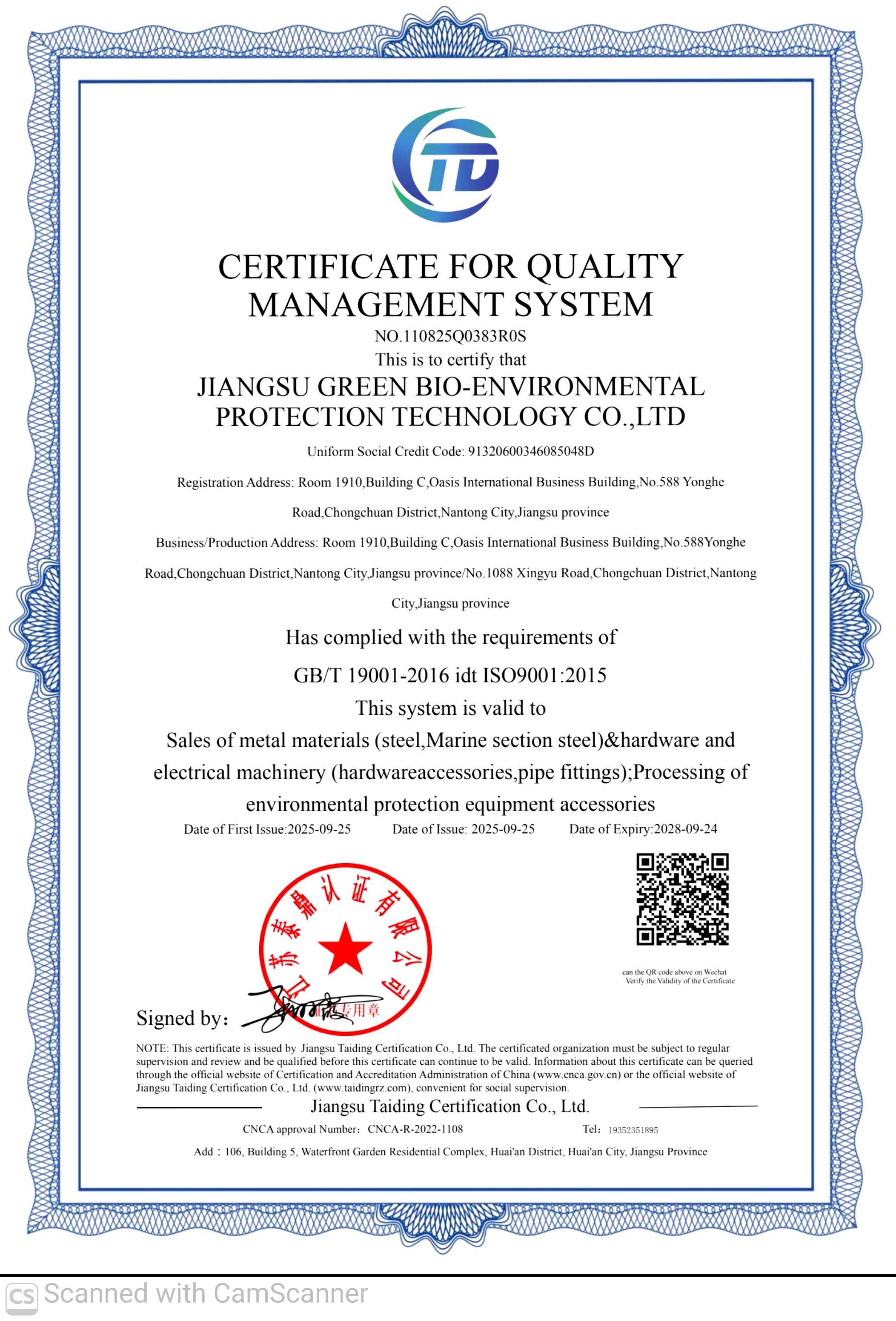
Quality management system certificate registered against the JSGREEN001 cold storage panel, issued by Jiangsu Taiding Certification Co., Ltd. and valid to 24 September 2028.
Full product and capability documentation, including panel configurations and certification details, is available in GREEN BIO's professional catalogue. The manufacturer's company profile and product range are published at GREEN BIO.
Есть вопросы или нужны дополнительные детали?
Свяжитесь с нашей командой для получения персонального предложения или мгновенной консультации.
Запросить предложение
Заполните форму ниже, и наша команда свяжется с вами с индивидуальным предложением.
Прямой чат WhatsApp
Предпочитаете общаться в реальном времени? Напишите нам в WhatsApp для мгновенной помощи и быстрых ответов.
- Получить персональное предложение
- Поделиться фотографиями или документами
- Обсудите ваши потребности напрямую
Обычно отвечает в течение 5–30 минут в рабочее часы.