
Specifying WPC Decking for Commercial and Residential Zones: A Scenario Fit Analysis
Scenario Fit Analysis · Construction & Decoration
Decking and cladding come from the same material family but are specified against two different duty cycles. A wood plastic composite board that performs underfoot on a private terrace is not automatically the right product for a hotel facade, and a vertical cladding panel is not a substitute for a deck board that has to carry foot traffic, shed standing water and resist slipping.
This analysis treats specification as a matching exercise between zone and documented product. It maps four models — GH024 and GH010 as cladding-specific profiles, and D053 and GH001 as decking profiles — against residential and commercial applications, and it states where the supporting documentation stops.
Terratsa New Material (Liaoning) Co., Ltd. is a wood-plastic composite manufacturer founded in 2007, operating a 74,000 m² production base in the Yingkou Area of the China (Liaoning) Pilot Free Trade Zone, producing outdoor WPC decking, outdoor WPC fencing and outdoor WPC cladding, and exporting to markets across Europe, Asia, the Middle East, South America and Australia.
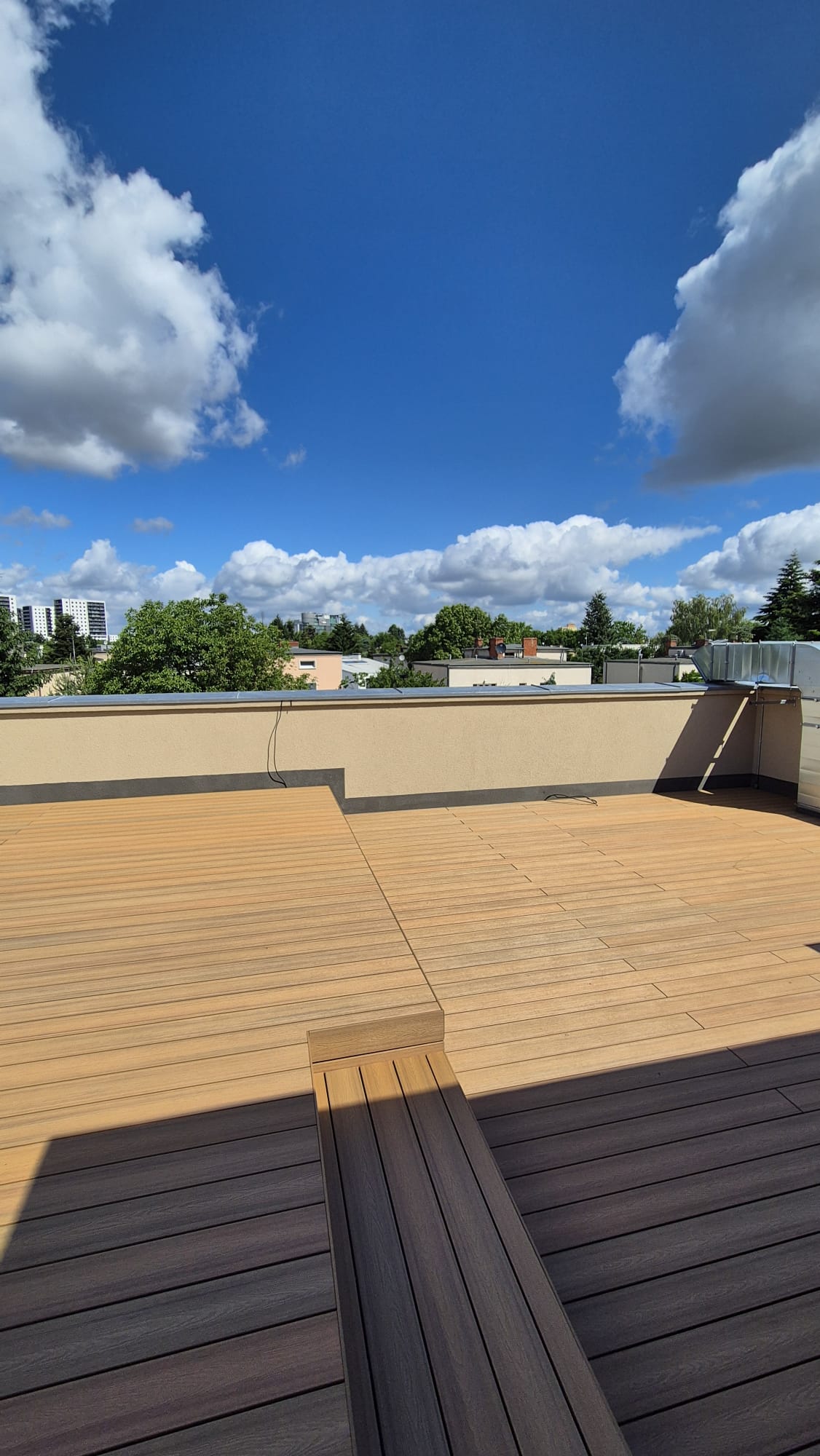
Why the Zone, Not the Material Name, Drives the Specification
A WPC profile is specified twice: once as a material and once as a system. The material question — wood powder and plastic composite, hollow or capped, embossed or smooth — is answered by a data sheet. The system question — vertical or horizontal, public or private, continuously wet or occasionally damp, high-traffic or occasional — is answered by the zone it will serve.
Vertical and horizontal applications distribute load in different ways. Cladding panels are fixed to a facade and are governed by dimensional stability, moisture behaviour under cyclical conditions and thermal movement. Deck boards are installed in static placement over a supporting frame and are governed by bending behaviour, water absorption and surface slip resistance.
Documented project requirements make the distinction concrete. For park decking in China, WPC products are installed in static placement mode and require supporting equipment such as joist clips and screws; the special requirements recorded for that scenario are weather resistance, anti-slip, anti-UV and anti-scratching, in a high-humidity environment. A cold-climate European terrace scenario — low winter temperatures combined with high humidity — adds low water absorption, no maintenance, anti-UV performance and anti-scratching to that list.
Two practical conclusions follow. First, a specification that names a material without naming a zone is incomplete. Second, the certification and test documentation attached to a product needs to match the zone the product will actually serve, not the brand it was bought from.
The Documented Product Range and What Each Model Is Built For
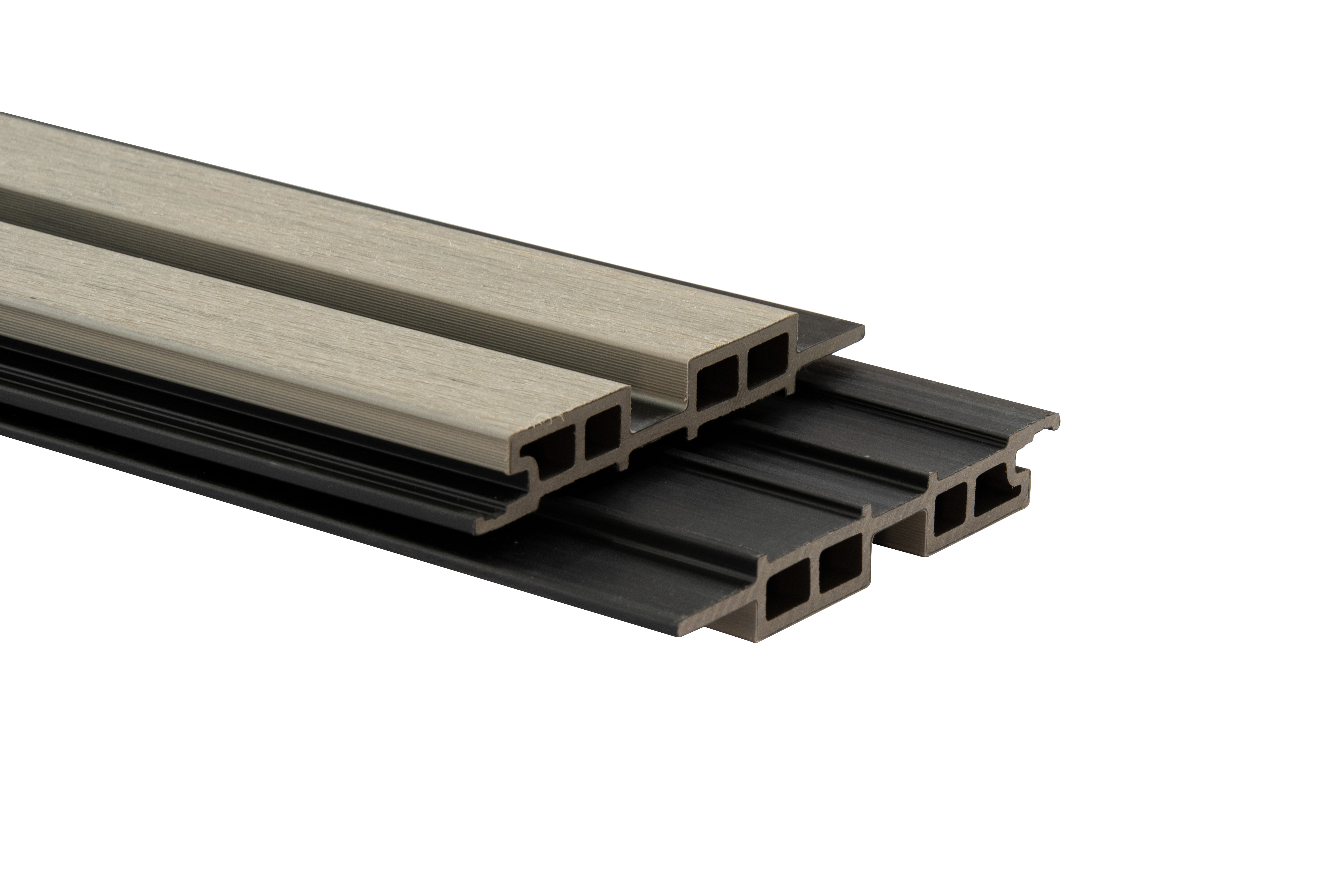
Four models form the working set for this analysis, and the split between them is deliberate rather than cosmetic. GH024 and GH010 are cladding profiles; D053 and GH001 are decking profiles.
| Model | Product type | Key documented values | Zone fit |
|---|---|---|---|
| GH024 | Outdoor WPC cladding | Flexural properties ≤ 0.9 mm; moisture resistance under cyclic test ≤ 0.9 mm; swelling and water absorption (28 days immersion) ≤ 4%; boiling test ≤ 3%; linear thermal expansion coefficient ≤ 37·10⁻⁶ K⁻¹ | Vertical surfaces: interior and exterior feature walls, humid indoor-adjacent walls, outdoor walls where a fluted 3D texture is specified |
| GH010 | Exterior wall cladding | Thickness 22 mm; width 136 mm; length 2900 mm; flexural properties ≤ 0.79 mm; moisture resistance under cyclic test conditions ≤ 60.7 mm; swelling and water absorption (28 days immersion) ≤ 2%; linear thermal expansion coefficient ≤ 37·10⁻⁶ K⁻¹ | Exterior facades of homes, commercial buildings, hotels and villas; garden feature walls, balcony privacy screens, fence cladding |
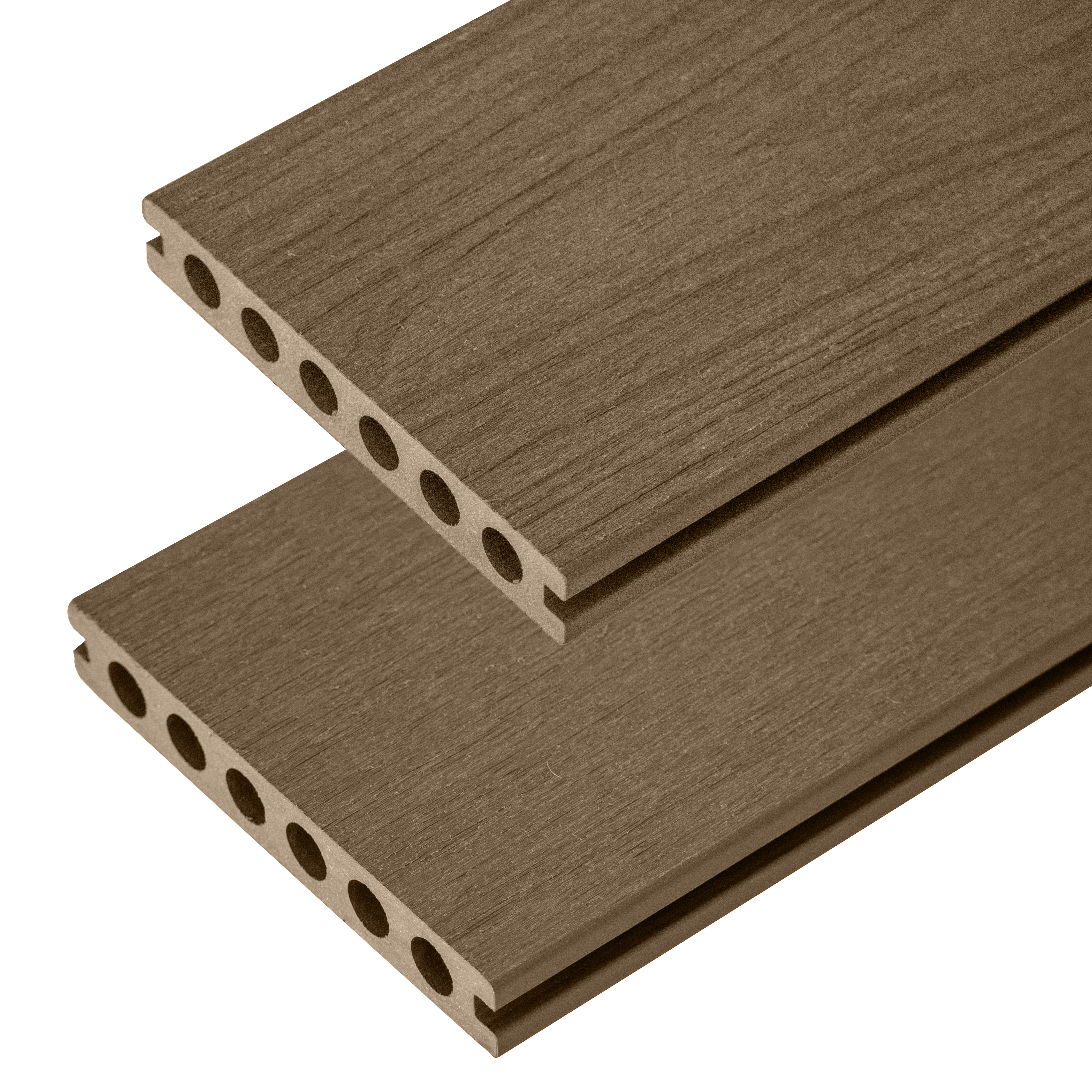
| D053 | Outdoor hollow WPC decking, first generation | Thickness 23 mm; width 146 mm; length 2900 mm; bending failure 3900 N; density 1.3 g/cm³; water absorption (boil for 5 hours) ≤ 2%; linear thermal expansion coefficient ≤ 37·10⁻⁶ K⁻¹ | Large-area horizontal installations: public parks, scenic spots, plazas, boardwalks and community pathways |
| GH001 | Co-extruded outdoor decking | Flexural properties ≥ 3300 N; moisture resistance under cyclic test conditions mean ≤ 10%; water absorption (boiling test) ≤ 7% | High-traffic and wet horizontal zones: swimming pool surrounds, waterfront boardwalks, park pathways, garden patios, balconies |
The values above are quoted from the respective model data sheets. They are not interchangeable between rows, and the next section explains why that matters at the point of specification.
Reading the Technical Data as Zone Constraints
Cladding data and decking data express different failures. The published values for GH024 and GH010 describe deflection-type flexural behaviour (≤ 0.9 mm and ≤ 0.79 mm respectively) alongside moisture-driven dimensional change: swelling and water absorption after 28 days of immersion, and boiling-test behaviour. These are stability values. They answer the question a facade asks, which is whether a panel will stay flat and stay fixed when it is rained on, heated and cooled repeatedly.
The published values for D053 and GH001 are load values. D053 is documented with a bending failure figure of 3900 N, a density of 1.3 g/cm³ and water absorption of ≤ 2% after a 5-hour boil. GH001 is documented with flexural properties of ≥ 3300 N, a cyclic moisture mean of ≤ 10% and boiling-test water absorption of ≤ 7%.
Those two decking figures should not be read as a simple ranking. They are recorded under different test conditions in their respective data sheets, and the design intent behind them differs. D053 is a first-generation hollow profile in which the material itself carries the moisture performance. GH001 is a capped co-extruded profile in which a second-generation polymer cap layer fully encapsulates the core, so the surface is engineered to keep water away from the core in the first place. For a dry-to-damp public area, the first-generation route is a cost-driven choice. For a zone where water is present most of the time, the capped route addresses the failure mode directly.
One further common value is worth noting: D053, GH010 and GH024 are each documented with a linear thermal expansion coefficient of ≤ 37·10⁻⁶ K⁻¹. Thermal movement is therefore a design input rather than a defect. Fixing patterns, gap width and joist spacing must be planned for it, and the documented installation method — static placement with joist clips and screws — exists to accommodate it.
The Certification Baseline: EPD Scope, ASTM D7032 and Wood Tracking
The most useful question a buyer can ask about a certificate is not “does the supplier hold it” but “which products does it actually cover”.
Terratsa holds a valid Environmental Product Declaration registered as EPD-IES-0012197:001 (S-P-12197), conforming to EN 15804+A2, with a version date of 2024-03-15 and a validity running to 2029-03-15. The declared product scope is co-extrusion WPC products.
That scope produces a clean, checkable mapping inside the four-model set. GH001 is a co-extruded outdoor decking profile and sits within the declared co-extrusion scope. D053 is a first-generation hollow decking profile outside that scope, so an EPD-based environmental argument should not be extended to it; D053 has to stand on its own deck-board documentation instead. This is exactly the kind of boundary a specification sheet should make explicit, because using a co-extrusion EPD to justify a first-generation board is a documentation error, not a performance one.
Two further references complete the baseline. ASTM D7032 is the primary standard specification for establishing performance ratings for wood-plastic composite deck boards, stair treads, guards and handrails; it is the vocabulary in which deck-board performance claims are normally compared. FSC certification, by contrast, addresses the wood-fibre sourcing chain — the wood-tracking side of the material — rather than structural or moisture performance. CE, FSC, ASTM, SGS and EPD documentation are all listed among the credentials held for Terratsa products, and each belongs in a specification package for a different reason.
Scenario Fit: Matching Zones to Models
Residential terraces, balconies and garden decks
Private residential decking is defined by moderate, intermittent traffic, mixed wetting from rain and cleaning, and a strong preference for low maintenance. Capped co-extruded WPC decking, represented in this set by GH001, is the natural specification: the capped structure keeps the core sealed, the embossed 3D wood grain surface gives the terrace the appearance of timber without the refinishing cycle, and the documented operating range of −40 °C to 75 °C covers the temperature swings of an exposed garden deck. Where a private project is driven primarily by budget rather than by continuous moisture, first-generation decking such as D053 remains a legitimate option.
Commercial and public-realm decking
Public parks, plazas, boardwalks and community pathways invert the priority order. Area is large, traffic is heavy and continuous, and the buyer is usually a project contractor working to a fixed budget. The documented scenario for park decking in China — static placement, joist clips and screws, high humidity, weather resistance, anti-slip, anti-UV and anti-scratching — describes this zone precisely. D053 is positioned for high-volume installations where cost efficiency and basic outdoor durability govern the decision; GH001 is positioned where traffic intensity or persistent wetness is the dominant risk.
Swimming pool surrounds and continuously wet zones
Pool surroundings combine three requirements that rarely appear together: standing water, barefoot use and constant UV exposure. GH001 is the model whose documented use cases explicitly include swimming pool surrounds, spas and wet outdoor spaces, with a textured anti-slip surface and a sealed, non-porous capped structure. The same profile is documented for waterfront boardwalks, where salt spray and repeated wetting replace pool water as the operating condition.
Exterior facades and vertical cladding
Facade work is a different procurement line. GH010 is a 22 mm by 136 mm by 2900 mm exterior wall cladding profile documented with flexural properties of ≤ 0.79 mm and swelling and water absorption of ≤ 2% after 28 days of immersion — values that support its use on residential homes, commercial buildings, hotels and villas, as well as garden feature walls, balcony privacy screens and fence cladding. GH024 is the fluted outdoor WPC cladding option, documented with a 28-day immersion figure of ≤ 4% and a boiling-test figure of ≤ 3%, aimed at vertical surfaces where a modern fluted 3D texture is the design intent, including humid interior-adjacent and outdoor walls.
Cold and humid climates
The European terrace scenario recorded for low winter temperatures combined with high humidity — weather resistance, anti-UV, no maintenance, low water absorption, anti-scratching and anti-slip — maps to GH001 in the documented product associations for that project type. Cold is not the primary threat to a correctly installed WPC deck; freeze-thaw moisture cycling is, which is why the low-water-absorption requirement appears alongside the temperature requirement rather than instead of it.
Project Evidence: 500 Tonnes of Park Decking, Fifteen Years in Service
Documentation predicts behaviour; installed projects record it. A park decking project in China, delivered for a project contractor client at an installed scale of 500 tonnes, is documented as achieving durable results with the decking maintaining its performance for 15 years, with no fading and no bending as the recorded case highlights. The associated products for that case are D053 and GH001.
Two things make this case useful for a specification decision. The scale — 500 tonnes — indicates a large-area public installation rather than a single terrace, which is the zone where first-generation and capped boards most often compete. The fifteen-year service record addresses the two failure modes that generate the most post-installation complaints on public decks: surface colour change and permanent deflection. It does not, on its own, replace a project-specific engineering review, and it should not be presented as doing so.
Market Trend: Documentation Is Becoming the Specification Language
The commercial context supports scenario-based specification rather than brand-based specification. The global wood plastic composite market was valued at USD 8.05 billion in 2025 and is projected to reach USD 11.26 billion by 2034, according to Straits Research. Within that market, North America held the largest regional share at 36.4% in 2025, also per Straits Research.
Two implications follow for buyers and specifiers. First, as the category scales, differentiation shifts from “is it WPC?” to “which WPC, documented to what, for which zone?” Environmental declarations, standard-based performance ratings and chain-of-custody certificates become the language in which that differentiation is written. Second, in markets where large-scale public and commercial work drives volume, the cost-efficiency argument for a first-generation deck board and the durability argument for a capped co-extruded board will continue to coexist rather than resolve into a single answer — which is precisely why a scenario fit framework is more durable than a single product recommendation.
Comparison with Traditional Solutions — and Where WPC Is the Wrong Choice
Against timber, the functional differences are well established. WPC decking requires no painting, staining or sealing; it does not rot or decay; it is resistant to termites and wood-boring insects; and routine cleaning with soap and water is sufficient. Against metal or stone cladding, WPC panels are lighter and can be cut, sawn and fastened with standard woodworking tools, which reduces installation labour and allows both horizontal and vertical mounting over different sub-frame systems.
Those advantages do not make WPC universally correct, and honest specification work requires the boundaries to be stated alongside the benefits.
- Certification scope is narrower than brand reputation. The EPD discussed here covers co-extrusion WPC products. It does not automatically extend to first-generation hollow profiles such as D053. A specification that relies on an EPD must name a product inside the declared scope.
- An EPD is a product declaration, not a project calculation. It supports comparative environmental assessment; it does not certify the performance of a specific installed deck, which depends on joist spacing, ventilation, fixing method and drainage design.
- Capped co-extrusion carries a higher material cost than first-generation profiles. Where the zone is large, dry-to-damp and cost-governed, the first-generation option can be the more rational specification, with the trade-off accepted knowingly.
- Thermal movement must be designed for. With all three documented profiles at a linear thermal expansion coefficient of ≤ 37·10⁻⁶ K⁻¹, unspecified expansion gaps and incorrect joist spacing are installation errors that no material property will absorb.
- WPC is not a structural member. Deck boards are installed in static placement over a supporting frame with joist clips and screws; they do not replace the frame.
- Customized orders follow production schedules. OEM/ODM customization including logo, a minimum order quantity of one container and a documented lead time of 30–45 days mean that project timelines must be planned around production slots rather than assumed to fit them.
Future Outlook
The direction of travel in WPC specification is toward evidence that can be checked at the product level. A valid environmental declaration running to 2029-03-15, a defined co-extrusion scope, standard-referenced deck-board ratings and chain-of-custody documentation together create a specification package that survives procurement review, whereas a brochure claim does not.
For buyers, the practical implication is a shift in what “fit” means. Fit will increasingly be defined as the overlap between three things: the zone's duty conditions, the model's documented values, and the scope of the certificates attached to that specific model. Where the three overlap, the specification is defensible. Where they do not — a co-extrusion EPD applied to a first-generation board, or a facade profile used as decking — the gap is a documentation gap, and it is better found during evaluation than during installation.
FAQ: Scenario Fit Questions Buyers Ask
Can the same WPC profile be used for both a facade and a deck?
No, based on the documented product set. GH024 and GH010 are specified as outdoor WPC cladding and exterior wall cladding respectively, and their published values describe flexural properties and moisture-related dimensional behaviour for vertical surfaces. D053 and GH001 are deck boards, and their published values describe load behaviour and water absorption under horizontal, static placement conditions. The two groups carry different data because they answer different engineering questions.
Which models are actually covered by the Environmental Product Declaration?
The valid declaration EPD-IES-0012197:001 (S-P-12197) covers co-extrusion WPC products, conforms to EN 15804+A2 and is listed with a validity to 2029-03-15. GH001, a co-extruded outdoor decking profile, sits within that declared scope. D053 is a first-generation hollow decking profile outside the declared co-extrusion scope and should be specified on its own deck-board documentation rather than on the co-extrusion EPD.
Which board suits a swimming pool surround or a persistently wet deck?
GH001 is the model whose documented use cases include swimming pool surrounds, spas and wet outdoor spaces, with a textured anti-slip surface and a fully sealed capped structure. D053 remains applicable to large dry-to-damp public areas where cost efficiency governs. Either way, fixing follows the documented system: static placement with joist clips and screws, with gaps planned for thermal movement.
What should be checked before specifying WPC decking for a public park project?
The documented requirements for park decking in China are weather resistance, anti-slip, anti-UV and anti-scratching, in a high-humidity environment, installed by static placement with joist clips and screws as supporting equipment. Both D053 and GH001 are listed as applicable products for that scenario. The selection between them then rests on traffic intensity, how persistent the wetness is, and the project's budget position.
What do FSC and ASTM actually contribute to a decking specification?
They answer different questions. ASTM D7032 is the primary standard specification for establishing performance ratings for wood-plastic composite deck boards, stair treads, guards and handrails, and is the reference framework for comparing deck-board data. FSC certification addresses the wood-fibre sourcing chain rather than structural performance. A complete specification package contains both, plus a valid environmental declaration scoped to the product actually being supplied.
What are the documented commercial parameters for customized orders?
Terratsa's documented production capability covers OEM/ODM production with customization including logo, a minimum order quantity of one container, a lead time of 30–45 days, 100% testing as the quality control standard, and remote after-sales support.
The full technical brochure for Terratsa's outdoor WPC decking and cladding range is available for download: Terratsa Brochure – Decking.