
Specifying a Paper Guillotine: Certification and Accuracy Checks
A paper guillotine is a post-press machine that cuts a stack of paper to a fixed size using a straight knife and a back gauge. For a buyer in research or evaluation, the useful question is not simply which guillotine is fastest. It is which configuration can be shown to meet a written specification for cutting accuracy, certification scope, control type and operating environment.
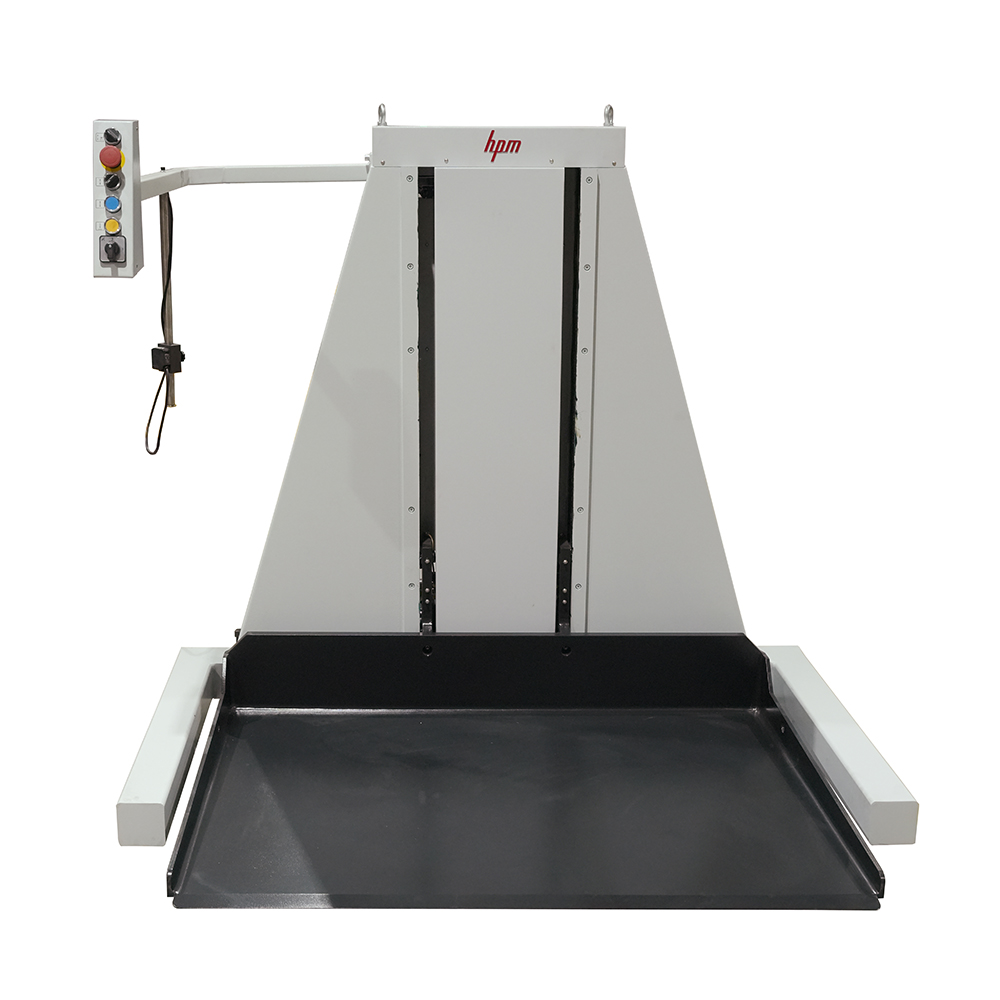
Paper cutting is a constraint-driven purchase: the machine, the handling line and the operating room all affect the result.
Why a paper guillotine specification needs constraints, not slogans
Paper cutters are often compared on headline speed, knife width or screen size. Those details matter, but they do not answer the buyer’s real question: will this hydraulic paper guillotine hold the required size across the paper stocks, pile heights and shift patterns used in my plant?
Three constraint gaps appear repeatedly in early-stage research. First, cutting accuracy and positioning accuracy are sometimes treated as one number. They are separate specifications. A high-precision paper cutting machine may state a cut tolerance and a back-gauge positioning tolerance; each needs its own verification method. Second, CE marking is sometimes read as a product label only. In practice, a certificate has a number, a scope, a model range and an expiry date. Third, the operating envelope is often omitted from the sales discussion. Temperature, humidity, dust and water exposure can decide whether a guillotine cutter is suitable for a given room, even when the machine itself meets the cutting specification.
The opportunity is straightforward. A constraint-led RFQ turns a vague request for a paper cutter into a comparable package: certified model, stated accuracy, control configuration, installation conditions, spare-parts scope and service terms. That package is easier to audit and easier to compare across suppliers.
What HPM specifies for its paper cutting machine range
Zhejiang Huayue Packing Machinery Co., Ltd (HPM) is a China-based manufacturer of paper cutting machines and post-press equipment, founded in 1983 and exporting to nearly 80 countries and regions. The company reports a 40% export ratio and main markets in the EU, USA, Brazil, India and Russia. Its paper cutting machine range covers models 66/92/115/130/137/168/188.
For the paper cutting machine, HPM states a cutting accuracy of 0.1 mm, a positioning accuracy of 0.01 mm and a cutting speed of 46 times per minute. The machine uses a dual hydraulic and turbine system. The machine body is a one-piece HT-250 cast iron casting, and cast iron is the primary material. A 16-inch touchscreen is standard, with optional 19-inch or 22-inch screens. Operating modes include manual, semi-automatic and fully automatic. The paper cutting line is ISO and CE certified. CE certification covers paper cutting machine models 66/92/115/130/137/168/188 and applies to the EU market.
These are specification facts, not a ranking. Their procurement value lies in what they allow a buyer to check. The model range defines the format envelope to discuss. The accuracy figures define the test agenda. The control options define the operator interface. The CE file defines the compliance scope.
Reading the technical parameters correctly
A 0.1 mm cutting accuracy and a 0.01 mm positioning accuracy should be read as two different promises. Cutting accuracy describes the dimensional result of the cut. Positioning accuracy describes the movement and setting of the back gauge. A buyer evaluating a high-precision paper cutting machine should ask how each figure is measured, on which material, and under which operating conditions. A number without a test method is difficult to compare across suppliers.
The cutting speed of 46 times per minute is also a specification that needs context. It should be checked against the actual cutting programme, pile height and handling flow. A fast guillotine cutter can still create a bottleneck if the stack loader, unloader or jogger is not matched to the line. HPM lists stack loader, stack unloader, stack lift, pile turner and jogger as matched equipment for the paper cutting line. That makes the line configuration, not the standalone machine alone, the relevant unit for throughput planning.
The control package is another constraint. A 16-inch touchscreen is standard, and 19-inch or 22-inch screens are optional. For a program control paper cutting machine, the screen size should be confirmed in the order specification, together with the operating mode. A program control paper cutter is intended to store multiple cutting sizes and reduce manual re-setup; a digital-display paper cutter is simpler and cheaper. The choice is not a status decision. It is a fit decision between batch pattern, operator skill and budget.
| Specification point | HPM stated data | Procurement check |
|---|---|---|
| Cutting accuracy | 0.1 mm | Ask for the measurement method and the paper stock used in the demonstration. |
| Positioning accuracy | 0.01 mm | Verify the back-gauge setting and repeatability separately from the cut result. |
| Cutting speed | 46 times per minute | Confirm how speed is defined and how it interacts with pile handling. |
| Machine body | One-piece HT-250 cast iron casting; cast iron as primary material | Check the technical file and the machine plate against the ordered model. |
| Drive configuration | Dual hydraulic and turbine system | Confirm the configuration in the quotation and the maintenance plan. |
| Control | 16-inch touchscreen standard; 19-inch or 22-inch optional | Match the screen size and operating mode to the production team. |
| Operating modes | Manual, semi-automatic and fully automatic | Select the mode that matches the actual workflow, not the brochure headline. |
| Model range | 66/92/115/130/137/168/188 | Confirm the ordered model is inside the CE certificate scope. |
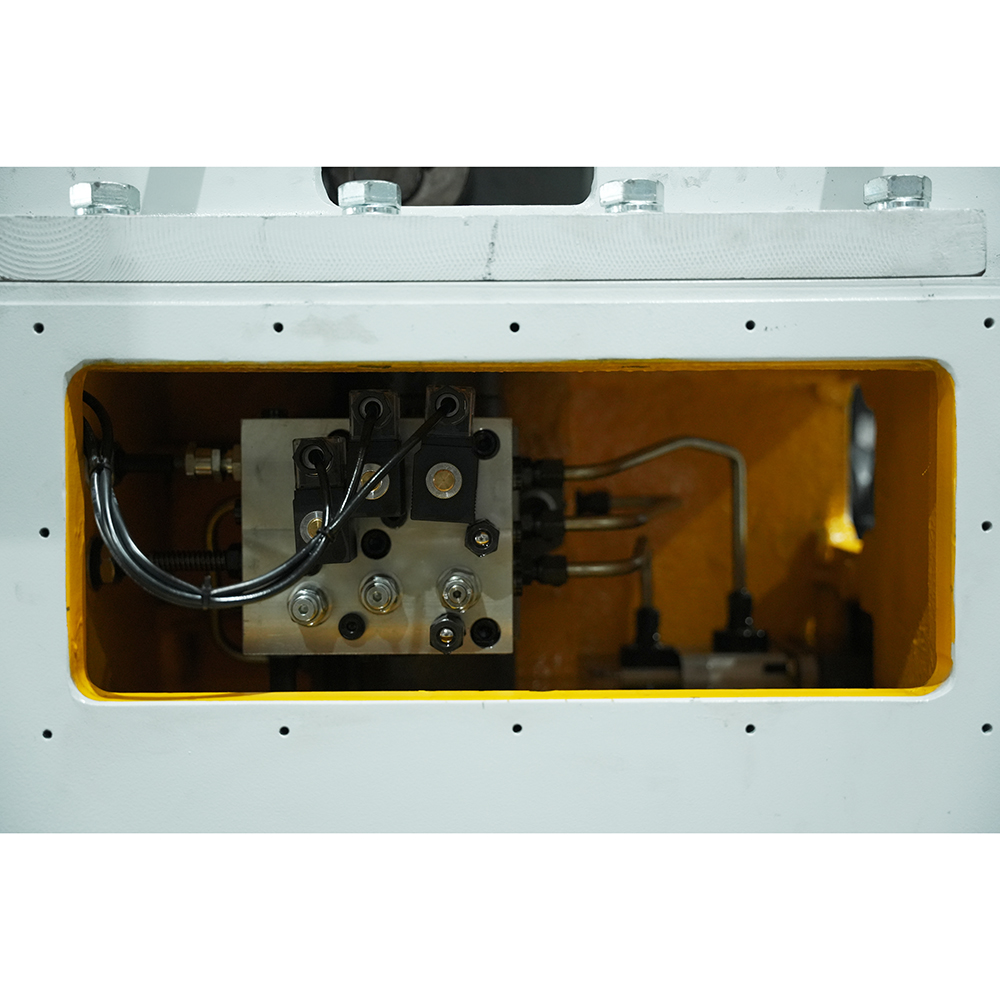
A program control paper cutter adds setup convenience, but the buyer still needs to verify the model, control package and accuracy data.
Certification and compliance: what the CE file actually covers
For an EU-bound paper guillotine, the CE certificate is a procurement document, not a decorative logo. HPM’s CE certificate number is C25.01.22515MLE. The certificate was issued by Shanghai Tebo Testing Technology Co., Ltd. on 20 January 2025 and expires on 20 January 2028. The certificate record lists the EU, US and BR as markets. CE itself is the EU conformity route, so buyers in the US and Brazil should confirm their own local requirements separately.
The certificate scope is a paper cutting system, including the paper cutting machine and related handling equipment, plus a window patching machine. That scope matters. A buyer who purchases a paper cutting line with stack loader, stack unloader, stack lift, pile turner and jogger should check whether the certificate covers the system configuration being ordered, not only the standalone cutter. The certificate covers paper cutting machine models 66/92/115/130/137/168/188. If the ordered model falls outside that list, the compliance file needs separate review.
| CE certificate field | Recorded detail |
|---|---|
| Certificate number | C25.01.22515MLE |
| Issuing authority | Shanghai Tebo Testing Technology Co., Ltd. |
| Issue date | 20 January 2025 |
| Expiry date | 20 January 2028 |
| Scope | Paper cutting system, including paper cutting machine, stack loader, stack unloader, pile turner, stack lift, stack jogger and window patching machine |
| Covered models | 66/92/115/130/137/168/188 |
| Standards listed | EN 1034-1:2021; EN 1034-5:2005+A1:2009; EN ISO 12100:2010; EN 60204-1:2018 |
| Market record | EU, US, BR |
The standards list is useful in an RFQ because it gives the buyer a fixed reference. Instead of asking whether a supplier is CE compliant in general terms, the buyer can ask for the certificate, the model range, the standards listed and the expiry date. That is a more reliable basis for comparing a hydraulic paper cutter from different origins.
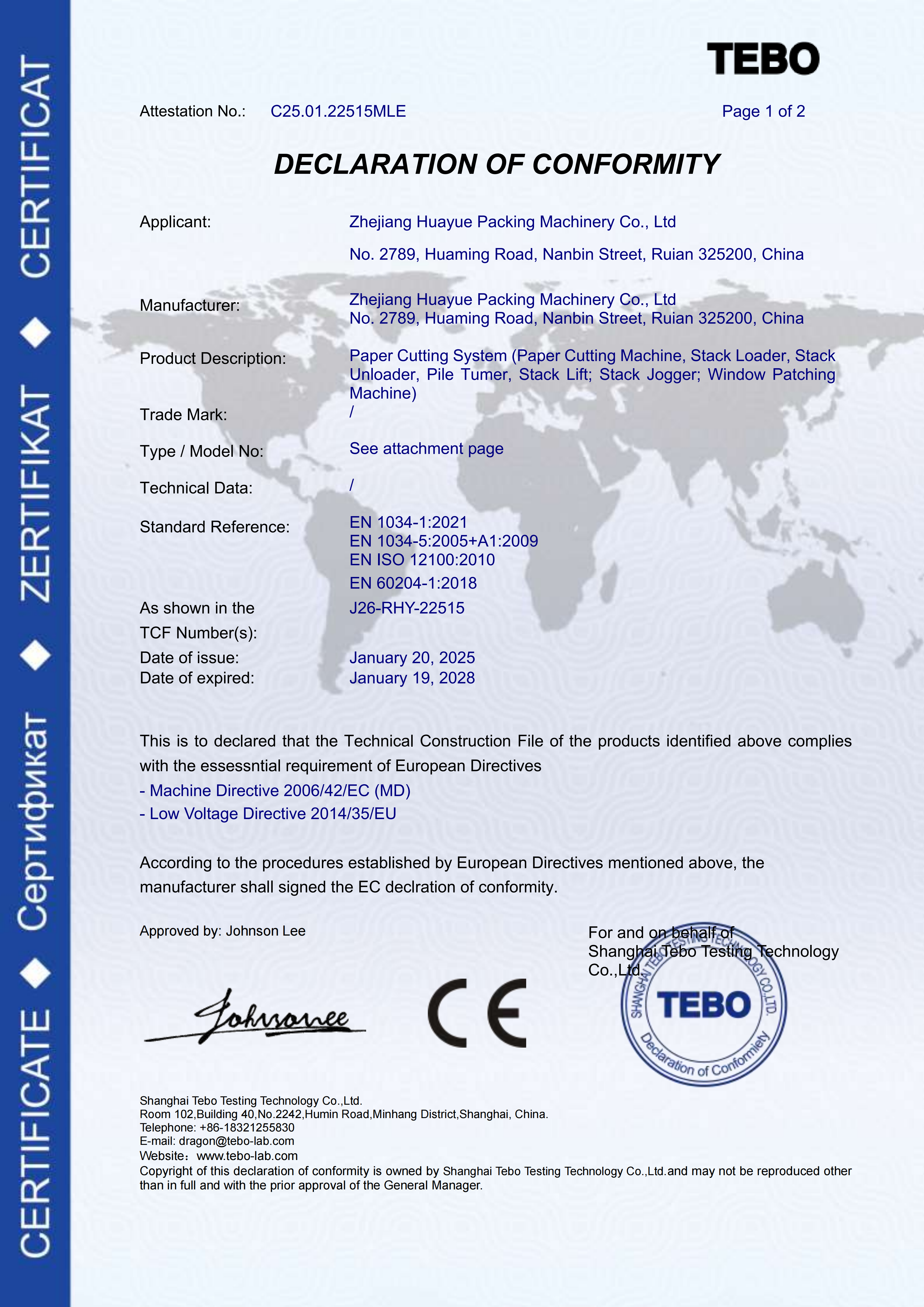
CE certificate C25.01.22515MLE is dated 20 January 2025 and valid to 20 January 2028; the ordered model must sit inside its scope.
Application fit: where the hydraulic paper guillotine earns its place
The application record for the paper cutting line describes a printing-industry installation with a semi-automatic operating mode. The stated function is to improve cutting efficiency and paper utilization while reducing costs. The line is matched with a stack loader, stack unloader, stack lift, pile turner and jogger. That combination is relevant for printers who need to move piles into and out of the cutter without turning every lift into a manual handling task.
A field case from Poland illustrates the evaluation logic. A printing factory purchased three units for commercial cutting and printing. After one year, the reported results were high-efficiency cutting, high-precision cutting, and simple and convenient operation that is easy to learn. The case highlight cites low noise level, high stability, fast cutting speed and a high yield rate. For a buyer, the useful part is not the adjective list. It is the fit between a multi-unit installation, commercial cutting work and a simple-to-operate paper cutter that a production team can learn quickly.
The same record also defines the operating boundary. The paper cutting machine must be operated in an enclosed area. Ambient air temperature must be +5°C to +40°C. Air humidity must be 35% to 90%, with no condensation. Outdoor use is prohibited. The machine must not be exposed to dripping water, splashing water or water mist. Excessive dust conditions must be avoided. These are not optional site notes. They are part of the suitability check for a hydraulic paper guillotine.
RFQ package for a paper guillotine: ordered model; control screen size; operating mode; voltage and customization requirements; CE certificate number and expiry; installation environment; matched handling equipment; spare-parts scope; warranty and overseas support terms.
Market trend: automation, trade and a dated EU compliance milestone
Third-party market estimates for paper cutting machines are not directly comparable, and buyers should treat them as directional. Dataintelo reports a global market value of USD 2.85 billion in 2025, while Statifacts reports USD 1.2 billion in 2025. The difference reflects scope and definition differences rather than a simple disagreement about the same basket. Dataintelo also reports that fully automatic paper cutting machines held a 42.5% share of the global market in 2025. That supports a practical observation: automation is a significant part of the category, but it does not remove the need to verify the model, the certificate and the operating conditions.
Trade data gives another signal. China’s total exports of cutting machines for paper pulp under HS 8441.10 were valued at USD 412.97 million in 2024, according to the World Integrated Trade Solution. HS 8441.10 is the six-digit subheading for cutting machines under the World Customs Organization nomenclature. For buyers, this is a reminder that the paper cutter market is international. A guillotine cutter sourced from one country may compete with European, North American or other Asian supply, so the compliance file and the technical file become part of the comparison.
The EU regulatory timeline adds a dated milestone. Regulation (EU) 2023/1230 on machinery replaces Directive 2006/42/EC and applies from 20 January 2027. Until then, Directive 2006/42/EC remains the applicable EU machinery framework. For an EU-bound paper cutting machine, this is a planning date. It affects the technical file, the declaration and the supplier’s readiness to document conformity under the framework that applies at the time of placing the machine on the market.
Comparison with traditional solutions: where the programmable guillotine stops
Traditional solutions are not obsolete. They serve a different constraint set. A digital-display paper cutter is simpler and cheaper, and it suits workshops with frequently changing specifications and low output. A program control paper cutting machine is recommended for high-volume, consistent production because it stores multiple cutting sizes, reduces manual re-setup and improves paper utilization. The difference is not only technology. It is batch pattern, operator dependence and the cost of changeover.
| Decision criterion | Digital-display paper cutter | Program-controlled hydraulic guillotine |
|---|---|---|
| Best fit | Small batches, limited budget, frequently changing specifications and low output | High-volume, consistent production with repeated cutting sizes |
| Setup logic | Simpler control; more manual re-setup | Stores multiple cutting sizes and reduces manual re-setup |
| Paper utilization | Adequate when the job mix is simple | Improved through stored programmes and repeatable settings |
| Operator learning | Simple and cheaper to start with | Requires training on programme management and control screens |
| Acquisition cost | Lower than a programmable model | Higher than a digital-display model |
The limits are real. A program-controlled hydraulic paper guillotine is not automatically the right purchase for every print shop. HPM’s own guidance recommends the digital-display model for small batches with limited budget. The machine must also be installed indoors within the stated temperature and humidity range, away from dripping water, splashing water, water mist and excessive dust. The CE certificate expires on 20 January 2028 and covers specific models. A buyer who needs a model outside that range, or who plans to operate beyond the stated environment, should treat those as open issues rather than assume the standard package applies.
Future outlook: the procurement file becomes the differentiator
The next phase of paper guillotine procurement will be less about brochure headlines and more about the file behind the machine. That file includes the CE certificate, the standards listed, the covered model range, the expiry date, the operating envelope, the control configuration and the service terms. It also includes the supplier’s ability to document the ordered configuration, not only a catalogue model.
HPM’s data illustrates how a buyer can build that file. The company reports a monthly capacity of 100 units, a lead time of 25 days and a minimum order quantity of 1 unit. Customization options listed are logo, voltage, platform and internal spare parts. Quality control is described as 100% test. The warranty period is one year, with overseas installation and online guidance or support available. Those facts do not replace a factory audit, but they give the buyer specific points to confirm in the quotation and the supply agreement.
As the EU machinery framework moves toward the 20 January 2027 application date, compliance documentation will become a more visible selection criterion. The same will apply to accuracy claims. A buyer who can ask for a model-specific certificate, a stated test method and a site-condition check is in a stronger position than one who compares only the cutting speed. That is the practical meaning of a high-precision paper cutting machine: a machine whose precision claim can be traced, tested and maintained.
FAQ
What should a buyer check in the CE certificate for a paper guillotine?
Check the certificate number, issuing authority, issue date, expiry date, covered models and scope. HPM’s certificate is C25.01.22515MLE, issued by Shanghai Tebo Testing Technology Co., Ltd. on 20 January 2025 and valid to 20 January 2028. It covers paper cutting machine models 66/92/115/130/137/168/188 and a paper cutting system scope.
What is the difference between 0.1 mm cutting accuracy and 0.01 mm positioning accuracy?
Cutting accuracy describes the dimensional result of the cut. Positioning accuracy describes the back-gauge positioning system. HPM states 0.1 mm cutting accuracy and 0.01 mm positioning accuracy for its paper cutting machine. Buyers should ask how each figure is measured and on which material.
Which HPM paper cutting machine models are covered by the CE certificate?
The CE certificate covers paper cutting machine models 66/92/115/130/137/168/188. The certificate applies to the EU market and the paper cutting machine product. A model outside this range should be reviewed separately before purchase.
What operating conditions are required for the paper cutting machine?
The machine must be operated in an enclosed area at +5°C to +40°C and 35% to 90% air humidity with no condensation. Outdoor use is prohibited. The machine must not be exposed to dripping water, splashing water or water mist, and excessive dust conditions must be avoided.
Is a program control paper cutter always better than a digital-display model?
No. A program-controlled paper cutting machine is recommended for high-volume, consistent production because it stores multiple cutting sizes, reduces manual re-setup and improves paper utilization. A digital-display paper cutter is simpler and cheaper, and it suits small batches with limited budget, frequently changing specifications and low output.
What control screen sizes are available on the HPM paper cutting machine?
A 16-inch touchscreen is standard. Optional control panel sizes are 19 inches and 22 inches. The screen size should be confirmed in the order specification together with the operating mode.
For readers who need the full model list and company profile, the HPM brochure is available for download: HPM company brochure (PDF).
Есть вопросы или нужны дополнительные детали?
Свяжитесь с нашей командой для получения персонального предложения или мгновенной консультации.
Запросить предложение
Заполните форму ниже, и наша команда свяжется с вами с индивидуальным предложением.
Прямой чат WhatsApp
Предпочитаете общаться в реальном времени? Напишите нам в WhatsApp для мгновенной помощи и быстрых ответов.
- Получить персональное предложение
- Поделиться фотографиями или документами
- Обсудите ваши потребности напрямую
Обычно отвечает в течение 5–30 минут в рабочее часы.