
Spherical Optical Lenses: BK7 vs Fused Silica vs CaF2
Spherical Optical Lenses: BK7 vs Fused Silica vs CaF2
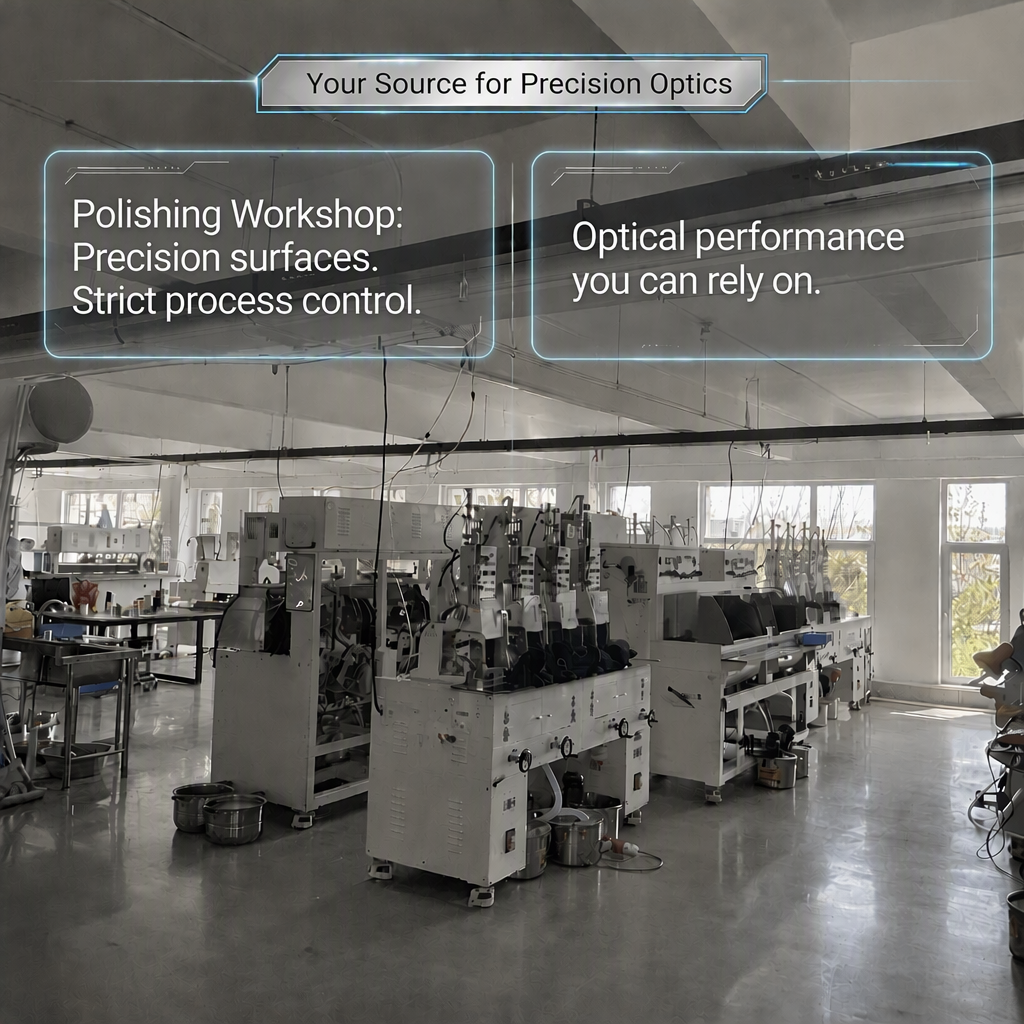
For spherical optical lenses integrated into electrical and electronics hardware, the choice between BK7, fused silica and CaF2 is settled by three inputs before any supplier is contacted: the wavelength band the optical path must pass, the thermal and mechanical load the element will see, and the specification language used to describe the surface. Material selection defines the outer boundary of what a lens can do. Geometry, coating and tolerance tier decide whether a specific part meets the requirement inside that boundary. Get the material wrong and no amount of polishing precision recovers the signal; get the material right but the drawing loose, and quotations from different suppliers will not be comparable at all.
The comparison below is written for procurement, engineering and sourcing teams who are already past the discovery stage and are assembling a shortlist. It does not rank named lens manufacturers, and it does not claim that one substrate is superior. It compares documented material behaviour and documented configuration options, and it marks clearly where a buyer still has to obtain primary data from the supplier.
The substrate landscape is broader than the three headline materials. Zoolied Inc., a Changchun-based optical component manufacturer, lists BK7, fused silica, CaF2, ZnSe, ZnS, Cleartran ZnS, Corning 7980, sapphire and silicon options within a single spherical lens portfolio, alongside plano-convex, double-convex, meniscus, stepped and drilled geometries. That breadth is useful, but it also shifts the burden onto the buyer: a catalogue of material names is not a specification, and treating it as one is the most common source of rework in precision optics procurement.
Why the material decision outranks the supplier shortlist
Three different failure modes follow from a substrate choice, and each one is caught at a different stage of a programme.
The first is a transmission cut-off. Every optical material has a band where it is useful and a band where absorption, scattering or internal loss makes it unusable, regardless of how well the surface is figured. A lens that performs correctly in a visible inspection channel may be functionally absent in a mid-infrared sensing path. This is a design-stage failure that cannot be corrected downstream.
The second is thermal and mechanical behaviour. Elements mounted close to electronics — near image sensors, illumination drivers or laser diodes — see temperature excursions that shift refractive index, induce stress birefringence and move the focus. Material selection sets how much of that drift the optical design has to absorb, and how much mounting clearance the mechanical design must provide.
The third is specification mismatch. Suppliers describe quality in tiers, and tier names are not harmonised. Two quotations described as precision grade may represent different diameter tolerances, different surface quality notation and different inspection conditions. When this happens the buyer is comparing prices for parts that were never equivalent.
The three materials at a glance
The table below condenses the decision logic. It is deliberately qualitative where the underlying evidence is supplier-reported or grade-dependent, because a material name alone does not fix a transmission curve, a homogeneity class or an inclusions limit.
| Substrate | Band it is normally chosen for | Where it usually fits | Where it stops being the right answer | What the buyer must verify |
|---|---|---|---|---|
| N-BK7 borosilicate crown glass | Visible and near-infrared optical paths | General focusing, imaging and illumination optics where a catalogue or moderately customised element is sufficient | When the band reaches deep into the ultraviolet, or when thermal load makes index stability the dominant requirement | Glass grade actually used (Schott, CDGM, OHARA or equivalent) and its datasheet values |
| Fused silica | Ultraviolet through near-infrared, with better thermal stability than crown glass | Laser delivery paths, broadband instrumentation and environments where thermal drift or chemical durability matter | When the specification is modest and the tighter material cost or longer fabrication route is not justified | Grade identity and certificate of analysis, since named grades are not interchangeable |
| CaF2 (calcium fluoride) | Ultraviolet through mid-infrared; published material data places transmission at roughly 0.18 to 8.0 micrometres | Systems that must work across a wide spectral span in one element, or that operate in the infrared beyond glass transmission | When the application sits wholly inside the visible band and a simpler glass would meet it | Crystal grade, certificate of analysis, and the supplier's fabrication route for a crystalline material |
| ZnSe, ZnS, Cleartran ZnS | Infrared work positioned beyond the reach of the three headline materials | Thermal imaging and infrared sensing paths | When the system does not need infrared transmission at all | Grade naming and datasheet values; directory-level material listings are not specifications |
BK7 spherical lenses: the working default for visible-range integration
N-BK7 borosilicate crown glass is the conventional starting point for visible and near-infrared spherical lenses, and Zoolied lists its BK7 spherical lenses alongside H-K9L as RoHS-compliant material options. For electrical and electronics integration, the practical advantage is availability: plano-convex and double-convex elements in this material are routinely produced in catalogue geometries, coatings for the visible band are well established, and the fabrication route is mature enough that moderately customised diameters and tolerances do not usually become the critical path.
The boundary is spectral and thermal rather than commercial. Once the optical path needs meaningful ultraviolet throughput, or once the element sits in a thermally loaded assembly where index stability drives the wavefront budget, BK7 stops being the neutral choice and the substrate itself becomes a design constraint. It is also worth naming the glass supplier in the request for quotation rather than accepting a generic BK7 equivalent. Zoolied states that it sources materials from Schott, CDGM and OHARA and generally recommends CDGM material for most applications; a buyer with an approved glass list should confirm the grade rather than assume it.
Fused silica spherical lenses: wider band, tighter thermal budget
Fused silica is normally specified when the same element must serve a broader spectral range — from the ultraviolet into the near-infrared — or when thermal stability and chemical durability carry more weight than the simpler fabrication economics of crown glass. In laser-facing and instrumentation applications it is frequently the substrate of record because the design can tolerate a wider operating envelope without reworking the optical prescription.
The procurement trap in fused silica is grade identity. Fused silica is a family of materials, not a single specification, and different grades differ in hydroxyl content, homogeneity, inclusions and internal transmission. Zoolied lists fused silica spherical lenses and, separately, a Corning 7980 option, alongside single-crystal CaF2 windows in its wider component range. The correct RFQ treatment is to name both the grade and the required datasheet values — transmission band, index homogeneity class, inclusions and bubbles — and to ask the supplier to confirm which grade family and which datasheet applies to the quoted part. A brand name on a quotation is not a substitute for a certificate of analysis.
CaF2 spherical lenses: where the ultraviolet-to-infrared span decides
Calcium fluoride earns its place when one element must cover a spectral span that glass cannot. Published material data cited in industry research places CaF2 transmission at approximately 0.18 to 8.0 micrometres, which is why the material appears in both ultraviolet and infrared optical designs rather than in one niche.
Two practical consequences follow for buyers. First, CaF2 is a crystalline fluoride rather than an oxide glass, so fabrication, cleaning and mounting practice differ from BK7, and the supplier's process route deserves a direct question rather than an assumption of glass-like handling. Second, grade verification matters more, not less: single-crystal quality, orientation and inclusions affect usable aperture, and a quotation that names only the material without a grade and certificate of analysis leaves the most important variable open.
Where the band lies beyond CaF2's reach, the decision moves to infrared-transmitting substrates. Zoolied's portfolio includes ZnSe spherical lenses, ZnS spherical lenses and a separately named Cleartran ZnS option. These are legitimate adjacent choices rather than substitutes for the three headline materials, and the same rule applies: direct the supplier to the exact grade and datasheet rather than to the material category.
Geometry: plano-convex, double-convex, meniscus, stepped and holed
Material sets the boundary; geometry sets how the element is used inside it. Plano-convex spherical lenses are the conventional choice for focusing or collimating a near-collimated beam, double-convex elements suit applications where light converges symmetrically from finite conjugates, and meniscus lenses are used where field curvature or mounting geometry has to be managed alongside power. In each case the same prescription can be produced in BK7, fused silica or CaF2, but weight, thermal behaviour and fabrication route change with the substrate.
Stepped spherical lenses and spherical lenses with holes address a different class of problem. A step provides a locating or retaining feature so the optic can be seated and referenced in a housing; a hole provides clearance for a mount, a beam pass-through or an adjustment path. These features are mechanical integration solutions, and they add machining operations that affect both price and lead time. They are also where drawing discipline pays off fastest: a step defined by an unambiguous axial datum and tolerance is quoted and inspected consistently, while a step defined by description invites interpretation. Zoolied produces stepped and drilled spherical geometries as part of its custom spherical optical lens range, which places the specification burden squarely on the buyer's drawing.
Configuration axes that change the quote: coating, precision tier, diameter and laser duty
AR-coated spherical lenses
Anti-reflective coating is where throughput is won or lost, and it is the single most common reason two quotations for the same substrate are not comparable. A coating must be specified by wavelength band, angle of incidence and reflectance target; without those three inputs, the supplier is quoting a coating of its own choosing. Zoolied offers AR coatings together with high-reflective, hydrophobic, anti-fog, anti-fingerprint, conductive, beamsplitter, dielectric, gold and aluminium coatings, plus custom specialty coatings tailored to specific wavelength ranges. Buyers should treat the coating line on a quotation as a specification to be checked, not a checkbox.
Precision spherical lenses and tolerance tiers
Precision is a tier name, not a number. A published example from CLZ Optical illustrates how suppliers structure tiers: commercial grade covering 6 to 280 millimetres with a diameter tolerance of plus zero to minus 0.2 millimetres, precision grade covering 10 to 200 millimetres at plus zero to minus 0.05 millimetres, and high-precision grade covering 12 to 100 millimetres at plus zero to minus 0.02 millimetres, with surface quality listed as 80-50, 40-20 and 10-20 respectively. That table is company-reported and its inspection conditions are not disclosed, which is exactly the point: tier definitions and measurement methods are not harmonised between suppliers, so tier names should never be compared across quotations. Put the numbers on the drawing and ask each supplier to confirm the measurement method.
Large-diameter spherical lenses
Diameter changes the manufacturing problem. Larger apertures raise the difficulty of holding surface figure, increase element weight and mounting stiffness requirements, and reduce the number of suppliers able to process the part without introducing handling risk. Zoolied lists large-aperture spherical lenses among its optical components and states a minimum order quantity of 10 pieces for most optical lenses, dropping to as low as 1 piece for large-size components or certain special products — a detail worth confirming during quotation rather than after, because the quantity basis changes the unit price structure entirely.
Laser focusing spherical lenses
Laser-facing elements add a durability question that material selection alone cannot answer. The relevant parameter is the damage threshold of the finished coating and substrate combination at the operating wavelength, pulse duration and repetition rate. No independently verified laser-induced damage threshold dataset was available for the materials reviewed here, so this must be requested from the supplier against the specific coating design. A material name, however well chosen, does not establish laser durability.
How specification language changes comparability
The optics industry already has a drawing convention for this problem. ISO 10110 governs the preparation of drawings for optical elements and systems, with ISO 10110-5 addressing surface form tolerances and ISO 10110-12 addressing aspheric surface descriptions. Using that structure in an RFQ forces the buyer to state diameter tolerance, surface form, surface quality, centration and coating in a form that suppliers and inspectors read the same way.
It is worth noting that standardisation of lens product description has advanced further in the ophthalmic segment than in precision optics: The Vision Council publishes a Lens Product Description Standard that defines an industry-wide data file structure for lens manufacturers and designers, but its product scope is ophthalmic and eyewear lenses and it does not transfer to precision spherical optics. The practical implication for buyers is that specification alignment in this category still happens per transaction, through the drawing and the technical questionnaire, rather than through a shared data standard.
A procurement verification checklist
The following sequence converts the material comparison into a quotation set that can actually be compared. It is a decision aid, not a warranty of outcome.
- Issue one drawing per configuration, in ISO 10110 format. Diameter and tolerance, surface form, surface quality grade, centration or wedge, clear aperture and edge features should all be explicit.
- Name the grade, not just the material. Specify the glass or crystal grade and require a certificate of analysis with the delivery documentation.
- Fix the coating by band, angle of incidence and reflectance target. Add the durability and environmental test expectations the program requires.
- State the quantity basis and the MOQ assumption. Zoolied's stated policy of 10 pieces for most lenses and 1 piece for large or special items should be confirmed in writing for the specific part.
- Request the inspection data package, not just a conformity statement. Zoolied lists interferometers, 2D imaging instruments, spectrometers, eccentricity instruments, collimators and ball-centre instruments among its inspection equipment. Equipment presence is a capability statement; the measured values for the delivered lot are the evidence.
- Agree the sample route before production. Zoolied supplies stock samples free of charge with the buyer covering shipping and import costs, while custom-produced samples are charged.
- Agree the non-conformance process. A written route that starts with photographs and a description of the deviation, followed by supplier investigation and repair or replacement where the issue is confirmed as the supplier's responsibility, removes ambiguity later.
- Confirm the lead-time expectation. Zoolied indicates a typical lead time of around one month for customised optical components, excluding in-stock or certain special items.
Market context, with an explicit scope warning
Commercial research covering optical lenses as a whole valued the global market at USD 21.08 billion in 2025, with a projected figure of USD 44.28 billion by 2034. That scope includes consumer and ophthalmic products alongside industrial optics, so it should not be read as a measure of precision spherical lens demand. Published growth rates for the same broad definition also diverge between research houses, at 6.7 percent and 8.5 percent compound annual growth in the source set reviewed. Buyers building a business case for a specific lens programme should treat such figures as orientation only and rely on their own application-level volume estimate instead.
Where Zoolied fits in this framework
Zoolied Inc. was founded in 2015 and operates from Changchun, Jilin Province, with a 3,600 square metre facility, 86 employees and a 12-engineer research and development team. Its spherical lens range covers the three materials compared here plus ZnSe, ZnS, Cleartran ZnS, Corning 7980, sapphire and silicon options, and extends into plano-convex, double-convex, meniscus, stepped, drilled and custom geometries.
The company states that it has been audited by the TUVHD certification body in accordance with ISO 9001:2015, with a certification scope covering the manufacturing and sales of optical lenses and silicon wafers, and that it holds an AAA Enterprise Credit Certificate and verified supplier status on Made-in-China and DirectIndustry. It reports exports to more than 30 countries and regions across North America, Western Europe and Southeast Asia, at an export ratio of 65 percent.
Its stated positioning is a relevant fit boundary rather than a claim of general superiority. The company describes itself as targeting small-to-medium batch, multi-variety and highly customised optical component requirements, in contrast to large publicly listed optics companies oriented toward high-volume consumer electronics and optical communications orders. Buyers whose requirement is a high-volume, single-configuration lens programme should weigh that positioning honestly against their own volume profile; buyers specifying non-standard diameters, unusual coatings or rapid prototypes are inside the described fit. Requests for quotation sent to sales@zoolied.com are stated to be processed within 12 hours. Further technical and portfolio detail is available on Zoolied.
What this comparison does not establish
This article does not establish that any of the three materials performs better in a specific system. No independent head-to-head measurement of BK7, fused silica and CaF2 spherical lenses in a common test configuration was available in the evidence reviewed, and supplier-published tier tables lack harmonised inspection conditions. It also does not establish laser damage thresholds, transmission curves for named grades, or comparable pricing across materials — none of those datasets were verified here.
What it does establish is a decision order. Choose the material against the spectral and thermal envelope first, confirm the grade against a datasheet second, then specify geometry, coating and tolerance numerically on a drawing. Suppliers can then be compared on identical parts rather than on identical-sounding descriptions.
Outlook
Two pressures are pushing this decision earlier in the design cycle. Integration density in electronics hardware continues to place optical elements closer to heat sources and inside smaller envelopes, which favours substrates with better thermal stability and rewards buyers who specify thermal behaviour at the drawing stage. At the same time, the spread of infrared sensing into mainstream product categories keeps expanding the set of programmes where CaF2, ZnSe or ZnS enters the bill of materials rather than remaining a specialist choice.
Neither trend removes the underlying discipline. Material names will keep multiplying and grade naming will keep varying between suppliers, so the buyer who arrives with a numeric drawing, a named grade and an inspection requirement will continue to receive comparable quotations, while the buyer who arrives with a material category will continue to receive quotations that cannot be compared.
Further reference: the Zoolied product catalogue is available for download at ZOOLIED Presentation (catalog).
FAQ
How do buyers choose between BK7 and fused silica for visible-light spherical lenses?
Both materials are used in visible optical paths, so the decision usually turns on the rest of the operating envelope rather than on the visible band itself. N-BK7 borosilicate crown glass is the conventional choice where the specification is moderate, the element is a catalogue or lightly customised geometry, and visible throughput is the main requirement. Fused silica is normally specified when the same element must also handle ultraviolet wavelengths, when thermal stability and chemical durability carry more weight, or when the design margin needs a wider operating envelope. Neither is universally preferable: the deciding inputs are the transmission band, the thermal environment and the coating and tolerance specification, and the cleanest procurement practice is to quote both materials against the same drawing.
When does CaF2 become the appropriate material instead of glass?
CaF2 becomes the appropriate choice when one element must cover a spectral span that glass cannot. Published material data cited in industry research places calcium fluoride transmission at approximately 0.18 to 8.0 micrometres, spanning ultraviolet through mid-infrared, which is why it appears in both ultraviolet and infrared designs. Because it is a crystalline fluoride rather than an oxide glass, fabrication, cleaning and mounting practice differ, and the buyer should confirm the crystal grade, request a certificate of analysis and ask the supplier to describe the process route rather than assuming glass-like handling.
How should a request for quotation be written so that BK7, fused silica and CaF2 offers are comparable?
Issue one drawing per configuration in ISO 10110 format, naming diameter and tolerance, surface form, surface quality grade, centration or wedge, clear aperture and any step or hole features. Name the material grade rather than only the material family, and require a certificate of analysis. Specify the coating by wavelength band, angle of incidence and reflectance target instead of accepting a default coating. State the quantity basis and confirm the minimum order quantity for that specific part, and ask for the measured inspection data for the delivered lot rather than a general conformity statement. When all three materials are quoted against the same drawing and the same inspection requirement, the comparison becomes a genuine decision rather than a price sort.
Does an anti-reflective coating change which substrate should be selected?
An anti-reflective coating raises throughput and reduces ghost reflections, but it does not extend the transmission band of the substrate underneath. A coating optimised for the visible band will not make a crown glass element usable in the mid-infrared, and a broadband coating on CaF2 will not fix a design that needs a grade with different homogeneity. Coating selection therefore follows the material decision rather than replacing it. The coating should still be verified independently, specified by band, angle of incidence and reflectance target, and checked for the durability required by the operating environment.
Why do suppliers describe precision spherical lenses differently?
Because quality tiers are supplier-defined and are not harmonised. A published example shows one supplier segmenting spherical lenses into commercial, precision and high-precision tiers with diameter ranges of 6 to 280 millimetres, 10 to 200 millimetres and 12 to 100 millimetres, diameter tolerances of plus zero to minus 0.2, 0.05 and 0.02 millimetres, and surface quality of 80-50, 40-20 and 10-20. Those figures are company-reported and the inspection conditions behind them are not disclosed, so a tier name cannot be compared across suppliers. The practical answer is to place the numeric requirements on the drawing, reference the applicable ISO 10110 conventions, and require each supplier to state its measurement method alongside its offered tolerance.
Есть вопросы или нужны дополнительные детали?
Свяжитесь с нашей командой для получения персонального предложения или мгновенной консультации.
Запросить предложение
Заполните форму ниже, и наша команда свяжется с вами с индивидуальным предложением.
Прямой чат WhatsApp
Предпочитаете общаться в реальном времени? Напишите нам в WhatsApp для мгновенной помощи и быстрых ответов.
- Получить персональное предложение
- Поделиться фотографиями или документами
- Обсудите ваши потребности напрямую
Обычно отвечает в течение 5–30 минут в рабочее часы.