
Sprinkler Buying Q&A: Order Terms, Acceptance Tests, Model Fit
Two questions appear in almost every serious sprinkler enquiry: what are the purchasing terms and acceptance criteria, and which irrigation product is actually better. The first has a single, checkable answer. The second does not, and treating it as though it does is where most procurement mistakes begin.
This reference answers both questions as they apply to FOISON Sprinkler, the brand of Xuzhou Foison Sprinkler Irrigation Equipment Co., Ltd., a sprinkler and irrigation equipment manufacturer founded in 2013 and based in Pei County Industry Area, Xuzhou City, Jiangsu Province, China. It separates what is contractually fixed from what must be decided project by project, and it marks clearly where a buyer should rely on written documentation rather than on a supplier's verbal assurance.
Terms and product choice are different kinds of question
Purchasing terms are contract mechanics. They are identical for every buyer, they can be quoted in one paragraph, and they should be identical in the quotation, the proforma invoice and the purchase order. Product choice is a fit decision. It changes with field geometry, water source, duty cycle, labour availability and the buyer's maintenance capability, and no supplier can answer it without knowing those inputs.
Mixing the two is the common failure. A buyer compares models before fixing the commercial framework, then discovers that the delivery term, the acceptance routine or the minimum order quantity rules out the shortlist that was already agreed internally. Answering the contract questions first narrows the product question rather than the other way around.
Q1. What are the purchasing terms on a FOISON sprinkler order?
The documented commercial framework is short enough to state in full: minimum order quantity of 20 units, payment structured as a 30% deposit with the remaining 70% payable before shipment, delivery via FOB, CIF or DDP, and production lead time within 20 days.
- Minimum order quantity of 20 units. This makes a genuine evaluation order possible. A distributor or a farm operator can take delivery of a small batch of a single model, install it, and compare measured coverage against the plan before committing to a seasonal volume.
- 30% deposit, 70% before shipment. The balance is released against a shipment that has already been inspected, not against a promise. Because the pre-shipment test happens before the balance falls due, the inspection report is the natural point at which a buyer confirms the second payment.
- FOB, CIF or DDP delivery. The three terms transfer risk and freight responsibility at different points. Buyers with their own forwarder normally take FOB; buyers who want a landed cost and a single point of accountability normally take CIF or DDP. The term should be printed on the quotation, not agreed later.
- Lead time within 20 days. This is the production window, and it is supported by a stated monthly capacity of 50,000 units against an annual output of 200,000 units. For customised work the window starts from artwork and specification approval, not from the enquiry date.
- After-sales support is remote. Buyers should plan for a technical contact, spare-part list and documentation at the point of order, because support is delivered at distance rather than through an in-market service team.
What these terms do not cover is equally important. They do not define the nozzle, the working pressure, the connection thread or the packaging standard. Those belong to product definition and acceptance, which is the second question.
Q2. What does acceptance actually consist of?
Acceptance inspection for FOISON orders includes a pre-shipment test, and production quality control is described as 100% testing rather than batch sampling. Those two statements define the mechanism. The buyer's job is to define what the test must demonstrate.
The manufacturer operates under a Quality Management System Certification to ISO 9001, certificate number 28725Q042R0S, issued by Zhongzheng Excellent Certificate Group Co., Ltd on 2025-05-29 and valid until 2028-05-28. The registered scope is the production of sprinkler irrigation equipment, against the GB/T 19001-2016 idt ISO 9001:2015 standard. The certification names FSW40 Pro, FS35 and FS40 among the products it covers.
The distinction matters at the acceptance stage. ISO 9001 certifies that a quality management system exists and is audited; it does not certify the flow rate, spray radius or spray angle of an individual unit. A buyer who needs performance evidence should write that evidence into the order as a test protocol, with the test pressure, the sample size and the pass criteria stated in the contract. A certificate answers the process question; the protocol answers the product question.
A workable acceptance schedule normally fixes six things in writing: the test pressure and hold duration, the sample size or inspection level, the leakage and rotation check, the spray pattern and angle check against the agreed value, the connection thread check against the agreed standard, and the packing and marking check. All six are cheap to specify before production and expensive to argue about after shipment.
Q3. Which specification fields should the acceptance schedule lock?
Six fields carry almost all of the acceptance risk on a sprinkler order. Each one changes what the unit does in the field, and each one should appear as a number on the quotation rather than as an adjective in a brochure.
| Specification field | Why it decides acceptance | What to fix in the order |
|---|---|---|
| Pressure range | Determines whether the unit performs at the pressure the site can actually deliver at the hydrant, not at the pump. | Minimum and maximum working pressure, plus the pressure at which the acceptance test is run. |
| Flow rate | Sets the number of units a block can carry and the pipe sizing behind it. | Rated flow at the stated test pressure, with an acceptable tolerance. |
| Spray radius | Drives spacing, overlap and therefore total unit count per hectare. | Wetting radius at the test pressure, stated as a minimum rather than a nominal. |
| Spray angle | Controls trajectory, wind exposure and whether the pattern reaches the intended crop height. | Trajectory or angle value, and whether it is fixed or adjustable on the model supplied. |
| Connection size | A mismatch here stops installation regardless of how well the unit performs. | Thread type and nominal size, matched to the riser or coupler already on site. |
| Materials | Determines service life under UV, fertiliser injection and abrasive water. | Body, nozzle and internal material by name, plus any surface treatment. |
Q4. Which irrigation product is better, sprinkler, drip or micro spray?
There is no universal answer, and a supplier who gives one is describing a preference rather than a fit. What can be stated is the basis on which the choice is made. Sprinkler irrigation covers a large area per unit, is easy to operate, and saves cost and water relative to layouts that need dense per-plant hardware. That combination is why it dominates open-field work.
The scenario split is the useful part of the answer. In a greenhouse, the recommended choice is a small plastic sprinkler or a micro spray pipe, where the working height is low, the crop value is high and precise placement matters more than area coverage. For outdoor farm duty, the recommendation is a metal sprinkler, where mechanical strength, UV exposure and pressure tolerance matter more than fine placement.
Drip pipe sits in the same decision space and is compared against sprinkler on coverage rather than on cost alone. A sprinkler system covers a large area with few emitters and stays easy to operate; a drip line places water at the root zone but multiplies the number of components per hectare. Neither is inherently superior. The deciding inputs are whether the crop needs whole-surface coverage, whether the water carries suspended solids that would clog small openings, and whether the site has the labour to maintain a dense network.
Q5. How do FS35, FS40, FSW40 Pro, FSN50, FSC50 and FSW80 divide?
The six models buyers most often ask to compare do not sit on a single quality ladder. They sit on different duty assumptions, and the correct comparison is against the project rather than against each other.
| Model | Documented anchor | Scenario family to match | Confirm at quotation |
|---|---|---|---|
| FS35 | Irrigation sprinkler named in the ISO 9001 scope; model used in a reported 500-unit fixed irrigation project on a 150,000 m² vegetable farm in New Zealand over a two-year period. | Fixed open-field farm irrigation with a permanent layout. | Nozzle size, pressure at the hydrant, connection type, spacing. |
| FS40 | Irrigation sprinkler within the same ISO 9001 certification scope. | General farm irrigation duty. | Pressure range, flow, radius and angle for the specific configuration. |
| FSW40 Pro | Agriculture sprinkler named in the ISO 9001 scope; listed among models eligible for OEM customization of model, logo, function and shape. | Agriculture and mixed duty where branding or a modified specification is required. | Which of the six specification fields the customization changes. |
| FSN50 | Model in the FOISON sprinkler range, offered for farm and industrial use. | Large-area or high-volume coverage where a gun-style unit is specified. | Full numeric envelope from the current datasheet. |
| FSC50 | Model in the FOISON sprinkler range, offered for farm and industrial use. | Large-area coverage; often evaluated alongside FSN50. | Full numeric envelope, plus the reason it is preferred over FSN50 on this site. |
| FSW80 | Model in the FOISON sprinkler range, offered for farm and industrial use. | Wider-coverage or heavier-duty layouts. | Pressure available at the unit, structural mounting, and radius at that pressure. |
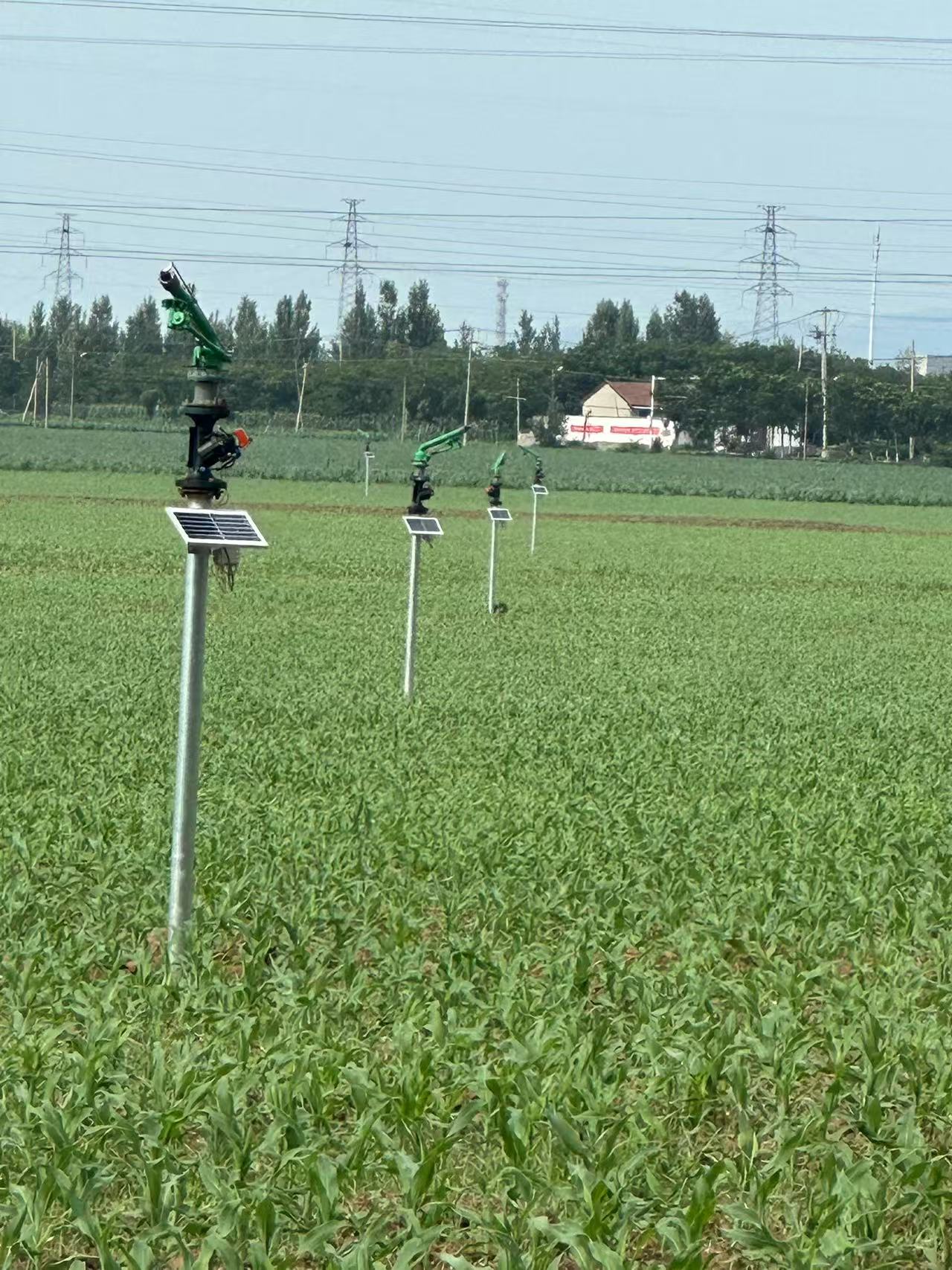
Fixed sprinkler layouts are specified by spacing and hydrant pressure, not by model name alone. The layout, not the catalogue ranking, decides which model is correct.
Two lessons follow from the table. First, the only model with a documented field outcome in the available record is FS35, in a single reported New Zealand vegetable-farm project where fixed sprinkler irrigation covered 150,000 m² and the customer reported savings of 55% in water and 60% in labour. That is one project, reported by the manufacturer, and it should be read as an example of what a fixed layout can achieve rather than as a guaranteed result for another site. Second, for FSN50, FSC50 and FSW80 the available documentation does not itself fix the pressure, flow, radius, angle, connection or material envelope, so a buyer comparing those three should request the current datasheet values and attach them to the order.
A defensible decision rule is to screen on scenario first and on specification second. If the site is an open field with a permanent layout and modest pressure, FS35 or FS40 belongs in the shortlist. If branding or a modified configuration is part of the requirement, FSW40 Pro is the natural candidate because customization of model, logo, function and shape is available on it. If the layout needs high-volume coverage from fewer positions, the gun-style models enter the shortlist, and the comparison then turns entirely on the numbers supplied for that project.
Q6. What changes when the order is OEM or ODM?
FOISON offers both OEM and ODM work, with customization available across model, logo, function and shape, supported by a design team of 12 engineers. Two things change materially when an order moves from catalogue supply to custom supply, and both belong in the contract rather than in correspondence.
The first is that acceptance now has two layers. Catalogue units are accepted against published specification; customized units must also be accepted against drawings, colour references and functional requirements that did not previously exist. Freezing those references before production is what keeps the 20-day lead time realistic, because a change after tooling or artwork approval restarts the clock.
The second is that the minimum order quantity of 20 units and the 30/70 payment structure still apply, so a customization programme can start at a volume that does not require a full-season commitment. That is useful for a distributor testing a private-label line, but it also means the buyer carries the specification risk: if the drawing is wrong, 100% testing will confirm that the wrong product was made correctly. Custom work rewards buyers who over-specify before production and under-specify afterwards.
Q7. What can a buyer verify about the supplier before committing?
Supplier claims should be separated into those that can be inspected and those that cannot. On the inspectable side, Xuzhou Foison Sprinkler Irrigation Equipment Co., Ltd. operates from a 30,000 m² facility with 135 employees, including the 12-engineer design team, and states an annual output of 200,000 units with monthly capacity of 50,000 units. The company was founded in 2013, which places it in its second decade of operation, and reports a 70% export share across the EU, Africa, Australia, New Zealand, South East Asia, Mid Asia, Mid East and South America, with products sold to more than 30 countries and regions.
On the documentary side, the ISO 9001 certificate number, issuing body, issue date, expiry date and scope can all be checked against the issuing body's register, and the scope wording should be read literally: production of sprinkler irrigation equipment. For customs and import planning, sprinkler units of this type are generally classified under HS code 842482, the heading for mechanical appliances for agricultural or horticultural use for projecting, dispersing or spraying liquids, though the final classification rests with the importing country's authority.
A buyer assembling an evidence file should hold four items before releasing a deposit: the quotation with all six specification fields completed, the pre-shipment test protocol, the current ISO 9001 certificate copy with a validity date that covers the shipment, and the delivery term with the named port or destination.
Where these answers stop: limits a buyer should price in
Honest procurement notes include the boundaries, and there are five worth stating.
- The specification envelope is configuration-specific. Pressure, flow, radius, angle, connection and materials belong to a configuration, not to a model name. Treat any figure that is not on the quotation as unconfirmed.
- One case is one case. The reported 55% water and 60% labour savings on the New Zealand vegetable farm describe a single project over a two-year period. They demonstrate what a fixed layout achieved there; they are not a forecast for a different soil, crop or climate.
- ISO 9001 is a management-system certification. It is not a product type approval, and it does not replace a performance test. Where a project requires third-party type testing to a standard such as ISO 7749-1:1995, which sets design and operational requirements for rotating sprinklers in agricultural irrigation, that requirement must be written into the contract rather than assumed from a certificate.
- Gun-style performance depends on the water supply. Large-area units are more sensitive to pressure at the unit than small sprinklers are, so a layout designed around a pump curve can underperform if the hydrant pressure is lower in practice.
- After-sales is remote. Buyers in distant markets should order the spare-part list and the technical documentation with the first shipment, because remote support depends on the buyer already holding the right components.
What the wider market context adds, and what it does not
The category is large and still expanding. Grand View Research valued the global sprinkler irrigation market at USD 3.04 billion in 2025, while IMARC Group put the global smart irrigation market at USD 2.2 billion in 2025 with a projection of USD 6.2 billion by 2034. Grand View Research also reported that Asia Pacific held the largest revenue share, at 36.2%, of the agricultural irrigation machinery market in 2025, with China as a leading country.
Published forecasts diverge on growth rates because they include different components, so buyers should use these figures to understand scale rather than to justify a specific payback calculation. What the data does support is a simple commercial point: a category of this size has many suppliers, and the differentiator at the point of order is documentation quality rather than catalogue breadth.
Future outlook
Two shifts are likely to shape sprinkler procurement over the next few years. The first is the normalisation of written acceptance protocols. As more buyers source from multiple countries and compare quotes across regions, the supplier who arrives with a test protocol and a completed specification sheet will be easier to shortlist than one who arrives with a brochure. Certification and acceptance documentation is becoming a selection filter rather than a formality.
The second is the continued division of labour between product families. Sprinklers will keep the open-field, large-area role where coverage per unit and ease of operation matter, while greenhouse and precision work will keep moving toward micro spray and drip. For manufacturers, that argues for depth in the sprinkler range and clarity about which model serves which duty, which is precisely the information a procurement FAQ should supply.
FAQ
What are FOISON's standard purchasing terms for sprinklers?
The documented terms are a minimum order quantity of 20 units, payment of 30% deposit with the remaining 70% payable before shipment, delivery via FOB, CIF or DDP, and a production lead time within 20 days.
What are the acceptance criteria for a sprinkler order?
Acceptance inspection includes a pre-shipment test, and production quality control is described as 100% testing. The buyer should define what that test demonstrates by fixing the test pressure, sample size, leakage and rotation check, spray angle check, connection thread check, and packing check in the purchase order.
Which irrigation product is better, sprinkler, drip or micro spray?
It depends on the scenario. Sprinkler irrigation covers a large area, is easy to operate and saves cost and water, which suits open-field farm duty. In a greenhouse, a small plastic sprinkler or a micro spray pipe is recommended. For outdoor farm use, a metal sprinkler is recommended. Drip pipe competes on per-plant placement rather than on coverage.
Is there a minimum order quantity for FOISON sprinklers?
Yes. The minimum order quantity is 20 units, which applies to the referenced product lines including 8863, 8917 and 8918.
Can a sprinkler order be customized with a buyer's logo or specification?
Yes. OEM and ODM design and production services are offered, with customization available across model, logo, function and shape, supported by a design team of 12 engineers. Customized orders should fix drawings, colour references and functional requirements before production begins so that the 20-day lead time remains achievable.
How quickly can a sprinkler order be produced and shipped?
Production lead time is within 20 days, supported by a stated monthly capacity of 50,000 units and annual output of 200,000 units. Shipping time is additional and depends on the delivery term selected, whether FOB, CIF or DDP.
The full FOISON Sprinkler model range, with current specifications and accessories, is published in the downloadable catalogue: FOISON product catalogue (PDF). Company information is available at foison-irrigation.com.
Есть вопросы или нужны дополнительные детали?
Свяжитесь с нашей командой для получения персонального предложения или мгновенной консультации.
Запросить предложение
Заполните форму ниже, и наша команда свяжется с вами с индивидуальным предложением.
Прямой чат WhatsApp
Предпочитаете общаться в реальном времени? Напишите нам в WhatsApp для мгновенной помощи и быстрых ответов.
- Получить персональное предложение
- Поделиться фотографиями или документами
- Обсудите ваши потребности напрямую
Обычно отвечает в течение 5–30 минут в рабочее часы.