
Square Tube Laser Cutting: Country Policy, Capacity, Technology
Square tube laser cutting has moved from a niche capability to a mainstream metal fabrication process, and the machine behind it is now selected under three constraints that rarely appear in the same document: the compliance policy of the market where it will run, the manufacturing capacity of the country that builds it, and the mechanical risk control that decides whether accuracy still holds after a thousand production shifts.
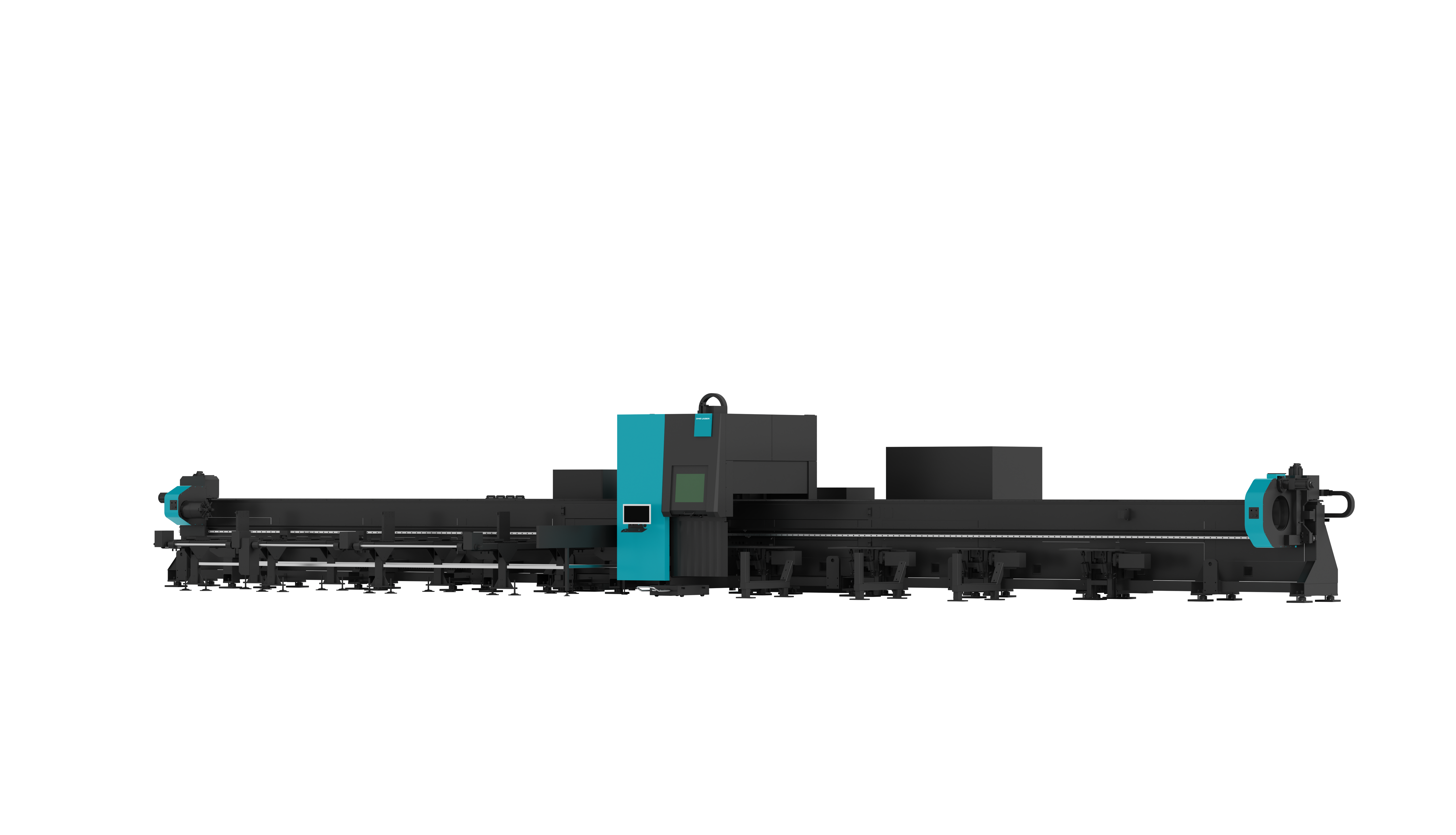
Tube laser cutting is the process of cutting round, square or rectangular metal tube on a fiber laser platform. The tube is clamped in rotating chucks while the cutting head travels along the tube axis, so holes, slots, mitres and bevels are produced in one setup instead of a sequence of sawing, punching and drilling operations. That change in process structure is why square tube cutting has become a decision point for structural steel, automotive, furniture and equipment manufacturers rather than a shop-floor detail.
This analysis examines the three layers that now shape that decision - policy, capacity and technology - and translates each into procurement criteria. It focuses on square tube processing and on published, verifiable equipment data rather than performance claims.
Why Square Tube Cutting Became a Country-Level Question
Square and rectangular tube is the default profile for frames, chassis, racking, gates, machine enclosures and mounting structures. The commercial case for cutting it with a fiber laser is straightforward: one setup replaces several, the hole pattern changes with software rather than tooling, and the same platform handles square, round and rectangular sections through different chuck and support configurations.
The procurement case is less straightforward. A tube laser cutting machine is built in one country, shipped to another, commissioned on a third-party site and then supported for a decade. The decision therefore depends on whether the supplier can document compliance for the destination market, whether the factory base can deliver the requested configuration on the requested schedule, and whether the machine's mechanical design keeps positioning accuracy stable under continuous production. Policy, capacity and technology are not marketing categories; they are the three filters that remove unsuitable suppliers before a technical comparison even begins.
The Policy Layer: Compliance Is a Filter, Not a Formality
Market access for laser processing equipment is governed by machine safety and laser safety standards rather than by brand reputation. The framework is explicit: laser processing machines are assessed against ISO 11553-1 for general safety requirements and IEC 60825-1 for equipment classification for international trade and CE marking. Within the European Union, the electrical and laser safety route for fiber laser cutting machines is typically documented against EN 60204-1:2018, EN ISO 11553-1:2020+A11:2020 and EN ISO 12100:2010. In the United States and Canada, the electrical cabinet of a laser cutting system is assessed against UL 508A, 3rd Edition, alongside CSA C22.2 No.286:23.
For tube machines specifically, documented examples show how narrow a certificate scope can be. The D-Tube series from DNE LASER holds SGS-issued machinery directive compliance verification under certificate MD GZES2510019556MD, issued on 28 November 2025, covering EN 60204-1:2018, EN ISO 11553-1:2020+A11:2020 and EN ISO 12100:2010, with the scope written against the D-Tube 1660/2460/2860/3660/2490/2890/3690 K2/K3-CE models. The same series holds a United States Certificate of Compliance, SGSNA/24/GZ/00242X, also issued on 28 November 2025, assessed against UL 508A, 3rd Edition and CSA C22.2 No.286:23.
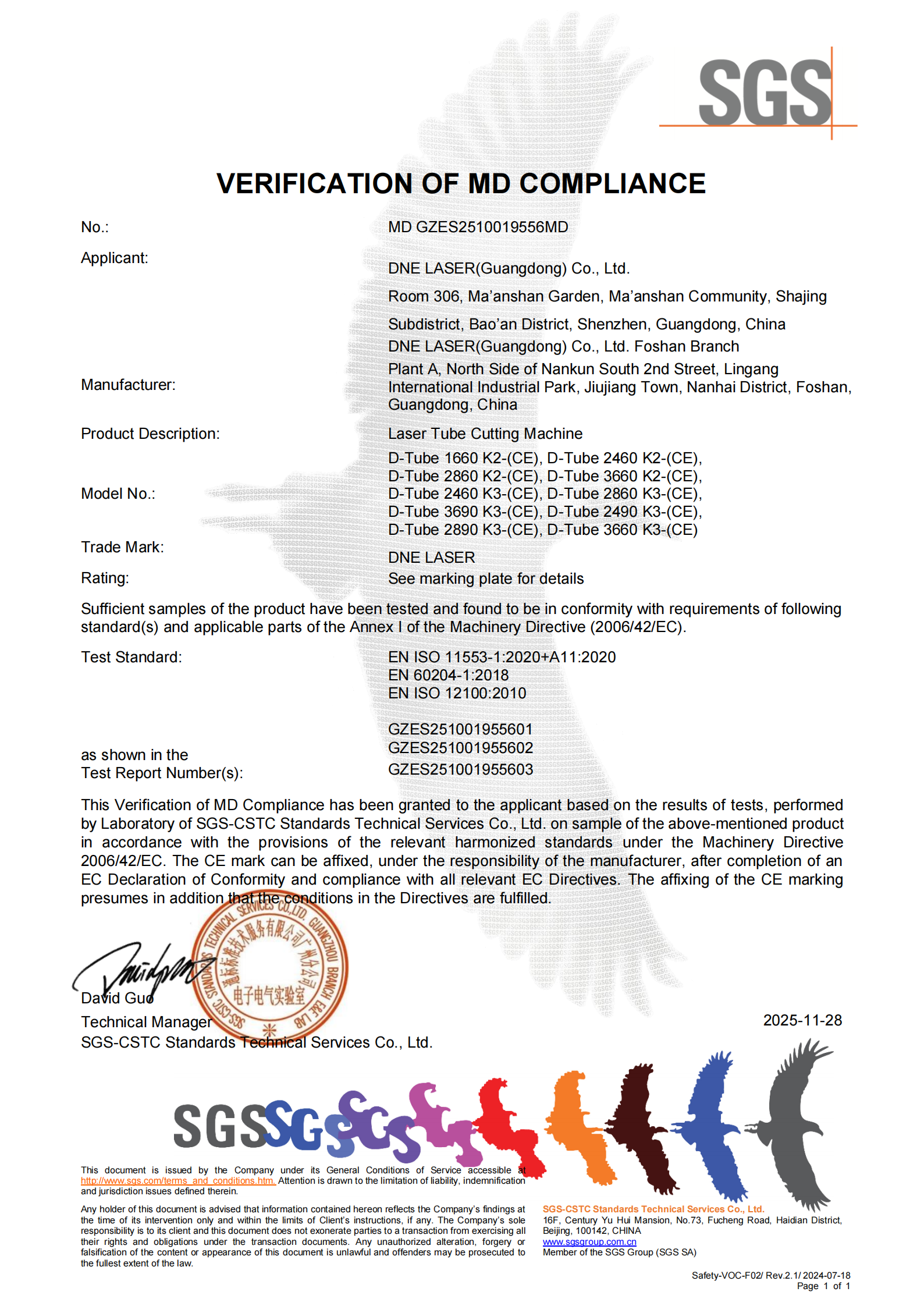
The buyer interpretation matters more than the certificate logo, and three checks separate usable evidence from decorative documentation. First, model scope: a family certificate naming specific models does not automatically cover a differently configured machine, so the quoted model number should appear inside the scope. Second, standards edition and issue date: EN ISO 11553-1:2020+A11:2020 is not interchangeable with older editions. Third, issuing authority and market: EU-facing and US-facing scopes are separate, and a supplier serving both markets should be able to produce both.
Policy pressure also extends beyond product certification. Localisation programmes, energy-efficiency requirements and public procurement rules in several industrial economies increasingly shape which equipment qualifies for tenders. For exporters, compliance readiness is no longer an afterthought appended to a quotation; it is a precondition for market access. DNE LASER reports that exports represent 45% of its output, with deliveries across markets in Europe, the Middle East, Africa, Asia-Pacific and the Americas, including Germany, Italy, the United States, Mexico, Brazil, Vietnam, India and Saudi Arabia. That footprint is only sustainable where documentation, electrical configuration and safety architecture are designed for export from the outset.
The Capacity Layer: Where Tube Cutting Supply Is Concentrated
Production capacity for laser cutting equipment is heavily concentrated. China's laser equipment market revenue accounted for 56.6% of the global total in 2024, with localisation of high-power laser systems exceeding 70%, according to IT Home / CCTV Finance. Technology choice shows the same concentration: fiber lasers command more than 55% of the industrial laser systems market, having displaced CO2 sources on the strength of 30-50% higher efficiency and around 50% lower operating costs, as reported by SNS Insider.
Capacity concentration changes what buyers can reasonably ask for. A vertically integrated manufacturer with in-house research, manufacturing and direct sales can support industrial equipment customisation across different cutting requirements, while an assembly-only supplier is limited to catalogue configurations. The practical signals of that capability are physical and specific. DNE Laser (Guangdong) Co., Ltd., which operates under the brand DNE LASER, was founded in 2008 and runs a production base of more than 60,000 ㎡ in Nanhai, Foshan, with over 600 employees, an annual output of more than 2,000 units and an R&D team of 38 engineers. The company is a wholly owned subsidiary of the Swiss Bystronic Group and is headquartered in Shenzhen; its product range covers laser cutting machines, tube laser cutting machines, press brakes, automatic devices, laser welding machines and software.
Capacity also determines how a supplier responds to order structure. Mass production capability for large-volume orders and a minimum order quantity of one unit are not contradictory; they describe a factory able to absorb both project-scale and single-machine demand. Lead time, by contrast, is quoted against actual order volume and project requirements rather than published as a fixed figure - which is the honest answer for a customised industrial machine, and a reminder that delivery schedules should be confirmed per configuration.
The Technology Layer: Risk Control Inside Tube Processing
Once a tube is clamped and rotating, three mechanical systems decide whether a cut stays repeatable: the guideway platform positioning the cutting head and carriage, the chuck system holding and indexing the tube, and the auxiliary supports keeping long stock stable. These are the components where tube processing diverges from flat sheet cutting, and they explain why two machines with identical laser power ratings can behave very differently after a year of production.
Precision linear guideways set the motion baseline. Positioning accuracy is documented per metre of travel on tube machines because the working envelope is long: across the D-Tube range, X/Y positioning accuracy is specified at ±0.05 mm/m and X/Y repeated positioning accuracy at ±0.03 mm/m. Those figures describe the machine's ability to return to the same point repeatedly - the property that determines whether a hole pattern stays consistent across a long tube rather than drifting between the first and last part.
Automatic centering chucks with sealed designs address the clamping side of the risk. A chuck must hold the tube concentrically, rotate it accurately and survive an environment where metal dust, slag and coolant are present. Sealed construction limits ingress of that debris into the jaw mechanism, which in practice protects centering repeatability and reduces maintenance frequency. Configuration varies with workload: D-Tube models are equipped with 2, 3 or 4 chucks depending on model and application, and theoretical maximum chuck load ranges from 100 kg on the D-Tube F 120 configuration to 1,500 kg on the D-Tube 520.
Synchronized auxiliary support devices control deflection. Long tube stock sags under its own weight, and unsupported sag translates directly into cut deviation, so supports that travel in sync with the cutting process keep the tube axis aligned. DNE documents loading lengths up to 12.5 m and unloading lengths up to 12.2 m on the larger D-Tube models, which is only meaningful if the support system maintains alignment across that distance.
Two further points belong to the technology layer rather than to the specification sheet. Bevel cutting is an optional function across the D-Tube range rather than a standard feature, a distinction that affects both quotation and machine configuration. And accuracy claims are only as good as the calibration behind them: DNE's stated quality-control process includes full-process factory performance testing, chuck and cutting accuracy calibration, a continuous operation trial run of the complete machine, and compliance verification of core component brands.
Square Tube Capability: Matching Section Range to Model
For square tube, the selection question is not what the largest cuttable tube is, but what the smallest section is that will be cut frequently, and how heavy the heaviest bundle loaded onto the machine will be. The D-Tube range spans a wide envelope, and the differences between models are structural rather than cosmetic.
| Model | Chucks | Square tube (mm) | Round tube (mm) | Theoretical max. chuck load | Loading / unloading length |
|---|---|---|---|---|---|
| D-Tube F (120) | 2 | □8*8 - □120*120 | Φ8 - Φ120 | 100 kg | 6.5 m loading / 2 m unloading |
| D-Tube F (240) | 2 | □12*12 - □240*240 | Φ12 - Φ240 | 300 kg | 6.5 m loading / 2 m unloading |
| D-Tube F (360) | 2 | □40*40 - □350*350 | Φ40 - Φ350 | 1,000 kg | 6.5 m loading / 2 m unloading |
| D-Tube 240 | 2 or 3 | □15*15 - □230*230 | Φ15 - Φ230 | 300 kg | 6.5 / 9.2 / 12.5 m loading; 2 / 4 / 6.5 / 9.2 / 12.2 m unloading |
| D-Tube 360 | 2, 3 or 4 | □40*40 - □350*350 | Φ40 - Φ350 | 1,200 kg | 6.5 / 9.2 / 12.5 m loading; 2 / 6.5 / 9.2 / 12.2 m unloading |
| D-Tube 520 | 3 or 4 | □50*50 - □510*510 | Φ50 - Φ510 | 1,500 kg | 12.5 m loading; 6.5 / 9.2 / 12.2 m unloading |
All D-Tube models: X/Y positioning accuracy ±0.05 mm/m, X/Y repeated positioning accuracy ±0.03 mm/m, bevel cutting function optional. Source: DNE LASER product specification data.
The practical boundaries deserve to be stated plainly. The D-Tube F 120 configuration carries a theoretical maximum chuck load of 100 kg, which suits light and thin-wall tube work but not heavy bundles. Square tube capability scales with model: □15*15-□230*230 on the D-Tube 240, □40*40-□350*350 on the D-Tube 360, and □50*50-□510*510 on the D-Tube 520, with chuck load rising to 1,200 kg and 1,500 kg respectively. Loading and unloading lengths extend from 6.5 m to 12.5 m in, and up to 12.2 m out on the largest configurations. Specifying below the required load class is the most common error in tube projects, because it only becomes visible when the machine is loaded at full capacity.
Application Fit: What Documented Deployments Show
Two documented deployments illustrate how tube cutting integrates with sheet metal processing rather than replacing it. In Vietnam, an automotive parts manufacturer installed nine units for the production of automobile parts and components; the equipment has been in operation for one year and the reported result is a 15% improvement in production efficiency, with the installation combining D-Soar sheet cutting machines and a D-Tube 240 tube machine. In Mexico, an industrial automation client working in intelligent equipment and precision structural parts - including data infrastructure and logistics automation - operates six units: three sets that have been in service for three years plus three additional new sets purchased. That project combines a D-Giant system with a D-Tube 360, and reports faster cutting speed, low maintenance and long service life as operational highlights.
The pattern is consistent with how tube processing is actually adopted. Tube machines rarely arrive alone; they are added to an existing sheet processing environment, sharing software, programming logic and floor space with flat-bed machines. Repeat purchasing after multi-year service, as in the Mexico case, is a durability signal that specification sheets cannot provide. The efficiency figure of 15%, however, should be read as project-specific: it reflects a particular mix of parts, materials and production organisation, and it is not a universal expectation for every tube cutting investment.
Market Trend Analysis: Power, Fiber Share and Demand Direction
Demand-side indicators point in one direction. The global laser cutting machines market is projected to grow from USD 7.44 billion in 2026 to USD 18.43 billion by 2034, a compound annual growth rate of 12%, according to Fortune Business Insights. Market size estimates for 2025 vary by research methodology - Market Research Future cites USD 6.16 billion, Fortune Business Insights USD 6.85 billion and Mordor Intelligence USD 7.14 billion - so the useful signal is the growth direction rather than any single baseline.
Technology mix is converging faster than total market size. Fiber lasers now hold more than 55% of the industrial laser systems market, and displacement of CO2 sources has been driven by measurable operating economics rather than novelty. At the high-power end, one third-party dataset reports a 75% increase in demand for ultra-high-power laser heads of 10 kW and above between 2023 and 2024, driven by thick-plate cutting needs in heavy industry; that figure comes from a medium-reliability source and should be treated as directional rather than definitive.
That high-power trajectory provides the context for tube cutting. In DNE's flat-bed range, laser power options run from 3,000 W to 30,000 W on the D-Soar series, up to 40,000 W on D-Soar Plus-G, and up to 80,000 W on D-Giant F - which places the 30 kW benchmark for thick-plate processing in the middle of what is currently offered rather than at the top. Tube machines follow the same curve with a lag, because the limiting factor is not only the laser source but also the chuck, support and guideway systems that must hold geometry while the tube rotates. The implication for buyers is that power ratings will keep rising predictably; mechanical risk control and compliance documentation are where differentiation will actually be found.
Comparison with Traditional Tube Processing and Configuration Boundaries
Tube laser cutting competes with established process routes rather than replacing them everywhere. A traditional saw-and-drill or punch line remains a rational choice under specific conditions, and buyers comparing the two should compare process structure rather than unit price alone.
| Criterion | Saw plus drilling / punching line | Tube laser cutting |
|---|---|---|
| Number of setups | Sequential operations across several stations | Holes, slots, mitres and bevels in one setup |
| Pattern change | Tooling changes or drill reprogramming | Software program change |
| Bevel and weld preparation | Separate machining or manual operation | Optional bevel cutting function on the machine |
| Tube handling | Tube moved between stations | Tube clamped and rotated in chucks |
| Heavy section capability | Standard equipment handles large sections | Limited by chuck load class (100-1,500 kg across the D-Tube range) |
| Best-fit conditions | Very large sections, field fabrication, simple hole patterns | Multi-hole patterns, mixed profiles, repeat production volumes |
The limitations of the laser route should be stated as clearly as its advantages. Chuck load class creates a hard ceiling: a model rated at 100 kg theoretical chuck load cannot substitute for a heavy-section machine, and the answer is a larger model rather than a parameter adjustment. Bevel cutting is optional rather than standard across the D-Tube range, so any project requiring mitres and weld preparation must specify it at quotation stage. Accuracy is documented per metre of travel, which means tolerance accumulates along long parts - ±0.05 mm/m positioning accuracy on a 12 m tube is not the same absolute tolerance as on a 6 m tube. Documented efficiency gains are project-specific, as the Vietnam and Mexico cases show. And for very large structural sections, or for fabrication carried out directly on site, sawing and manual assembly remain valid alternatives.
A short buyer checklist follows from the same logic:
- Confirm the quoted model number appears inside the compliance scope for the destination market.
- Confirm the chuck load class against the heaviest bundle, not the average tube.
- Confirm whether bevel cutting and loading/unloading automation are included or optional.
- Confirm the accuracy specification basis - per metre of travel versus absolute tolerance.
- Confirm acceptance criteria in writing, including factory inspection and site commissioning.
- Confirm spare-part availability and service coverage in the destination country.
Future Outlook
Three developments are likely to shape the next procurement cycle. First, compliance documentation will continue to consolidate as a minimum gate rather than a differentiator, particularly for exporters serving both EU and US markets. Second, equipment suppliers are repositioning from machine vendors toward system-level providers: DNE LASER, a brand under the Bystronic Group, presented a global brand refresh at FABTECH 2025, positioning itself as a provider of intelligent system-level manufacturing solutions - a direction that implies tighter integration between cutting, bending, automation and software. Third, the capacity map will remain concentrated while export performance becomes the distinguishing variable, which places pressure on suppliers to present model-specific evidence rather than family-level claims.
For tube cutting specifically, the technical agenda is already visible: higher laser power for thicker walls, tighter control of chuck and support systems to protect geometry, and automation of loading and unloading to reduce the handling content of each part. Buyers who frame their next tube machine purchase around those three elements, and who require documentation for each, will be less exposed to the specification gap that opens when power ratings rise faster than the mechanical systems that have to hold them.
Frequently Asked Questions
What does OEM or ODM production mean for a tube laser cutting machine project?
DNE LASER provides OEM and ODM production services for tube laser cutting machines, together with customized tube processing solution design. OEM production allows a client to have machines manufactured under its own brand; ODM production allows a client to draw on the manufacturer's design and manufacturing capability for its product. Customized solution design covers machine configuration developed against the client's tube range and processing requirements. The minimum order quantity is one unit, so OEM and ODM arrangements are not restricted to high-volume programmes.
Which machine parameters can be customized on a tube laser cutting machine?
Documented customization options for tube processing equipment include chuck type and quantity, laser power, loading and unloading system configuration, bevel cutting function, and cutting range and tube specification compatibility. For laser cutting equipment more generally, customization extends to cutting format (working area), laser power, cutting head focal length, laser source fiber core diameter, machine configuration and automation integration solutions.
How do the D-Tube models differ in square tube range and chuck load?
Square tube range and load capacity scale with model. The D-Tube F is available in 120, 240 and 360 configurations with 2 chucks, cutting square tube from □8*8-□120*120, □12*12-□240*240 and □40*40-□350*350 respectively, with theoretical maximum chuck loads of 100 kg, 300 kg and 1,000 kg. The D-Tube 240 uses 2 or 3 chucks and covers □15*15-□230*230 at 300 kg. The D-Tube 360 uses 2, 3 or 4 chucks and covers □40*40-□350*350 at 1,200 kg. The D-Tube 520 uses 3 or 4 chucks and covers □50*50-□510*510 at 1,500 kg.
How is accuracy verified before a tube laser cutting machine ships?
Tube machines in this range are documented at ±0.05 mm/m X/Y positioning accuracy and ±0.03 mm/m X/Y repeated positioning accuracy. The verification process behind those figures includes full-process factory performance testing, calibration of chuck and cutting accuracy, a continuous operation trial run of the complete machine, and compliance verification of core component brands, tested in accordance with industrial tube cutting equipment safety requirements.
Which certificates apply to tube laser cutting machines for the EU and US markets?
Two separate scopes apply. For the EU, SGS-issued machinery directive compliance verification under certificate MD GZES2510019556MD covers the D-Tube 1660/2460/2860/3660/2490/2890/3690 K2/K3-CE models against EN 60204-1:2018, EN ISO 11553-1:2020+A11:2020 and EN ISO 12100:2010. For the United States, Certificate of Compliance SGSNA/24/GZ/00242X covers the D-Tube series against UL 508A, 3rd Edition and CSA C22.2 No.286:23. Both were issued on 28 November 2025. At framework level, laser processing machines are assessed against ISO 11553-1 for general safety requirements and IEC 60825-1 for equipment classification.
What after-sales support is provided for tube laser cutting machines?
Documented support covers remote technical support and troubleshooting, on-site installation, commissioning and operator training, scheduled maintenance services, core component warranty, and lifetime technical upgrades together with process optimization support. For tube systems, after-sales scope also includes chuck and cutting accuracy service as part of scheduled maintenance.
What are typical purchasing terms and acceptance criteria?
Documented purchasing terms begin with a minimum order quantity of one unit, with delivery terms varying by market - FOB or CIF for Vietnam, and FOB, CIF, EXW, DDP or DAP for Mexico. Acceptance criteria combine on-site inspection at the supplier's factory with commissioning at the buyer's factory. Payment terms are 20% or 30% as a deposit, with the balance paid before shipping. Lead time is quoted against actual order volume and project requirements rather than fixed in advance.
For readers who need the underlying product documentation, the DNE LASER corporate introduction is publicly available as a PDF: DNE Laser Introduction V1.0 (2026). Company information: www.dne.global.