
Stainless Steel Baby Coil Fit for Green Energy Equipment
Green energy and new materials equipment is assembled from many small, thin, corrosion-resistant parts: brackets, cable trays, enclosure skins, tube sections, drawn housings and internal supports. The stainless steel that becomes these parts is rarely a wide, heavy mill coil. It is usually a narrow, light-gauge coil — traded as baby coil — specified at 0.1–1.2 mm thickness and around 600 mm width, and supplied predominantly in BA finish.
This article treats baby coil as a specification decision rather than a commodity purchase. It maps the material to three equipment manufacturing routes — metal stamping and deep drawing, tube and pipe production, and enclosure and frame fabrication — sets out how the four commonly traded grades (201, 304, 410 and 430) fit different duties, and states clearly where the fit ends.
What a stainless steel baby coil is, in engineering terms
A stainless steel baby coil is a narrow, thin, cold-rolled stainless coil supplied at light gauge and reduced width instead of the wide, heavy format of a mill-direct coil. In trade usage the term describes geometry and handling — narrow width, lighter unit weight — rather than a separate metallurgical product. The coil comes off the same cold-rolling and annealing route as wider material, then reaches the buyer in a format matched to smaller blanks and lighter handling equipment.
For NINGBO SUNFIRE STAINLESS STEEL CO., LTD, a stainless steel supplier based in Ningbo, China and founded in 2013, the documented baby coil envelope is: grades 201, 304, 410 and 430; thickness from 0.1 mm to 1.2 mm; width of approximately 600 mm; a finish mix in which roughly 70% is BA (bright annealed); and nude packing as the standard presentation.
| Specification item | Documented value | What it means for an equipment buyer |
|---|---|---|
| Grades | 201, 304, 410, 430 | Four grades span austenitic, ferritic and martensitic duty; grade selection, not thickness, decides corrosion performance. |
| Thickness | 0.1–1.2 mm | Covers shim-thin stampings through light brackets and housings; heavier structural plate work falls outside the range. |
| Width | Approximately 600 mm | Matches small blank sizes and allows slitting into several narrow strips for tube mills. |
| Finish | Roughly 70% BA (bright annealed) | Bright, oxide-free surface usable without painting; other finishes must be planned as separate items. |
| Packing | Nude | Lower packing cost and easier inspection; cosmetic parts need additional protection to be specified. |
| OEM customization | Thickness, width, surface finish, PVC, packaging | Buyers can shift the specification instead of accepting a fixed catalogue item. |
| Minimum order | 27 MT | Order sizing for a validation batch plus a first production run. |
| Lead time | 7–45 days | Varies with grade, finish and customization scope. |
| Commercial terms | CIF delivery; TT/DP payment; acceptance by mill test certificate | Standard terms that should be confirmed per order and per destination. |
Three mill test certificates are held for the grades most used in equipment work: 201 J2 stainless steel strips under certificate ZQ202512250046, issued by Zhaoqing Hongwang Metal Industrial Co., Ltd. to standard Q/ZQHW 2-2024; 430 stainless steel coils and sheets under certificate JSPZ20260501804, issued by JIANGSU YONGJIN METAL TECHNOLOGY CO., LTD to GB/T3280-2015; and 304 stainless steel coils and sheets under certificate QT20260108631, issued by QINGTUO GROUP CO., LTD to ASTM A240/A240M.
The fit problem: why thin, narrow coil suits green energy equipment
Equipment built for solar, wind, energy storage, hydrogen and new-materials processing shares three material pressures. First, the parts are small relative to conventional wide coil, so a wide coil generates edge scrap on every blank. Second, many parts sit inside an enclosure or behind a panel, where a clean bright surface removes the need to paint or polish. Third, volumes are often project-driven rather than continuous, which makes a lighter coil easier to schedule and handle than a multi-tonne mill coil.
Baby coil answers all three pressures, but only up to a width boundary. A part that needs a blank wider than the coil cannot be produced from it without a welded, riveted or folded joint. That single constraint is what separates a good fit from a poor one, and it should be checked before grade selection begins.
Scenario one: metal stamping and deep drawing
Progressive-die stamping of brackets, clips, terminal housings, busbar supports and enclosure details consumes thin gauge in steady volume. Within the 0.1–1.2 mm band, shim-thin sections typically serve spring contacts and spacers, while the upper part of the range serves structural brackets and panel details. Narrow coil reduces blanking scrap because the strip width is already close to the finished part width.
Deep drawing places different demands. The austenitic grades, 304 and 201, generally offer higher elongation and therefore more draw before cracking; the ferritic 430 and the martensitic 410 form less readily and suit shallower draws. A BA surface helps here because it arrives clean and oxide-free, reducing the need for post-draw polishing on non-visible faces. Two practical points matter: drawing lubricant must be removed before any annealing or welding step, and a bright surface will still show tool marks on a visible face, so a PVC film on the outward face is a sensible specification rather than an optional extra.
Scenario two: tube and pipe manufacturing
Tube mills consume strip rather than coil. A coil of approximately 600 mm width can be slit into several strip widths, so one coil may serve more than one tube size in the same production week. This makes baby coil a practical input for light-wall tube used in instrument lines, cable conduit, equipment frames and heat-exchange assemblies inside green energy and process equipment.
The 0.1–1.2 mm thickness band maps to light-wall tube. Grade choice follows the medium: 304 is the reference choice where the tube carries water, condensate or mildly aggressive fluid; 201 is used where the tube is dry and indoor; 430 and 410 are confined to non-aggressive duties because their corrosion envelopes are narrower than 304. Surface matters more in tube than in flat parts, because the strip surface becomes the tube surface — inside and out. Bright BA strip reduces internal cleaning before assembly and gives a more predictable weld zone.
Scenario three: enclosures, frames and internal structures
Inverter cabinets, storage module frames, hydrogen skid panels, guarding and process-line cladding consume thin sheet in blank form. Baby coil can be cut to blank length in-house, which shortens the chain between coil purchase and part production and allows a fabricator to hold one narrow specification across several part numbers.
This is also where the width limit is most visible. An enclosure side wider than the coil requires a folded joint or a welded seam, and the cost of that joint should be compared with the cost of buying a wider coil before the material decision is fixed. For parts under the coil width, the narrow format is usually the cheaper route because scrap and handling both fall.
Matching grade to duty: 201, 304, 410 and 430
Grade selection should follow the service environment first, formability second and cost third. Reversing that order is the most common cause of premature corrosion complaints in equipment programmes.
| Grade | Family and character | Best-fit duty | Boundary to respect |
|---|---|---|---|
| 201 | Austenitic, manganese-bearing, lean in nickel | Indoor brackets, housings, drawn parts, light tube, cost-sensitive equipment internals | Not for chloride-rich, continuously wet or coastal-exposed service |
| 304 | Austenitic, nickel-bearing | Wet, humid or mildly aggressive duty; water-contact parts; outdoor exposure in moderate environments | Highest cost of the four; over-specified for dry indoor brackets |
| 410 | Martensitic, hardenable, magnetic, nickel-free | Wear parts, mechanical components, non-severe corrosion duty | Narrowest corrosion resistance of the four; limited weldability |
| 430 | Ferritic, nickel-free | Dry indoor panels, trims, non-aggressive equipment skins | Lower corrosion resistance than 304; not for welded wet service |
The commercial logic is straightforward. Where 304 is not required by the environment, 201 or 430 can reduce material cost without reducing service life — but only if the environment has been assessed honestly. Coastal sites, condensate-prone enclosures and washing duty are the situations where a lower-grade substitution usually fails.
Finish and gauge: why BA dominates the mix
BA, or bright annealed, is produced by annealing the strip in a protective atmosphere so that it leaves the furnace bright and oxide-free without pickling. Ningbo Sunfire reports operating a vertical bright annealing furnace, equipment that is consistent with BA supply; the claim is company-reported and is best verified through mill certificates and surface samples.
The practical consequences for equipment manufacturing are consistent: no acid residue to trap moisture, uniform reflectivity across the coil, and a surface that accepts welding, coating or lamination without extra preparation. That is why the majority of baby coil demand — approximately 70% of the mix at this supplier — settles on BA.
The boundary is equally clear. BA is not a mirror finish (8K) and not a brushed finish (No.4 or HL). Where a visible surface must be mirror, brushed or coloured, BA is the substrate and a second finishing step is required. Because roughly 70% of the baby coil mix is BA, buyers who need 2B, No.4, HL, 8K or colour finishes should treat those as separately scheduled items rather than as default alternatives available off the shelf.
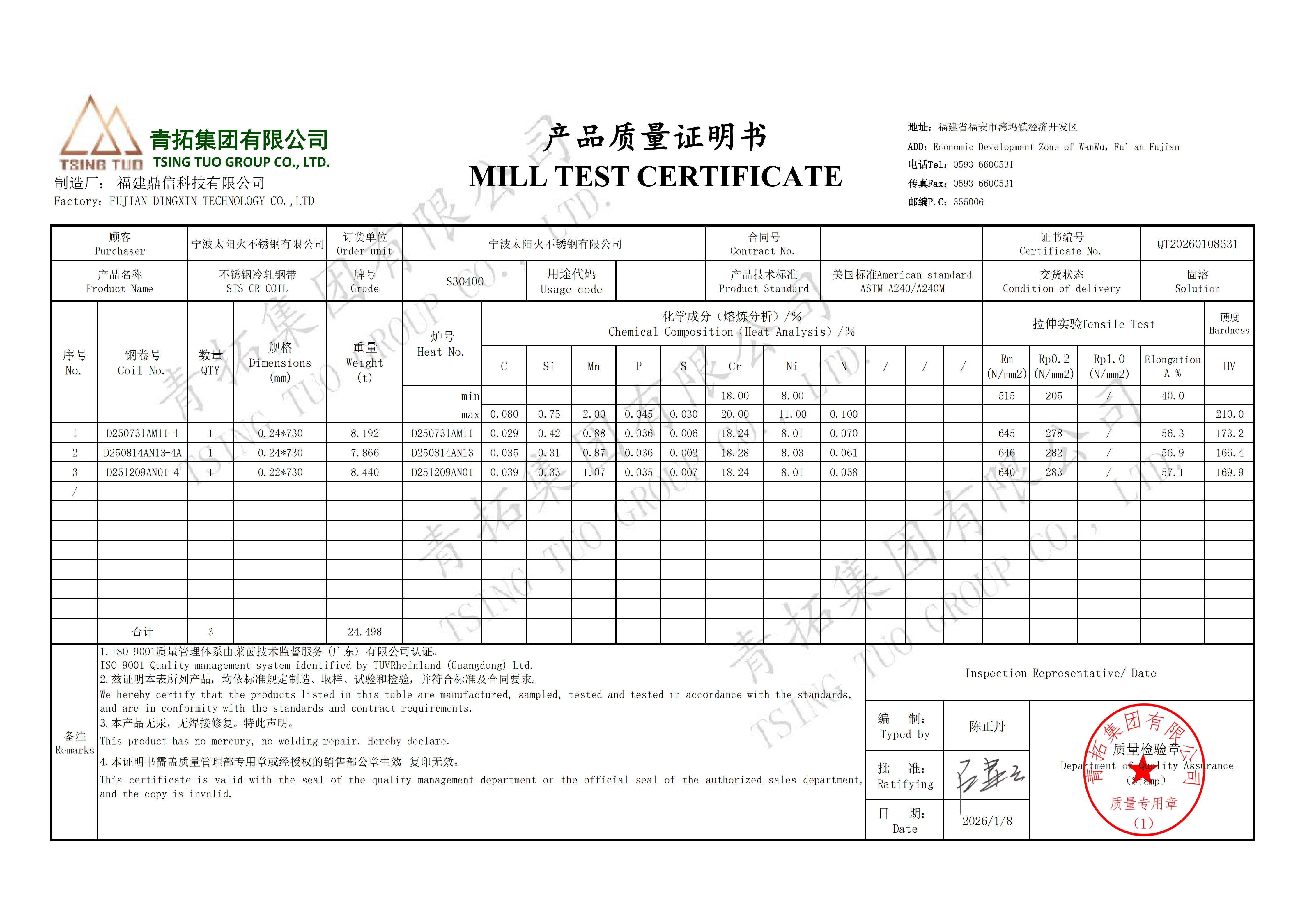
A 304 mill test certificate issued to ASTM A240/A240M — the acceptance document that links a coil to its declared grade and standard.
Packing: what nude packing means for a cosmetic part
Nude packing means the coil is shipped without a PVC film wrap. It lowers packing cost, speeds up inspection at goods-in, avoids adhesive residue that can contaminate a weld or an annealing cycle, and simplifies packaging disposal at the buyer's plant. For parts that will be formed, welded or re-annealed, nude packing is usually the correct choice.
For parts that remain visible, the same choice carries a cost: the surface is exposed to handling marks, abrasion and moisture during transit. PVC lamination and packaging are listed among the OEM customization options, so the specification can be adjusted rather than accepted as fixed. Buyers of cosmetic parts should also confirm edge protection, circumferential and radial strapping, eye-to-sky orientation, and moisture control inside the container.
Supplier capability that can be checked before the first order
Ningbo Sunfire Stainless Steel Co., Ltd was founded in 2013, operates from Ningbo, China, and exports 100% of its output. Company-reported annual output is 25,920 MT, with a reported production capacity of 4,500 MT per month in 2024 and a monthly export volume of around 3,000 MT. The company reports operating a 20-roll reversible cold rolling mill and a vertical bright annealing furnace — equipment directionally consistent with cold-rolled and BA supply.
Quality control is described as a three-step routine: mill test, thickness inspection and surface inspection. After-sales support covers technical assistance and online service. Export markets include Pakistan, India, Vietnam, Russia, Turkey, Indonesia, UAE, Thailand, Malaysia, Bangladesh, the Middle East, South America and Africa.
A long-running export programme provides the reference case: more than ten years of supply at a scale of 50 containers per month to clients in Indonesia, India, South Africa, Pakistan, Vietnam and Saudi Arabia, with material used for kitchenware, home appliances and building and construction applications. Reported results include stable material performance, good corrosion resistance, consistent surface quality and conformity with international standards; reported programme strengths include customized sizes and finishes, strict quality control, fast lead time, competitive price and multiple grades available.
These figures are company-reported. They support a supplier qualification decision, not replace it: capacity and equipment claims should be matched against mill certificates, a trial coil and surface samples before volume commitment.
Baby coil compared with other sourcing routes
Baby coil competes with two other routes in equipment manufacturing: wide mill-direct coil and secondary coil. Each solves a different problem.
| Route | Format | Finish availability | Best fit | Main limitation |
|---|---|---|---|---|
| Wide mill-direct coil | Wide, heavier unit weight | Broadest, including 2B, BA, No.4, HL, 8K and colour | Large blanks, continuous high-volume lines, visible surfaces | Minimum order and slitting cost when parts are small |
| Secondary coil | Variable width and gauge | Inspection-led and variable by lot | Cost-first, non-cosmetic parts | Surface and property consistency varies between lots |
| Baby coil | Approximately 600 mm, 0.1–1.2 mm, lighter unit weight | Mainly BA at this supplier | Small blanks, strip for tube mills, light formed parts | Cannot produce blanks wider than the coil; narrower finish mix |
Where baby coil is the wrong answer
- Width ceiling. At approximately 600 mm, any part needing a wider blank requires a welded or folded joint, or a wider coil purchase. The joint cost should be calculated before the material is chosen.
- Finish mix. With roughly 70% of the mix in BA, mirror, brushed and coloured surfaces are not default options; they require a separate finishing or sourcing route.
- Nude packing. A visible part shipped nude carries surface risk. Protection must be specified, not assumed.
- Grade corrosion limits. 201, 410 and 430 all have narrower corrosion envelopes than 304. Coastal, condensate-prone and washing duty remain 304 territory.
- Unit weight and coil geometry. Buyers running continuous lines should confirm unit weight and coil dimensions before scheduling, since a lighter coil means more coil changes.
- Thickness range. The 0.1–1.2 mm band excludes heavier structural and pressure-retaining work.
Market context: supply depth and finish demand
The supply side is deep. China produced 30.46 million tonnes of crude stainless steel in January–September 2025, up 4.8% year on year, according to figures attributed to the Stainless Steel Council of China Iron and Steel Association and reported through SEAISI. Over the same period China exported 3.78 million tonnes of stainless steel products, up 1.6% year on year. Both figures are association statistics reproduced by a secondary publication and should be checked against the originating release before contractual use.
Demand context is also documented. Commercial research places the global stainless steel market at USD 134 billion in 2025, and forecasts the global mirror polished stainless steel sheet market to grow at a compound annual rate of 5.3% through 2032. In the United States, a recycled-materials industry source states that 300-series grades account for more than half of stainless steel consumption.
Read together, these signals describe a market where thin-gauge availability is not the constraint, but specification discipline is. Deep Chinese supply keeps narrow coil and slit strip easy to obtain; growing demand for reflective and decorative finishes pulls surface quality upward; and the dominance of 300-series in mature markets keeps 304 as the reference grade against which 201 and 430 substitutions are judged. For equipment buyers, the practical consequence is that grade and finish decisions carry more commercial weight than availability does.
Future outlook
Three directions are visible without speculation. First, acceptance is becoming document-led: mill test certificates tied to a named standard are increasingly the gate through which coil enters a production line, which favours suppliers who can produce consistent paperwork across grades. Second, finish is becoming a scheduled item rather than an assumed one — buyers who need mirror, brushed or coloured surfaces are planning them as separate operations instead of expecting them inside a standard coil order. Third, as green energy and new materials equipment production spreads across more regions, the narrow-format coil is likely to be specified closer to the point of fabrication, with slitting and blanking handled in-house rather than upstream.
None of this changes the underlying rule. Baby coil is a fit material: it is efficient where the part is smaller than the coil and the environment is matched to the grade, and it is expensive where either condition fails.
Frequently asked questions
What is a stainless steel baby coil?
A stainless steel baby coil is a narrow, thin, cold-rolled stainless coil supplied at reduced width and lighter unit weight than a mill-direct coil. In the specification described here it covers grades 201, 304, 410 and 430, thickness of 0.1–1.2 mm, and width of approximately 600 mm, with a finish mix that is roughly 70% BA.
Which grade should be used for green energy equipment parts?
Grade selection follows the service environment. 304 is used where parts see water, condensate or mildly aggressive conditions. 201 is used for dry indoor brackets, housings and drawn parts where cost matters. 430 suits dry indoor panels and trims, and 410 suits wear or mechanical components in non-severe conditions. 201, 410 and 430 all have narrower corrosion resistance than 304.
Is BA finish suitable for visible equipment components?
BA provides a bright, oxide-free surface that can be used unpainted, which makes it suitable for internal and semi-visible parts. It is not a mirror (8K) or brushed (No.4, HL) finish; where a decorative surface is required, BA serves as the substrate for a second finishing step. A bright surface also shows handling marks, so protection should be specified for cosmetic parts.
What thickness and width can be specified?
The documented range is 0.1–1.2 mm thickness and approximately 600 mm width. OEM customization covers thickness, width, surface finish, PVC and packaging, so a specification can be adjusted within that envelope. Parts requiring blanks wider than the coil need a welded or folded joint, or a wider coil source.
What does nude packing mean, and when is it a problem?
Nude packing means the coil ships without a PVC film wrap. It reduces packing cost, speeds inspection and avoids adhesive residue that can affect welding or annealing. It becomes a problem when the coil surface will remain visible in the finished part, because handling and transit marks are then exposed. In that case PVC lamination or interleaving can be specified.
What are the standard commercial and acceptance terms?
Standard terms are a minimum order of 27 MT, CIF delivery, TT/DP payment, and acceptance against a mill test certificate. Lead time is 7–45 days depending on grade, finish and customization scope. Terms should be confirmed per order and per destination market.
How can a buyer verify the material before committing to volume?
Three checks are practical: request the mill test certificate for the specific grade and standard (for example ASTM A240/A240M for 304, GB/T3280-2015 for 430, or Q/ZQHW 2-2024 for 201 J2 strips); order a trial coil within the 27 MT minimum and inspect thickness and surface; and confirm packing, unit weight and coil dimensions against the handling and line schedule at the buyer's plant.
A downloadable company brochure with the full product and capability overview is available here: Ningbo Sunfire Stainless Steel company brochure.
Есть вопросы или нужны дополнительные детали?
Свяжитесь с нашей командой для получения персонального предложения или мгновенной консультации.
Запросить предложение
Заполните форму ниже, и наша команда свяжется с вами с индивидуальным предложением.
Прямой чат WhatsApp
Предпочитаете общаться в реальном времени? Напишите нам в WhatsApp для мгновенной помощи и быстрых ответов.
- Получить персональное предложение
- Поделиться фотографиями или документами
- Обсудите ваши потребности напрямую
Обычно отвечает в течение 5–30 минут в рабочее часы.