
Stainless Steel Baby Coil Shortlist: 201, 304, 410, and 430 for Thin-Gauge Manufacturing
Thin-gauge stainless steel manufacturing — the band between 0.1 mm and 1.2 mm — is where grade, gauge, finish, width and packing stop being separate purchasing decisions. In this range the material has little tolerance for mismatch: a grade that performs comfortably at 2 mm can fail at 0.3 mm, because forming strain, surface sensitivity and edge condition all become more critical at the same time.
For thin-gauge production at approximately 600 mm width with a predominantly BA finish, four grades cover most of the practical shortlist: 201 (cost-oriented austenitic), 304 (corrosion-critical austenitic), 410 (magnetic, wear-oriented martensitic) and 430 (general-purpose ferritic). The shortlist below explains what each grade is for, where it should not be used, and which purchasing terms should be fixed before an order is placed.
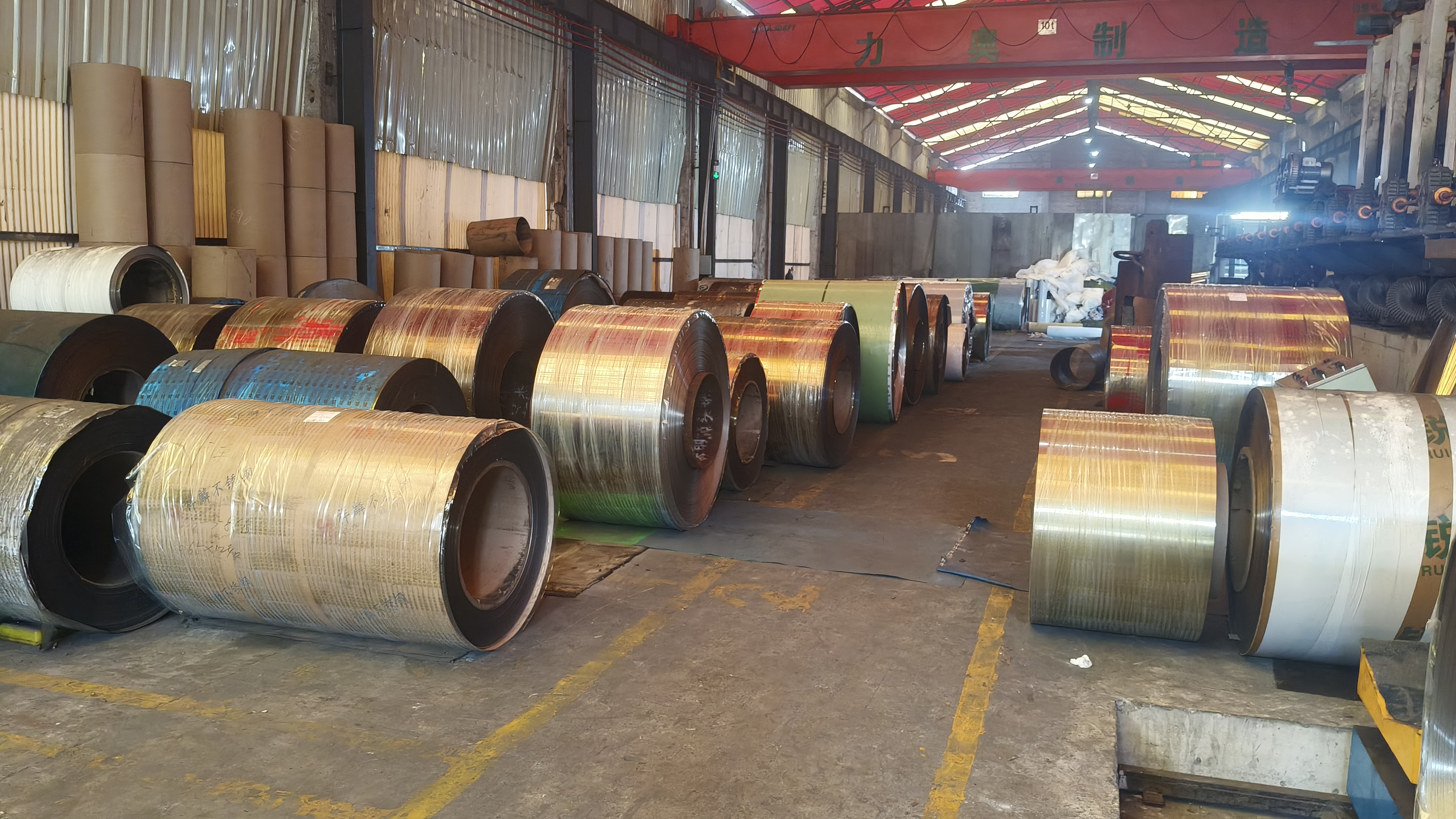
Thin-gauge baby coil is produced through cold rolling and bright annealing before slitting to narrow widths — the process route that determines whether a 0.1–1.2 mm coil is consistent enough for downstream forming.
Why Thin-Gauge Buyers Shortlist by Grade, Not by Price per Tonne
A tonne of 0.4 mm coil and a tonne of 1.2 mm coil are not interchangeable inputs, even when they carry the same grade name. At thin gauges the ratio of surface area to weight rises sharply, so surface defects, edge burrs and thickness drift affect far more finished parts per coil. That is why experienced buyers shortlist by application risk first and price second.
Four variables usually decide the grade before any quotation is compared:
- Corrosion exposure of the finished part. Indoor dry service, humid service, cleaning chemicals and food contact all pull the decision in different directions.
- Forming severity. Bending, stamping and deep drawing impose higher relative strain on thin material than on heavy gauge, so ductility and surface lubrication matter more.
- Surface requirement. A visible BA surface on an elevator panel or appliance front has different acceptance rules from a hidden internal bracket.
- Coil format and packing. Narrow width, unit weight and nude packing change handling frequency, yield and transit risk.
A fifth variable is increasingly decisive: documentation. Whether the mill test certificate states the grade, standard and finish that the purchase order actually requires determines how quickly a shipment can be accepted — or how long it sits in a warehouse waiting for a claim discussion.
The Shortlist: Four Grades for 0.1–1.2 mm Baby Coil
The four grades below are not ranked as “better” or “worse”. They are ranked by decision order: start with the corrosion and forming requirement of the part, then move to cost, then confirm surface and documentation.
201 — The Cost-Oriented Austenitic Option
201 belongs to the austenitic family and is widely used where a bright, non-magnetic, formable surface is needed at a lower alloy cost than 304. In thin gauges it is a common choice for dry indoor decorative parts, appliance internals and general hardware where the corrosion load is mild. The 201 family is traded in several sub-designations (J1, J2, J3, J5 in the Chinese market), and the designation stated on the mill certificate should match the designation on the purchase order.
Fits when: the part sees dry or lightly humid indoor service, the surface is visible but not exposed to chlorides, and forming is moderate rather than severe.
Watch-outs: 201 is not the grade to specify for sustained moisture, salt exposure or aggressive cleaning regimes; in severe deep drawing, edge-cracking sensitivity is higher than with 304. For reference, a 201 J2 mill test certificate held for supplied strip — number ZQ202512250046, issued by Zhaoqing Hongwang Metal Industrial Co., Ltd. to standard Q/ZQHW 2-2024 — illustrates the level of grade specificity a buyer should expect in documentation.
304 — The Corrosion-Critical Austenitic Option
304 is the reference grade of the four for corrosion resistance, formability and weldability. Where the finished part meets food, moisture, condensation or cleaning chemicals — kitchenware bodies, tube and pipe, appliance components in wet zones — 304 usually removes the corrosion question from the risk list, at a higher alloy cost.
Fits when: the part is exposed to moisture, food contact or cleaning agents, or when the forming step is demanding enough that ductility cannot be traded away.
Watch-outs: nickel-bearing cost makes 304 the wrong default for hidden or dry-service parts where 201 or 430 would pass the same service test. Documentation should reference a recognised product standard; the 304 mill test certificate held for supplied coil and sheet — number QT20260108631, issued by QINGTUO GROUP CO., LTD to ASTM A240/A240M — is the type of reference buyers should verify against the order.
410 — The Magnetic, Wear-Oriented Martensitic Option
410 is a martensitic grade: magnetic in the annealed condition and hardenable, with lower corrosion resistance than the austenitic and 430 options. In thin-gauge manufacturing it is used where magnetic response, hardness or wear behaviour matters more than corrosion resistance — internal mechanical components, hardware, some automotive parts and industrial equipment details that operate dry or oiled.
Fits when: the design needs a magnetic grade, wear or hardness is a functional requirement, and the service environment is dry or protected.
Watch-outs: 410 has the lowest corrosion resistance of the four and is not the grade for wet, humid or food-acid service; weldability is more limited than 304. Buyers should also confirm that a grade-specific mill test certificate for 410 is issued with the shipment, since it is not automatically part of every supplier's document set.
430 — The General-Purpose Ferritic Option
430 is ferritic, magnetic and readily formable, with corrosion resistance suited to mild atmospheric and general domestic environments but below 304. It sits between 201 and 304 on cost-performance for many visible indoor parts: appliance panels, kitchenware, interior decoration and general stamping work.
Fits when: the part is decorative or semi-structural, indoor, and does not face chlorides or prolonged wet conditions, but requires better surface stability than a low-cost 201 variant in a polished or bright finish.
Watch-outs: 430 is not a substitute for 304 in wet or chemical service, and its welding window is narrower. A 430 mill test certificate held for supplied coil and sheet — number JSPZ20260501804, issued by JIANGSU YONGJIN METAL TECHNOLOGY CO., LTD to GB/T3280-2015 — shows the standard reference a buyer should see on the document set.
| Grade | Family | Relative corrosion level (four-grade shortlist) | Magnetic | Thin-gauge forming | Typical 0.1–1.2 mm BA uses |
|---|---|---|---|---|---|
| 201 (J-series) | Austenitic | Moderate | Generally no | Good; more sensitive in severe draws | Kitchenware bodies, appliance internals, decorative trim, hardware |
| 304 | Austenitic | Highest | Generally no | Good to very good; best overall ductility | Cookware, tube and pipe, wet-zone appliance parts, food-contact surfaces |
| 410 | Martensitic | Lowest | Yes | Moderate; hardness-oriented | Dry mechanical components, hardware, automotive and equipment details |
| 430 | Ferritic | Moderate | Yes | Good for bending and general stamping | Appliance panels, interior decoration, tableware, general stamping |
Relative corrosion levels describe general metallurgical behaviour within this four-grade comparison only. Actual service performance depends on environment, finish, fabrication and maintenance, and should be confirmed against the application.
Technical Notes: Thickness, Width, BA Finish and Nude Packing
0.1–1.2 mm: Where Tolerance Discipline Matters Most
Thin-gauge coil is judged on thickness consistency more than on nominal gauge, because a small absolute deviation represents a large percentage of the section. Buyers should agree the measuring method and check points with the supplier before shipment, and should treat thickness inspection as a named quality-control step rather than an assumption. For forming operations, gauge drift changes both the press setting and the finished part weight, so a consistent coil-to-coil profile is usually worth more than a marginally thinner nominal gauge.
Approximately 600 mm Width: The Practical Narrow Format
Baby coil is supplied as narrow slit material, typically around 600 mm, which suits tube mills, small and medium presses, and lines where a wide coil would generate excess edge trim. Width is also a design constraint: any part wider than the available coil width requires a wider parent coil, longitudinal welding, or a design change. Buyers should therefore confirm both the target part blank layout and the supplier's slitting capability before fixing a width in the purchase order.
BA Finish: Bright, Smooth and Less Forgiving
BA (bright annealed) is the dominant finish in this shortlist because it delivers a smooth, reflective surface without the directional pattern of rolled finishes, making it suitable for visible appliance, kitchenware and decorative parts. Bright annealing is a distinct process step rather than a cosmetic add-on; Ningbo Sunfire Stainless Steel Co., Ltd reports operating a vertical bright annealing furnace alongside a 20-roll reversible cold rolling mill. The practical consequence for buyers is that BA surfaces show handling marks, die contact marks and transit scuffs more readily than rougher finishes, so protective film and careful stacking deserve explicit attention in the order terms.
Nude Packing: Faster, Cheaper and Exposed
Nude packing means the coil is shipped without PVC film wrapping. It reduces packing cost and preparation time and is often preferred when the buyer will rewind, slit or cut immediately, or when film residue would interfere with the first process step. The trade-off is exposure: without film, the bright surface is more vulnerable to moisture during long sea transit and to handling marks at transshipment. Where the BA surface is a visible final surface, PVC wrapping is normally the safer specification; where the coil goes directly into a forming line, nude packing can be the more efficient choice. Both options belong in the purchasing terms, not in an assumption.
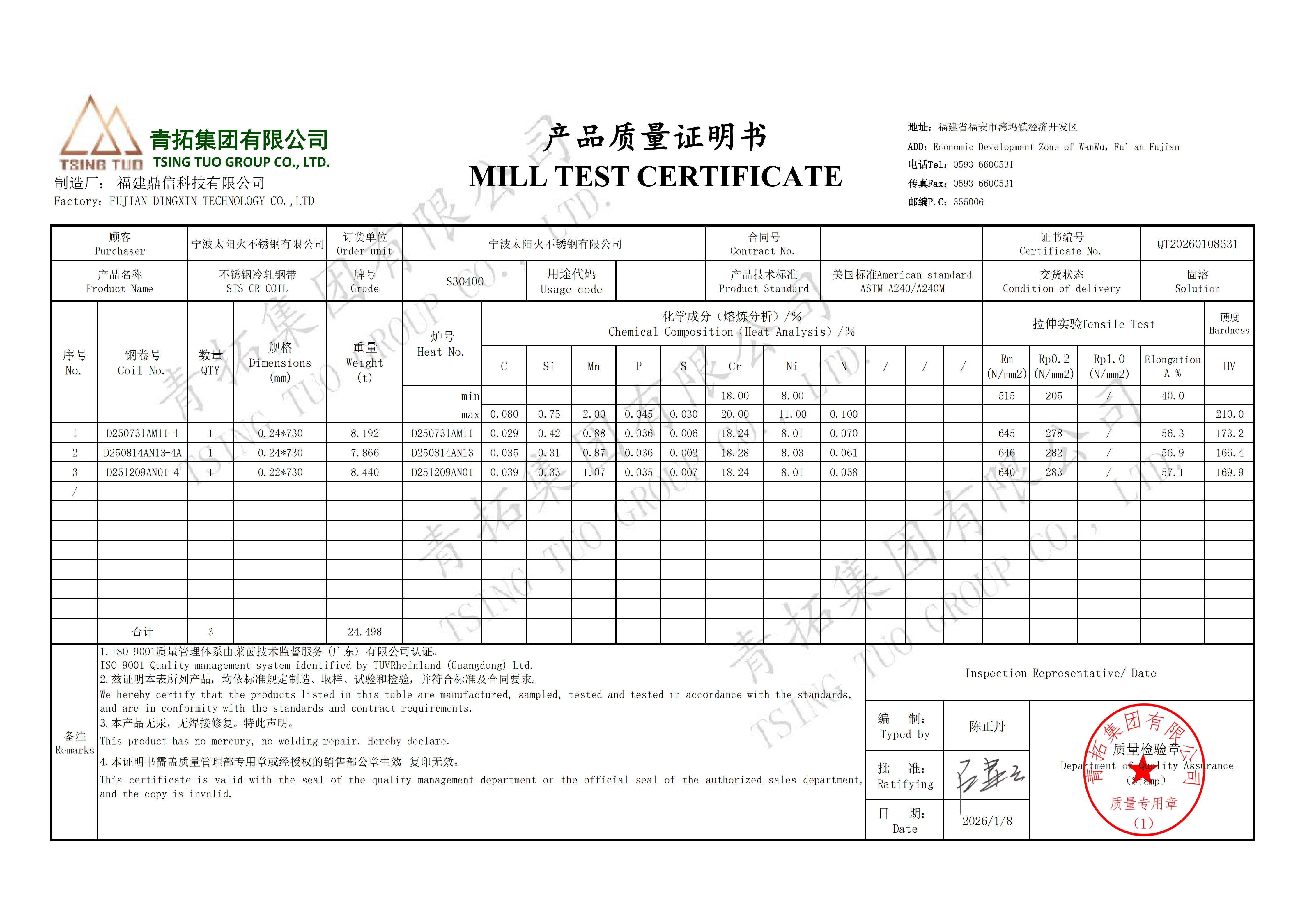
A mill test certificate is the acceptance anchor for thin-gauge coil: it should state the grade, the referenced standard and the scope of supply, and it should match the purchase order line by line.
Matching Grades to Applications
The application list below reflects where 0.1–1.2 mm baby coil in the four shortlisted grades is most commonly consumed. Each mapping is a starting point for specification, not a substitute for the buyer's own service testing.
- Kitchenware and cookware: 304 for food-contact and wet-cleaning surfaces; 201 or 430 for bodies, lids and components where corrosion load is lower.
- Home appliances: 430 and BA-finished 201 for panels and visible trim; 304 where condensation or cleaning chemicals are present.
- Elevator decoration: BA-finished 201 and 430 for interior panels and trim; surface protection and film choice matter as much as the grade.
- Construction and interior decoration: 430 and 201 for dry indoor profiles and cladding elements; 304 where exterior or humid exposure is expected.
- Automotive components: 410 where magnetism or hardness is functional; 304 and 430 for brackets, trim and internal parts.
- Industrial equipment: 304 for wet or chemical process areas; 410 and 430 for guards, covers and dry mechanical details.
- Metal stamping and deep drawing: 304 where draw severity is high; 430 for moderate draws; 201 where cost control dominates and the draw is shallow.
- Tube and pipe manufacturing: 304 and 201 in narrow widths that match tube mill entry, with edge condition specified.
- Tableware: 304 and 430 for visible, food-adjacent items; 410 for blades and hardened components where hardness drives the choice.
Market Context: A Deep Supply Base Shifts the Constraint to Documentation
Stainless steel availability is not the bottleneck it once was. Data attributed to the Stainless Steel Council of China Iron and Steel Association and republished by SEAISI reports China's crude stainless steel output at 30.46 million tonnes for January–September 2025, with exports of 3.78 million tonnes and imports of 1.14 million tonnes over the same period; a separate customs-based series published by SunSirs put January–September 2025 exports at 3.7827 million tonnes, up 2.4% year on year. Global market size was valued at USD 134 billion in 2025 by Custom Market Insights, while commercial research on mirror-polished sheet points to a 5.3% CAGR through 2032 — a signal that bright-finish demand continues to expand alongside general volume.
For thin-gauge buyers, the practical reading is straightforward: when material is broadly available, the differentiator moves from “can I get coil” to “can I get the grade, gauge, finish, width and paperwork I specified, consistently”. That is also why decorative-finish consumers in mature markets, where 300-series grades account for more than half of stainless consumption according to a U.S. recycled-materials industry source, still treat 304 as the reference point when corrosion performance is non-negotiable.
Trade and production figures are drawn from secondary publication of association statistics and should be validated against the originating statistical release before being used in commercial commitments.
Where Baby Coil Stops: Boundaries Against Wide Coil and Secondary Coil
A shortlist is only useful if it states where the format itself stops working. Baby coil is not a universal substitute for wide coil, and it is not the same product as secondary coil.
- Width ceiling. Narrow slit coil constrains part width. Any blank wider than the supplied width needs a wider parent coil, welding, or a design change — a real limit, not a technicality.
- Unit weight and coil changes. Lower coil weight means more coil changes per tonne on continuous lines, more threading time and more handling events. On high-speed lines, the labour cost of changeovers can offset part of the material saving.
- Yield versus blank layout. The cost advantage of a narrow coil erodes quickly if the blank layout leaves heavy edge scrap. Width should be chosen from the blank, not from what is in stock.
- Surface exposure. Nude-packed BA coil travels with the bright surface unprotected; long sea routes and multiple handling points increase the risk of marks that only appear at the customer's inspection station.
- Grade boundaries. 410 and 430 process within a narrower window than 304 in welding and severe forming; specifying them purely on cost can shift cost into rework.
- Format definition. Secondary coil and baby coil are distinct supply categories with different acceptance expectations; conflating them in a purchase order creates quality disputes that no certificate can resolve afterwards.
Supplier Side: What Ningbo Sunfire Documents
Ningbo Sunfire Stainless Steel Co., Ltd is a Ningbo-based stainless steel supplier founded in 2013, exporting stainless steel and stainless steel products to markets including Pakistan, India, Vietnam, Russia, Turkey, Indonesia, the UAE, Thailand, Malaysia and Bangladesh. The company states a specialisation in secondary materials and head-and-tail coil material — the category that includes baby coil — and reports monthly export capacity of 3,000 MT with an OEM scope covering thickness, width, surface finish, PVC and packaging customisation.
For evaluation-stage buyers, the operational terms are as relevant as the grade list: a minimum order quantity of 27 MT, a lead time range of 7–45 days, and a quality-control sequence built on mill test, thickness inspection and surface inspection. After-sales support is described as technical support plus online service. One long-running export programme is documented across Indonesia, India, South Africa, Pakistan, Vietnam and Saudi Arabia at roughly 50 containers per month over more than ten years, serving kitchenware, home appliances and building and construction applications; the reported outcomes are stable material performance, good corrosion resistance, consistent surface quality and conformity with international standards.
Two limitations belong in the same paragraph. First, capability statements of this kind are company-reported and should be verified through mill certificates, samples and pre-shipment inspection rather than accepted from a profile. Second, documentation depth varies by grade: certificate references are available for 201 J2, 304 and 430 supply, so a 410 order should have its certificate requirement written explicitly into the purchase terms.
Acceptance Checklist Before the Order Is Confirmed
Most thin-gauge disputes trace back to terms that were never written down. The checklist below converts the shortlist into an enforceable order.
- Grade and sub-designation stated in full (for example 201 J2 rather than “201”), with the referenced standard named.
- Thickness nominal plus tolerance, and the measuring method and check points agreed in writing.
- Width, edge condition and burr limits specified against the actual blank layout.
- Finish defined as BA with the inspection standard for surface acceptance — including what counts as a rejectable mark.
- Packing defined as nude or PVC-wrapped, with stacking, edge protection and moisture protection described.
- Mill test certificate required per coil, with grade, standard and scope matching the order line.
- Quantity, MOQ position and coil weight range confirmed, together with lead time and shipment terms.
- Claim window, inspection location and defect evidence requirements agreed before dispatch.
Future Outlook
Two directions are likely to shape thin-gauge baby coil sourcing over the next planning cycle. The first is finish-led demand: bright and decorative surfaces continue to expand in appliance, interior and elevator applications, which raises the weight of surface acceptance criteria relative to raw grade selection. The second is documentation-led procurement: as supply depth increases, buyers compete less on access to material and more on the traceability of what arrives — certificate accuracy, gauge consistency and packing discipline.
For the four-grade shortlist, that means 304 will likely remain the reference point wherever corrosion cannot be compromised, while 201, 430 and 410 absorb more application-specific volume as buyers become more precise about service conditions and acceptance terms. The supplier that wins those orders is usually the one whose paperwork matches its coils.
FAQ
Which stainless steel grade should a buyer start with for 0.1–1.2 mm baby coil?
Start from the service environment, not the price list. If the finished part meets moisture, food contact or cleaning chemicals, 304 is the reference grade in this shortlist because it offers the highest corrosion resistance and the widest forming window of the four. If service is dry and indoor, 201 or 430 can meet the requirement at lower alloy cost, and 410 is reserved for parts where magnetic response, hardness or wear behaviour is the functional priority.
What is the difference between 201 J1, J2, J3 and J5 in thin-gauge supply?
J1, J2, J3 and J5 are market sub-designations within the 201 family, used to distinguish variant compositions and processing behaviour. Because the forming and corrosion behaviour differs between them, the designation stated on the mill test certificate should match the designation in the purchase order. A 201 J2 mill test certificate referencing standard Q/ZQHW 2-2024, for example, identifies the strip scope explicitly rather than covering “201” generically.
Is BA finish suitable for every thin-gauge application?
No. BA (bright annealed) delivers a smooth, reflective surface suited to visible appliance, kitchenware and decorative parts, but it shows handling marks, die contact marks and transit scuffs more readily than rougher finishes. Where the surface is hidden, inside a forming line, or exposed to abrasion in service, a different finish or a protective film is usually the more practical specification.
Does approximately 600 mm width limit which parts can be produced?
Yes, and this should be checked before ordering. Any blank wider than the available coil width requires a wider parent coil, longitudinal welding or a design change. Buyers should confirm the blank layout first, then agree the slit width, edge condition and burr limits, rather than selecting from standard stock widths.
How should a buyer verify a baby coil shipment on arrival?
Verification normally combines document and physical checks: the mill test certificate should state the grade, referenced standard and scope matching the order; thickness should be measured at agreed points against the specified tolerance; the BA surface should be inspected under consistent lighting against the agreed acceptance standard; and packing should be checked for moisture, edge damage and stacking condition. Any deviation should be recorded with photographs inside the agreed claim window.
What order terms typically apply to thin-gauge baby coil?
Terms vary by supplier and specification. For reference, Ningbo Sunfire Stainless Steel Co., Ltd states a minimum order quantity of 27 MT and a lead time range of 7–45 days, with OEM customisation of thickness, width, surface finish, PVC and packaging, and quality control based on mill test, thickness inspection and surface inspection. Buyers should treat these as supplier-specific figures and confirm them in the quotation and purchase order.
Есть вопросы или нужны дополнительные детали?
Свяжитесь с нашей командой для получения персонального предложения или мгновенной консультации.
Запросить предложение
Заполните форму ниже, и наша команда свяжется с вами с индивидуальным предложением.
Прямой чат WhatsApp
Предпочитаете общаться в реальном времени? Напишите нам в WhatsApp для мгновенной помощи и быстрых ответов.
- Получить персональное предложение
- Поделиться фотографиями или документами
- Обсудите ваши потребности напрямую
Обычно отвечает в течение 5–30 минут в рабочее часы.