
Stainless Steel Jewelry: Matching Products to Projects
Stainless Steel Jewelry: Matching Products to Projects
A scenario-based evaluation guide for wholesale, OEM, and e-commerce buyers of custom stainless steel jewelry in 2026.
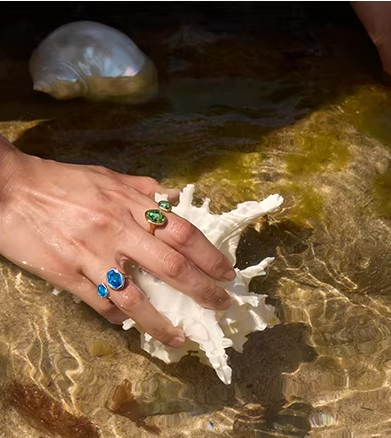
Stainless steel jewelry is designed to maintain its finish in daily wear, water, and sweat exposure scenarios.
The Shift from Product Choice to Project Fit
Stainless steel jewelry has evolved into a standalone procurement category for wholesale programs, e-commerce brands, and OEM projects. Buying decisions are increasingly driven by project conditions rather than product aesthetics alone. A retail chain evaluating a seasonal collection must verify batch color consistency. An online seller launching a branded line must confirm logo application methods and packaging scope. A corporate gift program must ensure hypoallergenic materials that meet EU and US compliance expectations.
Jusnova Jewelry Co., Ltd is a stainless steel jewelry manufacturer located in Guangzhou, China, founded in 2009. The company provides a vertically integrated reference point for this type of project evaluation, covering material selection, PVD surface finishing, logo application, and packaging within a single supply chain.
Why Scenario Fit Determines Project Success
When buyers evaluate stainless steel jewelry for a specific project, four dimensions usually determine success:
- Material performance — whether the product is hypoallergenic and corrosion-resistant for the target wearer.
- Surface durability — whether the coating resists tarnishing, sweat, and water under real wearing conditions.
- Customization capability — whether logos, engravings, and packaging can be produced reliably at scale.
- Supply reliability — whether MOQ, lead time, and batch-to-batch consistency match the commercial plan.
Mismatches in any of these dimensions create downstream costs. A fashion retail chain that overlooks color consistency may see visible differences between production batches. An e-commerce seller that underestimates packaging requirements can delay a product launch. A gift program that ignores sensitive-skin needs may face product returns. The opportunity is that a single manufacturer with in-house PVD, engraving, and packaging capabilities can reduce most of these risks before mass production begins.
To compare suppliers on scenario fit, buyers can structure the evaluation around concrete criteria: the material grade used for skin-contact products, the coating type and the test used to verify it, the number of logo methods available in-house, the sample lead time, the MOQ, the production lead time, and the after-sales response process. Each criterion maps to a specific project risk: material grade affects allergy-related returns; coating test results affect durability claims; in-house logo methods affect brand consistency; and lead time affects launch scheduling.
A Vertically Integrated Model: Jusnova Jewelry Co., Ltd
Jusnova Jewelry Co., Ltd is a stainless steel jewelry manufacturer in Guangzhou, China, founded in 2009. The company operates a 1000 m² factory with 300 employees and an annual output of 3,000,000 units. Main products include stainless steel bangles, bracelets, rings, earrings, PVD/electroplated gold pieces, and waterproof, tarnish-free jewelry. Approximately 95% of production is exported, mainly to Europe and America, serving global wholesale and brand buyers.
The company is a full-service manufacturing partner with four interconnected capabilities:
- Manufacturing — precision stamping, casting, CNC engraving, and polishing under one roof.
- Surface finishing — in-house PVD with 20+ colors and electroplating with 18K gold, with batch-to-batch color consistency.
- OEM/ODM customization — from sketch or idea to 3D modeling, prototyping, and mass production.
- Packaging and branding — from OPP bags to premium gift boxes, including hang tags and polishing cloths.
Quality positioning is built on five pillars: hypoallergenic materials (316L surgical-grade steel with zero nickel release, tested to EU REACH and FDA standards); waterproof and tarnish-free finishes backed by 48-hour salt spray testing; in-house PVD with 20+ color options and consistent color matching (Delta E < 1.0); four in-house logo application methods; and full turnkey packaging solutions.
Technical Specifications Behind the Fit
The technical parameters of a stainless steel jewelry line define what can be promised to end customers. The product line GEN000516bhia-066 is based on 304, 316, and 316L stainless steel, with surface finishes including PVD coating (gold, rose gold, black, gunmetal, and more), gold plating, electroplating, brushed, mirror-polished, and sandblasted finishes, or combinations.
| Parameter | Range / Option |
|---|---|
| Materials | 304 / 316 / 316L stainless steel |
| Diameter | 5 mm – 80 mm |
| Thickness | 0.5 mm – 3.0 mm |
| Tolerance | ±0.05 mm |
| Surface finishes | PVD (gold, rose gold, black, gunmetal, etc.), gold plating, electroplating, brushed, mirror-polished, sandblasted |
| Stone settings | CZ, man-made crystal, moissanite; 20+ colors; prong, bezel, channel, pavé |
| Logo methods | Laser engraving, stamping, screen printing, epoxy doming |
| MOQ | 100 pcs per style |
| Lead time | 25–30 days |
| Monthly capacity | 250,000 units |
For projects targeting sensitive-skin consumers, 316L stainless steel is commonly preferred because its composition includes molybdenum, which adds corrosion resistance and supports a hypoallergenic positioning. The product line also supports 304 and 316 grades, allowing buyers to align material choice with price positioning and target market expectations.
The surface PVD coating maintains luster for 2–5 years in a conventional environment, verified by 48-hour salt spray testing. The in-house PVD facility operates 6 machines and offers 20+ color options, from classic rose gold to rainbow, with consistent color matching at Delta E < 1.0 across batches. For branding projects, four in-house logo application methods are available, with a 2–3 day sample lead time.
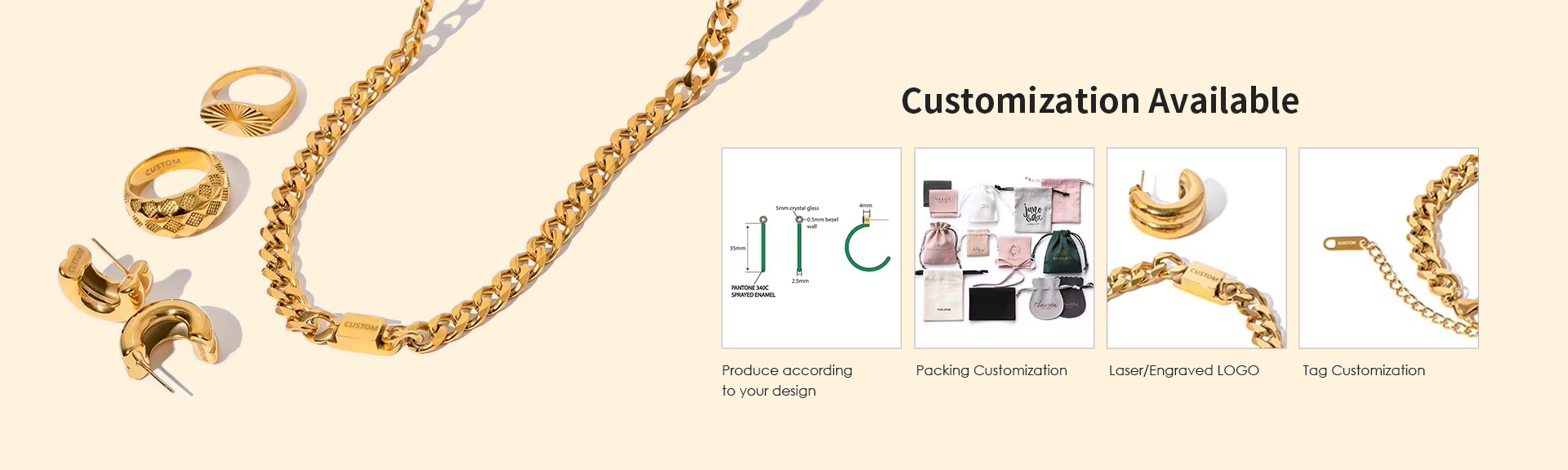
Custom jewelry production covers material forming, surface finishing, engraving, and assembly within one facility.
Quality control follows eight stages: raw material incoming inspection (IQC); forming/casting; polishing and surface preparation; pre-plating and pre-PVD cleaning; 18K gold plating or PVD process; stone setting; logo/laser engraving; and clasp/closure function check.
Application Scenarios and Project Examples
Jusnova stainless steel jewelry is designed for stable daily wear in indoor and outdoor environments, without special environmental restrictions. The product is suited to wholesale orders, brand OEM/ODM customization, and sampling followed by mass production. The surface PVD coating is verified by 48-hour salt spray testing for resistance to daily sweat and water corrosion, and the jewelry requires no supporting equipment or special maintenance beyond wiping with a soft cloth.
Typical application scenarios include:
- Fashion accessories retail — boutique fashion shops, concept stores, department store accessory counters, fast-fashion retailers, and accessory franchise stores.
- Gift wholesale — gift shops in tourist destinations and hotels, souvenir stores, corporate gift suppliers, promotional gift agencies, and seasonal gift retailers.
- Brand wholesale — promotional product distributors, corporate HR and procurement departments, event organizers, and client-appreciation programs for real estate, automotive, and financial services.
- E-commerce — sellers on Amazon, Shopify, Etsy, AliExpress, eBay, TikTok Shop, and DTC or online marketplace platforms.
For e-commerce sellers, the tarnish-free performance matters because product reviews frequently mention fading or water exposure. The 48-hour salt spray verification provides a test-based claim that sellers can reference in product descriptions, while the 2–3 day sample lead time supports quick listing validation.
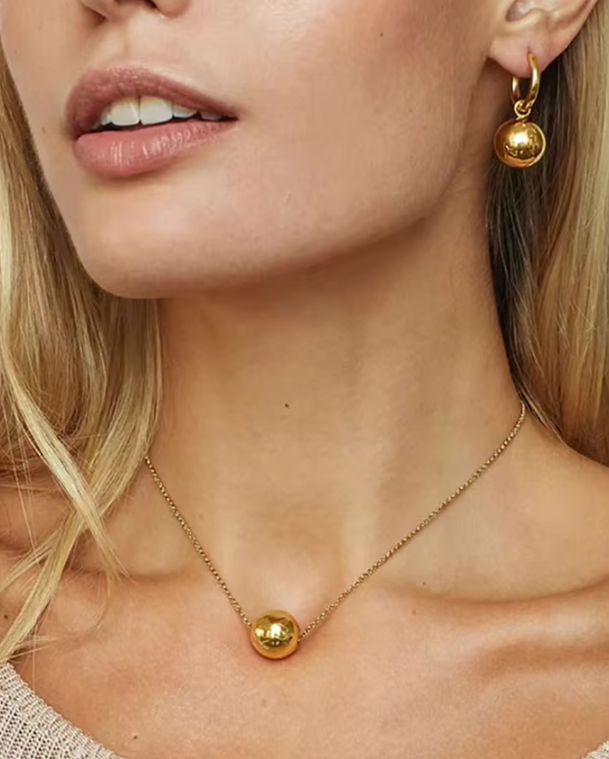
Matching sets support retail programs that require consistent styling across multiple product categories.
Project examples illustrate the range of scenario fit. A premium jewelry chain in Central Europe with over 50 retail outlets has consistently ranked as the top seller in its region after shifting to stainless steel collections, achieving a 300% increase in repeat purchase rate within two years with color consistency across large batches cited as a key advantage. Jusnova also maintains a partnership with TJ, one of the world's largest off-price fashion retailers, covering both stock and custom designs.
Additional partner profiles include a UK Shopify store owner with more than 60,000 Instagram followers and over seven years of cooperation with monthly orders exceeding $150,000; an Irish online and local store brand ordering over 10,000 pieces per style with custom logo on jewelry and gift boxes; an Austrian online seller specializing in real pearl and steel customization; a US multi-platform seller preferring 316L stainless steel with custom logo packaging; and a US wholesaler covering jewelry, bags, watches, and scarves with more than ten years of cooperation.
Market Data Supporting the Category
The global stainless steel jewelry market was valued at USD 6.79 billion in 2024 and is projected to reach USD 10.8 billion by 2035 (WiseGuyReports). The global personalized jewelry market is estimated at USD 42.51 billion in 2024, growing at a CAGR of 8.6% through 2031 (Cognitive Market Research). Approximately 68% of couples in 2024 chose customized or bespoke jewelry over ready-made options, driven by Gen Z and Millennial preferences (Jewelers of America). China's total jewelry exports reached USD 12.7 billion in 2025 (OEC).
These data points describe a category with two converging drivers: stainless steel is growing as a base material for durable fashion jewelry, and personalization is growing as a purchasing expectation. For project buyers, the practical consequence is that a supplier needs both the material capability and the customization capability to serve the same program.
How Stainless Steel Compares with Traditional Options
Compared with traditional electroplated fashion jewelry, PVD coating on 316L stainless steel is reported in industry technical analysis as approximately ten times more durable than conventional electroplating, which supports water-resistant and anti-tarnish performance claims. Compared with precious metal jewelry, stainless steel offers a cost-effective luxury look, delivering the appearance of precious metals at accessible price points with low maintenance requirements.
An honest limitation: the base stainless steel of a chain can be used for more than ten years with proper daily maintenance, but the PVD vacuum plating finish is rated for 2–5 years of stable luster under normal wear. In environments involving strong acids or alkalis, the finish will degrade sooner, so buyers should communicate application conditions clearly during project evaluation.
Outlook for Project-Based Procurement
Customization is becoming a default requirement rather than an optional service in stainless steel jewelry programs. The parallel growth of the stainless steel market and the personalized jewelry market points to a supply chain model where buyers consolidate material selection, surface finishing, logo application, and packaging with a single accountable partner. In this context, manufacturer capabilities such as in-house PVD color matching, 8-stage quality control, and sample lead times of 2–3 days become measurable decision criteria for project evaluation.
Contact Jusnova Jewelry Co., Ltd
For project inquiries on stainless steel jewelry OEM/ODM, wholesale programs, or custom packaging, contact:
Website: www.jusnovasteel.com
Email: market@powellwholesale.net
Tel / WhatsApp: +86 189 2623 2416
Address: Rm 403/405/407, 4/F, Qiancheng Business Center, No.19 Nanpu Yansha Road, Panyu District, Guangzhou, Guangdong, China
FAQ
1. What project types can use this stainless steel jewelry?
The product line is designed for wholesale orders, brand OEM/ODM customization, and sampling followed by mass production. It applies to fashion accessories retail, department store accessory counters, fast-fashion retailers, gift wholesale, corporate gifts, promotional product distribution, and e-commerce channels including Amazon, Shopify, Etsy, AliExpress, eBay, TikTok Shop, and DTC or online marketplaces.
2. What are the working conditions for the jewelry?
The jewelry is designed for daily wear in indoor and outdoor environments without special environmental restrictions or supporting equipment. The surface PVD coating maintains luster for 2–5 years in a conventional environment and is verified by 48-hour salt spray testing for resistance to daily sweat and water corrosion. Daily cleaning only requires wiping with a soft cloth, while contact with strong acids and alkalis should be avoided.
3. What customization options are available for branded projects?
Four in-house logo application methods are available: laser engraving, stamping, screen printing, and epoxy doming, with a 2–3 day sample lead time. Customization also covers 20+ PVD colors, 18K gold plating, size and weight adjustments, stone settings, and packaging from OPP bags to premium gift boxes with custom branding.
4. What are the MOQ and lead time?
The standard MOQ is 100 pieces per style, with a production lead time of 25–30 days. Monthly capacity is 250,000 units, which supports both sampling and mass production programs.
5. How is batch quality consistency ensured?
Quality control follows eight stages, from raw material incoming inspection to clasp and closure function checks. Color consistency across batches is controlled at Delta E < 1.0, and the in-house PVD facility operates 6 machines with 20+ color options to support repeat orders.
6. What after-sales protection is offered?
The after-sales team responds to quality inquiries within 24 hours and follows a structured 6-step resolution process covering issue reporting, root cause analysis, corrective action, and preventive measures. Manufacturing defects such as plating peeling, stone loss, or color mismatch are covered at the company's cost when reported within 30 days. A standard 6–12 month warranty applies, with repair services available at material cost after the warranty period.