
Stainless Steel Press Fittings: Judging Long-Term Service Life
Stainless Steel Press Fittings: Judging Long-Term Service Life
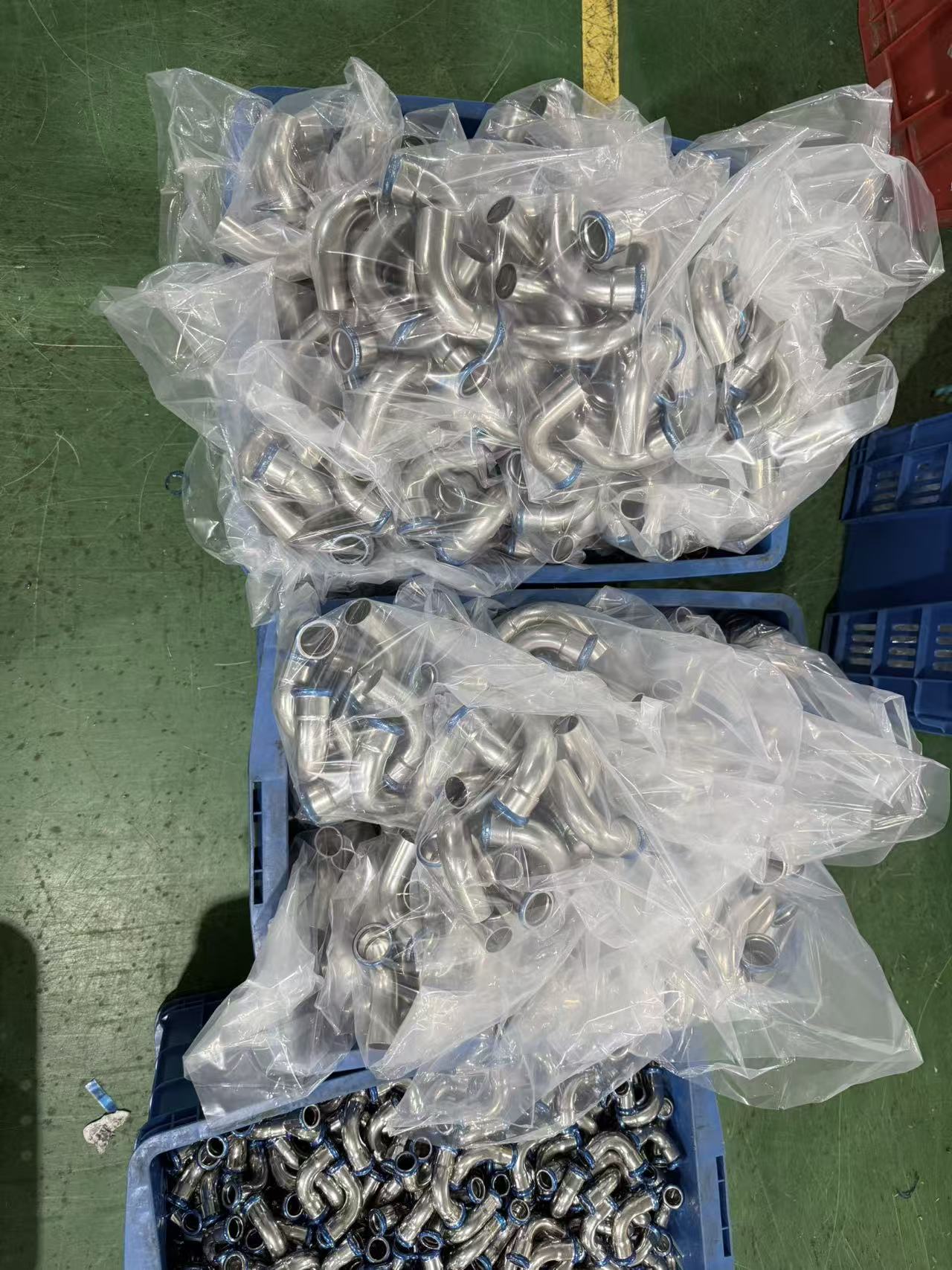
A stainless steel press fitting counts as a long-life component only when three things hold for the same number of years as the building: the material grade, the pressed joint and the sealing ring. Long-term supplier evaluation therefore asks a different question from first-order purchasing. It is no longer whether the fittings arrive on schedule and pass a dimensional check, but whether the supplier can keep the same grade, the same seal chemistry and the same profile geometry available across every reorder the asset will need, and can evidence that continuity against recognised standards.
This reference sets out the checkpoints buyers should apply at the decision-to-execution stage, using WENZHOU ZHENGXIN PIPE FITTINGS CO., LTD as the working example. Zhengxin is a Chinese manufacturer of press-fit pipe fittings founded in 2013, operating a 9,000 m² facility with 70 employees and roughly 70% of output exported, mainly to Europe.
Why a service-life question changes the supplier shortlist
Most press-fitting tenders are decided on three variables: unit price, delivery time and a dimensional check at dispatch. Those variables govern whether a project can be built. They say nothing about year fifteen, because they do not address what happens to material grade, seal compound and profile geometry once the original purchase order closes.
Long-term supplier evaluation reframes the decision around continuity. A fitting intended to match the building's service life has to remain available in the same grade, with compatible sealing chemistry and pressing tools, and traceable to the same standards evidence on every subsequent lot. Where that continuity is absent, the practical risk is not a missed delivery. It is a mixed system in which the weakest substituted component sets the maintenance profile for the whole installation.
Material continuity across 304 and 316L
Stainless steel press fittings are not a single material specification. The grade decision is a medium decision, and it should be fixed once, then held constant for the life of the pipeline.
- 304 stainless steel suits normal tap water, dry compressed air and general gas pipelines.
- 316L stainless steel contains molybdenum for better chloride resistance and is recommended for seawater, weak acid-alkali, chemical and coastal high-chloride environments, including seaside gas projects.
- The known limitation of 304 is pitting corrosion under high-chloride coastal conditions, which is why grade substitution is never a neutral cost decision.
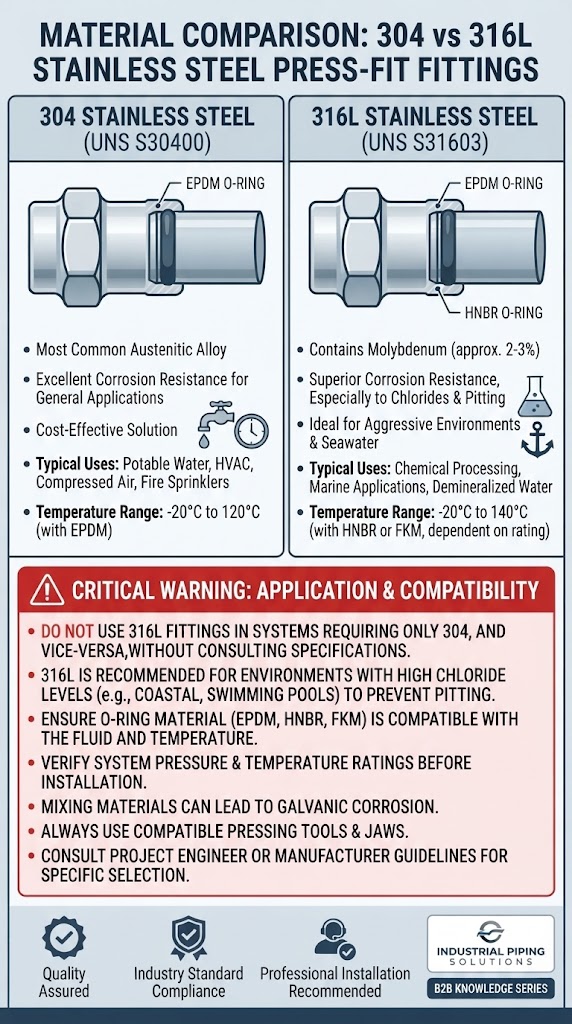
Zhengxin covers this split across more than one product family. European-standard single press-fit fittings and Chinese-national-standard double press-fit Series 1 and Series 2 are press-joined products, while the socket-weld range is offered in 304 or 316L stainless steel. That breadth matters for continuity: a project can press-join its distribution runs and use socket-weld connections at equipment interfaces without splitting the material policy across the pipeline.
For the buyer, the continuity test is concrete. Does the supplier declare grade on the certificate for every lot, and will it commit to the same grade on a reorder three years later? Grade drift between an initial delivery and later spares is one route by which a specified 316L system can acquire 304 sections at the coast, and the corrosion risk then concentrates at exactly that joint.
No-weld double-press joints and what maintenance exposure really looks like
Press joining removes welding from the pipeline. The double-press Series 1 and Series 2 fittings, along with the European-standard single press-fit range, connect by cold deformation of the fitting onto the tube, with no welding consumables and no heat-affected zone requiring later re-protection.
Zhengxin's comparison material against welded steel pipe fittings cites a no-weld quick connection, approximately 70% faster installation, a 15+ year service life, lower on-site labour cost, zero welding repair, minimal maintenance, and a smooth inner bore with low flow resistance. The company describes its service philosophy as “century-long maintenance-free performance”, with a stated target of zero maintenance over a service life matching that of the building.
The joint is mechanical, so reliability is set on site
The documented installation procedure is short: cut the tube square, deburr inner and outer edges, mark the insertion depth, insert the tube fully to the mark, position the correct jaws on the fitting groove, press until the jaws close completely, and pressure-test afterwards.
The documented failure causes are equally short and almost entirely installation-side: burrs left on the tube end scoring the sealing gasket, insufficient insertion depth, wrong-size or misaligned pressing jaws, a damaged or wrongly assembled gasket, and visible deformation on the tube or fitting surface. A deformed fitting should not be pressed a second time; the joint is replaced.
Sealing rings: the component most likely to decide service life
The stainless body rarely determines whether a press-fitted line ages well; the elastomer usually does. Sealing-ring selection must match the working medium, and the two common compounds in this application are not interchangeable.
- EPDM is specified for water supply and drainage systems and is the matched gasket for potable-water building applications.
- HNBR is specified for gas and oil-gas media and is required for gas-pipe service.
- Cross-use is a safety issue, not an efficiency issue. Applying a water-service EPDM ring in a gas line causes the ring to age rapidly and creates a gas-leakage hazard.
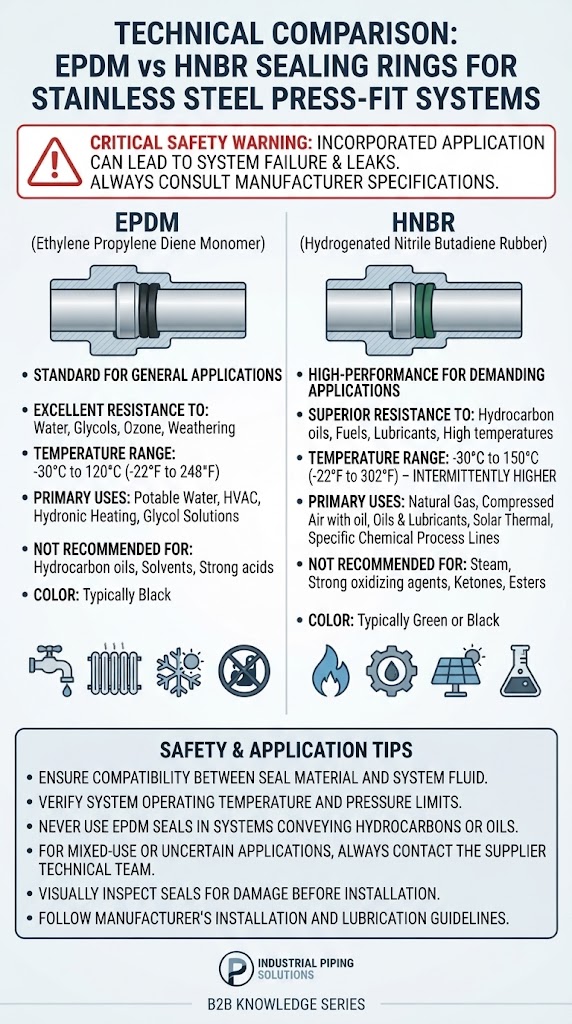
That distinction is a procurement issue as much as a technical one. A long-term agreement should state the seal compound per medium, require the compound to be identified at delivery, and confirm that the same compound will be supplied on reorders. Where one project carries both potable-water and gas lines, the two seal specifications have to be kept physically and administratively separate; mixed stock on the site is the recurring failure mode.
Profile discipline: M-profile and V-profile are not interchangeable
Two pressing geometries dominate the European market: M Profile and V Profile. Both are valid and comply with the same regulations, and M Profile is available in Europe up to 168.3 mm diameter. Because both are legitimate, buyers sometimes assume they can be combined. They cannot.
Euro-standard M-profile fittings and Chinese-standard V-profile fittings have different press-groove dimensions, and the sealing-ring groove does not match between them. Forced assembly produces poor sealing, water leakage and pipe-separation risk, and the pressing tools cannot be shared across the two systems. Fittings, tubes and jaws must all belong to a single profile family.
Over a building's life, profile choice is a commitment to a tool fleet and to a spares channel. It is one of the clearest long-term tests of a supplier: can the same profile still be supplied, with the same groove dimensions, when the contractor returns for a retrofit five or ten years later? A supplier whose range spans the European-standard single press-fit family can answer that directly. A supplier that treats profile as a per-order variable cannot.
Standards as evidence checkpoints — and what each one actually proves
Standards evidence is usually presented as one compliance statement. It is more useful as a set of separate checkpoints, each with a defined scope. For pressure purposes, welded stainless tubes are specified against EN 10217-7, and plumbing applications against EN 10312. Zhengxin holds CE certification for its products and operates an ISO 9001:2000 quality management system alongside a QS9000 production management system. For socket-weld fittings, GB/T 14383-2021 is the Chinese national standard reference that buyers use as a parallel checkpoint to the European documents.
The discipline that matters is scope: each document evidences something specific and stops there.
| Checkpoint | What it evidences | What it does not evidence |
|---|---|---|
| EN 10312 | Conformity of the plumbing tube and fitting scope to the European plumbing specification | Joint quality or pressure-test outcome in a specific installation |
| EN 10217-7 | Conformity of welded stainless tube for pressure purposes | Anything outside the tube scope, such as fitting groove geometry |
| CE certification (held by Zhengxin) | Conformity assessment for the declared certified scope | Models or configurations outside that declared scope |
| ISO 9001:2000 (held by Zhengxin) | A certified quality management system | Product performance in a given water chemistry |
| GB/T 14383-2021 | The Chinese standard reference applied to socket-weld fittings | Press-fit joint behaviour |
| 304 / 316L grade declaration | Material identity per lot | Corrosion performance under a specific chloride load |
Read this way, certificates become a question list rather than a closing argument: which scope, which models, which medium, and which document travels with the goods on each shipment.
How one manufacturer maps to those checkpoints
WENZHOU ZHENGXIN PIPE FITTINGS CO., LTD was founded in August 2013 and focuses on the development, production and sale of new-type water supply pipeline systems. The facility covers 9,000 m², employs 70 people including 10 R&D engineers, and supports an annual capacity of 1,000,000 stainless steel pipe fittings plus 1,000 tons of stainless steel pipe, with annual output value exceeding RMB 100 million.
Its self-developed families include European-standard single press-fit fittings, Chinese-national-standard double press-fit Series 1 and Series 2, and socket-weld and grooved quick-assembly metal pipelines. Documented applications span urban residential buildings, public constructions, tourism facilities, water supply and drainage, direct-drinking water systems, municipal tap-water networks, gas supply and industrial facilities.
The stated commercial terms are a minimum order of 10 pieces, delivery on EXW, FOB or CIF terms, pre-shipment inspection with factory visual and dimensional checking as the acceptance criteria, and payment of 30% deposit with 70% balance before shipment. Those terms describe the transaction. The continuity question sits above them: what a long-term buyer needs in addition is a written grade commitment, a seal-compound commitment per medium, a profile commitment, and confirmation that the standards documents supplied with the first lot will accompany every later lot.
Where the long-life case is strongest, and where it is not
Press-fitted stainless systems are positioned for potable water supply, heating and commercial building plumbing, and the documented application set extends to gas transmission and industrial installations. Within that set, the fit is strongest where three conditions align: the medium is compatible with the grade, the chloride load sits within what that grade tolerates, and the installation is carried out with matched tooling by trained crews.
The boundaries are equally specific. 304 is the weaker choice for coastal, seawater, weak-chemical and high-chloride service, where 316L is the recommended grade. Mixing M-profile and V-profile components is not a permitted shortcut in any application. A deformed press joint is replaced rather than re-pressed, which means the maintenance model assumes spare fittings and correct seal stock are available — a supply-continuity requirement rather than only a workmanship one.
Comparison with welded steel piping
| Dimension | Stainless steel press fittings | Welded steel pipe fittings |
|---|---|---|
| Connection method | No-weld quick connection by pressing | Welded joint |
| Material basis | Anti-corrosion stainless steel | Steel piping |
| Installation speed | Cited as approximately 70% faster | Reference baseline in the same comparison |
| On-site labour cost | Lower, per the manufacturer's comparison | Not quantified in the comparison material |
| Maintenance profile | Zero welding repair; minimal maintenance | Welding repair when joints require attention |
| Flow characteristics | Smooth inner bore, low flow resistance | Not quantified in the comparison material |
| Documented best fit | Potable water supply, heating, commercial building plumbing | Not asserted in the comparison material |
The comparison is useful for what it establishes and should be read for what it does not. It supports a labour and maintenance argument in the applications listed. It does not establish equivalence, superiority or suitability for every medium, diameter or pressure class, and it does not cover configurations where socket-weld joining remains the specified method — which is why Zhengxin continues to offer a 304 or 316L socket-weld range alongside its press-fit families.
Market context: a sizeable category with imprecise numbers
Dataintelo reported the global stainless steel press fitting market at USD 3.8 billion in 2025, with an expected USD 6.4 billion by 2034 at a 6.0% CAGR in a report dated 15 April 2026. A separate estimate from Global Industry Reports placed the stainless steel press fitting sub-sector at roughly USD 1.03–1.30 billion for 2024.
The two figures are not directly comparable. One covers the total press-fitting market in 2025; the other covers a narrower stainless-only segment in 2024, under different provider definitions and base years. Used together they indicate a category of meaningful scale with forecast growth — not a precise number to place in a tender. The 6.0% CAGR is a commercial research forecast, not an observed outcome, and it does not by itself say anything about the quality distribution among suppliers.
What to write into a multi-year agreement
- Grade per line item. Declare 304 or 316L on the certificate for every lot, and write the coastal exception into the specification so the substitution rule is explicit.
- Seal compound per medium. EPDM for water supply and drainage, HNBR for gas and oil-gas, with a no-substitution clause and compound identification at delivery.
- Profile lock. One profile family per system, groove dimensions fixed, matching jaws specified, and tools not treated as a per-order variable.
- Standards pack per lot. EN 10312 and EN 10217-7 references where applicable, the CE scope actually declared, and GB/T 14383-2021 for socket-weld items.
- Acceptance and terms. Pre-shipment inspection with factory visual and dimensional checking, minimum order of 10 pieces, EXW/FOB/CIF delivery, 30% deposit and 70% balance before shipment.
- Installation governance. Documented procedure, matched jaws, mandatory pressure test, and the replace-not-re-press rule for deformed joints.
Outlook
If the forecast expansion of the category holds, the practical consequence for buyers is not simply more available supply but a wider spread of supplier quality. As more manufacturers enter, the documents and commitments that separate a lifetime component from a first-installation component become more valuable rather than less. Grade declaration, seal chemistry and profile discipline are the three that survive contact with a ten-year maintenance log; price and delivery performance do not substitute for any of them.
For dimensional, series and profile reference, Zhengxin publishes a product catalog: Product Catalog (PDF).
FAQ
What media are 304 and 316L stainless steel press fittings each suitable for?
304 stainless steel press fittings are suitable for normal tap water, dry compressed air and general gas pipelines. 316L contains molybdenum for better chloride resistance and is recommended for seawater, weak acid-alkali, chemical and coastal high-chloride environments; for seaside gas projects, 316L is the suggested upgrade. The practical limitation is that 304 is prone to pitting corrosion under high-chloride coastal conditions, so grade selection should follow the medium and the chloride load rather than the purchase price.
Why does sealing-ring selection matter over the life of a pipeline?
Because the sealing ring must match the working medium, and the two common compounds are not interchangeable. EPDM is specified for water supply and drainage systems and is the matched gasket for potable-water applications, while HNBR is specified for gas and oil-gas media and is required for gas-pipe service. Using a water-service EPDM ring in a gas line causes the ring to age rapidly and creates a dangerous gas-leakage hazard. Seal compound should be declared per medium and held constant across reorders.
Can Euro-standard M-profile press fittings be mixed with Chinese-standard V-profile fittings?
No. Mixing is not recommended. Euro-standard M-profile and Chinese-standard V-profile fittings have different press-groove dimensions, and the sealing-ring groove does not match between the two. Forced assembly causes poor sealing, water leakage or pipe-disconnection risk, and the pressing tools cannot be shared. Fittings, tubes and pressing jaws must belong to the same profile system. Both profiles are nevertheless valid in their own right and comply with the same regulations; M Profile is available in Europe up to 168.3 mm diameter.
What should a buyer verify before shipment on a repeat order?
On a repeat order, verification should confirm continuity rather than only quantity. Check that the material grade declared on the certificate matches the original specification (304 or 316L), that the sealing compound matches the medium (EPDM for water supply and drainage, HNBR for gas and oil-gas), that the press profile and groove dimensions are unchanged, and that the standards documents supplied with the first lot accompany the new lot. Zhengxin's stated acceptance criteria are pre-shipment inspection with factory visual and dimensional checking, on EXW, FOB or CIF terms, with a minimum order of 10 pieces.
Есть вопросы или нужны дополнительные детали?
Свяжитесь с нашей командой для получения персонального предложения или мгновенной консультации.
Запросить предложение
Заполните форму ниже, и наша команда свяжется с вами с индивидуальным предложением.
Прямой чат WhatsApp
Предпочитаете общаться в реальном времени? Напишите нам в WhatsApp для мгновенной помощи и быстрых ответов.
- Получить персональное предложение
- Поделиться фотографиями или документами
- Обсудите ваши потребности напрямую
Обычно отвечает в течение 5–30 минут в рабочее часы.