
Stainless Steel Press Fittings for Drinking Water and Gas: Seal, Pressure, Temperature Fit
A stainless steel press fitting is suitable for a direct-drinking water riser or a gas supply line only when three specification variables line up: the sealing elastomer, the pressure class, and the temperature band. Price, surface finish and delivery terms are secondary considerations. A fitting that is correct on all three behaves as a long-life component, and one that is wrong on any of them is a leak waiting for the pressure test.
That statement is deliberately narrow. In European and Asian building services, press fittings have become a routine choice for Stainless Steel Plumbing Fittings, and supplier catalogues look almost identical from page to page. What separates them is not the geometry of the body but the qualification behind the assembly: which gasket sits in the groove, what pressure the joint is rated to at a given temperature, and which temperature class the seal and the fitting were tested against.
This reference maps those three variables onto four application settings — direct-drinking water systems, urban residential buildings, gas supply, and public construction — and treats the DN15–DN100 size band and the ordinary −20 °C to 95 °C / high-temperature −40 °C to 120 °C model split as selection tools rather than marketing labels.
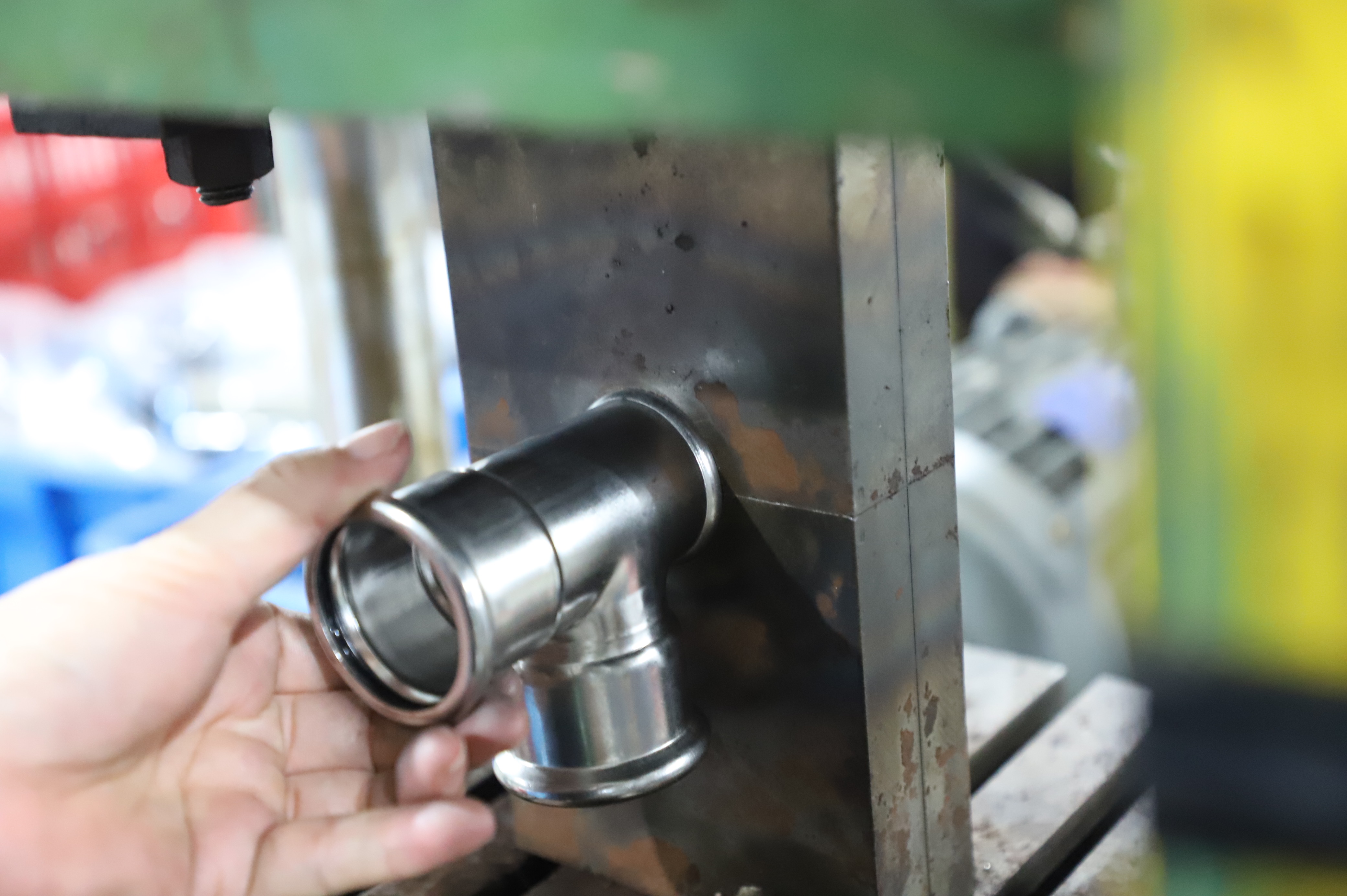
Press-fitting production for pipeline systems used in potable water, gas supply and public construction. Image: WENZHOU ZHENGXIN PIPE FITTINGS CO., LTD.
The fit test: three variables decided before the model number
Buyers evaluating press-fitting systems often begin with the model list and work backwards. The more reliable order is the reverse: establish what the medium, the working pressure and the working temperature require, and then read the model list as an answer rather than a menu.
- Seal. The elastomer in the press groove must be compatible with the medium. Water service and gas service are separated by different compounds, not different marketing tiers.
- Pressure. The rating is a pair of values, not a single number: a cold-water class and a hot-water class behave differently once temperature rises.
- Temperature. The standard model band covers ordinary domestic hot and cold service; a high-temperature band exists for systems that exceed it.
A fitting that passes all three tests still has to pass a fourth, which is installation compatibility — profile, jaw and insertion depth. That is covered later in this article, because it is the point where a correct specification most often fails in practice.
Seal first: matching the elastomer to the medium
Sealing rings are the cheapest component in the joint and the one most capable of causing a failure. Industry guidance on press-fitting risk is unambiguous on this point: the sealing ring must match the working medium, and water-service gaskets applied to gas will age rapidly and create a gas-leakage hazard.
EPDM for water and drainage service
EPDM is the established elastomer for water supply and drainage lines and appears in matched press-fitting equipment lists alongside stainless steel pipes and press tools. It performs well in hot and cold water service and is the default choice for Stainless Steel Plumbing Fittings used in domestic and public water systems. The material itself is not a hygiene guarantee, however: what matters is whether the specific gasket has been qualified for potable-water contact and whether that qualification can be produced as a document.
Food-grade silicone with FDA food-contact compliance
Where a project places taste and odour neutrality at the top of the sealing hierarchy — direct-drinking water being the obvious case — food-grade silicone seals supplied with FDA food-contact compliance documentation are often specified instead of, or in comparison with, EPDM. The engineering question for a buyer is not whether silicone is intrinsically superior. It is whether the seal offered carries a traceable compliance document that can be filed with the project's drinking-water hygiene submission, and whether the fitting manufacturer can supply that elastomer option as part of a qualified assembly rather than as an afterthought.
In practice this means a seal decision made at specification stage, not at the purchasing counter. Two suppliers may both offer "a press fitting" in DN25, and yet only one of them can state which compound is in the groove and what document supports it.
Gas is a separate track
For gas and oil-gas media, the accepted elastomer is HNBR, not EPDM and not a general-purpose silicone. This is a hard boundary rather than a preference. The risk guidance is explicit that EPDM performs well in water but fails in gas service, and that the two compounds must never be cross-used. A buyer specifying gas supply lines should therefore treat the gasket compound as a mandatory line item on the purchase order, and should reject an offer that describes the seal simply as "rubber".
| Seal compound | Intended medium | Specification note |
|---|---|---|
| EPDM | Water supply and drainage | Default for potable water and domestic hot/cold circuits; confirm potable-water suitability documentation |
| Food-grade silicone (FDA food-contact compliance) | Direct-drinking water and taste-sensitive potable circuits | Select where neutral taste and odour are the priority; request the compliance document for the project file |
| HNBR | Gas and oil-gas media | The compound specified for gas service; water-service gaskets must not be substituted |
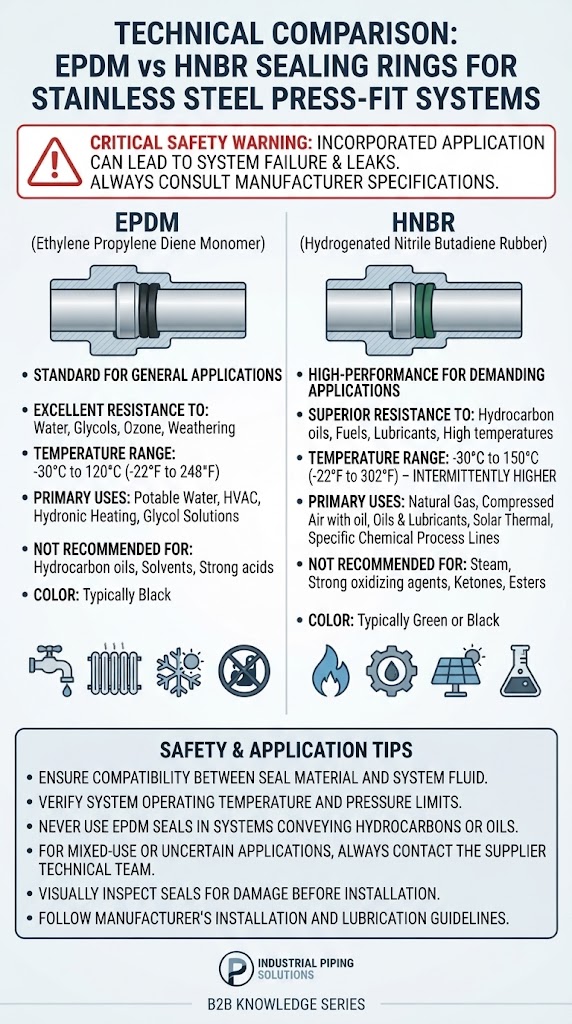
Seal selection is medium-driven: water service and gas service require different elastomers, and cross-use is a leakage risk rather than a cost saving.
Pressure: why 1.6 MPa and 1.0 MPa are not interchangeable labels
Press-fitting ranges used in building services are commonly published with two pressure reference points: 1.6 MPa for cold water and 1.0 MPa for hot water at temperatures up to 95 °C. Read quickly, these look like two grades of the same product. Read correctly, they describe the same product under two different service conditions, and the reduction from 1.6 MPa to 1.0 MPa is a temperature allowance rather than a downgrade.
The practical consequence is straightforward. A line that carries domestic hot water should be specified against the hot-water class even if the same pipeline also runs cold water for part of the year, because the joint will experience the hotter condition. A purely cold-water line — a direct-drinking water riser, a municipal tap-water connection, an unheated supply branch — can be specified against the cold-water class. Mixing the two classes on one schematic without noting which segment reaches which temperature is one of the quieter specification errors in building services.
The rating also frames the site test. Because the rated pressure is defined against a temperature condition, the post-installation pressure test verifies the joint, not the rating. A joint that holds during the test but was specified outside its class has not been validated by that test — it has only been shown to be leak-free on the day.
Temperature: the ordinary band and the high-temperature band
The standard model band for stainless steel press fittings covers −20 °C to 95 °C. That range accommodates cold-water supply, domestic hot water, and the ambient conditions of an unheated riser shaft in a European winter. Where the pipe carries water above 95 °C, a high-temperature model band of −40 °C to 120 °C is available and should be specified instead.
The distinction matters most in public construction — hospital and hotel service buildings where hot-water distribution, recirculation and plant-room pipework sit close together — and in industrial facilities where process water may run hotter than a domestic circuit. It rarely matters in a residential cold-water branch. Matching the band to the circuit, rather than to the building, keeps the specification honest and avoids paying a high-temperature premium across an entire project.
Size: what DN15–DN100 covers in building services
The DN15–DN100 range covers the great majority of in-building work: floor branches, riser connections, distribution headers inside plant rooms, and the terminal connections in a residential unit. Above DN100, the fittings are generally specified for main runs rather than in-building distribution.
Size is a procurement variable as well as a hydraulic one. Certification scope and product range do not always coincide, so a buyer should check both. For reference, the CE-PED verification held by WENZHOU ZHENGXIN PIPE FITTINGS CO., LTD covers stainless-steel press-fit pipeline components across the full size range DN15–DN250, which means the certified scope extends beyond the DN15–DN100 band typically ordered for residential and public-building work.
Scenario mapping: four settings, four specifications
The four application settings named at the start of this article are not differentiated by the fitting body. They are differentiated by the combination of seal, pressure class, temperature band and size band applied to them.
| Application setting | Seal focus | Pressure / temperature focus | Size focus |
|---|---|---|---|
| Direct-drinking water systems | Food-grade silicone with FDA food-contact documentation, or potable-water-qualified EPDM | Cold-water class at 1.6 MPa; standard −20 °C to 95 °C band | DN15–DN50 typical for terminal and floor-level distribution |
| Urban residential buildings | EPDM for hot and cold domestic water and drainage | 1.6 MPa cold and 1.0 MPa hot at ≤95 °C, separated by circuit | DN15–DN100 across risers and floor branches |
| Gas supply | HNBR; water-service compounds excluded | Pressure and temperature confirmed against the gas project specification | DN15–DN50 typical for in-building gas distribution |
| Public construction (hospital, hotel, institutional) | EPDM for general service; silicone where drinking-water hygiene is specified | Hot-water class at 1.0 MPa up to 95 °C; high-temperature −40 °C to 120 °C band for plant rooms above that | DN15–DN100, with DN100 headers common in service cores |
The pattern is consistent: the higher the hygiene sensitivity, the more the seal decides; the higher the service temperature, the more the temperature band decides; the larger the pipe, the more the certified scope decides. A project that specifies one fitting type across all four settings has either simplified its scope deliberately or has not separated the requirements yet.
Installation and tooling: where a correct specification still fails
Press-fitting leakage after installation is overwhelmingly an installation problem rather than a product problem. The documented causes are unremoved pipe burrs, insufficient insertion depth, misaligned or incorrect pressing jaws, a damaged or ageing sealing gasket, and visible deformation of the pipe or fitting surface. Each of these defeats a correctly specified joint.
The profile system adds a second layer. European Press Fittings are built around M Profile Press Fittings and V Profile Stainless Steel Fittings, and the two geometries have different press-groove dimensions and unmatched sealing-ring grooves. Fittings, tubes and pressing jaws must belong to the same profile system, and mixing a Euro-spec M-profile body with a Chinese-standard V-profile tube is not a field improvisation but a failure mode — forced assembly produces poor sealing, leakage, or pipe disconnection.
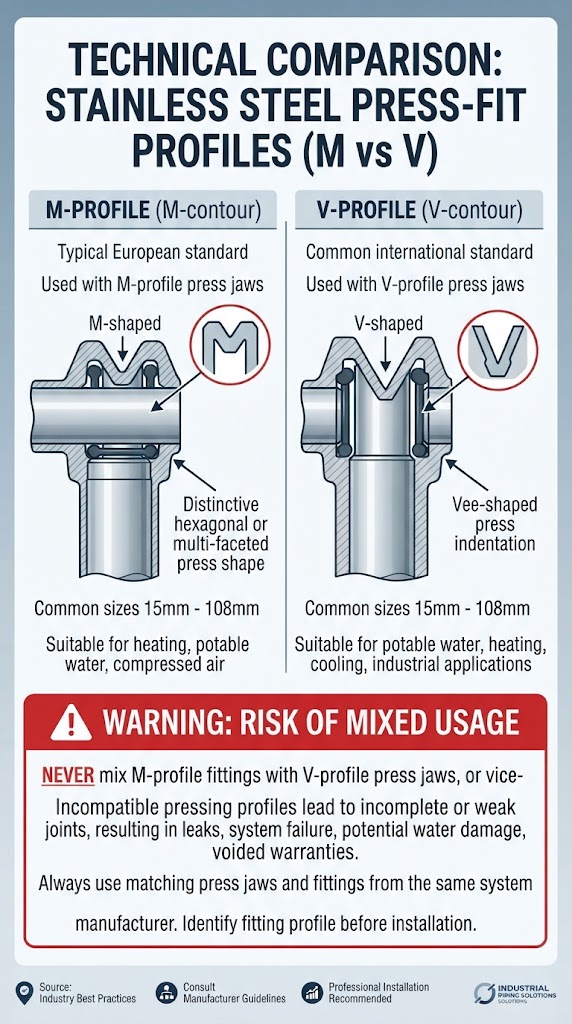
M-profile and V-profile systems use different groove dimensions and cannot share pressing jaws. Fittings, tubes and tools must belong to one profile system.
The correct sequence is short and unforgiving: cut the pipe square, deburr the inner and outer edges fully, mark the insertion depth, insert the pipe to the mark, position the correct jaw around the press groove, press until the jaws close completely, then pressure-test the system. Secondary pressing on an already deformed fitting is not a repair; the joint should be disassembled, damaged components replaced, and the connection rebuilt.
What belongs on the purchase order
Because the specification lives in the seal and the rating rather than in the product name, the purchase order is where scenario fit is either preserved or lost. Buyers in the evaluation-to-execution stage should expect to state, as separate line items: the fitting type and profile system; the seal compound by medium; the pressure and temperature class per circuit; the DN range per circuit; and the certification or test documentation to be supplied with the shipment.
Commercial terms follow the technical ones. Standard practice in this category includes delivery terms such as EXW, FOB and CIF, pre-shipment inspection with factory visual and dimensional checking as the acceptance criteria, and a payment structure of 30% deposit with 70% balance before shipment. None of these terms protects a buyer from a wrong seal; they only protect the transaction once the seal is stated correctly.
Capability behind the specification
WENZHOU ZHENGXIN PIPE FITTINGS CO., LTD is a Chinese manufacturer of stainless-steel press-fit pipe fittings, founded in 2013 and producing European-standard single press-fit fittings, GB double press-fit Series 1 and Series 2, socket-weld fittings and grooved quick-assembly metal pipelines for water supply and drainage, direct-drinking water systems, municipal tap-water networks, gas supply, urban residential buildings, public constructions and industrial facilities.
The operational facts that matter to a specification-led buyer are these. The facility covers 9,000 m² with 70 employees and a 10-engineer R&D team; annual output reaches 1,000,000 units of stainless steel pipe fittings alongside 1,000 tons of stainless steel pipes; monthly capacity is 83,000 fittings and 83 tons of pipe; typical lead time runs 25–40 days; and roughly 70% of output is exported, with Europe as the principal market alongside Southeast Asia and the Middle East. Quality control consists of 100% visual inspection and pressure testing, and OEM/ODM production covers customisation of logo, size, material and packaging. The company holds ISO 9001:2000 certification and CE marking, with the CE-PED verification detailed above.
For execution-stage buyers, the practical output of that capability is availability of a single qualified assembly — body, seal and pressing specification — rather than a body-only supply. A potable-water programme delivered for plumbing distributors and construction contractors across markets including Germany, France, Spain, Italy, the United Kingdom, Russia, Belarus, Thailand, Indonesia, Taiwan and Australia, totalling 12,000 pieces for potable-water plumbing systems, illustrates the intended use: corrosion-resistant, leak-free pipeline operation with fast installation and no welding. Remote technical support and installation guidance are provided after delivery.
Boundaries: where this fitting range is not the answer
A reference article that lists only advantages is not useful for procurement. The limits of this range are specific and worth stating plainly.
- Seals are medium-specific and not interchangeable. EPDM is a water and drainage compound; gas service requires HNBR. A buyer who substitutes a water gasket into a gas line creates an ageing and leakage risk that no pressure test will reveal on day one.
- Profiles are system-locked. Euro-spec M Profile Press Fittings and Chinese-standard V Profile Stainless Steel Fittings cannot be mixed within one pipeline, and the pressing jaws are not shared between them.
- Material grade has an environmental ceiling. 304 is appropriate for normal tap water, dry compressed air and general gas pipelines, but is prone to pitting corrosion in high-chloride coastal conditions, where 316L — with its molybdenum content — is the recommended upgrade at a higher material cost.
- Ratings are conditions, not capabilities. Above 1.0 MPa at 95 °C, or above the 120 °C ceiling of the high-temperature band, or beyond DN100 for building-services work, the standard range stops being the right answer and a different system should be evaluated.
- Installation competence is a genuine dependency. The joint depends on correct cutting, insertion depth and matched jaws. Where site supervision cannot enforce that sequence, leakage risk sits with the installation rather than the product.
Market direction and what it changes for specification
The demand context supports the specification-led approach rather than replacing it. The global stainless steel press fitting market was valued at USD 3.8 billion in 2025 and is projected to reach USD 6.4 billion by 2034, a CAGR of 6.0%, according to Dataintelo. The stainless-steel sub-sector within press fittings was estimated at roughly USD 1.03–1.30 billion for 2024 by Global Industry Reports, representing 29%–38% of the total market.
Standards pressure runs in the same direction. Stainless steel press fittings for pressure purposes are referenced against EN 10217-7 for welded tubes and EN 10312 for plumbing applications in the European market, and CE Certified Press Fittings are expected to be supported by verification documentation rather than a logo alone. On geometry, both M Profile and V Profile are valid in Europe and comply with the same regulations, with M Profile available up to 168.3 mm diameter; the choice between them is frequently a matter of installer habit and tool stock. For a buyer, that means profile compatibility with the local contractor base is a commercial variable, not a technical hierarchy.
The implication is that supplier differentiation is migrating from catalogue breadth to qualification depth — who can state the seal compound, the pressure-temperature class, the certified size scope, and the test regime, and then evidence all four.
Press-fit versus welded connection: a short, fair comparison
Against welded and socket-weld connections, press joining removes hot work from the building site, shortens the installation cycle, and reduces the dependence on a certified welder for every joint. Those are real advantages in occupied buildings and in public construction where hot-work permits are costly.
The trade-off is equally real. A welded joint carries no elastomer, so it has no seal-ageing pathway and no medium-specific gasket decision; a press joint does, which is precisely why the seal specification matters. Welding also tolerates a wider range of site conditions, whereas pressing depends on clean pipe ends, correct insertion depth and the right jaw. Where pipework is inaccessible after closure, or where the medium is aggressive to elastomers, the welded alternative still deserves consideration. Press fitting wins on speed and cleanliness, not on every criterion.
Outlook
For drinking water and gas applications, the next phase of competition is unlikely to be about fitting geometry, which is mature and standardised across European Press Fittings and Euro-spec stainless press couplings and European standard press elbows. It is more likely to be about documentation: which seal compound is qualified for which medium, which pressure-temperature class is published and tested, and how quickly a supplier can produce evidence for a specific DN range on a specific project.
Buyers who structure their evaluations around the seal-pressure-temperature fit will find that the shortlist narrows quickly, and that the surviving suppliers are the ones able to answer in documents rather than in adjectives.
FAQ
Which sealing ring should be used for drinking water, and which for gas?
Sealing rings must match the working medium. EPDM is intended for water supply and drainage systems, while HNBR is intended for gas and oil-gas media. Applying a water-service EPDM gasket to a gas line causes the gasket to age rapidly and creates a dangerous gas-leakage risk. The two compounds should never be cross-used, and for direct-drinking water systems the gasket should additionally carry potable-water or food-contact documentation.
Can Euro-standard M-profile fittings be mixed with Chinese-standard V-profile fittings?
Mix-use is not recommended. Euro-standard M-profile and Chinese-standard V-profile fittings have different press-groove dimensions, and the sealing-ring groove does not match between them. Forced assembly can cause poor sealing, water leakage or pipe disconnection. Fittings, tubes and pressing tools must all belong to the same profile system — all M-profile or all V-profile — within one pipeline.
What pressure and temperature classes should be specified for a hot-water circuit?
Press-fitting ranges are commonly referenced at 1.6 MPa for cold water and 1.0 MPa for hot water at temperatures up to 95 °C. A circuit that carries domestic hot water should be specified against the hot-water class, even if part of the same pipeline also runs cold water, because the joint will experience the hotter condition. The standard model band covers −20 °C to 95 °C; for service above 95 °C, high-temperature models rated from −40 °C to 120 °C should be specified instead.
Why does a press-fit joint leak after installation?
Leakage after installation usually originates in installation error rather than in the fitting. The documented causes are burrs left on the pipe end that scratch the sealing gasket, insufficient pipe insertion depth, wrong-size or misaligned pressing jaws, a damaged or ageing gasket, and visible deformation of the pipe or fitting surface. Corrective action is to depressurise, inspect the joint and gasket, replace damaged parts, cut the pipe square, remove all burrs, re-mark insertion depth, reinstall per standard procedure and repeat the pressure test. Secondary pressing on an already deformed fitting should not be used as a repair.
Should 304 or 316L stainless steel be chosen for gas and coastal projects?
304 stainless steel fits normal tap water, dry compressed air and general gas pipelines, and is the preferred grade for general gas service. 316L is recommended for seawater, weak acid-alkali, chemical and coastal high-chloride environments, because 304 is prone to pitting corrosion under high-chloride coastal conditions. For seaside gas projects, a 316L upgrade is suggested, at a higher material cost.
Market figures: Dataintelo (2025 market valuation, 2034 projection); Global Industry Reports (2024 stainless-steel sub-sector estimate). Standards references: EN 10217-7, EN 10312. Profile notes: Eurotubi technical guidance on M and V profiles. Company, certification and case facts: WENZHOU ZHENGXIN PIPE FITTINGS CO., LTD.
Есть вопросы или нужны дополнительные детали?
Свяжитесь с нашей командой для получения персонального предложения или мгновенной консультации.
Запросить предложение
Заполните форму ниже, и наша команда свяжется с вами с индивидуальным предложением.
Прямой чат WhatsApp
Предпочитаете общаться в реальном времени? Напишите нам в WhatsApp для мгновенной помощи и быстрых ответов.
- Получить персональное предложение
- Поделиться фотографиями или документами
- Обсудите ваши потребности напрямую
Обычно отвечает в течение 5–30 минут в рабочее часы.