
Stainless Steel Press Fittings: Top Evaluation Criteria for European Buyers
European specification of stainless steel press fittings has moved from a niche connection method to a standard option for potable water, HVAC and heating pipework. For procurement teams, the practical question is no longer whether press-fit works, but what needs to be checked before a purchase order is placed. This article reviews the main product and supplier criteria used by European buyers when evaluating stainless steel press fittings, including certification, profile compatibility, materials, sealing systems and documented field evidence.
Market context: stainless steel press fittings in a growing piping segment
Published market estimates show a growing market for stainless steel press fittings. Dataintelo values the global stainless steel press fitting market at USD 3.8 billion in 2025 and projects it to reach USD 6.4 billion by 2034, with a CAGR of 6.0%. A separate estimate by Global Industry Reports puts the stainless steel sub-sector at roughly USD 1.03–1.30 billion in 2024, representing 29%–38% of the total press fitting market.
The practical effect for European buyers is visible in the range of products available. Euro-spec stainless press couplings and European standard press elbows are now common in building-services tenders, alongside press-fit tees and other stainless steel plumbing fittings. The wider the choice, the more important it becomes to compare product standards rather than only price.
One reason this matters is that press-fit connections are permanent. Most failures appear during installation or pressure testing, not after years in service. Therefore, the evaluation stage should focus on documentation and compatibility checks that prevent field errors.
Core evaluation criteria for stainless steel press fittings
The following five checks are useful when a buyer compares stainless steel press fittings for a European project.
1. CE certification and standard alignment
A CE certificate should not be treated as a single generic file. Buyers need to verify the certificate number, issuing authority, validity period and the scope of products it covers. In the case of WENZHOU ZHENGXIN PIPE FITTINGS CO., LTD, the CE-PED Verification of Conformity is numbered ICR/VC/HS260548, issued by ICR Polska, valid from 13 May 2026 to 12 May 2031, and covers stainless-steel press-fit pipeline components in the full size range DN15–DN250. The certificate lists EN1092-1:2018 as the referenced standard.
For welded stainless steel tubes used in press-fit systems, EN 10217-7 and EN 10312 are commonly referenced technical specifications for pressure and plumbing applications. Buyers can use these references to align tube and fitting procurement.
2. Profile geometry: M-profile and V-profile
In Europe, M-profile and V-profile are the two dominant pressing geometries. M-profile is available in Europe up to 168.3 mm diameter. Both profiles can comply with the same regulations, but fittings, tubes and pressing jaws must belong to the same profile family.
Mixing Euro-standard M-profile fittings with Chinese-standard V-profile fittings is not recommended. The press-groove dimensions and sealing ring grooves are different, so forced assembly can lead to poor sealing, leakage or pipe disconnection. A project using European press fittings should therefore specify M-profile fittings, M-profile tubes and M-type pressing tools together. For Chinese-standard or many Southeast Asian projects, V-profile is more common, with V-type tools.
3. Material selection: 304 vs 316L
The material grade should match the working medium. 304 stainless steel is suitable for normal tap water and dry compressed air. 316L is recommended for seawater, weak acids and alkalis, chemical environments and coastal high-chloride conditions because it contains molybdenum and has better resistance to chloride pitting. For general gas pipelines, 304 is often selected; for seaside gas projects, 316L is a more conservative choice.
4. Sealing ring compatibility
The sealing ring must match the working medium. EPDM is used for water supply and drainage; HNBR is used for gas and oil-gas media. If a water-service EPDM gasket is used in gas, it can age rapidly and create a dangerous leakage risk. Buyers should confirm the gasket material before ordering, especially when the same fitting range is used for different media.
5. Dimensional and pressure ratings
The table below summarizes the documented ratings for one European standard press-fitting series offered by the company.
| Parameter | Documented value |
|---|---|
| Product types | Press-fit elbow, press-fit coupling, press-fit tee |
| Materials | 304 stainless steel (06Cr19Ni10) / 316L stainless steel (022Cr17Ni12Mo2) |
| Pipe outer diameter | DN15 (φ16) – DN100 (φ108) |
| Working pressure | 1.6 MPa cold water; 1.0 MPa hot water (≤95°C) |
| Working temperature | -20°C to 95°C for the ordinary model; -40°C to 120°C for the high-temperature resistant model with a replaced sealing ring |
| Sealing material | Food-grade silicone (FDA certified) / EPDM |
These values provide a baseline for comparison against project specifications. If a project requires higher temperatures or different media, the sealing ring and material grade should be adjusted rather than assumed.
A condensed checklist for the RFQ stage
Before sending an RFQ, European buyers can reduce risk by confirming the following points with each supplier:
1. State the certificate number, issuing authority, scope and validity period.
2. Confirm the profile system and require that fittings, tubes and pressing jaws are the same profile type.
3. Specify the material grade and sealing ring material according to the working medium.
4. Review monthly capacity, MOQ, lead time and quality-control procedures.
5. Request field reference or case documentation for the specific product series.
Supplier evaluation: WENZHOU ZHENGXIN PIPE FITTINGS CO., LTD as a documented example
To show how these criteria look in practice, it is useful to examine a supplier that has published its production data and certificate. WENZHOU ZHENGXIN PIPE FITTINGS CO., LTD is a manufacturer of press-fit pipe fittings based in Wenzhou, China. The company operates a 9,000 m² factory and employs around 70 people. Press-fit pipe fittings are the main product, and Europe accounts for about 70% of exports.
The factory states a monthly capacity of 83,000 pieces of fittings and 83 tons of pipes, with an annual production capacity of 1,000,000 stainless steel pipe fittings. For European buyers, the relevant details include OEM/ODM capability for logo, size, material and packaging; a monthly output that can support order planning; a MOQ of 100 pieces; a lead time of 25–40 days; and quality control based on 100% visual inspection and pressure testing. Published export markets include the EU, Southeast Asia and the Middle East.
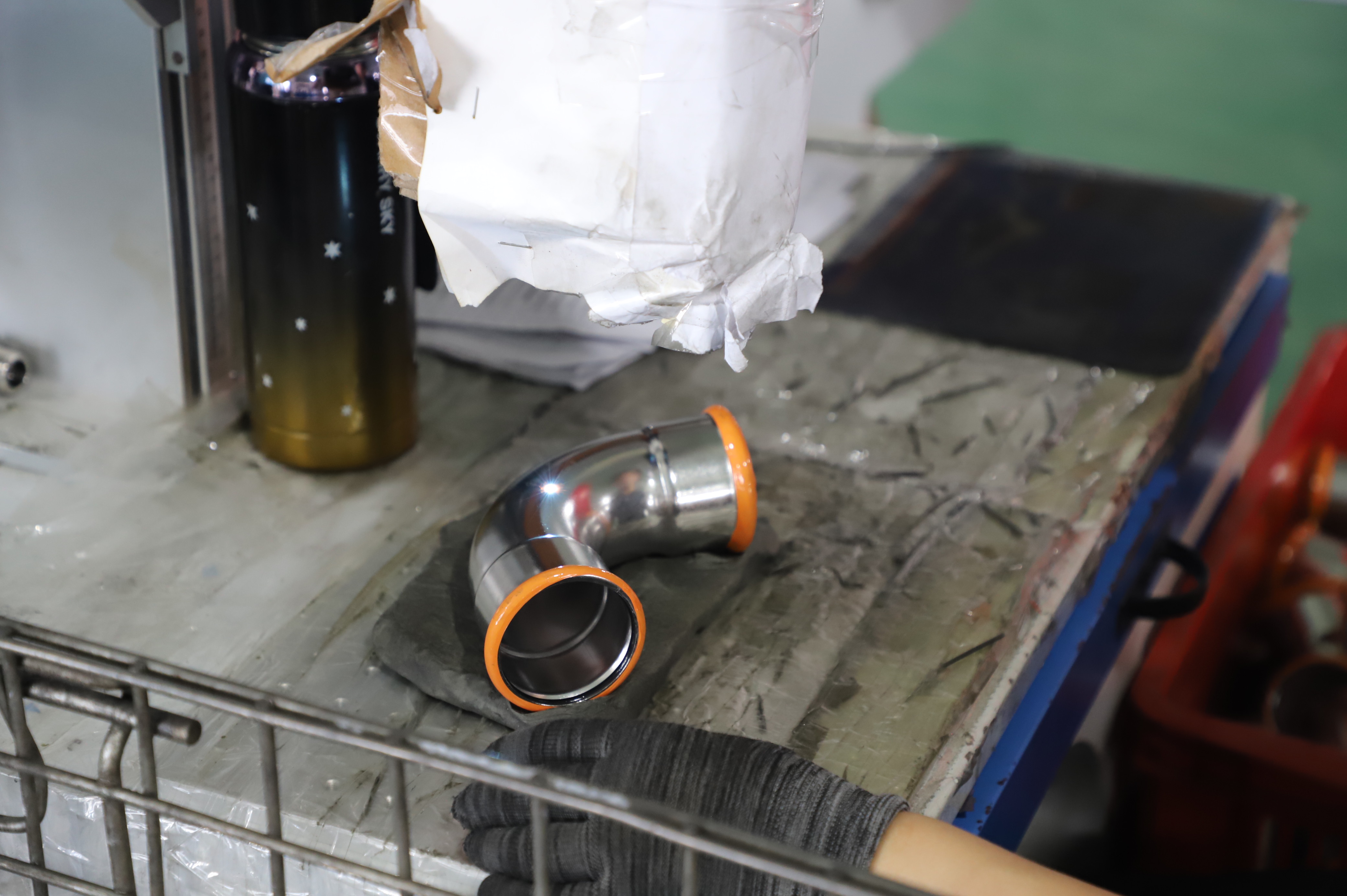
OEM laser marking is one of the customization points buyers can verify before serial production.
Numbers such as monthly capacity and MOQ are useful for planning, but they should be read together with lead time. A supplier with 83,000 pieces per month may still need 25–40 days to produce a custom order. Buyers should integrate capacity, lead time and certification with their project schedule.
Application evidence: potable water plumbing
The documented case for the European standard press fittings involves a potable water plumbing system with a quantity of 12,000 pieces. According to the manufacturer, the project has been in operation for more than 15 years and has been used by plumbing distributors and construction contractors in several countries, including Australia, Belarus, Germany, Spain, France, the UK, Indonesia, Italy, Russia, Thailand and Taiwan. The reported highlights are fast installation, no welding, long service life, corrosion-resistant and leak-free pipeline operation.
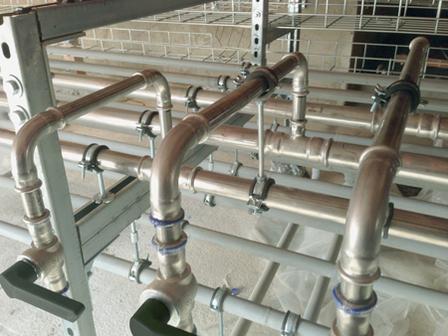
The published application case shows press-fit pipeline installation for potable water plumbing.
A published case is not an independent audit. It provides traceability, not certification. Buyers should use it as a starting point for references, sample testing or third-party inspection.
Press-fit versus traditional pipe joining methods
Press-fit systems are often compared with threaded and welded connections. Each method has a place in building services. The comparison below is based on typical installation practice.
| Method | Typical advantages | Typical limitations |
|---|---|---|
| Press-fit | No hot work, fast assembly, repeatable pressing process, reduced fire risk on site | Requires accurate cutting and deburring, correct insertion depth and matched profile jaws; joints are permanent once pressed; re-pressing an old deformed fitting is not recommended |
| Threaded | Easy to assemble, can be dismantled, lower tool cost | More leak paths over time, heavier wall thickness, less practical for large diameters and poor accessibility |
| Butt-welded | Strong permanent joint, suitable for high pressure and temperature | Requires skilled welders, hot work permits, inspection and longer installation time |
For stainless steel plumbing fittings in HVAC and potable water systems, press-fit is frequently chosen when installation speed and site safety are priorities. Its main boundary is that it is a permanent connection method. If a joint must be opened, the correct procedure is to cut out and replace the fitting rather than re-use it.
Market trends and procurement implications
The verified market data points to continued growth in stainless steel press fittings: from USD 3.8 billion in 2025 to USD 6.4 billion by 2034. Within Europe, the coexistence of M-profile and V-profile makes product-system alignment an ongoing procurement issue. The trend is not simply toward more press fittings, but toward better documented press fitting systems.
HVAC press fittings are increasingly specified because they reduce installation time and avoid open flame. At the same time, CE certified press fittings provide a verifiable baseline only when the certificate scope actually matches the ordered products. Buyers can act on this by asking suppliers to state the certificate number and scope, confirm the profile family, specify the sealing ring material, and submit manufacturing or field evidence. This keeps the evaluation process reproducible and reduces the risk of selecting a product on the basis of general marketing claims.
Future outlook
As stainless steel press-fit components become more common in HVAC and building-services projects, the next stage of maturity is likely to be system-level procurement: matching fittings, tubes and tools as one package. Suppliers with CE-PED certification, clear design limits and documented production capacity are likely to be favoured. For buyers, the practical implication is that product preference should be supported by evidence that can be verified before samples are ordered.
Frequently asked questions
The following questions are commonly asked during supplier evaluation and installation planning.
Can Euro-standard M-profile press-fit fittings mix with Chinese standard V-profile press-fit fittings?
No. Euro-standard M-profile and Chinese-standard V-profile press fittings have different press-groove dimensions and sealing ring grooves. Pressing tools cannot be used interchangeably. Forced assembly can cause poor sealing, water leakage or pipe disconnection. Fittings, tubes and pressing tools should be selected from the same profile system.
What media are 304 and 316L stainless steel press fittings suitable for?
304 stainless steel is suitable for normal tap water and dry compressed air. 316L is recommended for seawater, weak acids and alkalis, chemical environments and coastal high-chloride environments. 304 is often used for general gas pipelines, while 316L is suggested for seaside gas projects.
What risks will wrong sealing ring selection bring for press-fit fittings?
The sealing ring must match the medium. EPDM is designed for water supply and drainage; HNBR is required for gas and oil-gas media. If an EPDM water-service gasket is used for gas, it will age rapidly and may cause dangerous gas leakage. The correct approach is to confirm the medium before selecting the gasket.
How to correctly install stainless steel press-fit fittings?
Cut the pipe vertically and deburr both inner and outer edges. Mark the insertion depth, insert the pipe fully into the fitting socket, place the correct pressing jaws around the groove, and press until the jaws close completely. After installation, carry out a pressure test to check for leakage. Improper cutting, incomplete insertion or wrong jaw position can cause leakage.
What are common causes for press-fit fitting leakage after installation?
Most press-fit leakage comes from installation error: burrs left on the pipe end, insufficient insertion depth, misaligned pressing jaws, mismatched profile tools, or a damaged sealing gasket. The joint should be inspected, the gasket checked, and any damaged parts replaced before reinstalling. Secondary pressing on an old deformed fitting should be avoided.
Additional documentation
A more detailed specification and product range overview can be downloaded from the manufacturer's product catalog: Product Catalog. The catalog is publicly accessible and useful for procurement review.
Есть вопросы или нужны дополнительные детали?
Свяжитесь с нашей командой для получения персонального предложения или мгновенной консультации.
Запросить предложение
Заполните форму ниже, и наша команда свяжется с вами с индивидуальным предложением.
Прямой чат WhatsApp
Предпочитаете общаться в реальном времени? Напишите нам в WhatsApp для мгновенной помощи и быстрых ответов.
- Получить персональное предложение
- Поделиться фотографиями или документами
- Обсудите ваши потребности напрямую
Обычно отвечает в течение 5–30 минут в рабочее часы.