
Stamping in Sheet Metal Fabrication: A Buyer's Guide
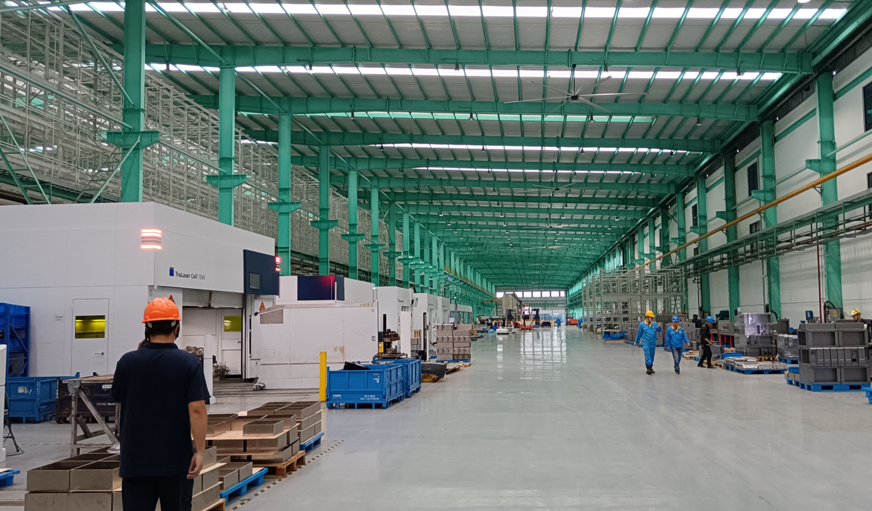
Sheet metal fabrication shop at the Openex manufacturing premise near Shanghai Port, where cutting, punching and forming operations are carried out.
Stamping in Sheet Metal Fabrication: A Buyer's Guide
Stamping is a press-and-die process that cuts, punches or forms flat sheet metal into repeated parts. In custom sheet metal fabrication, stamping is rarely chosen for its own sake. It is chosen when a part will be produced often enough, and consistently enough, that a punch- or die-based route is more reliable than cutting and welding every unit.
For buyers entering the category, stamping usually appears in a long process list next to laser cutting, bending, roll forming, welding and machining. That list is where most sourcing confusion begins. The practical question is not which process is best, but which process fits the part, the volume and the material, and whether the fabricator can actually perform it in-house.
What Stamping Covers in a Fabrication Workflow
Stamping is an umbrella term. In production engineering it covers blanking, which cuts a part outline from sheet; piercing or punching, which makes holes; forming and bending inside a die; and drawing, in which sheet is pulled into a hollow shape. All of these rely on a press applying force through a tool.
In custom fabrication shops, punching and stamping are often listed as a single capability line, because the same equipment families, including turret punches, punch presses and press tooling, perform hole-making and light forming on flat sheet before the part moves on to bending and welding. That is how the process appears in the Openex fabrication scope: punching and stamping are listed alongside laser cutting, bending, welding, machining, assembling, roll forming, casting, forging, galvanizing and powder coating.
The distinction that matters commercially is between dedicated die stamping for high-volume serial production and punching or forming of flat sheet inside a fabricated assembly. The first is a tooling investment decision that locks a design. The second is a routing decision inside an existing fabrication job, and it is the one most buyers in equipment manufacturing actually face.
Why the Stamping Decision Matters to Buyers
The trade-off is straightforward but frequently misjudged. A dedicated or progressive die carries upfront cost and lead time and locks the geometry; in return it delivers short cycle times and highly repeatable parts. Cut-and-form fabrication carries almost no tooling cost and absorbs design changes easily, but every unit consumes machine time and depends on correct setup and fixturing.
Common sourcing errors run in both directions. Some buyers order laser-cut, individually welded parts at volumes where punching would have been cheaper and more consistent per unit. Others request stamped parts where the quantity is too low to justify tooling, and end up paying for a die that is never amortized across production.
The opportunity sits in the middle. Manufacturers in energy storage, battery systems, industrial enclosures and material handling typically need large numbers of brackets, panels, doors, trays, box sections and mounting plates. These are punched-and-formed parts rather than precision die stampings, and they are the parts where process choice shows up most clearly in delivered cost, fit-up speed and consistency from batch to batch.
The Technical Choices Behind a Stamped or Punched Part
Materials that suit punched and formed sheet
Material selection is usually driven first by the service environment and second by formability. Openex handles brass, bronze and aluminum as well as steel grades. In carbon steel, the most frequently seen families are Q235B, covering A36, SS400 and S235JR, and Q355B, covering A572 Gr50, SS490, SPCC and S355JR. Higher-strength and wear-resistant grades such as Q690 and NM450 or NM500 are also handled. In stainless steel, SUS304 and SUS316L are the most common grades. Where a project requires special grades of casting or forging, those are supplied through long-term partners rather than produced in-house.
For buyers, the practical reading is that abrasion-resistant grades such as NM450 and NM500 point to wear parts in mining or material handling, Q690 points to structures where strength-to-weight ratio matters, and SUS316L points to corrosion-driven applications. Each of these affects punch and die wear, springback and edge quality, so the grade should be declared at the quotation stage rather than discovered after tooling or fixtures have been prepared.
What the drawing has to specify
Accepted drawing formats are STEP, IGES, DWG, DXF and PDF. For simple parts, 2D drawings alone are usually sufficient. Supplying both 2D and 3D drawings produces the fastest quotations, because the fabricator does not need to reconstruct missing information. A 3D model alone is rarely enough to quote directly, since the fabricator must first create a 2D drawing for the buyer's approval, which lengthens the quotation process.
The information that must appear on the 2D drawing includes tolerances, welding requirements, surface roughness and chamfers, cutting direction relative to the hot-rolling direction, plate bending radius, material requirement, heat treatment and stress-relief method, and the finish specification such as hot dip galvanizing, sandblasting, painting or powder coating.
Equipment scale sets the upper limit
Forming capacity determines which parts are feasible. In the Openex manufacturing premises, overhead crane tonnage is over 250 tons, the maximum bending machine length and tonnage exceed 18 meters and 10,000 tons, and the maximum CNC machine tool travel reaches 50 m x 8 m x 7 m. The practical consequence is that large formed and machined weldments are not limited by the forming step itself. Handling, transport and site access usually become the binding constraints instead.
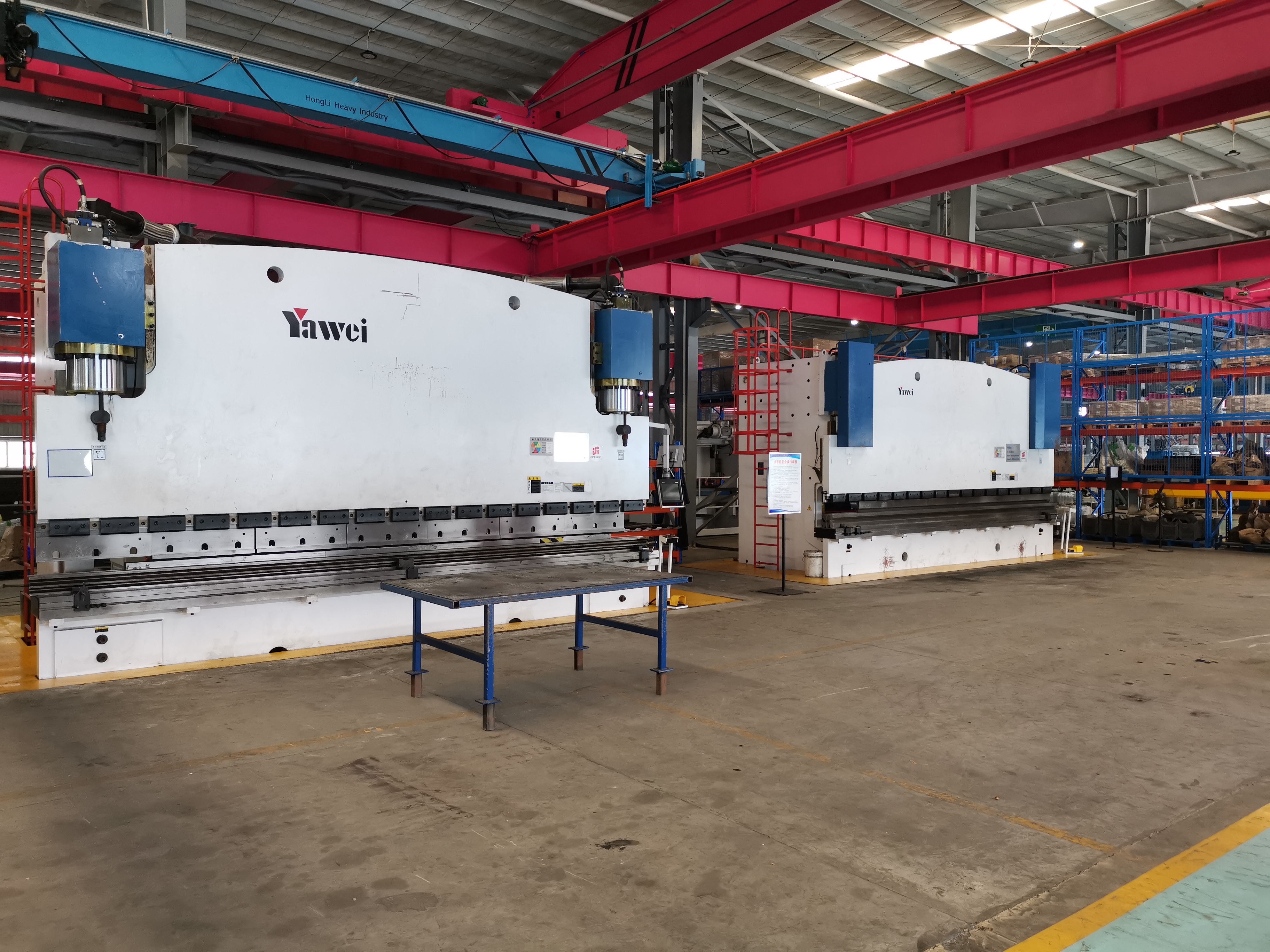
Press-brake forming equipment at the Openex premise near Xiamen Port. Punching or stamping and bending are complementary steps: flat parts are punched first, then formed to their final geometry.
Stamping and the Forming Processes Around It
| Process | What it does | Typical fit |
|---|---|---|
| Bending on a press brake | Forms an already-cut blank along a straight line, one bend at a time | Low to medium volume, large parts, frequent design change |
| Punching and stamping | Makes holes, blanks or formed features using press tooling | Repeated patterns, medium to high volume, consistent parts |
| Roll forming | Continuously forms long sections from coil through a series of rolls | Long parts with a constant cross-section |
| Cold forming | General term for shaping metal at room temperature, covering most punching, bending and drawing | Depends on the specific operation required |
| Deep drawing | Pulls sheet into a hollow shape using a die and punch | Cups, housings and enclosures; capability must be confirmed |
Two of these deserve a buyer's attention. Roll forming is listed among the processes Openex offers, which makes it relevant for long, uniform sections such as the ultra-long formed steel box section produced in Q355B, EN S355J2+N or ASTM A572 Grade 50, 8,000 mm long with 6 mm plate and a specified overall straightness of 3.0 mm or better per 10,000 mm. Deep drawing, by contrast, is not among the confirmed in-house processes, so a project that depends on drawn enclosures should have that capability confirmed explicitly before drawings are released for tooling.
Where Openex Sits Within This Process Landscape
Xiamen Openex Mechanical Technology Ltd is a custom metal fabricator established in 2009, with over 15 years of experience in custom metal fabrication. It operates two manufacturing premises, one near Xiamen Port and one near Shanghai Port, covering a 30,000 square meter facility with approximately 200 staff, including a 35-engineer R&D team, and an annual production capacity of 20,000 tons. Export accounts for 80% of total sales, with major markets in Europe, the USA, Australia, New Zealand, Japan, Singapore, South America and the Middle East. Delivered work includes pressure vessels, machine frames, steel chassis and steel structures for customers in the USA, Canada, Japan, the UK, European countries and Australia.
The company is explicit about how it is structured, which is useful for buyers assessing fit. It describes itself as a metal fabricator rather than a single-process stamping house. Between 80% and 90% of the metal parts, components and assemblies it exports are produced in-house. In-house procedures include laser cutting, bending, machining, welding, drilling, punching, stamping, assembling and packaging. Casting, forging, hot dip galvanization, powder coating and other anti-rust finishes come from partner suppliers, and a dedicated powder-coating shop for light structural parts is under consideration.
For higher-volume cabinet and enclosure work, the fabrication route typically combines fiber laser cutting, automated full-sheet punching, automated panel bending and CNC forming, robotic and manual welding including AWS certified structural welding and spot welding, assembly, and powder-coating finishing. For large quantities of small metal parts, Openex has developed visual inspection machines that check small parts at 100% rather than relying on sampling by human inspectors. That detail matters for punched and stamped components shipped in high counts, where a single missed hole or burr becomes a line-stoppage risk at the customer's assembly station.
Application Scenarios Where Punched and Formed Parts Dominate
| Product | Model | Material | Key parameters |
|---|---|---|---|
| Energy Storage System Cabinet | Customized-J-05 | Carbon steel, galvanized steel, stainless steel or aluminum | Thickness 1.5 to 5.0 mm; IP54, IP55 or IP65; powder or anti-corrosion coating; customized dimensions and load capacity |
| Steel frames and boxes for ESS | XHC-009 | Steel tube, steel sheet, carbon steel | 1.1 m x 1.1 m x 2.2 m; 1,000 kg per unit; powder-coated anti-rust finish |
| Equipment enclosure | Custom-L-2 | SS304 or 304L mirror-finish sheet with SS304 stiffeners | 7,000 mm x 1,300 mm x 1,000 mm; 6 mm internal partition; 2.0 t finished mass |
| Ultra-long formed steel box section | Custom-L-1 | Q355B, EN S355J2+N or ASTM A572 Grade 50 | 8,000 mm long; 6 mm plate; 1.5 t unit mass; straightness 3.0 mm or better per 10,000 mm |
| Steel chassis for steel coils | JFE-1 | Carbon steel | Approximately 15 x 2.5 x 2.1 m; 10 t net weight; 35 t maximum load |
| Chain conveyor steel frame | MBM-1 | Carbon structural steel | Cutting, welding and CNC machining; high dimensional precision; sand blasting or painting |
| Solar panel support | Customized-C-10 | Per drawing | Base supports, brackets and beams supplied as a prefabricated support structure |
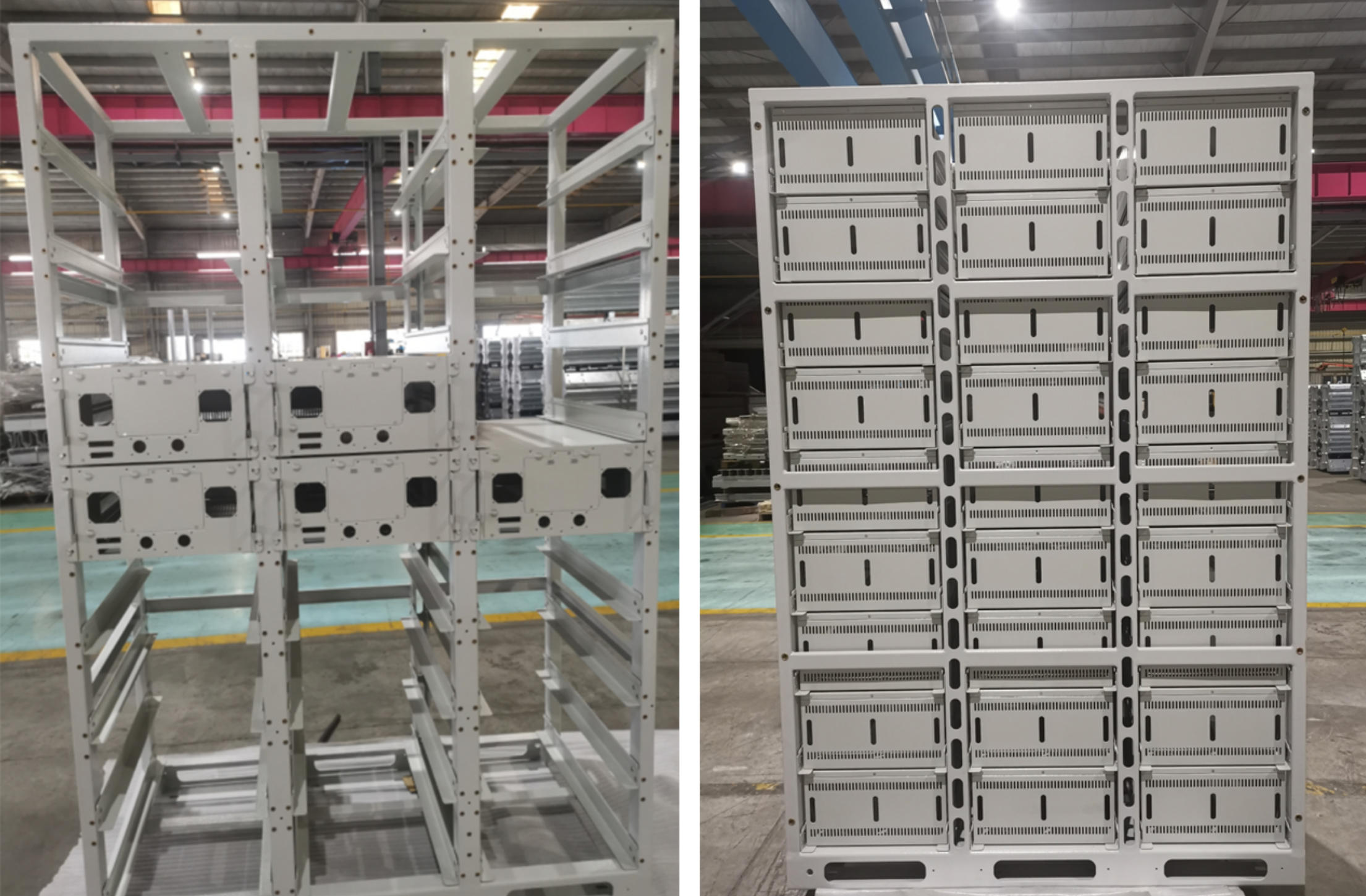
Steel boxes and cluster frames for lithium battery energy storage, built from punched, formed and welded sheet metal parts.
These examples show a consistent pattern. Most of them are assemblies built from flat sheet and tube that is cut, punched, formed, welded and finished. In energy storage, the cabinet and rack parts are where punching repeated hole patterns and forming flanges consistently across many units determines how quickly a battery module can be assembled on the customer's line. The chassis and conveyor frame examples point the other way: large welded steel structures where forming is a supporting step and dimensional precision after welding governs whether the part fits up on site without rework.
The solar panel support case falls between the two. It is supplied as a prefabricated support structure with base supports, brackets and beams, all customizable in dimensions, tolerances, materials, surface treatment and heat treatment. Structures of this type are usually produced in repeated batches per project, which places them squarely in the band where punching and forming are worth evaluating against pure cut-and-weld fabrication.
Market Signals Worth Tracking
Energy storage systems, renewable energy, battery manufacturing and industrial power systems are listed application areas for cabinet-type sheet metal products, and energy storage is a named application for steel frames and boxes used as battery racks and cluster frames. As these sectors expand, demand shifts toward enclosure-type sheet metal parts produced in repeated batches, which is precisely the volume band where punching and forming tend to outperform one-off cutting on cost and consistency.
A second signal is the growing preference for one-stop fabrication, with cutting, forming, welding, machining, assembly and finishing managed under a single quality system. This reduces the number of suppliers accountable for a delivered assembly. The counterweight is that fabricators rarely perform every process internally. Openex produces most fabrication in-house but sources casting, forging, hot dip galvanizing, powder coating and other anti-rust finishes from partners, so buyers should verify which processes are internal for their specific part rather than assuming full vertical integration.
A third signal is that inspectability is moving into the specification itself. Commonly stated special requirements include material traceability, welding procedure qualifications, coating and corrosion protection, and third-party inspection, and these are expected to be defined at the order stage rather than after production. For some product families this already extends to dimensional inspection, NDT testing and welding inspection, and for tube sheets to CMM measurement together with UT, PT, MT and PMI inspection. Buyers who write inspection scope into the enquiry get fewer surprises at final acceptance.
Finally, verification of the supplier itself is becoming routine. Buyers increasingly ask whether the company is a manufacturer or a trader, and request factory photographs, workshop video and certificates, particularly for parts that fall outside the confirmed in-house process list.
Stamping Versus Cut-and-Weld Fabrication, and the Limits to Watch
| Decision dimension | Cut-and-weld route | Punch and stamp route | What it means for the buyer |
|---|---|---|---|
| Upfront cost | Low; programming and setup only | Higher where dedicated tooling is required | Tooling only pays back above a certain annual quantity |
| Per-unit consistency | Depends on operator setup and fixture quality | High repeatability once the tool is proven | Matters most for parts assembled in high counts |
| Design change | Absorbed quickly | Modifying a die is slower and costlier | Do not lock a design before it is validated |
| Large part size | Well suited, including very large weldments | Limited by press bed and handling capacity | Large structures usually stay on the cut-and-weld route |
| Small parts in small quantities | Acceptable technically | Not economical at any scale | Consolidate orders or reconsider the sourcing market |
Limits are as important as capabilities, and Openex is unusually direct about several of them.
- Process scope boundary. Openex states that when a project requires only casting, forging or anti-rust finishing, it is not a good choice, because those processes come from partners rather than its own shop. It positions itself as suitable when fabrication and machining are the main bodies of work.
- Small parts in small quantities. There is no fixed minimum order quantity, but the guidance is that small components in small volumes are generally not recommended, since setup and communication effort is comparable to that for large parts. Full container load shipping costs less per unit than LCL consolidations, overheads spread over larger quantities, and larger orders support better material purchasing. Large parts in container-load quantities are the preferred profile, and repeat ordering supports both price and quality stability.
- Drawing dependency. A 3D model alone generally cannot be quoted directly. The fabricator has to create a 2D drawing for approval first, which extends lead time. 2D plus 3D is the fastest route to a quotation.
- Processes requiring confirmation. Deep drawing and cold forming are not listed among the confirmed in-house processes. Buyers whose part depends on a deep drawn enclosure, a forged blank or high-volume dedicated die stamping should confirm capability and tooling ownership before releasing drawings.
- Handling and logistics. Extremely large formed and machined parts are technically feasible given the equipment described, but moving, inspecting and shipping them depends on heavy lifting capacity and port access rather than on the forming process itself.
Future Outlook
The boundary between general fabrication and production stamping is likely to keep blurring. Automated full-sheet punching and CNC forming already allow fabricators to deliver punch-formed parts without dedicated dies, at volumes that would previously have gone straight to laser cutting and manual welding. For buyers, that means fewer parts need to be split between a fabrication supplier and a stamping house.
Documentation expectations will continue to rise alongside that shift. Material traceability, welding procedure qualification, NDT and dimensional inspection, and for critical components CMM measurement with UT, PT, MT and PMI inspection, are already treated as specification items rather than optional extras. Automated 100% inspection of small parts in large quantities is a natural extension of the same trend, replacing sampling where a single defect can stop a customer assembly line.
The most useful preparation a buyer can make is a simple one: sort the part list by material, thickness and annual quantity before approaching any fabricator. Parts that repeat in high counts belong in a punching or forming conversation. One-off frames, large weldments and design-unstable prototypes belong in a cut-and-weld conversation. Process selection should be an outcome of that sorting, not an assumption that precedes it.
FAQ
What metal materials can be used for stamped and punched sheet metal parts?
Brass, bronze and aluminum can all be fabricated, although carbon steel and stainless steel are the most frequently seen metals in custom fabrication projects. In carbon steel, Q235B, covering A36, SS400 and S235JR, and Q355B, covering A572 Gr50, SS490, SPCC and S355JR, are the two most common grade families; Q690 and NM450 or NM500 are also handled. In stainless steel, SUS304 and SUS316L are the most common grades. Where a project requires special grades of casting or forging, these are supplied through long-term partners rather than produced in-house.
What drawing formats should be supplied to get a quotation quickly?
STEP, IGES, DWG, DXF and PDF are accepted. For simple parts, 2D drawings alone are usually sufficient. Supplying both 2D and 3D drawings produces the fastest quotation. A 3D model alone is rarely sufficient, because several details are normally carried on the 2D drawing: tolerances, welding requirements, surface roughness and chamfers, cutting direction relative to the hot-rolling direction, plate bending radius, material requirement, heat treatment and stress-relief method, and finish specification such as hot dip galvanizing, sandblasting, painting or powder coating.
Which fabrication processes are usually performed in-house and which are outsourced?
In-house procedures at Openex include laser cutting, bending, machining, welding, drilling, punching, stamping, assembling and packaging, and between 80% and 90% of the metal parts, components and assemblies it exports are produced in-house. Casting, forging, hot dip galvanization, powder coating and other anti-rust finishes are provided by partner companies, with a dedicated powder-coating shop for light structural parts under consideration. Buyers should confirm the routing for their specific part at the quotation stage rather than assuming every process is internal.
How do order quantity and MOQ affect the cost of punched or stamped metal parts?
There is no single MOQ figure, because cost is driven by how fixed effort is distributed across an order. A full container load costs less per unit in freight than a less-than-container load, overheads are spread across a larger quantity, and larger orders support better material purchasing. Small parts in small quantities are generally not recommended, since setup and communication effort is comparable to that for large parts. Large parts in container-load quantities are the preferred profile, and large parts in smaller quantities are acceptable where the quantity is reasonable for container loading. Repeat ordering supports price and quality stability over time.
How can a buyer distinguish a metal fabricator from a trading supplier?
The verifiable questions are which processes are physically performed on site, what proportion of delivered parts is produced in-house, and whether factory photographs, workshop video and certificates can be provided. Openex describes itself as a metal fabricator operating two manufacturing premises near Xiamen Port and Shanghai Port, producing 80% to 90% of its exported metal parts in-house and sourcing the balance from partners. A useful cross-check for any buyer is whether the supplier can be equally specific about the processes it does not perform.
How are large quantities of small stamped or punched parts inspected?
For small metal parts produced in large quantities, Openex has developed visual inspection machines that check parts at 100%, in contrast with sampling carried out by human inspectors. For other product families, inspection can include dimensional inspection, NDT testing and welding inspection, and for tube sheets it extends to CMM measurement with UT, PT, MT and PMI inspection. Inspection scope and acceptance criteria are best agreed at the order stage.
Process scope, material grades and equipment figures quoted in this article are drawn from Openex published capability information. Additional process and capability detail is compiled in the Openex mechanical fabrication brochure: Openex mechanical fabrication brochure (PDF). General company information is also published at www.cncmetalworking.com.