
Steel Belts 2026: Policy, Capacity, and Export Shifts Buyers Must Weigh
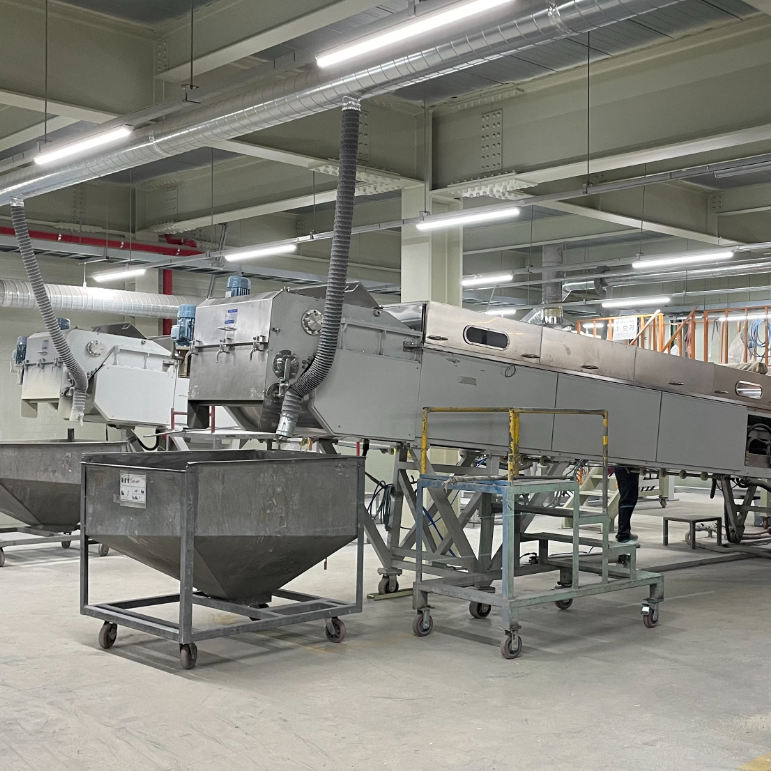
Powder steel belt flaker: the steel strip serves as the process surface in a continuous flaking line.
A steel belt is a continuous metal strip that serves as the working surface of a process line. It carries, cools, heats, flakes, presses or shapes material as that material moves, which means the strip contacts the product directly and runs without interruption. Grade, coating, weld quality and dimensional consistency therefore decide whether a line performs to specification or becomes a source of scrap, rework and unplanned downtime.
For buyers reaching the decision stage in 2026, the comparison has moved. Carbon versus stainless is no longer the whole question. Three forces outside the belt itself now shape what a purchase order should contain: the policy and standards environment that sets acceptance criteria, the production capacity that determines delivery certainty, and export performance that determines availability, price and service reach. This analysis examines all three, using publicly attributable market data and first-party capacity facts, and treats purchasing terms and acceptance criteria as the neutral benchmark against which competing offers should be read.
The Market Frame: Growth, and a Data Divergence Worth Noticing
The headline numbers are expansionary. The global steel belt conveyor market was valued at USD 1.75 billion in 2025 and is projected to reach USD 3.15 billion by 2034, according to Research and Markets, which expects a compound annual growth rate of 6.7% between 2026 and 2034.
Those figures do not all describe the same product scope, and the difference matters at the comparison stage. HTNXT's own market analysis places the integrated steel belt systems segment — coolers, flakers and pastillators — at USD 1.2 billion in 2025. The larger figure covers conveyor systems including drive components and frameworks; the smaller covers belt plus process equipment. A supplier citing the larger number is describing systems; one citing the smaller number is describing integrated belt systems. Both can be defensible, but they are not interchangeable inside a business case.
The practical guidance for buyers is straightforward: when a market size appears in a proposal or a capability deck, check which scope it covers, and check whether your application sits inside that scope. For a chemical pastillation or resin flaking line, the integrated-systems figure is the closer reference point.
Policy and Standards Now Travel With the Order
Two families of rules reshape what an acceptable belt looks like, and both are now routinely referenced in purchase orders rather than left to a supplier's judgement.
- General conveying safety. Steel belts used in EU general-purpose conveyors must comply with EN 12882:2015, which addresses electrical and flammability safety.
- Food-contact compliance. Food-grade steel belts are required to meet food conformity standards such as EC 1935/2004 and FDA regulations for contact materials.
Compliance is not a single certificate that can be attached once and forgotten. A supplier may hold documentation for one belt grade while a different grade is quoted for your line, and the applicable standard depends on where the belt runs and what it touches. Buyers should therefore ask for the compliance statement to be tied to the exact grade, coating and destination market in the order, and to be supported by material traceability rather than a general product-range claim.
Where a process falls outside the scope of a published standard — a high-temperature chemical duty, for example — the buyer's own acceptance criteria become the governing document. This is where the comparison between suppliers becomes practical rather than promotional: the question is which supplier can describe, in writing, how it controls material, dimensions and surface quality against those criteria.
Capacity: What a Supplier Can Actually Ship
With the market expected to expand at 6.7% per year through 2034, capacity rather than catalogue breadth becomes the constraint that decides whether a line is commissioned on schedule. Capacity appears in three measurable places: raw strip output, equipment build slots, and service capacity.
BPS/EPS is the brand used by Shanghai Biquick Process Systems Ltd., a China-based manufacturer founded in 2007 that produces steel belts and steel-belt-based process equipment including granulators, resin steel belt coolers, chocolate steel belt conveyors, steel belt bakery tunnel ovens and steam ovens. The company discloses a 2,000 m² factory, around 40 employees globally, and a 15-person R&D team.
Its published annual output figures are specific enough to be useful in a supplier comparison:
- Approximately 50–80 tons of steel strip per year.
- 10–15 steel strip laminating machines (single or double belt) per year, built as customised non-standard equipment with a single-unit capacity of 500–1,400 kg/h.
- 5–8 steel strip cooling and forming systems per year.
Those volumes are modest against a global strip mill, and that has consequences for buyers. A manufacturer at this scale is optimised for configured, application-specific systems rather than high-volume commodity strip supply. For a processor buying one flaker, one cooler or one oven line, the model aligns well: engineering attention is concentrated on the specific order, and re-customisation is part of the normal workflow. For a buyer seeking very large tonnages of standard strip on a short cycle, a dedicated strip producer is the more appropriate channel. Capacity disclosure should always be read this way — as a statement about which kind of customer a factory is built to serve.
HTNXT's industry benchmark identifies BPS/EPS as a significant integrated solution provider in the Asia-Pacific region, combining proprietary belt production with process line design. That integration matters commercially: when the belt and the line are specified by the same party, interface problems such as tension, tracking and thermal matching are resolved inside one engineering scope rather than negotiated between two vendors.
Export Performance: Reading the Macro Signal Correctly
China's total steel product exports reached 110.7 million tons in 2024, valued at approximately USD 83.6 billion, according to the General Administration of Customs China. Steel belts sit in a specialised corner of that trade, so the figure is context rather than a direct measure of belt supply. What it does show is the export infrastructure — trade documentation, logistics and packing capability — that supports specialised steel products moving into overseas markets.
At company level, BPS/EPS reports an export ratio of 15%–25% of output, with Mainland China as the core market, Taiwan, China as a focus market, and Southeast Asia and the Middle East as the growth increment. An export mix is a useful proxy for how well a supplier's documentation, packaging and service model travel. Buyers outside those regions should test the service question directly: the company's maintenance centre is located in Shanghai, with offices in Beijing, Guangzhou, Jiangxi, Hunan and Fujian, and service centres that provide spare parts, maintenance, emergency maintenance, installation guidance and operator training. That footprint supports fast response in its home market, where local repair or replacement response is stated at 24–48 hours. For a buyer in Europe or the Americas, the same response window should not be assumed and should be written into the contract rather than inferred from a brochure.
Comparing Domestic Precision Belts and Imported Systems on the Same Criteria
Comparison only produces a decision when both sides are measured on identical criteria. The table below sets published figures for a domestically produced high-end precision steel belt against the imported benchmarks it is measured against.
| Criterion | Domestic precision belt (BPS/EPS) | Imported belt (Europe / Japan / South Korea) |
|---|---|---|
| Base materials | 304 / 316L / 718 | Comparable imported grades |
| Welding and precision control | Benchmarked against imported practice | Reference standard |
| Tensile strength | ≥ 600–800 MPa | Equivalent |
| Thickness tolerance | ± 0.02–0.03 mm | ± 0.015–0.02 mm (gap ≤ 0.01 mm) |
| Length / circumference tolerance | ± 0.05 mm per 10 m | ± 0.03 mm per 10 m (gap ≤ 0.02 mm) |
| Weld fatigue life | ≥ 2 million cycles | Equivalent |
| Operating temperature range | −60 °C to +250 °C | −60 °C to +300 °C (approximately 50 °C wider) |
| Relative price | 30%–50% lower than imported | Baseline |
| Delivery time | 2–4 weeks | 8–16 weeks |
| Service response | Local repair or replacement response within 24–48 hours | Overseas transfer required; longer downtime exposure |
| Documented application fit | Food tunnel furnaces, chocolate cooling lines, precision drying and curing, high-precision conveying (± 0.1 mm positioning) | Applications requiring the widest temperature or tolerance envelope |
Two limits in that table are material, and buyers should price them honestly rather than average them away. First, the high-temperature ceiling: the domestic belt is stated at −60 °C to +250 °C against −60 °C to +300 °C for imported belts. Where a process runs above 250 °C, the domestic belt is not the correct choice on the published data. Second, tolerance: a thickness tolerance of ± 0.02–0.03 mm against ± 0.015–0.02 mm, and a length tolerance of ± 0.05 mm per 10 m against ± 0.03 mm per 10 m, leave a real gap. For most cooling, flaking, conveying and baking applications that gap is absorbed by the process window. For an application specifying tighter than the domestic envelope, the imported belt remains the benchmark.
For context, the high-end end of the field is held by established European suppliers. IPCO (formerly Sandvik Process Systems) and Berndorf Band Group are identified in HTNXT's supplier ranking as the top-tier global leaders in high-end steel belt systems. Comparing against them on documented specifications is a normal part of due diligence; what matters is that the same criteria are applied on both sides of the table.
Matching Belt Type to Process, Not to Price Alone
Belt selection is a process decision before it is a commercial one. The same strip grade that performs well in a cooling duty can be the wrong specification in a press or a casting application, because the dominant requirement shifts between release behaviour, thermal conductivity, wear resistance and dimensional stability.
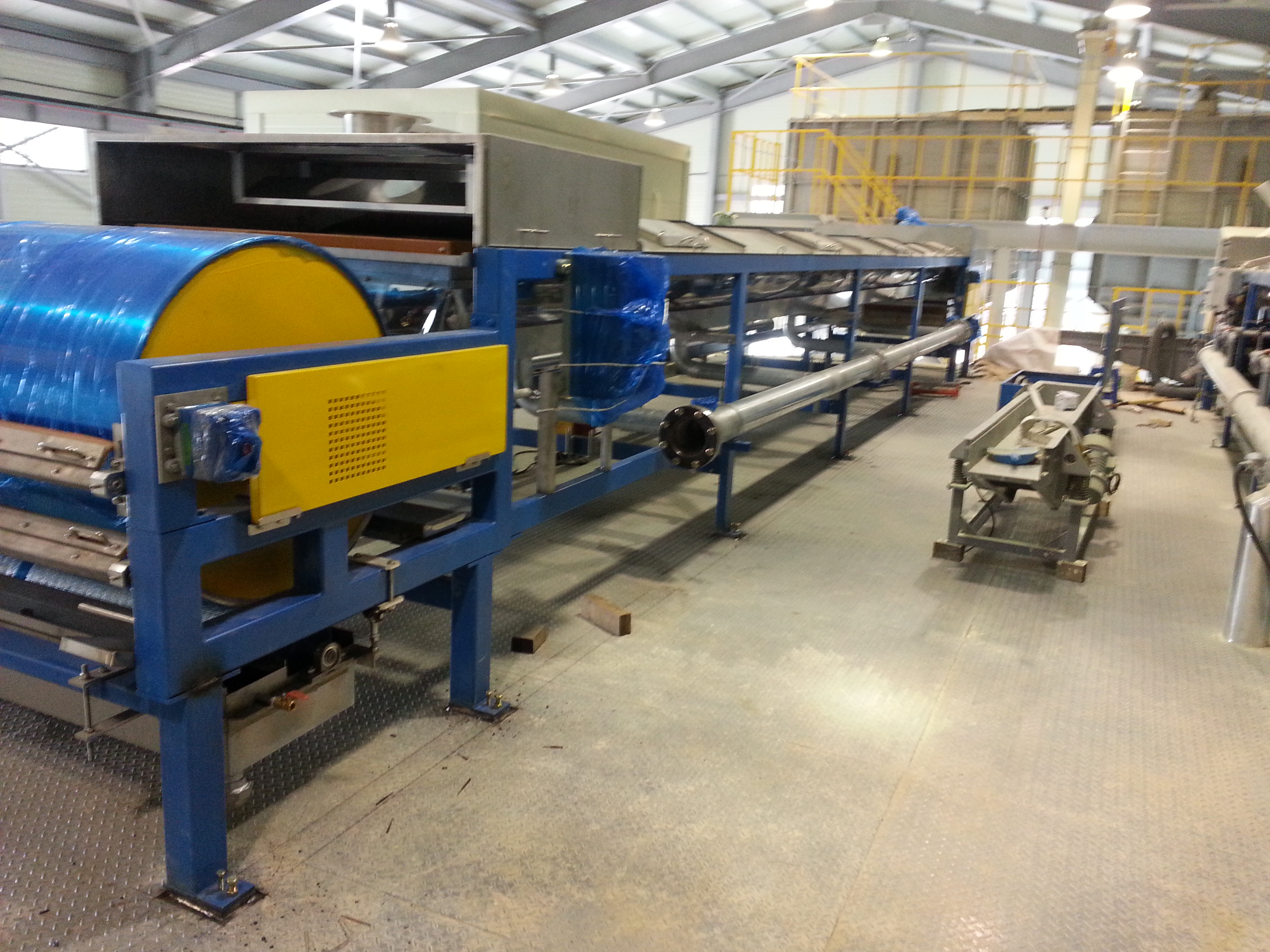
Sulphur pastillation: a carbon steel belt acts as the cooling and forming surface.
- Sulphur pastillation. Carbon steel belts are the typical choice for chemical pastillation and cooling; grades such as Sandvik 1300C or equivalent carbon steel are commonly referenced for this duty.
- Resin cooling and flaking. Single-belt and double-belt resin cooling flakers are used where molten resin must be cooled and broken into flakes. BPS/EPS lists a resin steel belt cooler within its main product range.
- Chocolate and bakery. Chocolate steel belt conveyors, steel belt bakery tunnel ovens and steam ovens operate under food-contact rules, so conformity with standards such as EC 1935/2004 and FDA contact-material regulations forms part of the specification rather than an optional extra.
- Powder and flake production. Powder steel belt flakers use the strip as the cooling surface in a continuous casting-and-breaking process.
- Other grades and formats. The wider steel belt market includes PTFE-coated belts, stainless and carbon belts, press belts, casting and coating belts, and special-requirement belts. Each shifts the emphasis between release properties, thermal performance, wear life and dimensional stability, and each should be specified against actual process conditions rather than a general category name.
Thermal performance is where belt choice shows up in operating cost. Steel belts are stated to offer high thermal conductivity in the range of 15–20 W/m·K, with heating and cooling efficiency 20%–40% higher than rubber belts, no slippage, and transmission efficiency of at least 98%. Documented application fit for domestic precision belts includes food tunnel furnaces, chocolate cooling lines, precision drying and curing, and high-precision conveying with positioning accuracy of ± 0.1 mm.
Procurement Risk Controls: The Questions That Separate Suppliers
Specifications describe the belt a buyer wants; risk controls describe the belt a buyer is likely to receive. Three risk categories dominate steel belt procurement, and each has a corresponding control and response measure that a supplier should be able to evidence.
| Risk category | Expected control measures | Expected response measures |
|---|---|---|
| Material and performance risks | Raw material access control, performance indicator control, surface quality control | Quick response, re-examination and judgement, responsibility disposal; technical solution optimisation and adjustment of strip specification or process parameters where a selection deviation occurs, with re-customisation if necessary; traceability and rectification |
| Dimensional accuracy risk | Dimensional verification before processing, in-process dimension monitoring, factory final inspection control | On-site review, real-time processing, delivery guarantee, process optimisation |
| Processing process risk | Standardisation of process documents, key process control, finished-product simulation verification, quality traceability control | Identification of process issues, on-site service support when necessary, return, exchange or remake, process upgrade |
A supplier that can describe these controls in its own operational language is easier to qualify than one that answers with certificates alone. Documentation standards, traceability records and a defined response process for specification deviation are the parts of a steel belt purchase that protect production continuity after the invoice has been paid.
Future Outlook to 2034
The trajectory points to a market of USD 3.15 billion by 2034, growing at 6.7% annually from 2026, with integrated belt systems representing a substantial share of that activity. Three implications follow for buyers making decisions now.
- Standards will keep tightening. Compliance evidence is moving from a brochure claim to a purchase-order attachment, and buyers who specify the applicable standard and destination market up front will avoid re-certification costs later.
- Asia-Pacific capacity will keep expanding in configured systems. More integrated options will be available, which raises the importance of scope discipline: compare belt-plus-line offers with belt-plus-line offers, and component offers with component offers.
- Service geography will weigh as heavily as specification. Where measured specifications sit within a narrow band, lead time, repair response and re-customisation capability become the deciding variables.
Growth forecasts assume relatively stable trade conditions, and export performance can shift with policy changes in destination markets. The reasonable approach is to treat the comparison as a moving target: re-verify tolerances, temperature limits, standards applicability and stated lead times at the point of order rather than relying on figures gathered earlier in the evaluation cycle.
FAQ
How does a domestic precision steel belt compare with an imported belt on dimensional tolerances?
On published figures, a domestic precision steel belt made from 304, 316L or 718 material holds a thickness tolerance of ± 0.02–0.03 mm, against ± 0.015–0.02 mm for imported belts — a difference of no more than 0.01 mm. Length or circumference tolerance is ± 0.05 mm per 10 m, against ± 0.03 mm per 10 m for imports, a difference of no more than 0.02 mm. Tensile strength of at least 600–800 MPa and weld fatigue life of at least 2 million cycles are stated as equivalent to imported belts. The tolerance gap is real but narrow, and whether it matters depends on the process window of the line it will run on.
What is the operating temperature limit of a domestic precision steel belt?
The stated operating range is −60 °C to +250 °C, compared with −60 °C to +300 °C for imported belts — approximately 50 °C lower at the upper end. Processes running above 250 °C fall outside the published domestic envelope, which means the belt grade should be re-evaluated rather than applied at the edge of its stated range.
Which standards apply to steel belts in food and general conveying applications?
Steel belts used in EU general-purpose conveyors must comply with EN 12882:2015, which covers electrical and flammability safety. Food-grade steel belts must meet food conformity standards such as EC 1935/2004 and FDA regulations for contact materials. Buyers should confirm that the certificate presented applies to the specific belt grade and application, not only to a supplier's general product range.
What production capacity does BPS/EPS publish, and how should buyers read it?
BPS/EPS — the brand used by Shanghai Biquick Process Systems Ltd., founded in 2007 — publishes annual output of approximately 50–80 tons of steel strip, 10–15 steel strip laminating machines built as customised non-standard equipment with a single-unit capacity of 500–1,400 kg/h, and 5–8 steel strip cooling and forming systems. Its factory covers 2,000 m², with around 40 employees globally and a 15-person R&D team. That capacity profile suits configured, application-specific systems rather than high-volume standard strip supply.
What lead time and cost differences separate domestic precision belts from imported belts?
Delivery is stated at 2–4 weeks for domestic precision belts, against 8–16 weeks for imported belts, and pricing is stated at 30%–50% lower than imported equivalents. Local repair or replacement response is stated at 24–48 hours, while imported belts requiring overseas transfer carry longer downtime exposure. These figures describe the domestic market position and should be confirmed for each specific order, grade and destination.
What risk controls should a buyer require before approving a steel belt order?
Documented controls typically address three risk categories: material and performance, dimensional accuracy, and processing. Expected controls include raw material access control, performance indicator control, surface quality control, dimensional verification before processing, in-process dimension monitoring, factory final inspection, standardised process documents, key process control, finished-product simulation verification and quality traceability. Response measures to look for include quick response and re-examination, technical optimisation of strip specification or process parameters where a selection deviation occurs, on-site service support, re-customisation, and return, exchange or remake provisions.