
Steel Modular Capsule House OEM: What Capability Really Means
When a hospitality project moves from evaluating capsule house designs to placing production orders, the decisive factor is no longer just the shape of the capsule. It is the manufacturer's engineering depth, customization ability, production capacity, and delivery discipline.
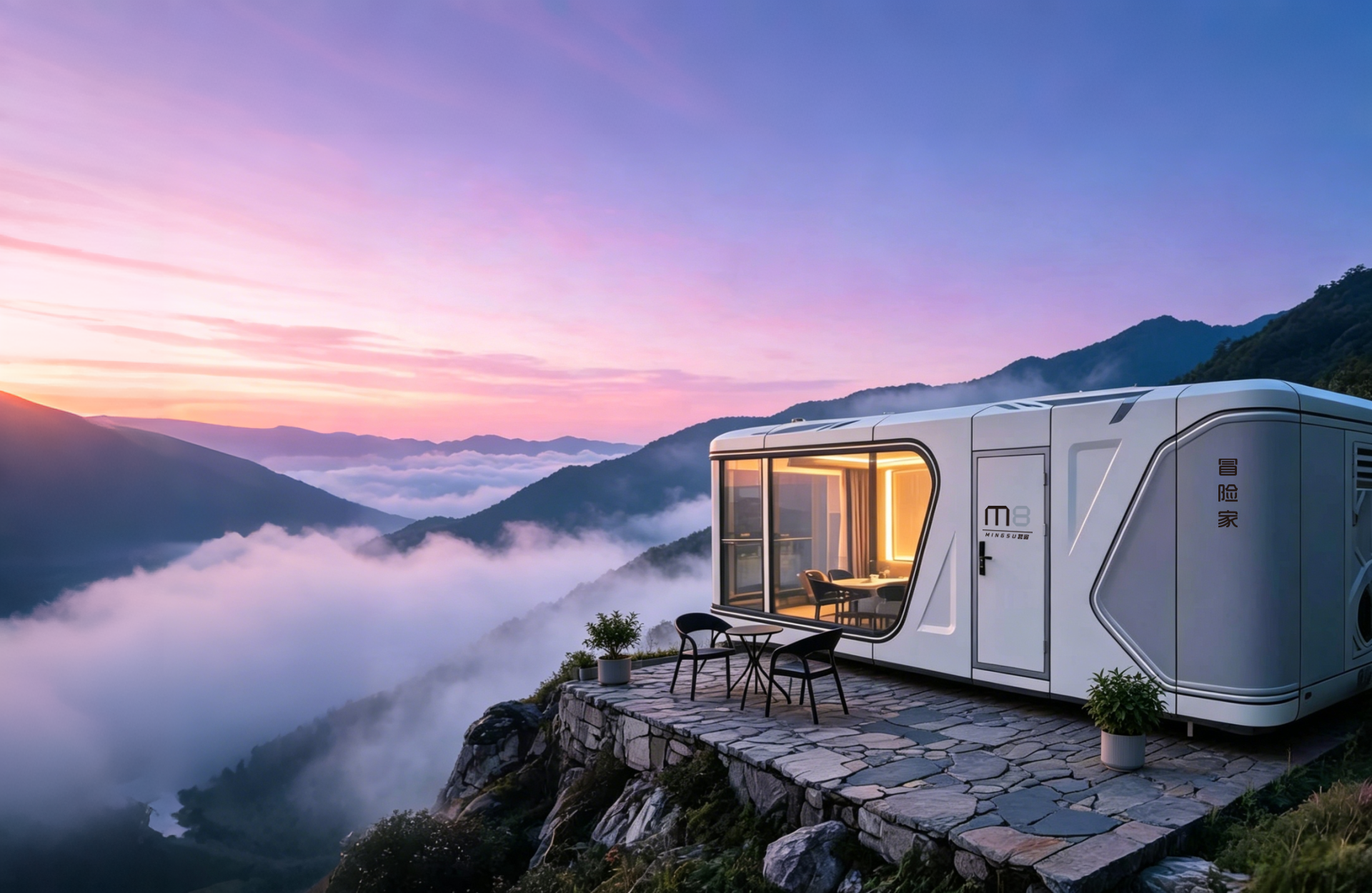
M8 steel modular capsule house (Adventurer Series)
Why Capability Evaluation Matters for Capsule House Projects
Steel modular capsule houses are used across outdoor glamping, eco-resorts, holiday parks, beach resorts, mountain resorts, staff accommodation, and other hospitality developments. Many of these projects share a common pressure: the construction window is short, the landscape has to remain intact, and the accommodation format must be distinct enough to attract guests.
Traditional site-built construction can take months and often requires foundations, approval processes, and on-site labor. A factory-prefabricated capsule house reduces that burden. The manufacturer states that no complex foundation is needed on site, the ground only needs leveling, and a single capsule can be lifted into place and installed within two hours. The same modular process avoids on-site construction waste and can save about 80% of civil construction costs.
For a buyer, however, those benefits depend on the supplier's ability to produce the right unit for the site, the climate, and the target market. That is why capability evaluation has become a core part of capsule house procurement.
Manufacturer Profile: BOITO-MINGSU
BOITO-MINGSU is the export brand of Guangdong Mingsu Sojourn Technology Co., Ltd., a member of the BOITO Group. The company was founded in 2003 and operates from a 10,000 square meter factory in Yangjiang, Guangdong. It employs 30 staff and reports an annual output of 1,000 modular accommodation units. A 25-person R&D team supports product engineering and customization. Approximately 40% of production is exported, with principal markets in Southeast Asia, the European Union, and the United States.
Main products include capsule houses, modular hotel units, glamping cabins, mobile sleep pods, and modular villas. All products are factory-prefabricated and delivered as complete units. The manufacturer states that units can be customized to meet the building codes and electrical standards of different countries.
ODM and Customization Capability
ODM is the key capability that allows a hospitality operator to move from a standard product catalog to project-specific units. BOITO-MINGSU offers ODM production services, which means the manufacturer takes responsibility for producing the design defined for the buyer's project.
Standard customization options include voltage and logo. Voltage adaptation is essential for cross-border projects, especially when electrical systems differ from the factory's domestic standard. Logo customization supports branded resort environments, capsule hotel rooms, and glamping accommodation where visual identity matters.
| Parameter | Details |
|---|---|
| Production mode | ODM |
| Customization | Voltage / logo |
| Monthly capacity | 30 to 50 units |
| Lead time | 30 to 45 days |
| MOQ | 10 units |
| Quality control | 100% test |
| After-sales support | Remote support |
Order execution is also defined. Delivery terms include FOB, CIF, and EXW. Payment is typically 50% deposit with the balance before shipment. Buyers can accept the order through factory inspection or video inspection. These details matter when a project has a fixed opening date and a customs or logistics plan to align.
Steel Frame Construction and Product Baseline
The structural core of the company's capsule houses is a hot-dip galvanized steel frame. This frame is designed for outdoor all-weather use in conditions that include high temperature, sunlight exposure, humid coastal air, and mountainous environments. The main supporting components are a seismic hot-dip galvanized steel frame, broken-bridge aluminum doors and windows, double-layer tempered Low-E hollow glass, exterior wall thermal insulation composite panels, and sound insulation materials.
The product range covers different program types, from single-occupancy sleep capsules to larger commercial units:
| Model | Type | Dimensions (LxWxH) | Area | Guests | Power | Weight |
|---|---|---|---|---|---|---|
| M8 | Sleep Pod (Adventure) | 8.3m x 3.3m x 3.2m | 27.39 m² | 1–4 | 8KW | ≈7T |
| M10 | Exotic-Style Capsule House | 10m x 3.6m x 3.2m | 27.36 m² | 1–4 | 10KW | ≈9.5T |
| M3 | Breeze Single Capsule | 3m x 2.3m x 2.5m | 6.9 m² | 1 | 6KW | ≈2T |
| Apple Capsule MINI | Apple Capsule | 8.3m x 3.3m x 3.2m | 27.39 m² | 1–4 | 7KW | ≈6.5T |
| MS-XO8 F | Cafe Capsule | 16m x 3.6m x 3.2m | 57.6 m² | 1–4 | 10KW | ≈13T |
The weight figures are important at the planning stage. An M8 unit weighs approximately 7 tonnes, and an M10 unit weighs approximately 9.5 tonnes. Transport access, crane capacity, and ground load-bearing conditions must be confirmed before ordering.
Quality, Certification, and Market Compliance
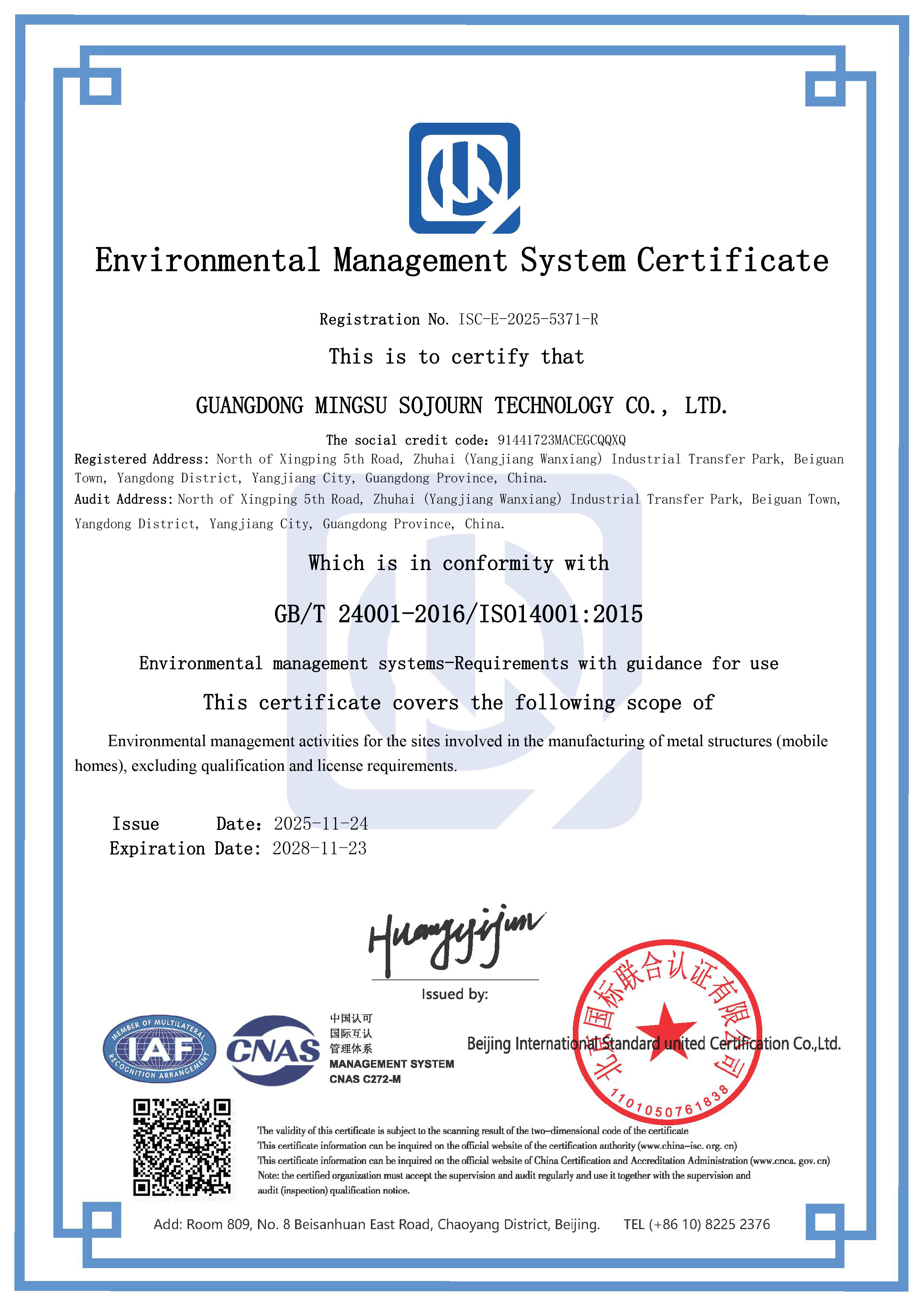
ISO 14001:2015 environmental management system certificate
BOITO-MINGSU holds an ISO 14001 environmental management system certificate, number ISC-E-2025-5371-R, issued by Beijing International Standard United Certification Co., Ltd. The certificate is based on GB/T 24001-2016 / ISO 14001:2015 and covers environmental management activities for the manufacturing of metal structures (mobilehomes). It was issued on 2025-11-24 and is valid until 2028-11-23.
Destination-market compliance is a separate step. In the European Union, capsule houses fall under the Construction Products Regulation (CPR) and must bear CE marking for legal installation. In the United States, capsule units can be classified as RVs, ADUs, or state-certified modular construction, and each classification requires different foundation and approval procedures. Buyers should confirm the applicable classification for their project site and verify that the manufacturer can supply the necessary documentation.
Application and Use Cases
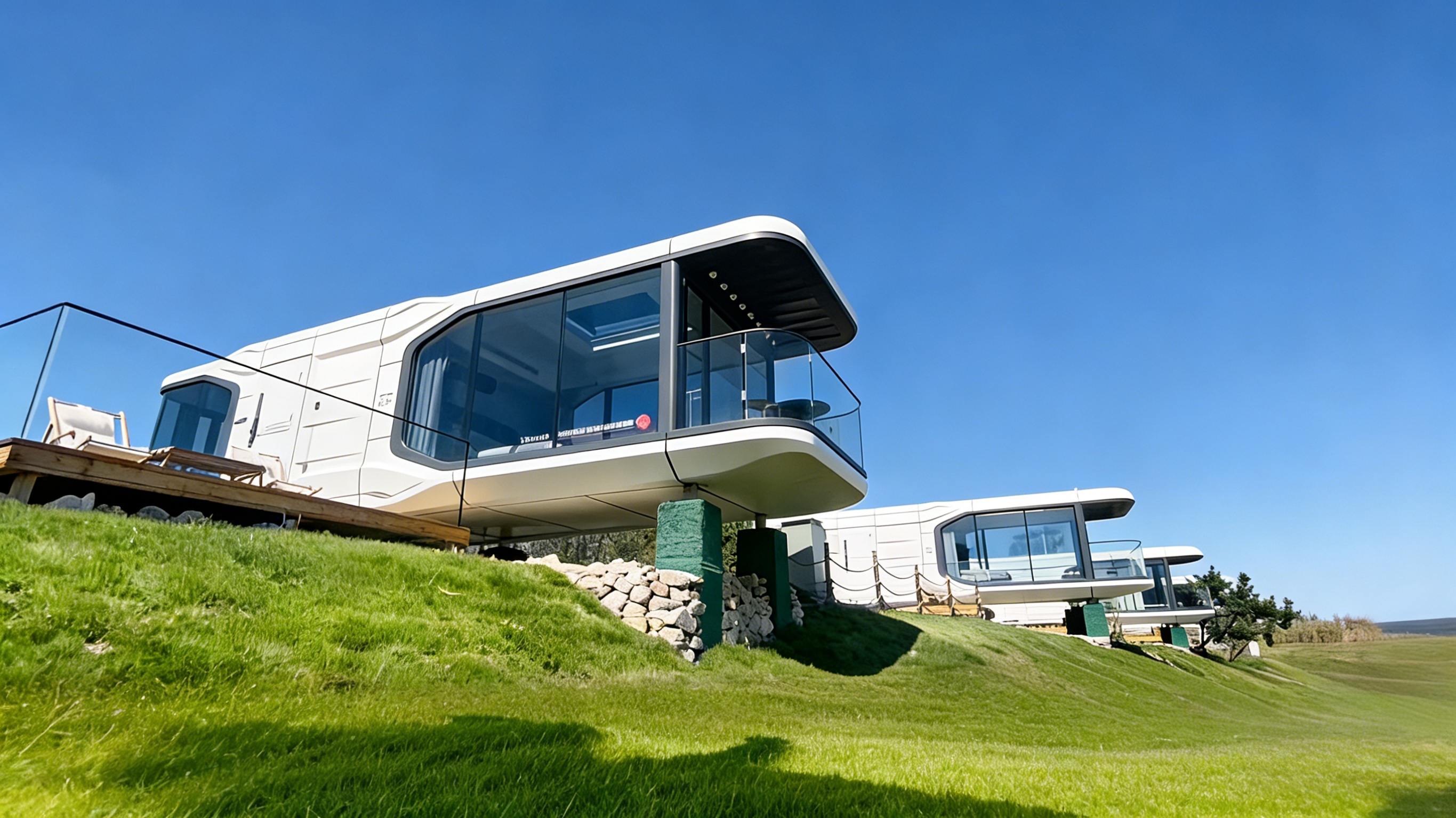
On-site capsule house project showcase
Documented deployments from the manufacturer's scenario records include a tourism resort OEM order in Malaysia for 10 capsule units used in camping resorts. The reported result is stable operation, with low noise highlighted as a positive point.
Other project references in the manufacturer's scenario data cover:
| Region | Application | Units / model |
|---|---|---|
| Thailand | Camping resorts | 10 units, M8 |
| Malaysia | Tourism villages | 4 units, M8 |
| China | Camping resorts | 36 units, M8 + M12 |
| Canada | Holiday homes | 6 customized units |
| Hong Kong | Business cabins | 2 customized units |
These examples indicate that the same steel modular system can be adapted to different regional markets and site conditions. For evaluation purposes, buyers should still request project references directly from the manufacturer and confirm that a proposed unit has been used in a comparable environment.
Market Trends Supporting Modular Capsule Accommodation
Market research points to continued growth in prefabricated and modular accommodation. The global prefabricated housing market is projected to reach approximately USD 152.74 billion by 2026, according to Mordor Intelligence, with modular homes growing at an estimated CAGR of 7.05% through 2031.
Within the glamping segment, Grand View Research projects the market will reach USD 7.9 billion by 2033. Cabins and pods are the largest accommodation type, accounting for 43.0% of the glamping market in 2025. For a steel modular capsule house manufacturer, this translates into demand for units that are faster to build but still differentiated in design.
Modular construction can compress project timelines by 30–50% compared to traditional on-site construction, according to Fortune Business Insights. In seasonal hospitality markets, a delay of one or two months can mean missing an entire booking season. This makes the manufacturer's lead time and production capacity as important as the unit's technical specifications.
Evaluation Checklist Before Placing an Order
Once a buyer reaches the execution stage, the following points should be confirmed in writing:
- Site access: confirm road width, turning radius, and crane positioning for units weighing up to approximately 13 tonnes.
- Ground preparation: confirm leveling requirements and load-bearing capacity for the selected model.
- Local classification: verify whether the project jurisdiction treats the capsule as an RV, ADU, modular building, or temporary structure.
- Electrical configuration: define voltage, plug standards, and total power load. Models range from 6KW to 10KW.
- Customization scope: list all ODM items, including logo, exterior finish, interior layout, glazing, and brand-specific features.
- Production schedule: align order quantity with the manufacturer's monthly capacity of 30 to 50 units and lead time of 30 to 45 days.
- Acceptance method: choose factory inspection or video inspection before shipment.
- After-sales support: confirm the remote support process for troubleshooting and technical assistance.
Comparison with Traditional Solutions and Known Boundaries
Compared with brick-and-concrete or conventional light-steel construction, a steel modular capsule house offers a different risk profile. The foundation requirement is lower, installation is faster, and the asset remains movable. The manufacturer reports that the modular installation process avoids on-site construction waste and can save about 80% of civil construction costs. Because the unit can be relocated and reused, it avoids the fixed-asset loss that occurs when a conventional building is abandoned after a project changes.
There are practical boundaries to plan around. The units are heavy, as the model table shows, so site access and lifting equipment need to be arranged. The ground must be level and capable of supporting the unit's weight. Local approvals still apply, whether through CE marking in the EU or through RV, ADU, or modular certification in the US. ODM customization takes engineering time, lead time of 30–45 days is realistic for production, and the 10-unit MOQ means a very small pilot may need to be planned differently. In sites where local zoning requires a permanent foundation, or where steep terrain exceeds the leveling capability of the unit, conventional construction may still be required.
Future Outlook
As capsule houses move from novelty format to standard hospitality inventory, buyers are likely to expect more integration between the steel frame, interiors, climate control, and smart features. Asia-Pacific is the fastest-growing region for glamping and luxury modular pods, with a projected CAGR of 12.6% through 2034, according to IMARC Group. The 18–32 age group accounts for approximately 45.3% of the glamping and capsule stay consumer base in 2025, which suggests that design, shareability, and comfort will remain central to purchasing decisions.
Manufacturers that can support ODM projects with clear engineering documentation, tested quality, and remote after-sales support will be better positioned to serve resort operators and developers who are converting an evaluation into an execution plan.
For readers evaluating BOITO-MINGSU for a steel modular capsule house program, the manufacturer's 2026 brochure is available for public reference and download: BOITO-MINGSU capsule house brochure.
Frequently Asked Questions
What are the advantages of modular space capsules?
A modular space capsule is factory-prefabricated and does not require a complex foundation on site. The ground only needs to be leveled, after which the capsule can be lifted and placed. The installation and placement of a single capsule can be completed in two hours, significantly shortening the project cycle. The modular structure does not produce on-site construction waste, can save about 80% of civil construction costs, and can be moved and reused as a whole unit after a project ends.
What customization options are available for steel modular capsule houses?
The manufacturer provides ODM production services. Standard customization includes voltage and logo, and products can be customized to meet the building codes and electrical standards of different countries. Buyers can also choose from different models, including M8, M10, M3, Apple Capsule MINI, and MS-XO8 F, depending on the accommodation or commercial function required.
What are the typical order requirements for OEM capsule house projects?
The stated MOQ is 10 units. Monthly production capacity is 30 to 50 units, and lead time is typically 30 to 45 days. Delivery terms include FOB, CIF, and EXW. Payment terms are 50% deposit with the balance before shipment, and buyers can use factory inspection or video inspection for acceptance. After-sales remote support is available.
Which certifications should a capsule house buyer check?
At the manufacturer level, BOITO-MINGSU holds an ISO 14001:2015 environmental management certificate, number ISC-E-2025-5371-R, covering the manufacturing of metal structures and mobilehomes. For destination markets, EU buyers should check CE marking under the Construction Products Regulation, while US buyers should confirm whether the unit is classified as an RV, an ADU, or state-certified modular construction.