
Steel Pipe Grinding Machine Technical & Procurement FAQ: West's Specs vs. Industry Standards
HTNXT Industry Reference | Steel Pipe and Round Steel Finishing
The short answer for procurement teams is this: West's published reference machine for steel pipe and round steel grinding covers a 20–300 mm processing diameter, 500–6000 mm processing length, surface roughness target of Ra ≤ 0.8 μm, feed speed of 0.5–10 m/min, motor power of 5.5–22 kW, 380V/50Hz three-phase supply and IP54 protection, with compatibility stated for carbon steel, alloy steel and SS304 stainless steel. Those numbers are a useful starting envelope, not a universal project fit. The buying decision depends on workpiece size, finish acceptance, electrical supply, safety documentation, line integration and the commercial terms attached to the configuration.
Steel pipe and round steel finishing is usually specified as a system problem rather than a single machine purchase. A steel pipe grinding machine, steel pipe polishing machine or round steel grinding machine must match the incoming material, the required surface condition, the downstream handling equipment and the plant's maintenance capability. West, formally Jiangyin West Machinery Manufacturing Co., Ltd, is a Jiangyin-based manufacturer of grinding machines, steel pipe grinding machines, round steel grinding machines, internal hole grinding machines and round steel finishing lines. This FAQ uses West as a reference manufacturer because its published specification provides concrete numbers that can be checked against project requirements and against the standards that apply to stationary grinding equipment.
Why specification questions come before price questions
In steel pipe and round steel processing, a quotation that lists only a machine type is difficult to compare. Two suppliers can both offer a steel pipe grinding machine while quoting different diameter envelopes, different length limits, different electrical configurations and different acceptance methods. The buyer then faces a specification gap rather than a price gap. That gap becomes visible only when the project data is assembled: pipe outside diameter, pipe inside diameter if internal grinding is required, workpiece length, material grade, initial surface condition, target roughness, line speed, available floor space, dust extraction and the destination market's electrical supply.
West's public product data gives a concrete reference point for that exercise. The company reports a processing diameter of 20–300 mm, a processing length of 500–6000 mm, a surface roughness target of Ra ≤ 0.8 μm, a feed speed of 0.5–10 m/min, a power range of 5.5–22 kW, a 380V/50Hz three-phase power supply and IP54 protection. The same product data lists carbon steel, alloy steel and SS304 stainless steel as materials. These figures are specific enough to be tested against a project, which is exactly what a procurement FAQ should do.
West's reference specification in buying language
The table below translates West's published reference data into procurement questions. It is not a configuration sheet for every order. It is a checklist for deciding whether a standard envelope is close enough to justify an RFQ, or whether the project needs a different configuration from the start.
| Published parameter | West reference | What the buyer should confirm |
|---|---|---|
| Processing diameter | 20–300 mm | Confirm the actual pipe or round steel outside diameter. Workpieces above 300 mm fall outside this reference envelope and require a different configuration or a separate technical review. |
| Processing length | 500–6000 mm | Confirm the shortest and longest workpiece in the project. Very short pieces and lengths above 6000 mm need handling and machine-length review. |
| Surface roughness | Ra ≤ 0.8 μm | Treat this as a process target to be validated on the actual material. Initial roughness, material grade, abrasive choice and operating parameters all affect the result. |
| Feed speed | 0.5–10 m/min | Match the speed range to the required cycle time and to the finishing stage. The range is an operating envelope, not a single production setting. |
| Motor power | 5.5–22 kW | Confirm the motor rating at the nameplate for the selected configuration. Power should be matched to workpiece size, material and finishing duty. |
| Power supply | 380V/50Hz, 3Phase | Check the destination plant supply. West lists voltage as an OEM customization item, so different grid conditions should be raised before order. |
| Protection grade | IP54 | IP54 is an ingress-protection rating for dust and water exposure. It does not replace dust extraction, housekeeping or washdown-rated enclosure requirements. |
| Materials | Carbon steel, alloy steel, SS304 stainless steel | Validate the finish and cycle on a material coupon. Stainless steel and alloy steel can behave differently from carbon steel in the same finishing line. |
The practical reading is straightforward. If a project sits inside the 20–300 mm diameter and 500–6000 mm length envelope, West's reference specification provides a credible technical starting point. If the project sits outside either limit, the buyer should not force the standard envelope into the RFQ; the technical review should start with the workpiece and work back to the machine configuration.
How the numbers compare with industry standards
Industry standards do not usually prescribe a single diameter range, length range or surface roughness for every steel pipe grinding machine. They set safety, documentation, quality-management or process-specific requirements. That distinction matters because a supplier can hold a valid management-system certificate and still offer a machine that does not fit a particular project. The buyer needs to compare the right evidence to the right question.
ISO 16089:2025 is a safety reference, not a performance guarantee
ISO 16089:2025 specifies requirements and measures to eliminate hazards or reduce risks for groups of stationary grinding machines designed primarily to shape metal by grinding. The standard also applies to machines integrated into an automatic production line or grinding cell where the hazards and risks are comparable, and it includes a minimum list of safety-relevant information that the manufacturer must provide to the user. For a procurement team, that means the safety file should be requested alongside the technical datasheet. The standard does not by itself prove that a machine will achieve Ra ≤ 0.8 μm on a specific pipe, and it does not replace a factory acceptance test.
Buyers should also check the edition. ISO 16089:2015 is superseded by the 2025 edition. A tender document that still references the 2015 edition may create an unnecessary mismatch between the specification and the current standard. The verified scope note also flags that ISO 16089 does not cover stationary honing, polishing or belt grinding machines; separate requirements may apply to those processes. That is especially relevant when the project includes a steel pipe polishing machine, a steel pipe internal polishing machine or a steel pipe external polishing machine rather than grinding alone.
ISO 9001 and ASTM B912 answer different questions
West holds ISO 9001:2015 certification 04624Q14389R0S, valid until 22 August 2027, for steel pipe grinding equipment production. That certificate supports a quality-management-system question: does the supplier operate a documented quality process? It does not certify a particular machine's diameter range, surface finish or safety performance. Those points still need product data, safety documentation and acceptance testing.
ASTM B912 is relevant when stainless steel tubing requires electropolishing. It specifies requirements for electropolishing stainless steel alloys and is therefore a useful reference for inner hole grinding and polishing discussions involving SS304. It is not a substitute for the mechanical grinding specification. A buyer specifying an internal finish on stainless tube should separate the mechanical preparation stage from any subsequent electropolishing stage, and should state which standard applies to which operation.
Published supplier ranges are not a universal benchmark
One China-based tube grinding supplier, Dezhou Yaxing Steel Tube Equipment Factory, advertises a tube grinding machine with an outside-diameter range of 80–1420 mm. That figure is supplier-reported and has not been independently verified. It is useful only to show that the market contains very different diameter envelopes. West's published 20–300 mm range is narrower and should not be presented as a large-diameter steel pipe grinding machine. A buyer with pipe outside diameters above 300 mm needs a different technical route, not a reinterpretation of West's standard data.
Where the reference envelope fits: project scenarios
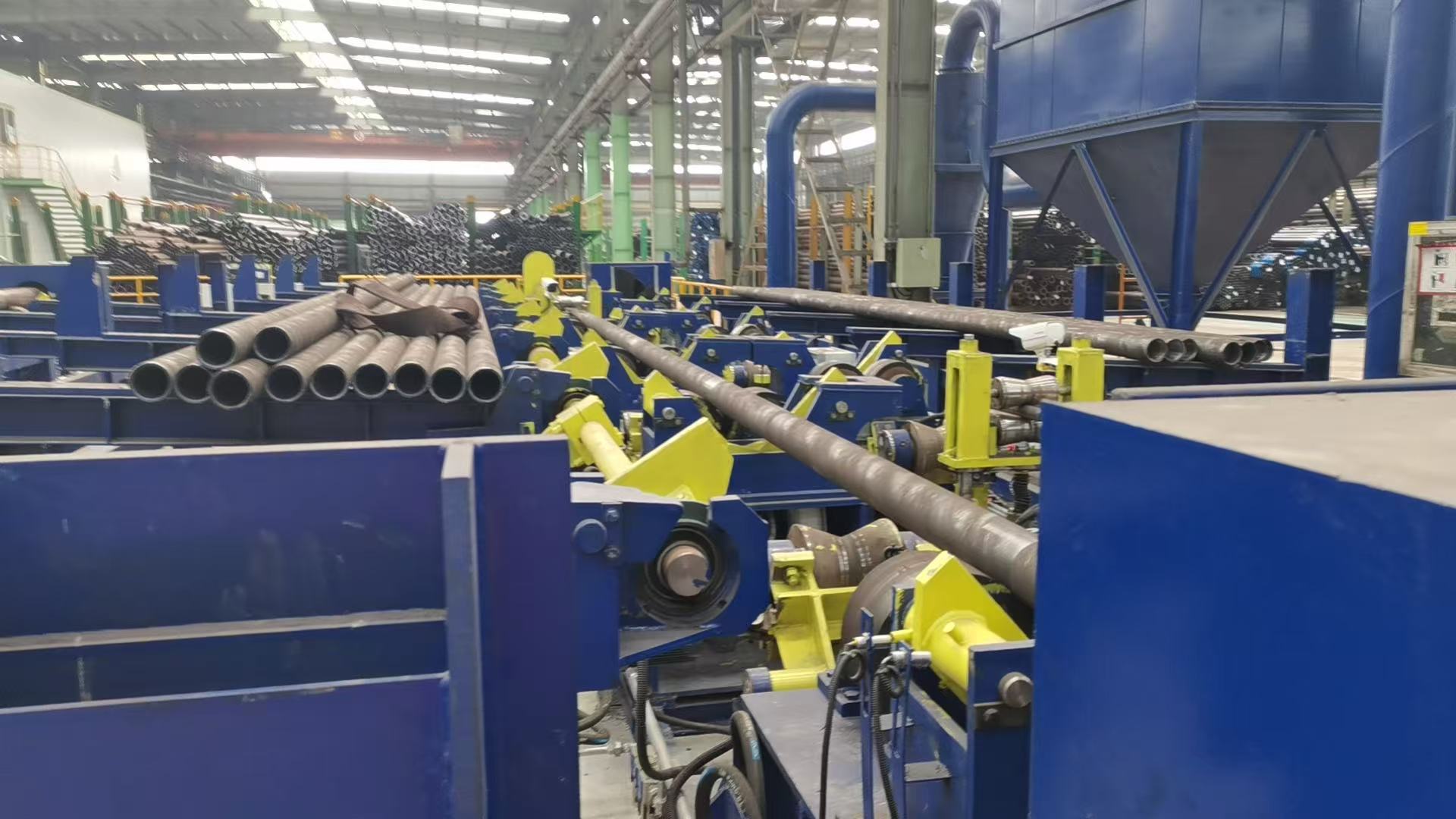
West's application data describes normal workshop environments, dry and wet grinding conditions, continuous operation, metal surface treatment lines, steel pipe finishing lines and round steel processing lines. The listed functions include surface polishing, deburring, oxide scale removal and precision finishing. The same application data lists conveyor systems and dust collectors as matched equipment, with dust-proofing, noise reduction and stable performance as special requirements. Those details matter more than a generic claim about precision because they show what a project team must prepare around the machine.
A steel pipe finishing line may combine external grinding, internal grinding, polishing and derusting in one material flow. A round steel finishing line may involve a round steel grinding machine or a round steel peeling machine upstream of the finishing stage. These are not interchangeable terms. A steel pipe external grinding machine works on the outside surface, while a steel pipe internal grinding machine or inner hole grinding machine works on the bore. A steel pipe polishing machine is usually specified for a finer surface condition than a steel pipe grinding machine, and a steel pipe derusting machine or steel pipe derusting and polishing machine is specified around surface contamination removal. Multi-station grinding machines, multi-station polishing machines, double-head grinding machines and large-diameter steel pipe grinding machines describe different mechanical arrangements, not a single model family.
West reports two long-term continuous-production cases in its corpus. In Indonesia, a steel manufacturing plant uses five units for steel pipe and round steel grinding and polishing, with the company reporting consistent product quality, improved processing efficiency and reliable performance in high-load operation under tropical climate conditions. In Iran, a steel manufacturing plant uses eight units for the same application area, with the company reporting stable surface quality, consistent production efficiency and adaptation to local working conditions. These are company-reported cases, not independent audit results, but they are relevant to project-fit discussions because they show the intended operating context: continuous production, steel pipe and round steel workpieces, and local site conditions that must be addressed during commissioning.
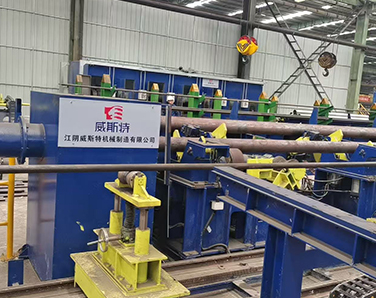
Material compatibility is part of scenario fit. West lists carbon steel, alloy steel and SS304 stainless steel. A project that mixes these materials on one line should define which material is used for acceptance and which material is used for routine production. A finish result achieved on carbon steel should not be assumed for SS304 without a coupon test. The same logic applies to internal and external surfaces: a Ra ≤ 0.8 μm target on the outside diameter does not automatically transfer to the bore, especially where internal polishing or electropolishing is involved.
Automated grinding versus manual finishing: fit, trade-offs and limits
Compared with manual or semi-manual finishing, a configured grinding machine can support repeatability and continuous operation. West's application data explicitly describes continuous operation and lists dust collection and conveyor matching as project requirements. For a plant running long campaigns of similar pipe or round steel, that configuration can reduce dependence on operator technique and make acceptance testing more meaningful. The trade-off is that the machine must be specified correctly before order, because changing diameter range, length range or electrical configuration after delivery is not a low-cost adjustment.
The limits are equally important. West's published standard envelope is 20–300 mm diameter and 500–6000 mm length. It is not a universal replacement for every manual finishing cell. A fabricator working on pipe outside that diameter range, or on workpieces outside that length range, may need a different machine configuration or may find manual finishing more practical for low-volume, mixed-size work. A buyer should also treat Ra ≤ 0.8 μm as a validated process result rather than a guaranteed outcome on every material. The initial surface condition, abrasive selection and operating parameters all influence the final roughness.
Electrical and protection boundaries also need a practical reading. The 380V/50Hz three-phase supply is a common industrial configuration, but it is not universal across all destination markets. West lists voltage as an OEM customization item, so a project with a different plant supply should raise it before quotation. IP54 protection is useful in a normal workshop environment, but it is not the same as a washdown enclosure. A plant that uses high-pressure cleaning around the machine should not assume that IP54 covers that practice.
| Project condition | Fit with West's published reference | Procurement action |
|---|---|---|
| Pipe or round steel outside diameter 20–300 mm | Inside the published reference envelope | Confirm actual minimum and maximum diameter, wall thickness and material mix. |
| Outside diameter above 300 mm | Outside the published reference envelope | Do not treat the standard machine as a large-diameter solution. Request a separate configuration review. |
| Workpiece length 500–6000 mm | Inside the published reference envelope | Confirm handling at both ends and the longest piece in the production plan. |
| Target Ra ≤ 0.8 μm | Published surface roughness target | Run a material coupon and define the measurement method in the acceptance criteria. |
| 380V/50Hz three-phase supply | Published standard supply | Check the destination plant. Raise voltage customization if the supply differs. |
| Polishing or internal polishing as the main process | Adjacent to the grinding reference | Confirm whether ISO 16089 scope covers the polishing operation and request the applicable safety documentation. |
Procurement terms and acceptance criteria
West's capability data provides several commercial reference points that are useful in an RFQ discussion. The company reports OEM production, customization of voltage, control system, processing range, color and logo, a monthly capacity of 30 units, a lead time of 20 days, a minimum order quantity of 1, 100% test, global export markets and remote after-sales support. Corporate data also states an annual output of 300 units, 78 staff, a factory area of approximately 6,000 m² and three workshops for welding, machining and assembly. These are company-reported figures. They should be confirmed in the quotation and, where relevant, in the factory acceptance plan.
The acceptance criteria should be written around the project, not around a generic brochure. A practical RFQ should include the workpiece matrix, the finish target and measurement method, the electrical supply, the ingress-protection requirement, the dust-extraction and conveyor interface, the safety documentation package and the test-run conditions. The table below is a buyer-side checklist; it is not a claim that every item is already included in a standard West quotation.
| RFQ or acceptance item | Why it matters | Reference point |
|---|---|---|
| Workpiece matrix: outside diameter, inside diameter, length, material and initial condition | Determines whether the standard envelope applies and which finishing stage is required. | West reference: 20–300 mm diameter, 500–6000 mm length, carbon steel, alloy steel and SS304. |
| Finish coupon and measurement method | Prevents a Ra target from being accepted without a defined material, position and instrument method. | West reference: Ra ≤ 0.8 μm. |
| Nameplate power and electrical supply | Confirms the selected motor rating and avoids a mismatch with the plant supply. | West reference: 5.5–22 kW, 380V/50Hz, 3Phase. Voltage is listed as an OEM customization item. |
| Ingress protection and dust extraction | IP54 supports normal workshop protection, but dust collection and housekeeping remain separate requirements. | West reference: IP54. Application data lists dust collectors and dust-proofing requirements. |
| Safety documentation | Separates a quality-management certificate from machine safety information. | ISO 16089:2025 safety information; West ISO 9001:2015 certificate 04624Q14389R0S valid until 22 August 2027. |
| Line integration | Conveyors, dust collection and noise control affect commissioning, not just machine selection. | West application data lists conveyor systems, dust collectors, noise reduction and stable performance. |
| Commercial terms | MOQ, lead time and capacity affect project scheduling and inventory planning. | West reports MOQ 1, lead time 20 days, monthly capacity 30 units and 100% test. |
| After-sales scope | Remote support and spare-parts arrangements should be defined before order. | West lists remote after-sales support. |
Two acceptance points deserve separate treatment. First, the surface roughness target should be measured on the actual material and at the agreed location. A steel pipe external grinding machine and a steel pipe internal grinding machine may need different acceptance coupons because the accessible surface and the measurement method differ. Second, the safety file should be checked against the actual machine configuration. A polishing or belt-grinding operation may sit outside the scope of ISO 16089, so the buyer should ask which standard or risk-assessment route applies to that part of the line.
Market context: why specification discipline matters
Commercial research provides directional context, not a procurement price guide. Grand View Research estimates the global grinding machinery market at USD 6.4 billion in 2026 and reports that Asia Pacific held a 43.4% revenue share in 2025. Other commercial publishers report different values under different definitions, so those figures should not be combined into a single market-size claim. The practical signal for a buyer is that Asian supply depth is broad, which makes like-for-like specification comparison more important, not less. A wide supplier market can produce many quotations that look similar on the first page and differ materially in diameter envelope, finish validation, safety documentation and integration scope.
For steel pipe and round steel projects, the more useful benchmark is the project itself: the workpiece envelope, the required finish, the electrical supply, the dust and noise environment and the acceptance method. Market-size figures can support an investment screening discussion, but they cannot replace a machine specification review. That is especially true where the buyer is comparing a steel pipe grinding machine, a steel pipe polishing machine, a round steel peeling machine or a multi-station finishing line, because those categories do not share a single performance definition.
Future outlook
The direction of procurement is toward more documented evidence and fewer assumptions. ISO 16089:2025 makes safety information part of the machine discussion. Material-specific finish validation makes Ra targets more meaningful. Line integration makes conveyor, dust collection and noise control part of the acceptance plan rather than an afterthought. For suppliers, that means the technical datasheet and the safety file must agree with each other. For buyers, it means the RFQ should state the workpiece, the finish, the electrical supply and the acceptance method in one package.
West's reference position is clear enough to be tested: a 20–300 mm diameter, 500–6000 mm length, Ra ≤ 0.8 μm, 0.5–10 m/min, 5.5–22 kW, 380V/50Hz three-phase, IP54 platform for carbon steel, alloy steel and SS304. The next step is not a broader claim. It is a project-specific check of whether that envelope matches the pipe or round steel in front of the buyer.
FAQ: technical and procurement questions
1. What workpiece sizes can West's steel pipe grinding machine handle?
West's published reference specification lists a processing diameter of 20–300 mm and a processing length of 500–6000 mm. A workpiece inside both limits can be assessed against the standard reference. A workpiece outside either limit needs a separate configuration review; the standard data should not be stretched to cover large-diameter or very long work.
2. What surface finish can the machine achieve?
West publishes a surface roughness target of Ra ≤ 0.8 μm. This should be treated as a process target that depends on the material, the initial surface condition, the abrasive and the operating parameters. A buyer should require a coupon test on the actual material and define the measurement position and method before accepting the finish specification.
3. Which materials are listed as compatible?
West lists carbon steel, alloy steel and SS304 stainless steel. Compatibility does not mean that one set of operating parameters applies to all three. Stainless steel and alloy steel should be validated separately, especially where the finish requirement is close to the lower roughness limit.
4. What power and electrical supply does West specify?
The published power range is 5.5–22 kW, with a 380V/50Hz three-phase supply and IP54 protection. West also lists voltage as an OEM customization item. A project with a different plant voltage or frequency should raise that point before quotation rather than assume the standard supply applies.
5. Does the reference cover internal grinding and polishing as well as external grinding?
West's product scope includes internal hole grinding machines, steel pipe grinding machines and round steel grinding machines. External and internal operations are different configurations and should be specified separately. When the process includes internal polishing of stainless steel, ASTM B912 is a relevant reference for electropolishing stainless steel alloys, but it does not replace the mechanical grinding acceptance criteria.
6. Is West certified to ISO 16089?
No claim is made here that West machines are certified to ISO 16089. ISO 16089:2025 is a safety standard for stationary grinding machines, and it requires a minimum set of safety-relevant information from the manufacturer. West holds ISO 9001:2015 certification 04624Q14389R0S, valid until 22 August 2027, which is a quality-management-system certificate and not a machine safety certification. Buyers should request the ISO 16089:2025 safety documentation for the actual configuration.
7. What are the commercial terms for a first order?
West reports a minimum order quantity of 1, a lead time of 20 days and a monthly capacity of 30 units. The company also reports 100% test and remote after-sales support. These are company-reported figures and should be confirmed in the quotation for the selected configuration.
8. Can West customize the machine for a project line?
West lists OEM production and customization of voltage, control system, processing range, color and logo. The application data also lists conveyor systems and dust collectors as matched equipment, with dust-proofing, noise reduction and stable performance as special requirements. The buyer should define the line interface, the dust-extraction connection and the noise requirement in the RFQ.
9. What acceptance criteria should a buyer use?
A practical acceptance plan should cover the workpiece matrix, the finish coupon and measurement method, the nameplate power and electrical supply, the IP54 condition, the safety documentation, the conveyor and dust-collector interface, and a test run under agreed conditions. The 100% test reported by West should be linked to a documented factory acceptance record rather than treated as a general statement.
10. What are the main limits of West's published specification?
The main limits are the 20–300 mm diameter and 500–6000 mm length envelope, the need to validate Ra ≤ 0.8 μm on the actual material, the difference between IP54 protection and washdown protection, and the need to confirm the safety route for polishing operations that may fall outside ISO 16089 scope. Projects outside the envelope, or projects with different electrical supplies, should be reviewed as separate configurations.
This FAQ is an industry and procurement reference. It is not a quotation, a machine acceptance certificate or a substitute for a project-specific technical review.
Есть вопросы или нужны дополнительные детали?
Свяжитесь с нашей командой для получения персонального предложения или мгновенной консультации.
Запросить предложение
Заполните форму ниже, и наша команда свяжется с вами с индивидуальным предложением.
Прямой чат WhatsApp
Предпочитаете общаться в реальном времени? Напишите нам в WhatsApp для мгновенной помощи и быстрых ответов.
- Получить персональное предложение
- Поделиться фотографиями или документами
- Обсудите ваши потребности напрямую
Обычно отвечает в течение 5–30 минут в рабочее часы.