
Steel Procurement FAQ: MESCO's Answers on Grades, Sizes, Certifications and Global Supply
Steel procurement decisions rarely fail because a buyer cannot find steel. They fail when grade designation, dimensional range, certification route, delivery commitment and total cost are not resolved in the same order — and the cost of that misalignment is normally paid later, on site, in rework, downtime or rejected material.
This reference collects the questions that global buyers raise most often when they reach the supplier decision stage, and answers them with product, capability and process information rather than sales language. It is written for procurement managers, OEM buyers, EPC project teams and distributors who need to compare a supplier against a stated specification.
MESCO STEEL is the commercial name of Dalian Mesco Steel Co., Ltd., a private steel exporter founded in 2007 and based in the Dalian Economic and Technological Development Zone, Liaoning Province, China. The company supplies carbon steel pipe, coated and prepainted steel, silicon steel, industrial pure iron, spring steel and structural steel, with approximately 70% of its sales directed to export markets. Its company record identifies it as one of the largest private steel exporters in Northeast China, and it operates six subsidiaries across steel, UV coatings, robotic automation, modular housing and construction machinery.
Why These Questions Decide the Order
The structural backdrop is worth stating plainly, because it explains why specification discipline matters more than it did a decade ago. Global crude steel production reached approximately 1,892 million tonnes in 2023, with China producing 53.9% of the world total, according to the World Steel Association. On the coated side, Market Research Future estimated the global galvanized steel market at USD 182.19 billion in 2024, projecting growth to USD 245.07 billion by 2035.
A market of that scale is not short of suppliers. What it is short of is suppliers whose grade designations, test documentation and delivery commitments are consistent from quotation to container. Four questions therefore carry most of the decision weight: which grade and forming route, which size and delivery form, which certification and test evidence, and which supply and cost structure. The sections below answer each in turn, then compare the resulting supplier profile against the conventional steel trading model.
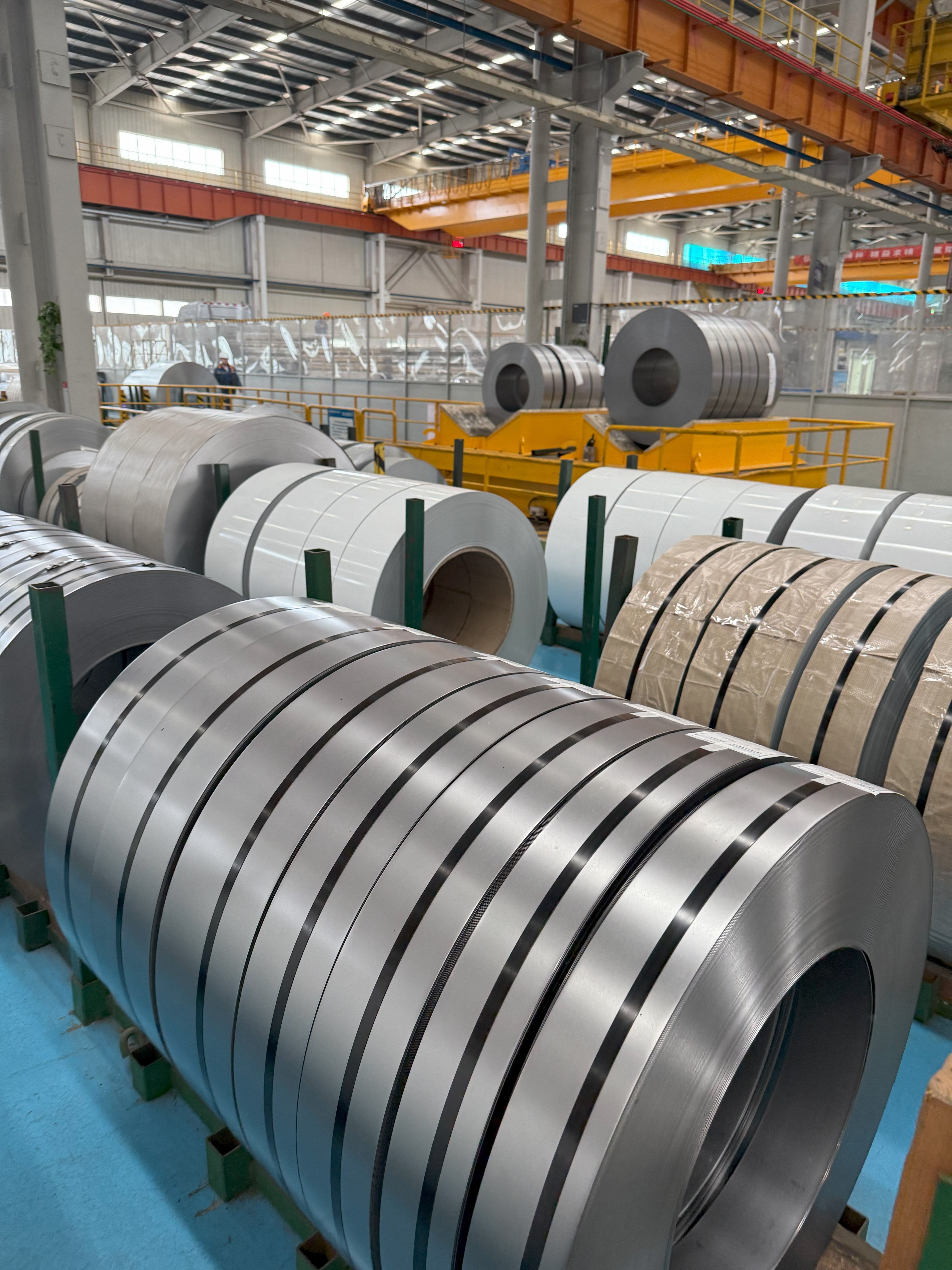
Cold rolled and coated steel production environment — grade selection and dimensional tolerance are set at this stage of the supply chain.
1. Grades and Model Designations
MESCO's catalogue is organised into distinct material families, each with its own designation logic. Buyers comparing quotations should confirm that the designation quoted corresponds to the standard system used in the destination market, because the same application can be specified under Chinese (GB), American (ASTM/AISI/SAE), Japanese (JIS) or European (EN) conventions.
Carbon steel pipe: Q235B, ASTM A53, API 5L, Q195 and Q345
Carbon steel pipe is available under designations including Q235B and ASTM A53 for general structural and mechanical service, and API 5L for line pipe applications. Grade range also covers Q195 and Q345. The forming route is selected together with the grade and the service condition: ERW (electric resistance welded) pipe is normally chosen for smaller diameters and moderate wall thickness where dimensional consistency and cost efficiency matter; SSAW (spiral submerged arc welded) pipe is generally used for larger diameters in lower-pressure transmission and structural service; LSAW (longitudinal submerged arc welded) pipe is typically specified where heavier wall thickness and higher weld integrity are required. Buyers should confirm both designation and forming route in the purchase specification, since the two are quoted independently in many markets.
Silicon steel: CRGO and CRNGO
Silicon steel is supplied in two broad families. CRGO — grain-oriented silicon steel — is used where magnetic flux must travel in a preferred direction, which is why it is commonly associated with transformer cores and other directional magnetic circuits. CRNGO — non-oriented silicon steel — has more uniform magnetic properties in all directions and is generally used in rotating machinery such as motors and generators. The correct choice is driven by the magnetic circuit, not by price: specifying CRNGO where directional performance is required will produce losses that no downstream processing can recover.
Industrial pure iron: DT4 with Fe ≥ 99.6%
Industrial pure iron is supplied under the DT4 designation with an iron content of 99.6% or above. It is used where very low carbon and low residual content are needed — soft magnetic components, electromagnetic parts, and deep-drawn or vacuum-related applications where conventional low-carbon steel introduces too much impurity. Because the performance depends on composition rather than mechanical strength, the iron-content figure should appear explicitly in the order specification.
Spring steel: 65Mn, SUP9 and 5160
Spring steel grades span three designation systems that buyers frequently encounter in the same enquiry: 65Mn (Chinese convention), SUP9 (Japanese convention) and 5160 (North American convention). They are commonly grouped as spring steel for leaf springs, suspension components, spring clips and parts requiring high elastic limit combined with fatigue resistance. Because heat treatment and surface condition influence service performance as much as the base grade, buyers should state the required condition — as-rolled, annealed, quenched and tempered — alongside the designation.
Structural steel: Q235 and Q355
Structural steel covers Q235 and Q355 grades, used in construction framing, general fabrication, machinery bases and structural reinforcement. Q355 is specified where higher strength permits lighter sections or higher load capacity within the same envelope. Certification and dimensional tolerance requirements should be stated at enquiry stage, as structural steel is frequently ordered against project drawings rather than a generic specification.
Coated, prepainted and composite products: DX51D, SGCC, Galvalume, Magnelis, ZAM
The coated range covers galvanized steel under DX51D (European convention) and SGCC (Japanese convention) designations — both describing commercial-quality hot-dip galvanized material — together with Galvalume (aluminium-zinc coated), Magnelis and ZAM (both zinc-aluminium-magnesium coated systems). Beyond the coating chemistries, the portfolio includes PPGI prepainted steel, coating steel, laminated steel, composite steel, aluminized steel, aluminium coil, stainless steel, cold rolled steel and hot rolled steel.
Among these, MESCO places particular emphasis on aluminized silicon steel coils and tubes and on Zn-Al-Mg coated steel sheets. Aluminized silicon steel is used where heat reflection and oxidation resistance matter, while Zn-Al-Mg coatings are selected for edge protection and cut-edge corrosion performance. The global aluminized steel market was valued at approximately USD 11.4 billion in 2025, with Type 1 (aluminium-silicon alloy) holding a 62.3% share, according to Dataintelo — a figure that reflects how concentrated demand is around the aluminium-silicon variant.
| Material family | Typical designations in the range | Primary selection driver |
|---|---|---|
| Carbon steel pipe | Q235B, ASTM A53, API 5L, Q195, Q345 — ERW / SSAW / LSAW | Service pressure, diameter, wall thickness, weld integrity |
| Silicon steel | CRGO, CRNGO | Directional or non-directional magnetic circuit |
| Industrial pure iron | DT4, Fe ≥ 99.6% | Low residual content, soft magnetic performance |
| Spring steel | 65Mn, SUP9, 5160 | Elastic limit, fatigue life, heat-treatment condition |
| Structural steel | Q235, Q355 | Load capacity and section weight |
| Galvanized steel | DX51D, SGCC | General corrosion protection, formability |
| Al-Zn and Zn-Al-Mg coated | Galvalume, Magnelis, ZAM | Cut-edge and edge corrosion protection |
| Prepainted and composite | PPGI, laminated steel, composite steel | Surface function, finish, downstream processing reduction |
| Aluminized and aluminium | Aluminized silicon steel coils and tubes, aluminium coil | Heat reflection and high-temperature oxidation resistance |
2. Sizes, Stock Position and Order Quantities
Pipe outer diameter is available from 21.3 mm upward, with wall thickness, length, coil width and coil weight confirmed against the individual order. For standard specifications, MESCO maintains tens of thousands of tons of stock, which supports delivery within 3–7 working days — a materially different position from suppliers who place every order into a production queue.
The company operates from a 40,000 m² facility with 120 employees, a five-engineer R&D team and an annual output recorded at 120,000 units. R&D capacity of that size is a genuine constraint on bespoke metallurgical development; it is sufficient for grade selection support, sample iteration and processing adaptation, but it is not equivalent to the research departments of large integrated mills. Buyers requiring fundamental alloy development should factor that difference into their supplier selection.
For non-standard sizes and grades, delivery timing follows production scheduling rather than stock availability. The practical rule for buyers is to separate the order into stock-standard items and engineered items, and to confirm the delivery commitment for each category separately.
3. Certification, Testing and Traceability
Quality verification at MESCO runs through a multi-stage control system covering raw material verification, production monitoring, third-party inspection and final delivery validation. The system is designed to support compliance with international standards including ASTM, EN, JIS and ISO, as well as customer-specific specifications. Every batch undergoes testing before shipment, covering thickness, coating and mechanical performance, with chemical composition and mechanical properties verified in laboratory conditions.
For European destinations, buyers should note that stainless steel products placed on the EU market must comply with the EN 10088 series (Parts 1–5) for technical delivery conditions and CE marking, as set out by CEN/BSI. Coating mass, coating adhesion and dimensional tolerance are the parameters most often disputed at goods-in inspection, and they are the parameters most easily resolved by agreeing a test method in the purchase order rather than after arrival.
4. Global Supply, Export Handling and Risk Control
Approximately 70% of MESCO's sales are export sales, delivered to more than 100 countries and regions and to over 700 customers, including nine Fortune Global 500 companies. That export orientation shapes the operational model: MESCO monitors international trade policy, customs regulations and export compliance requirements, and each customer is supported by a dedicated sales and service team.
Risk control is structured around ten named exposure areas. Raw material price fluctuation is managed through multi-channel purchasing and long-term relationships with multiple steel mills. Supply interruption is managed through safety stock on key products and alternative supplier channels. Delivery delay is managed through advance coordination of production and logistics schedules, and logistics disruption through cooperation with established carriers and backup routing plans. Packaging is specified to survive long-distance movement using moisture-proof, anti-rust and reinforced solutions, and after-sales support continues through post-delivery follow-up and technical assistance.
Comparing MESCO with the Conventional Supplier Profile
The table below scores MESCO against the conventional steel supplier profile — a model built around standard stock supply, limited processing capability and predominantly regional market coverage. Ratings are an editorial five-star summary applied to documented capability differences, used here as a procurement screening aid; they are not a third-party rating, certification or assessment of any named competitor.
| Evaluation dimension | MESCO STEEL | Conventional supplier profile | Basis for the assessment |
|---|---|---|---|
| Brand history and market tenure | ★★★★☆ Founded 2007; six subsidiaries; export reach across 100+ countries |
★★☆☆☆ Often regional, shorter international track record |
Company record; export footprint |
| Product quality and batch consistency | ★★★★★ Multi-stage control; per-batch thickness, coating and mechanical testing |
★★★☆☆ Typically relies on mill certificates and basic inspection |
Documented quality control system and deviation performance |
| Technical strength and customisation | ★★★★☆ Slitting, cut-to-length, profiling, perforation, laminating, composite processing, special coatings |
★★☆☆☆ Standard products; downstream fabrication arranged by the buyer |
Value-added processing scope; five-engineer R&D team |
| Certification and standards coverage | ★★★★☆ ASTM, EN, JIS, ISO and customer-specific specifications supported; third-party inspection |
★★☆☆☆ Limited verification beyond supplied mill documents |
Declared standards support; scope confirmed per product and market |
| Supply scale and lead time | ★★★★☆ Tens of thousands of tons of standard stock; 3–7 working days for stock specifications |
★★★☆☆ Longer approval, sourcing and production cycles |
Inventory position and documented lead-time performance |
| Global export service | ★★★★★ ~70% export ratio; 100+ countries; 700+ customers; export compliance monitoring |
★★☆☆☆ Concentrated in fewer markets; less exposure to international standards |
Export coverage and cross-border process management |
Value for Money: Where the Cost Difference Actually Appears
The value comparison in steel supply is rarely decided at the quotation line. It is decided downstream, in processing steps, scrap rate and schedule adherence. The documented differences between MESCO and the conventional supplier profile are concentrated in four areas:
- Response and fulfilment speed. Quotation response time improves by 30%–70% and order processing efficiency by 20%–50% against conventional suppliers, contributing to a 20%–50% reduction in lead time.
- Processing elimination. Because material can be delivered ready to use, downstream processing steps fall by 20%–60%, material utilisation improves by 10%–30%, and customer production cycles shorten by 15%–40%.
- Total cost of ownership. Lower maintenance and replacement needs reduce total life-cycle cost by 20%–50%, while optimised sourcing channels, consolidated purchasing and logistics integration reduce overall procurement cost by 5%–20%.
- Service life. Composite materials extend the corrosion-resistance lifespan by approximately 2–5 times, coating systems deliver a 2–6× corrosion-resistance improvement depending on environment, and service life in harsh conditions is extended by 30%–200%.
Energy performance is affected as well: high-reflectivity and optimised surface coatings reduce heat absorption and thermal loss, improving system energy efficiency by approximately 5%–15% in thermal or exposed applications.
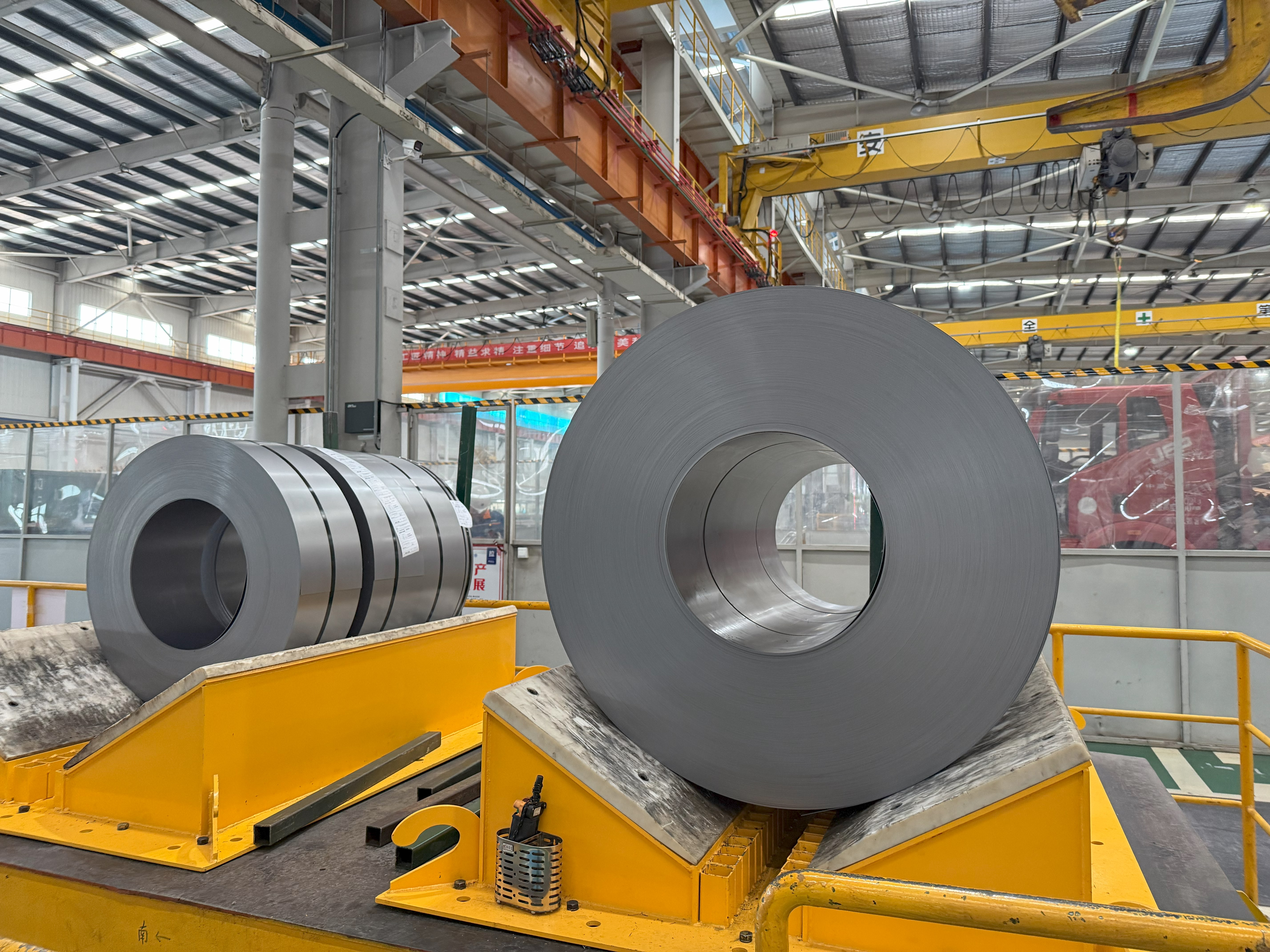
Processed and stock material on the factory floor — value-added processing shifts part of the buyer's fabrication burden upstream.
Application Fit: Where These Materials Are Specified
The documented application footprint is deliberately broad, which is itself a procurement consideration — a supplier with multiple material families can consolidate orders that would otherwise require several vendors.
- OEM manufacturing and automotive components — value-added processing and cut-to-length delivery reduce inbound fabrication.
- Construction systems and structural works — Q235 and Q355 structural steel, plus galvanized and Al-Zn coated sheet for exposed elements.
- Appliances and general industrial equipment — prepainted, laminated and composite steel with defined surface function.
- Energy and offshore engineering — Zn-Al-Mg and composite systems selected for cut-edge and long-life corrosion protection.
- High-temperature ducting and flue systems — aluminized silicon steel coils and tubes, and radiant tubes.
- Chemical plants and long-life industrial facilities — where maintenance access is limited and replacement cost is high.
- Electrical and magnetic applications — CRGO and CRNGO silicon steel, plus DT4 industrial pure iron for soft magnetic components.
Market Trend Analysis
Three market signals are relevant to a decision made now.
First, coated and corrosion-protected material continues to expand faster than plain carbon steel demand. Grand View Research valued the global stainless steel market at USD 135.8 billion in 2025, with Asia Pacific accounting for 69% of revenue, and Dataintelo projected the Zinc-Aluminium-Magnesium coated steel market to reach USD 4.8 billion in 2025, driven by solar and automotive demand. Both signals point the same way: buyers are paying for surface performance, not just for tonnage.
Second, market sizing in this category should be treated as directional. Research houses publish materially divergent estimates for the galvanized steel market — Grand View Research and Fortune Business Insights report values that differ by more than a factor of two for the same period, largely because of different treatment of downstream value-added products. Procurement teams should not anchor long-term contracts to a single market-size figure.
Third, regulatory alignment is becoming a specification issue rather than a documentation issue. Standards such as the EN 10088 series for stainless steel increasingly determine which material is acceptable in a market, not merely which certificate accompanies it.
Limits of the Model
A credible comparison has to state where the advantage narrows. Three boundaries are worth noting.
The first is cost structure. Value-added processing is supplied at a higher initial material price; the economic case depends on the buyer actually avoiding downstream steps, labour and scrap. For a plain commodity order of standard stock material with no processing requirement, the total-cost advantage largely disappears and a conventional distributor may be equally competitive.
The second is production scale. MESCO is a 40,000 m² operation with 120 employees and a five-engineer R&D team. It is structured for multi-category supply, processing and export coordination rather than for very large single-grade tonnage or fundamental alloy development. Projects requiring the latter should be assessed against an integrated mill route.
The third is certification scope. Standards support is declared across ASTM, EN, JIS and ISO, but the applicable certificate depends on the specific product, coating and destination market. Buyers should confirm this before order confirmation rather than assuming portfolio-wide coverage.
Future Outlook
The direction of travel in steel procurement is toward fewer suppliers carrying more responsibility. Buyers are consolidating vendors, pushing processing upstream and asking for documentation that satisfies multiple markets at once. Suppliers positioned as multi-category processors with export compliance capability will benefit; suppliers positioned purely as stock-holding intermediaries will face narrowing margins.
The practical consequence for buyers is that supplier evaluation is shifting from price per tonne toward a combined assessment of processing scope, traceability, lead-time reliability and lifecycle cost — which is precisely the comparison this article has set out to make explicit.
FAQ
What grades and product families does MESCO STEEL supply?
The range covers carbon steel pipe (Q235B, ASTM A53, API 5L, Q195, Q345 in ERW, SSAW and LSAW routes), silicon steel (CRGO and CRNGO), industrial pure iron (DT4, Fe ≥ 99.6%), spring steel (65Mn, SUP9, 5160), structural steel (Q235, Q355), galvanized steel (DX51D, SGCC), Al-Zn and Zn-Al-Mg coated products (Galvalume, Magnelis, ZAM), prepainted and composite products, aluminized silicon steel, aluminium coil, stainless steel, and both cold rolled and hot rolled steel.
What pipe sizes are available?
Carbon steel pipe is available from 21.3 mm outer diameter upward. Wall thickness, length and coil dimensions are confirmed per order. Standard specifications are held in stock, while non-standard sizes follow production scheduling.
Which standards and certifications can be supported?
Quality control is designed to support compliance with ASTM, EN, JIS and ISO standards as well as customer-specific specifications, with raw material verification, production monitoring, third-party inspection and final delivery validation. Stainless steel destined for the EU must meet the EN 10088 series. Applicable certification should be confirmed per product and market.
What lead time applies to a typical order?
Stock-standard specifications can be delivered within 3–7 working days. Documented lead-time performance against the conventional supplier profile shows a 20%–50% reduction, and quotation response times improve by 30%–70%. Engineered or non-standard items depend on production scheduling.
How does the cost comparison work against a conventional supplier?
The initial material price is higher where value-added processing is included. The offset appears downstream: 20%–60% fewer processing steps, 10%–30% better material utilisation, 15%–40% shorter production cycles, a 20%–50% reduction in total life-cycle cost, and a 5%–20% reduction in overall procurement cost. Where no processing is required, the advantage narrows.
What should a buyer confirm before placing a first order?
Confirm that the grade designation matches the standard system used in the destination market, that the forming route and heat-treatment condition are stated, that the applicable certificate is identified for the exact product and market, that the delivery commitment distinguishes stock from engineered items, and that packaging and test methods are agreed in the purchase order.
For a consolidated view of the material families, designations and processing services described above, MESCO STEEL publishes a full product catalogue: MESCO STEEL CATALOGUE 202507 (PDF).