
Steel Shot Explained: Metal Abrasives Basics for Buyers
Steel shot is a spherical metallic abrasive produced by atomizing molten high-carbon steel into round particles, which are then quenched, tempered, rounded and screened into graded sizes. It is one of the core media families within metal abrasives, and it sits at the centre of blast cleaning, surface preparation and shot peening work across shipbuilding, steel structure fabrication, foundry and automotive component production.
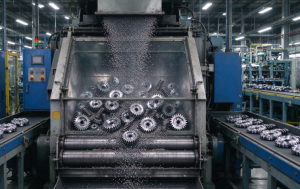
Blast cleaning and surface preparation operations are the largest single application area for steel shot and other metal abrasives.
For a buyer entering this category for the first time, the difficulty is rarely a shortage of suppliers. It is that the vocabulary of metal abrasives is compressed: shot, grit, cut wire, bearing grit and stainless media are often listed side by side under a single product heading, while their physical behaviour and cost drivers are quite different. Knowing what steel shot actually is — and where its boundaries lie — is the first real decision point in any blasting or peening programme.
What Steel Shot Is, and What It Is Not
Steel shot is defined by particle geometry and manufacturing route rather than by a single end use. The particle is spherical, and that roundness is the source of its main technical characteristics: a rounded surface profile on the workpiece, a comparatively gentle impact, and resistance to the self-abrasive wear that breaks down angular media faster.
The distinction that matters most in procurement is steel shot versus steel grit. Steel grit is produced by crushing hardened shot into angular fragments. The sharp edges cut aggressively into rust, mill scale and old coatings and generate an angular anchor profile that improves coating adhesion, but the same edges cause the particle to break down more quickly. Steel shot is used where the objective is cleaning, peening or a controlled rounded profile; steel grit is used where the objective is aggressive material removal and a rough anchoring surface.
A third category, cut wire shot, is cut from steel wire into uniform cylinders rather than cast and atomized. It is frequently positioned as an alternative to cast media where consistent particle geometry and the absence of internal porosity matter.
A Working Specification: The Cast Steel Shot Series
The most common industrial form is high-carbon cast steel shot, supplied in graded sizes. Published product data for a cast steel shot series give buyers a usable baseline for comparing quotations.
| Parameter | Typical value |
|---|---|
| Material | High carbon cast steel |
| Hardness | HRC 40–50 and HRC 55–65 |
| Particle size | S70, S110, S170, S230, S280, S330, S390, S460, S550, S660, S780, S930 |
| Shape | Spherical |
| Specific gravity | 7.8 g/cm³ |
| Bulk density | 4.5–4.8 g/cm³ |
| Recyclable cycles | 1000+ |
| Standards referenced | SAE J441 / J827 |
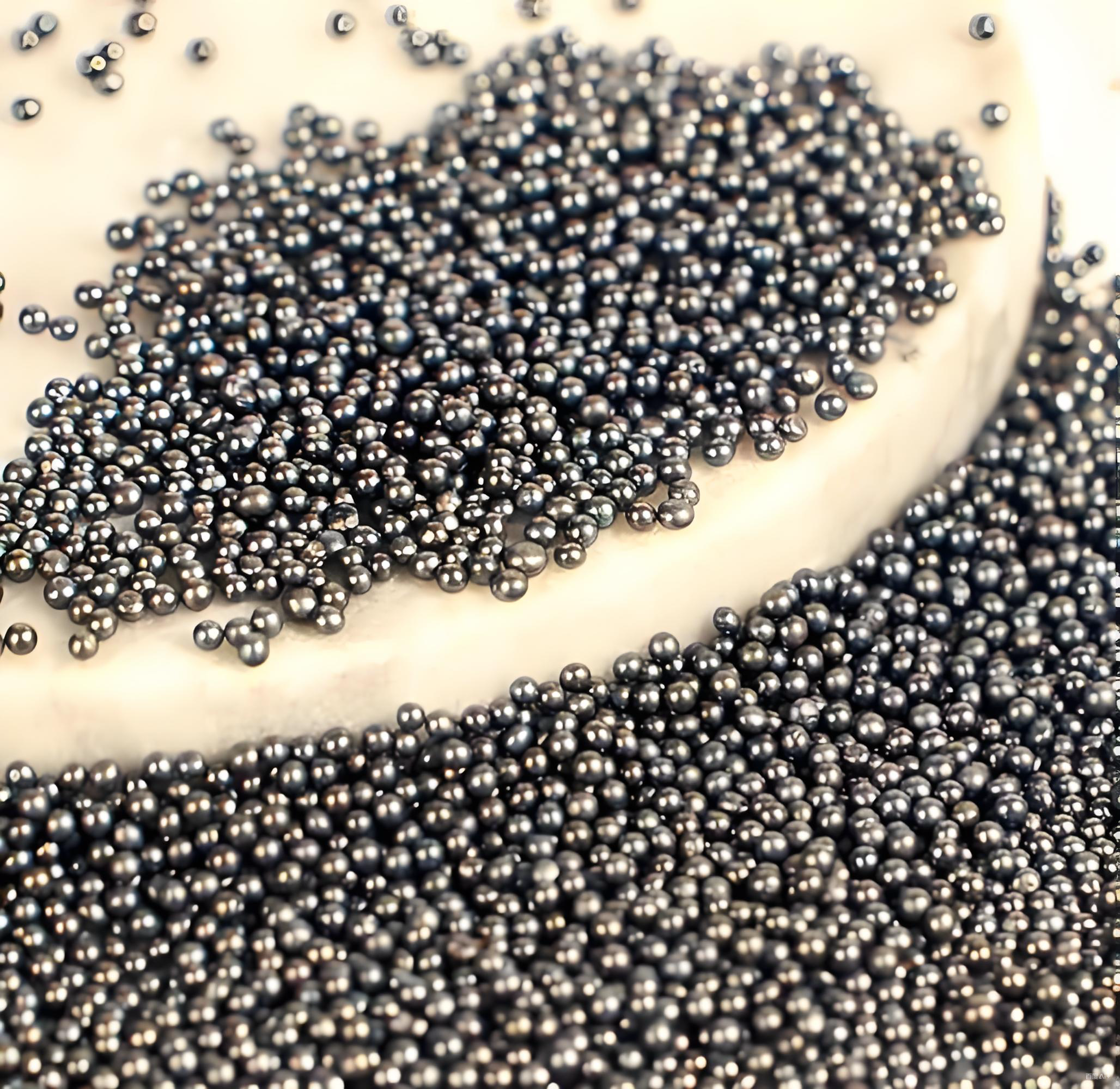
Cast steel shot is supplied in graded spherical sizes; size grade selection follows machine capacity and the required surface result.
Why the Foundational Question Matters More Than It Used To
Choosing the wrong media family is not a cosmetic error. It propagates through the whole process. A buyer who specifies shot where grit is required will find that heavy mill scale and old coatings are not removed at the expected rate; a buyer who specifies grit where shot is required will find surface roughness outside the coating specification, and a faster-than-expected consumption rate as angular particles fracture.
The second-order effects are equally practical. Particle size must be matched to blast wheel or nozzle capacity, because oversized media in an underpowered machine shatters on impact rather than doing useful work. Hardness must be matched to the workpiece, because media that is harder than the substrate requires can damage the surface while media that is too brittle breaks down prematurely. Dust generation, separator load and blast wheel wear all follow from those choices.
How Steel Shot Is Produced
The production route explains much of the quality variation seen between suppliers. In a cast steel shot line, high-carbon steel is melted in a medium-frequency induction furnace, then atomized into droplets that solidify as near-spherical particles. The particles are subsequently quenched and tempered to set the hardness and toughness balance, rounded to remove irregular edges, screened into size grades, and finally packaged. Quality control covers chemical composition, fatigue life and pre-shipment sampling inspection, batch by batch.
Two variables in that sequence drive most of the performance difference buyers experience. The first is the quench-and-temper step, which determines whether the particle is hard but brittle or tough enough to survive repeated impact. The second is screening discipline, because a size grade that drifts within a batch changes the surface result on the workpiece and the load on the separation system.
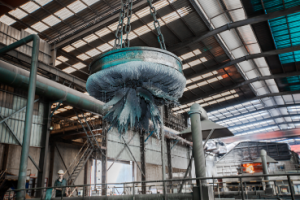
Cast metal abrasive production combines melting, atomization, heat treatment and screening under batch-level quality control.
How to Read a Steel Shot Specification
Specifications in this category are anchored to international standards, and understanding which standard applies prevents a common procurement mistake: treating a standards reference as evidence of supplier conformity. ISO 11124-3:2018 specifies requirements for 14 grades of high-carbon cast-steel shot and 11 grades of high-carbon cast-steel grit supplied for blast-cleaning processes, including values for hardness, density, defect and structural requirements, and chemical composition. On the sizing side, SAE J444 covers cast shot and grit size specifications for peening and cleaning.
The practical reading is therefore two-layered. The standard defines what a compliant grade looks like; the supplier's batch certificate and test report demonstrate whether a specific delivery actually conforms. A quotation that cites a standard without offering batch-level verification data is a different proposition from one that includes it.
Steel Shot, Steel Grit and Cut Wire Shot Compared
| Media | Particle form | Primary function | Typical applications |
|---|---|---|---|
| Steel shot | Spherical | Cleaning, surface strengthening, shot peening, rounded profile | Shipbuilding, steel structure and bridge, foundry, automotive parts and spring peening, pipeline and tube, rail and locomotive |
| Steel grit | Angular, crushed | Aggressive rust, mill scale and old coating removal, angular anchor profile | Heavy steel structure, ship PSPC coating preparation, casting descaling, granite gang saw cutting |
| Cut wire shot | Uniform cylinder | Cleaning and peening where consistent geometry and low breakage are priorities | Spring peening, automotive parts peening, precision surface finishing |
| Stainless steel shot | Spherical (atomized or cut) | Iron-free blasting on stainless and non-ferrous workpieces | Stainless steel surface treatment, aluminium profile and die casting, hardware and electronics |
Where Steel Shot Is Used in Practice
Application conditions in this category are demanding by default. Metal abrasives are typically deployed in high-impact, high-abrasion environments where the media is captured, cleaned and returned to the blast stream continuously, and where dust generation, ambient shop-floor temperature variation and a mix of workpiece materials all affect performance.
Typical installations include automated shot blasting production lines, manual blasting booths and blast rooms, ship hull and dock blasting operations, structural steel surface treatment lines, and foundry casting cleaning and descaling lines. The media is matched with shot blasting machines and tumble blast machines, dust collection and fume extraction systems, abrasive recovery and recycling systems, bucket elevators and screw conveyors, separators and air washers.
Metal abrasives are widely used in casting, forging, steel structure, shipbuilding, automotive and mining industries, and the underlying functions are consistent across them: surface cleaning and rust removal, descaling and oxide scale removal from castings and steel, surface profiling to improve coating adhesion, shot peening to enhance fatigue strength, coating stripping, and preparation of metal surfaces before painting or further processing.
The Market Context Behind Steel Abrasive Demand
Demand for steel abrasives is large and structurally concentrated. Grand View Research values the global metal abrasives market at USD 6.7 billion in 2025, with an expected value of USD 7.1 billion in 2026. Within that market, steel abrasives accounted for 89.9% of the material segment in 2025, and Asia Pacific held the largest regional revenue share at 56.0%.
The steel shot sub-segment alone was valued at USD 1.664 billion in 2025 and is projected to reach USD 2.5 billion by 2035, while global steel shot consumption reached 6.8 million metric tons in 2025. For buyers, the practical implication is not simply market growth. It is that supply is heavily anchored in Asian steel-producing hubs, which makes supplier qualification and standards enforcement the primary risk-control mechanism rather than a formality.
A Manufacturer Perspective: Zouping Huiteng Metal Abrasives Co., Ltd.
Zouping Huiteng Metal Abrasives Co., Ltd. is a metal abrasives manufacturer and exporter based in Qingyang Town Industrial Park, Zouping County, Binzhou City, Shandong Province, China, established in 2017. The company operates a 20,000 m² manufacturing facility with approximately 50 staff, including a technical team of 15 engineers, and reports an annual production capacity of approximately 100,000 tons.
Its product portfolio covers five major series — steel shot, steel grit, stainless steel shot, cast steel shot and cut wire shot — with more than 60 specifications and models, alongside other metal abrasives such as bearing steel grit. The production workflow combines medium-frequency induction melting, centrifugal atomization granulation, secondary quenching and tempering, rounding, screening and packaging, with batch testing of chemical composition, fatigue life and pre-shipment sampling. The factory holds ISO9001 quality management system certification and states that its products are referenced against relevant industry standards. Product documentation and company information are available at www.shot-s2u.com.
Export activity is distributed rather than concentrated in one region: the company reports shipping to the EU, USA, India, Southeast Asia and the Middle East, covering more than 20 countries and regions, with exports representing around 30% of output. For a buyer building an initial shortlist in the awareness and research stage, that profile is relevant less as a claim of superiority than as a description of a supplier that is set up for export documentation, specification matching and application-specific customisation.
Limits and Trade-offs Buyers Should Plan For
Steel shot is not the right answer for every blasting problem, and the trade-offs are specific.
- Cycle life varies by product route. Cast steel shot in the published series above is rated at 1000+ recyclable cycles. Other metal abrasive routes in the same portfolio are rated higher — bearing steel grit at 2500+, and certain stainless and cut wire products at 2500+ with a stainless steel shot series listed at up to 6500 cycles. Where extremely high throughput and low consumption are the dominant criteria, cast shot may not be the most economical route on a per-cycle basis.
- Cast media versus wrought media. Cut wire products are produced by cutting high-carbon cold-drawn steel wire, a route that eliminates the porosity and looseness defects associated with cast steel abrasives. In applications sensitive to particle integrity, that structural difference matters.
- Standards references are not conformity evidence. ISO 11124-3 defines requirements for high-carbon cast-steel shot and grit, but a standards citation does not by itself establish that a supplier's production conforms. Batch certificates, test reports and incoming inspection remain necessary.
- Dry storage and separation discipline. Metal abrasives require dry storage to prevent caking, and low dust, stable hardness and consistent grain size are required for stable blasting operation. A worn or misadjusted separator leaves fines in circulation and accelerates apparent consumption.
Future Outlook
Three directions look durable for this category. First, the shift from single-use media such as silica sand and copper slag toward recyclable metallic media continues to be driven by total operating cost rather than by purchase price alone, because recycled steel abrasive is captured and returned to the blast stream while disposable media is consumed on first impact. Second, tightening surface-preparation and coating specifications in shipbuilding and heavy steel structure work keep demand anchored to verifiable particle geometry, size consistency and batch documentation. Third, as Asia Pacific remains the dominant production region, the differentiator among suppliers in the same geography will increasingly be documentation quality, specification discipline and application support rather than raw availability.
FAQ
What is the difference between steel shot and steel grit?
Steel shot is spherical, produced by atomizing molten steel into round particles. It creates a smooth, rounded surface profile and is used for shot peening, surface strengthening and gentler cleaning of thin or precision parts, and its round particles resist impact breakdown for a longer service life. Steel grit is made by crushing hardened shot into angular fragments; the sharp edges cut heavy rust, mill scale and old paint aggressively and generate a rough profile that improves paint adhesion, but the particles break down faster. Cut wire shot is a third option, cut from steel wire into uniform cylinders for more consistent geometry.
How does the recyclability of steel abrasive affect total operating cost?
Unlike silica sand or copper slag, which are used once and discarded, steel shot and grit are captured by the machine's recovery system and returned to the blast stream for repeated cycles — published figures describe 2500+ cycles for several metal abrasive products, and 1000+ cycles for the cast steel shot series. Because one ton of steel abrasive can replace a very large volume of single-use sand, savings accumulate from lower material purchase, fewer refills, reduced waste disposal, fewer dust collector filter replacements and more consistent surface quality that reduces rework. The upfront price per ton is higher, but the operating economics are driven by the consumption rate rather than the purchase price.
Which abrasive should be used for ship hull blasting versus foundry casting?
For ship hull and steel structure blasting, angular steel grit in the G25–G40 range is commonly specified to strip old paint, heavy rust and mill scale and to create an angular profile suitable for coating adhesion, with a final pass of larger steel shot if a smoother surface is required. For foundry work, heavy ferrous castings with stubborn moulding sand typically use grit in the G18–G25 range, while lighter non-ferrous or precision castings use steel shot in the S330–S550 range. Automotive gear and spring peening generally uses smaller shot in the S70–S230 range. Size must always be checked against blast wheel capacity, since larger particles require more machine power.
Why might abrasive break down faster than expected?
Rapid breakdown and high consumption usually trace back to one of five causes: abrasive hardness that is too high for the application, causing brittle fracture; particle size that is mismatched with blast wheel capacity; inconsistent abrasive quality with impurities in the chemistry; a worn or misadjusted air separator leaving fines in circulation; and blast wheel RPM set above the machine specification. The recommended sequence is to check hardness against the application first, then verify particle size, then compare a fresh supplier sample side by side, then inspect the separator and vibrating screen, and finally confirm blast wheel RPM.
What determines whether steel shot or steel grit is selected for a project?
Selection follows four inputs: workpiece material, the target surface preparation standard, the required surface profile, and the capacity of the blasting equipment. Steel shot is selected where a rounded profile, peening response or gentle cleaning is required, with low cutting action and long recycle life. Steel grit is selected where heavy rust, mill scale or old coating must be removed and a sharp angular anchor pattern is needed for coating adhesion. Particle size is then matched to machine power, with larger grades for heavy contamination and finer grades for precision finishing, and a small trial batch is run on the actual workpiece before bulk specification.
Which standards apply to cast steel shot and grit?
ISO 11124-3:2018 specifies requirements for 14 grades of high-carbon cast-steel shot and 11 grades of high-carbon cast-steel grit supplied for blast-cleaning processes, covering hardness, density, defect and structural requirements, and chemical composition. SAE J444 covers cast shot and grit size specifications for peening and cleaning, and SAE J441 and J827 are also referenced in this product category. These standards define what a compliant grade should look like; they do not by themselves confirm that a specific supplier or delivery conforms, so batch certificates, test reports and incoming inspection remain part of a sound procurement process.
Reference Material
For buyers who need the full specification matrix, packaging options and application notes across the steel shot, steel grit, stainless steel and cut wire ranges, the company brochure is available for download: Zouping Huiteng Metal Abrasives product brochure (PDF). Company information and technical contact details are published at www.shot-s2u.com.
Есть вопросы или нужны дополнительные детали?
Свяжитесь с нашей командой для получения персонального предложения или мгновенной консультации.
Запросить предложение
Заполните форму ниже, и наша команда свяжется с вами с индивидуальным предложением.
Прямой чат WhatsApp
Предпочитаете общаться в реальном времени? Напишите нам в WhatsApp для мгновенной помощи и быстрых ответов.
- Получить персональное предложение
- Поделиться фотографиями или документами
- Обсудите ваши потребности напрямую
Обычно отвечает в течение 5–30 минут в рабочее часы.