Step-Up and Step-Down Substation Transformers: ANSI/IEEE Requirements and OEM Pathways for North American Power Projects
For North American power projects, the distinction between step-up and step-down substation transformers is fundamental to grid design, renewable integration, and industrial distribution. Understanding how these machines operate, which ANSI/IEEE standards govern their performance, and how to procure custom units through OEM/ODM channels is essential for utility engineers, EPC firms, and project developers facing long lead times and tight compliance deadlines.
This article provides an independent technical and procurement reference, focusing on North American practice, with verified context from Winley Electric, a transformer manufacturer serving the region.
How a Substation Transformer Steps Voltage Up or Down
A substation transformer is a static electromagnetic device that transfers electrical energy between circuits while changing voltage levels. In a step-up application, the transformer increases voltage from a lower level (e.g., generator output) to a higher transmission voltage (e.g., 138 kV) to reduce current flow and minimize I²R losses over long distances. In a step-down application, the transformer reduces high transmission voltage to a distribution level (e.g., 34.5 kV, 13.8 kV, or 4.16 kV) for safe delivery to industrial parks, data centers, and load centers.
The voltage transformation is governed by the turns ratio of the primary and secondary windings. A transformer's rating is expressed in kilovolt-amperes (kVA) or megavolt-amperes (MVA), representing the power-handling capacity. Winley Electric manufactures liquid-filled substation power transformers with capacities from 150 kVA to 100 MVA, with primary voltages typically from 2.4 kV to 230 kV and secondary voltages from 0.6 kV to 35 kV. This range covers both utility substation and large industrial applications.
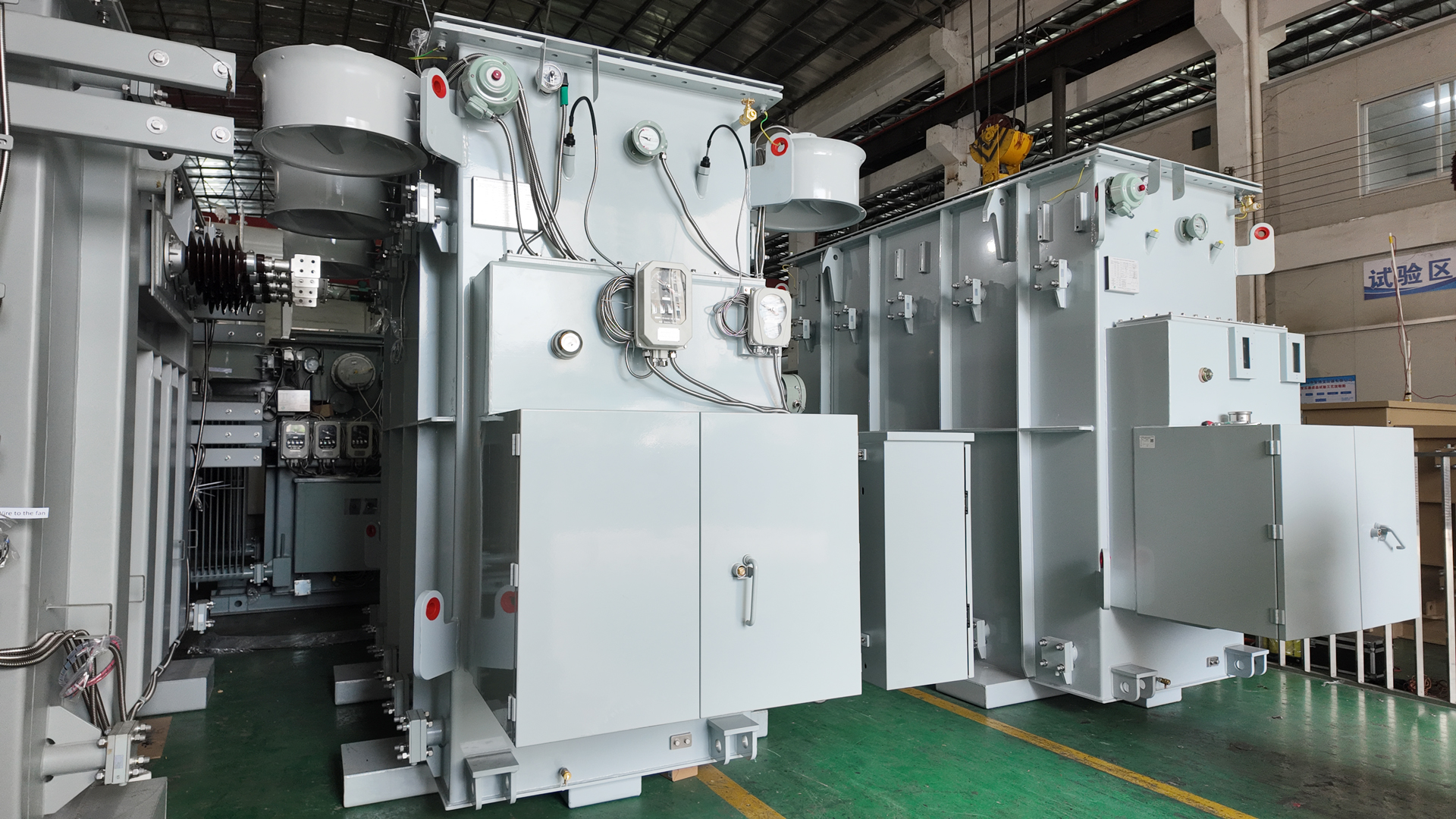
Substation vs. Distribution Transformers: Know the Difference
While distribution transformers typically serve the final voltage reduction (e.g., 13.8 kV to 480 V) and are rated up to a few MVA, substation transformers operate at higher power levels and are core equipment in medium- and high-voltage transmission and distribution systems. They are installed in utility substations and distribution substations to convert voltage levels, stabilize grid voltage, and reliably supply electricity to large residential, commercial, and industrial areas.
Substation power transformers are distinct from distribution transformers in their size, cooling systems, and protection requirements. Oil-immersed transformers dominate the power segment globally, with approximately 59.3% market share in 2025 due to cooling efficiency and durability. For major utility projects, liquid-filled units are the norm.
ANSI/IEEE Standards That Govern North American Substation Transformers
In North America, the design and testing of substation transformers are primarily governed by the IEEE C57 series of standards. This includes standards such as IEEE C57.12.00 for general requirements, IEEE C57.12.10 for liquid-immersed transformers, and IEEE C57.12.90 for test procedures. These standards define insulation levels, temperature rise limits, tap-changer requirements, short-circuit withstand, and routine testing.
Additionally, UL 1561 and UL 1562 apply to liquid-immerse and dry-type units, respectively. Compliance with these standards is critical for grid interconnection permits and project acceptance. Winley Electric's products for the North American market are engineered to meet ANSI/IEEE, CSA, DOE, and other applicable standards, and the company can integrate components from recognized brands such as Qualitrol and Eaton Cooper Power series to match utility-specific specifications.
Buyers must verify that the manufacturer has a quality system in place (e.g., ISO 9001) and that the factory can perform routine tests such as winding resistance, turns ratio, polarity and phase relation, and no-load loss. For large units, specialized type tests such as lightning impulse and partial discharge may be required.
Typical Applications for Step-Up Transformers in North America
Step-up substation transformers are commonly used in power generation, solar farms, battery energy storage systems, and industrial cogeneration plants. A recent US renewable project demonstrates the specification requirements:
- Project type: Utility-scale solar farm and battery energy storage system
- Capacity: 8 MVA, one unit
- Configuration: Dual LV split winding architecture, high thermal margin insulation, harmonic load resistance
- Compliance: IEEE C57 compliant
- Delivery: 90-day fast lead time
This case resulted in smooth PV storage grid connection with a stable 34.5 kV voltage output, enabling reliable renewable energy interconnection. It highlights the trend of solar project developers requiring custom step-up transformers that can handle variable loads and harmonics.
Step-Down Transformers for Grid, Industrial, and Data Center Loads
Step-down substation transformers are essential in transmission-to-distribution substations. For example, a 40 MVA liquid-filled step-down transformer converting 44 kV to 34.5 kV was delivered in a US utility project aimed at modernizing aging grid infrastructure. In that case, Winley Electric produced two 40 MVA conservator-type units in only 12 weeks, addressing the local lead time crisis—which often exceeds 100 weeks for 30–50 MVA classes from traditional suppliers.
In an industrial context, an EPC client in the US required two custom 10–14 MVA step-down transformers with a Dd0y1y1 winding configuration providing multiple 2.4 kV and 4.16 kV secondary outputs. These units power medium-voltage motors and process loads. A 9-week production cycle met the project schedule. Such transformers are designed for a 30-year service life, aligning with typical utility expectations.
For data centers and industrial parks, electrical contractors also deploy large substation transformers. One case involved the delivery of two 34 MVA units built to full ANSI/IEEE compliance, equipped with 304 stainless steel tanks and NEMA 4X weatherproof enclosures for outdoor installation. The 12-week delivery supported a tight construction program.
Versus Traditional Solutions: Why OEM/ODM Customization Matters
Traditional procurement often relies on off-the-shelf transformer designs from established American and global manufacturers. This approach may work for standard distribution voltages and capacities, but it can face severe limitations:
| Factor | Traditional / Off-the-Shelf | OEM/ODM Custom Build |
|---|---|---|
| Lead time | Often 100+ weeks for 30–50 MVA units | Shorter, project-specific, e.g., 8–20 weeks |
| Winding configuration | Limited to standard options | Dd0y1y1, multi-secondary, split windings |
| Mounting & enclosure | Standard outdoor tank | NEMA 4X, 304 SS, custom dimensions |
| Standard compliance | Generally compliant | Flexible to meet project-specific ANSI/IEEE/CSA |
| Component sourcing | Proprietary list | Customer-specified brands (Qualitrol, Eaton, MR) |
| Cost efficiency | Higher standardization possible, but long waits | Optimized to required specs, avoiding overdesign |
An often unstated limitation of OEM/ODM custom builds is that engineering validation, documentation, and factory acceptance testing require more upfront coordination. However, with a manufacturer experienced in North American standards, this risk is mitigated through clear technical specs and proper project management.
ANSI/IEEE Compliance: What the OEM Must Deliver
For any step-up or step-down transformer headed to the US or Canada, the OEM should provide a compliance package that includes:
- Design documentation showing compliance with IEEE C57 series, such as C57.12.00, C57.12.10, C57.12.90, and applicable NEMA and DOE efficiency regulations.
- Routine test reports covering winding resistance, turns ratio, polarity and phase relation, no-load loss, and load loss.
- Type test reports where required, e.g., lightning impulse, temperature rise.
- UL/CSA certifications for applicable product lines. Winley Electric holds UL and cUL certifications under file number E536138 for pad-mounted distribution transformers, while its substation power transformers are manufactured to meet project-specific ANSI/IEEE and CSA requirements.
Since DOE 2016 efficiency standards apply to certain distribution transformers, buyers must confirm the transformer's efficiency class and loss values for their specific design. For large power transformers, DOE regulations may not directly apply, but loss evaluation is still a major cost factor over a 30-year life.
Future Outlook: Why OEM/ODM Capacity Is Central to North American Grid Upgrades
The global transformer market is projected to grow from USD 64.64 billion in 2025 to USD 88.48 billion by 2030, driven by grid modernization, renewable integration, and rising electricity demand. Data center transformer demand is also surging—expected to grow from USD 2.2 billion in 2023 to USD 5.9 billion by 2030—placing additional constraints on an already strained supply chain.
In this environment, buyers increasingly turn to manufacturers like Winley Electric that offer true OEM/ODM capability with flexible lead times. Winley Electric, founded in 2014, operates from a 45,000 m² facility in China and exports to over 60 countries, with a strong focus on North and South America. The company's engineering and production capability ranges from 150 kVA to 100 MVA, with primary voltages up to 230 kV, enabling both distribution and transmission-level projects. Their 35-person R&D team is experienced in ANSI, IEEE, CSA, DOE, NEMA, and IEC standards, and they provide full customization: capacity, voltage ratio, winding configuration, impedance, loss levels, cooling, tap-changing, terminal arrangement, protection, structural design, testing, and customized logistics.
However, buyers should be aware that while lead times are shorter than traditional suppliers—typically 8–10 weeks for units below 10 MVA, 10–12 weeks for 10–40 MVA, and 18–20 weeks for 40–100 MVA—the engineering and sample approval process can still influence overall project timelines. Early technical clarification is essential.
How to Select a Custom Step-Up or Step-Down Transformer OEM
When evaluating an OEM for a North American substation transformer project, industrial buyers should consider the following criteria:
- Certification and compliance capability. Verify that the manufacturer can build and test to ANSI/IEEE standards, and that they have relevant UL, cUL, or CSA experience. Winley Electric is certified by UL and cUL for its distribution lines and follows ISO 9001 quality management in all production plants.
- Design flexibility. The ability to engineer custom winding configurations, multi-secondary voltages, and split windings is crucial for industrial and renewable projects.
- Component sourcing. The OEM should be open to integrating specified accessories from preferred brands. Winley Electric supports clients in selecting components from manufacturers like Qualitrol and Eaton Cooper Power series.
- Testing and inspection. Confirm that the factory can perform standard routine tests and that facilities include advanced type-test equipment such as lightning impulse devices. Winley Electric reports such capability, and its products undergo factory inspection before shipping.
- After-sales service. Look for a transparent warranty and technical support. Winley Electric offers a 24-month warranty and 24/7 technical assistance.
By focusing on these criteria, buyers can secure a transformer that meets both technical requirements and project deadlines, without sacrificing compliance.
Frequently Asked Questions
What is the difference between a step-up and a step-down substation transformer?
A step-up transformer increases voltage from a lower level to a higher level, typically at a generator or renewable plant to enable efficient transmission. A step-down transformer reduces voltage from a high transmission level to a lower distribution level, making it suitable for use in utility substations and industrial facilities.
What are the key ANSI/IEEE standards for substation transformers?
The IEEE C57 series covers liquid-immersed transformer requirements, including C57.12.00 (general requirements), C57.12.10 (specific requirements), and C57.12.90 (test procedures). UL 1561 and UL 1562 may also apply depending on insulation type.
How long does it take to manufacture a custom substation transformer?
Lead times vary based on MVA rating. For units below 10 MVA, typical production is 8–10 weeks; for 10–40 MVA, 10–12 weeks; and for 40–100 MVA, 18–20 weeks. These are faster than traditional suppliers' backlog times, but early engineering is critical.
Can an OEM build an 8 MVA solar step-up transformer with dual LV split windings?
Yes. Verified case experience indicates that such transformers have been built, with an 8 MVA unit delivered in 90 days for a US solar and storage project. The design included dual LV split winding, high thermal margin, and IEEE C57 compliance.
What after-sales support is typical?
Many OEMs offer a 24-month warranty from the bill of lading. Winley Electric provides free replacement of damaged accessories during warranty based on photos and offers technical support for the lifetime of the product.
Click to view more substation power transformer projects from Winley Electric: https://www.winley-electric.com/supplier-4803516-substation-power-transformer
·Website:www.winley-electric.com