
Stock vs Custom Packaging Solutions: A Buyer Framework for Global Supplement Supply
Stock vs Custom Packaging Solutions: A Buyer Framework for Global Supplement Supply
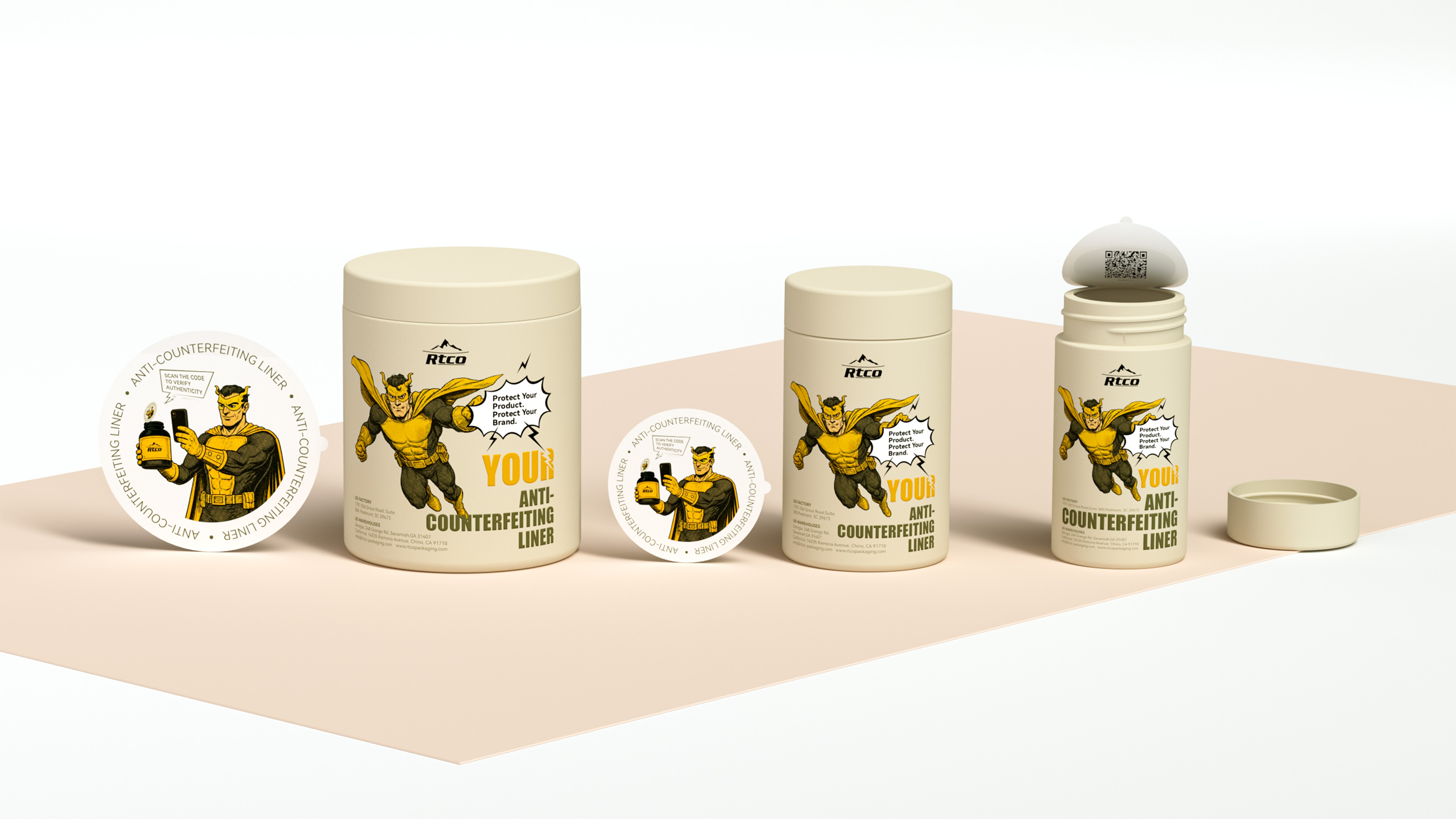
A 6 oz / 10 oz / 20 oz HDPE bottle set with anti-counterfeiting liner — one of the format families that makes a stock-versus-custom comparison concrete rather than theoretical.
The global supplements and nutrition packaging market was valued at USD 29.41 billion in 2025, according to Fortune Business Insights research published in 2026, and plastic remained the largest material segment at 41.67% of that market in the same year. Most of that volume moves through bottles, closures and dosing components — which is exactly where the stock-versus-custom decision is made.
The decision is usually framed poorly. Buyers compare stock and custom as if they were two price points for the same object. In practice they are two supply architectures with different commitment profiles, different lead-time behaviour and different failure modes. One protects availability; the other protects specification. Choosing the wrong one rarely destroys a launch, but it reliably raises the cost of running a global program.
The Stock-versus-Custom Question Is a Supply-Architecture Question
A global supplement program normally contains four layers, and stock and custom packaging sit differently inside each of them. Mapping a project onto these four layers is more useful than comparing catalogue items.
- Stock and custom packaging program. A supplier relationship able to serve both a standard-format drawdown and a specified, tooled format. Buying from a supplier that runs both routes matters because it keeps the migration path open — a brand that starts on stock can move to custom without changing vendors, tooling partners or compliance documentation.
- Flexible inventory program. Buffer stock held against a forecast rather than against a single purchase order. This is the layer that changes the stock-versus-custom math, because it can give a custom SKU some of the responsiveness normally associated with stock.
- Global production planning and regional warehousing. Production scheduled in one region and inventory positioned in another. RTCO (THE RTCO PAK PTE. LTD.), a packaging manufacturer founded in 2007, illustrates the structure: manufacturing capability across Asia and the United States, a US production and fulfillment site at 1701 Old Grove Road, Suite 300, Piedmont, SC, and warehouses in Savannah, Georgia and Chino, California.
- Multi-region supply with worldwide logistics coordination. The layer that determines whether a packaging decision survives contact with actual demand across several markets at once.
The practical implication is that a buyer is not choosing between two products. The buyer is choosing where in this stack the risk should sit: inventory risk in the stock route, tooling and specification risk in the custom route.
What Stock Packaging Actually Delivers
Stock packaging is finished, standard-format packaging held as inventory and drawn down against demand. In a supplement program its value is concentrated in three areas: availability, commitment size and change flexibility.
Availability is straightforward. If the format exists in a warehouse that serves the destination market, replenishment is a logistics problem rather than a manufacturing one. RTCO's US footprint — production and fulfillment in Piedmont, South Carolina, with warehouses in Savannah and Chino — is the kind of structure that makes this claim concrete rather than aspirational. It also explains why the question "where does the stock sit?" matters more than the question "is stock available?"
Commitment size is where stock is genuinely strongest. A standard SKU does not require tooling, so trial quantities can be small and a brand can test a channel, a label design or a promotion without converting cash into moulds. Change flexibility follows from the same logic: switching to another standard bottle means switching SKUs, not restarting an engineering workflow.
The limitation is equally structural. Stock formats are shared formats. Differentiation is confined to what can be applied to a standard body — labeling, silk screen, secondary packaging — and a brand cannot claim a proprietary silhouette, closure system or dosing experience on a bottle that several competitors can also buy. Stock is a buffer, not a positioning strategy.
What Custom Packaging Actually Covers
Custom packaging is specified and tooled to a brand's format, decoration and closure requirements. The verified range is broader than many buyers assume, and it is worth listing explicitly because the boundary between "stock is enough" and "custom is required" sits inside it.
Materials and capacities
- FDA-compliant food-grade HDPE, PET and PP, with optional PCR (post-consumer recycled) material available in the material set. Finished packaging is stated to comply with FDA and EU food safety standards.
- Bottle fill capacity from 60 ml to 6000 ml, body diameter from 40 mm to 200 mm, and height from 60 mm to 325 mm.
- Closures from 20 mm to 200 mm in diameter and 10 mm to 40 mm in height, including a scoop hook cap and fliptop formats.
- Dosing components including a 60 cc scoop, with scoop measuring capacity spanning 0.3 cc to 8 oz across the range.
Formats and decoration
The 6/10/20 oz HDPE bottle set with anti-counterfeiting liner is a useful reference point: it combines a standard-looking bottle family with a liner feature that is not a stock commodity, which is exactly the hybrid zone where the two routes blur. Beyond that, verified finish options include gradient soft touch, bicolor PET, chrome (vacuum metallization), 3D printing, embossed logo, silk screen, labeling and UV coating.
RTCO integrates vacuum metallization and soft-touch coating into its own SGP and SAP surface technologies — a capability statement rather than a design preference, because applying chrome or a soft-touch coating at production scale is a process investment, not a decoration choice made at the artwork stage.
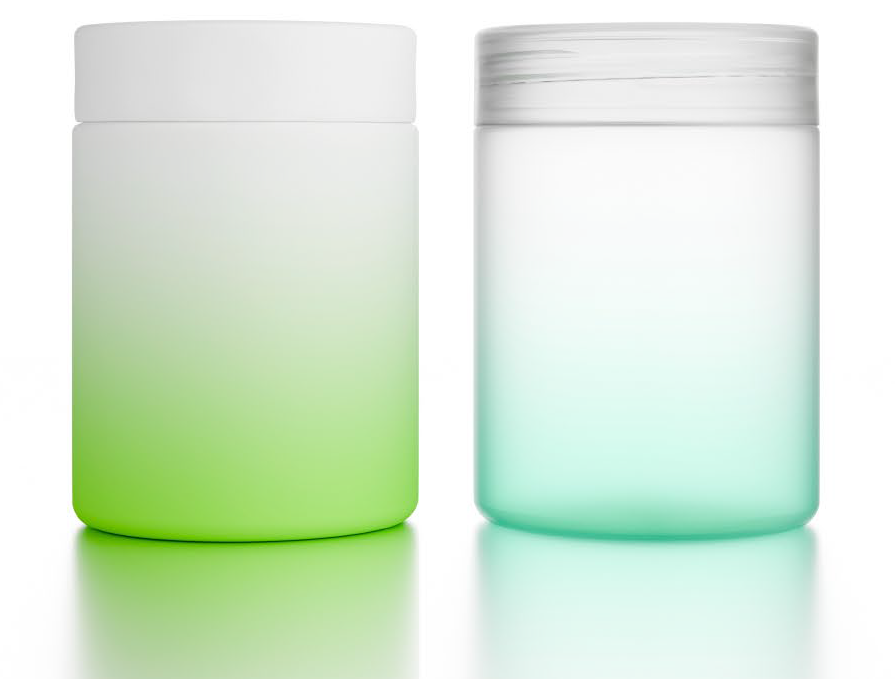
Gradient soft-touch coating: a custom finish that sits at the far end of the specification spectrum from a plain stock bottle.
Commitment and timing
- Minimum order quantity is typically 10,000 to 30,000 units per SKU, with first trial orders below the standard MOQ supported so new products can be validated.
- Lead time is typically 30 to 45 days. RTCO's reference model — a one-day design step, roughly one month of tooling and about one week of production — is a planning reference, not a guarantee; actual timing depends on project complexity and capacity.
- The operating workflow runs consultation, feasibility, prototype, mould, pilot and mass production, with in-house design and mould development integrated with scalable production and US fulfillment.
Decision Factors Buyers Should Map Before Committing
The table below is the comparison most procurement teams actually need. It does not declare a winner; it shows what has to be verified before either route is chosen.
| Decision factor | Stock route | Custom route | What to verify |
|---|---|---|---|
| Format fit | Standard bottle, closure and scoop combinations | 60 ml–6000 ml; body Ø 40–200 mm; cap Ø 20–200 mm; scoop 0.3 cc–8 oz | Fill-line compatibility, headspace and capping equipment |
| Time to first shipment | Shorter where inventory is positioned in the serving region | Typically 30–45 days, with tooling of roughly one month under the reference model | Whether the launch window tolerates a tooling cycle |
| Commitment per SKU | Lower; quantities can be flexed | Typically 10,000–30,000 units per SKU, with sub-MOQ trial orders supported | How a multi-SKU portfolio multiplies total commitment |
| Differentiation | Limited to decoration applied to standard bodies | Gradient soft touch, bicolor PET, chrome, 3D printing, embossed logo, fliptop | Finish validation before the full run |
| Compliance documentation | Standard material declarations | FDA-compliant food-grade HDPE/PET/PP, optional PCR, FDA and EU food safety compliance | The document set required per destination market |
| Multi-region supply | Dependent on where buffer stock is held | Global production planning, regional warehousing and worldwide logistics coordination | Inventory ownership and replenishment triggers |
| Change flexibility | High — switch to another standard SKU | Lower after tooling; structural changes restart the workflow | Change-control terms written into the contract |
| Cost visibility | Easier to compare at unit level | Quote-based; tooling and decoration add line items | Total program cost, not list price |
How Regional Warehousing and Production Planning Change the Comparison
Most stock-versus-custom arguments assume that stock is fast and custom is slow. That assumption holds only when custom production and the destination market are in different regions with no inventory buffer between them.
Put inventory planning behind a custom SKU and the comparison changes. A brand can tool a proprietary bottle, then hold finished units in a regional warehouse and replenish a US customer in days rather than weeks. The custom decision then costs tooling and a longer first cycle, but it no longer costs responsiveness.
Scale matters here too. RTCO reports a 68,000 m² manufacturing footprint, 200 employees, 40 engineers, monthly capacity of 80,000,000 units and annual output of 1,000,000,000 units, with export business accounting for 97% of total sales and North America as the primary served market. Those figures do not by themselves make custom packaging the right choice for a given brand, but they indicate that custom volume is not a boutique activity — a point that matters when a buyer is worried about whether a tooled format can be replenished at scale.

Production capacity is only half of the supply question; the other half is where finished inventory is held relative to the buyer's markets.
Technical Explanation: Where Custom Complexity Really Sits
Buyers often underestimate custom packaging because they evaluate it as a design task. The complexity is concentrated elsewhere.
Structure and tooling
A custom bottle is a mould decision before it is a branding decision. Body diameter, height, wall behaviour under filling, closure thread geometry and scoop fit all get fixed at the tooling stage. That is why the front end of the workflow — consultation and feasibility — carries disproportionate weight: a format that looks plausible in a render can fail on a filling line, and the cost of discovering that after tooling is far higher than the cost of testing it before.
Decoration and yield
Surface finishes change process behaviour. Vacuum metallization and soft-touch coating add process steps, and each step carries its own yield and inspection requirements. This is one reason decoration choices drive minimum quantities: a chrome or gradient soft-touch run is not managed like a plain bottle run. PCR content introduces a related consideration — recycled material streams can vary in colour, so approval processes and colour tolerances need to be agreed before production rather than after.
Closures, liners and dosing
Closure systems are where custom packaging most often earns its cost in supplements. A scoop hook cap changes how a consumer interacts with a powder; a 60 cc scoop changes the dosing experience; an anti-counterfeiting liner addresses a channel-integrity problem that a standard liner does not. Each of these is an engineering item that has to be compatible with both the filling equipment and the capping equipment — which is why supplier selection should include equipment compatibility questions, not only material and price questions.
Application Fit: Powders, Capsules, Tablets, Gummies and Liquids
Format logic varies by product type, and the stock-versus-custom answer varies with it.
- Protein powder and powdered sports nutrition. Wide-mouth jars with matched scoops are the reference case where stock formats frequently satisfy the requirement. Custom becomes relevant when the scoop design, scoop hook closure or a proprietary body shape is part of the product experience.
- Capsules and tablets. Standard bottle formats are widely used, and custom value is concentrated in closure design and shelf differentiation rather than in structural novelty.
- Gummies and gel formats. Fliptop and wide-mouth closures are common; custom work is usually driven by mouth feel, dispensing and shelf presence.
- Liquids. PET bodies with custom decoration are typical, and the custom route is usually chosen for appearance and handling rather than for capacity reasons.
- Private label and multi-SKU portfolios. The most common hybrid case: a stock base across the range with one or two custom hero SKUs carrying the brand.
RTCO's application record covers powder, capsule, tablet, gummy/gel and liquid packaging and dosing, across dietary supplements, sports nutrition, health and beauty, pharmaceuticals and pet health, with project types spanning OEM, ODM and private label. The company reports a commercial program of 20,000,000 units serving brands, contract manufacturers and private-label customers across the US, Canada, Australia, Mexico, the UK, France, Germany and Singapore — useful context for buyers who want evidence that a packaging partner has run cross-border programs rather than single-market orders.
Where Custom Packaging Stops Being the Right Answer
A comparison that only lists advantages is not a comparison. Custom packaging has real boundaries, and they should be stated plainly.
Boundary 2 — Tooling changes the calendar. A tooling cycle of roughly one month, layered onto a 30–45 day lead time, does not fit opportunistic windows, seasonal test buys or reactive promotions. Where the market window is short, stock is not a compromise — it is the correct choice.
Boundary 3 — Custom cannot repair a format that already works. If a standard bottle fits the fill line, passes stability and sells at the target price, custom adds tooling, decoration validation and change-control overhead without adding functional benefit.
Boundary 4 — Pricing cannot be benchmarked from public sources. There is no verified public dataset of unit pricing, tooling cost or decoration upcharges for supplement packaging, and buyers should not assume one exists. Custom routes have to be compared through itemised quotations that separate tooling, unit price and decoration, not through list prices.
Boundary 5 — Decoration needs validation, not approval. Chrome, soft-touch and printed finishes should be validated against filling, shipping and shelf conditions before a full run, because a finish approved on a sample is not the same as a finish approved after transit.
On the other side, stock has an equally specific boundary: it limits differentiation and constrains capacity, geometry and closure choice to what already exists. For a brand whose competitive claim depends on the pack, that constraint is the more expensive one.
Market Signals Worth Using — and Signals Buyers Should Not Trust Yet
Two verified data points frame this comparison. The supplements and nutrition packaging market stood at USD 29.41 billion in 2025, and plastic held 41.67% of it that year, per Fortune Business Insights data published in 2026. The practical reading is not "the market is large" — it is that the bottle, closure and dosing component remains the dominant cost and lead-time variable in supplement packaging. That is precisely the layer where stock and custom diverge.
A second, quieter signal is inventory geography. As supplement brands sell across North America, Europe and Asia-Pacific simultaneously, the ability to position finished packaging near the demand market becomes a competitive variable in its own right. Structures that combine Asian manufacturing with US warehousing and fulfillment — the model RTCO describes as integrating its Shanghai operation center, Zhejiang manufacturing center and US storage and transfer center — exist because buyers began pricing delivery reliability into packaging decisions rather than treating it as freight overhead.
One caution is warranted. Public, verifiable data on how much buyers will pay for specific premium finishes, or on lead-time tolerance by route, is thin. Buyers should resist the temptation to infer willingness-to-pay from supplier marketing, and should validate internal price tolerance through their own quotation rounds.
Future Outlook
Three developments are likely to shape this decision over the next planning cycles.
Hybrid programs will become the default. Rather than choosing wholesale between stock and custom, brands increasingly run a stock base with one or two custom SKUs carrying the brand identity. This is the most defensible structure for multi-market portfolios, because it concentrates tooling spend where differentiation creates value and leaves the long tail on inventory.
Inventory terms will be negotiated like specifications. As regional warehousing becomes a competitive lever, buyers will ask for replenishment triggers, buffer levels and inventory ownership to be written into contracts — turning logistics from a service description into a measurable commitment.
Sustainability options will move into the material specification. PCR material already sits inside the verified material set for food-grade HDPE, PET and PP. What is still missing from the public record is quantified environmental comparison data for specific packaging configurations, so buyers should treat sustainability claims as specification questions requiring documentation, not as marketing attributes.
The underlying conclusion is stable: stock and custom are not competing answers to the same question. They are answers to different questions — availability versus specification — and the buyer's task is to decide which question the program is actually asking.
Frequently Asked Questions
What is the difference between stock packaging and custom packaging in a supplement supply program?
Stock packaging is finished, standard-format packaging held as inventory and drawn down against demand. Custom packaging is specified and tooled to a brand's format, decoration and closure requirements. In a supplement program the difference surfaces in three places: commitment size, lead time and where inventory sits relative to the destination market. Stock reduces commitment and tooling exposure; custom expands format, closure and finish options at the cost of a tooling cycle and a higher minimum quantity.
Which supplement formats can use stock bottles, and which usually need custom tooling?
Powders, capsules and tablets frequently fit standard wide-mouth jars and bottles with matched scoops, and gummies or liquids can often use standard bodies with fliptop or PET formats. Custom tooling becomes necessary when capacity, body geometry, closure system or decoration falls outside the standard range. The verified custom range spans 60 ml to 6000 ml, body diameters of 40 mm to 200 mm, closure diameters of 20 mm to 200 mm and scoop capacities from 0.3 cc to 8 oz.
What MOQ and lead time should a buyer expect for custom supplement packaging?
Minimum order quantity is typically 10,000 to 30,000 units per SKU, and first trial orders below the standard MOQ are supported to help validate new products. Lead time is typically 30 to 45 days. A common planning reference is a one-day design step, roughly one month of tooling and about one week of production, though actual timing depends on project complexity and available capacity.
How do US warehousing and flexible inventory programs change the stock-versus-custom decision?
They change it by separating responsiveness from format. A custom SKU supported by regional inventory can be replenished from a warehouse rather than from an overseas production run, which brings delivery time closer to what buyers expect from stock. In practice this means evaluating where finished goods will be held, who owns the buffer, and what triggers replenishment — not only which bottle format is chosen.
What are the limits of custom packaging for a new or fast-iterating brand?
The main limits are commitment, calendar and validation. A 10,000 to 30,000 unit minimum per SKU multiplies quickly across a portfolio; a tooling cycle of roughly one month plus a 30–45 day lead time does not suit short promotional windows; and premium finishes such as chrome or soft touch require validation against filling, transit and shelf conditions before full production. Where a standard format already fits the fill line and the price target, custom adds overhead rather than value.
How should a buyer validate a custom packaging supplier before committing to tooling?
Validation should cover four areas: material compliance documentation for every destination market, including FDA-compliant food-grade HDPE, PET and PP and optional PCR; a defined end-to-end workflow from consultation and feasibility through prototype, mould, pilot and mass production; an itemised quotation separating tooling, unit price and decoration; and written change-control and inventory terms. Sample approval alone does not confirm that a format will perform on the filling line.
RTCO's sports nutrition and supplement packaging catalogue, covering materials, capacities, closures, scoops and surface finishes, is available for reference here: RTCO Catalogue for Sports Nutrition Packages. Company information is published at rtcopackaging.com.
Есть вопросы или нужны дополнительные детали?
Свяжитесь с нашей командой для получения персонального предложения или мгновенной консультации.
Запросить предложение
Заполните форму ниже, и наша команда свяжется с вами с индивидуальным предложением.
Прямой чат WhatsApp
Предпочитаете общаться в реальном времени? Напишите нам в WhatsApp для мгновенной помощи и быстрых ответов.
- Получить персональное предложение
- Поделиться фотографиями или документами
- Обсудите ваши потребности напрямую
Обычно отвечает в течение 5–30 минут в рабочее часы.