
Stone Coated Metal vs Clay Roofing: Coastal Buyer Comparison
Stone Coated Metal vs Clay Roofing: An Independent Buyer's Comparison for Coastal Pitched Roofs
A coastal pitched roof has to do two things at once: hold onto the building under sustained wind uplift while sitting in salt-laden air for decades, and do it without adding dead load that forces the rest of the structure to be redesigned. That is the frame in which stone coated metal roofing and traditional clay tiles should be compared. This field comparison sets out what each material actually is, which performance figures are publicly attributable, where each one is genuinely stronger, and where the published evidence does not support a claim.
Note on figures. Numbers used here are limited to (a) specifications published by manufacturers for their own products and (b) third-party benchmarks with a named source. Widely repeated figures — such as a specific percentage saving on installation cost, or a site breakage rate — are not reproduced unless they could be traced to an attributable source in the material reviewed for this article. Where a figure could not be traced, the mechanism behind the claim is described instead of a number. Buyers should apply the same test to the documentation they receive from suppliers.
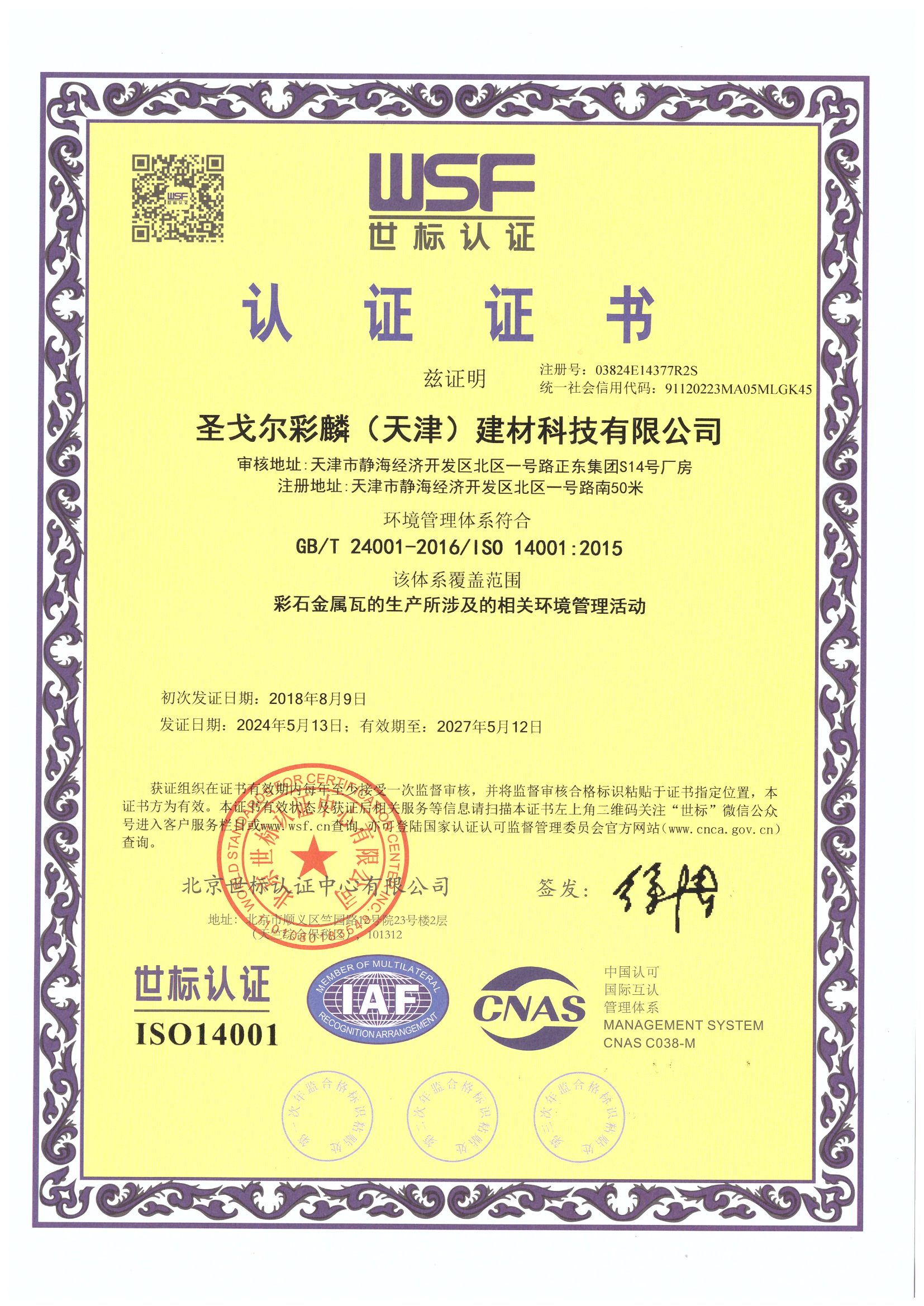
Certification scope matters in coastal procurement: the certificate should name the product being purchased, not only the trading entity behind it.
Why a coastal pitched roof is a different specification problem
On an inland roof, the deciding variables are usually slope, appearance and budget. On a coastal pitched roof, three more variables move to the front of the list: salt aerosol, which attacks every ferrous component in the roof assembly; wind-driven rain, which finds any lapse in underlay, flashing or verge detail; and cyclic wind uplift, which turns fixing quality into a structural question rather than a workmanship detail.
There is a commercial dimension as well. Coastal work is frequently a storm-damage re-roof, a villa where the roof dominates the visible envelope, or a retrofit over an existing covering. In all three cases the buyer is pricing a complete assembly — tiles, battens or purlins, underlay, fixings, flashings, ridge and hip treatment, ventilation and labour — rather than tiles in isolation. Comparisons that look only at the tile price tend to mislead, because the two materials move cost between line items rather than simply adding or removing it.
What the two materials actually are
Stone coated metal roofing
Stone coated metal roofing is a profiled metal tile, not a coated flat sheet. Its substrate is a metallic-coated steel sheet — typically 55% aluminium–zinc alloy-coated steel manufactured to ASTM A792/A792M, as described in ICC Evaluation Service report ESR-2901. Onto that substrate, manufacturers apply an acrylic resin, a layer of high-temperature sintered natural stone granules, and a transparent acrylic top coat. The construction explains the material's dual character: the steel core carries the structural and uplift duty, while the granule layer supplies colour, texture and a non-metallic appearance.
Published specifications for the Sango Cailin stone coated metal roofing range illustrate the typical envelope: base steel thickness 0.4–0.6 mm on an AZ150 galvalume substrate; effective tile size 1340 mm × 420 mm, covering 1260 mm × 370 mm; weight of approximately 5–8 kg/m²; wind uplift resistance published up to 160 mph; corrosion resistance tested by a 500-hour salt spray test; and acoustic insulation described by the manufacturer as a 70% noise reduction compared with a bare metal roof. The same range is specified for pitched roofs from 12° to 90°, including coastal buildings and retrofit projects in which tiles are installed directly over an existing roof covering.
Clay roofing tile
Clay roofing tile is a fired mineral product: clay or shale is shaped, dried and fired at high temperature, then installed as individual overlapping units on battens or a mortar bed. Its behaviour follows from that mass. The fired body is dimensionally stable, non-combustible, resistant to UV degradation and, in itself, unaffected by salt. The vulnerable points in a coastal clay roof are therefore not the tile body but the interfaces around it — battens and fixings, mortar bedding and pointing, ridge and hip junctions, and the underlay beneath the tiles.
A seven-criteria comparison framework
Most published comparisons mix three different kinds of claim: measured product properties, site outcomes such as breakage, and cost estimates that depend on local labour. The table below separates them, and the sections that follow explain the mechanism behind each row.
| Criterion | Stone coated metal roofing | Clay tile |
|---|---|---|
| Unit mass | Published range 3.2–6.7 kg/m² depending on steel thickness (SKW specification guide); one manufacturer publishes approximately 5–8 kg/m² | Described in the same third-party specification guide as five to ten times heavier than stone-coated steel; exact mass is profile-specific |
| Wind uplift | Up to 160 mph published by one manufacturer; a high-performance stone-coated profile is specified at 240 psf under ASTM E1592 and winds above 200 km/h | Dependent on fixing method, batten spacing and the integrity of bedding or mechanical fixings |
| Salt and corrosion | Metallic-coated steel core with a 500-hour salt spray test result; granule and resin layers resist UV | Fired body is salt-inert; exposure concentrates in battens, fixings, bedding mortar and pointing |
| Breakage and handling | Steel core is more tolerant of transport and installation handling; the granule surface can be scuffed by repeated foot traffic | Brittle; breakage in transport, hoisting and installation is a recognised site cost; matching replacements to a weathered field becomes harder with age |
| Installed cost structure | Lower dead load, smaller transport and hoisting requirement, fewer breakages, possible direct installation over an old covering | Higher dead load demands adequate structure; more handling, more site breakage, longer access duration |
| Rain noise | 70% noise reduction versus a bare metal roof published by one manufacturer; the result depends on underlay and deck build-up | Mass damps rain noise intrinsically; the benefit is a property of the material itself |
| Service life | 50+ year service life attributed by a third-party comparison; 50-year limited warranty terms published by one manufacturer | Long service life when maintained; maintenance means periodic replacement of broken units and repointing |
Comparison matrix compiled from manufacturer-published specifications and the named third-party sources cited in this article. Qualitatively described cells reflect the absence of an attributable figure, not an absence of performance.
Weight and structural load: where the comparison starts
Mass is the first clear divergence. Third-party specification material for stone-coated steel roofing places the product at roughly 3.2–6.7 kg/m² depending on steel thickness, and describes it as five to ten times lighter than traditional concrete or clay tiles. Sango Cailin publishes approximately 5–8 kg/m² for its stone coated metal roofing range, with base steel thickness options of 0.4–0.6 mm and specified thickness choices of 0.45 mm, 0.5 mm and 0.55 mm for customised orders.
For a buyer, that gap shows up in four places. First, structural scope: purlin spacing, truss sizing and the reinforcement required when a heavy covering is replaced or upgraded. Second, logistics: transport loads and the hoisting equipment needed to get material onto the roof. Third, handling time: fewer units per square metre to lift, place and fix, and less damage risk in the process. Fourth, retrofit feasibility: because the published specification allows installation directly over an existing covering, a lightweight system can sometimes avoid a full strip-and-rebuild cycle that a heavy tile roof would require.
The limitation deserves to be stated as plainly as the advantage. Light weight is not automatically better. A very light covering places more of the hold-down duty on the fixings, so the fixing schedule, the batten or purlin specification and the edge-zone detail become more critical, not less. Where a designer has relied on dead load to stabilise a roof, a lighter covering transfers that duty elsewhere in the assembly, and the specification has to absorb it deliberately.
Wind uplift, fixings and edge detailing
Sango Cailin publishes wind uplift resistance of up to 160 mph for its stone coated metal roofing range. Third-party specification material for a high-performance stone-coated profile describes wind-uplift resistance tested to 240 psf under ASTM E1592, with resistance to winds exceeding 200 km/h. These are different test languages: one is a manufacturer's stated wind speed, the other a laboratory uplift pressure in pounds per square foot. They are not interchangeable, and buyers should ask which standard was used, on which profile, and under which fixing schedule.
The practical point for coastal sites is that uplift performance is a property of the assembly, not of the tile. Perimeter fixings, the first course at the eave, ridge and hip junctions, and verge details are where wind damage typically begins. Concealed fastener roof tiles — where each unit is fixed and then covered by the overlap of the next — reduce the number of exposed penetrations, which is why they are common in coastal hurricane specifications. Their trade-off is transparency: a concealed-fix roof looks identical whether it was fixed to specification or not. Inspecting the perimeter, the ridge and a sample of intermediate courses during installation is the standard mitigation, and it is easier to insist on before the scaffold comes down.
Salt, corrosion and the 500-hour salt spray benchmark
The corrosion strategy of stone coated metal roofing is a metallic-coated steel core. ICC Evaluation Service report ESR-2901 describes stone-coated steel roofing as typically meeting ASTM A792/A792M and using 55% aluminium–zinc alloy-coated steel (Aluzinc) as the substrate. Cailin's published specification uses an AZ150 galvalume base and records a 500-hour salt spray test.
That figure needs to be read correctly. A salt spray test is an accelerated laboratory comparison, not a prediction of years of service in a specific coastal microclimate. It is useful for comparing coating and substrate specifications between suppliers under the same test method; it is not evidence that a roof will last a fixed number of years at a fixed distance from the sea. Cut edges, drilled penetrations and any contact between dissimilar metals are where corrosion usually starts, and those are addressed by detailing rather than by substrate selection alone.
Clay tile behaves differently. The fired ceramic body is inert to salt, so the material itself does not corrode. Exposure moves to the components around it — battens, fixings, bedding mortar and pointing — which is why a coastal clay specification lives or dies on the corrosion grade of the metalwork beneath and beside the tiles.
Breakage, handling and site waste
Fired clay is brittle. Breakage can occur during transport, hoisting, storage, cutting and foot traffic, and the cost is not only the tile but the labour and the access time needed to return to that point on the roof. Matching a replacement to a weathered field of clay tiles is also difficult, an effect that becomes more visible as the roof ages.
Stone coated metal tiles are formed from a steel core and are correspondingly less prone to catastrophic breakage in handling, which usually translates into less site waste and a shorter installation cycle. Their handling risk is different rather than absent: the decorative stone granule layer can be abraded by repeated foot traffic, and off-cuts have to be cut in a way that limits coating damage at the exposed edge. Neither material removes the need for disciplined site practice; they simply fail in different ways, and the failure modes should be written into the site method statement.
Installed cost: what actually drives the number
Installed-cost comparisons between stone coated metal roofing and clay tile are widely published, usually expressed as a percentage advantage for a metal system. Those percentages are not reproduced here, because a defensible figure depends on local labour rates, structural design, access, roof complexity and the scope included — and no attributable source reviewed for this article states a percentage that would hold across markets. What can be described is the mechanism, which is what a buyer needs in order to interrogate quotations properly.
| Cost driver | Why it differs between the two materials | What to request in the quotation |
|---|---|---|
| Structural and framing scope | A heavier covering requires adequate purlins, trusses and fixings; a lighter one shifts the duty to uplift restraint | Separate line items for structural work, so the two options are compared on the same basis |
| Transport and hoisting | Mass per square metre affects vehicle loads and lifting equipment | Delivered cost per square metre to site, including offloading |
| Site labour hours | Unit size, weight and breakage rate all change handling time | Labour hours per square metre, not a lump sum |
| Breakage and waste allowance | Brittle units need a higher allowance; coated metal needs edge-care procedures | The waste percentage assumed, and who carries it |
| Access and scaffold duration | A longer installation extends scaffold rental and disruption | Programmed days on site, including weather contingency |
| Retrofit scope | Direct installation over an existing covering can avoid a full strip | Structural check of the existing roof and a written statement of what stays |
| Maintenance reserve | Maintenance event frequency and access cost differ between the systems | A maintenance schedule over the intended service life |
Cost comparison is only meaningful when both quotations describe the same scope; the rows above are the places where scopes usually diverge.
Noise, heat and energy performance
Rain noise is a legitimate coastal purchasing criterion, particularly under metal and under lightweight construction. Cailin publishes acoustic insulation equivalent to a 70% noise reduction compared with a bare metal roof. That benchmark is important to read accurately: the comparison is against bare metal, not against clay tile. A fired clay roof has intrinsic mass damping, so buyers who expect a stone coated roof to match clay acoustically should ask for the full build-up — underlayment type, deck construction and insulation — that achieves the published figure, and confirm it in the specification rather than assuming it from the tile alone.
On thermal performance, one 2024 industry recap published by DECRA Roofing attributes cooling-energy savings of up to 40% to reflective metal roofing. That figure is competitor-published and should be treated as directional rather than as a guaranteed outcome on a specific building; actual performance depends on roof colour, ventilation, insulation and climate. Clay tile works through the opposite mechanism: its mass moderates peak heat transfer, with the benefit depending heavily on whether the roof is ventilated and how the building below is used.
Field evidence from the stone coated side is limited but documented. In a residential project in the United States, 700 units of stone coated metal roofing were installed on a pitched roof, with the project recorded as achieving energy savings, eco-friendliness, hurricane resistance, wind resistance and noise reduction.
Lifespan, maintenance and lifetime cost
A third-party durability comparison attributes a 50+ year lifespan to stone-coated steel roofing against roughly 20 years for asphalt shingles, and one manufacturer publishes 50-year limited warranty terms alongside technical installation guides, video support and a stated 24-hour response commitment. That comparison is against asphalt, not against clay, and clay tile has a long service life of its own. Lifespan alone therefore does not separate the two materials.
What separates their lifetime cost is the maintenance profile. A clay roof that loses units or needs repointing requires access, matching units and skilled labour, and those events recur. A coated metal roof is designed to avoid that cycle, provided the coating, fixings and flashings are specified to the coastal exposure. The honest formulation is that the two systems trade a higher initial material and handling cost against a different profile of maintenance events — and the buyer's job is to size both profiles against the intended holding period rather than comparing tile prices.
Where clay still wins — and the limits of stone coated metal
A comparison that never states a boundary is not a comparison. Clay tile retains clear advantages in specific coastal situations. In heritage and conservation areas, planning consent may require a fired clay or natural slate covering irrespective of technical performance. Clay is non-combustible as a fired mineral body. Its appearance is the reference point that coated metal systems imitate. It is often locally manufactured, which shortens supply lines and suits local trades that have worked with it for generations, and its mass provides acoustic and thermal-mass behaviour that a lightweight system has to engineer around.
Stone coated metal roofing carries its own constraints, and they are specification constraints rather than defects:
- Minimum pitch. The published application range for the Cailin stone coated range is pitched roofs from 12° to 90°. Below that, the system is out of scope and a different solution is required.
- Noise depends on build-up. The published 70% noise-reduction figure is measured against a bare metal roof; matching clay requires the correct underlay and deck specification.
- Surface wear. The stone granule layer can be abraded by repeated foot traffic, so roof access discipline and walkway provision form part of the specification.
- Appearance is not clay. The granule finish reproduces the look of tile profiles closely, but it remains a coated metal surface, and colour matching across production batches needs to be managed on repairs.
- Concealed fixing hides workmanship. Hidden fasteners reduce exposed penetrations but also make fixing errors less visible at handover; perimeter and ridge inspection is the countermeasure.
- Coastal performance is assembly-level. Cut-edge treatment, dissimilar-metal separation, fixing grade and underlay detail determine real-world salt resistance more than the substrate alone.
- Light weight shifts duty to fixings. Where dead load previously contributed to stability, uplift restraint has to be explicitly designed.
In short, neither material wins on every criterion, and the correct answer is project-specific rather than categorical.
Building a supplier shortlist for coastal stone coated projects
Because the coastal case for stone coated metal roofing rests on assembly-level detailing, supplier selection is really a question of specification support and traceable evidence rather than brand familiarity. Third-party market research from Mordor Intelligence and Benchmark International names DECRA Roofing Systems, Ross Roof Group, Boral Steel and Tilcor among the major global competitors in the stone-coated steel roofing market. Those names are cited here as market participants only: the published material reviewed for this article does not support a defensible numeric ranking of suppliers by performance, and no such ranking is offered.
For buyers building a shortlist, the useful filter is documentary and technical. The table below sets out what to verify before a supplier enters a coastal tender.
| What to verify | Evidence to request | Why it matters on a coastal pitched roof |
|---|---|---|
| Substrate and coating | Steel thickness range, coating type (for example AZ150 galvalume), and the standard the substrate meets, such as ASTM A792/A792M | The steel core and its metallic coating carry the corrosion duty |
| Test evidence | Wind uplift test standard and result, salt spray duration, acoustic result and the reference build-up | Test languages differ; results must match the profile and fixing schedule being purchased |
| Certification scope | Certificate number, standard, issuing authority, validity dates and named scope of production | A certificate that does not cover the purchased product is not evidence for that product |
| Production and capacity | Stated annual output, monthly capacity and lead time | Confirms whether the supply programme is realistic before it is committed to a site programme |
| Customisation control | Granule colour range, steel thickness options, profile list and packaging or logo options | Coastal projects often require specific colours and thicker steel, not catalogue defaults |
| Inspection regime | In-house inspection rate, pre-shipment sampling and availability of third-party inspection | Breakage and coating defects are easier to resolve before shipment than after installation |
| Installation support | Installation guides, video or remote support and warranty terms | Concealed-fix systems depend on installer competence and documented fixing detail |
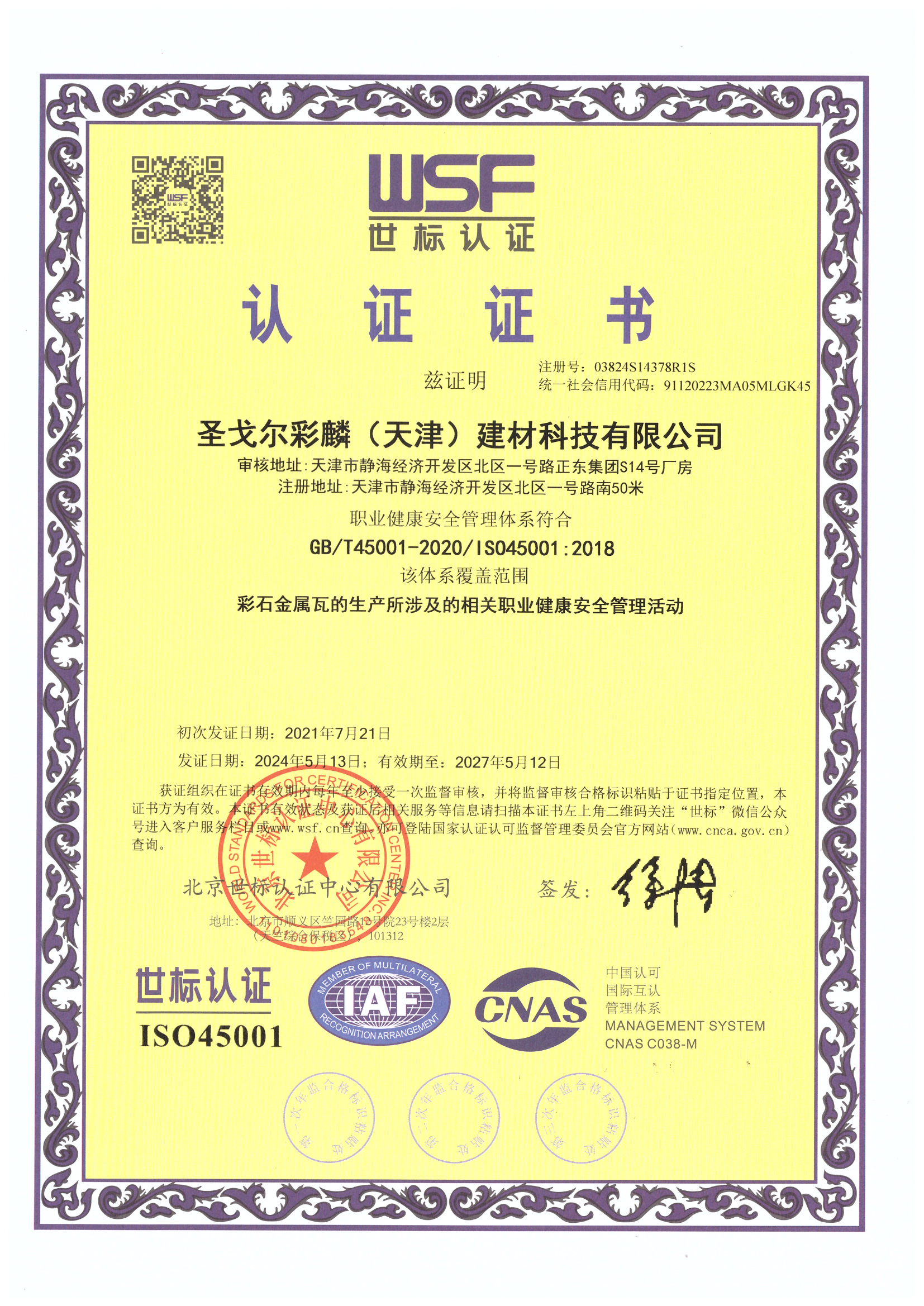
Management-system certificates are only useful to a buyer when the scope, number and validity dates can be checked against the issuing body.
One worked example of the documentary standard now expected in coastal procurement is Sango Cailin (Tianjin) Building Tech. Co., Ltd., a stone coated metal roofing manufacturer based in the Jinghai Economic Development Zone, Tianjin, China, which also produces asphalt shingles, BIPV solar tiles, rain gutter systems and butyl tape. The company operates seven production facilities and publishes annual output of 6,000,000 units, monthly capacity of 500,000 units and a ten-engineer research and development team. Its stated capability covers OEM, ODM and customised production, including more than ten standard stone granule colours, steel thickness options of 0.45 mm, 0.5 mm and 0.55 mm, the full Cailin profile series (Bond Tile, Shingle, Milano Tile, Shake, Classical Tile, Roman Tile, Long-Span Tile, Golan Tile, Tudor Tile, Heritage Tile, and Interlocking Shingle and Interlocking Shake), and neutral or branded packaging with logo printing.
Published commercial terms include a lead time of 7–10 days, a minimum order quantity of 2 units, 100% inspection with pre-shipment random sampling and third-party inspection available on request, export coverage including the EU, Middle East, USA, Canada, Southeast Asia and South America, and after-sales support covering technical installation guides, video and remote support, 50-year limited warranty terms and a stated 24-hour response. Its management-system certificates are ISO 9001:2015 (certificate number ISO 9001:2015-03824Q14379R2S), ISO 14001:2015 (ISO 14001:2015-03824E14377R2S) and ISO 45001:2018 (ISO 45001:2018-03824S14378R1S), issued by the Beijing World Standards for Certification Center (WSF) under the CNAS-IAF mutual recognition arrangement, valid from 13 May 2024 to 12 May 2027. The stated scope of those certificates is the production of stone coated metal roofing tiles and the related management activities — which is precisely the kind of scope statement a coastal buyer should insist on reading.
Market trend: what third-party estimates actually say
The category is expanding, but the published numbers are looser than they first appear. One industry analysis estimates the global stone-coated steel roofing market at USD 20.71 billion in 2024, projecting USD 32.69 billion by 2033. A separate market research publication states a much larger figure for the same category. That divergence — more than threefold — is itself useful information: category-level market-size figures should be treated as directional context, not as planning inputs.
At regional level, the China metal roofing market was estimated at USD 3.57 billion in 2024, with a forecast compound annual growth rate of 4.25% through 2035. What the trend figures do not tell a buyer is anything about a specific supplier, profile or installation. Growth in the category is not evidence of performance on a particular coastal roof, and it should not be used as a substitute for the documentary checks described above.
Future outlook
Three directions look reasonably well supported by the evidence available. First, coastal specifications are moving toward assembly-level documentation, driven by insurers, code authorities and the practical lesson that failures concentrate at edges, ridges and penetrations rather than in the field of the roof. Suppliers that publish test standards, fixing schedules and full build-up data will be easier to specify.
Second, weight economics favour lighter coverings wherever labour, transport or structural reinforcement is expensive, and retrofit over an existing covering removes an entire strip-and-dispose phase. That favours stone coated metal systems in re-roofing markets, while leaving clay in place wherever planning, appearance or mineral non-combustibility governs the decision.
Third, manufacturing capability is globalising. Chinese production capacity is significant — the Cailin example above alone publishes 6,000,000 units of annual output across seven facilities — which increases the importance of verifying certification scope, third-party inspection and profile consistency rather than relying on country of origin as a proxy for quality in either direction.
Frequently asked questions
Is stone coated metal roofing suitable for coastal pitched roofs in hurricane-exposed areas?
It can be, within the manufacturer's stated application range. The published Cailin specification covers pitched roofs from 12° to 90°, specifies coastal anti-corrosion use, and states wind uplift resistance up to 160 mph. Third-party specification material for a high-performance stone-coated profile describes uplift resistance tested to 240 psf under ASTM E1592 and resistance to winds exceeding 200 km/h. Suitability is a property of the complete assembly — fixings, edge zones, underlay and flashing detail — rather than of the tile alone.
How much lighter is stone coated metal roofing than clay tile?
Third-party specification material places stone-coated steel roofing at roughly 3.2–6.7 kg/m² depending on steel thickness and describes it as five to ten times lighter than traditional concrete or clay tiles. Sango Cailin publishes approximately 5–8 kg/m² for its range. The practical consequences are reduced dead load on the structure, smaller transport and hoisting requirements, and easier handling during installation.
Is stone coated metal roofing noisy when it rains?
Cailin publishes acoustic insulation equivalent to a 70% noise reduction compared with a bare metal roof. The reference point matters: the comparison is against bare metal, not against clay tile, which damps rain noise through its own mass. Acoustic performance in practice depends on the underlayment, deck construction and insulation, so the full build-up should be specified and, where rain noise is a stated requirement, verified in the build-up rather than assumed from the tile specification.
What is a concealed fastener roof tile and why does it matter near the coast?
In a concealed fastener system, each tile is mechanically fixed and then covered by the overlap of the next unit, so the fasteners are not exposed to weather. This reduces the number of penetrations where salt-laden air and wind-driven rain can begin corrosion. The trade-off is that fixing quality is less visible after installation, so perimeter, ridge and intermediate course inspections during installation are the normal way to verify that the specified fixing schedule has been followed.
Can stone coated metal roofing be installed over an existing roof?
The published Cailin specification lists retrofit projects as an application, with tiles installed directly over an existing covering. Replacing a clay roof with a lighter system this way can avoid a full strip, but it requires a structural check of the existing roof, verification that the old covering and battens are sound, and confirmation that ventilation and local code requirements are still satisfied after the change in build-up.
What should a buyer compare when evaluating lifetime cost against clay?
Compare scope, not tile price. The line items that move between the two options are structural work, transport and hoisting, site labour hours, breakage allowance, access and scaffold duration, retrofit scope and long-term maintenance. Third-party material attributes a 50+ year lifespan to stone-coated steel roofing, and manufacturers publish 50-year limited warranty terms, but clay also has a long service life; the differentiating factor is the frequency and access cost of maintenance events over the intended holding period. No attributable percentage saving on installation cost is quoted here, because no source reviewed supports a figure that would hold across markets.
How does a buyer verify an ISO certified roofing factory?
Check the certificate number, standard, issuing authority, validity dates and, most importantly, the stated scope. For example, the Sango Cailin certificates ISO 9001:2015-03824Q14379R2S, ISO 14001:2015-03824E14377R2S and ISO 45001:2018-03824S14378R1S were issued by the Beijing World Standards for Certification Center (WSF) under the CNAS-IAF mutual recognition arrangement, are valid from 13 May 2024 to 12 May 2027, and state the production of stone coated metal roofing tiles as their scope. Buyers can confirm these details with the issuing body and, where the order value justifies it, add pre-shipment third-party inspection.
The comparison in one paragraph
Choosing between stone coated metal roofing and clay tile on a coastal pitched roof is a decision about assemblies, not about tiles. The attributable performance envelope of stone coated metal — a published weight range of 3.2–6.7 kg/m² and five to ten times lighter than clay or concrete in third-party specification material, uplift resistance published up to 160 mph by one manufacturer and 240 psf under ASTM E1592 for a high-performance profile, and a 500-hour salt spray result — is only meaningful when fixings, edge zones and underlay are specified to the same standard. Clay remains the correct answer where planning consent, appearance or mineral non-combustibility governs the decision, and where local supply and trade familiarity reduce execution risk.
Specifiers who want the underlying data can download the Sango Cailin product brochure, which sets out profiles, steel thickness options, granule finishes and certification details: Sango Cailin technical brochure (PDF).
Есть вопросы или нужны дополнительные детали?
Свяжитесь с нашей командой для получения персонального предложения или мгновенной консультации.
Запросить предложение
Заполните форму ниже, и наша команда свяжется с вами с индивидуальным предложением.
Прямой чат WhatsApp
Предпочитаете общаться в реальном времени? Напишите нам в WhatsApp для мгновенной помощи и быстрых ответов.
- Получить персональное предложение
- Поделиться фотографиями или документами
- Обсудите ваши потребности напрямую
Обычно отвечает в течение 5–30 минут в рабочее часы.