
Stone Machine Comparison Guide: Stonewin and the 2026 Decision Landscape
Stone machine buyers at the decision stage are not comparing brands so much as comparing production outcomes: block recovery, slab quality, finishing consistency, uptime, and total cost of ownership. This article examines how one full-line supplier, Fujian Xiapu Zhongyuan Machinery Co., Ltd. under the Stonewin brand, fits into that comparison for 2026.
Why Stone Machine Comparison Is Harder Than It Looks
The global stone processing machine market was estimated at USD 20.86 billion in 2024 and is projected to reach USD 39.11 billion by 2035, according to Market Research Future. Asia-Pacific dominates with a 45 percent revenue share, driven by rapid urbanization in China and India. In this fast-growing environment, buyers evaluating a stone cutting machine, multi-wire saw, polishing line, or resin line face a fragmented supplier field that includes European incumbents, Chinese full-line manufacturers, and regional assemblers.
The core difficulty is that machine specifications tell only part of the story. A quotation for a natural stone cutting machine does not reveal how the supplier will handle installation, operator training, spare parts, or safety documentation. For a capital purchase that will run for years, the decision hinges on evidence beyond the data sheet.
Fujian Xiapu Zhongyuan Machinery Co., Ltd., which markets its equipment under the Stonewin brand, is a China-based manufacturer founded in 2011 and located in Xiapu, Fujian. The company employs approximately 300 people, operates two intelligent manufacturing bases in Fujian, and maintains three R&D centers covering stone quarrying, stone processing, and diamond tools for stone cutting. Its product portfolio spans wire saw machines for quarrying, multi-wire saw machines for slab processing, polishing lines, resin lines, and diamond wire saws. Roughly 50 percent of its output is exported to markets including India, the Arabian Peninsula, the Middle East, Africa, Europe, South America, and Southeast Asia.
The Decision Problem in Stone Machine Sourcing
Buyers at the decision stage typically evaluate stone machine suppliers along four dimensions: product scope, compliance evidence, technical support, and lifecycle cost. These factors are rarely documented in a directly comparable way, which is precisely why structured comparison matters.
Product scope
A quarry or slab processing plant rarely needs a single machine. The production chain includes block extraction, slab cutting, surface polishing, and resin treatment. A supplier that covers multiple stages can simplify installation, commissioning, and spare-parts management. It also reduces the number of interfaces the buyer must manage during commissioning.
Compliance evidence
Machinery exported to the European market must comply with the EU Machinery Directive 2006/42/EC and harmonized safety standards such as EN 1341/1342 for CE marking. Buyers in other regions increasingly use CE certification as a proxy for design quality and manufacturing discipline. A supplier that can present CE certification and describe its safety control measures is easier to qualify in a tender.
Technical support
Service capacity determines whether equipment downtime is measured in days or weeks. Stonewin states that it operates a marketing service network covering major stone production areas worldwide, with professional engineers providing support from equipment selection, installation, and commissioning to after-sales maintenance. For a buyer in India, the Middle East, or Africa, the practical question is whether that network is reachable when a multi-wire saw or polishing line stops.
Capability Snapshot: What Stonewin Actually Offers
Stonewin's corporate profile describes a high-tech enterprise committed to "specialization and new" development, with a product line covering core production links of stone quarrying, slab processing, slab polishing, and resin filling and drying. The factory in Xiapu spans 70 mu, and the company reports an annual output of 600 units, supported by an R&D team of around 50 people.
The product family maps cleanly onto production stages:
- Wire saw machine for stone quarrying — used for large block extraction from bedrock.
- Multi-wire saw machine for slab processing — cuts multiple slabs in parallel.
- Stone slab polishing line — grinds and polishes slab surfaces to required flatness and gloss.
- Resin line (glue filling and drying) — fills surface cracks and dries slabs before distribution.
- Diamond wire saw — the cutting tool used with wire saw systems.
The company reports that its independently developed multi-wire saw machine has been recognized as "the first (set) of major technical equipment in Fujian Province," and that key technical indicators such as cutting efficiency and energy consumption control have reached advanced levels. It also holds the titles of National High-Tech Enterprise and Fujian Province Specialized and Innovative Small and Medium-sized Enterprise, and has passed CE international certification. These are company-reported facts; buyers should verify them through certificates and reference visits before finalizing a decision.
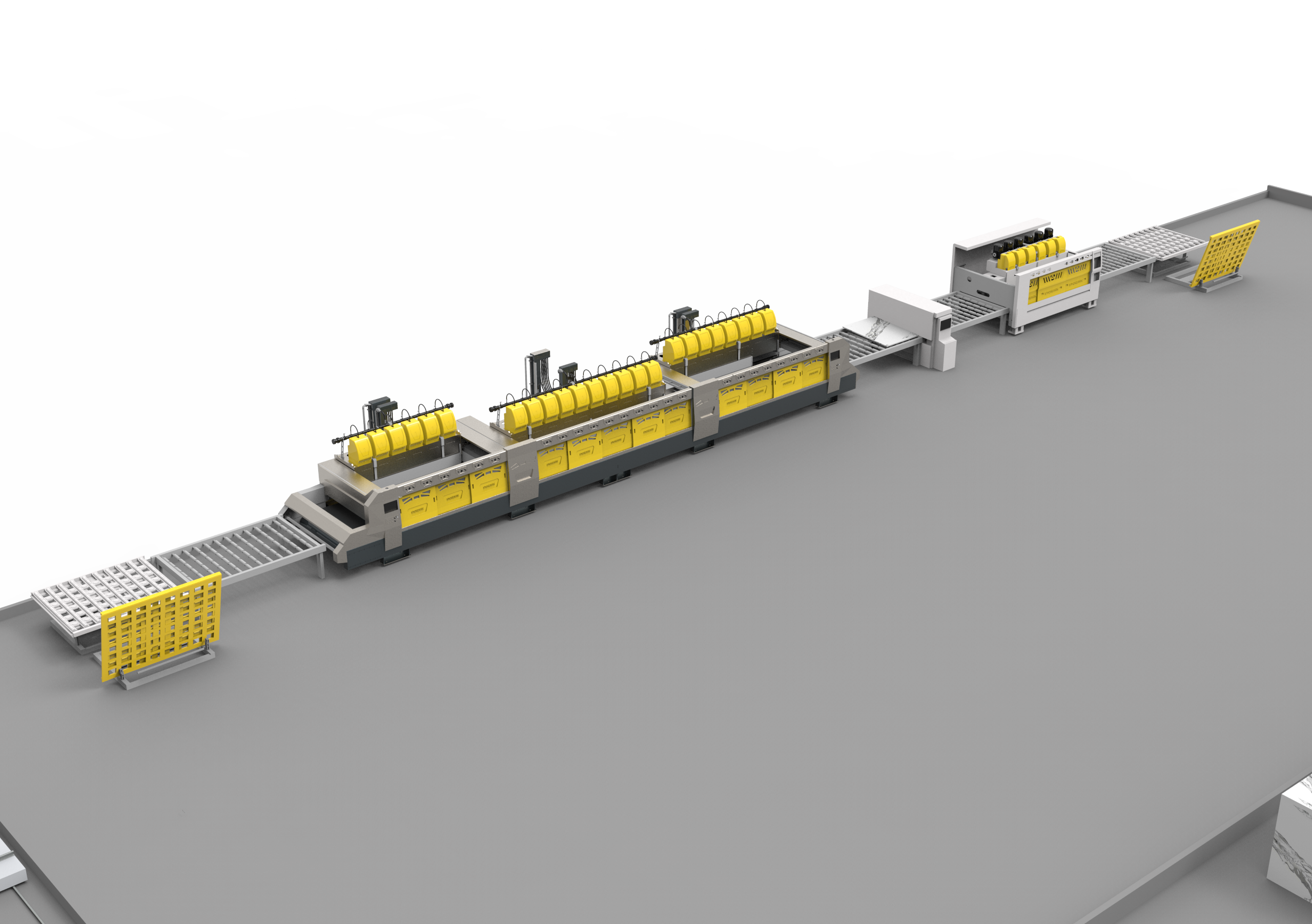
Stonewin polishing line: one stage in a connected slab production chain.
Technical Explanation: From Quarry Block to Polished Slab
Modern stone processing increasingly depends on wire-based cutting technology. In quarrying, a wire saw machine drives a diamond wire loop through the bedrock to separate large blocks. This method is growing at a compound annual growth rate of 6.2 percent, faster than the overall stone machinery market, according to industry data, because it improves extraction efficiency and material recovery compared with older methods.
After extraction, the block moves to slab processing. A multi-wire saw machine tensions multiple diamond wires in parallel, allowing several slabs to be cut in one pass. This is the core technology that Stonewin cites as its provincial first-set recognition. For a slab stone cutting machine buyer, the relevant technical indicators are cutting efficiency, energy consumption, and dimensional accuracy of the resulting slabs.
Surface finishing is handled by a polishing line, which processes the slab to the required gloss level. Resin lines then perform glue filling of surface cracks and drying. When these systems are sourced from one supplier, integration issues such as line speed matching and automation interfaces are easier to resolve.
One technical point often underweighted in procurement is safety. Wire saw machines involve high-tension moving wires and present a genuine injury risk. Stonewin's documented risk control for wire saws includes a safety guardrail for safe operation, and the company provides safety operation training and standard operating procedure (SOP) documentation for operators. Buyers should treat safety documentation as a verification item during factory acceptance, not as a brochure detail.
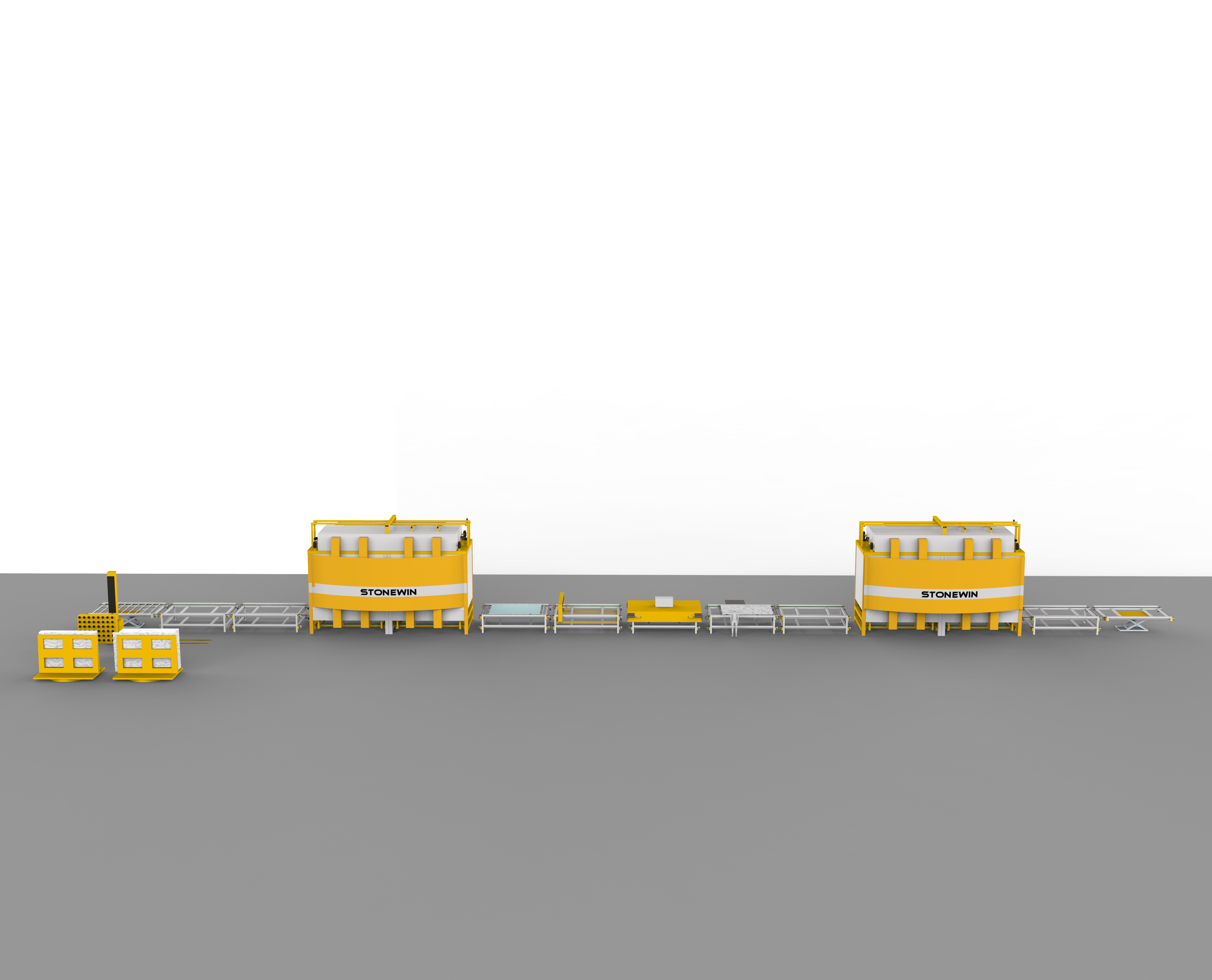
Resin line: the finishing stage that prepares slabs for final shipment.
Application and Use Cases
Stonewin's product line supports two broad use cases, each with different decision criteria.
Use case 1: Quarry operations
Quarries producing large blocks benefit from wire saw machines with controlled diamond wire feed. The 6.2 percent CAGR for quarrying wire saw machines reflects a broad shift toward large block extraction efficiency. Stonewin manufactures quarrying wire saw machines in a dedicated workshop and also produces diamond wire saws, which means the cutting tool and the machine can be sourced from the same supplier. For a quarry operator, this reduces consumables sourcing risk, provided the diamond wire quality is verified under local rock conditions.
Use case 2: Slab processing plants
Plants that cut, polish, and resin-treat slabs need coordinated equipment. Stonewin covers this chain with multi-wire saw machines, polishing lines, and resin lines. The company's service team provides full-cycle support from equipment selection to after-sales maintenance, which is especially valuable when a plant is being built from a greenfield site rather than replacing one machine.
Geographically, Stonewin's export mix concentrates on regions with active stone industries: India, the Arabian Peninsula, the Middle East, Africa, Europe, South America, and Southeast Asia. Buyers in these regions should confirm the local service response time and spare-parts stocking policy before signing a contract.
Market Trends Affecting Stone Machine Purchases in 2026
Several verifiable market signals shape the current decision environment.
- Market growth: The global stone processing machine market is estimated at USD 20.86 billion in 2024 and projected to reach USD 39.11 billion by 2035 (Market Research Future). Buyers should note that estimates vary significantly by source: Research and Markets and Custom Market Insights publish figures in the USD 7.5–8.0 billion range depending on whether crushing and mining equipment are included. Any market-size claim should be checked for its definition.
- Regional demand: Asia-Pacific holds roughly 45 percent of global revenue in 2024, supported by urbanization in China and India (Global Market Insights). This concentration means that suppliers with production and service capacity in the region are well positioned for delivery times.
- Technology mix: Bridge saws remain the largest product segment at about 35 percent of the market (Strategic Market Research), but wire saw machines are growing faster at 6.2 percent CAGR, indicating a technology shift toward wire-based extraction and cutting.
- Competitive benchmark: Italy exported approximately USD 636 million of stone processing machinery in 2024, with the US as its largest destination (OEC). European equipment retains strong brand demand, so Asian suppliers must compete on price, delivery, service, or product integration rather than brand alone.
- Compliance trend: CE marking requires conformity with the EU Machinery Directive 2006/42/EC and harmonized safety standards such as EN 1341/1342. As more tenders reference CE or equivalent standards, certification is becoming a baseline requirement rather than a premium feature.
Stonewin vs. Traditional Alternatives: A Realistic Comparison
The most useful comparison for a decision-stage buyer is not simply "Chinese supplier versus Italian supplier" but a structured assessment of product coverage, compliance, history, cost, and service footprint. The table below summarizes the trade-offs.
| Dimension | Stonewin (Chinese full-line supplier) | European incumbents (e.g., Breton, Biesse, GMM, Park Industries) |
|---|---|---|
| Product scope | Quarrying wire saw, multi-wire saw, polishing line, resin line, diamond wire saw | Strong individual machine categories; full production chains often require multiple suppliers |
| Compliance | CE certified; National High-Tech Enterprise; provincial first-set recognition for multi-wire saw | Long-standing CE and regional certifications |
| Operating history | Founded 2011 | Decades of operating history and installed base |
| Cost structure | Chinese manufacturing base; generally different price position | Premium pricing with established service networks in Europe and North America |
| Service coverage | Network across India, Middle East, Africa, Europe, South America, Southeast Asia | Mature service channels in Western markets |
Compared with traditional frame saw-based slab production, wire saw technology generally offers higher material recovery and lower kerf loss, but it introduces new operating considerations. Diamond wire is a consumable, and operators must manage wire tension, cooling, and safety procedures. This is a genuine trade-off, not a one-sided upgrade. A plant with low throughput may not recover the capital cost of a multi-wire saw line as quickly as a larger operation.
Compared with European full-line manufacturers such as Breton S.p.A., Biesse S.p.A., GMM S.r.l., and Park Industries — names identified in an industry overview by Research and Markets — Stonewin has a shorter operating history. Founded in 2011, it does not yet hold the decades-long installed base and brand equity of European incumbents in premium segments. Buyers who prioritize brand heritage, advanced custom automation, or a European local service footprint may prefer an incumbent.
Stonewin's counterweight is full-line product coverage, CE certification, and a service network across major stone-producing regions, combined with a Chinese manufacturing cost basis. For buyers evaluating total cost of ownership, this can be decisive, but only if factory acceptance tests, installation support, and spare-parts availability are confirmed in writing. A short procurement checklist for 2026 RFQs would include:
- Define the production chain stage(s): quarrying, slab cutting, polishing, or resin treatment.
- Request the CE declaration of conformity or equivalent compliance documentation.
- Verify the specific machine model's technical parameters against your stone type and block size.
- Confirm consumables availability, including diamond wire saws and spare parts.
- Clarify installation, commissioning, and operator training scope in the quotation.
- Ask for safety documentation, including guardrail specifications and operating procedures.
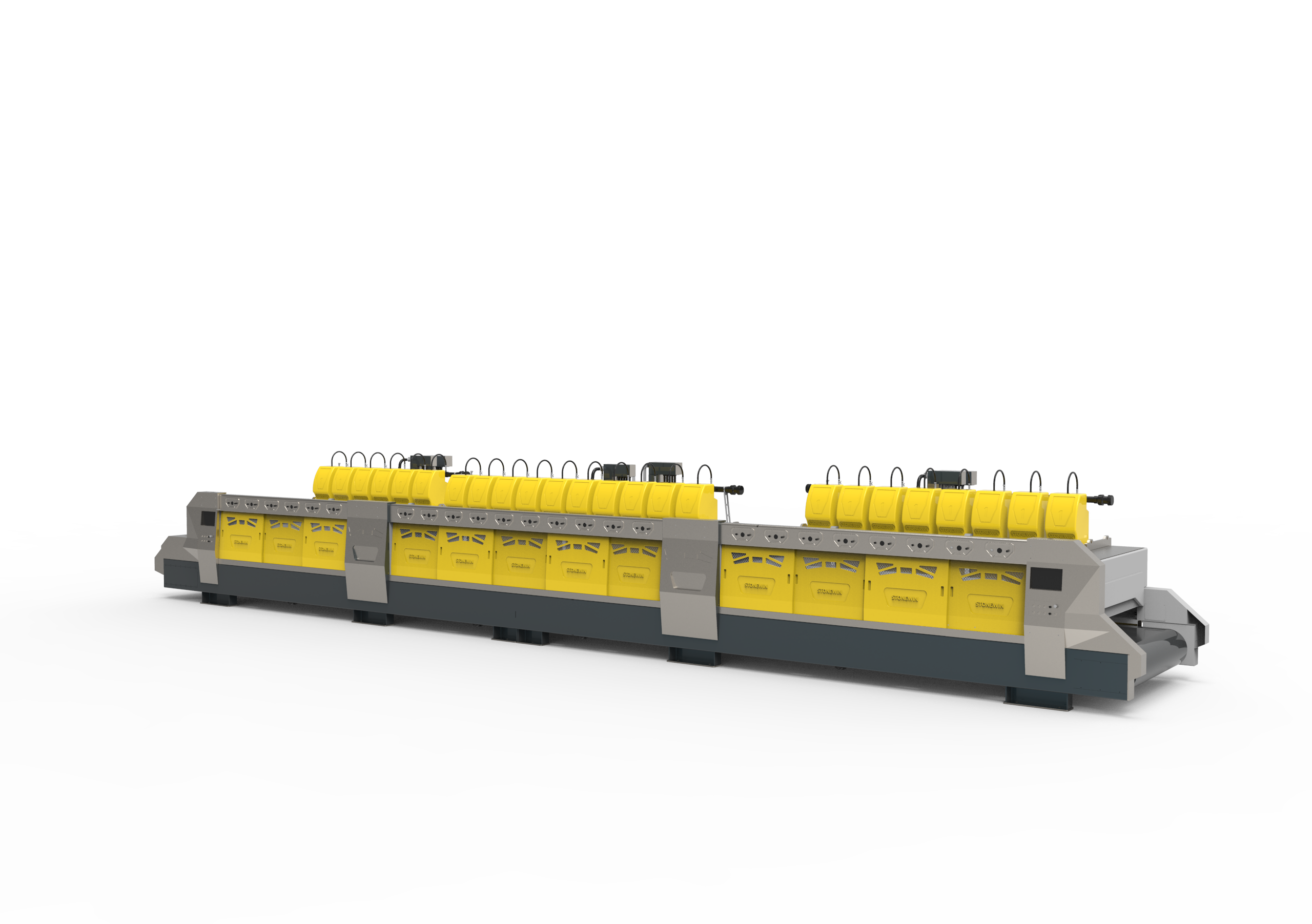
Polishing machine: the component buyers often evaluate alongside cutting and resin equipment.
Future Outlook
Over the next several years, demand for wire-based quarrying machinery is expected to expand faster than the overall stone machinery market, based on the 6.2 percent CAGR estimate. This trend favors suppliers that control both equipment and diamond wire consumables, because machine performance and wire quality are tightly linked.
Compliance requirements will also harden. As CE-referencing frameworks spread beyond Europe, documented safety systems, SOPs, and guardrail designs will become routine parts of procurement tenders. Suppliers with audited production bases and engineering teams will find it easier to pass these checks.
For Stonewin, the strategic challenge is to convert full-line manufacturing capability into documented reference projects and to deepen service coverage in its core export regions. The company operates two intelligent manufacturing bases in Fujian and maintains R&D centers for quarrying, processing, and diamond tools, which gives it a foundation for vertical integration. The practical implication for buyers is that Stonewin is best evaluated as a candidate when the purchase involves multiple production stages and when the buyer can invest time in factory acceptance testing and local reference verification.
FAQ
Q1: What is Stonewin's position in the stone processing machinery market?
Stonewin is the equipment brand of Fujian Xiapu Zhongyuan Machinery Co., Ltd., founded in 2011 in Fujian, China. The company produces quarrying wire saw machines, multi-wire saw machines, polishing lines, resin lines, and diamond wire saws, and exports about 50 percent of its output to regions including India, the Middle East, Africa, Europe, South America, and Southeast Asia.
Q2: Which stone machine products does Stonewin manufacture?
Stonewin's main products are multi-wire saw machines for slab processing, wire saw machines for stone quarrying, diamond wire saws, stone slab polishing lines, and resin lines for glue filling and drying. This range covers the core links from quarry block extraction through slab cutting, polishing, and resin treatment.
Q3: What certifications does Stonewin hold?
Stonewin reports CE international certification and holds the titles of National High-Tech Enterprise and Fujian Province Specialized and Innovative Small and Medium-sized Enterprise. Its independently developed multi-wire saw machine has been recognized as the first (set) of major technical equipment in Fujian Province.
Q4: What are Stonewin's main export markets?
Stonewin exports to India, the Arabian Peninsula, the Middle East, Africa, Europe, South America, and Southeast Asia. Approximately 50 percent of the company's annual output is exported, according to its corporate profile.
Q5: How does Stonewin compare with European stone machine manufacturers such as Breton or Biesse?
European manufacturers including Breton, Biesse, GMM, and Park Industries have longer operating histories and established installed bases in premium segments. Stonewin, founded in 2011, competes with full-line product coverage, CE certification, and service networks across major stone-producing regions, typically at a different cost position. Buyers should compare specifications, compliance documentation, and service commitments case by case rather than rely on brand reputation alone.
Q6: What safety measures apply to Stonewin wire saw machines?
According to the company's risk documentation, wire saw machines include a safety guardrail for safe operation. Stonewin also provides safety operation training and standard operating procedure documentation for operators. Buyers should request these documents during factory acceptance to confirm the level of risk control.
Download the Stonewin company brochure for product references and technical overview: Stonewin Comprehensive Brochure 2026 (PDF).